
Environmental Biology Genetics Genotype Phenotype n o s
Environmental Biology & Genetics Genotype & Phenotype n o s d i v a D R G r M
Alleles • Genes control the characteristics of an organism, e. g. flower colour in peas. • Alleles are different forms of the same gene. – An allele is a different form of that gene, e. g. red flower or white flower. Friday, September 18, 2020 Mr G Davidson 2
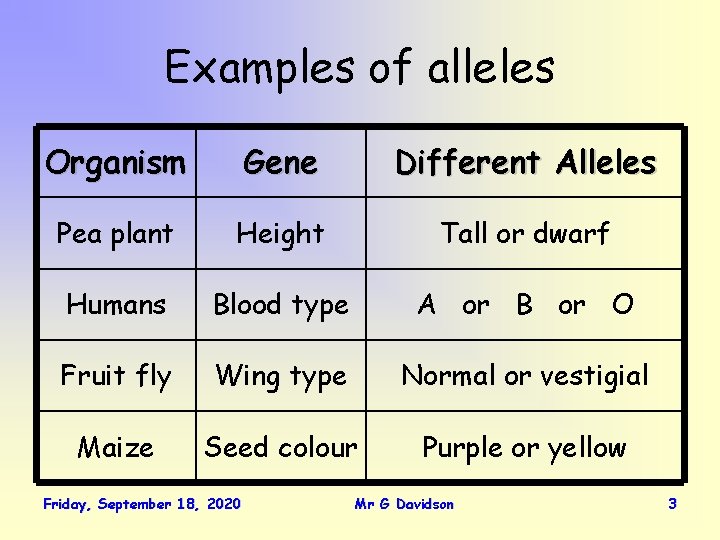
Examples of alleles Organism Gene Different Alleles Pea plant Height Tall or dwarf Humans Blood type A or B or O Fruit fly Wing type Normal or vestigial Maize Seed colour Purple or yellow Friday, September 18, 2020 Mr G Davidson 3
Alleles • Most genes normally have at least 2 forms. (Some have more than 2) • Each body cell contains 2 alleles for every characteristic. • This is because the cell contains 2 of each type of chromosome and the alleles are found at the same place on each of the two chromosomes. Friday, September 18, 2020 Mr G Davidson 4
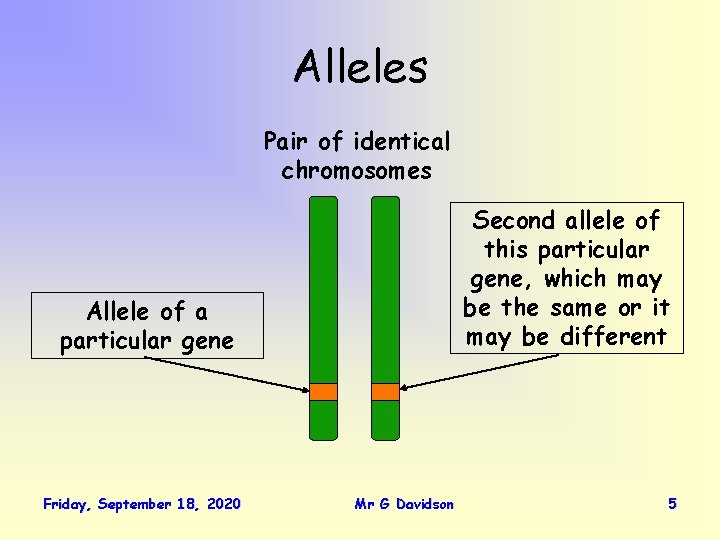
Alleles Pair of identical chromosomes Second allele of this particular gene, which may be the same or it may be different Allele of a particular gene Friday, September 18, 2020 Mr G Davidson 5
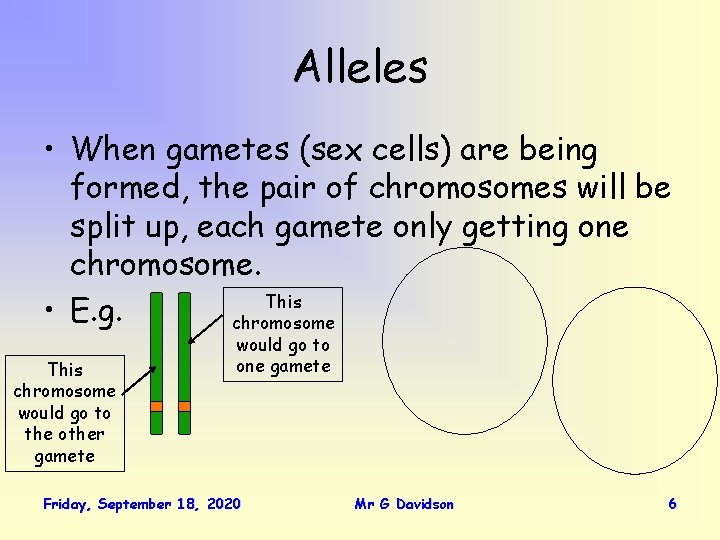
Alleles • When gametes (sex cells) are being formed, the pair of chromosomes will be split up, each gamete only getting one chromosome. This • E. g. chromosome This chromosome would go to the other gamete would go to one gamete Friday, September 18, 2020 Mr G Davidson 6
Alleles • This means that when one gamete fertilises another, the resulting zygote will have 2 alleles, one from each gamete. • The appearance of the organism depends on which of the alleles is dominant or recessive. Friday, September 18, 2020 Mr G Davidson 7
Alleles • A dominant allele will always show up in the appearance of an organism. • A recessive allele will only show up if it is paired with another recessive allele. • When describing an allele, for convenience, we usually give it a symbol, generally the first letter of the dominant allele. Friday, September 18, 2020 Mr G Davidson 8
Alleles • If it is dominant it gets the capital letter and if it is recessive it gets the lower case of the same letter. • E. g. in pea plants tall is dominant over dwarf, and so the tall allele is given the letter T, and the dwarf allele the letter t. • The genotype of the organism is the alleles it carries for that particular characteristic. Friday, September 18, 2020 Mr G Davidson 9
Alleles • TT is a genotype and the plant will be tall. • Tt is a genotype and the plant will be tall, because the T is dominant over the t. • tt is a genotype and the plant will be dwarf. • What the plant actually looks like (how the genes are expressed) is called its phenotype. Friday, September 18, 2020 Mr G Davidson 10
Genotypes & Phenotypes • If both alleles are the same in the genotype of an organism, it is said to be true-breeding or homozygous, i. e. TT or tt. • If the alleles are different in the genotype of the organism, it is said to be heterozygous, i. e. Tt. Friday, September 18, 2020 Mr G Davidson 11
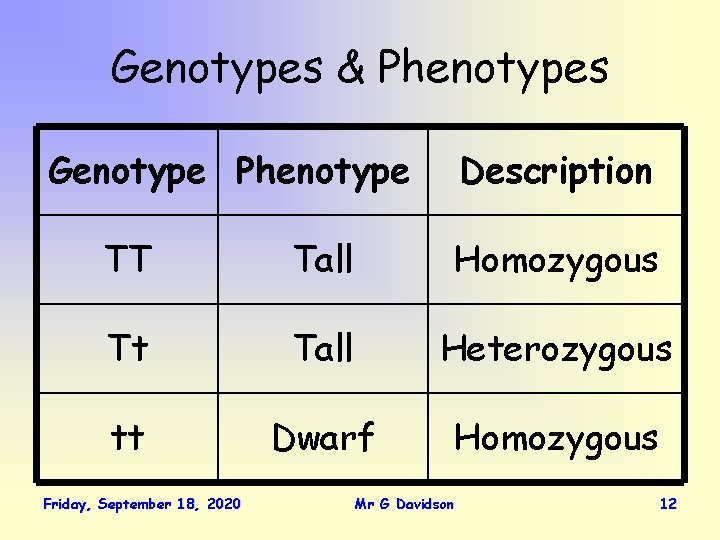
Genotypes & Phenotypes Genotype Phenotype Description TT Tall Homozygous Tt Tall Heterozygous tt Dwarf Homozygous Friday, September 18, 2020 Mr G Davidson 12
Monohybrid Inheritance • In pea plants, red flower colour (R) is dominant to white flower colour (r). • If we were to cross a homozygous red plant with a white plant, we would set the cross out as follows: Friday, September 18, 2020 Mr G Davidson 13
Monohybrid Inheritance • To find out which characteristic is dominant we carry out a test cross. • We cross true breeding (homozygous) strains of the two alleles. • We refer to the first generation as the P (parent) generation and the resulting generations as F 1 and F 2 (first and second filial generations) Friday, September 18, 2020 Mr G Davidson 14
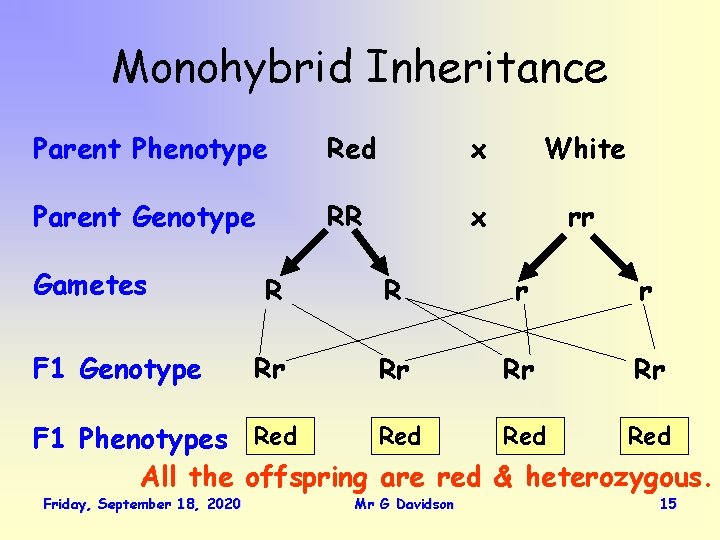
Monohybrid Inheritance Parent Phenotype Red x White Parent Genotype RR x rr Gametes F 1 Genotype R R r r Rr Rr Red Red F 1 Phenotypes Red All the offspring are red & heterozygous. Friday, September 18, 2020 Mr G Davidson 15
Monohybrid Inheritance • To complete the test cross the F 1 generation are allowed to breed together producing a ratio of 3 dominant : 1 recessive trait • This is split up into: • 1 dominant homozygous: 2 dominant heterozygous : 1 recessive homozygous. Friday, September 18, 2020 Mr G Davidson 16
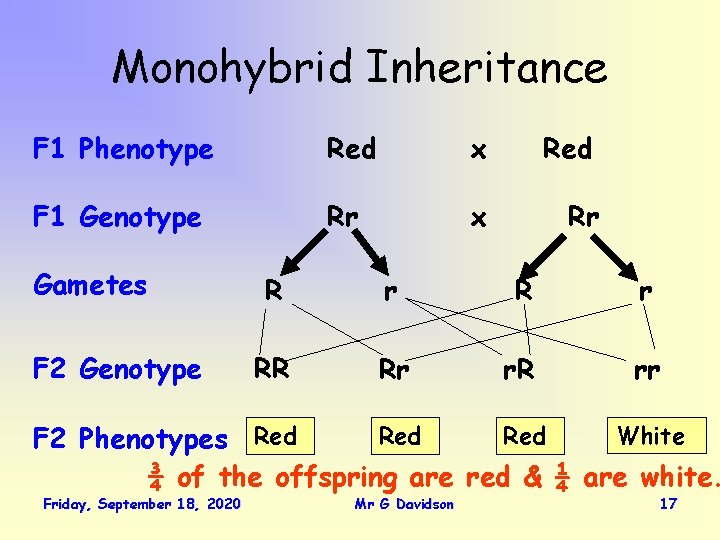
Monohybrid Inheritance F 1 Phenotype Red x Red F 1 Genotype Rr x Rr Gametes F 2 Genotype R r RR Rr r. R rr Red White F 2 Phenotypes Red ¾ of the offspring are red & ¼ are white. Friday, September 18, 2020 Mr G Davidson 17
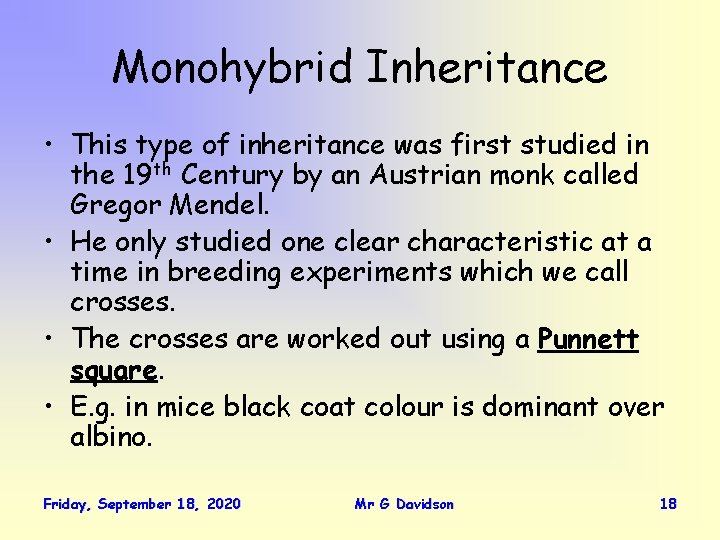
Monohybrid Inheritance • This type of inheritance was first studied in the 19 th Century by an Austrian monk called Gregor Mendel. • He only studied one clear characteristic at a time in breeding experiments which we call crosses. • The crosses are worked out using a Punnett square. • E. g. in mice black coat colour is dominant over albino. Friday, September 18, 2020 Mr G Davidson 18
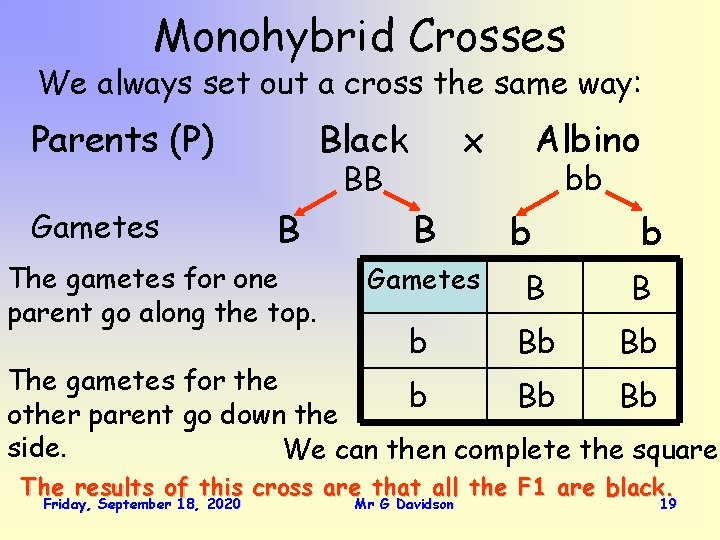
Monohybrid Crosses We always set out a cross the same way: Parents (P) Gametes Black x BB B The gametes for one parent go along the top. B Albino bb b b Gametes B B b Bb Bb The gametes for the b Bb Bb other parent go down the side. We can then complete the square. The results of this cross are that all the F 1 are black. Friday, September 18, 2020 Mr G Davidson 19
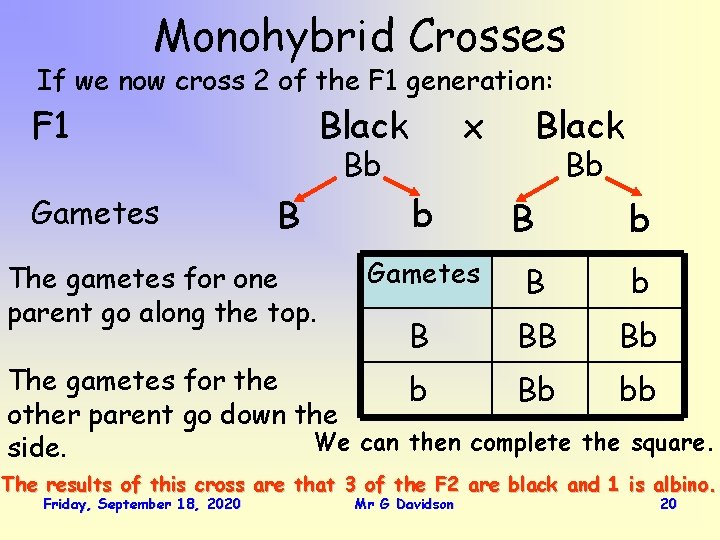
Monohybrid Crosses If we now cross 2 of the F 1 generation: F 1 Gametes Black x Bb B The gametes for one parent go along the top. b Black Bb B b Gametes B b B BB Bb The gametes for the b Bb bb other parent go down the We can then complete the square. side. The results of this cross are that 3 of the F 2 are black and 1 is albino. Friday, September 18, 2020 Mr G Davidson 20
Monohybrid Inheritance • We can then identify the genotype of individuals who have black fur by backcrossing them with albino mice. • This is called a test backcross and would look like the following. Friday, September 18, 2020 Mr G Davidson 21
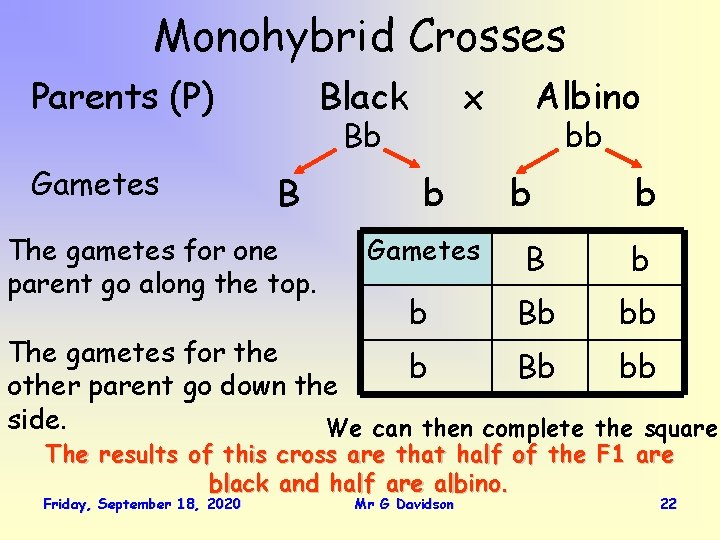
Monohybrid Crosses Parents (P) Gametes Black x Bb B The gametes for one parent go along the top. b Albino bb b b Gametes B b b Bb bb The gametes for the b Bb bb other parent go down the side. We can then complete the square. The results of this cross are that half of the F 1 are black and half are albino. Friday, September 18, 2020 Mr G Davidson 22
Monohybrid Crosses • Your answer should always have the parental genotypes. • Your answer should always have the parental gametes. • Your answer should always have a completed punnett square. • Your answer should always have the F 1 phenotypes and the ratio they occur in. Friday, September 18, 2020 Mr G Davidson 23
Family Trees • Family tree diagrams can be used to show the transmission of alleles over a number of generations. • The following family tree shows how the “ability to roll the tongue” allele is transmitted through 3 generations. Friday, September 18, 2020 Mr G Davidson 24
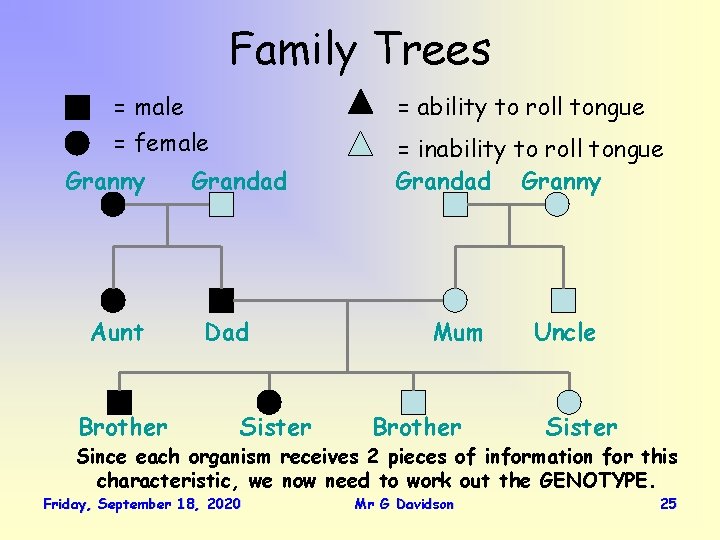
Family Trees = male = ability to roll tongue = female = inability to roll tongue Grandad Granny Aunt Brother Grandad Dad Sister Mum Brother Uncle Sister Since each organism receives 2 pieces of information for this characteristic, we now need to work out the GENOTYPE. Friday, September 18, 2020 Mr G Davidson 25
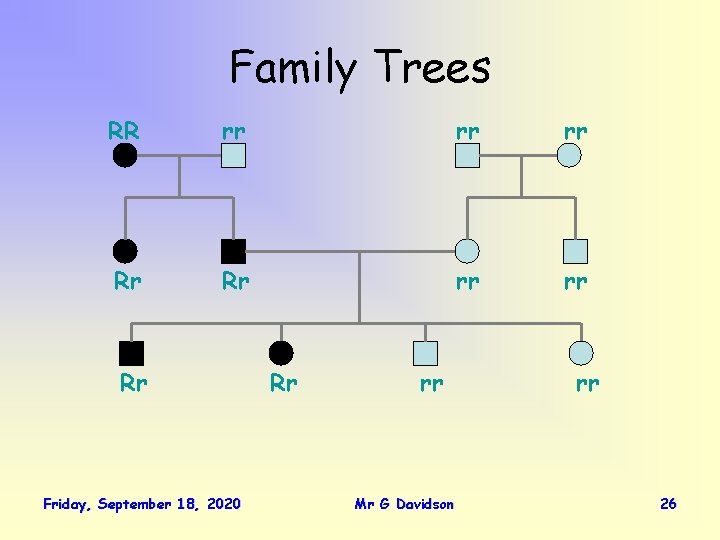
Family Trees RR rr rr rr Rr Rr rr rr Rr Friday, September 18, 2020 Rr rr Mr G Davidson rr 26
Co-Dominance • It is possible for 2 alleles to have the same level of dominance, and in this case they are said to be co-dominant. • In this case the offspring usually have a phenotype consisting the characteristics of both parents. • E. g. If red and a white short horn cattle are crossed, the offspring has red and white hairs, resulting in a roan cow (looks pinkish). Friday, September 18, 2020 Mr G Davidson 27
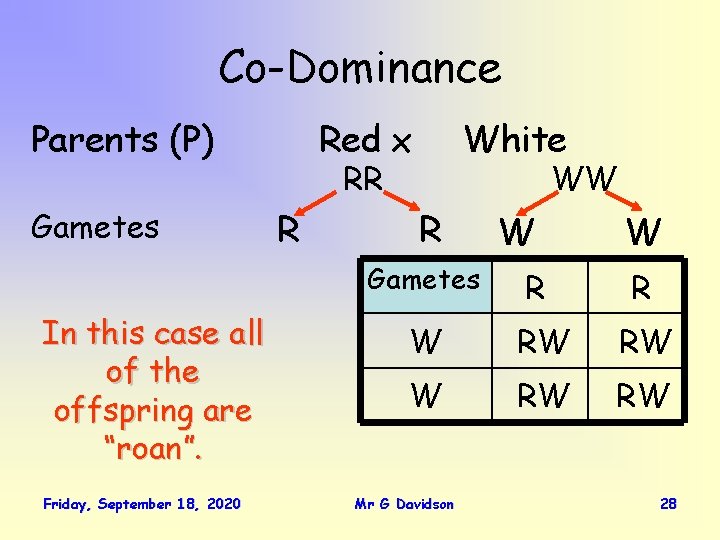
Co-Dominance Parents (P) Gametes Red x White RR R WW R Gametes In this case all of the offspring are “roan”. Friday, September 18, 2020 W W R R W RW RW Mr G Davidson 28
Variation • There are 2 types of variation shown in organisms: – Discontinuous variation – Continuous variation Friday, September 18, 2020 Mr G Davidson 29
Variation • Discontinuous variation shows distinct clear-cut differences, and is controlled by only one gene. • Discontinuous variation is usually displayed in a bar chart. Friday, September 18, 2020 Mr G Davidson 30
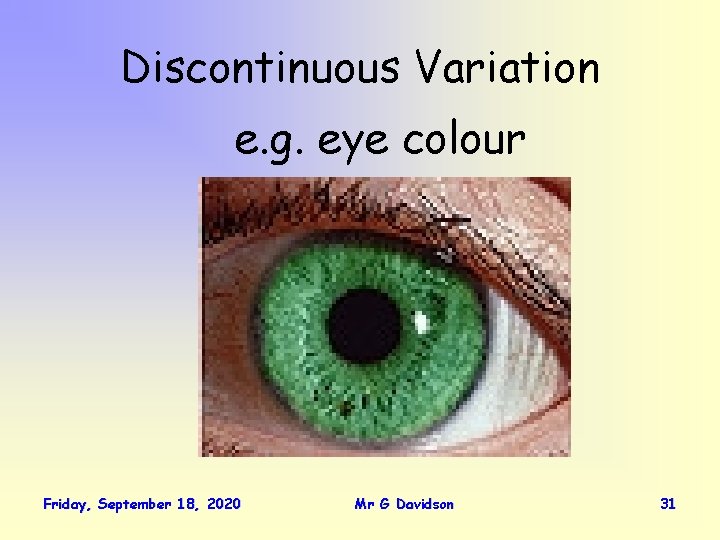
Discontinuous Variation e. g. eye colour Friday, September 18, 2020 Mr G Davidson 31
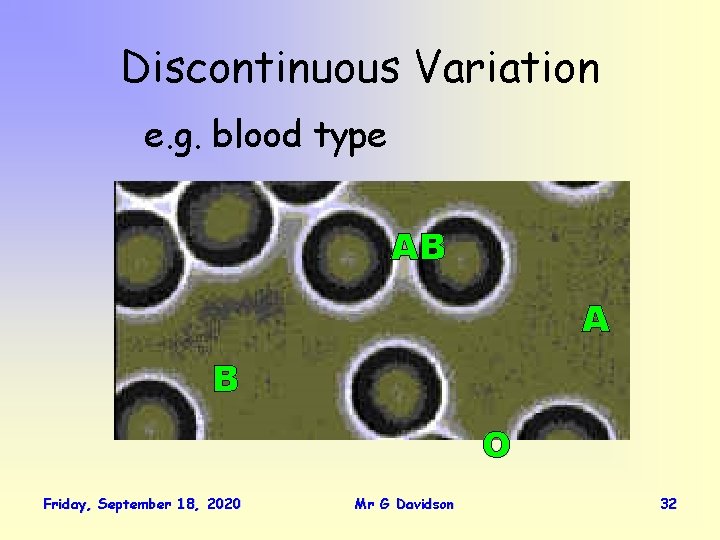
Discontinuous Variation e. g. blood type AB A B O Friday, September 18, 2020 Mr G Davidson 32
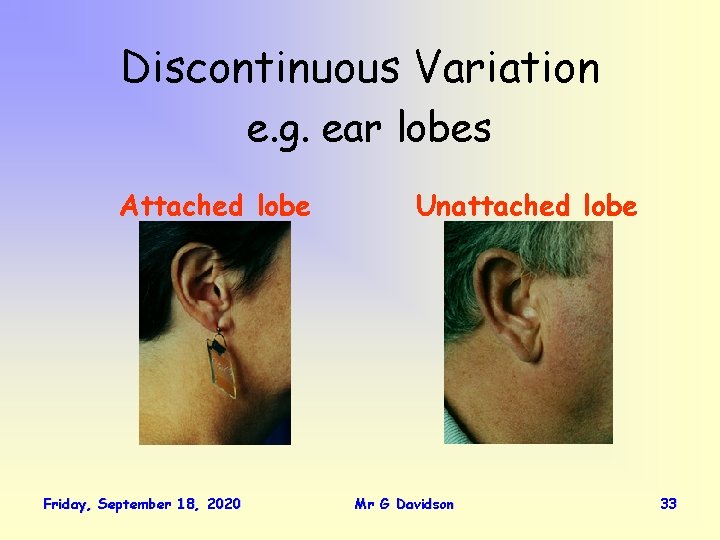
Discontinuous Variation e. g. ear lobes Attached lobe Friday, September 18, 2020 Unattached lobe Mr G Davidson 33
Variation • Continuous variation shows a range of differences, and is controlled by more than one gene. • These differences can usually be measured. • Continuous variation is usually displayed in a histogram. Friday, September 18, 2020 Mr G Davidson 34
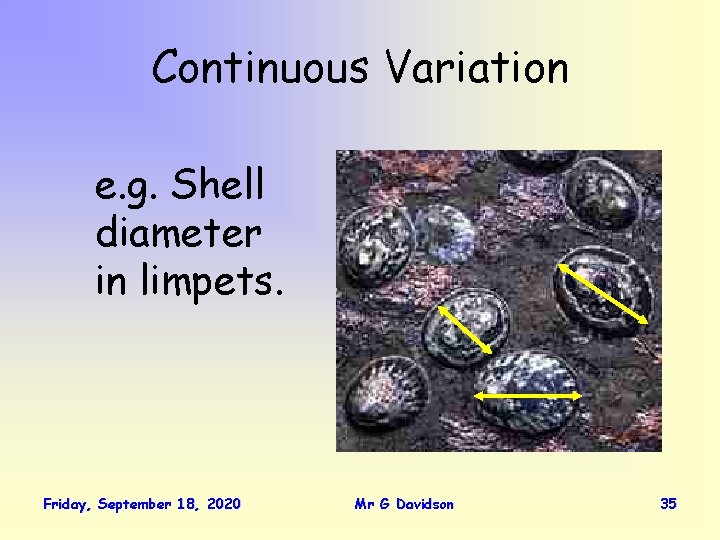
Continuous Variation e. g. Shell diameter in limpets. Friday, September 18, 2020 Mr G Davidson 35
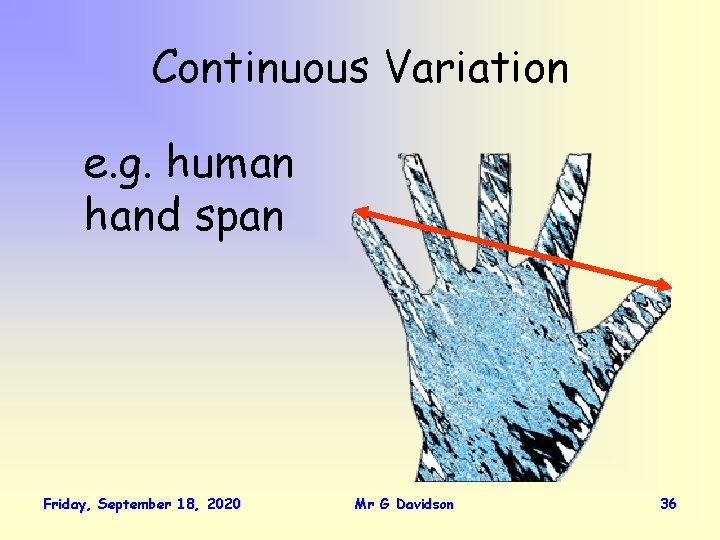
Continuous Variation e. g. human hand span Friday, September 18, 2020 Mr G Davidson 36
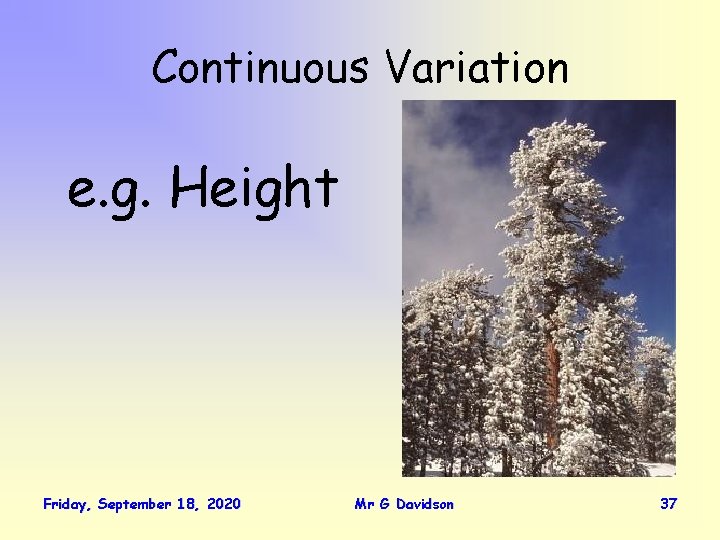
Continuous Variation e. g. Height Friday, September 18, 2020 Mr G Davidson 37
Environmental Impact • The final phenotype of an organism is influenced by variation in the environment in which the organism lives. • Identical twins have the same genotype but may differ because of: – Diet (eating different food) – Activities (if one exercises a lot) – Climate (if one moves to another climate) GENOTYPE + ENVIRONMENT Friday, September 18, 2020 Mr G Davidson PHENOTYPE 38
Natural Selection • Most organisms produce far more offspring than are able to survive. • This leads to a struggle for survival and many offspring will die before reaching an age where they can reproduce. Friday, September 18, 2020 Mr G Davidson 39
Natural Selection • There are several reasons why offspring do not survive. – – Starvation Eaten by predators Disease Exposure Friday, September 18, 2020 Mr G Davidson 40
Natural Selection • The ones which survive often have a better phenotype, suited to the environment, and they can pass on their genes. • This is called “survival of the fittest”. Friday, September 18, 2020 Mr G Davidson 41
Natural Selection • Examples of genes which can be advantageous include: – – – Speed Aggression Resistance to disease Coat thickness Coat colour (better camouflage) Quicker reactions Friday, September 18, 2020 Mr G Davidson 42
Natural Selection • Only the organisms better adapted to survive in their environment go on to reproduce. • This can lead to the appearance of a new species. • This is called evolution. Friday, September 18, 2020 Mr G Davidson 43
Peppered Moth • The peppered moth is an excellent example of natural selection. • It has a lightly speckled body colour which provides camouflage against lichens which grow on tree barks. • This means the birds can’t see them. Friday, September 18, 2020 Mr G Davidson 44
Peppered Moth • There is also a black variety of the peppered moth. (MELANIC) • The black moths are easily seen and eaten by the birds. • However, during the industrial revolution, the burning of coal produced a lot of black sooty smoke. Friday, September 18, 2020 Mr G Davidson 45
Peppered Moth • This killed the lichens on the trees and turned them black. • This allowed the black moths to be easily camouflaged, and so they survived to reproduce more black moths, and so the population of black moths increased rapidly. • However, the speckled moth became easier for the birds to see, and so their numbers were quickly reduced. Friday, September 18, 2020 Mr G Davidson 46
Peppered Moth • This only happened in industrial areas where the pollution was at its highest. • Today both types of moth survive in different areas and they can still interbreed. – In large industrial areas the black (melanic) moth is more common. – In rural areas the light speckled moth is more common. Friday, September 18, 2020 Mr G Davidson 47
Peppered Moth • Evolution has not yet caused these moths to become different species. • Today, the Clean Air Act is reducing pollution, and this will reduce the numbers of the melanic moth. • Natural selection allows the moths to survive where they are. • Natural selection leads to Biodiversity. Friday, September 18, 2020 Mr G Davidson 48
- Slides: 48