
Environmental Authentication in Malware Jeremy Blackthorne Benjamin Kaiser
Environmental Authentication in Malware Jeremy Blackthorne, Benjamin Kaiser, Benjamin Fuller, and Bulent Yener
Contribution • Malware changes behavior by observing environment to avoid analysis • Complementary technique to obfuscation • Formal analysis of interplay between analyst and malware • Malware in the wild • Malware on a critical piece of infrastructure • Malware on machine that can be modified by the analyst
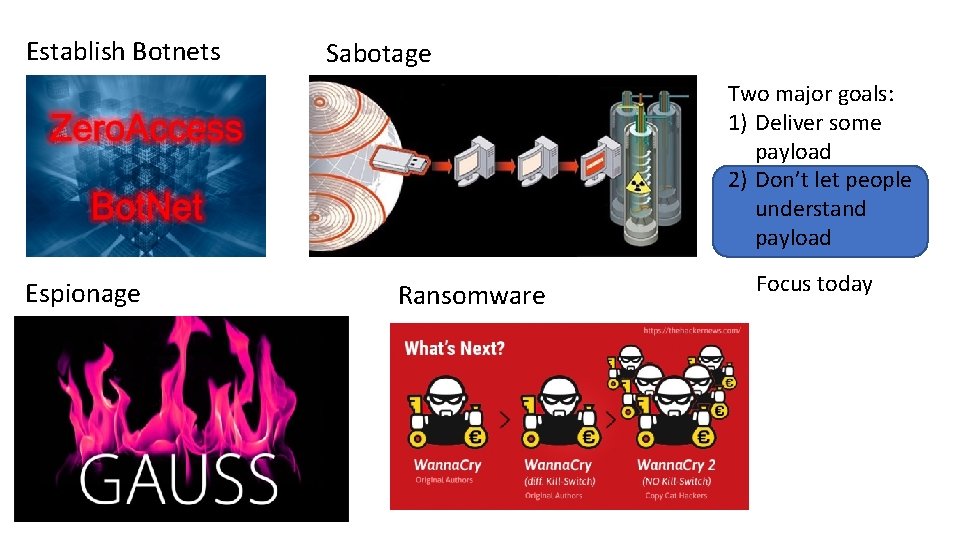
Establish Botnets Sabotage Two major goals: 1) Deliver some payload 2) Don’t let people understand payload Espionage Ransomware Focus today
Espionage Two major goals: 1) Deliver some payload 2) Don’t let people understand payload Preventing analysis is a major goal of modern malware: • Malware is expensive • Malware families reuse components • Malware is randomized, creating defenses requires deep understanding
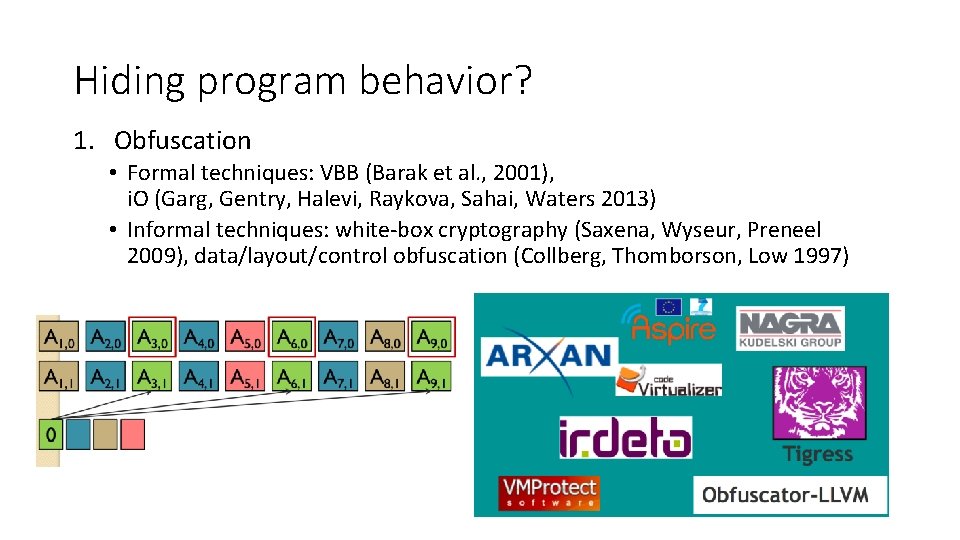
Hiding program behavior? 1. Obfuscation • Formal techniques: VBB (Barak et al. , 2001), i. O (Garg, Gentry, Halevi, Raykova, Sahai, Waters 2013) • Informal techniques: white-box cryptography (Saxena, Wyseur, Preneel 2009), data/layout/control obfuscation (Collberg, Thomborson, Low 1997)

Hiding program behavior? 1. Obfuscation • Formal techniques: VBB (Barak et al. , 2001), i. O (Garg, Gentry, Halevi, Raykova, Sahai, Waters 2013) • Informal techniques: white-box cryptography (Saxena, Wyseur, Preneel 2009), data/layout/control obfuscation (Collberg, Thomborson, Low 1997) Obfuscation isn’t enough in the malware setting: 1) Does not protect learnable programs 2) Cannot obfuscate system calls which are needed for many payloads (file system, network, keyboard, GPU, screen, USB) Establish Botnets Espionage Sabotage Ransomware
Hiding program behavior? 1. Obfuscation • Formal techniques: VBB (Barak et al. , 2001), i. O (Garg, Gentry, Halevi, Raykova, Sahai, Waters 2013) • Informal techniques: white-box cryptography (Saxena, Wyseur, Preneel 2009), data/layout/control obfuscation (Collberg, Thomborson, Low 1997) 2. Environmental Authentication • Change behavior based on the execution environment • Complementary technique to obfuscation
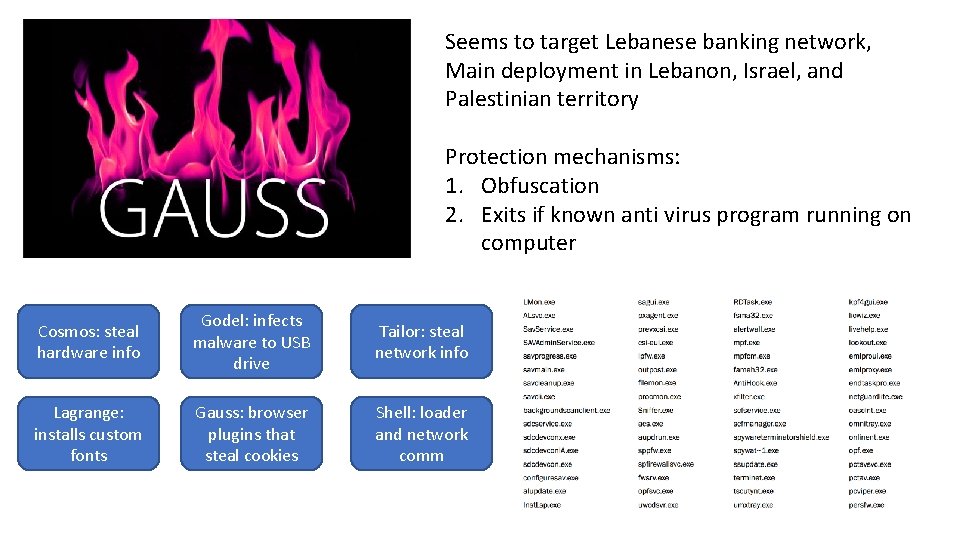
Seems to target Lebanese banking network, Main deployment in Lebanon, Israel, and Palestinian territory Protection mechanisms: 1. Obfuscation 2. Exits if known anti virus program running on computer Cosmos: steal hardware info Godel: infects malware to USB drive Tailor: steal network info Lagrange: installs custom fonts Gauss: browser plugins that steal cookies Shell: loader and network comm
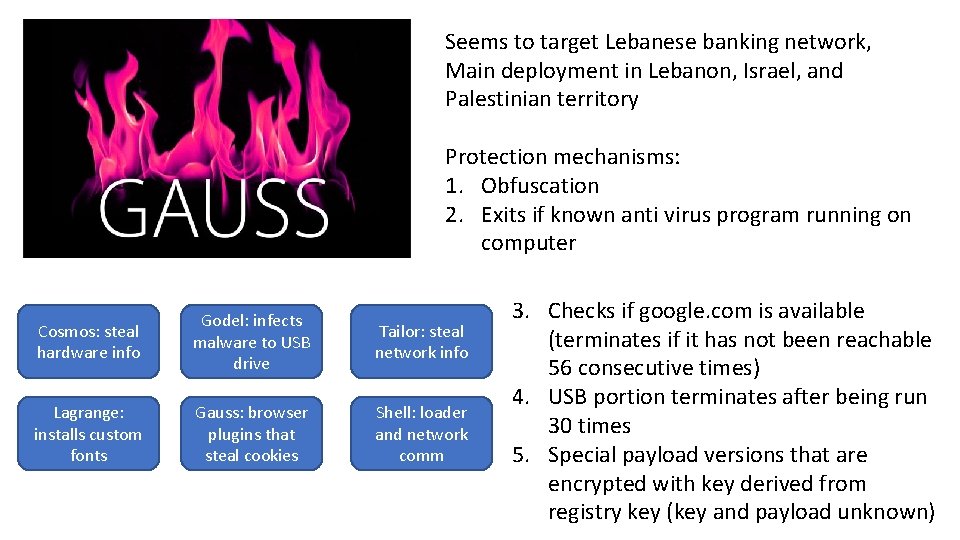
Seems to target Lebanese banking network, Main deployment in Lebanon, Israel, and Palestinian territory Protection mechanisms: 1. Obfuscation 2. Exits if known anti virus program running on computer Cosmos: steal hardware info Godel: infects malware to USB drive Tailor: steal network info Lagrange: installs custom fonts Gauss: browser plugins that steal cookies Shell: loader and network comm 3. Checks if google. com is available (terminates if it has not been reachable 56 consecutive times) 4. USB portion terminates after being run 30 times 5. Special payload versions that are encrypted with key derived from registry key (key and payload unknown)
Seems to target Lebanese banking network, Main deployment in Lebanon, Israel, and Palestinian territory Protection mechanisms: 1. Obfuscation 2. Exits if known anti virus program running on computer Program that changes behavior based on environment: environmentally authenticating 3. Checks if google. com is available (terminates if it has not been reachable 56 consecutive times) 4. USB portion terminates after being run 30 times 5. Special payload versions that are encrypted with key derived from registry key (key and payload unknown)
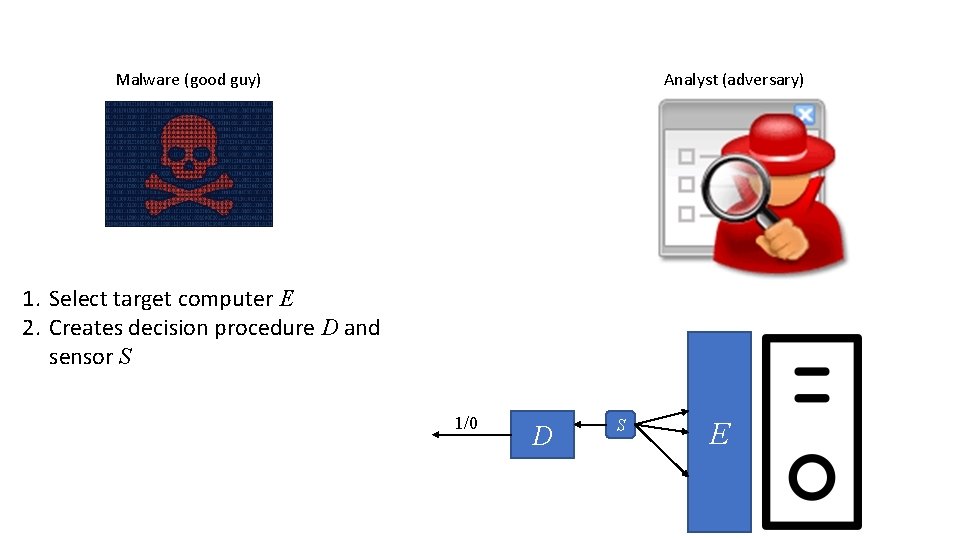
Malware (good guy) Analyst (adversary) 1. Select target computer E 2. Creates decision procedure D and sensor S 1/0 D S E
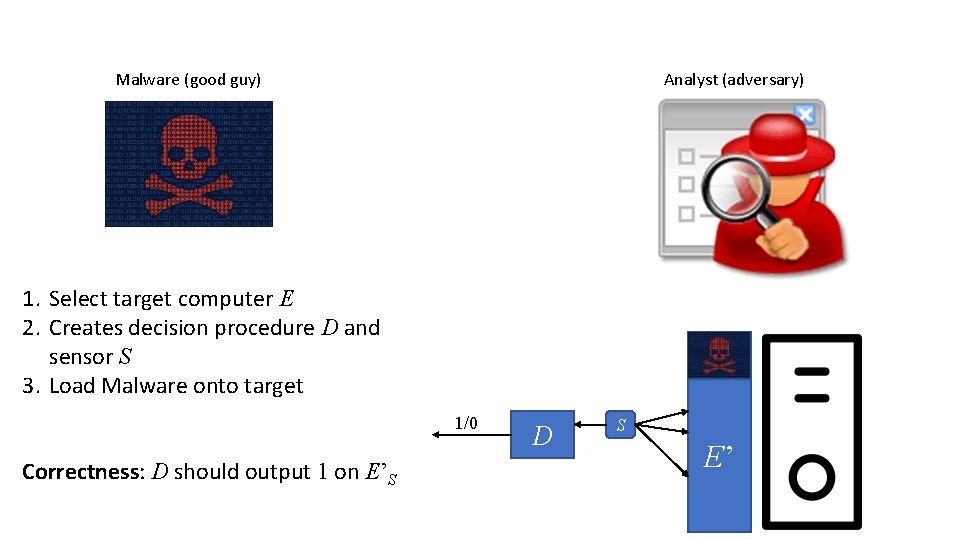
Malware (good guy) Analyst (adversary) 1. Select target computer E 2. Creates decision procedure D and sensor S 3. Load Malware onto target 1/0 Correctness: D should output 1 on E’S D S E E’
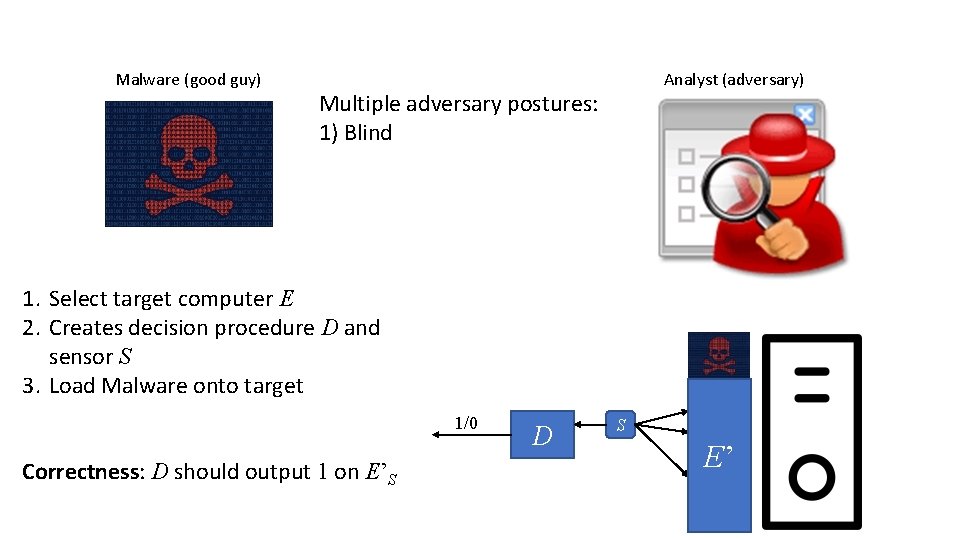
Malware (good guy) Analyst (adversary) Multiple adversary postures: 1) Blind 1. Select target computer E 2. Creates decision procedure D and sensor S 3. Load Malware onto target 1/0 Correctness: D should output 1 on E’S D S E’
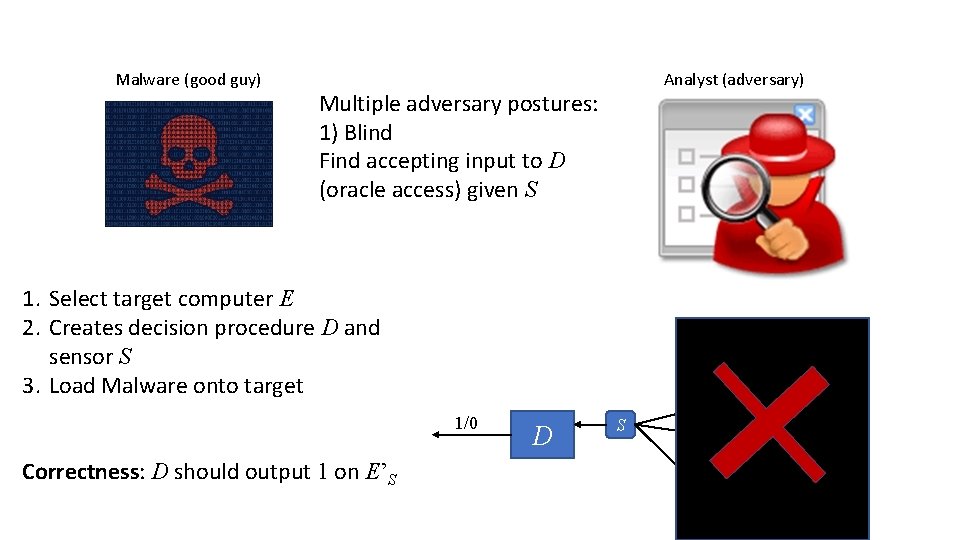
Malware (good guy) Analyst (adversary) Multiple adversary postures: 1) Blind Find accepting input to D (oracle access) given S 1. Select target computer E 2. Creates decision procedure D and sensor S 3. Load Malware onto target 1/0 Correctness: D should output 1 on E’S D S E’
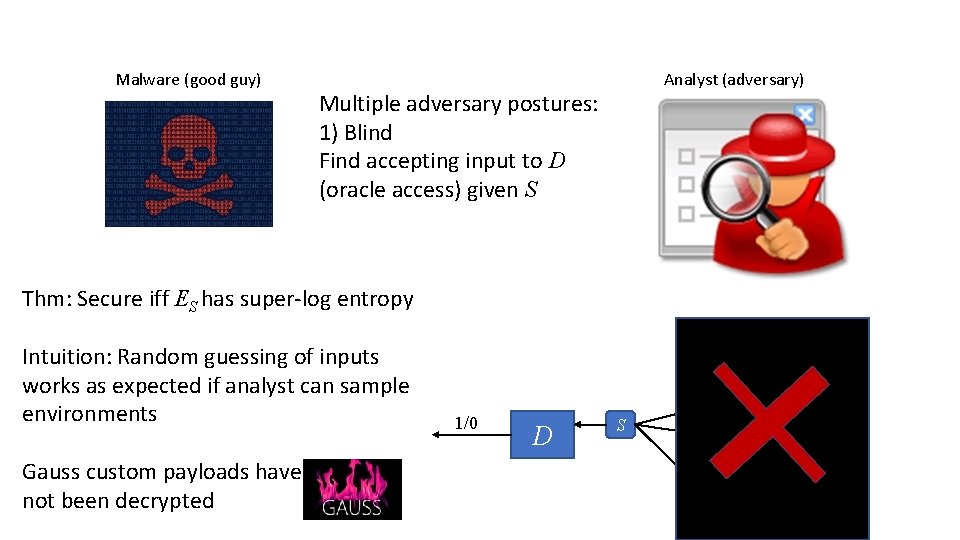
Malware (good guy) Analyst (adversary) Multiple adversary postures: 1) Blind Find accepting input to D (oracle access) given S Thm: Secure iff ES has super-log entropy Intuition: Random guessing of inputs works as expected if analyst can sample environments Gauss custom payloads have not been decrypted 1/0 D S E’
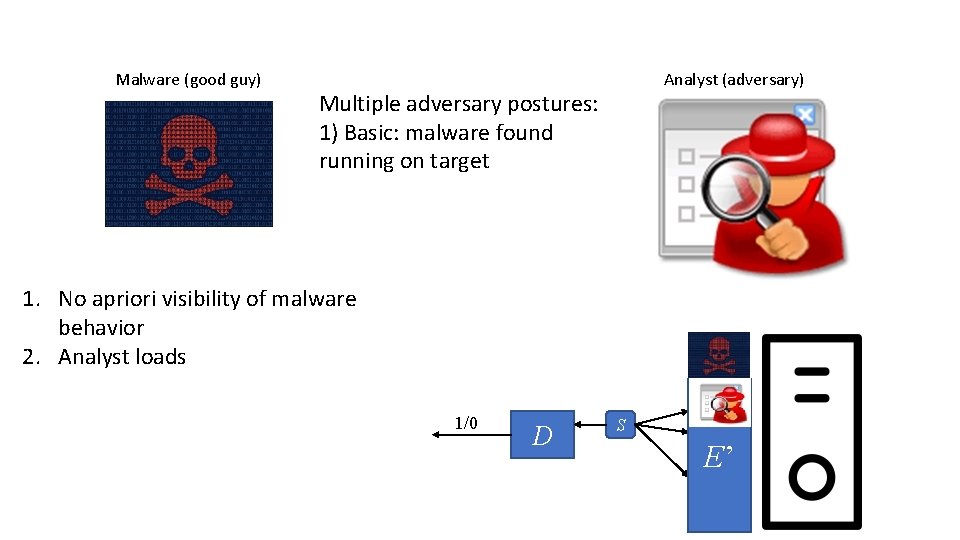
Malware (good guy) Analyst (adversary) Multiple adversary postures: 1) Basic: malware found running on target 1. No apriori visibility of malware behavior 2. Analyst loads 1/0 D S E’
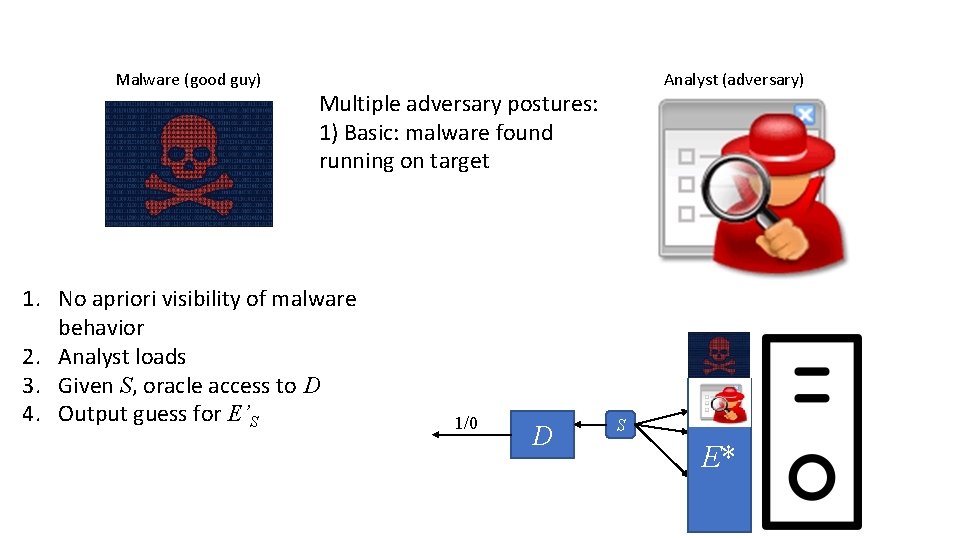
Malware (good guy) Analyst (adversary) Multiple adversary postures: 1) Basic: malware found running on target 1. No apriori visibility of malware behavior 2. Analyst loads 3. Given S, oracle access to D 4. Output guess for E’S 1/0 D S E*
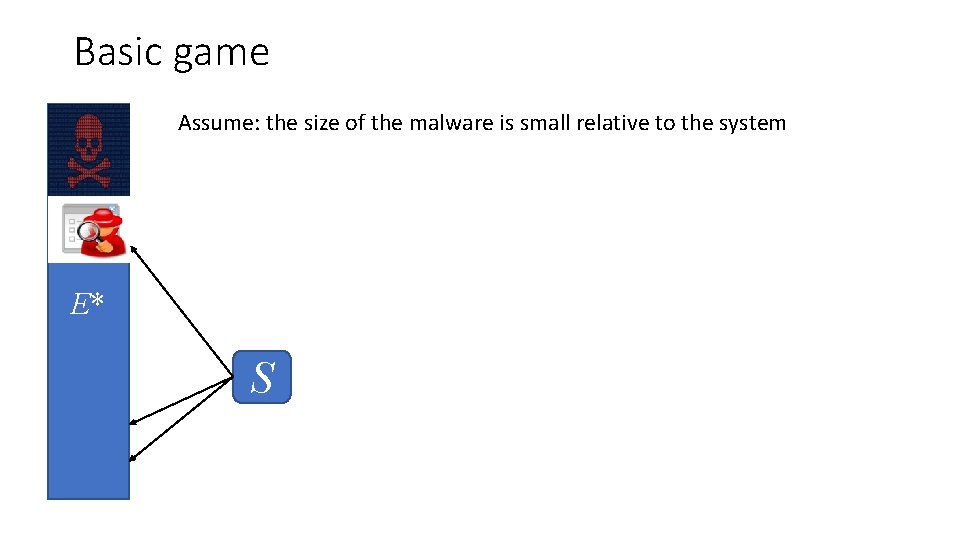
Basic game Assume: the size of the malware is small relative to the system E* S
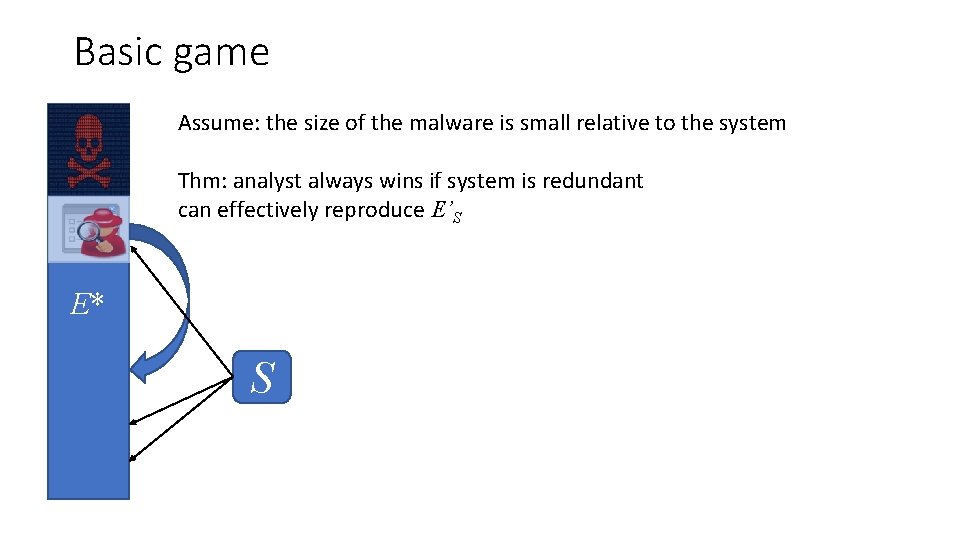
Basic game Assume: the size of the malware is small relative to the system Thm: analyst always wins if system is redundant can effectively reproduce E’S E* S
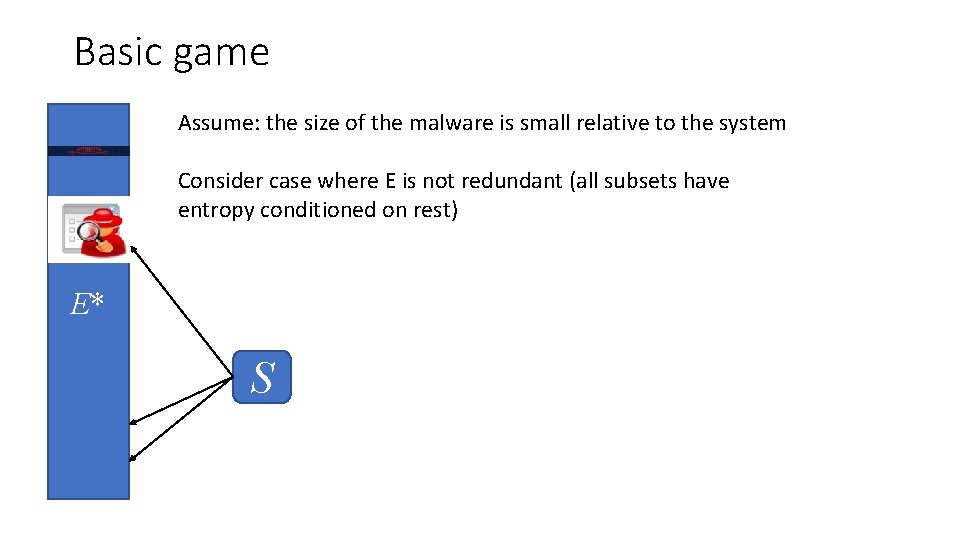
Basic game Assume: the size of the malware is small relative to the system Consider case where E is not redundant (all subsets have entropy conditioned on rest) E* S
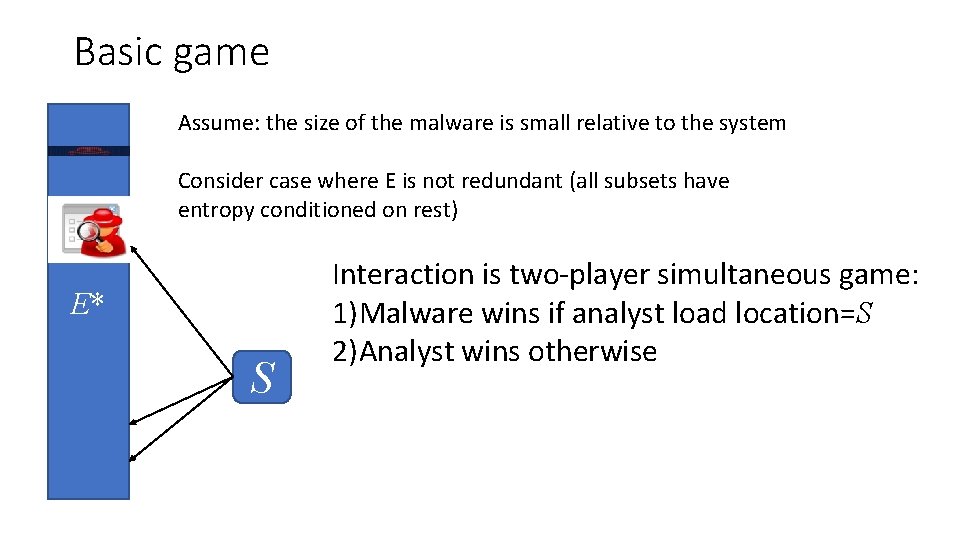
Basic game Assume: the size of the malware is small relative to the system Consider case where E is not redundant (all subsets have entropy conditioned on rest) E* S Interaction is two-player simultaneous game: 1)Malware wins if analyst load location=S 2)Analyst wins otherwise
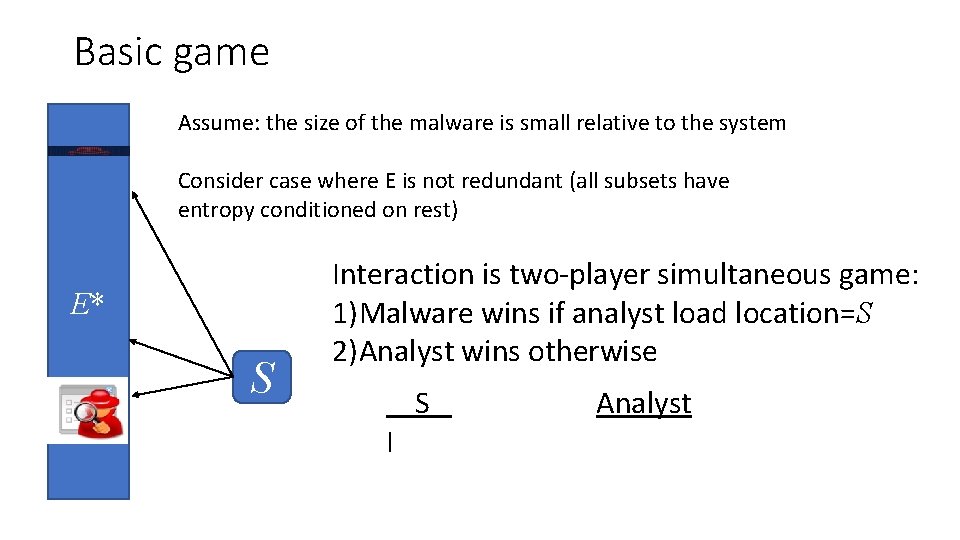
Basic game Assume: the size of the malware is small relative to the system Consider case where E is not redundant (all subsets have entropy conditioned on rest) E* S Interaction is two-player simultaneous game: 1)Malware wins if analyst load location=S 2)Analyst wins otherwise I S Analyst
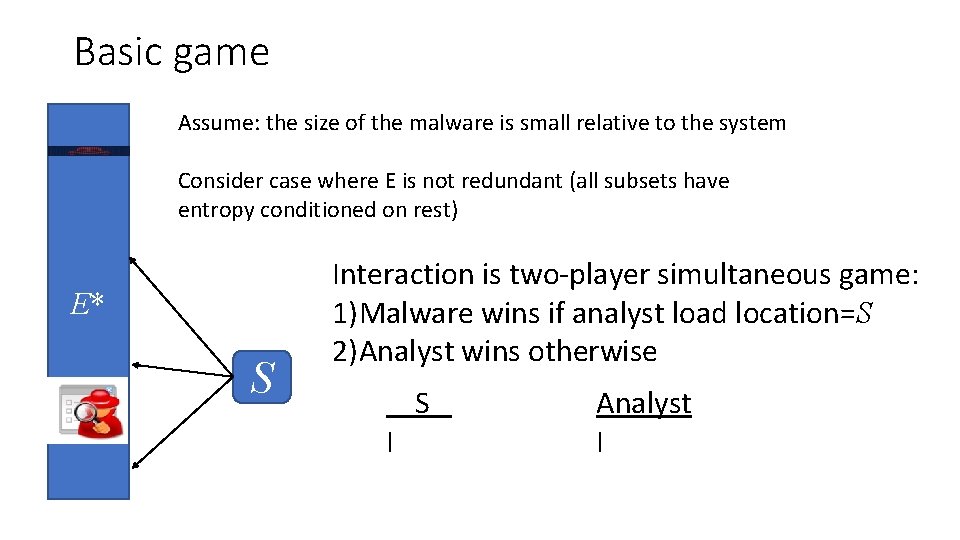
Basic game Assume: the size of the malware is small relative to the system Consider case where E is not redundant (all subsets have entropy conditioned on rest) E* S Interaction is two-player simultaneous game: 1)Malware wins if analyst load location=S 2)Analyst wins otherwise I S Analyst I
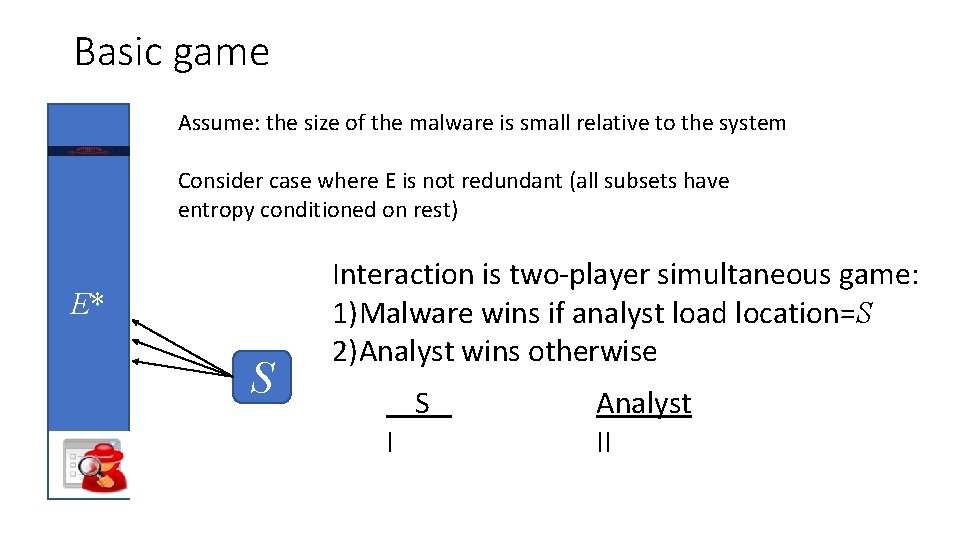
Basic game Assume: the size of the malware is small relative to the system Consider case where E is not redundant (all subsets have entropy conditioned on rest) E* S Interaction is two-player simultaneous game: 1)Malware wins if analyst load location=S 2)Analyst wins otherwise I S Analyst II
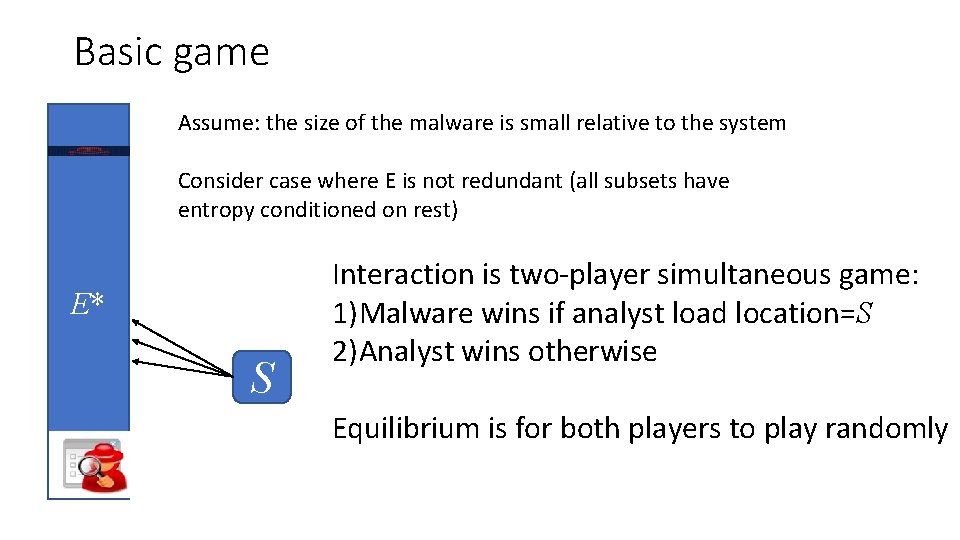
Basic game Assume: the size of the malware is small relative to the system Consider case where E is not redundant (all subsets have entropy conditioned on rest) E* S Interaction is two-player simultaneous game: 1)Malware wins if analyst load location=S 2)Analyst wins otherwise Equilibrium is for both players to play randomly
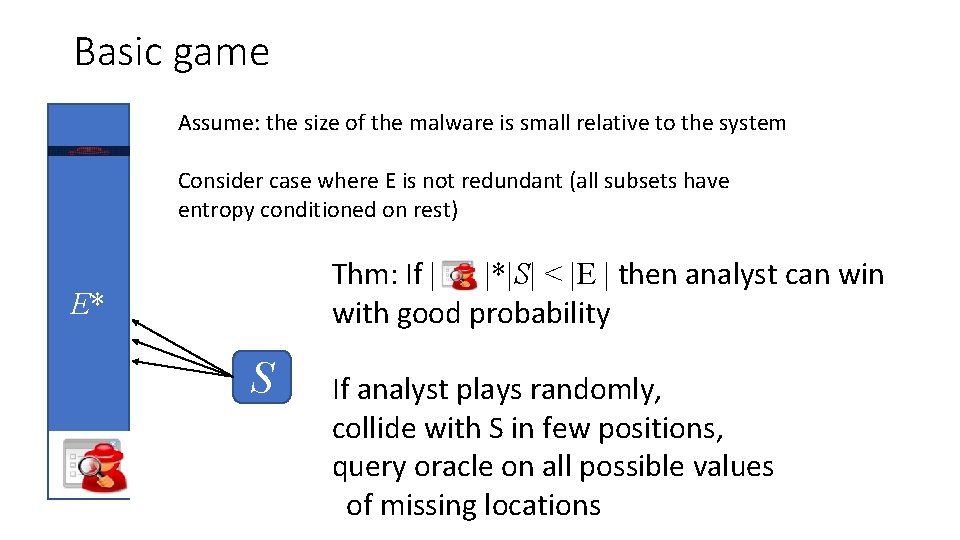
Basic game Assume: the size of the malware is small relative to the system Consider case where E is not redundant (all subsets have entropy conditioned on rest) Thm: If | |*|S| < |E | then analyst can with good probability E* S If analyst plays randomly, collide with S in few positions, query oracle on all possible values of missing locations
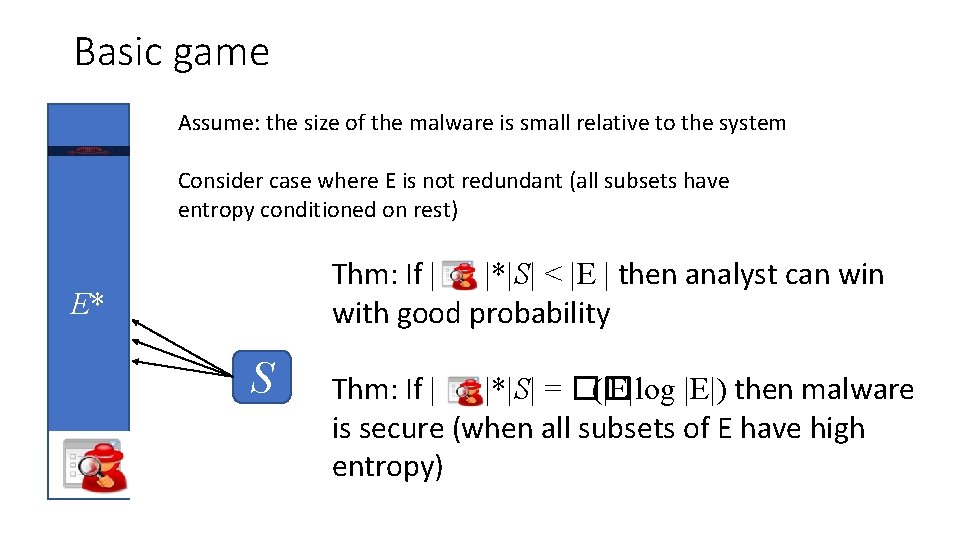
Basic game Assume: the size of the malware is small relative to the system Consider case where E is not redundant (all subsets have entropy conditioned on rest) Thm: If | |*|S| < |E | then analyst can with good probability E* S Thm: If | |*|S| = �� (|E|log |E|) then malware is secure (when all subsets of E have high entropy)
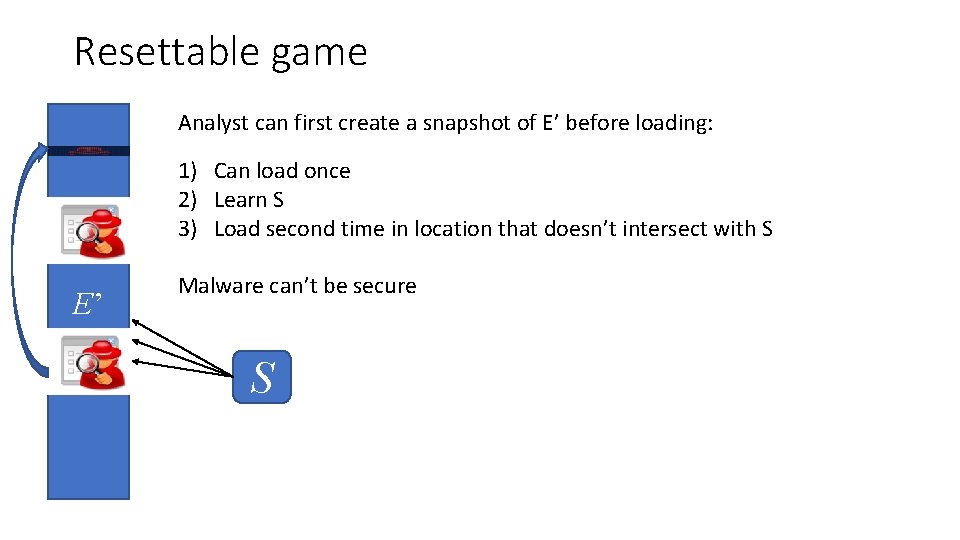
Resettable game Analyst can first create a snapshot of E’ before loading: 1) Can load once 2) Learn S 3) Load second time in location that doesn’t intersect with S E’ Malware can’t be secure S
Conclusion and Open Problems • Formalized common malware goal of authenticating the environment: • Blind game: malware found in the wild • Basic game: malware found on target but target cannot be interrupted • Resettable game: target machine can be snapshotted and reconstituted • Open problems: • Modeling time in sensor procedures • Modeling malware that receives state from an online command control Questions? Benjamin. fuller@uconn. edu
- Slides: 29