
Environmental Audit on Air Quality Improvement Projects Control
![Audit Findings and Recommendation [Table] Actual Installation of emission reduction devices in 2006 Items](https://slidetodoc.com/presentation_image_h2/d85e6203780e22498eb15964398ac6a2/image-19.jpg "Audit Findings and Recommendation [Table] Actual Installation of emission reduction devices in 2006 Items")

- Slides: 24
Environmental Audit on Air Quality Improvement Projects : Control of Diesel Emissions Seung Yeon Weon
Environmental Audit Activities Performance auditing on Biodiversity National park designation and management Waste management Conservation and Management of the Back-Du-Dae-Gan( trans-korea backbone mountain range) Environmental Audit on Water Quality Improvement Projects Environmental Audit on Air Quality Improvement Projects
CONTENTS Ⅰ. Air Quality Status in Metropolitan Area Ⅱ. Major Causes of Air Pollution Ⅲ. Special Measures for Air Quality Improvement Ⅳ. Audit Results (findings and recommendation)
Ⅰ. Current Air Quality Status in Metropolitan Area
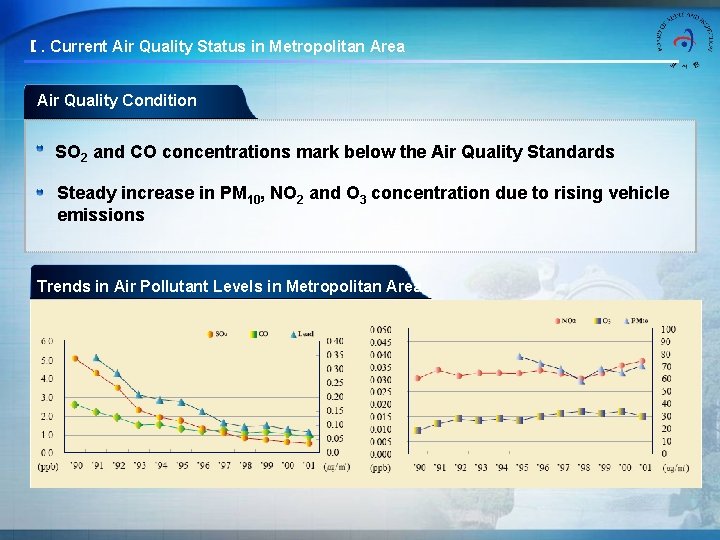
Ⅰ. Current Air Quality Status in Metropolitan Area Air Quality Condition SO 2 and CO concentrations mark below the Air Quality Standards Steady increase in PM 10, NO 2 and O 3 concentration due to rising vehicle emissions Trends in Air Pollutant Levels in Metropolitan Area
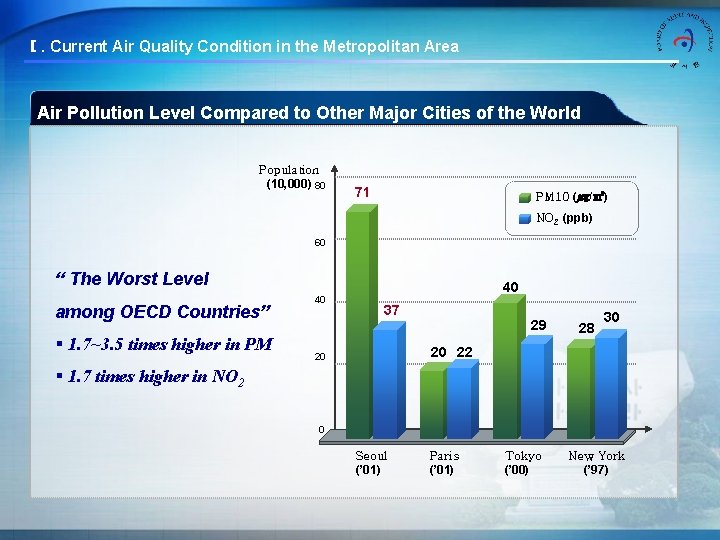
Ⅰ. Current Air Quality Condition in the Metropolitan Area Air Pollution Level Compared to Other Major Cities of the World Population (10, 000) 80 71 PM 10 (㎍/㎥) NO 2 (ppb) 60 “ The Worst Level among OECD Countries” § 1. 7~3. 5 times higher in PM 40 40 37 29 28 30 20 22 20 § 1. 7 times higher in NO 2 0 Seoul (’ 01) Paris (’ 01) Tokyo (’ 00) New York (’ 97)
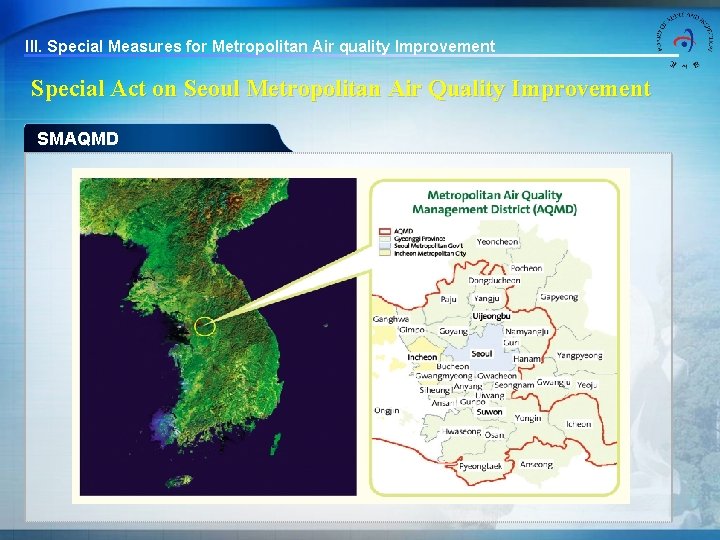
III. Special Measures for Metropolitan Air quality Improvement Special Act on Seoul Metropolitan Air Quality Improvement SMAQMD
Ⅱ. Major Causes of Air Pollution
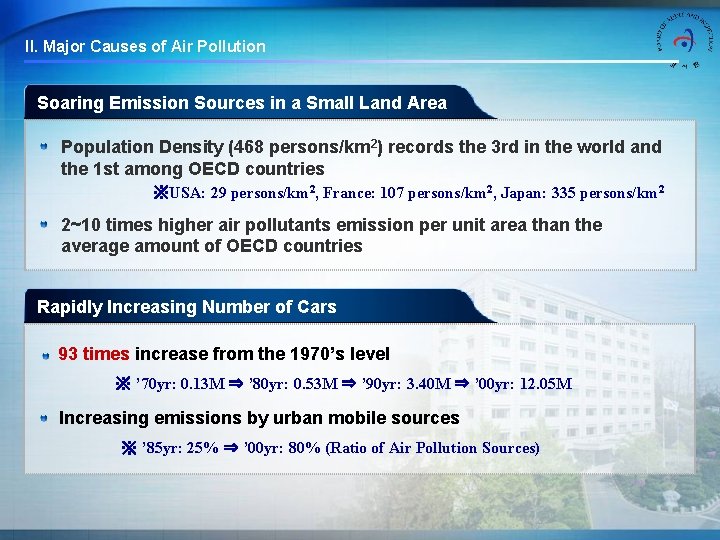
II. Major Causes of Air Pollution Soaring Emission Sources in a Small Land Area Population Density (468 persons/km 2) records the 3 rd in the world and the 1 st among OECD countries ※USA: 29 persons/km 2, France: 107 persons/km 2, Japan: 335 persons/km 2 2~10 times higher air pollutants emission per unit area than the average amount of OECD countries Rapidly Increasing Number of Cars 93 times increase from the 1970’s level ※ ’ 70 yr: 0. 13 M ⇒ ’ 80 yr: 0. 53 M ⇒ ’ 90 yr: 3. 40 M ⇒ ’ 00 yr: 12. 05 M Increasing emissions by urban mobile sources ※ ’ 85 yr: 25% ⇒ ’ 00 yr: 80% (Ratio of Air Pollution Sources)
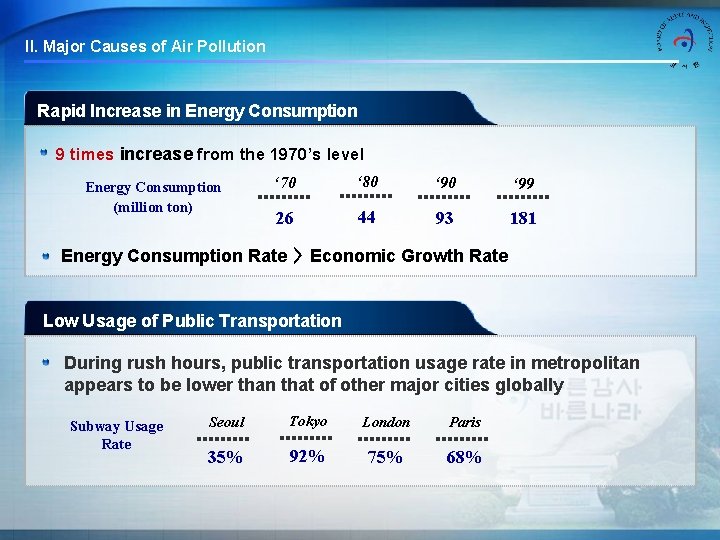
II. Major Causes of Air Pollution Rapid Increase in Energy Consumption 9 times increase from the 1970’s level Energy Consumption (million ton) ‘ 70 ‘ 80 ‘ 99 26 44 93 181 Energy Consumption Rate 〉Economic Growth Rate Low Usage of Public Transportation During rush hours, public transportation usage rate in metropolitan appears to be lower than that of other major cities globally Subway Usage Rate Seoul Tokyo London Paris 35% 92% 75% 68%
Ⅲ. Special Measures for Metropolitan Air Quality Improvement
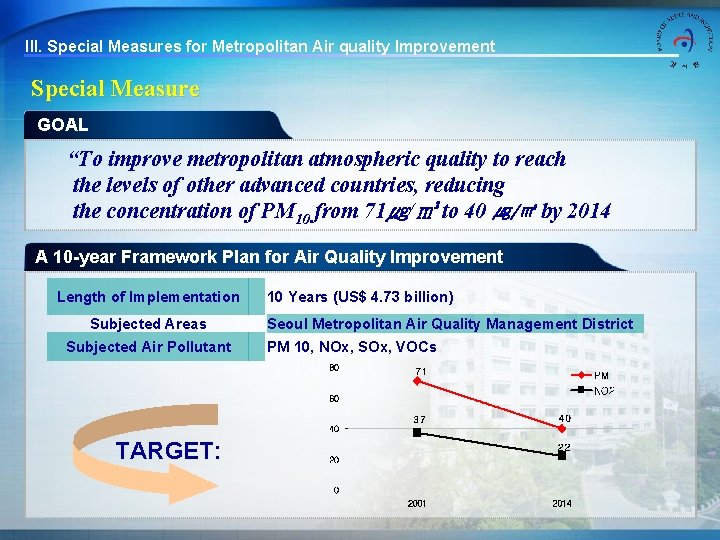
III. Special Measures for Metropolitan Air quality Improvement Special Measure GOAL “To improve metropolitan atmospheric quality to reach the levels of other advanced countries, reducing the concentration of PM 10 from 71㎍/㎥ to 40 ㎍/㎥ by 2014 A 10 -year Framework Plan for Air Quality Improvement Length of Implementation Subjected Areas Subjected Air Pollutant TARGET: 10 Years (US$ 4. 73 billion) Seoul Metropolitan Air Quality Management District PM 10, NOx, SOx, VOCs
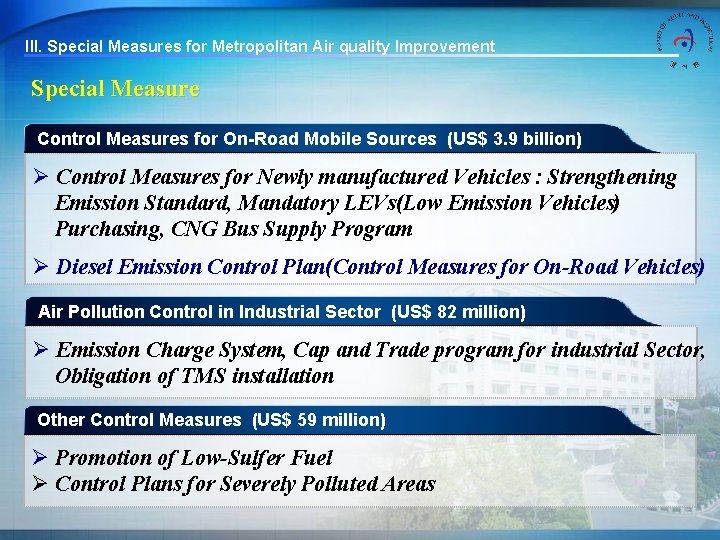
III. Special Measures for Metropolitan Air quality Improvement Special Measure Control Measures for On-Road Mobile Sources (US$ 3. 9 billion) Ø Control Measures for Newly manufactured Vehicles : Strengthening Emission Standard, Mandatory LEVs(Low Emission Vehicles) Purchasing, CNG Bus Supply Program Ø Diesel Emission Control Plan(Control Measures for On-Road Vehicles) Air Pollution Control in Industrial Sector (US$ 82 million) Ø Emission Charge System, Cap and Trade program for industrial Sector, Obligation of TMS installation Other Control Measures (US$ 59 million) Ø Promotion of Low-Sulfer Fuel Ø Control Plans for Severely Polluted Areas
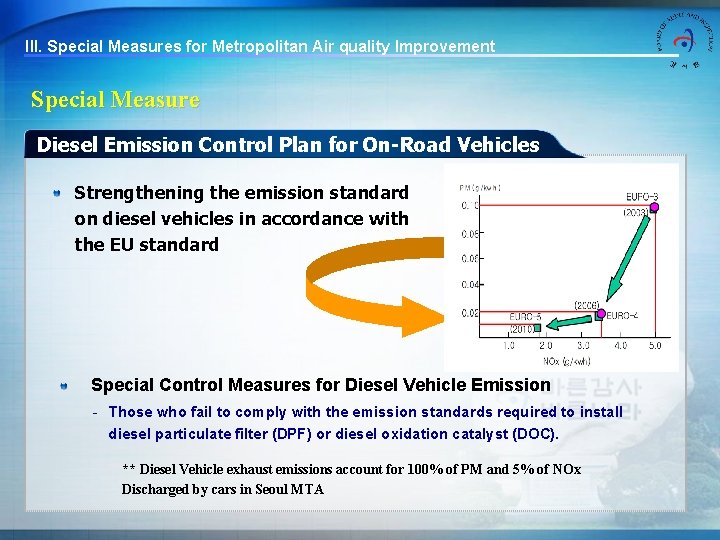
III. Special Measures for Metropolitan Air quality Improvement Special Measure Diesel Emission Control Plan for On-Road Vehicles Strengthening the emission standard on diesel vehicles in accordance with the EU standard Special Control Measures for Diesel Vehicle Emission - Those who fail to comply with the emission standards required to install diesel particulate filter (DPF) or diesel oxidation catalyst (DOC). ** Diesel Vehicle exhaust emissions account for 100% of PM and 5% of NOx Discharged by cars in Seoul MTA
Objects of the Audit To conduct an in-depth analysis of appropriateness of the master plan, performance, follow-up management for the diesel emission control plan, and to suggest solutions to improve air quality in the metropolitan areas.
The Audit Focus Reasonableness of the basic master plan which aims to improve air quality in the metropolitan areas Appropriateness of plan promotion and follow-up management Appropriateness of the certification for emission reduction devices and prime cost accounting
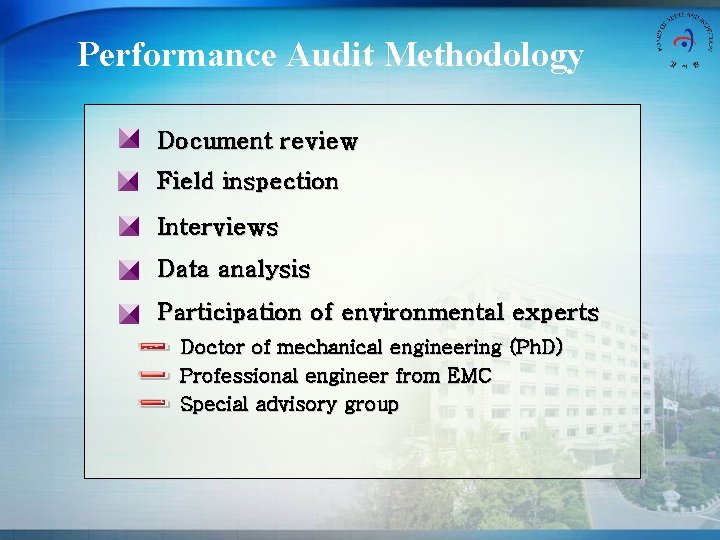
Performance Audit Methodology Document review Field inspection Interviews Data analysis Participation of environmental experts Doctor of mechanical engineering (Ph. D) Professional engineer from EMC Special advisory group
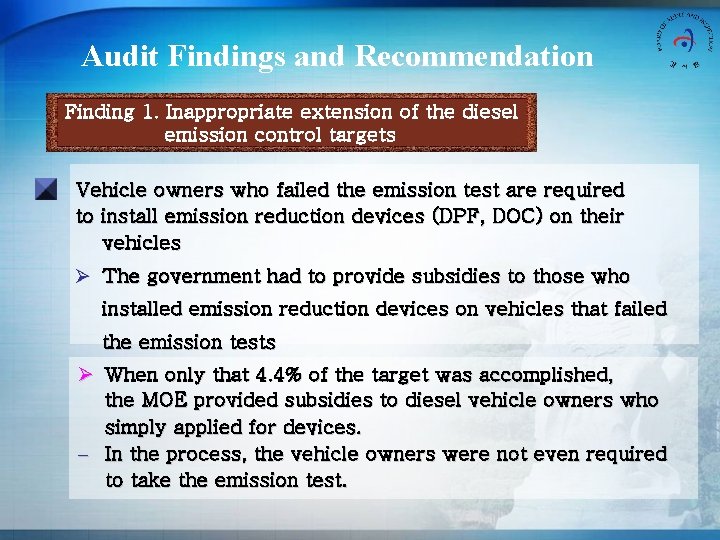
Audit Findings and Recommendation Finding 1. Inappropriate extension of the diesel emission control targets Vehicle owners who failed the emission test are required to install emission reduction devices (DPF, DOC) on their vehicles Ø The government had to provide subsidies to those who installed emission reduction devices on vehicles that failed the emission tests Ø When only that 4. 4% of the target was accomplished, the MOE provided subsidies to diesel vehicle owners who simply applied for devices. – In the process, the vehicle owners were not even required to take the emission test.
Audit Findings and Recommendation [Table] Actual Installation of emission reduction devices in 2006 Items Total Passed Failed Non-test No. of Vehicles 116, 687 (100%) 51, 411 (44. 1%) 30, 818 (26. 4%) 34, 458 (29. 5%) Subsidies 328 150 71 107 Ø The subsidies worth US $150 million was misallocated to vehicle owners emitting moderate volume of pollutant Recommendations The BAI advised the MOE to adjust the range of target drivers in line with the Special Act on Metropolitan Air Quality Improvement to include only the vehicles that fail the emission test.
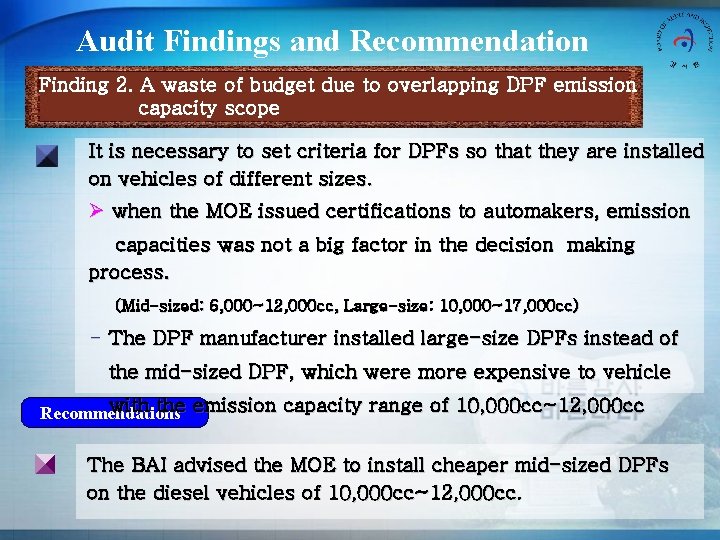
Audit Findings and Recommendation Finding 2. A waste of budget due to overlapping DPF emission capacity scope It is necessary to set criteria for DPFs so that they are installed on vehicles of different sizes. Ø when the MOE issued certifications to automakers, emission capacities was not a big factor in the decision making process. (Mid-sized: 6, 000~12, 000 cc, Large-size: 10, 000~17, 000 cc) - The DPF manufacturer installed large-size DPFs instead of the mid-sized DPF, which were more expensive to vehicle with the emission capacity range of 10, 000 cc~12, 000 cc Recommendations The BAI advised the MOE to install cheaper mid-sized DPFs on the diesel vehicles of 10, 000 cc~12, 000 cc.
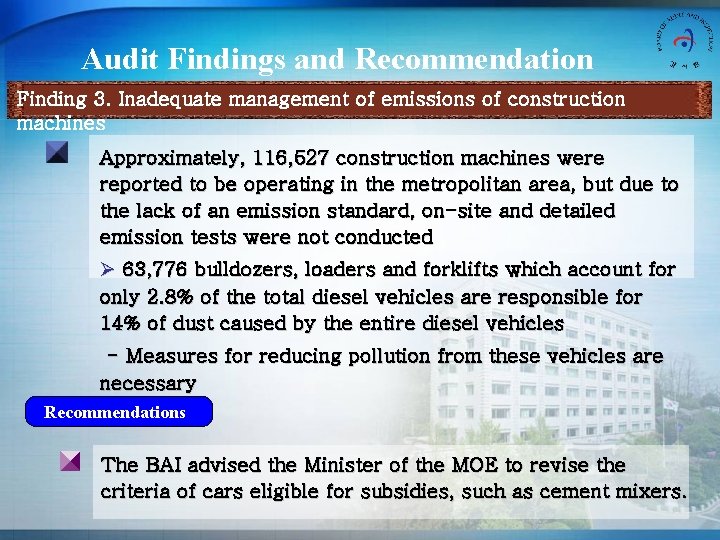
Audit Findings and Recommendation Finding 3. Inadequate management of emissions of construction machines Approximately, 116, 527 construction machines were reported to be operating in the metropolitan area, but due to the lack of an emission standard, on-site and detailed emission tests were not conducted Ø 63, 776 bulldozers, loaders and forklifts which account for only 2. 8% of the total diesel vehicles are responsible for 14% of dust caused by the entire diesel vehicles - Measures for reducing pollution from these vehicles are necessary Recommendations The BAI advised the Minister of the MOE to revise the criteria of cars eligible for subsidies, such as cement mixers.
Follow-ups to the BAI’s Recommendations The MOE prepared and carried out the follow-up measures below To enhance the budgeting effectiveness, the main target vehicles are now limited to those that fail the test. For the vehicles that fall in the overlapping range of engine displacements, the MOE will encourage them to install the med-sized DPFs, which are just effective but cheaper. The MOE will arrange a plan to reduce the gas emission of construction machines by installing DPFs on them.
Epilogue The MOE demanded a budget increase of US$4. 7 billion for coming 10 years for their general air quality improvement plan Ø the clean air related policies only deal with emission reduction of on-road vehicle, rather than having a bottomup approach such as expansion and improvement of the public transport system Expansion and improvement of the public transport system which will curb the vehicle ownership seem to be the ultimate solution to clean air.
Thank You