
Environment Safety and Health Hazard Analysis HA Process
- Slides: 48
Environment, Safety and Health Hazard Analysis (HA) Process. Basic Concepts and Techniques Bill Schleyer NNSA-SC for Integrated Safety Management Conference 17 November 2003
Environment, Safety and Health Analysis Process- What it Does n n Hazard analysis is the activity that: n Comprehensively evaluates facility and process hazards n Requires a full understanding of facility activities n Identifies more important engineered and administrative controls Identifies accidents for further analysis due to a public consequence potential or extreme harm to workers 11 -28 -2007 2
Environment, Safety and Health Purpose of the Hazard Analysis (HA) n n Document Safety Controls The real value in HA performance stems from: n n n Comprehensive and systematic evaluation of hazards Coverage of a complete spectrum of accidents for both normal and abnormal conditions and events Assessing the effectiveness and adequacy of controls Recommending additional controls as needed Bottom line: A better understanding the spectrum of controls that make any facility or work safe n n 11 -28 -2007 Construction and processing facilities Environmental restoration activities 3
Environment, Safety and Health Information Derived from HA n Independent of the Method, the HA Should: n n n n 11 -28 -2007 Identify facility or process hazards Identify potential accident scenarios involving the hazards and initiating events Qualitatively estimate the uncontrolled consequences of potential accident scenarios Qualitatively estimate the frequency that a potential accident scenario may occur Rank the accident scenario according to its relative risk Identify potential preventive and mitigative controls Recommend actions to reduce facility or process risk 4
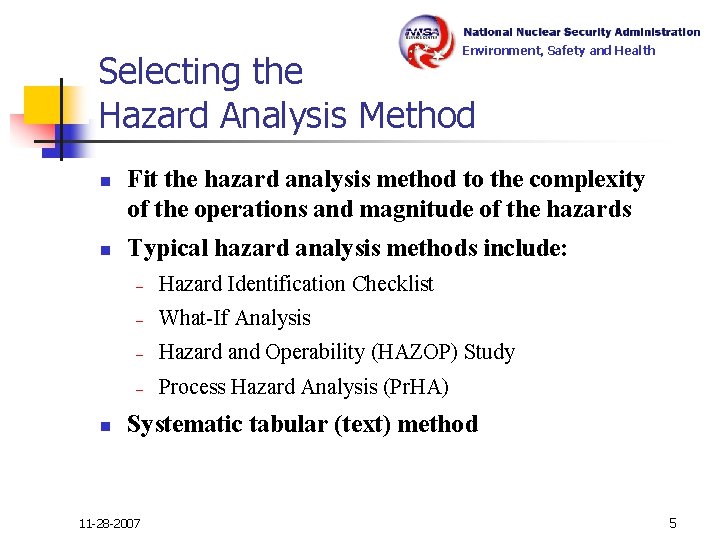
Environment, Safety and Health Selecting the Hazard Analysis Method n n n Fit the hazard analysis method to the complexity of the operations and magnitude of the hazards Typical hazard analysis methods include: – Hazard Identification Checklist – What-If Analysis – Hazard and Operability (HAZOP) Study – Process Hazard Analysis (Pr. HA) Systematic tabular (text) method 11 -28 -2007 5
Environment, Safety and Health Methods Overview 11 -28 -2007 6
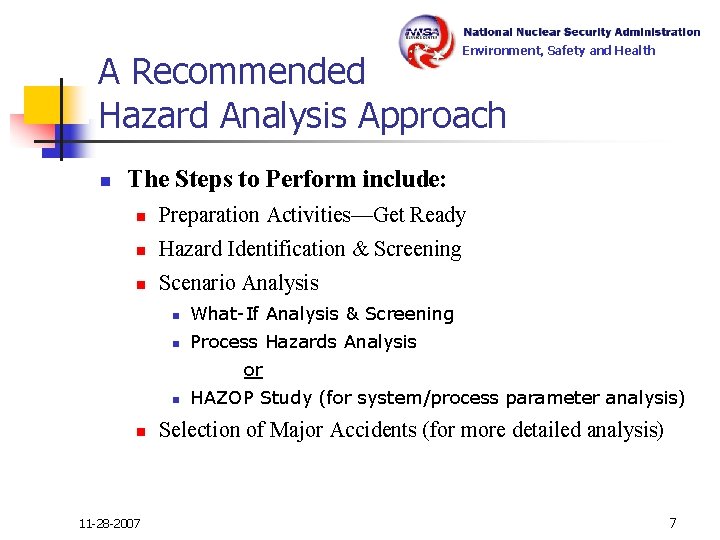
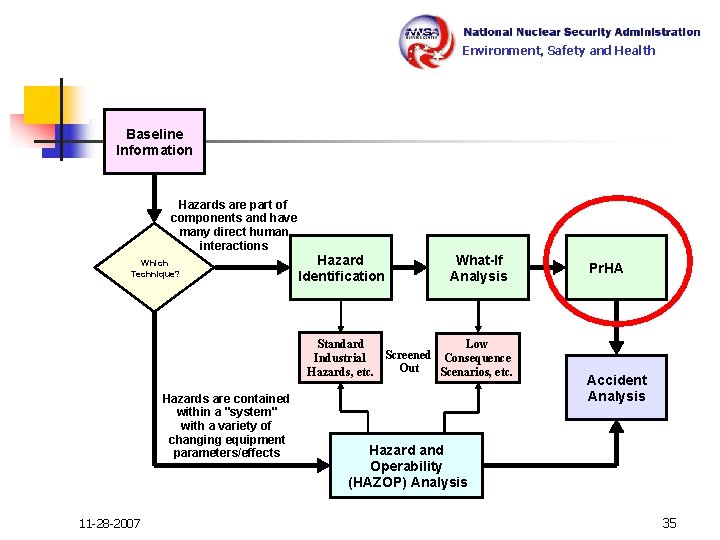
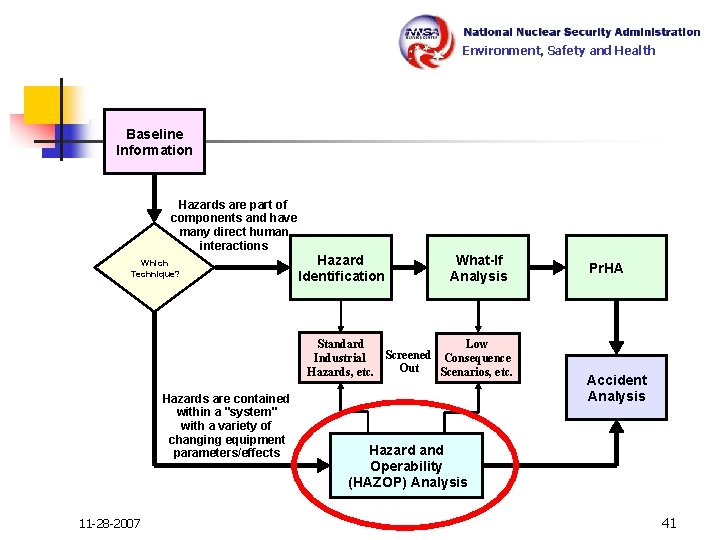
Environment, Safety and Health A Recommended Hazard Analysis Approach n The Steps to Perform include: n Preparation Activities—Get Ready n Hazard Identification & Screening n Scenario Analysis n What-If Analysis & Screening n Process Hazards Analysis or n n 11 -28 -2007 HAZOP Study (for system/process parameter analysis) Selection of Major Accidents (for more detailed analysis) 7
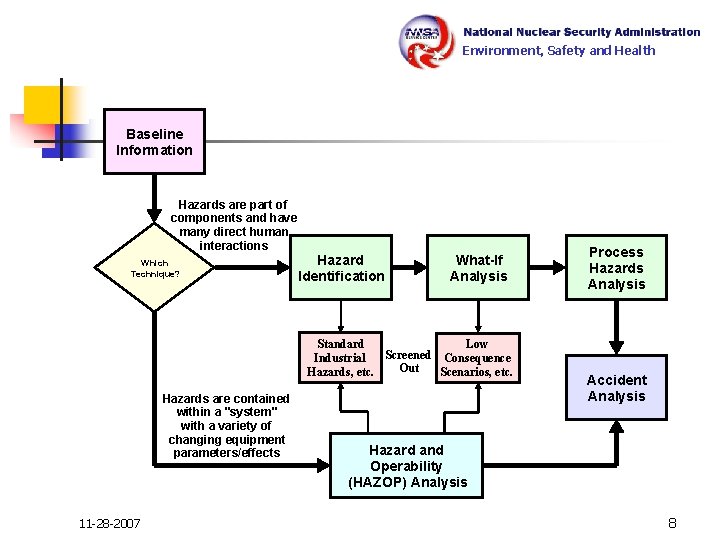
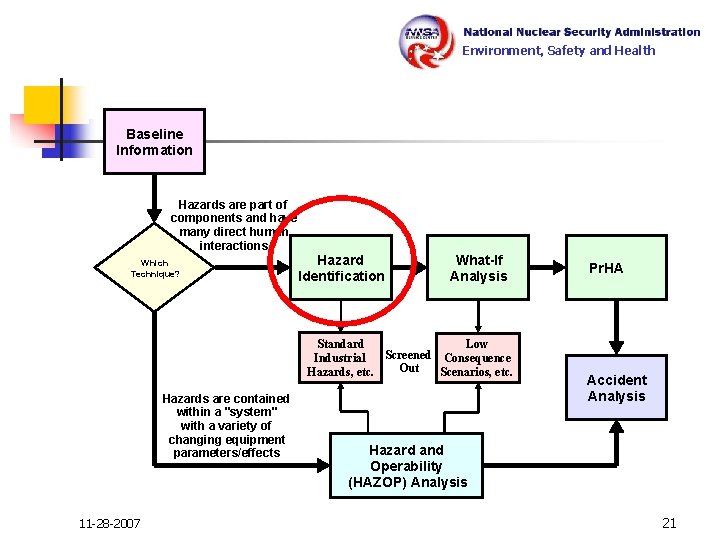
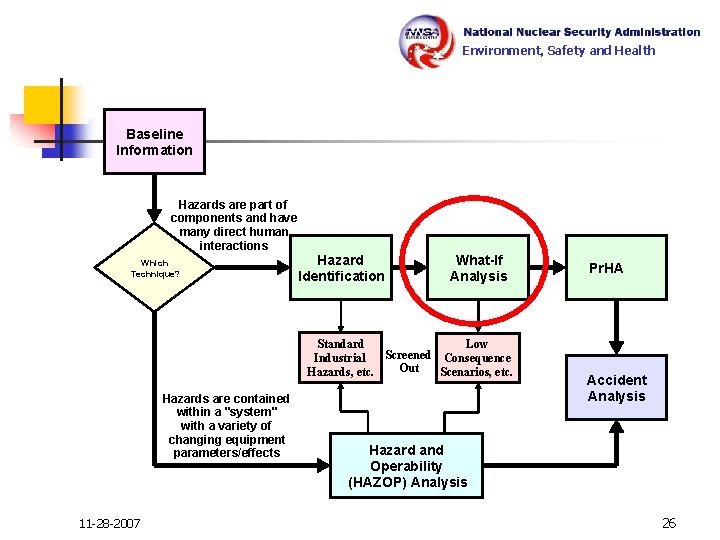
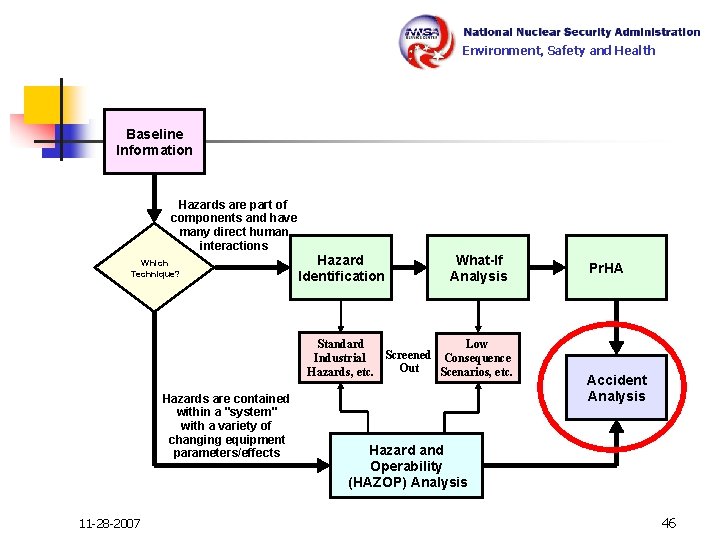
Environment, Safety and Health Baseline Information Hazards are part of components and have many direct human interactions Which Technique? Hazard Identification What-If Analysis Standard Low Screened Consequence Industrial Out Hazards, etc. Scenarios, etc. Hazards are contained within a "system" with a variety of changing equipment parameters/effects 11 -28 -2007 Process Hazards Analysis Accident Analysis Hazard and Operability (HAZOP) Analysis 8
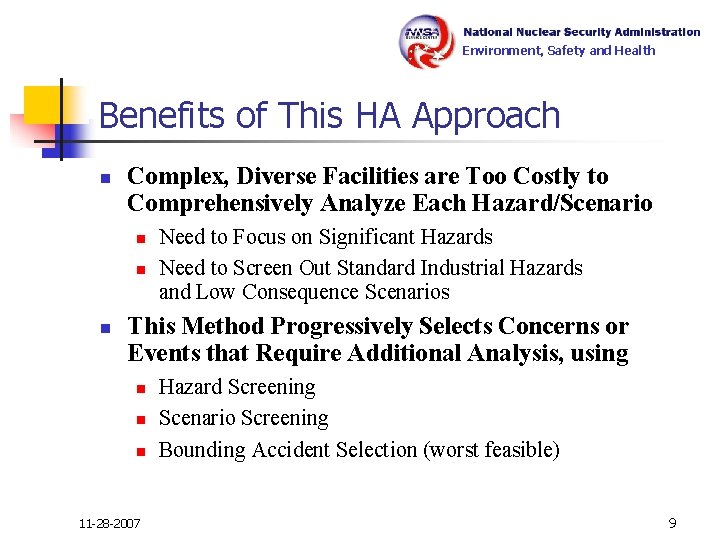
Environment, Safety and Health Benefits of This HA Approach n Complex, Diverse Facilities are Too Costly to Comprehensively Analyze Each Hazard/Scenario n n n Need to Focus on Significant Hazards Need to Screen Out Standard Industrial Hazards and Low Consequence Scenarios This Method Progressively Selects Concerns or Events that Require Additional Analysis, using n n n 11 -28 -2007 Hazard Screening Scenario Screening Bounding Accident Selection (worst feasible) 9
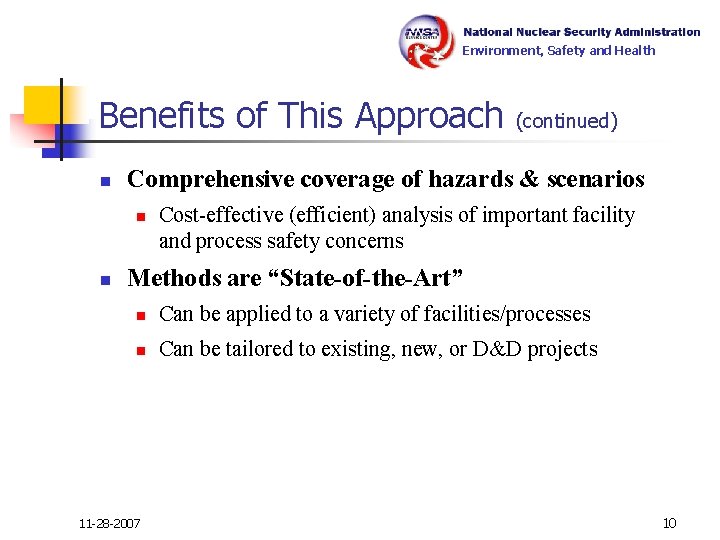
Environment, Safety and Health Benefits of This Approach n Comprehensive coverage of hazards & scenarios n n (continued) Cost-effective (efficient) analysis of important facility and process safety concerns Methods are “State-of-the-Art” n Can be applied to a variety of facilities/processes n Can be tailored to existing, new, or D&D projects 11 -28 -2007 10
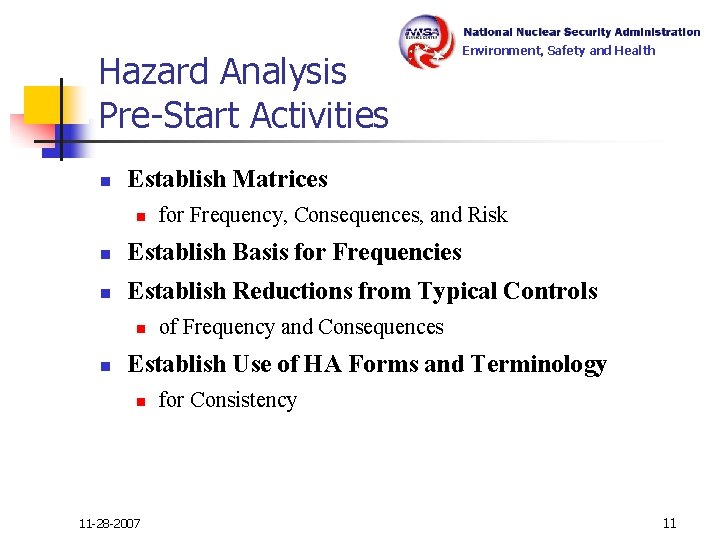
Hazard Analysis Pre-Start Activities n Environment, Safety and Health Establish Matrices n for Frequency, Consequences, and Risk n Establish Basis for Frequencies n Establish Reductions from Typical Controls n n of Frequency and Consequences Establish Use of HA Forms and Terminology n 11 -28 -2007 for Consistency 11
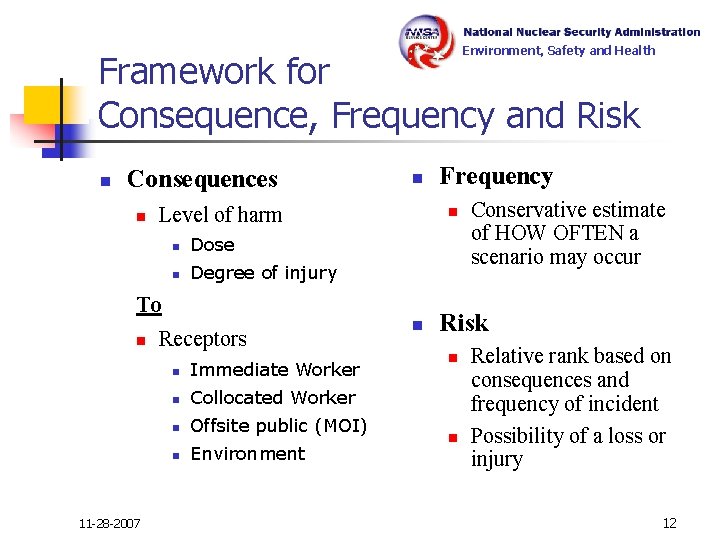
Environment, Safety and Health Framework for Consequence, Frequency and Risk n Consequences n n Level of harm n Dose n Degree of injury n To n 11 -28 -2007 Receptors n Immediate Worker n Collocated Worker n Offsite public (MOI) n Environment Frequency n Conservative estimate of HOW OFTEN a scenario may occur Risk n n Relative rank based on consequences and frequency of incident Possibility of a loss or injury 12
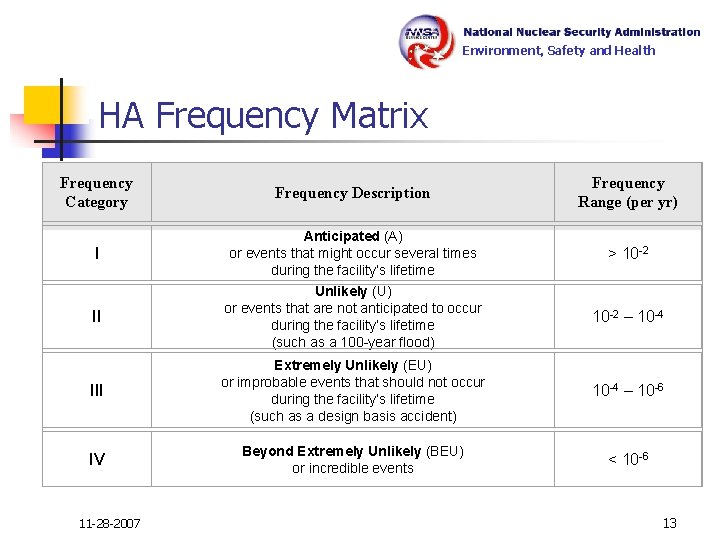
Environment, Safety and Health HA Frequency Matrix Frequency Category Frequency Description Frequency Range (per yr) I Anticipated (A) or events that might occur several times during the facility’s lifetime > 10 -2 II Unlikely (U) or events that are not anticipated to occur during the facility’s lifetime (such as a 100 -year flood) 10 -2 – 10 -4 III Extremely Unlikely (EU) or improbable events that should not occur during the facility’s lifetime (such as a design basis accident) 10 -4 – 10 -6 IV Beyond Extremely Unlikely (BEU) or incredible events < 10 -6 11 -28 -2007 13
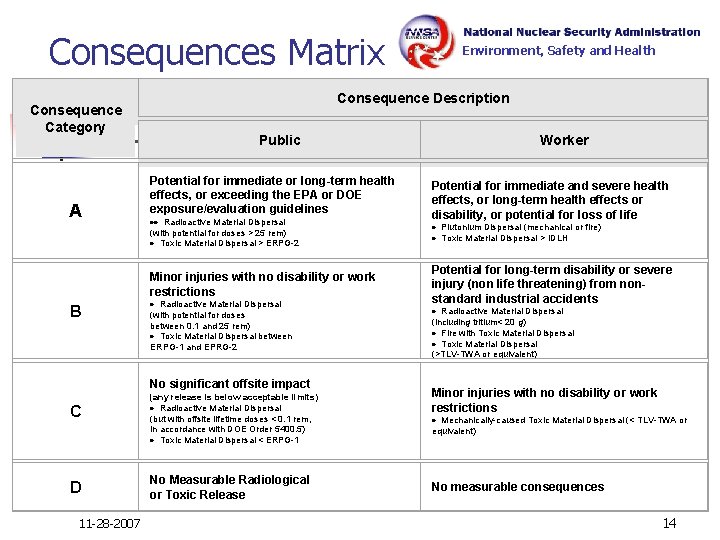
Consequences Matrix Consequence Category A Consequence Description Public Potential for immediate or long-term health effects, or exceeding the EPA or DOE exposure/evaluation guidelines ·· Radioactive Material Dispersal (with potential for doses > 25 rem) · Toxic Material Dispersal > ERPG-2 Minor injuries with no disability or work restrictions B · Radioactive Material Dispersal (with potential for doses between 0. 1 and 25 rem) · Toxic Material Dispersal between ERPG-1 and EPRG-2 No significant offsite impact C D 11 -28 -2007 Environment, Safety and Health (any release is below acceptable limits) · Radioactive Material Dispersal (but with offsite lifetime doses < 0. 1 rem, in accordance with DOE Order 5400. 5) · Toxic Material Dispersal < ERPG-1 No Measurable Radiological or Toxic Release Worker Potential for immediate and severe health effects, or long-term health effects or disability, or potential for loss of life · Plutonium Dispersal (mechanical or fire) · Toxic Material Dispersal > IDLH Potential for long-term disability or severe injury (non life threatening) from nonstandard industrial accidents · Radioactive Material Dispersal (including tritium< 20 g) · Fire with Toxic Material Dispersal · Toxic Material Dispersal (>TLV-TWA or equivalent) Minor injuries with no disability or work restrictions · Mechanically-caused Toxic Material Dispersal (< TLV-TWA or equivalent) No measurable consequences 14
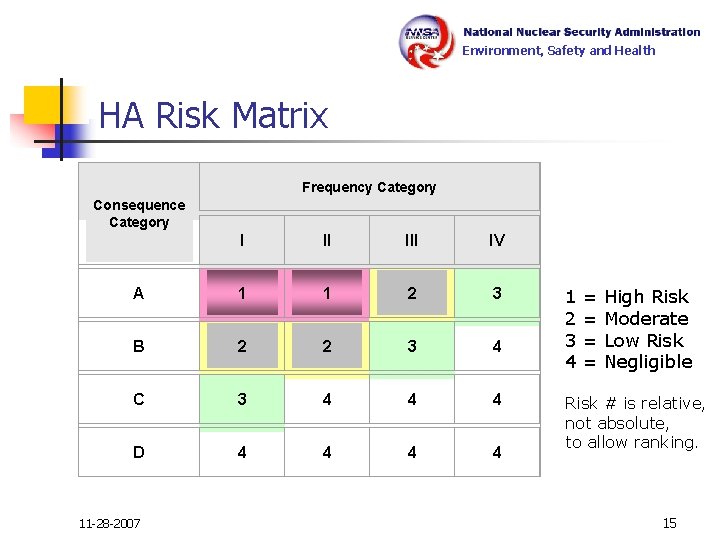
Environment, Safety and Health HA Risk Matrix Frequency Category Consequence Category I II IV A 1 1 2 3 B 2 2 3 4 C 3 4 4 4 D 4 4 11 -28 -2007 1 2 3 4 = = High Risk Moderate Low Risk Negligible Risk # is relative, not absolute, to allow ranking. 15
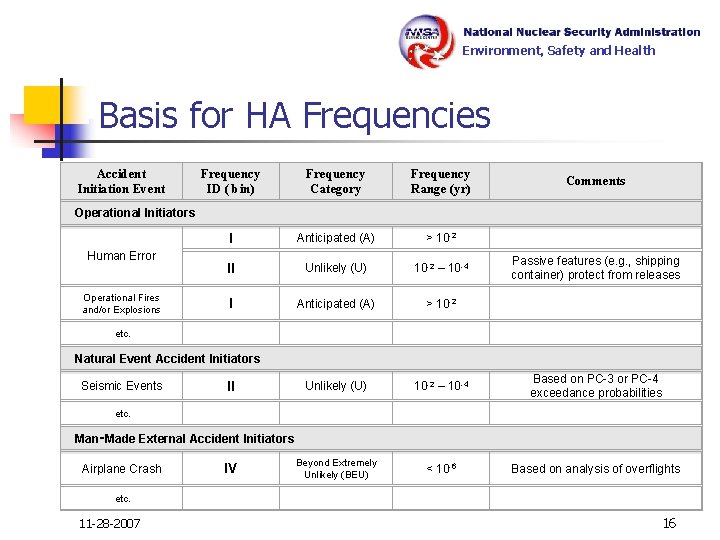
Environment, Safety and Health Basis for HA Frequencies Accident Initiation Event Frequency ID ( bin) Frequency Category Frequency Range (yr) Comments I Anticipated (A) > 10 -2 II Unlikely (U) 10 -2 – 10 -4 Passive features (e. g. , shipping container) protect from releases Operational Fires and/or Explosions I Anticipated (A) > 10 -2 etc. Operational Initiators Human Error Natural Event Accident Initiators Seismic Events II Unlikely (U) 10 -2 – 10 -4 Based on PC-3 or PC-4 exceedance probabilities etc. Man‑Made External Accident Initiators Airplane Crash IV Beyond Extremely Unlikely (BEU) < 10 -6 Based on analysis of overflights etc. 11 -28 -2007 16
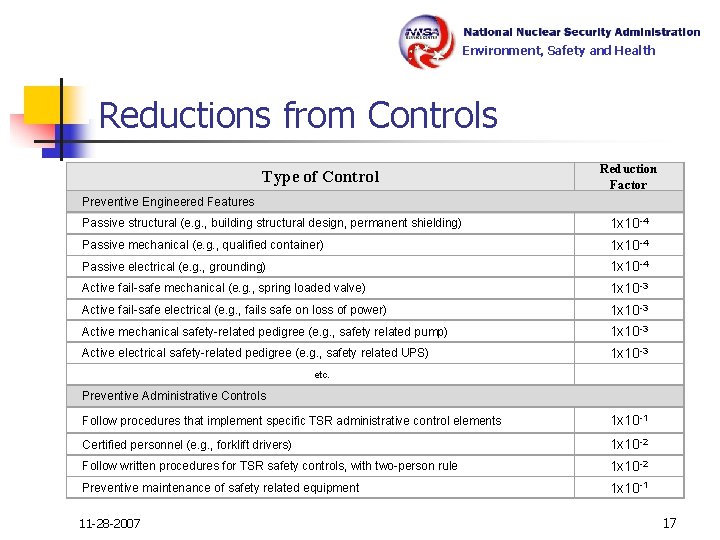
Environment, Safety and Health Reductions from Controls Type of Control Reduction Factor Preventive Engineered Features Passive structural (e. g. , building structural design, permanent shielding) 1 x 10 -4 Passive mechanical (e. g. , qualified container) 1 x 10 -4 Passive electrical (e. g. , grounding) 1 x 10 -4 Active fail-safe mechanical (e. g. , spring loaded valve) 1 x 10 -3 Active fail-safe electrical (e. g. , fails safe on loss of power) 1 x 10 -3 Active mechanical safety-related pedigree (e. g. , safety related pump) 1 x 10 -3 Active electrical safety-related pedigree (e. g. , safety related UPS) 1 x 10 -3 etc. Preventive Administrative Controls Follow procedures that implement specific TSR administrative control elements 1 x 10 -1 Certified personnel (e. g. , forklift drivers) 1 x 10 -2 Follow written procedures for TSR safety controls, with two-person rule 1 x 10 -2 Preventive maintenance of safety related equipment 1 x 10 -1 11 -28 -2007 17
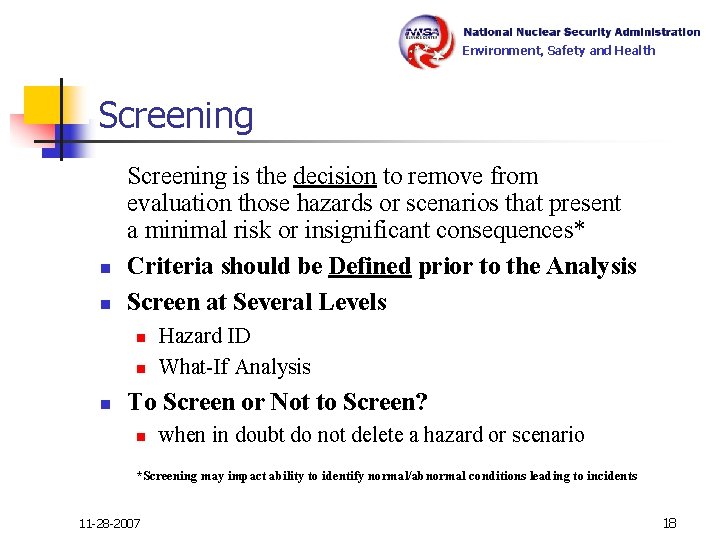
Environment, Safety and Health Screening n n Screening is the decision to remove from evaluation those hazards or scenarios that present a minimal risk or insignificant consequences* Criteria should be Defined prior to the Analysis Screen at Several Levels n n n Hazard ID What-If Analysis To Screen or Not to Screen? n when in doubt do not delete a hazard or scenario *Screening may impact ability to identify normal/abnormal conditions leading to incidents 11 -28 -2007 18
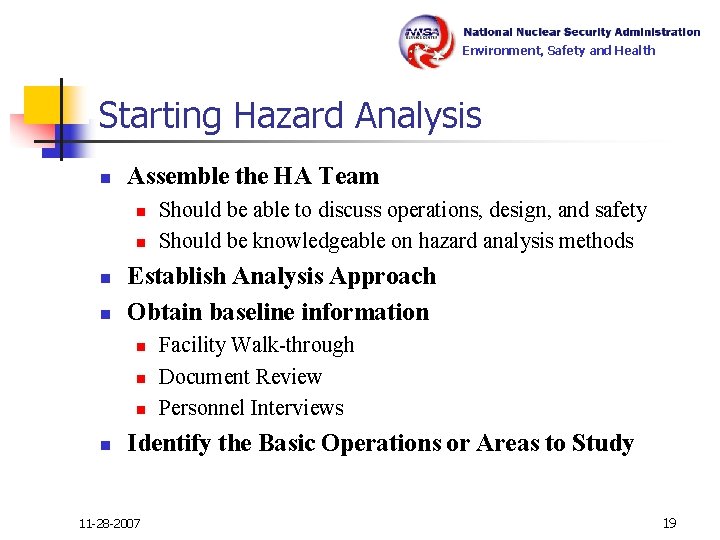
Environment, Safety and Health Starting Hazard Analysis n Assemble the HA Team n n Establish Analysis Approach Obtain baseline information n n Should be able to discuss operations, design, and safety Should be knowledgeable on hazard analysis methods Facility Walk-through Document Review Personnel Interviews Identify the Basic Operations or Areas to Study 11 -28 -2007 19
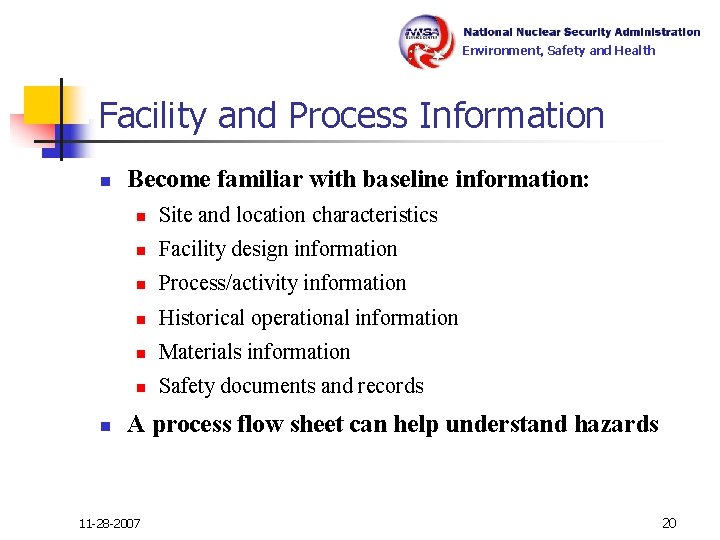
Environment, Safety and Health Facility and Process Information n n Become familiar with baseline information: n Site and location characteristics n Facility design information n Process/activity information n Historical operational information n Materials information n Safety documents and records A process flow sheet can help understand hazards 11 -28 -2007 20
Environment, Safety and Health Baseline Information Hazards are part of components and have many direct human interactions Which Technique? Hazard Identification What-If Analysis Standard Low Screened Consequence Industrial Out Hazards, etc. Scenarios, etc. Hazards are contained within a "system" with a variety of changing equipment parameters/effects 11 -28 -2007 Pr. HA Accident Analysis Hazard and Operability (HAZOP) Analysis 21
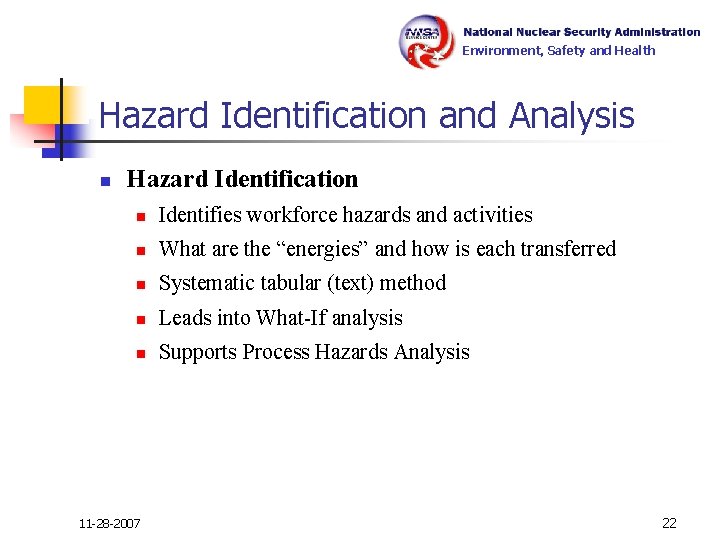
Environment, Safety and Health Hazard Identification and Analysis n Hazard Identification n Identifies workforce hazards and activities n What are the “energies” and how is each transferred n Systematic tabular (text) method n Leads into What-If analysis n Supports Process Hazards Analysis 11 -28 -2007 22
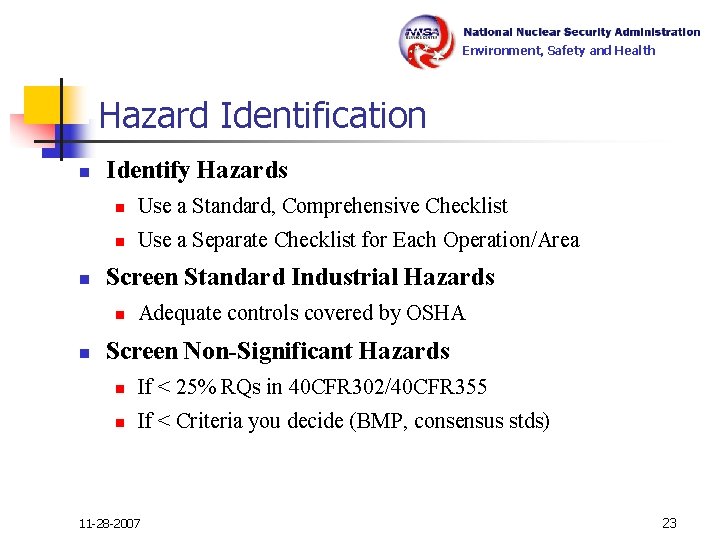
Environment, Safety and Health Hazard Identification n n Identify Hazards n Use a Standard, Comprehensive Checklist n Use a Separate Checklist for Each Operation/Area Screen Standard Industrial Hazards n n Adequate controls covered by OSHA Screen Non-Significant Hazards n If < 25% RQs in 40 CFR 302/40 CFR 355 n If < Criteria you decide (BMP, consensus stds) 11 -28 -2007 23
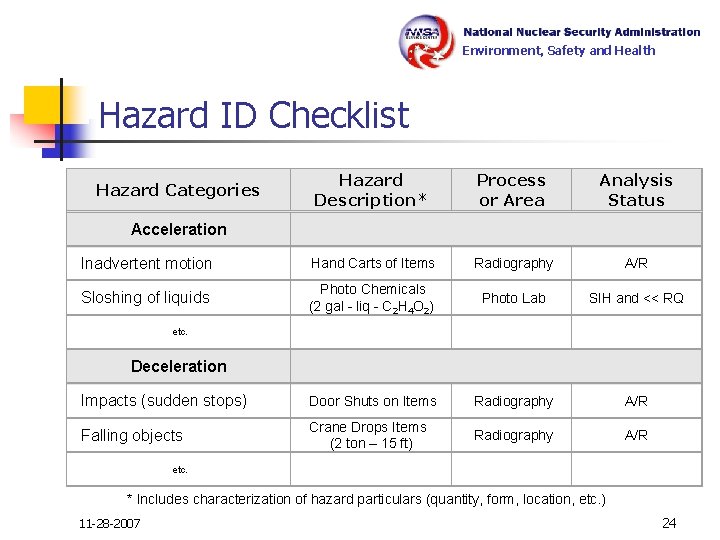
Environment, Safety and Health Hazard ID Checklist Hazard Description* Hazard Categories Process or Area Analysis Status Acceleration Inadvertent motion Hand Carts of Items Radiography A/R Sloshing of liquids Photo Chemicals (2 gal - liq - C 2 H 4 O 2) Photo Lab SIH and << RQ etc. Deceleration Impacts (sudden stops) Door Shuts on Items Radiography A/R Falling objects Crane Drops Items (2 ton – 15 ft) Radiography A/R etc. * Includes characterization of hazard particulars (quantity, form, location, etc. ) 11 -28 -2007 24
Environment, Safety and Health Hazard Identification (continued) n Hazards not Screened Out are Evaluated Further n Results can be Summarized and Tabulated n 11 -28 -2007 Allows for checking hazards that may be common to several processes or areas 25
Environment, Safety and Health Baseline Information Hazards are part of components and have many direct human interactions Which Technique? Hazard Identification What-If Analysis Standard Low Screened Consequence Industrial Out Hazards, etc. Scenarios, etc. Hazards are contained within a "system" with a variety of changing equipment parameters/effects 11 -28 -2007 Pr. HA Accident Analysis Hazard and Operability (HAZOP) Analysis 26
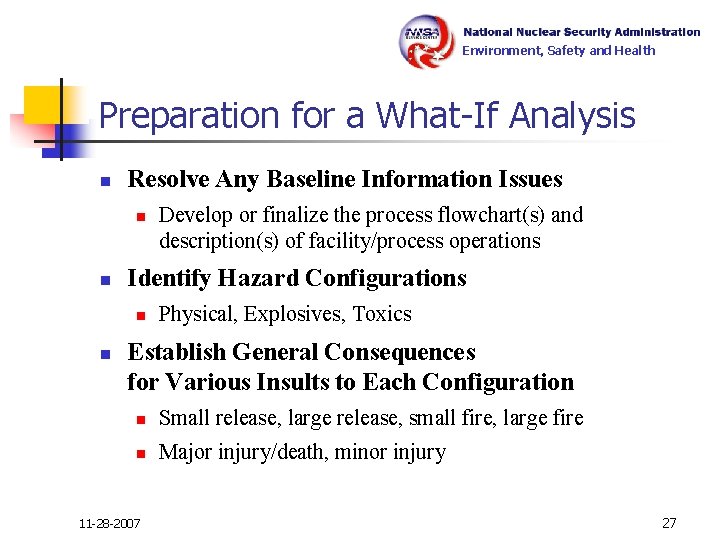
Environment, Safety and Health Preparation for a What-If Analysis n Resolve Any Baseline Information Issues n n Identify Hazard Configurations n n Develop or finalize the process flowchart(s) and description(s) of facility/process operations Physical, Explosives, Toxics Establish General Consequences for Various Insults to Each Configuration n Small release, large release, small fire, large fire n Major injury/death, minor injury 11 -28 -2007 27
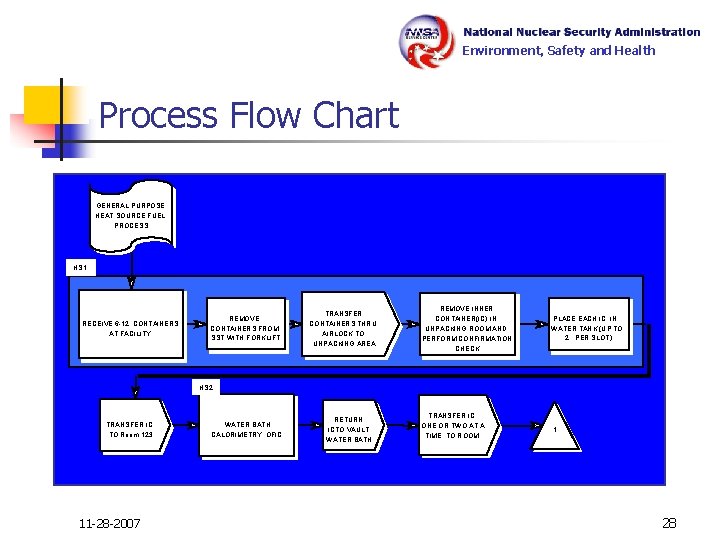
Environment, Safety and Health Process Flow Chart GENERAL PURPOSE HEAT SOURCE FUEL PROCESS HS 1 RECEIVE 6 -12 CONTAINERS AT FACILITY REMOVE CONTAINERS FROM SST WITH FORKLIFT TRANSFER CONTAINERS THRU AIRLOCK TO UNPACKING AREA REMOVE INNER CONTAINER(IC) IN UNPACKING ROOM AND PERFORM CONFIRMATION CHECK PLACE EACH IC IN WATER TANK (UP TO 2 PER SLOT) HS 2 TRANSFER IC TO Room 123 11 -28 -2007 WATER BATH CALORIMETRY OFIC RETURN ICTO VAULT WATER BATH TRANSFER IC, ONE OR TWO AT A TIME, TO ROOM 1 28
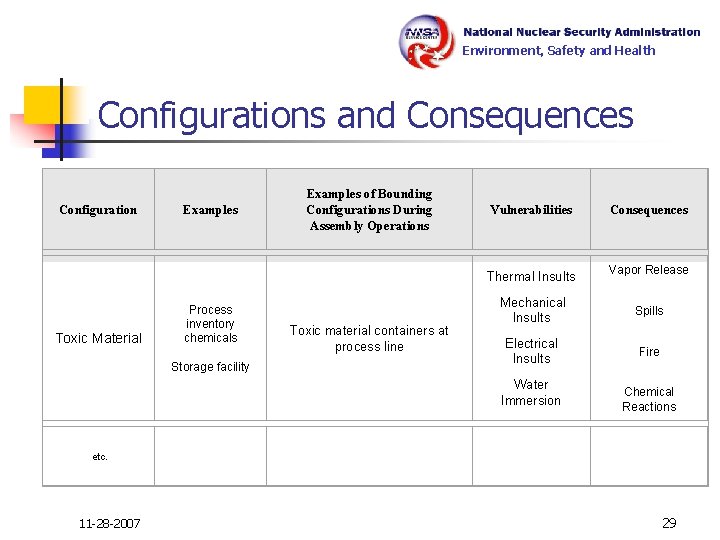
Environment, Safety and Health Configurations and Consequences Configuration Examples of Bounding Configurations During Assembly Operations Vulnerabilities Thermal Insults Toxic Material Process inventory chemicals Storage facility Toxic material containers at process line 11 -28 -2007 Vapor Release Mechanical Insults Spills Electrical Insults Fire Water Immersion etc. Consequences Chemical Reactions 29
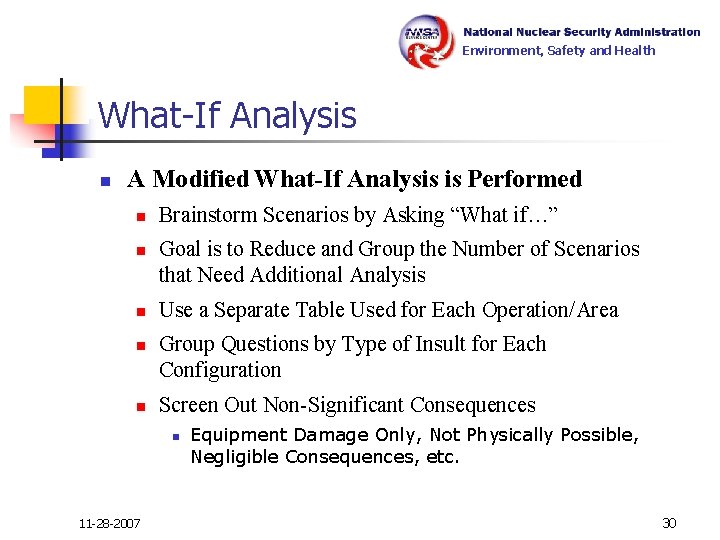
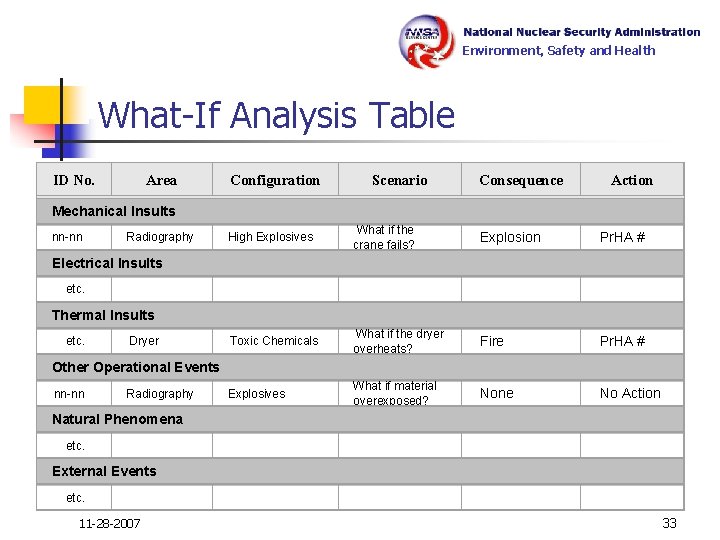
Environment, Safety and Health What-If Analysis n A Modified What-If Analysis is Performed n n n Brainstorm Scenarios by Asking “What if…” Goal is to Reduce and Group the Number of Scenarios that Need Additional Analysis Use a Separate Table Used for Each Operation/Area Group Questions by Type of Insult for Each Configuration Screen Out Non-Significant Consequences n 11 -28 -2007 Equipment Damage Only, Not Physically Possible, Negligible Consequences, etc. 30
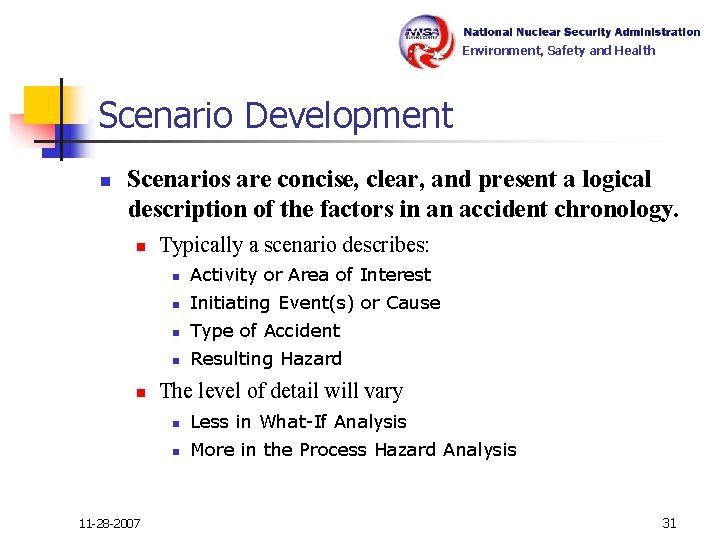
Environment, Safety and Health Scenario Development n Scenarios are concise, clear, and present a logical description of the factors in an accident chronology. n n 11 -28 -2007 Typically a scenario describes: n Activity or Area of Interest n Initiating Event(s) or Cause n Type of Accident n Resulting Hazard The level of detail will vary n Less in What-If Analysis n More in the Process Hazard Analysis 31
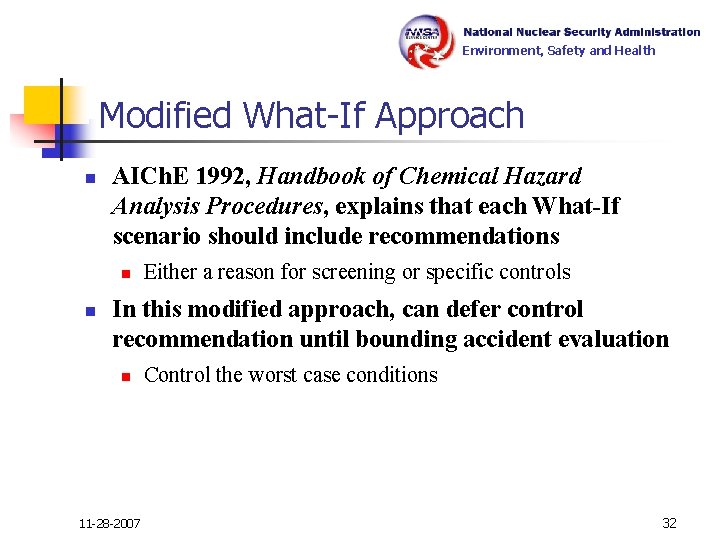
Environment, Safety and Health Modified What-If Approach n AICh. E 1992, Handbook of Chemical Hazard Analysis Procedures, explains that each What-If scenario should include recommendations n n Either a reason for screening or specific controls In this modified approach, can defer control recommendation until bounding accident evaluation n 11 -28 -2007 Control the worst case conditions 32
Environment, Safety and Health What-If Analysis Table ID No. Area Configuration Scenario Consequence Action Mechanical Insults nn-nn Radiography High Explosives What if the crane fails? Explosion Pr. HA # Fire Pr. HA # Electrical Insults etc. Thermal Insults etc. Dryer Toxic Chemicals What if the dryer overheats? Other Operational Events nn-nn Radiography Explosives What if material overexposed? None No Action Natural Phenomena etc. External Events etc. 11 -28 -2007 33
Environment, Safety and Health AICh. E What If Format 11 -28 -2007 34
Environment, Safety and Health Baseline Information Hazards are part of components and have many direct human interactions Which Technique? Hazard Identification What-If Analysis Standard Low Screened Consequence Industrial Out Hazards, etc. Scenarios, etc. Hazards are contained within a "system" with a variety of changing equipment parameters/effects 11 -28 -2007 Pr. HA Accident Analysis Hazard and Operability (HAZOP) Analysis 35
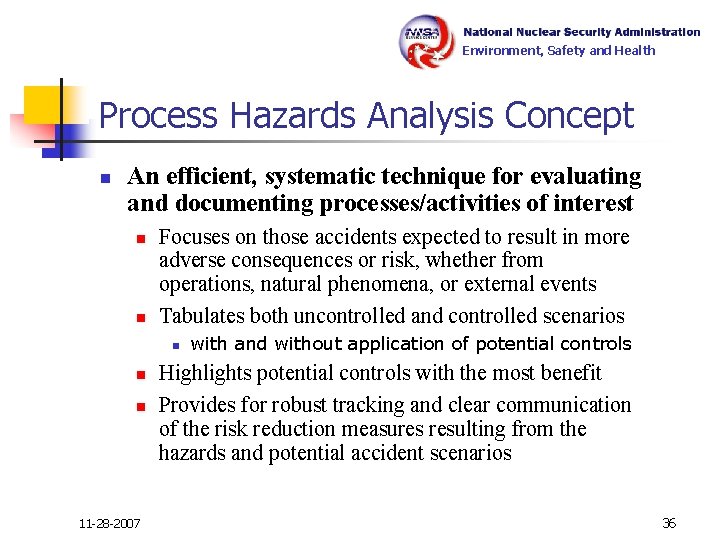
Environment, Safety and Health Process Hazards Analysis Concept n An efficient, systematic technique for evaluating and documenting processes/activities of interest n n Focuses on those accidents expected to result in more adverse consequences or risk, whether from operations, natural phenomena, or external events Tabulates both uncontrolled and controlled scenarios n n n 11 -28 -2007 with and without application of potential controls Highlights potential controls with the most benefit Provides for robust tracking and clear communication of the risk reduction measures resulting from the hazards and potential accident scenarios 36
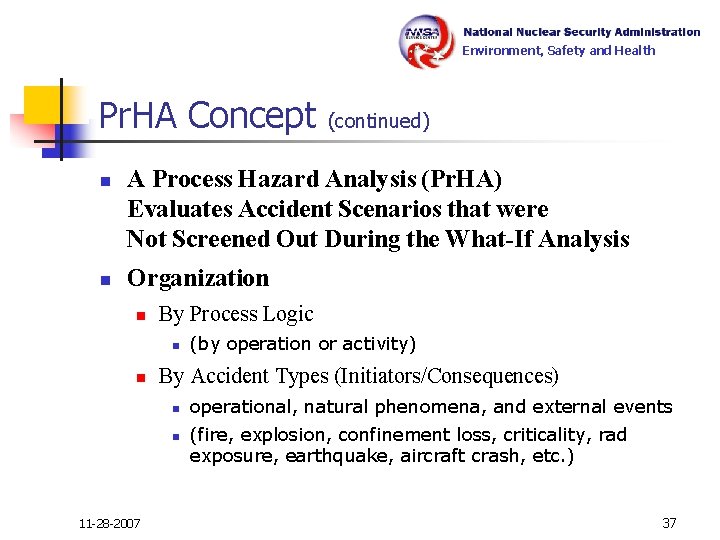
Environment, Safety and Health Pr. HA Concept n n (continued) A Process Hazard Analysis (Pr. HA) Evaluates Accident Scenarios that were Not Screened Out During the What-If Analysis Organization n By Process Logic n n By Accident Types (Initiators/Consequences) n n 11 -28 -2007 (by operation or activity) operational, natural phenomena, and external events (fire, explosion, confinement loss, criticality, rad exposure, earthquake, aircraft crash, etc. ) 37
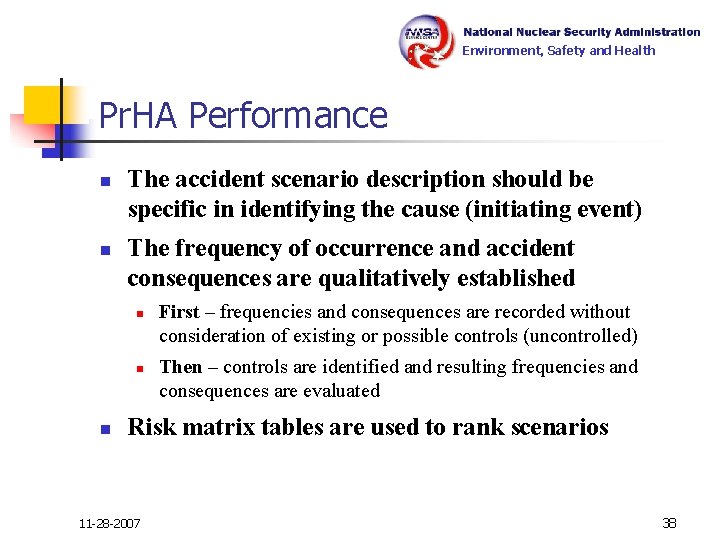
Environment, Safety and Health Pr. HA Performance n n The accident scenario description should be specific in identifying the cause (initiating event) The frequency of occurrence and accident consequences are qualitatively established n n n First – frequencies and consequences are recorded without consideration of existing or possible controls (uncontrolled) Then – controls are identified and resulting frequencies and consequences are evaluated Risk matrix tables are used to rank scenarios 11 -28 -2007 38
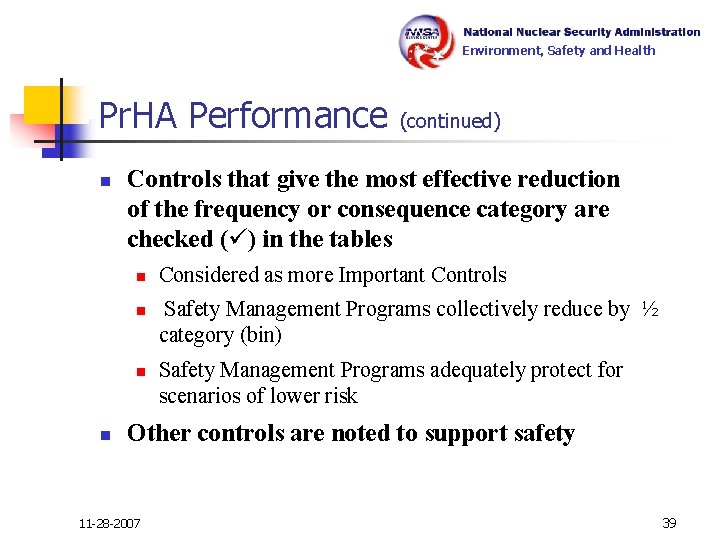
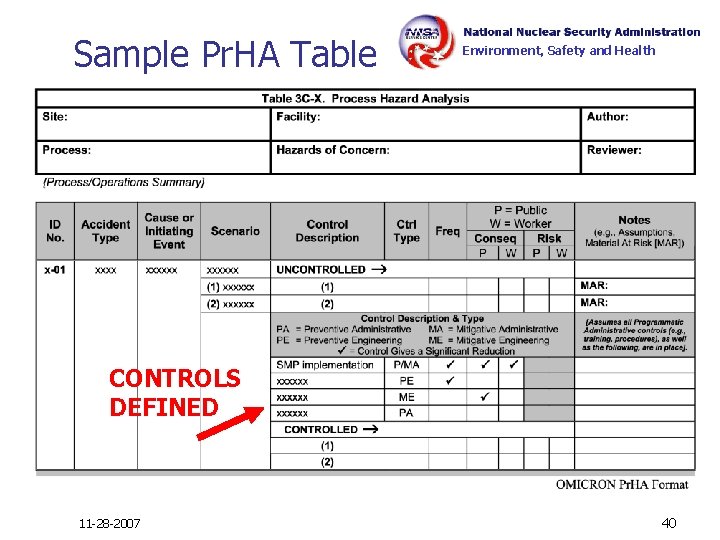
Environment, Safety and Health Pr. HA Performance n Controls that give the most effective reduction of the frequency or consequence category are checked ( ) in the tables n n (continued) Considered as more Important Controls Safety Management Programs collectively reduce by ½ category (bin) Safety Management Programs adequately protect for scenarios of lower risk Other controls are noted to support safety 11 -28 -2007 39
Sample Pr. HA Table Environment, Safety and Health CONTROLS DEFINED 11 -28 -2007 40
Environment, Safety and Health Baseline Information Hazards are part of components and have many direct human interactions Which Technique? Hazard Identification What-If Analysis Standard Low Screened Consequence Industrial Out Hazards, etc. Scenarios, etc. Hazards are contained within a "system" with a variety of changing equipment parameters/effects 11 -28 -2007 Pr. HA Accident Analysis Hazard and Operability (HAZOP) Analysis 41
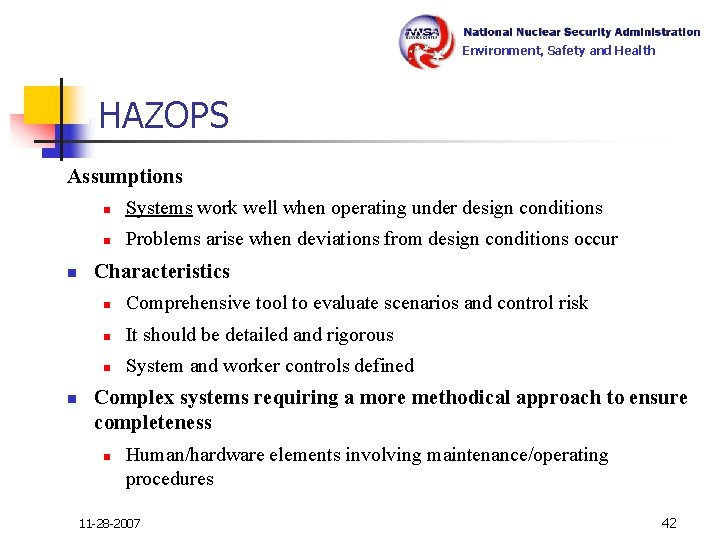
Environment, Safety and Health HAZOPS Assumptions n Systems work well when operating under design conditions n Problems arise when deviations from design conditions occur n n Characteristics n Comprehensive tool to evaluate scenarios and control risk n It should be detailed and rigorous n System and worker controls defined Complex systems requiring a more methodical approach to ensure completeness n Human/hardware elements involving maintenance/operating procedures 11 -28 -2007 42
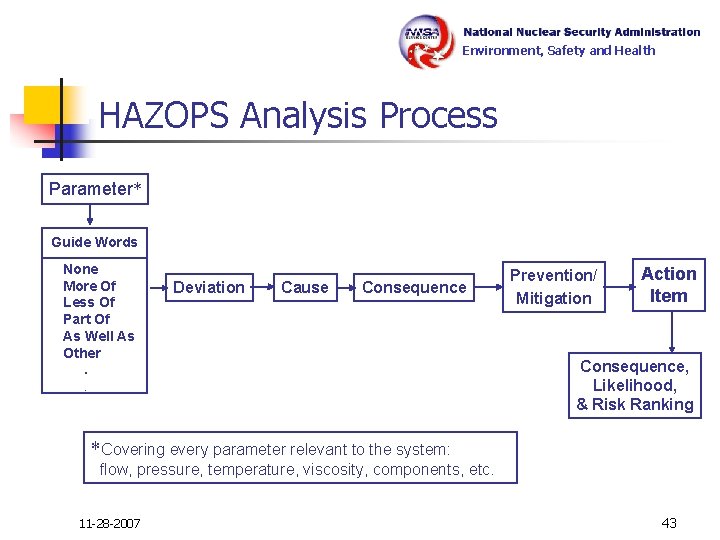
Environment, Safety and Health HAZOPS Analysis Process Parameter* Guide Words None More Of Less Of Part Of As Well As Other. . Deviation Cause Consequence Prevention/ Mitigation Action Item Consequence, Likelihood, & Risk Ranking *Covering every parameter relevant to the system: flow, pressure, temperature, viscosity, components, etc. 11 -28 -2007 43
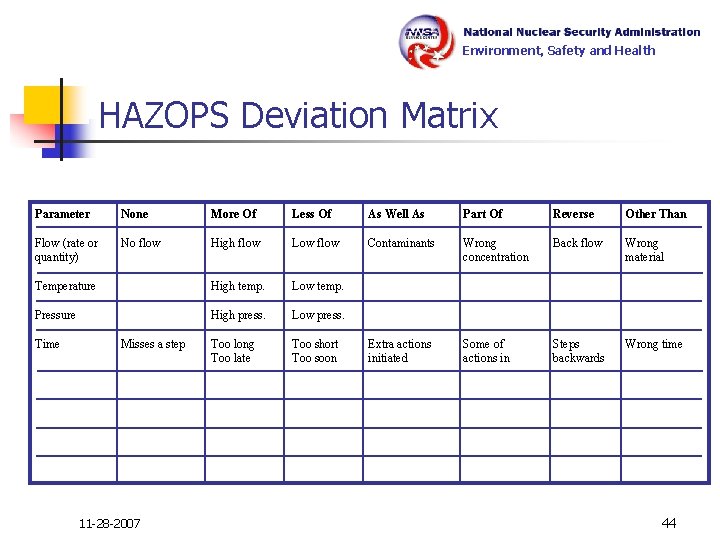
Environment, Safety and Health HAZOPS Deviation Matrix Parameter None More Of Less Of As Well As Part Of Reverse Other Than Flow (rate or quantity) No flow High flow Low flow Contaminants Wrong concentration Back flow Wrong material Temperature High temp. Low temp. Pressure High press. Low press. Too long Too late Too short Too soon Extra actions initiated Some of actions in Steps backwards Wrong time Time Misses a step 11 -28 -2007 44
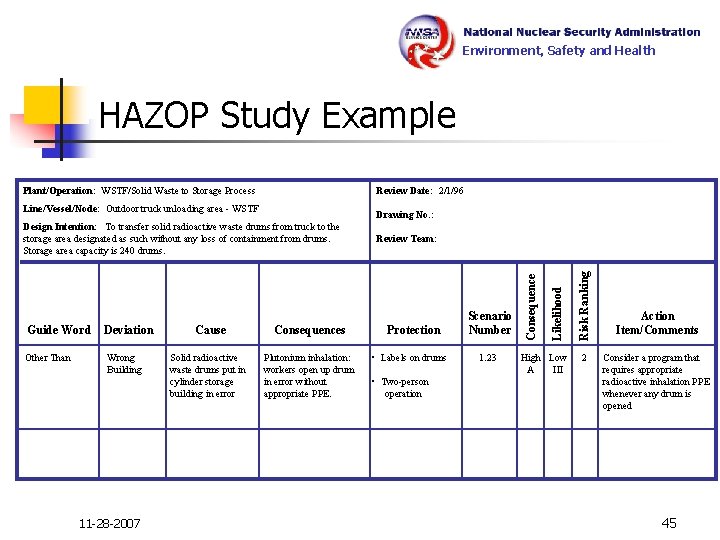
Environment, Safety and Health HAZOP Study Example Plant/Operation: WSTF/Solid Waste to Storage Process Review Date: 2/1/96 Line/Vessel/Node: Outdoor truck unloading area - WSTF Drawing No. : Other Than Wrong Building 11 -28 -2007 Cause Consequences Solid radioactive waste drums put in cylinder storage building in error Plutonium inhalation: workers open up drum in error without appropriate PPE. Protection • Labels on drums • Two-person operation 1. 23 High Low A III Risk Ranking Deviation Scenario Number Likelihood Guide Word Review Team: Consequence Design Intention: To transfer solid radioactive waste drums from truck to the storage area designated as such without any loss of containment from drums. Storage area capacity is 240 drums. 2 Action Item/Comments Consider a program that requires appropriate radioactive inhalation PPE whenever any drum is opened 45
Environment, Safety and Health Baseline Information Hazards are part of components and have many direct human interactions Which Technique? Hazard Identification What-If Analysis Standard Low Screened Consequence Industrial Out Hazards, etc. Scenarios, etc. Hazards are contained within a "system" with a variety of changing equipment parameters/effects 11 -28 -2007 Pr. HA Accident Analysis Hazard and Operability (HAZOP) Analysis 46
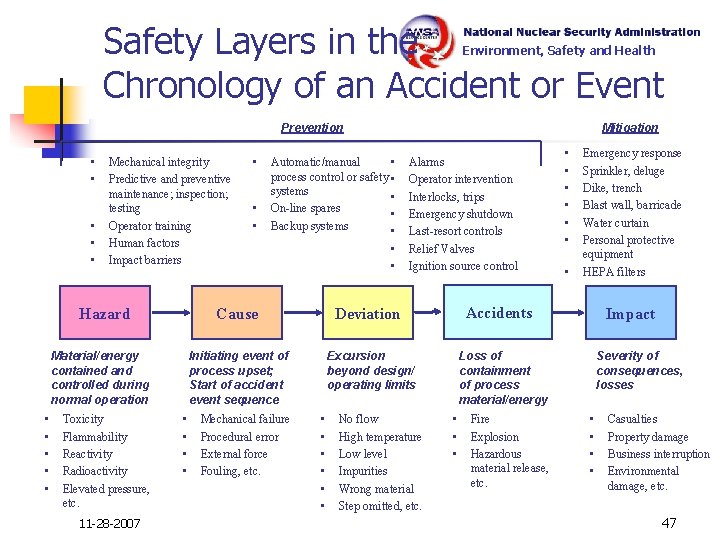
Safety Layers in the Chronology of an Accident or Event Environment, Safety and Health Prevention • • • Mechanical integrity Predictive and preventive maintenance; inspection; testing Operator training Human factors Impact barriers Hazard Material/energy contained and controlled during normal operation • • • Toxicity Flammability Reactivity Radioactivity Elevated pressure, etc. 11 -28 -2007 • • Automatic/manual • process control or safety • systems • On-line spares • Backup systems • • • Mitigation Alarms Operator intervention Interlocks, trips Emergency shutdown Last-resort controls Relief Valves Ignition source control Cause Deviation Initiating event of process upset; Start of accident event sequence Excursion beyond design/ operating limits Mechanical failure Procedural error External force Fouling, etc. • • • No flow High temperature Low level Impurities Wrong material Step omitted, etc. • • Emergency response Sprinkler, deluge Dike, trench Blast wall, barricade Water curtain Personal protective equipment HEPA filters Accidents Impact Severity of consequences, losses Loss of containment of process material/energy • • • Fire Explosion Hazardous material release, etc. • • Casualties Property damage Business interruption Environmental damage, etc. 47
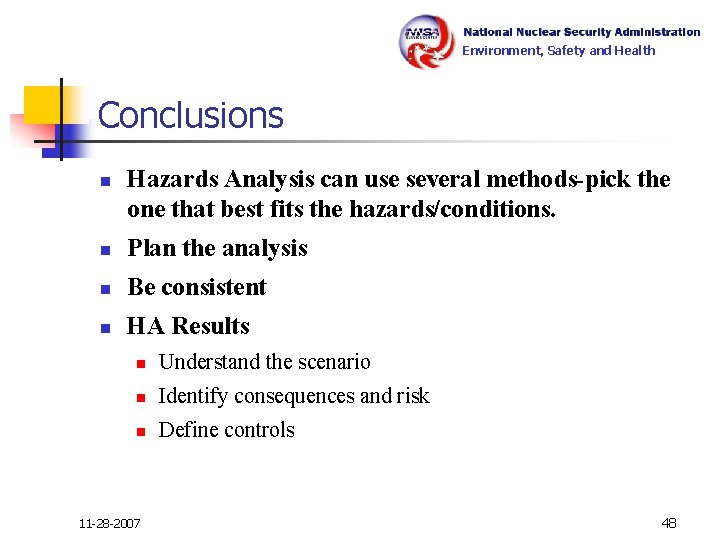
Environment, Safety and Health Conclusions n Hazards Analysis can use several methods-pick the one that best fits the hazards/conditions. n Plan the analysis n Be consistent n HA Results n Understand the scenario n Identify consequences and risk n Define controls 11 -28 -2007 48