
ENVIRONMENT FACTORS SUN LIGHT Contents Solar Radiation The
- Slides: 60
ENVIRONMENT FACTORS SUN LIGHT
Contents Solar Radiation The Atmosphere as Filter and Reflector The Ecological Significance of Light on Earth Characteristics of Visible Light Exposure Determinant of Variations in the Light Environment Other Forms of Response to Light Managing The Light Environment in Agroecosystem
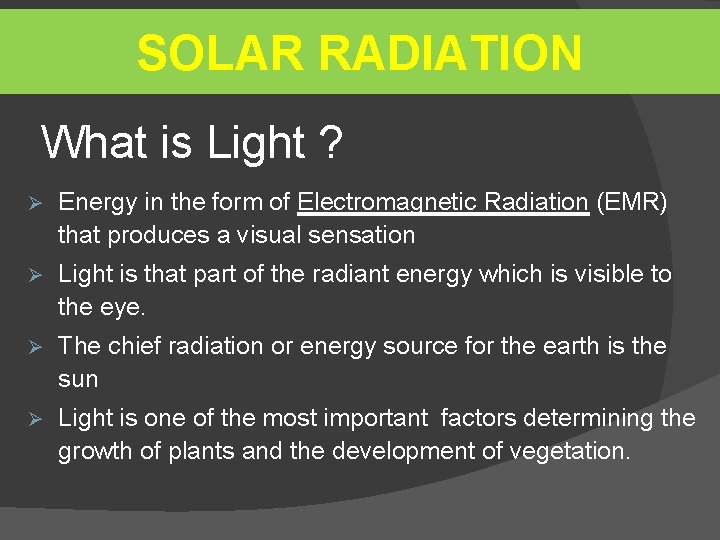
SOLAR RADIATION What is Light ? Ø Energy in the form of Electromagnetic Radiation (EMR) that produces a visual sensation Ø Light is that part of the radiant energy which is visible to the eye. Ø The chief radiation or energy source for the earth is the sun Ø Light is one of the most important factors determining the growth of plants and the development of vegetation.
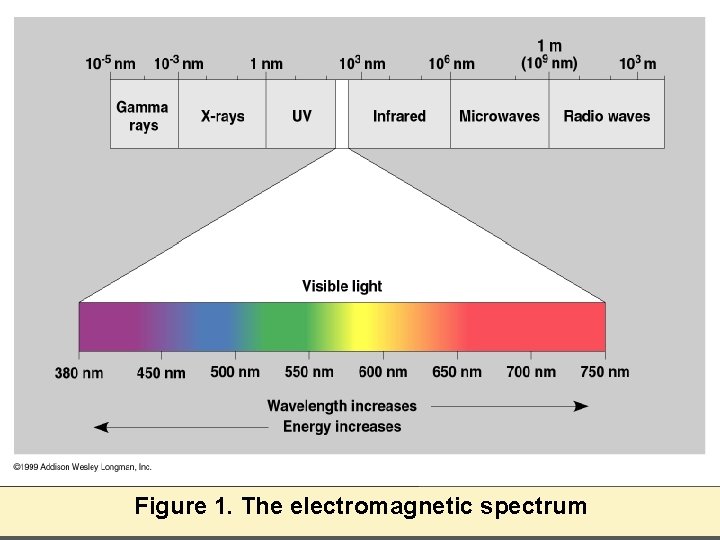
Figure 1. The electromagnetic spectrum
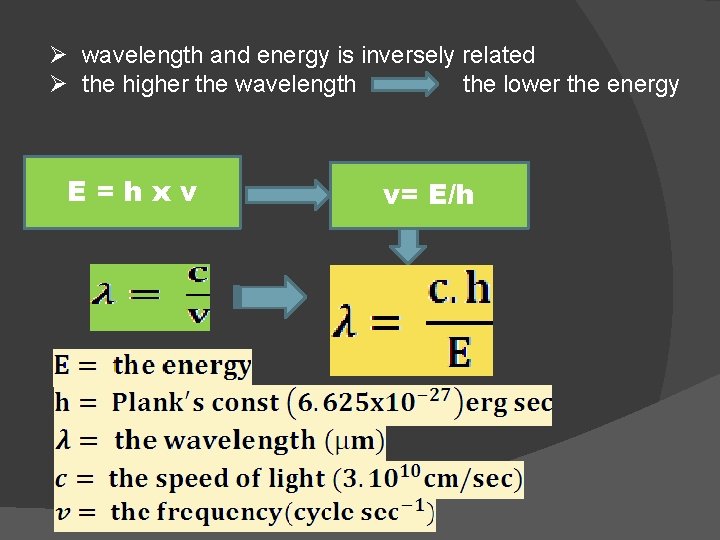
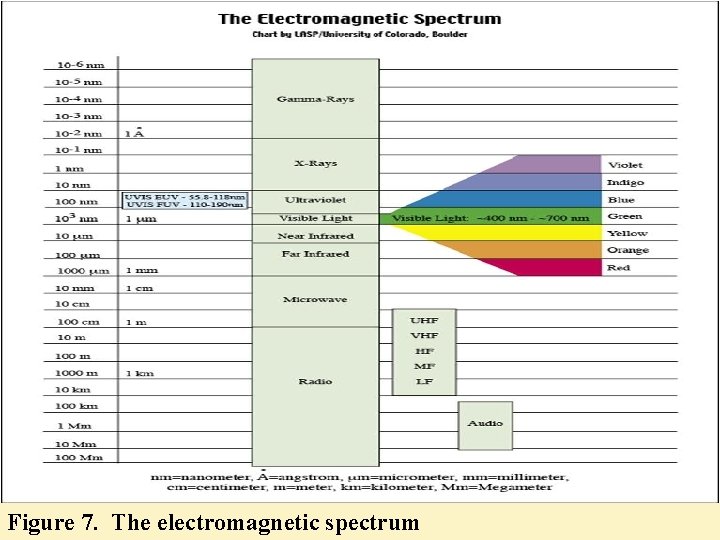
Ø wavelength and energy is inversely related Ø the higher the wavelength the lower the energy E=hxv v= E/h
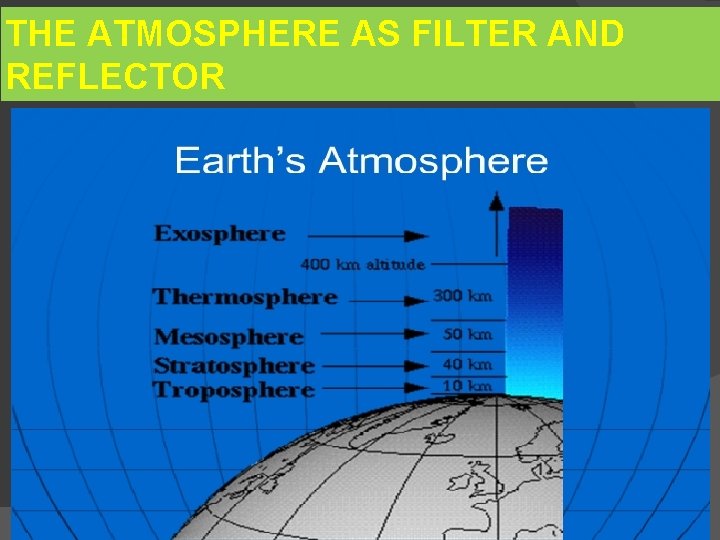
THE ATMOSPHERE AS FILTER AND REFLECTOR
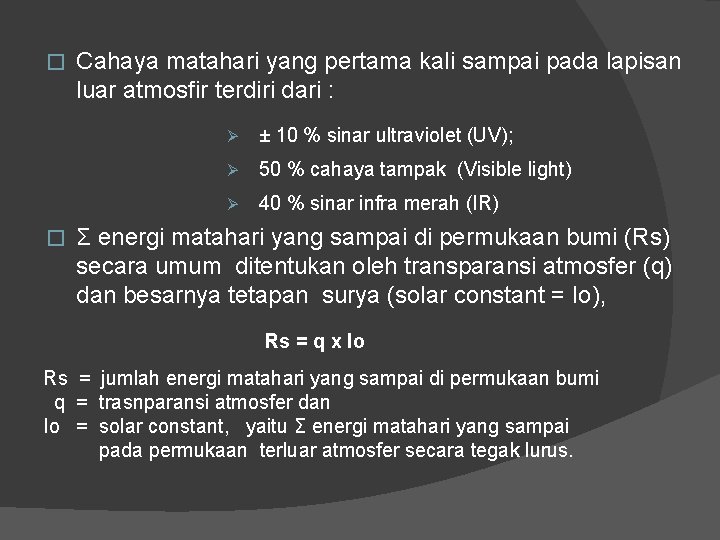
� � Cahaya matahari yang pertama kali sampai pada lapisan luar atmosfir terdiri dari : Ø ± 10 % sinar ultraviolet (UV); Ø 50 % cahaya tampak (Visible light) Ø 40 % sinar infra merah (IR) Σ energi matahari yang sampai di permukaan bumi (Rs) secara umum ditentukan oleh transparansi atmosfer (q) dan besarnya tetapan surya (solar constant = Io), Rs = q x Io Rs = jumlah energi matahari yang sampai di permukaan bumi q = trasnparansi atmosfer dan Io = solar constant, yaitu Σ energi matahari yang sampai pada permukaan terluar atmosfer secara tegak lurus.
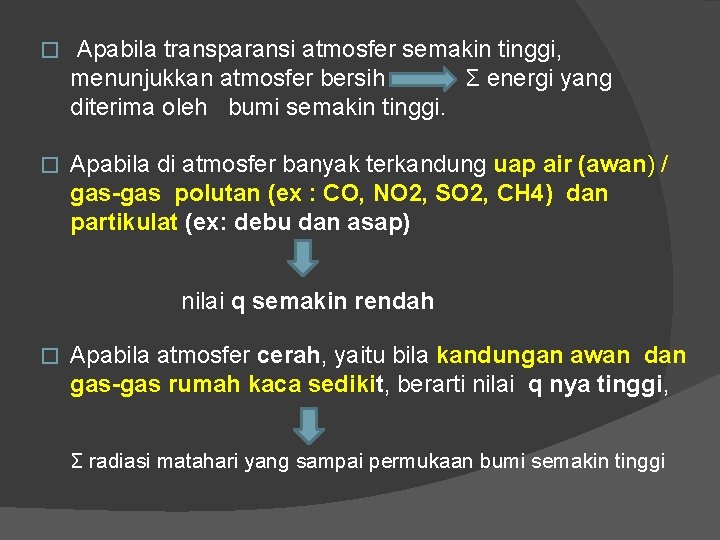
� Apabila transparansi atmosfer semakin tinggi, menunjukkan atmosfer bersih Σ energi yang diterima oleh bumi semakin tinggi. � Apabila di atmosfer banyak terkandung uap air (awan) / gas-gas polutan (ex : CO, NO 2, SO 2, CH 4) dan partikulat (ex: debu dan asap) nilai q semakin rendah � Apabila atmosfer cerah, yaitu bila kandungan awan dan gas-gas rumah kaca sedikit, berarti nilai q nya tinggi, Σ radiasi matahari yang sampai permukaan bumi semakin tinggi
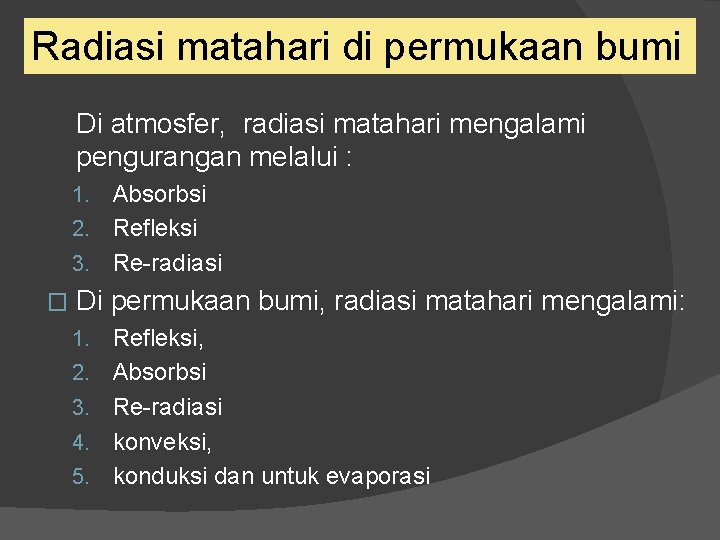
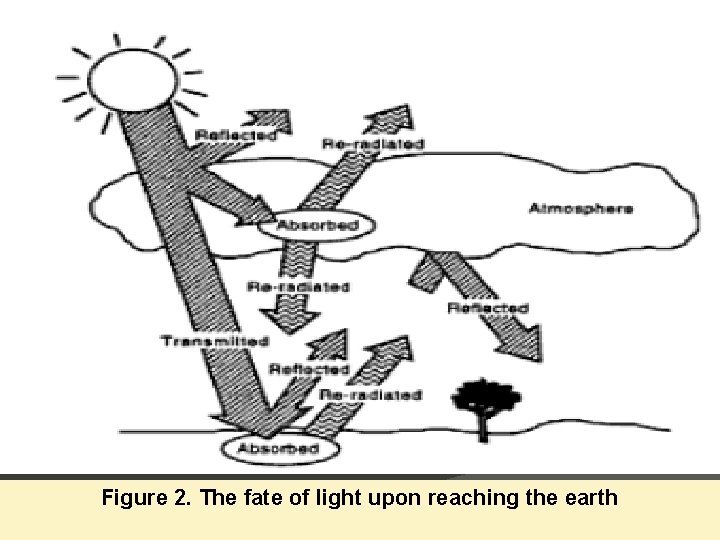
Radiasi matahari di permukaan bumi Di atmosfer, radiasi matahari mengalami pengurangan melalui : 1. Absorbsi 2. Refleksi 3. Re-radiasi � Di permukaan bumi, radiasi matahari mengalami: 1. Refleksi, 2. Absorbsi 3. Re-radiasi 4. konveksi, 5. konduksi dan untuk evaporasi
Figure 2. The fate of light upon reaching the earth
THE ECOLOGICAL SIGNIFICANCE OF LIGHT ON EARTH Ultraviolet Light B. Photo synthetically Active Radiation (PAR) C. Infrared Light A.
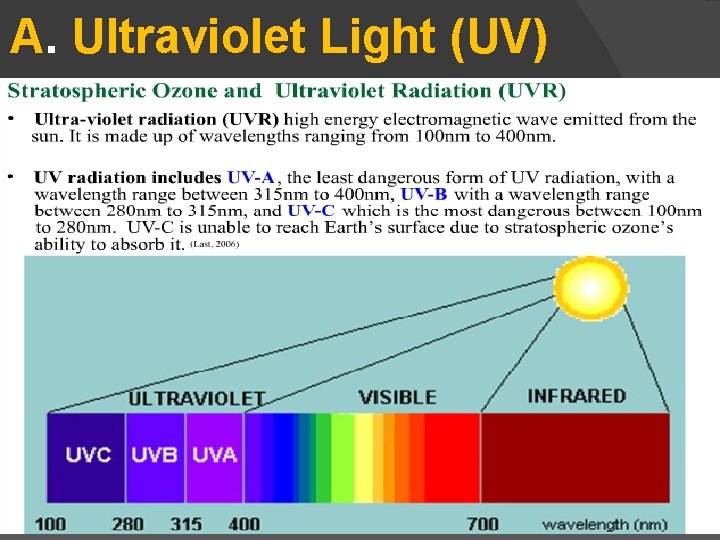
A. Ultraviolet Light (UV)
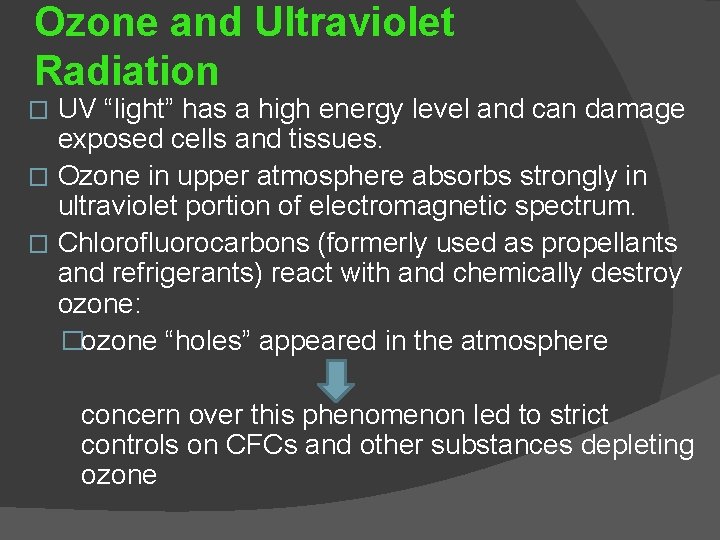
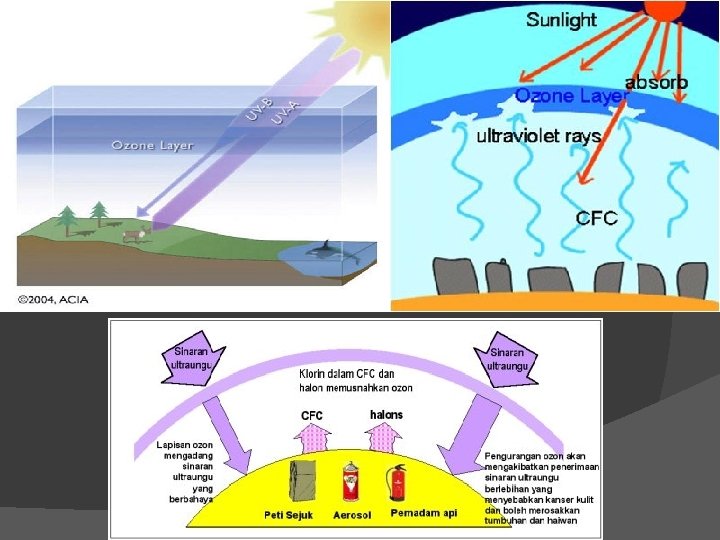
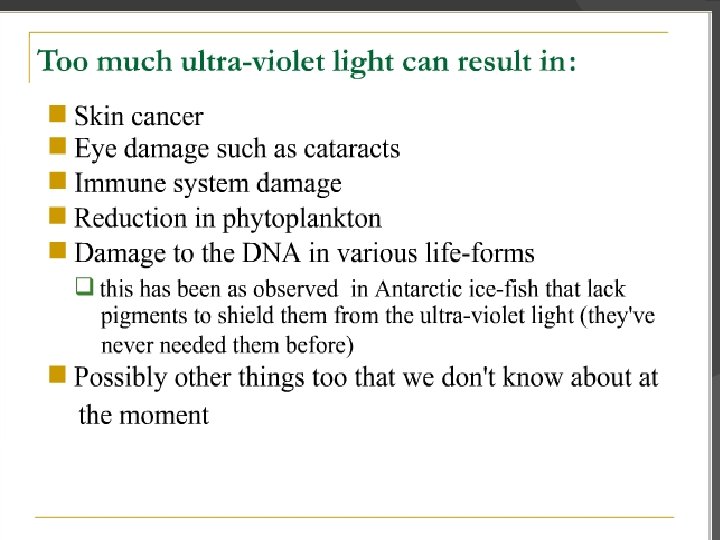
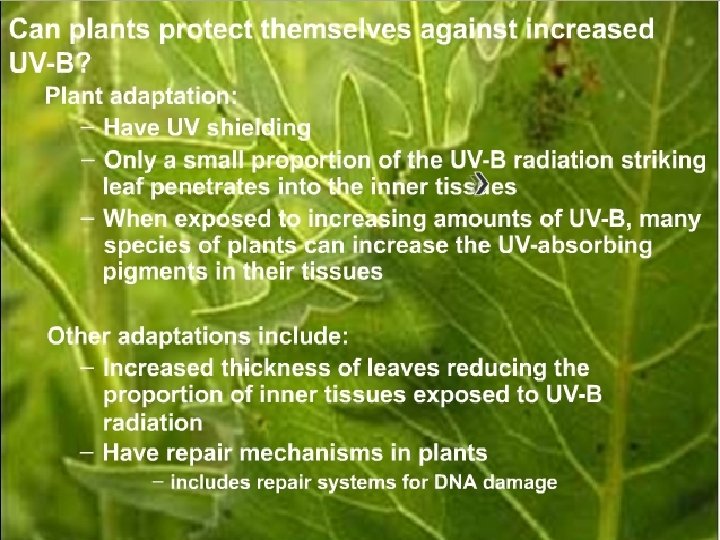
Ozone and Ultraviolet Radiation UV “light” has a high energy level and can damage exposed cells and tissues. � Ozone in upper atmosphere absorbs strongly in ultraviolet portion of electromagnetic spectrum. � Chlorofluorocarbons (formerly used as propellants and refrigerants) react with and chemically destroy ozone: �ozone “holes” appeared in the atmosphere � concern over this phenomenon led to strict controls on CFCs and other substances depleting ozone
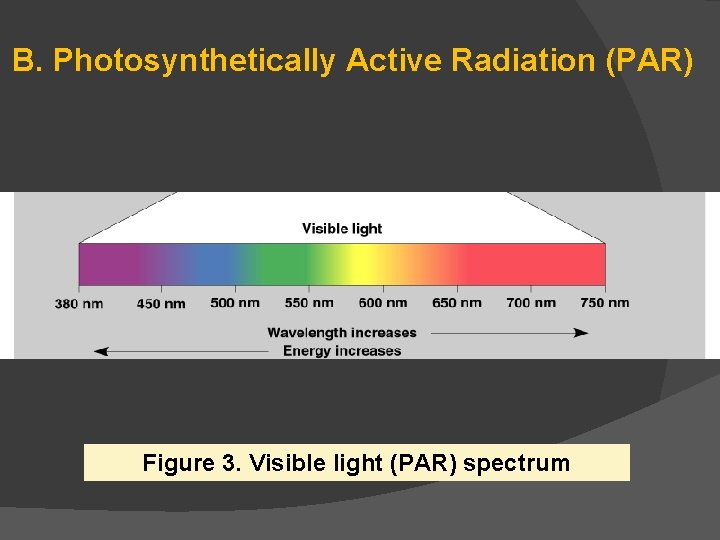
B. Photosynthetically Active Radiation (PAR) Figure 3. Visible light (PAR) spectrum
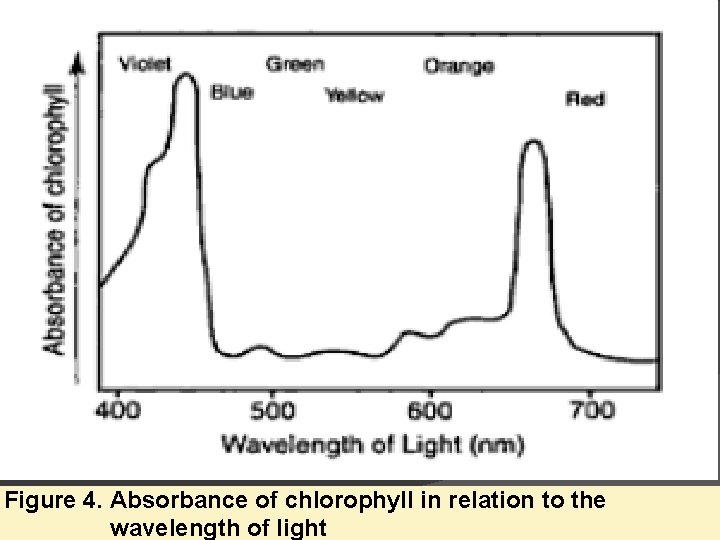
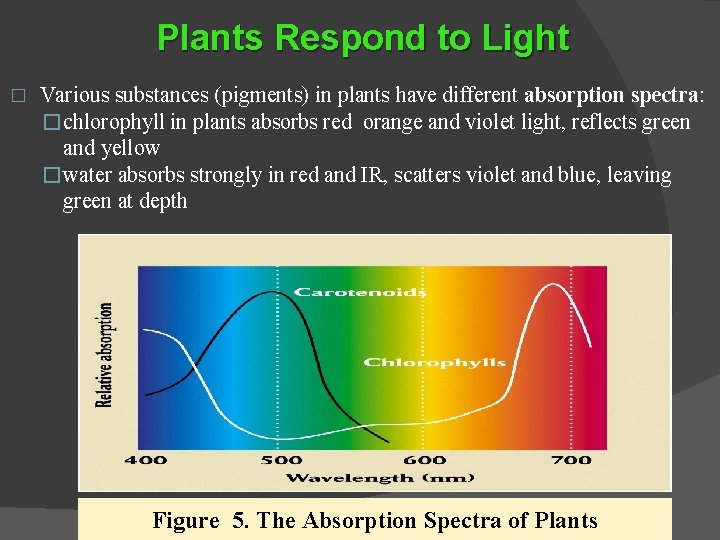
Photosynthetically Active Radiation (PAR) � The photoreceptors in chlorophyll are most absorptive of violet-blue and orange -red light � Since chlorophyll cannot absorb green light very well, most of it is reflected back, making plants appear green
Figure 4. Absorbance of chlorophyll in relation to the wavelength of light
Plants Respond to Light � Various substances (pigments) in plants have different absorption spectra: � chlorophyll in plants absorbs red orange and violet light, reflects green and yellow � water absorbs strongly in red and IR, scatters violet and blue, leaving green at depth Figure 5. The Absorption Spectra of Plants
C. Infrared Light (IR) � Infrared light energy with a wavelength from 800 nm to 3000 nm, � IR has an important role in influencing the hormones involved in germination, plant’s responses to changes to day length and other plant processes.
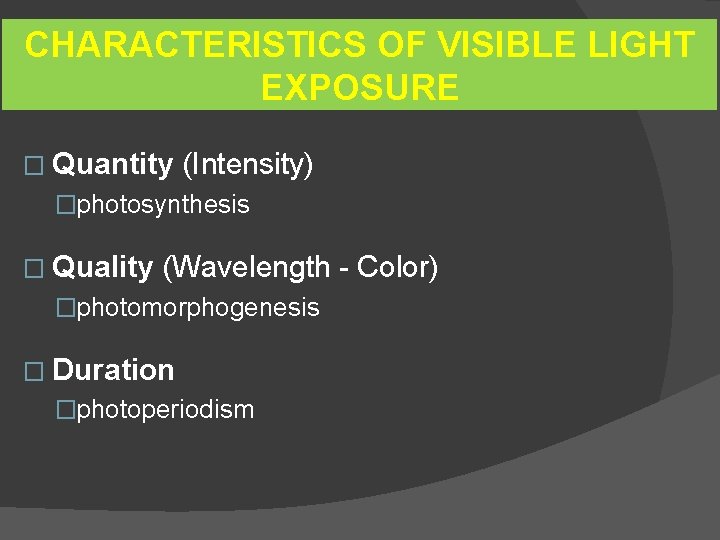
CHARACTERISTICS OF VISIBLE LIGHT EXPOSURE � Quantity (Intensity) �photosynthesis � Quality (Wavelength - Color) �photomorphogenesis � Duration �photoperiodism
Light Intensity The total energy content of all the light in the PAR range that reaches a leaf surface Ø Energy units: Calories cm-2, Joule second-1, Lux or Watt. m-2 Ø Ø Intensity provides energy for photosynthesis The rate of photosynthesis is affected by the availability of water, CO 2 and sunlight.
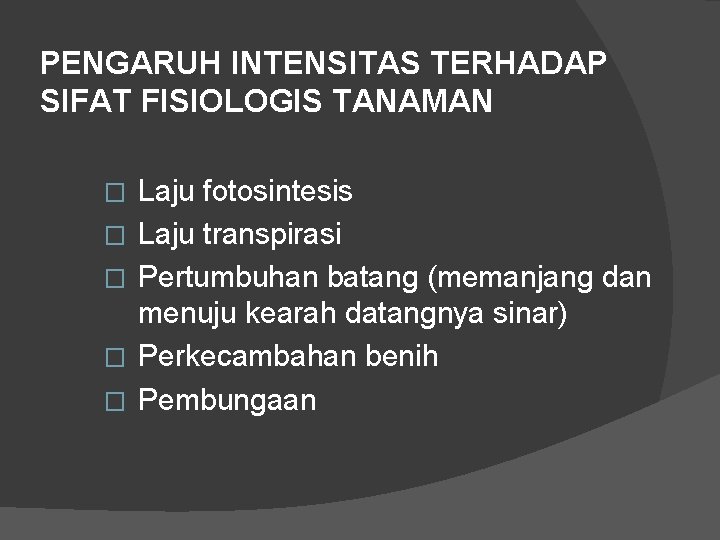
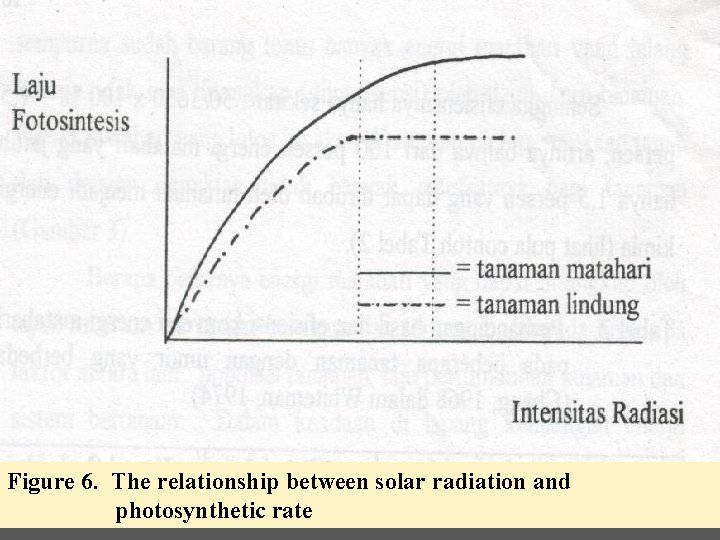
PENGARUH INTENSITAS TERHADAP SIFAT FISIOLOGIS TANAMAN � � � Laju fotosintesis Laju transpirasi Pertumbuhan batang (memanjang dan menuju kearah datangnya sinar) Perkecambahan benih Pembungaan
Figure 6. The relationship between solar radiation and photosynthetic rate
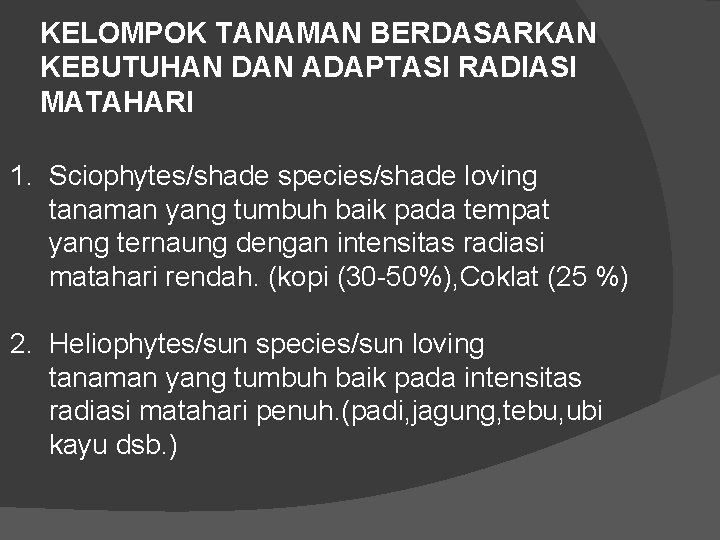
KELOMPOK TANAMAN BERDASARKAN KEBUTUHAN DAN ADAPTASI RADIASI MATAHARI 1. Sciophytes/shade species/shade loving tanaman yang tumbuh baik pada tempat yang ternaung dengan intensitas radiasi matahari rendah. (kopi (30 -50%), Coklat (25 %) 2. Heliophytes/sun species/sun loving tanaman yang tumbuh baik pada intensitas radiasi matahari penuh. (padi, jagung, tebu, ubi kayu dsb. )
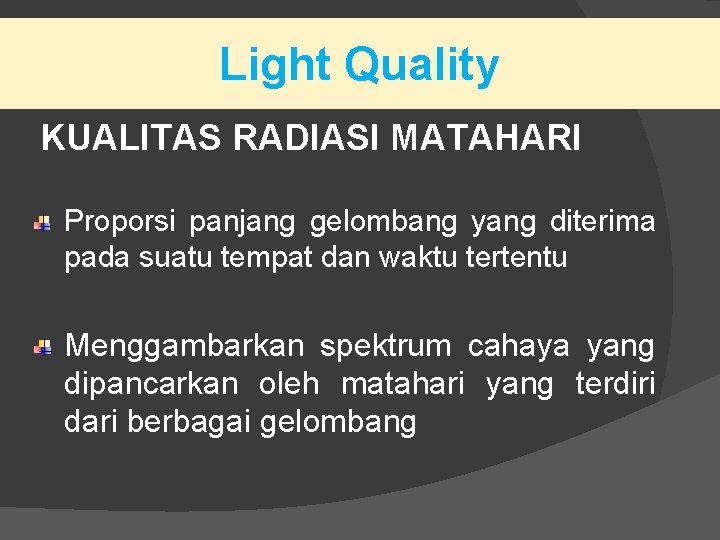
Light Quality KUALITAS RADIASI MATAHARI Proporsi panjang gelombang yang diterima pada suatu tempat dan waktu tertentu Menggambarkan spektrum cahaya yang dipancarkan oleh matahari yang terdiri dari berbagai gelombang
Figure 7. The electromagnetic spectrum
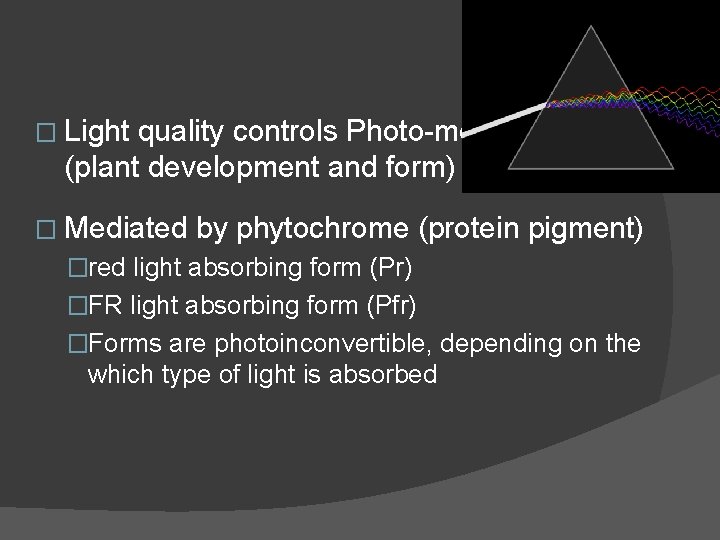
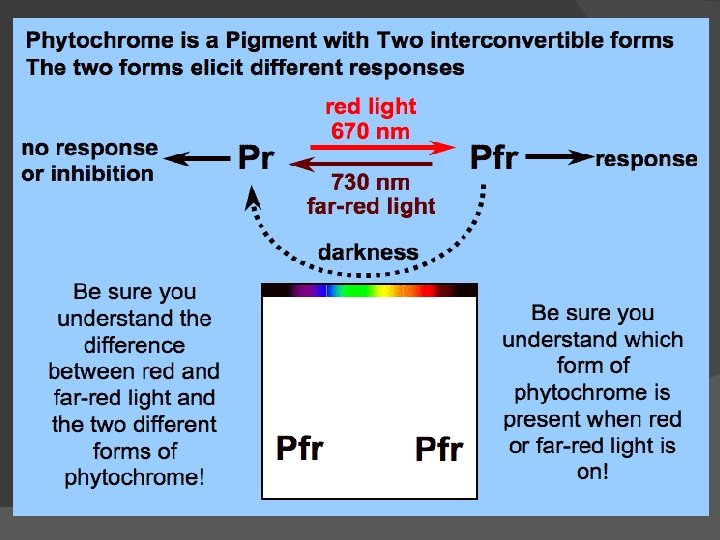
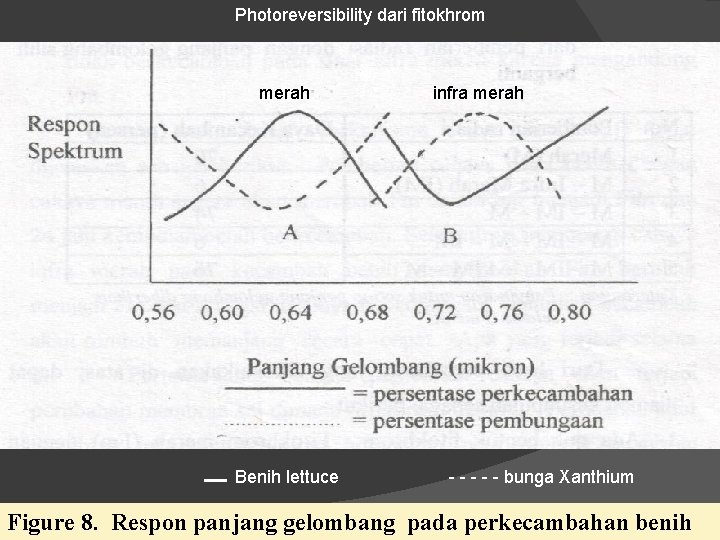
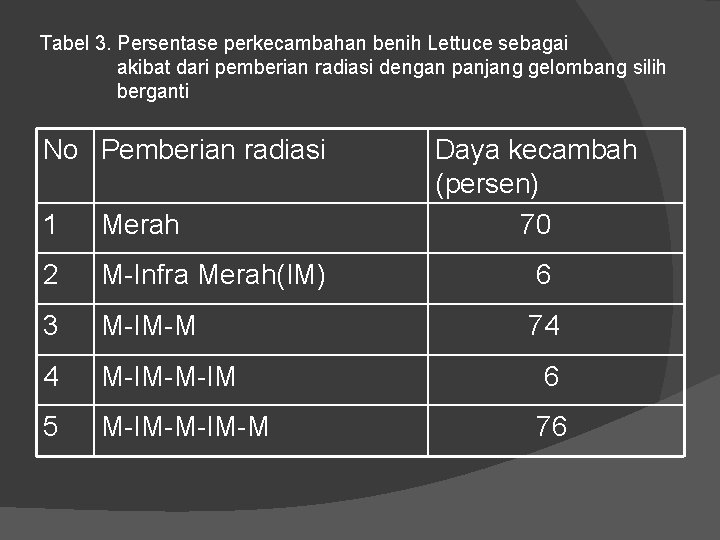
� Light quality controls Photo-morphogenesis (plant development and form) � Mediated by phytochrome (protein pigment) �red light absorbing form (Pr) �FR light absorbing form (Pfr) �Forms are photoinconvertible, depending on the which type of light is absorbed
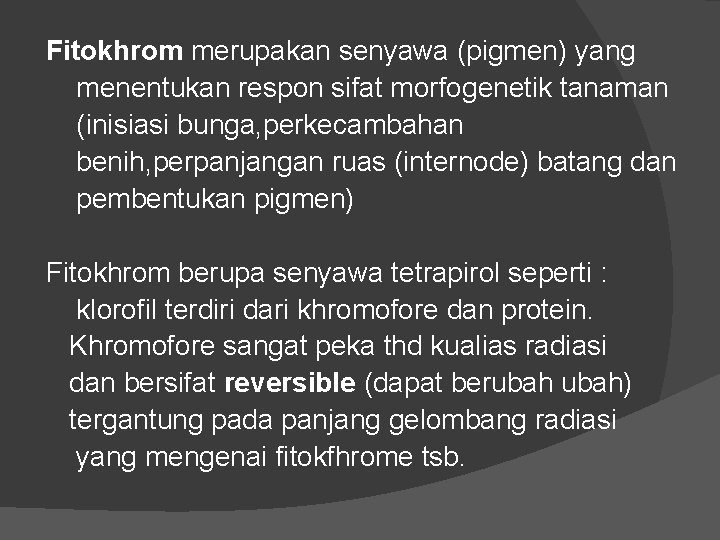
Fitokhrom merupakan senyawa (pigmen) yang menentukan respon sifat morfogenetik tanaman (inisiasi bunga, perkecambahan benih, perpanjangan ruas (internode) batang dan pembentukan pigmen) Fitokhrom berupa senyawa tetrapirol seperti : klorofil terdiri dari khromofore dan protein. Khromofore sangat peka thd kualias radiasi dan bersifat reversible (dapat berubah) tergantung pada panjang gelombang radiasi yang mengenai fitokfhrome tsb.
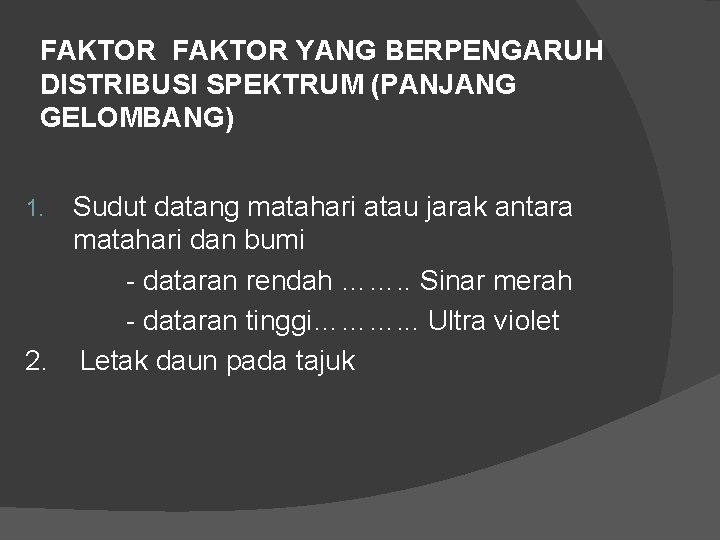
FAKTOR YANG BERPENGARUH DISTRIBUSI SPEKTRUM (PANJANG GELOMBANG) Sudut datang matahari atau jarak antara matahari dan bumi - dataran rendah ……. . Sinar merah - dataran tinggi………. . . Ultra violet 2. Letak daun pada tajuk 1.
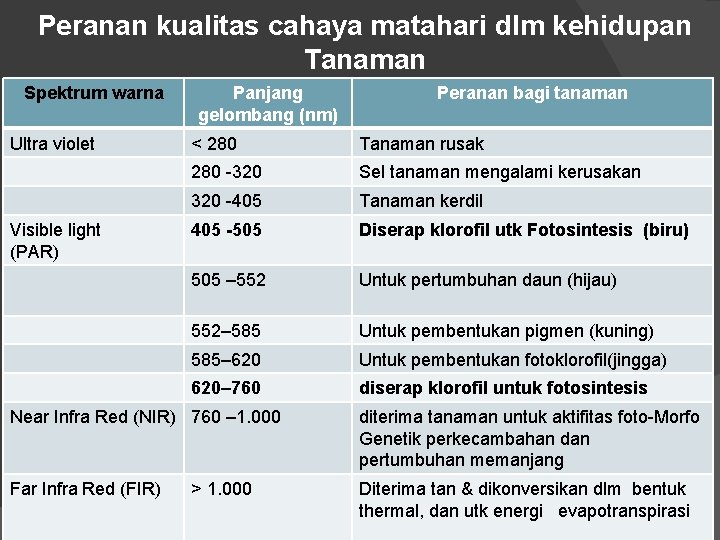
Peranan kualitas cahaya matahari dlm kehidupan Tanaman Spektrum warna Ultra violet Visible light (PAR) Panjang gelombang (nm) Peranan bagi tanaman < 280 Tanaman rusak 280 -320 Sel tanaman mengalami kerusakan 320 -405 Tanaman kerdil 405 -505 Diserap klorofil utk Fotosintesis (biru) 505 – 552 Untuk pertumbuhan daun (hijau) 552– 585 Untuk pembentukan pigmen (kuning) 585– 620 Untuk pembentukan fotoklorofil(jingga) 620– 760 diserap klorofil untuk fotosintesis Near Infra Red (NIR) 760 – 1. 000 diterima tanaman untuk aktifitas foto-Morfo Genetik perkecambahan dan pertumbuhan memanjang Far Infra Red (FIR) Diterima tan & dikonversikan dlm bentuk thermal, dan utk energi evapotranspirasi > 1. 000
Photoreversibility dari fitokhrom merah Benih lettuce infra merah - - - bunga Xanthium Figure 8. Respon panjang gelombang pada perkecambahan benih
Tabel 3. Persentase perkecambahan benih Lettuce sebagai akibat dari pemberian radiasi dengan panjang gelombang silih berganti No Pemberian radiasi Daya kecambah (persen) 70 1 Merah 2 M-Infra Merah(IM) 6 3 M-IM-M 74 4 M-IM-M-IM 6 5 M-IM-M 76
Photoperiodism (Duration of the Light Period) ialah : lamanya siang hari dihitung mulai matahari terbit hingga terbenam v berpengaruh pada: 1. inisiasi bunga 2. produksi 3. pembentukan umbi 4. dormansi benih 5. pertumbuhan tanaman (pembentukan anakan percabangan dan pertumbuhan memanjang) v
Berdasarkan respon tumbuhan pada variasi panjang hari, maka dikenal : 1. Tumbuhan Hari Panjang (Long day plant) : kelompok tumbuhan yg akan memasuki fase generatifnya (membentuk organ reproduktif) hanya jika tumbuhan tsb menerima penyinaran yang panjang (> 14 jam), contoh : spinasi, beberapa jenis radish dan sawi. 2. Tumbuhan Hari Pendek (Short day plant) : kelompok tumbuhan yg akan memasuki fase generatif (membentuk organ reproduktif) hanya jika tumbuhan tersebut menerima penyinaran yang pendek (< 10 jam) contoh : labu siam, kecipir dan bayam. 3. Tumbuhan Hari Netral (Neutral day plant) : kelompok tumbuhan yg fase perkembangannya tidak dipengaruhi oleh lama penyinaran. Kelompok tumbuhan ini tetap akan memasuki fase generatif baik jika menerima yg panjang/ pendek contoh : tomat, blewah, kacang-kacangan dll.
ü We can control light and influence blooming or vegetative growth by: • Shortening day with black cloth: covering the growing plant with an opaque cover to exclude light. • Lengthening day with artificial light: adding light in the evening hours.
DETERMINANT OF VARIATIONS IN THE LIGHT ENVIRONMENT � Seasonality � Latitude � Altitude � Topography � Air Quality � Vegetation Canopy Structure
OTHER FORMS OF RESPONSE TO LIGHT � Germination � Growth and Development - Establishment - Plant Growth - Phototropism - Photoperiod � Production of the Harvestable Portion of the Plant
• Phototropism: the tendency for plants to “lean” in the direction of the greatest light intensity.
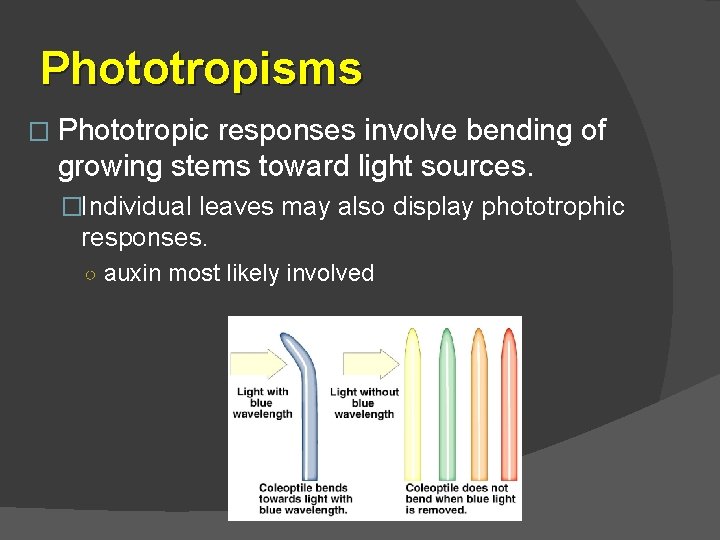
Phototropisms � Phototropic responses involve bending of growing stems toward light sources. �Individual leaves may also display phototrophic responses. ○ auxin most likely involved
Plant Physiology Under Low Light Intensity 1. Longer internodes, increased stem elongation 2. Leaves have larger surface area 3. Thinner leaves and stems 4. Thinner cuticle 5. One layer of palisade cells
MANAGING THE LIGHT ENVIRONMENT IN AGROECOSYSTEM
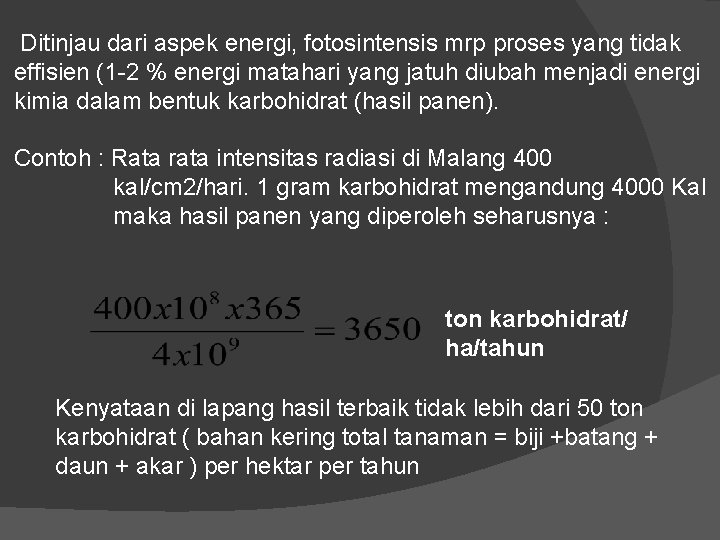
Ditinjau dari aspek energi, fotosintensis mrp proses yang tidak effisien (1 -2 % energi matahari yang jatuh diubah menjadi energi kimia dalam bentuk karbohidrat (hasil panen). Contoh : Rata rata intensitas radiasi di Malang 400 kal/cm 2/hari. 1 gram karbohidrat mengandung 4000 Kal maka hasil panen yang diperoleh seharusnya : ton karbohidrat/ ha/tahun Kenyataan di lapang hasil terbaik tidak lebih dari 50 ton karbohidrat ( bahan kering total tanaman = biji +batang + daun + akar ) per hektar per tahun
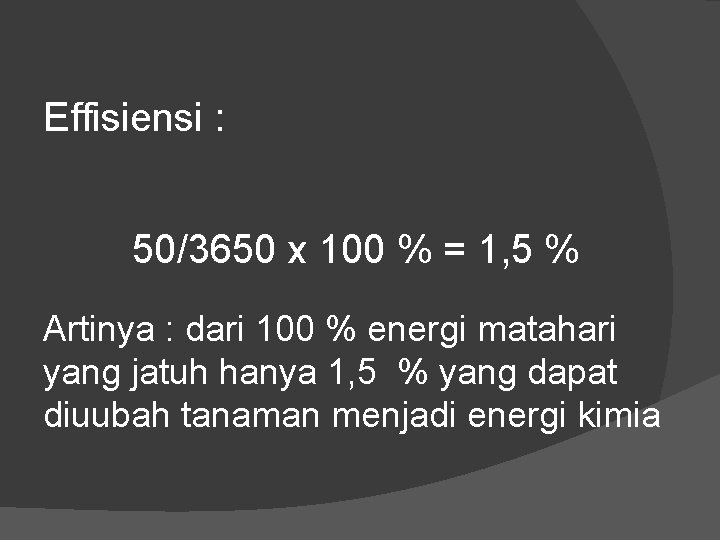
Effisiensi : 50/3650 x 100 % = 1, 5 % Artinya : dari 100 % energi matahari yang jatuh hanya 1, 5 % yang dapat diuubah tanaman menjadi energi kimia
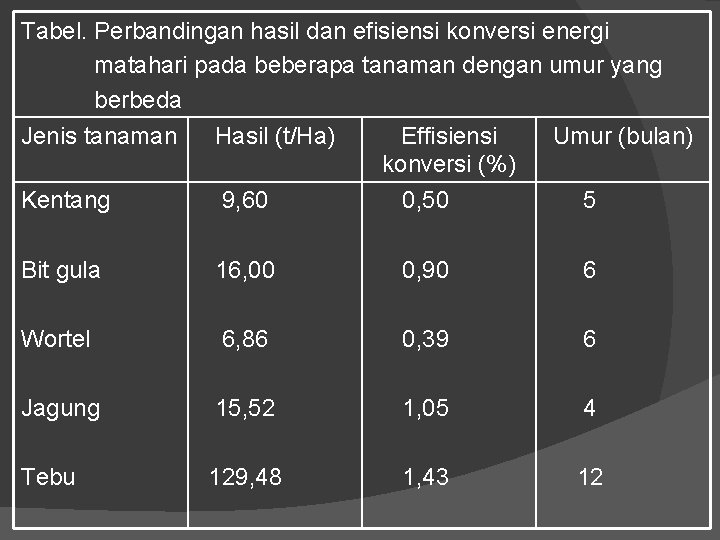
Tabel. Perbandingan hasil dan efisiensi konversi energi matahari pada beberapa tanaman dengan umur yang berbeda Jenis tanaman Hasil (t/Ha) Effisiensi Umur (bulan) konversi (%) Kentang 9, 60 0, 50 5 Bit gula 16, 00 0, 90 6 Wortel 6, 86 0, 39 6 Jagung 15, 52 1, 05 4 Tebu 129, 48 1, 43 12
Suatu proses produksi pertanian (agronomi) ditinjau dari aspek energi matahari bertujuan untuk meningkatkan effisiensi konversi energi matahari atau mengurangi hilangnya energi matahari selama proses produksi harus mengetahui kemana hilangnya energi matahari tersebut.
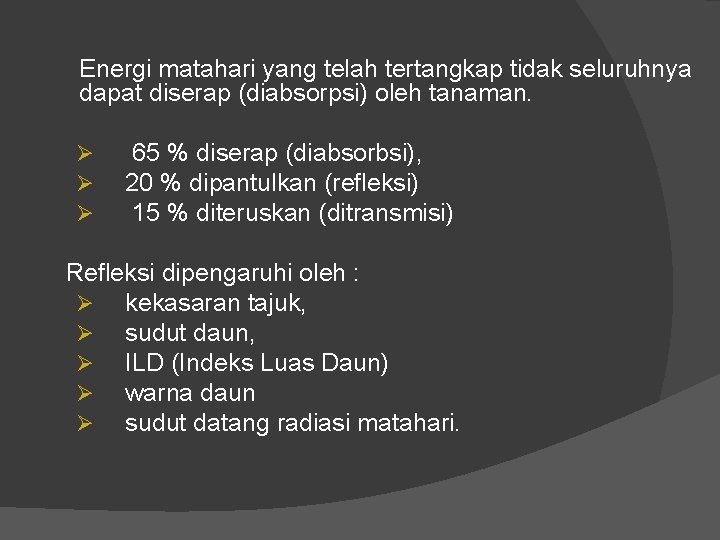
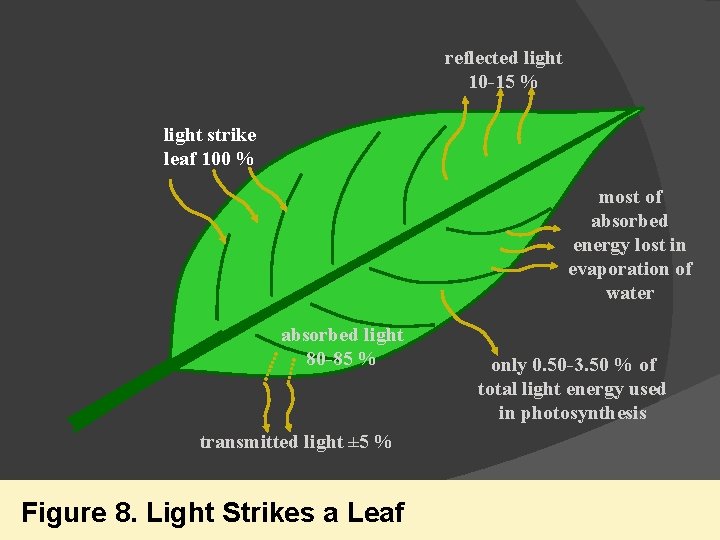
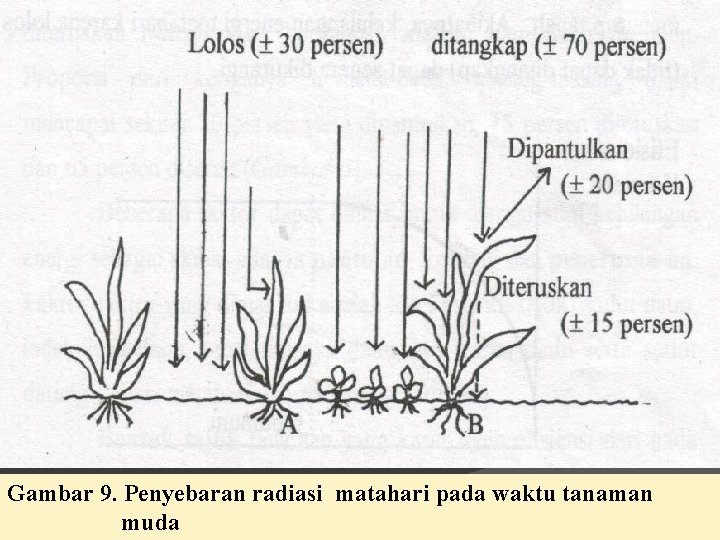
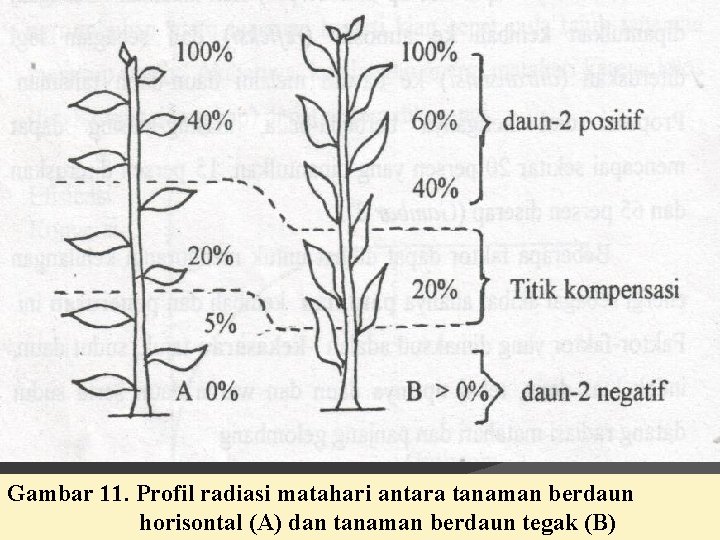
Energi matahari yang telah tertangkap tidak seluruhnya dapat diserap (diabsorpsi) oleh tanaman. Ø Ø Ø 65 % diserap (diabsorbsi), 20 % dipantulkan (refleksi) 15 % diteruskan (ditransmisi) Refleksi dipengaruhi oleh : Ø kekasaran tajuk, Ø sudut daun, Ø ILD (Indeks Luas Daun) Ø warna daun Ø sudut datang radiasi matahari.
reflected light 10 -15 % light strike leaf 100 % most of absorbed energy lost in evaporation of water absorbed light 80 -85 % transmitted light ± 5 % Figure 8. Light Strikes a Leaf only 0. 50 -3. 50 % of total light energy used in photosynthesis
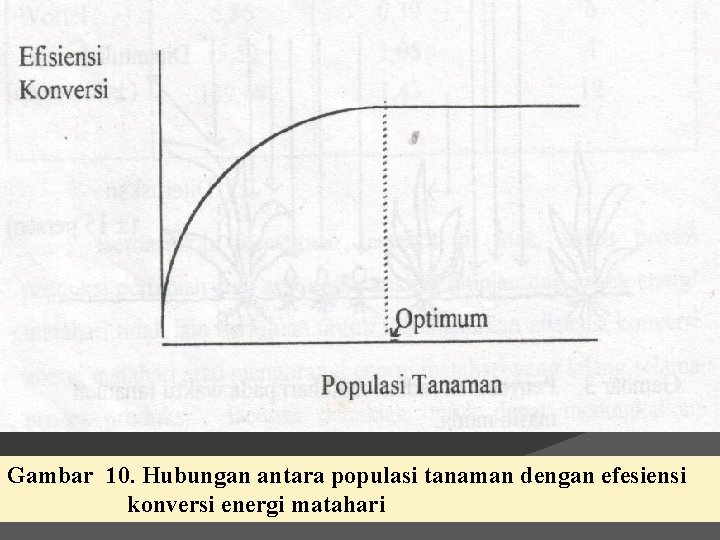
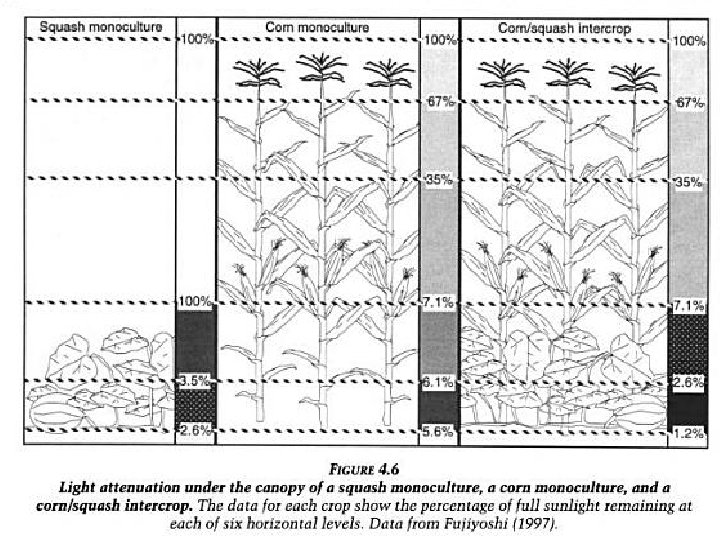
Faktor yang perlu diperhatikan penyebab hilangnya energi matahari 1. 2. 3. 4. 5. Umur tanaman Populasi tanaman Bentuk tajuk tanaman Laju pertumbuhan tanaman Sistem/Pola bertanam
Gambar 9. Penyebaran radiasi matahari pada waktu tanaman muda
Gambar 10. Hubungan antara populasi tanaman dengan efesiensi konversi energi matahari
Gambar 11. Profil radiasi matahari antara tanaman berdaun horisontal (A) dan tanaman berdaun tegak (B)
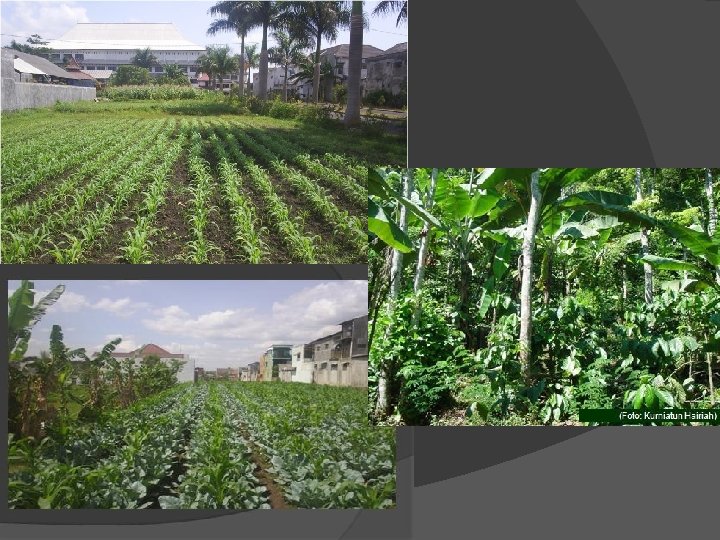
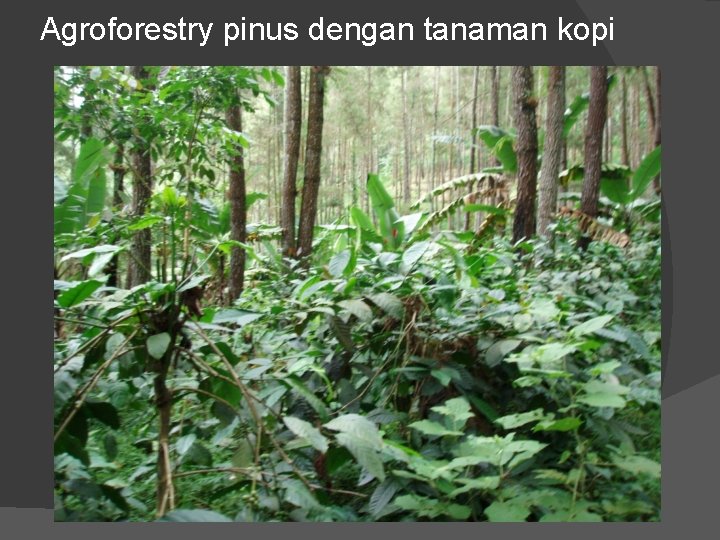
Agroforestry pinus dengan tanaman kopi
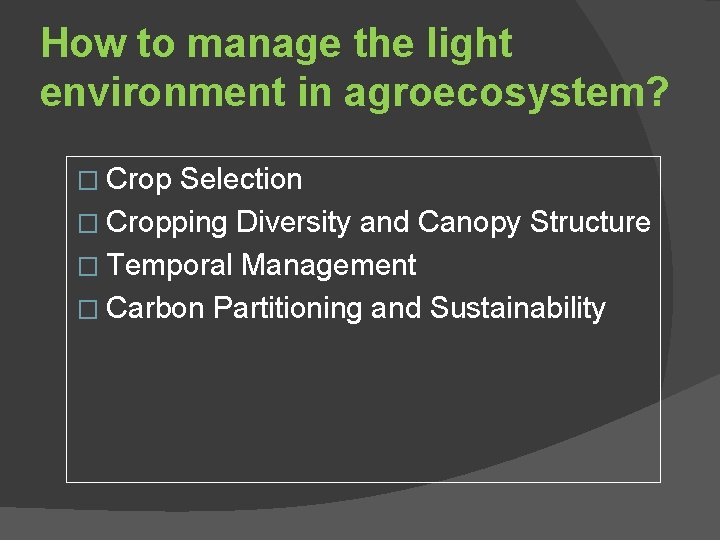
How to manage the light environment in agroecosystem? � Crop Selection � Cropping Diversity and Canopy Structure � Temporal Management � Carbon Partitioning and Sustainability
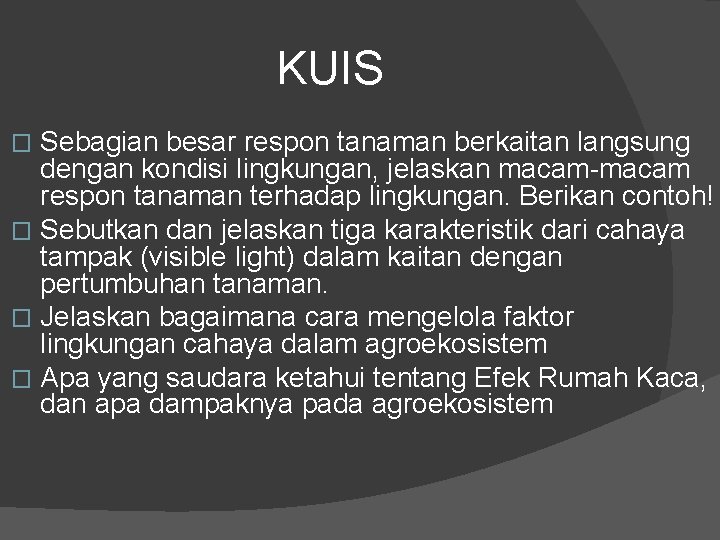
KUIS Sebagian besar respon tanaman berkaitan langsung dengan kondisi lingkungan, jelaskan macam-macam respon tanaman terhadap lingkungan. Berikan contoh! � Sebutkan dan jelaskan tiga karakteristik dari cahaya tampak (visible light) dalam kaitan dengan pertumbuhan tanaman. � Jelaskan bagaimana cara mengelola faktor lingkungan cahaya dalam agroekosistem � Apa yang saudara ketahui tentang Efek Rumah Kaca, dan apa dampaknya pada agroekosistem �