
Environment Community EngagementEnvironmental Education and the Behavior Change
Environment Community Engagement—Environmental Education and the Behavior Change Process Session 4: Bridge to Activities Office of Overseas Programming & Training Support (OPATS)
‘EXERCISE’ EXERCISE Introduction 1. The project implementers need to conduct in-depth audience research in each community as part of the baseline data survey and continuously throughout the life of the project. If used during project design, the qualitative research can be useful in helping project designers narrow down the list of behaviors to target once the research has been completed. 2. For this exercise, you will each play a community member. (See the behavior campaign goal written on the flip chart paper. ) 3. Before we decide how to address that goal, we’re going to undertake some audience research—involving all of you as research participants!
‘EXERCISE’ EXERCISE § What we know and believe is often quite different from what we do. Identifying doers and non-doers is an important part of this type of qualitative research. § If you had to pick one audience segment to work with first, which group would you pick? § How else might you use this information in a behavior change program? § What did you notice about prioritizing barriers?
‘Exercise’ Exercise Providing information isn’t enough to change Behavior and actions are what matter
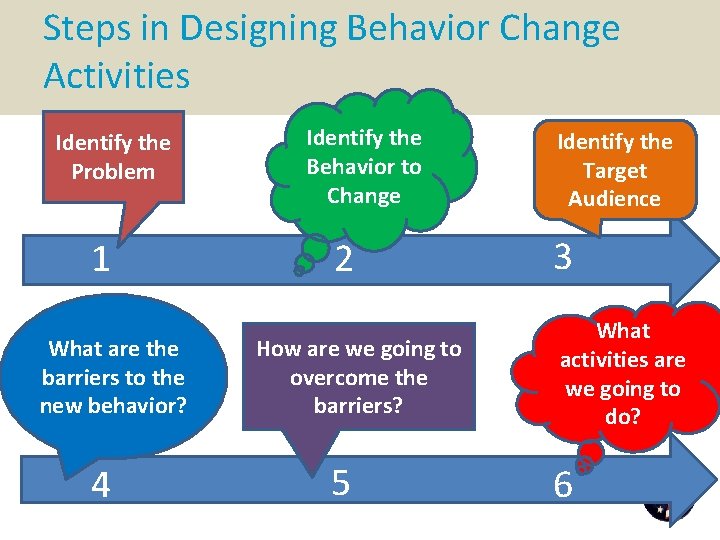
Steps in Designing Behavior Change Activities Identify the Problem 1 What are the barriers to the new behavior? 4 Identify the Behavior to Change 2 How are we going to overcome the barriers? 5 Identify the Target Audience 3 What activities are we going to do? 6
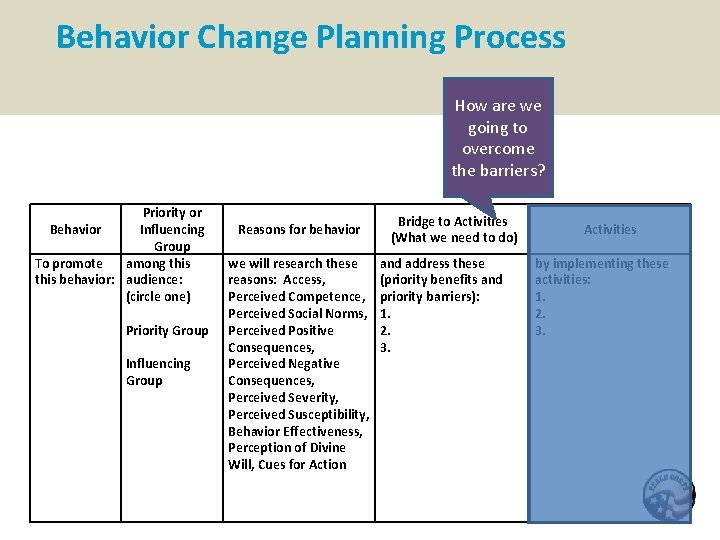
Behavior Change Planning Process How are we going to overcome the barriers? Priority or Behavior Influencing Group To promote among this behavior: audience: (circle one) Priority Group Influencing Group Reasons for behavior we will research these reasons: Access, Perceived Competence, Perceived Social Norms, Perceived Positive Consequences, Perceived Negative Consequences, Perceived Severity, Perceived Susceptibility, Behavior Effectiveness, Perception of Divine Will, Cues for Action Bridge to Activities (What we need to do) and address these (priority benefits and priority barriers): 1. 2. 3. Activities by implementing these activities: 1. 2. 3.
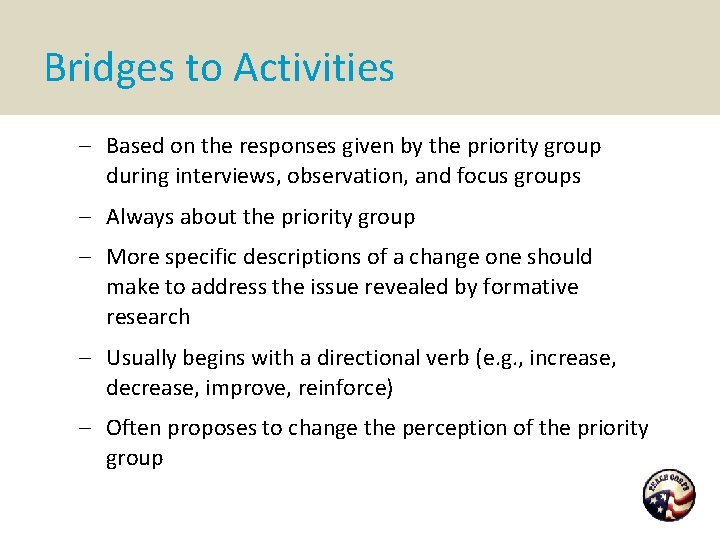
Bridges to Activities Based on the responses given by the priority group during interviews, observation, and focus groups Always about the priority group More specific descriptions of a change one should make to address the issue revealed by formative research Usually begins with a directional verb (e. g. , increase, decrease, improve, reinforce) Often proposes to change the perception of the priority group
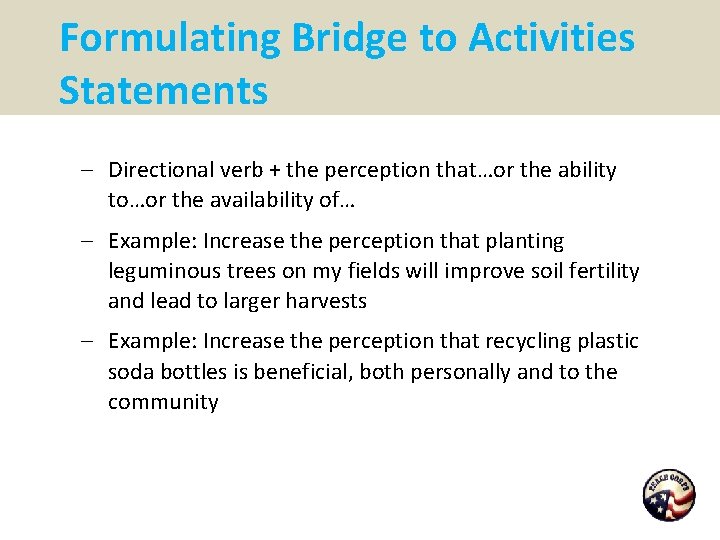
Formulating Bridge to Activities Statements Directional verb + the perception that…or the ability to…or the availability of… Example: Increase the perception that planting leguminous trees on my fields will improve soil fertility and lead to larger harvests Example: Increase the perception that recycling plastic soda bottles is beneficial, both personally and to the community
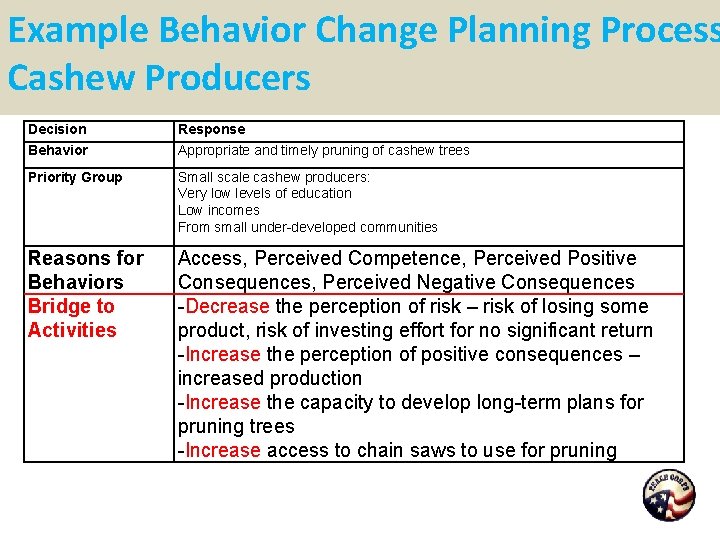
Example Behavior Change Planning Process Cashew Producers Decision Response Behavior Appropriate and timely pruning of cashew trees Priority Group Small scale cashew producers: Very low levels of education Low incomes From small under-developed communities Reasons for Behaviors Bridge to Activities Access, Perceived Competence, Perceived Positive Consequences, Perceived Negative Consequences -Decrease the perception of risk – risk of losing some product, risk of investing effort for no significant return -Increase the perception of positive consequences – increased production -Increase the capacity to develop long-term plans for pruning trees -Increase access to chain saws to use for pruning
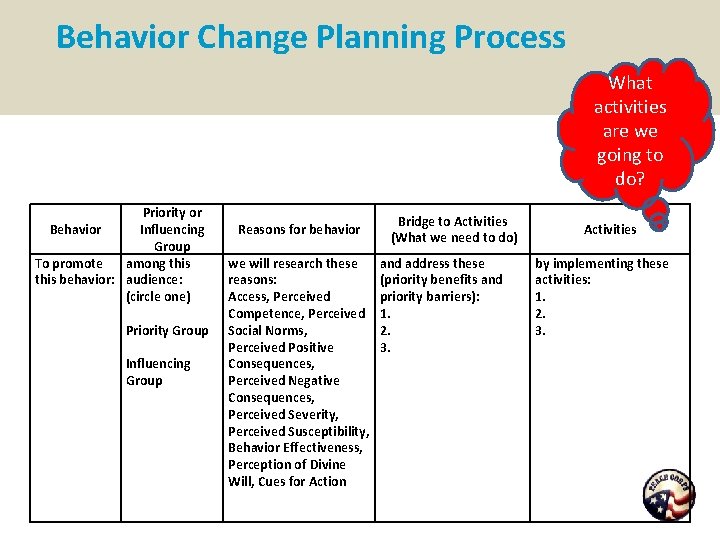
Behavior Change Planning Process What activities are we going to do? Priority or Behavior Influencing Group To promote among this behavior: audience: (circle one) Priority Group Influencing Group Reasons for behavior we will research these reasons: Access, Perceived Competence, Perceived Social Norms, Perceived Positive Consequences, Perceived Negative Consequences, Perceived Severity, Perceived Susceptibility, Behavior Effectiveness, Perception of Divine Will, Cues for Action Bridge to Activities (What we need to do) and address these (priority benefits and priority barriers): 1. 2. 3. Activities by implementing these activities: 1. 2. 3.
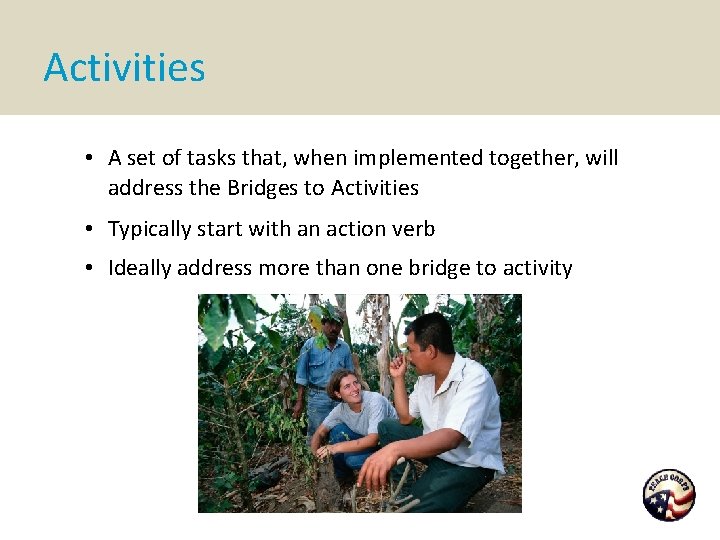
Activities • A set of tasks that, when implemented together, will address the Bridges to Activities • Typically start with an action verb • Ideally address more than one bridge to activity
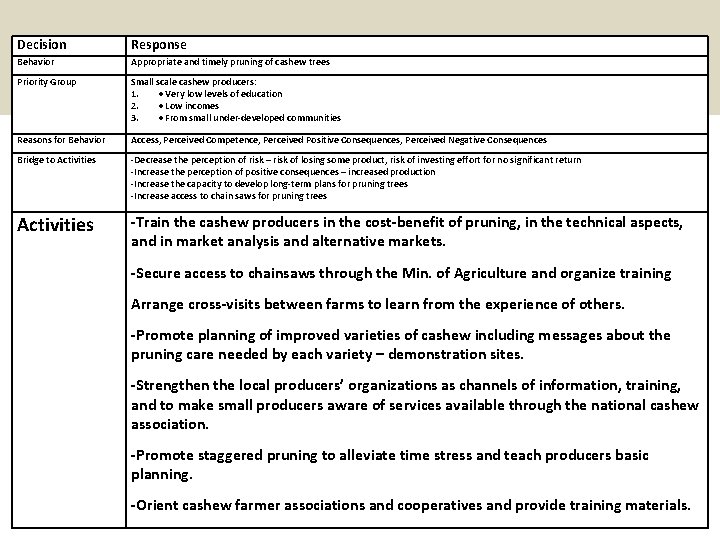
Decision Response Behavior Appropriate and timely pruning of cashew trees Priority Group Small scale cashew producers: 1. • Very low levels of education 2. • Low incomes 3. • From small under-developed communities Reasons for Behavior Access, Perceived Competence, Perceived Positive Consequences, Perceived Negative Consequences Bridge to Activities -Decrease the perception of risk – risk of losing some product, risk of investing effort for no significant return -Increase the perception of positive consequences – increased production -Increase the capacity to develop long-term plans for pruning trees -Increase access to chain saws for pruning trees Activities -Train the cashew producers in the cost-benefit of pruning, in the technical aspects, and in market analysis and alternative markets. -Secure access to chainsaws through the Min. of Agriculture and organize training Arrange cross-visits between farms to learn from the experience of others. -Promote planning of improved varieties of cashew including messages about the pruning care needed by each variety – demonstration sites. -Strengthen the local producers’ organizations as channels of information, training, and to make small producers aware of services available through the national cashew association. -Promote staggered pruning to alleviate time stress and teach producers basic planning. -Orient cashew farmer associations and cooperatives and provide training materials.
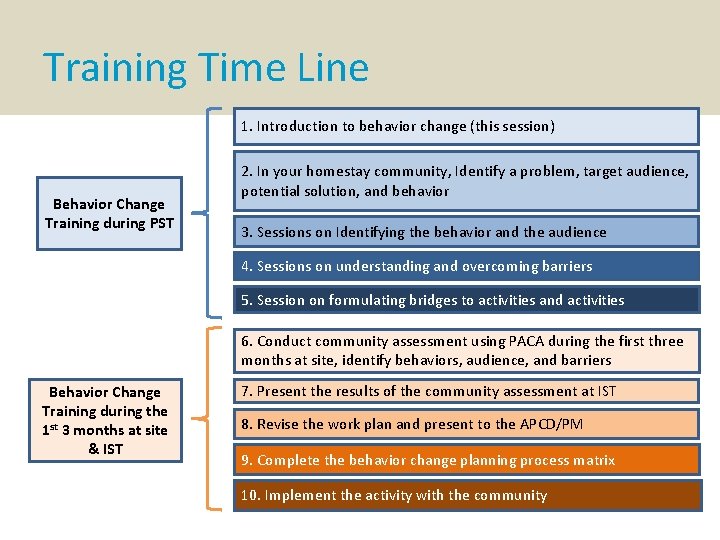
Training Time Line 1. Introduction to behavior change (this session) Behavior Change Training during PST 2. In your homestay community, Identify a problem, target audience, potential solution, and behavior 3. Sessions on Identifying the behavior and the audience 4. Sessions on understanding and overcoming barriers 5. Session on formulating bridges to activities and activities 6. Conduct community assessment using PACA during the first three months at site, identify behaviors, audience, and barriers Behavior Change Training during the 1 st 3 months at site & IST 7. Present the results of the community assessment at IST 8. Revise the work plan and present to the APCD/PM 9. Complete the behavior change planning process matrix 10. Implement the activity with the community
- Slides: 13