
Environment Climate Change Poverty ECP Mainstreaming Workshop for

- Slides: 26
Environment, Climate Change & Poverty (ECP) Mainstreaming Workshop for Dzongkhag Planning Officers, NRDCL Hall, Thimphu March 5 -8, 2012 ECP Mainstreaming Reference Group
Outline � What is ECP Mainstreaming ? � Why Mainstream ECP-Linkages and what is it’s relevance to Bhutan? � Major Drivers of Mainstreaming & Constraints. � ECP Initiatives and Outcomes.
Most current environmental management practice to date is “safeguarding”: � EIA/Environmental Clearance � Pollution Control Regulations � Controls on industrial plants/etc � Prevention of forest clearance/etc Safeguarding is important: focuses on compliance with standards & mitigation of adverse impacts Source: A. L Brown
Safeguarding must be complemented by Mainstreaming
‘Environmental Mainstreaming’ … the active promotion of environmental sustainability in the identification, planning, design, negotiation, and implementation of strategies, policies and investment programs. ……. after Seymour et al (2005) or Environmental Integration or Environmental Policy Integration
Definition…. . � “The informed inclusion of relevant environmental concerns into the decisions and institutions that drive national, sectoral, city and local development policy, rules, plans, investment and action” (IIED 2009) � “integration”, “cross-cutting”, “early in the decision making process”, “promotion of environmental sustainability”.
Why Environmental Mainstreaming? National goals & global compacts - Article 5 of the country’s constitution mandates to maintain 60% of the land under forest cover in perpetuity. - Environment is one of the four pillars of Gross National Happiness (GNH), the country's overarching development goal - About 70% of the rural population depend on agriculture and related services for livelihood. - More than 98% of those under poverty are rural based. - More than half of Bhutan's GDP can be attributed to sectors directly or indirectly dependent on the health of our environment. 7
Environment is integral to achieving the MDGs 1: Eradicate poverty and hunger – NR for food, shelter, livelihoods 2: Universal primary education – sanitation / water / fuelwood 3: Gender equality and empower women – NR access / Indoor Air Pollution 4: Reduce child mortality – sanitation / water / Indoor Air Pollution 5: Improve maternal health – water / fuelwood / IA Pollution 6: Combat major diseases – wat-san / biodiversity / climate 7: Ensure env sustainability – env info / rights / accountability 8: Global partnership – manage global public goods (BD, CC) Bhutan’s commitment to remain carbon neutral (1559. 56 gg; 6309. 6 gg sequesteration; NKRA)
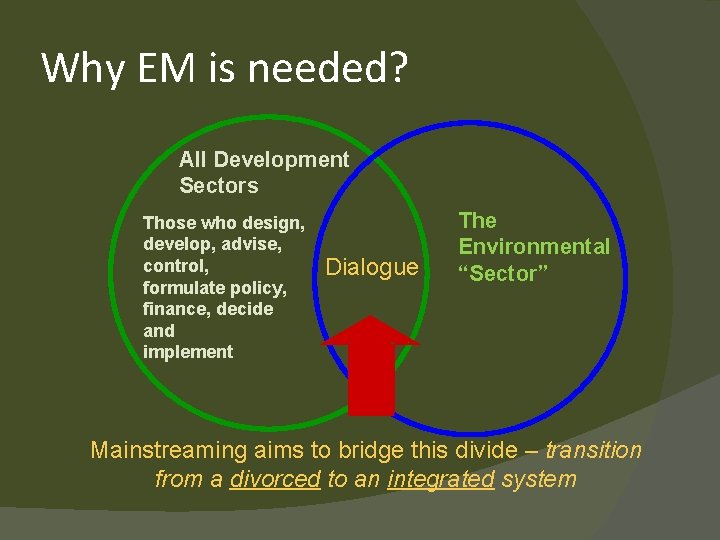
Why EM is needed? All Development Sectors Those who design, develop, advise, control, formulate policy, finance, decide and implement Dialogue The Environmental “Sector” Mainstreaming aims to bridge this divide – transition from a divorced to an integrated system
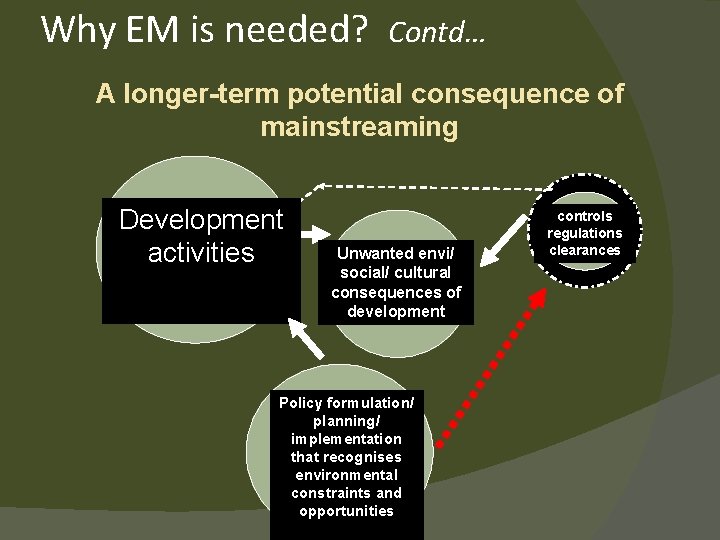
Why EM is needed? Contd… A longer-term potential consequence of mainstreaming Development activities Unwanted envi/ social/ cultural consequences of development Policy formulation/ planning/ implementation that recognises environmental constraints and opportunities controls regulations clearances
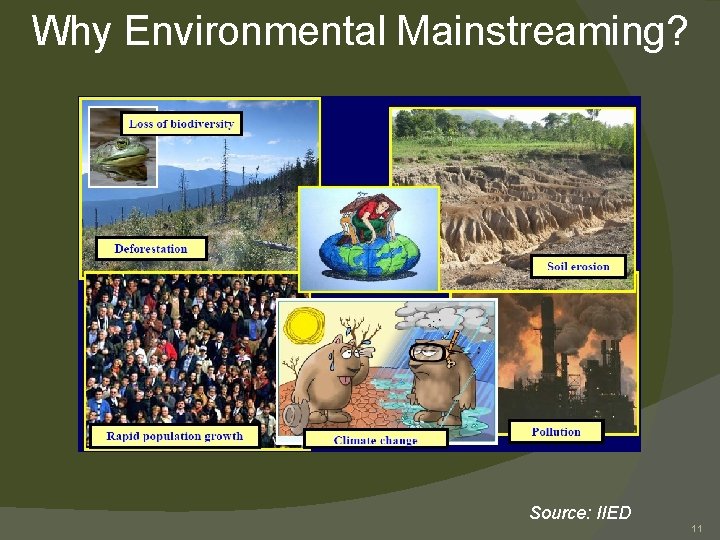
Why Environmental Mainstreaming? Source: IIED 11
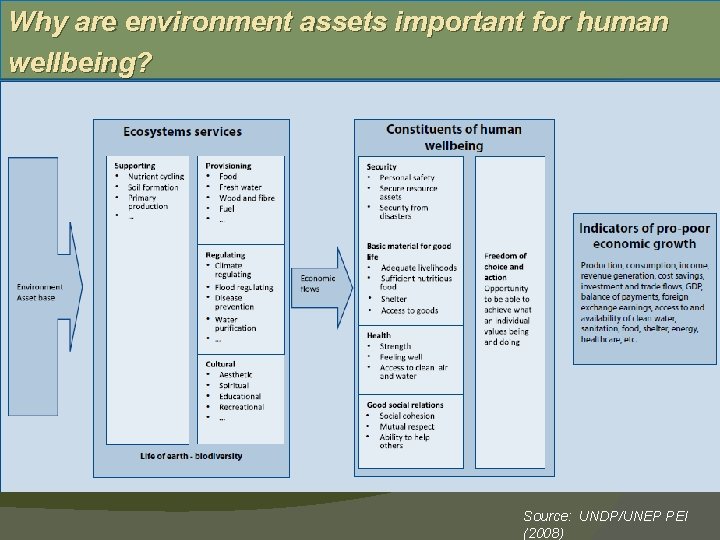
Why EM is needed? Contd… � Economy and society depend on the health of environmenteconomic & social dev. & environment are fundamentally inter-dependant � Environmental assets (fertile soils, clean water, biodiversity, etc): � � yield income safety net for poor maintain public health drive economic growth. . . bad management of envi. assets. . . � Environmental hazards (pollution, climate change, natural disasters) � threaten livelihood � threaten development � poor are especially vulnerable
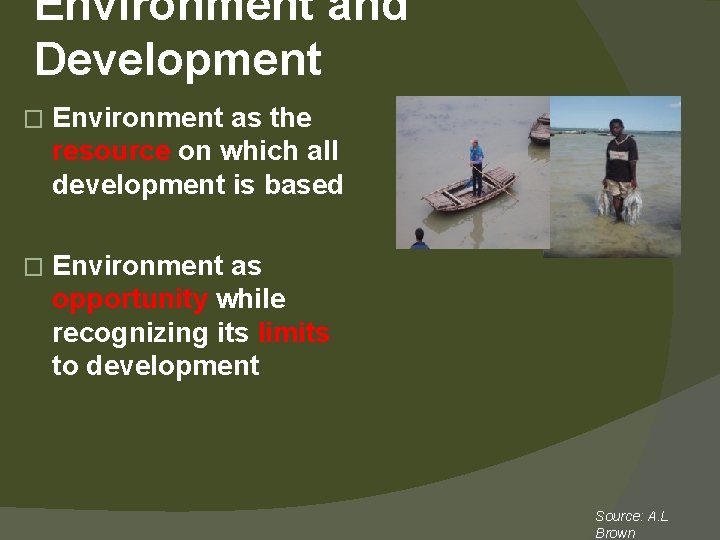
Environment and Development � Environment as the resource on which all development is based � Environment as opportunity while recognizing its limits to development Source: A. L Brown
Why are environment assets important for human wellbeing? Source: UNDP/UNEP PEI (2008)
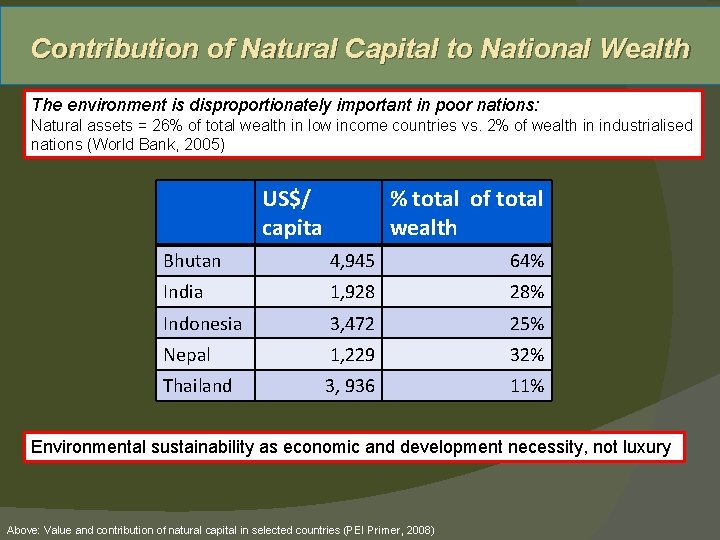
Contribution of Natural Capital to National Wealth The environment is disproportionately important in poor nations: Natural assets = 26% of total wealth in low income countries vs. 2% of wealth in industrialised nations (World Bank, 2005) US$/ capita % total of total wealth Bhutan 4, 945 64% India 1, 928 28% Indonesia 3, 472 25% Nepal 1, 229 32% Thailand 3, 936 11% Environmental sustainability as economic and development necessity, not luxury Above: Value and contribution of natural capital in selected countries (PEI Primer, 2008)
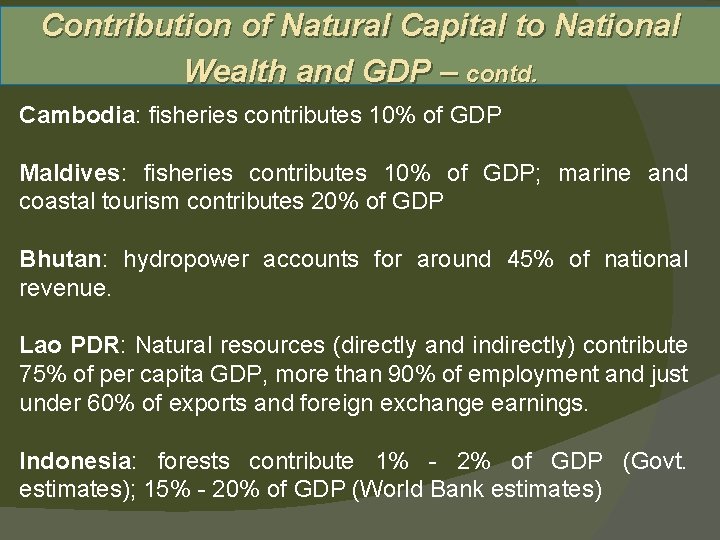
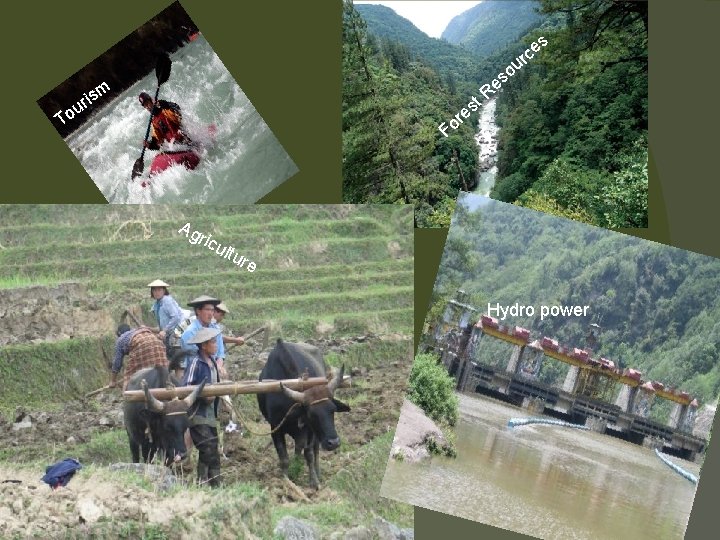
Contribution of Natural Capital to National Wealth and GDP – contd. Cambodia: fisheries contributes 10% of GDP Maldives: fisheries contributes 10% of GDP; marine and coastal tourism contributes 20% of GDP Bhutan: hydropower accounts for around 45% of national revenue. Lao PDR: Natural resources (directly and indirectly) contribute 75% of per capita GDP, more than 90% of employment and just under 60% of exports and foreign exchange earnings. Indonesia: forests contribute 1% - 2% of GDP (Govt. estimates); 15% - 20% of GDP (World Bank estimates)
s e c r u o s m ris e R t s u To re o F Ag ric ult ure Hydro power
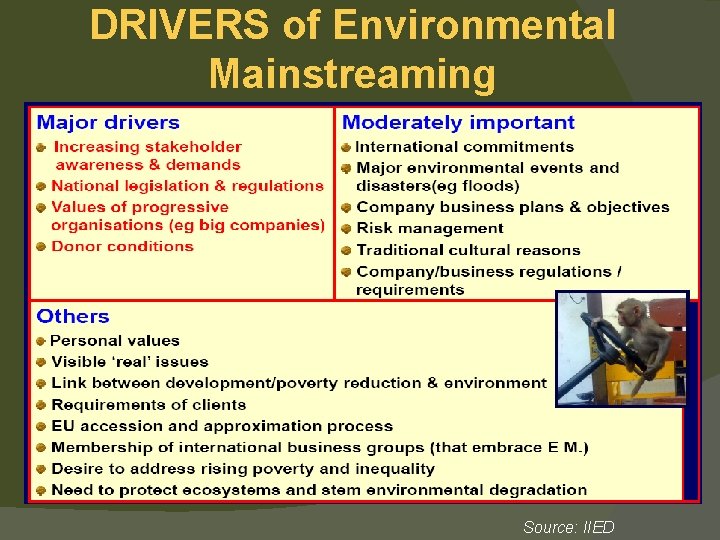
DRIVERS of Environmental Mainstreaming Source: IIED
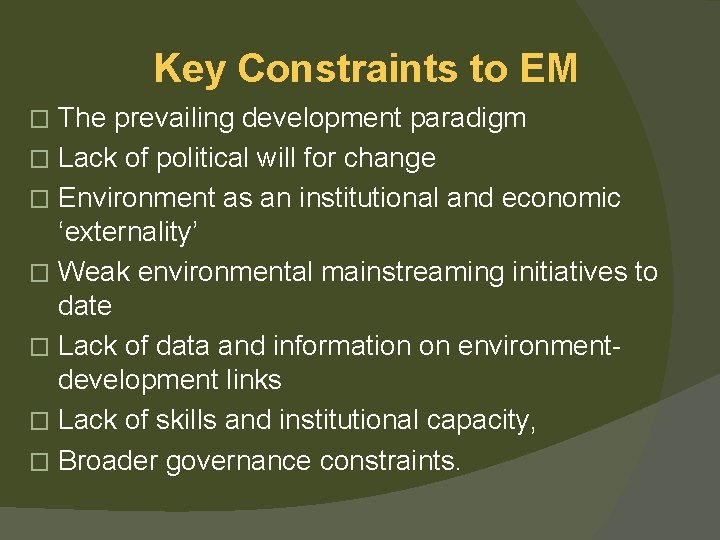
Key Constraints to EM The prevailing development paradigm � Lack of political will for change � Environment as an institutional and economic ‘externality’ � Weak environmental mainstreaming initiatives to date � Lack of data and information on environmentdevelopment links � Lack of skills and institutional capacity, � Broader governance constraints. �
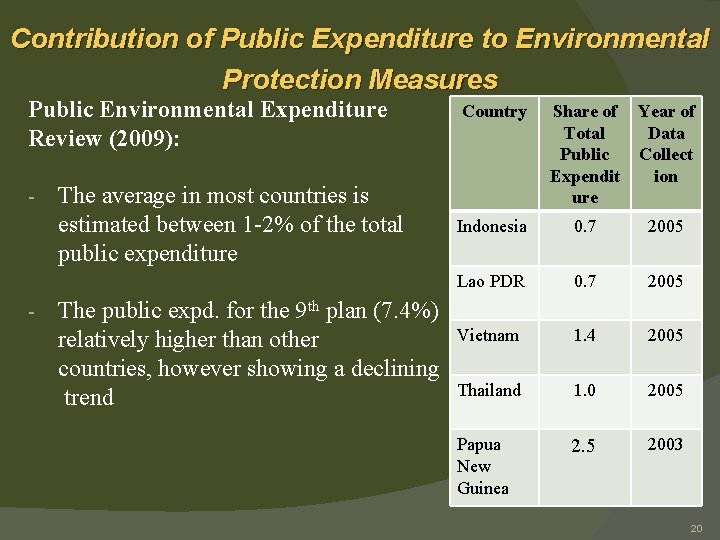
Contribution of Public Expenditure to Environmental Protection Measures Public Environmental Expenditure Review (2009): - - The average in most countries is estimated between 1 -2% of the total public expenditure The public expd. for the 9 th plan (7. 4%) relatively higher than other countries, however showing a declining trend Country Share of Year of Total Data Public Collect Expendit ion ure Indonesia 0. 7 2005 Lao PDR 0. 7 2005 Vietnam 1. 4 2005 Thailand 1. 0 2005 Papua New Guinea 2. 5 2003 20
Emerging Opportunities for Mainstreaming � Decentralization and local government support – effective to engage/empower local communities (in processes affecting their lives) � Private Sector – a key agent of change; changing rural landscapes; creating new (green) opportunities but also threats � Climate change ‘band wagon’– opportunities to increase financing; sustainable environmental management reinvented � Mainstreaming programmes across development assistance
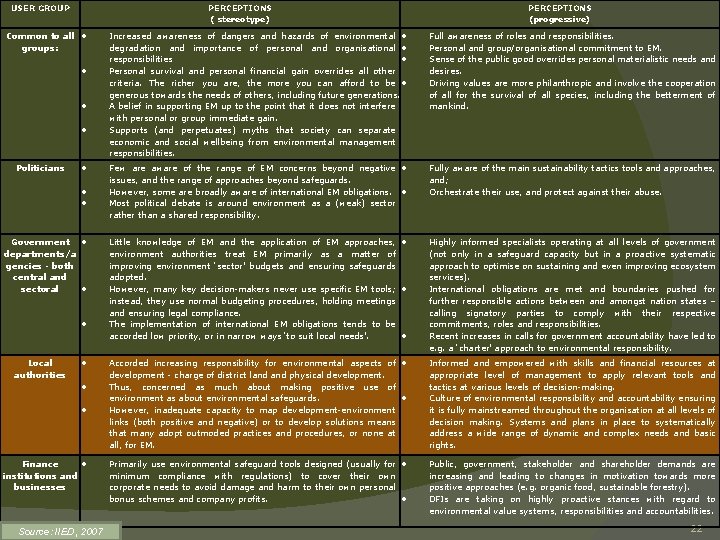
USER GROUP PERCEPTIONS ( stereotype) Common to all groups: Politicians Government departments/a gencies - both central and sectoral Local authorities Finance institutions and businesses Source: IIED, 2007 PERCEPTIONS (progressive) Increased awareness of dangers and hazards of environmental degradation and importance of personal and organisational responsibilities Personal survival and personal financial gain overrides all other criteria. The richer you are, the more you can afford to be generous towards the needs of others, including future generations. A belief in supporting EM up to the point that it does not interfere with personal or group immediate gain. Supports (and perpetuates) myths that society can separate economic and social wellbeing from environmental management responsibilities. Full awareness of roles and responsibilities. Personal and group/organisational commitment to EM. Sense of the public good overrides personal materialistic needs and desires. Driving values are more philanthropic and involve the cooperation of all for the survival of all species, including the betterment of mankind. Few are aware of the range of EM concerns beyond negative issues, and the range of approaches beyond safeguards. However, some are broadly aware of international EM obligations. Most political debate is around environment as a (weak) sector rather than a shared responsibility. Fully aware of the main sustainability tactics tools and approaches, and; Orchestrate their use, and protect against their abuse. Little knowledge of EM and the application of EM approaches, environment authorities treat EM primarily as a matter of improving environment ‘sector’ budgets and ensuring safeguards adopted. However, many key decision-makers never use specific EM tools; instead, they use normal budgeting procedures, holding meetings and ensuring legal compliance. The implementation of international EM obligations tends to be accorded low priority, or in narrow ways ‘to suit local needs’. Highly informed specialists operating at all levels of government (not only in a safeguard capacity but in a proactive systematic approach to optimise on sustaining and even improving ecosystem services). International obligations are met and boundaries pushed for further responsible actions between and amongst nation states – calling signatory parties to comply with their respective commitments, roles and responsibilities. Recent increases in calls for government accountability have led to e. g. a ‘charter’ approach to environmental responsibility. Accorded increasing responsibility for environmental aspects of development - charge of district land physical development. Thus, concerned as much about making positive use of environment as about environmental safeguards. However, inadequate capacity to map development-environment links (both positive and negative) or to develop solutions means that many adopt outmoded practices and procedures, or none at all, for EM. Informed and empowered with skills and financial resources at appropriate level of management to apply relevant tools and tactics at various levels of decision-making. Culture of environmental responsibility and accountability ensuring it is fully mainstreamed throughout the organisation at all levels of decision making. Systems and plans in place to systematically address a wide range of dynamic and complex needs and basic rights. Primarily use environmental safeguard tools designed (usually for minimum compliance with regulations) to cover their own corporate needs to avoid damage and harm to their own personal bonus schemes and company profits. Public, government, stakeholder and shareholder demands are increasing and leading to changes in motivation towards more positive approaches (e. g. organic food, sustainable forestry). DFIs are taking on highly proactive stances with regard to environmental value systems, responsibilities and accountabilities. 22
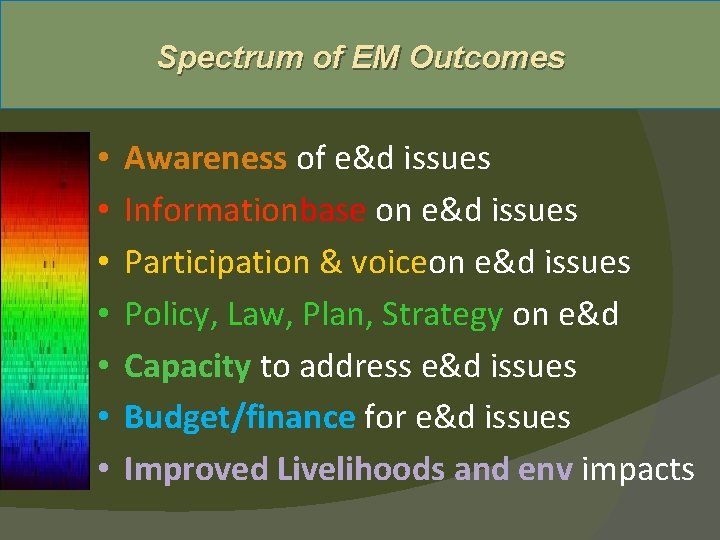
Spectrum of EM Outcomes • • Awareness of e&d issues Informationbase on e&d issues Participation & voiceon e&d issues Policy, Law, Plan, Strategy on e&d Capacity to address e&d issues Budget/finance for e&d issues Improved Livelihoods and env impacts
ECP Initiatives and Outcomes achieved � Improved awareness and capacities � ECP linkages in practice documented/mainstreamed (REAP, PEER, PEM Guideline, GNH Indicators, Policy Protocol). � Partnerships enabled between DPs. � ECP Reference Group formed to spearhead and support ECP mainstreaming in Bhutan. (11 th Plan ECP Mainstreaming Framework & capacity building)
Links to EM tools and materials www. environmental-mainstreaming. org http: //www. unpei. org/ http: //www. naturaledgeproject. net/default. aspx 25
Tashi Delek! 26