
Environment and its segments Environment Every thing in

- Slides: 156
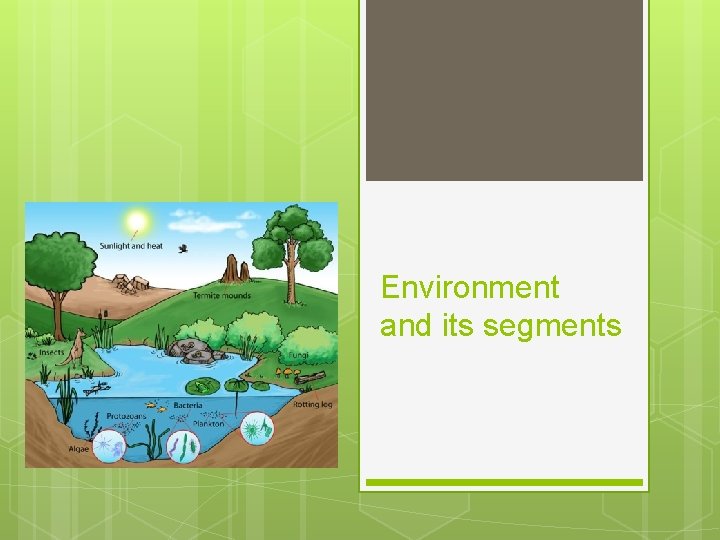
Environment and its segments
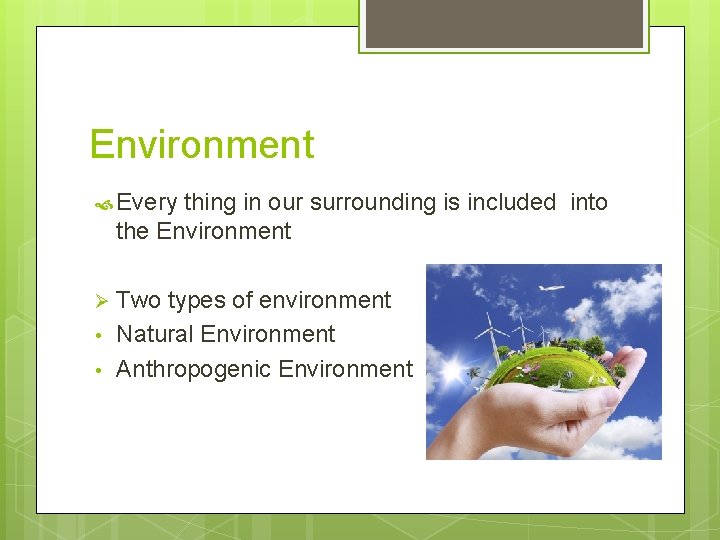
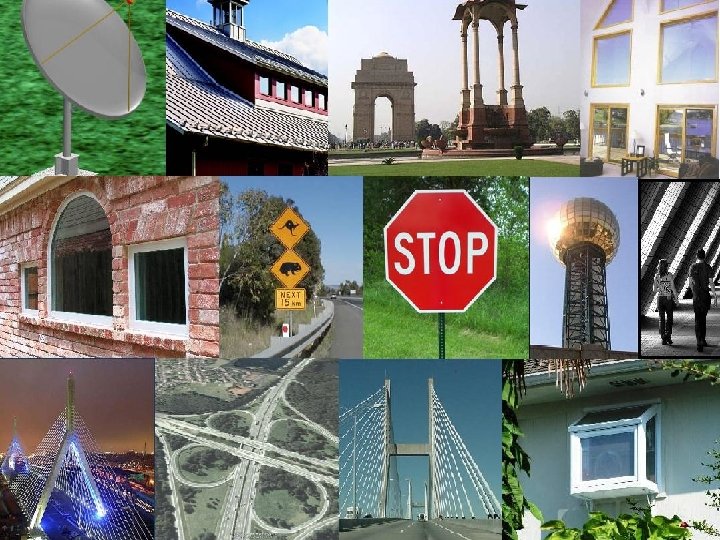
Environment Every thing in our surrounding is included into the Environment Ø • • Two types of environment Natural Environment Anthropogenic Environment
Natural Environment The natural environment encompasses all living and non-living things occurring naturally on Earth or some region thereof. It is an environment that encompasses the interaction of all living species. The concept of the natural environment can be distinguished by components: Complete ecological units that function as natural systems without massive human intervention, including all vegetation, microorganisms, soil, rocks, atmosphere, and natural phenomena that occur within their boundaries. Universal natural resources and physical phenomena that lack clear-cut boundaries, such as air, water, and climate, as well as energy, radiation, electric charge, and magnetism, not originating from human activity
Anthropogenic Environment • • Manmade Environment Artificial Environment Example; Buildings , Industries , Vehicles and all other human made things
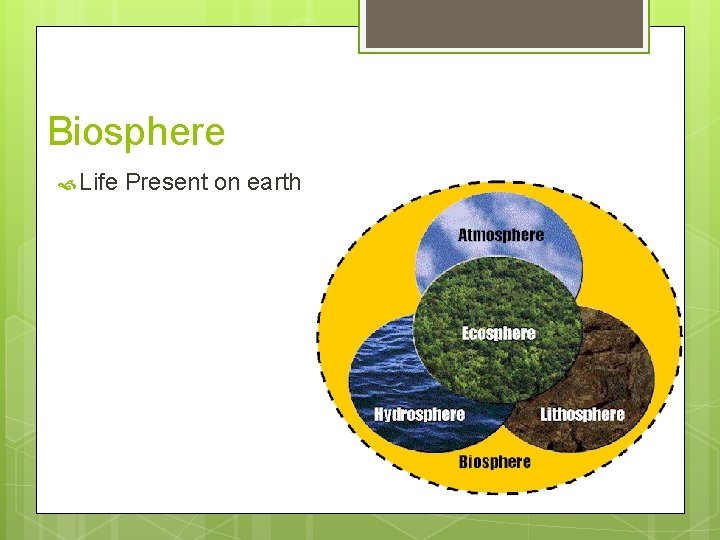
Segments of Natural Environment Division of Environment Ø Hydrosphere Ø Lithosphere Ø Atmosphere Ø Biosphere
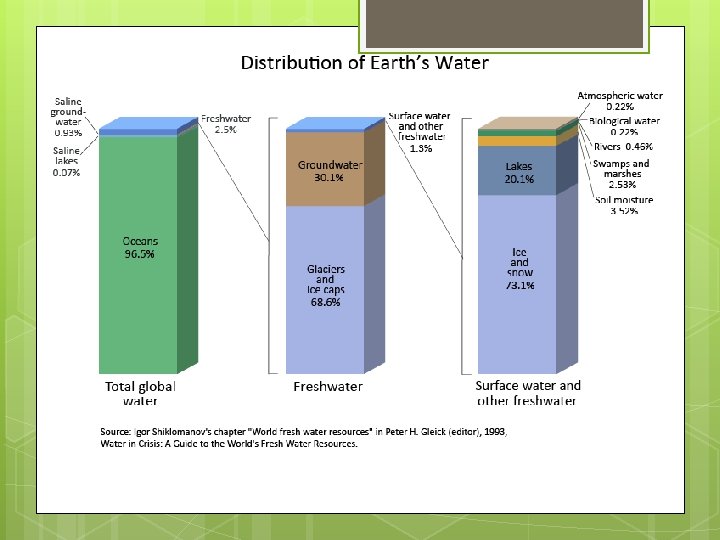
Hydrosphere The hydrosphere describes the combined mass of water found on, under, and over the surface of a planet. Ø 1386 million cubic kilometers of water on earth. Ø This includes water in liquid and frozen forms in groundwater's, glaciers, oceans, lakes and streams. Ø Saline water account for 97. 5% , Fresh Water 2. 5%
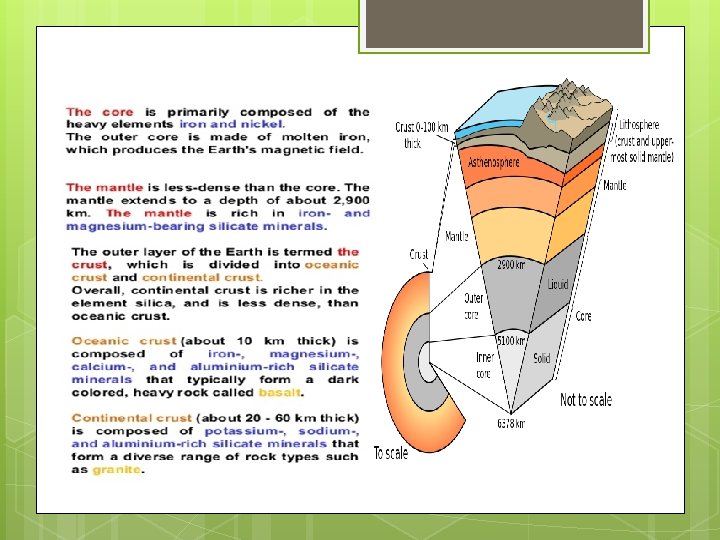
Lithosphere The lithosphere is the rigid outermost shell of a rocky planet. On Earth, it comprises the crust and the portion of the upper mantle that behaves elastically on time scales of thousands of years or greater.
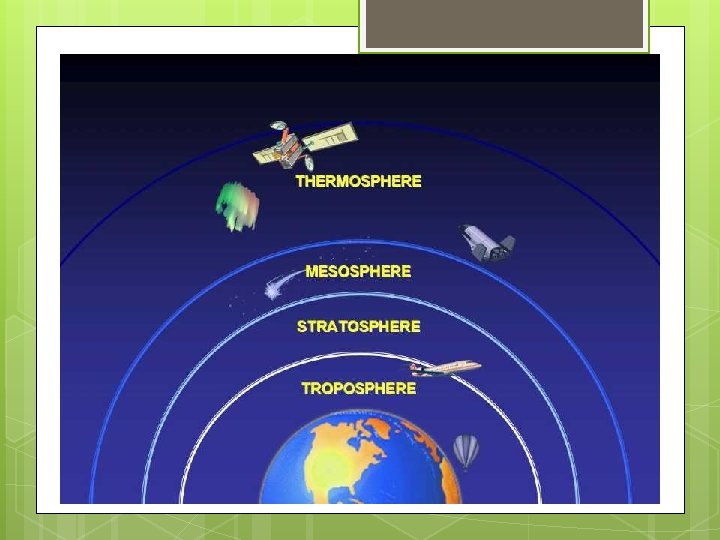
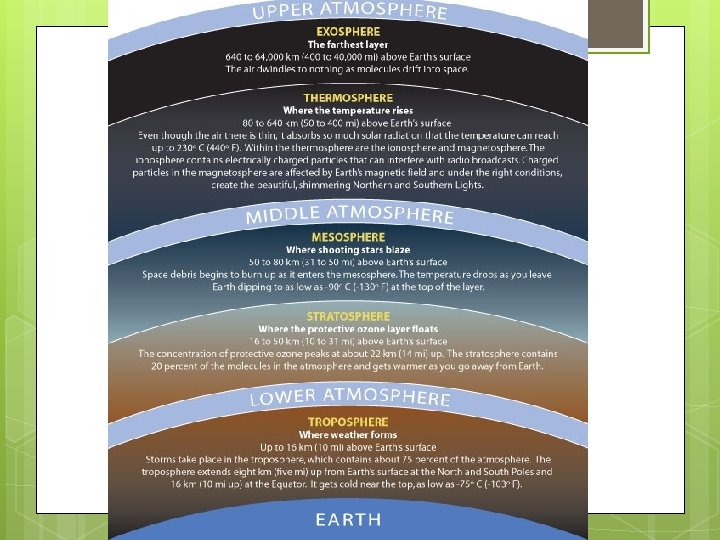
Atmosphere An atmosphere is a layer of gases surrounding a material body of sufficient mass that is held in place by the gravity of the body. An atmosphere is more likely to be retained if the gravity is high and the atmosphere's temperature is low.
Biosphere Life Present on earth
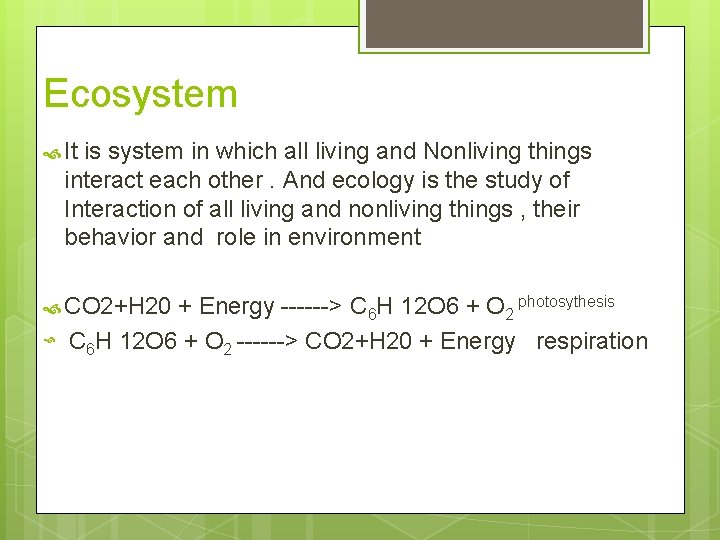
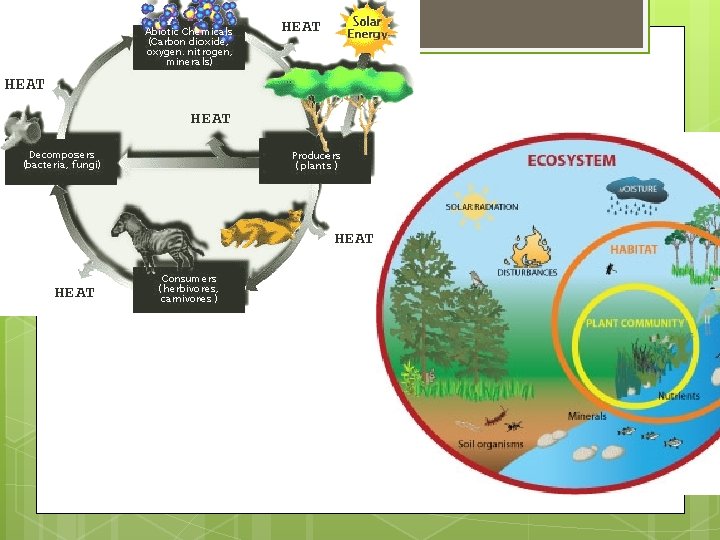
Ecosystem It is system in which all living and Nonliving things interact each other. And ecology is the study of Interaction of all living and nonliving things , their behavior and role in environment CO 2+H 20 + Energy ------> C 6 H 12 O 6 + O 2 photosythesis C 6 H 12 O 6 + O 2 ------> CO 2+H 20 + Energy respiration
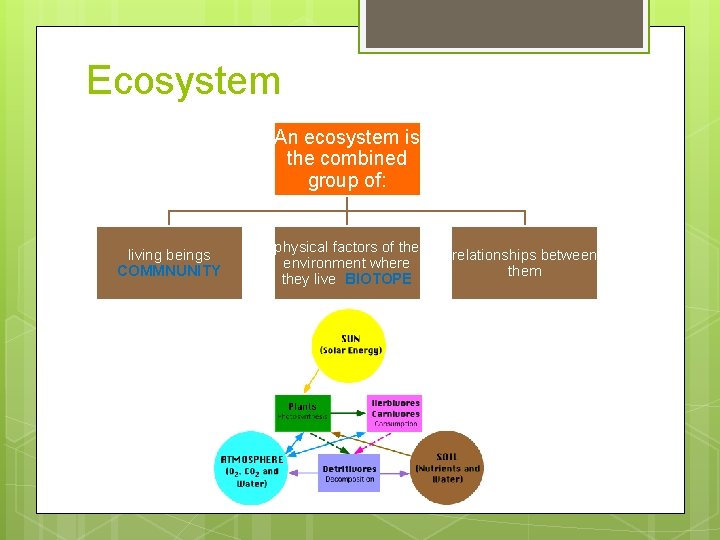
Ecosystem An ecosystem is the combined group of: living beings COMMNUNITY physical factors of the environment where they live BIOTOPE relationships between them
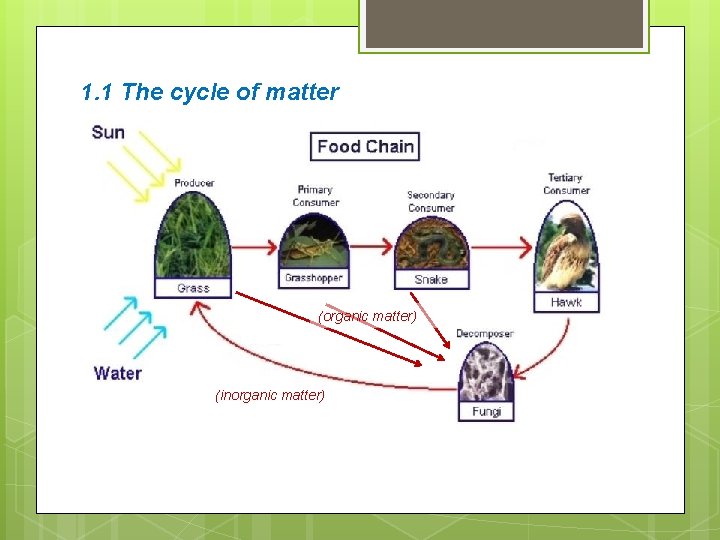
1. 1 The cycle of matter (organic matter) (inorganic matter)
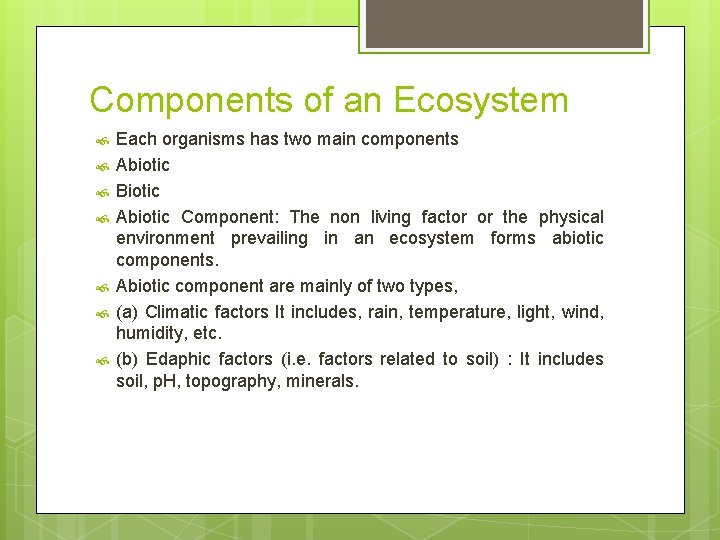
Components of an Ecosystem Each organisms has two main components Abiotic Biotic Abiotic Component: The non living factor or the physical environment prevailing in an ecosystem forms abiotic components. Abiotic component are mainly of two types, (a) Climatic factors It includes, rain, temperature, light, wind, humidity, etc. (b) Edaphic factors (i. e. factors related to soil) : It includes soil, p. H, topography, minerals.
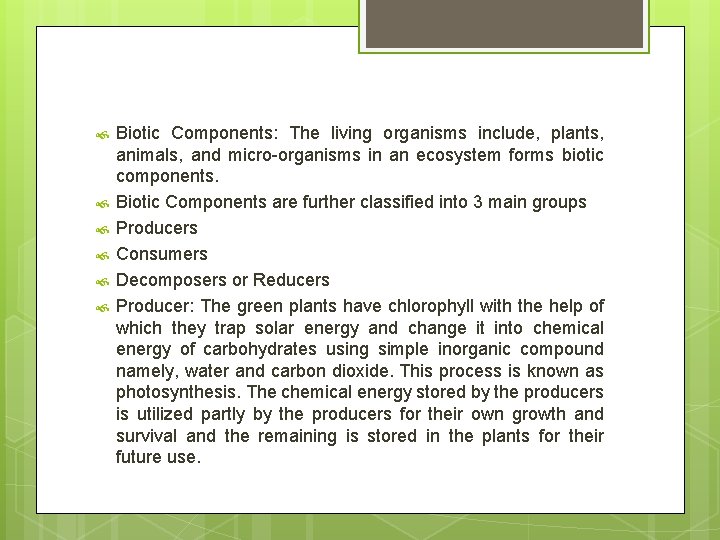
Biotic Components: The living organisms include, plants, animals, and micro-organisms in an ecosystem forms biotic components. Biotic Components are further classified into 3 main groups Producers Consumers Decomposers or Reducers Producer: The green plants have chlorophyll with the help of which they trap solar energy and change it into chemical energy of carbohydrates using simple inorganic compound namely, water and carbon dioxide. This process is known as photosynthesis. The chemical energy stored by the producers is utilized partly by the producers for their own growth and survival and the remaining is stored in the plants for their future use.
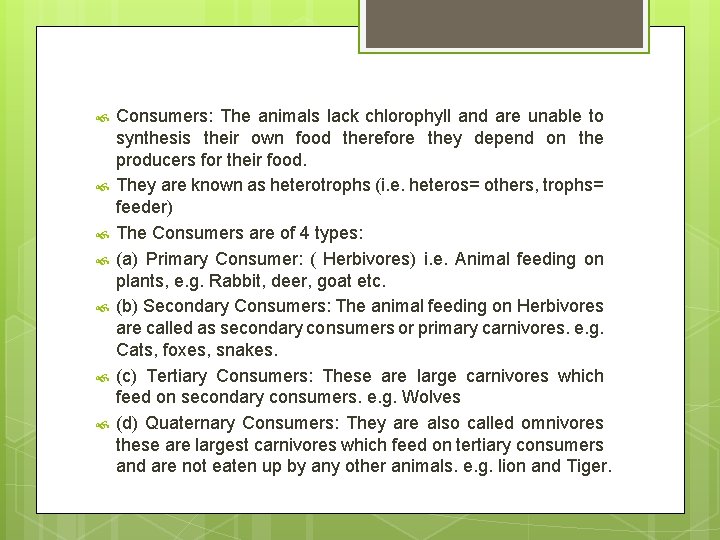
Consumers: The animals lack chlorophyll and are unable to synthesis their own food therefore they depend on the producers for their food. They are known as heterotrophs (i. e. heteros= others, trophs= feeder) The Consumers are of 4 types: (a) Primary Consumer: ( Herbivores) i. e. Animal feeding on plants, e. g. Rabbit, deer, goat etc. (b) Secondary Consumers: The animal feeding on Herbivores are called as secondary consumers or primary carnivores. e. g. Cats, foxes, snakes. (c) Tertiary Consumers: These are large carnivores which feed on secondary consumers. e. g. Wolves (d) Quaternary Consumers: They are also called omnivores these are largest carnivores which feed on tertiary consumers and are not eaten up by any other animals. e. g. lion and Tiger.
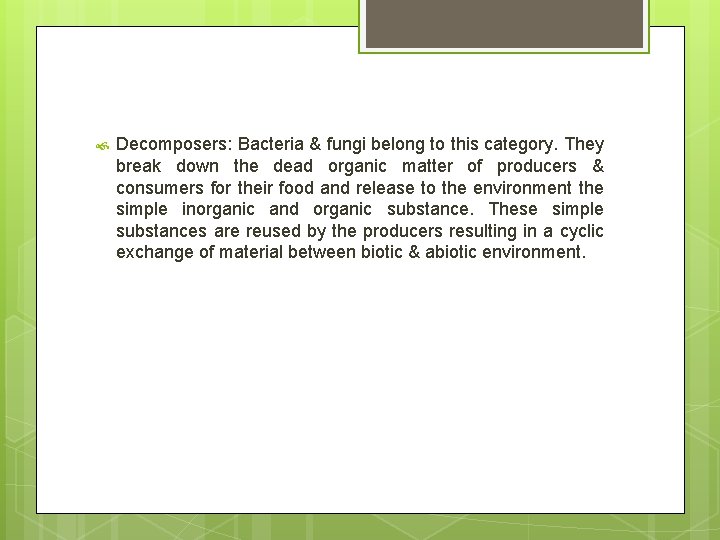
Decomposers: Bacteria & fungi belong to this category. They break down the dead organic matter of producers & consumers for their food and release to the environment the simple inorganic and organic substance. These simple substances are reused by the producers resulting in a cyclic exchange of material between biotic & abiotic environment.
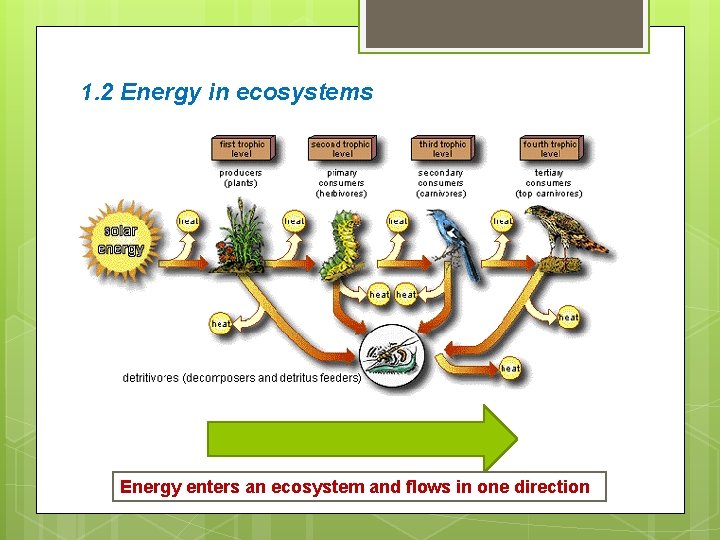
1. 2 Energy in ecosystems Energy enters an ecosystem and flows in one direction
FUNCTION OF AN ECOSYSTEM To understand clearly the nature of ecosystem its functioning should be thoroughly understood. The function of an ecosystem is to allow flow of energy and cycling of nutrients.
Types of Functions of an ecosystem are of three types. 1. Primary function The primary function of all ecosystem is manufacture of starch (photosynthesis). 2. Secondary function The secondary function of all ecosystem is distribution energy in the form of food to all consumers.
Tertiary Function All living systems diet at a particular stage. These dead systems are decomposed to initiate third function of ecosystems namely “cycling”. The functioning of an ecosystems may be understood studying the following terms. • Energy and material flow. • Food chains • Food webs • Food pyramids
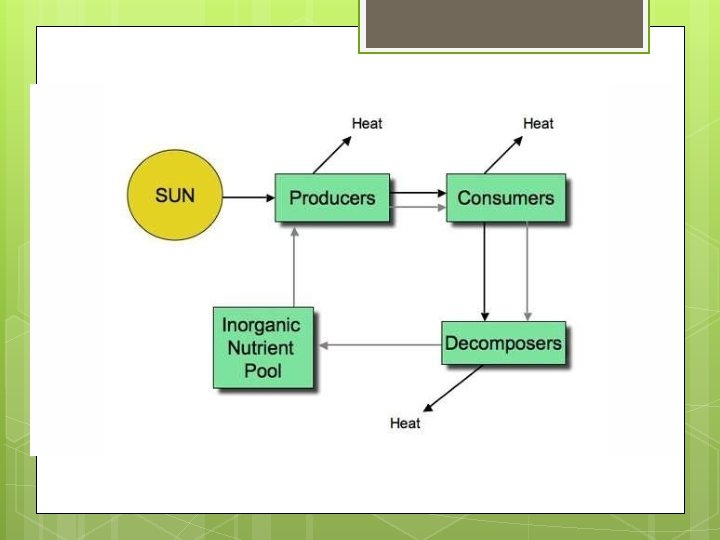
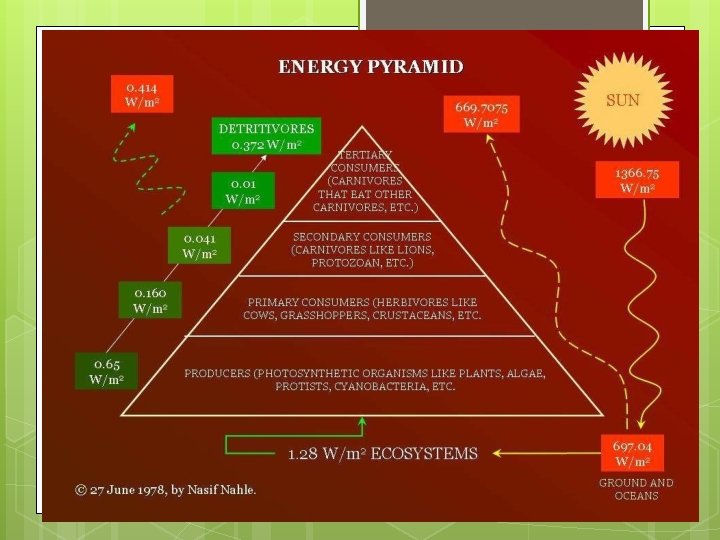
ENERGY FLOW IN THE ECOSYSTEMS Energy is the most essential requirement for all living organism. Solar energy is the only source to our planet earth. Solar energy is transformed to chemical energy in photosynthesis by the plants (called as primary producers). Though a lot of sunlight falls on the green plants, only 1% of it is utilized for photosynthesis. This is the most essential step to provide energy for all other living organisms in the ecosystem. Some amount of chemical energy is used by the plants for their growth and the remaining is transferred to consumers by the process of eating. Thus the energy enters the ecosystems through photosynthesis and passes through the different tropic levels feeding levels.
Energy flow and Thermodynamics The flow of energy through an ecosystem follows the two laws of thermodynamics. 1. I law of thermodynamics It states chat “energy can be created nor destroyed, but it can be considered from one from to another”. Illustration Energy for an ecosystems comes from the sum. It is absorbed by plants, herein it is converted into stored chemical energy i. e. , solar energy in converted into chemical energy. 2. II law of thermodynamics Statement It states that, “Whenever energy is transformed, there is a loss of energy through the release of heat”. Illustration This occurs when energy is transferred between tropic levels. There will be a loss of energy (about 80 -90%) in the form of heat as it moves from one tropic level to another tropic level. The loss of energy takes place through respiration, running, hunting etc. ,
Relationship between structure and function (flow model) From the above it is clear that, the biotic components and abiotic components are linked together through energy flow and nutrient cycling as shown in the following figure.
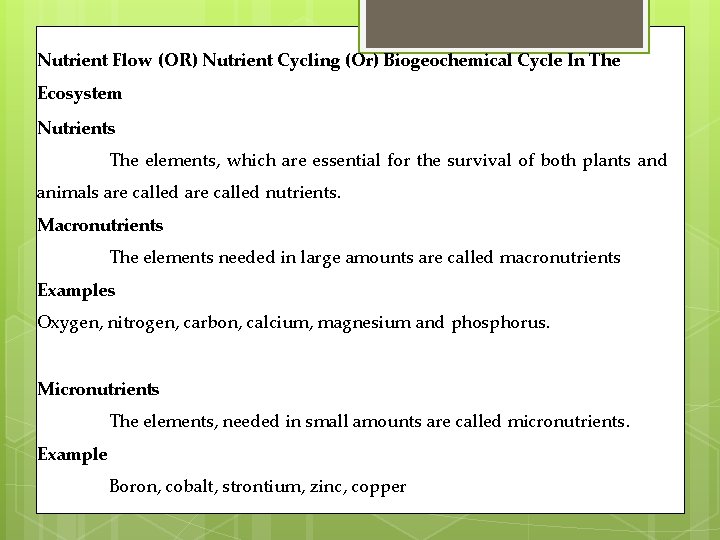
Nutrient Flow (OR) Nutrient Cycling (Or) Biogeochemical Cycle In The Ecosystem Nutrients The elements, which are essential for the survival of both plants and animals are called nutrients. Macronutrients The elements needed in large amounts are called macronutrients Examples Oxygen, nitrogen, carbon, calcium, magnesium and phosphorus. Micronutrients The elements, needed in small amounts are called micronutrients. Example Boron, cobalt, strontium, zinc, copper
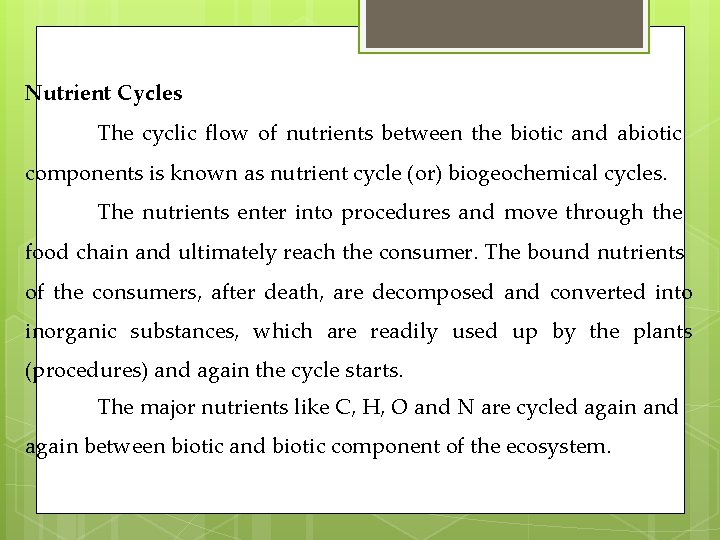
Nutrient Cycles The cyclic flow of nutrients between the biotic and abiotic components is known as nutrient cycle (or) biogeochemical cycles. The nutrients enter into procedures and move through the food chain and ultimately reach the consumer. The bound nutrients of the consumers, after death, are decomposed and converted into inorganic substances, which are readily used up by the plants (procedures) and again the cycle starts. The major nutrients like C, H, O and N are cycled again and again between biotic and biotic component of the ecosystem.
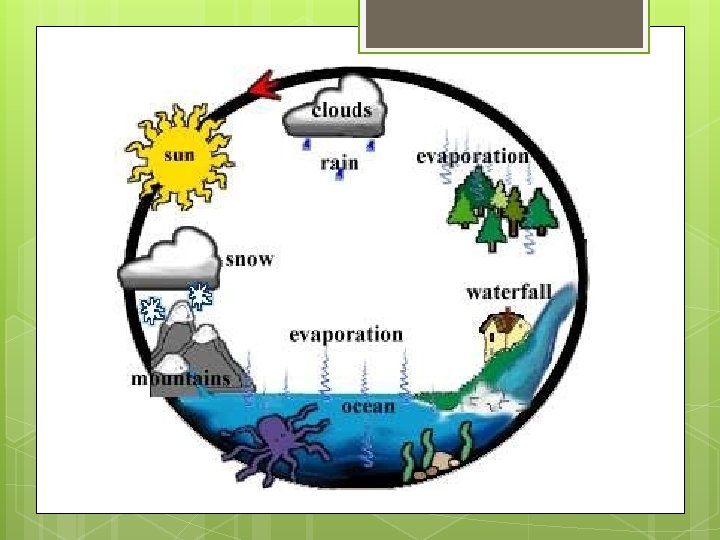
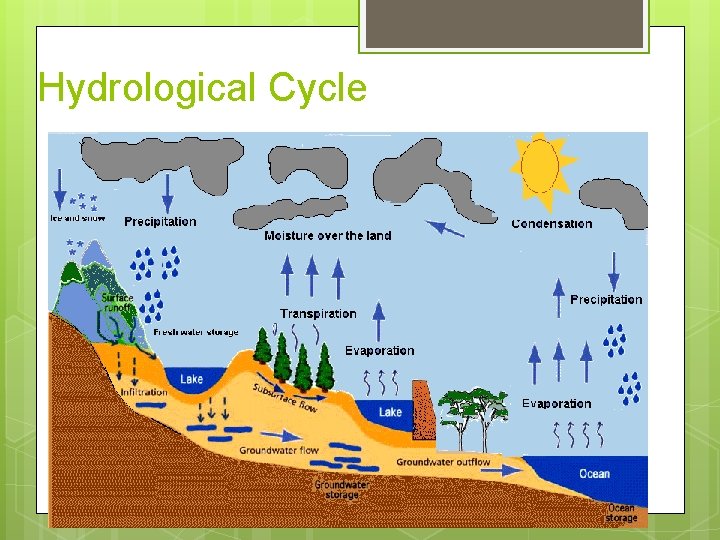
Hydrological Cycle Movement of water in a cyclic manner is known as hydrological cycle.
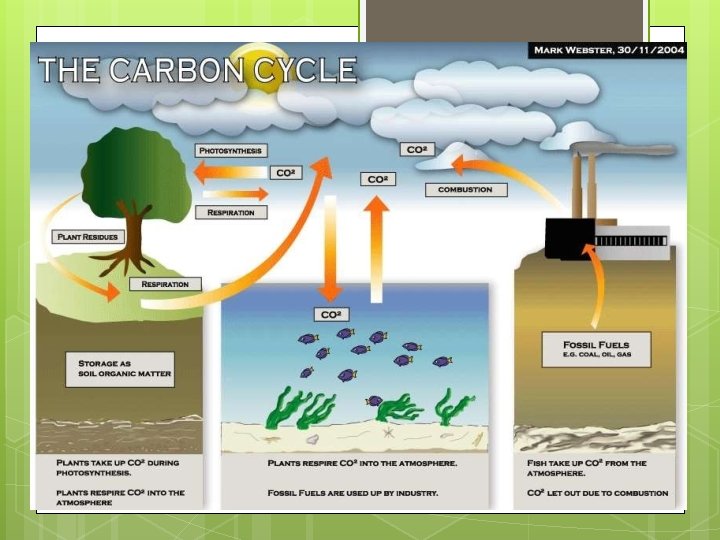
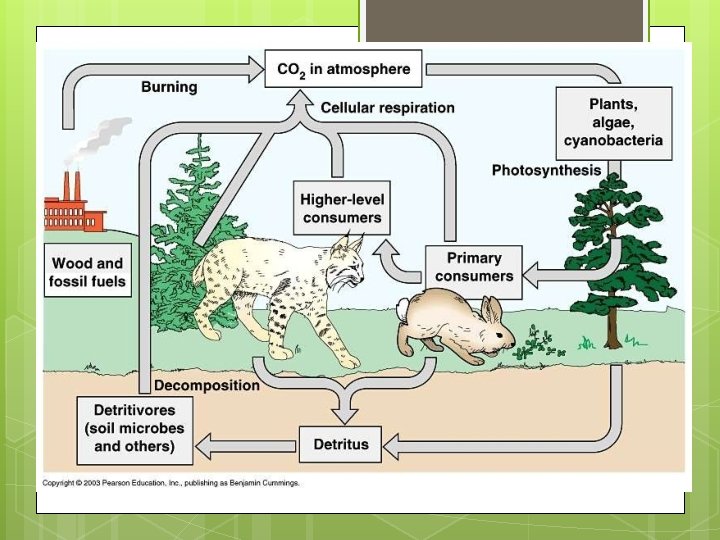
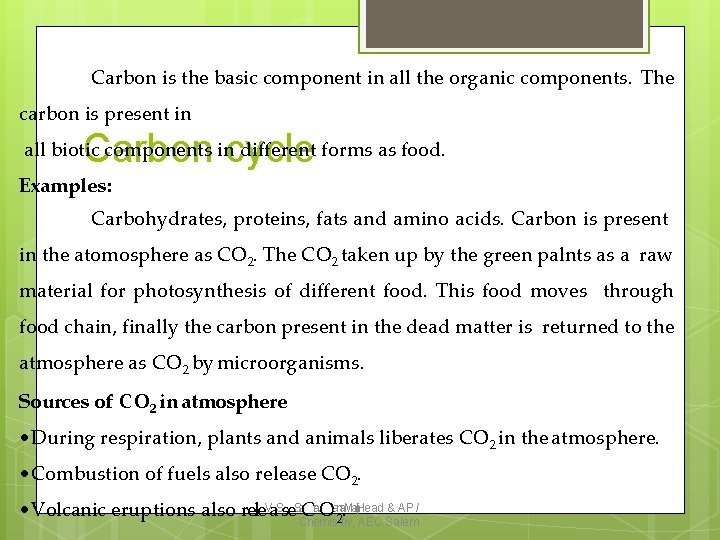
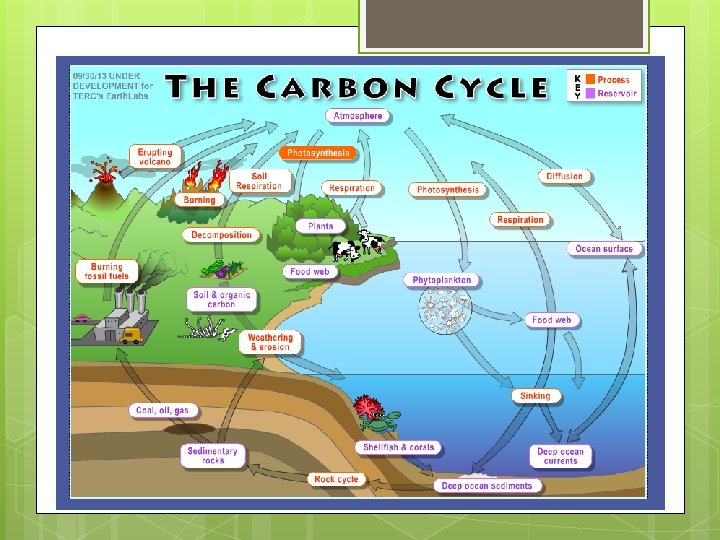
Carbon is the basic component in all the organic components. The carbon is present in Carbon cycle all biotic components in different forms as food. Examples: Carbohydrates, proteins, fats and amino acids. Carbon is present in the atomosphere as CO 2. The CO 2 taken up by the green palnts as a raw material for photosynthesis of different food. This food moves through food chain, finally the carbon present in the dead matter is returned to the atmosphere as CO 2 by microorganisms. Sources of CO 2 in atmosphere • During respiration, plants and animals liberates CO 2 in the atmosphere. • Combustion of fuels also release CO 2. , i & AP / • Volcanic eruptions also rele. Va. S. se. Sa. Chemis Crav. Oan 2 atry, . Man. Head AEC Salem
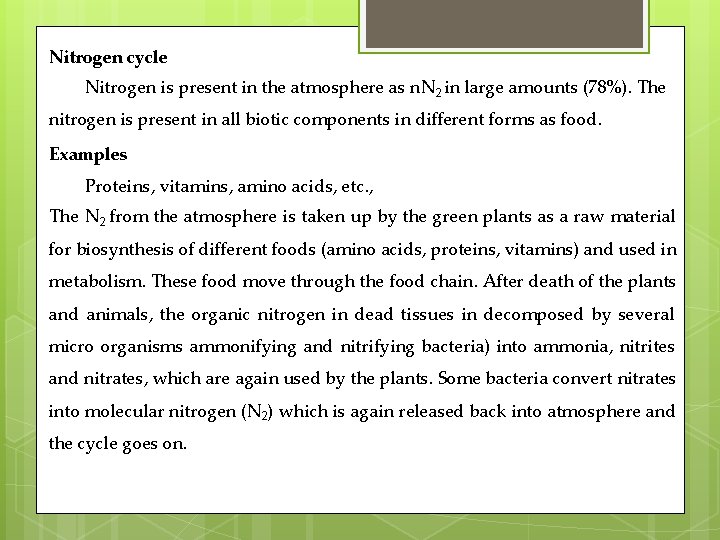
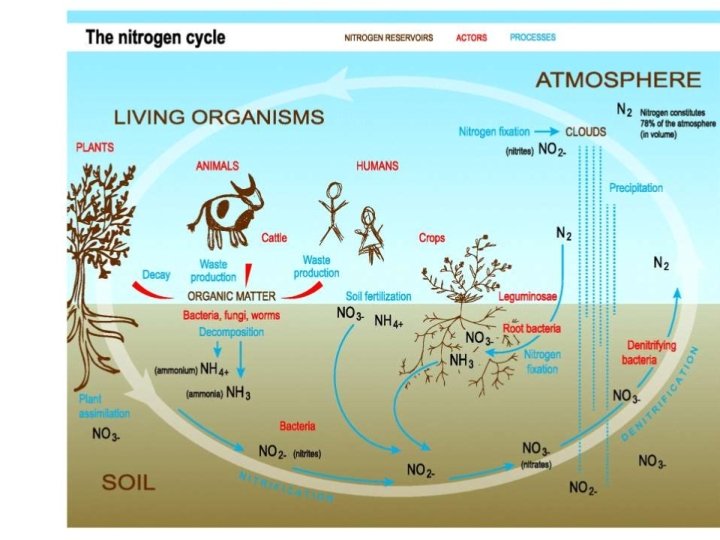
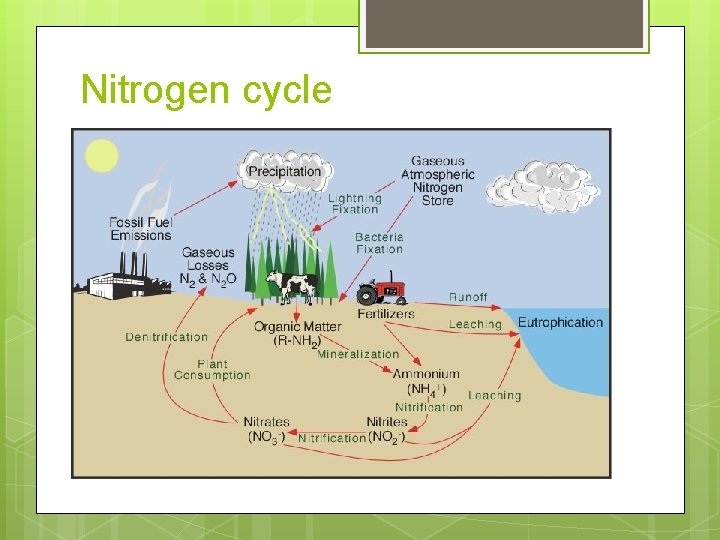
Nitrogen cycle Nitrogen is present in the atmosphere as n. N 2 in large amounts (78%). The nitrogen is present in all biotic components in different forms as food. Examples Proteins, vitamins, amino acids, etc. , The N 2 from the atmosphere is taken up by the green plants as a raw material for biosynthesis of different foods (amino acids, proteins, vitamins) and used in metabolism. These food move through the food chain. After death of the plants and animals, the organic nitrogen in dead tissues in decomposed by several micro organisms ammonifying and nitrifying bacteria) into ammonia, nitrites and nitrates, which are again used by the plants. Some bacteria convert nitrates into molecular nitrogen (N 2) which is again released back into atmosphere and the cycle goes on.
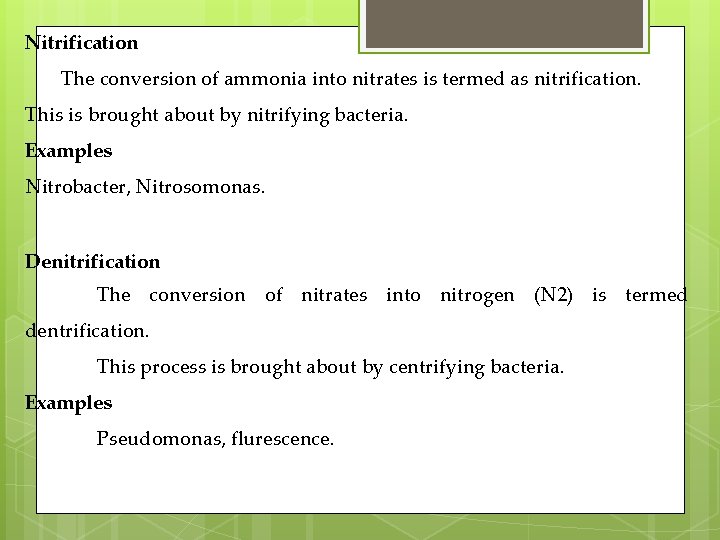
Nitrification The conversion of ammonia into nitrates is termed as nitrification. This is brought about by nitrifying bacteria. Examples Nitrobacter, Nitrosomonas. Denitrification The conversion of nitrates into nitrogen (N 2) is termed dentrification. This process is brought about by centrifying bacteria. Examples Pseudomonas, flurescence.
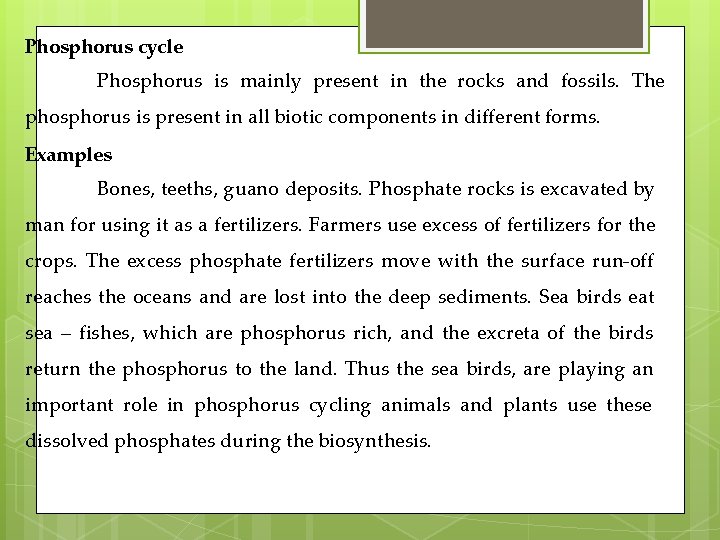
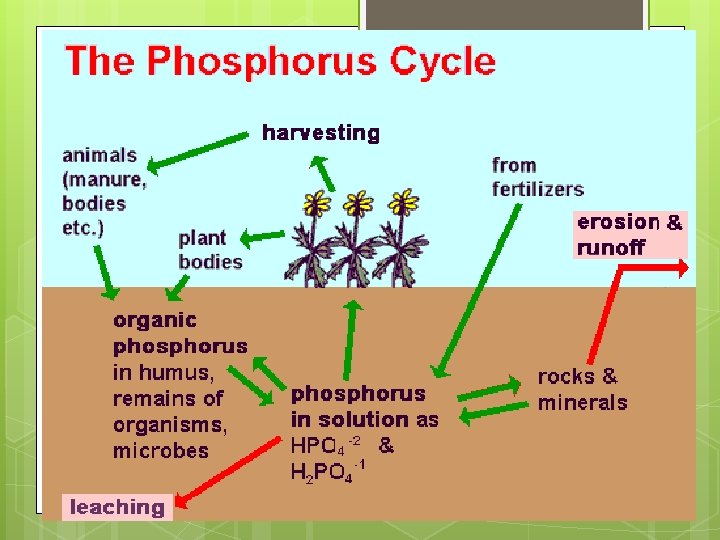
Phosphorus cycle Phosphorus is mainly present in the rocks and fossils. The phosphorus is present in all biotic components in different forms. Examples Bones, teeths, guano deposits. Phosphate rocks is excavated by man for using it as a fertilizers. Farmers use excess of fertilizers for the crops. The excess phosphate fertilizers move with the surface run-off reaches the oceans and are lost into the deep sediments. Sea birds eat sea – fishes, which are phosphorus rich, and the excreta of the birds return the phosphorus to the land. Thus the sea birds, are playing an important role in phosphorus cycling animals and plants use these dissolved phosphates during the biosynthesis.
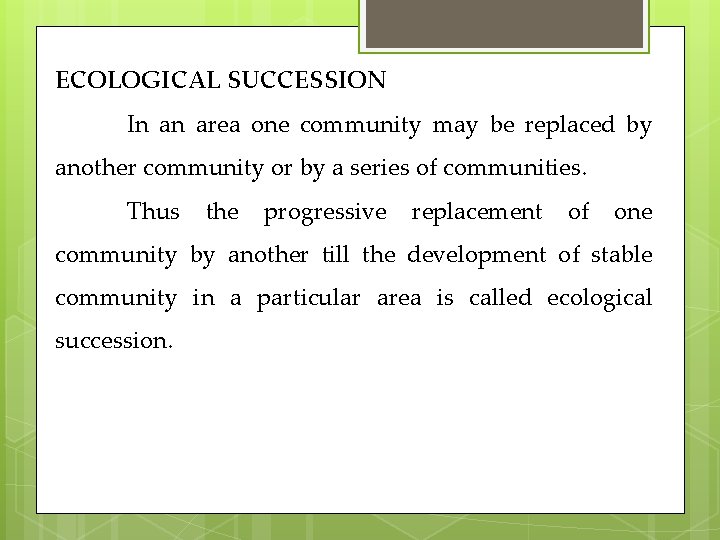
ECOLOGICAL SUCCESSION In an area one community may be replaced by another community or by a series of communities. Thus the progressive replacement of one community by another till the development of stable community in a particular area is called ecological succession.
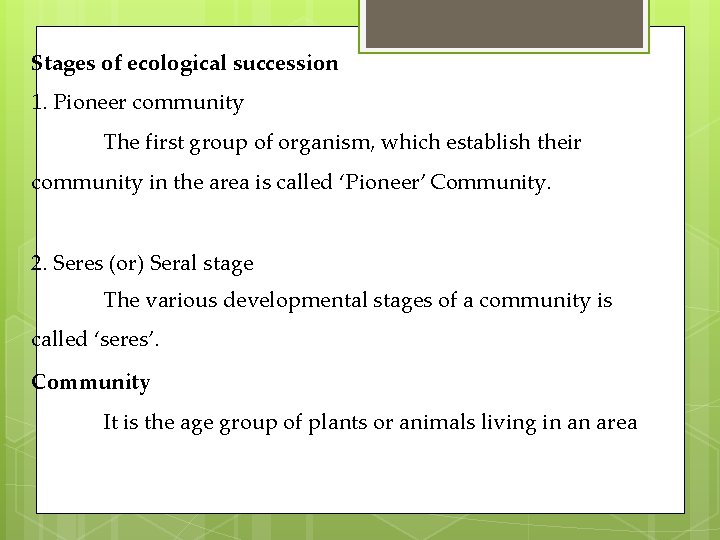
Stages of ecological succession 1. Pioneer community The first group of organism, which establish their community in the area is called ‘Pioneer’ Community. 2. Seres (or) Seral stage The various developmental stages of a community is called ‘seres’. Community It is the age group of plants or animals living in an area
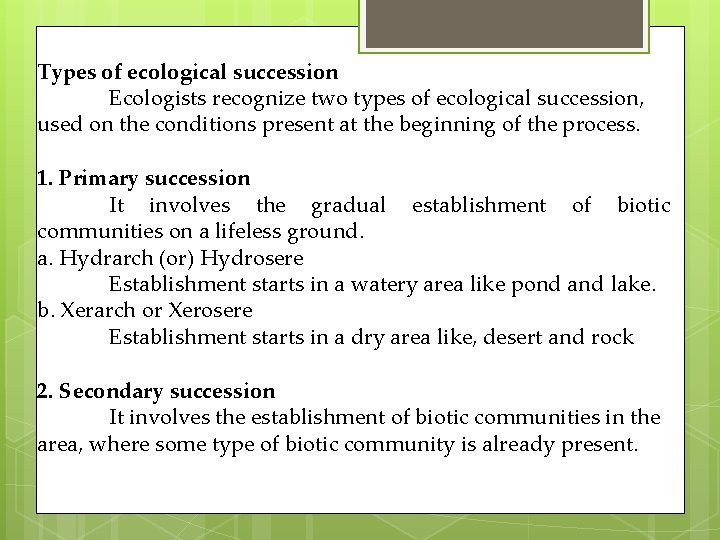
Types of ecological succession Ecologists recognize two types of ecological succession, used on the conditions present at the beginning of the process. 1. Primary succession It involves the gradual establishment of biotic communities on a lifeless ground. a. Hydrarch (or) Hydrosere Establishment starts in a watery area like pond and lake. b. Xerarch or Xerosere Establishment starts in a dry area like, desert and rock 2. Secondary succession It involves the establishment of biotic communities in the area, where some type of biotic community is already present.
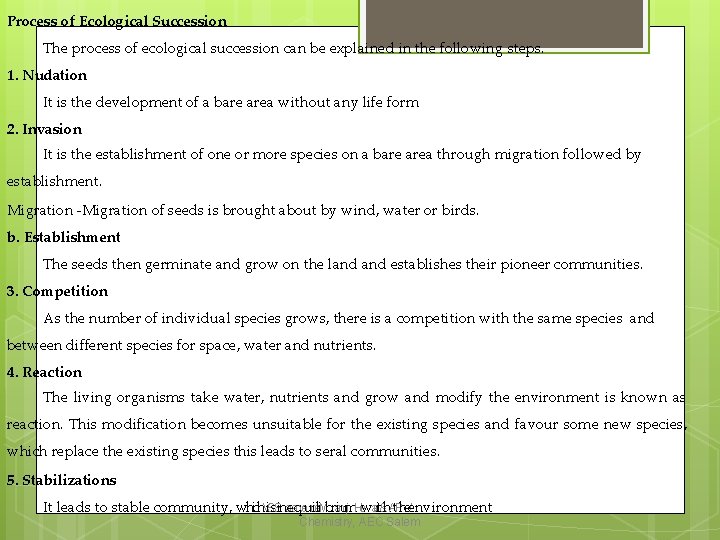
Process of Ecological Succession The process of ecological succession can be explained in the following steps. 1. Nudation It is the development of a bare area without any life form 2. Invasion It is the establishment of one or more species on a bare area through migration followed by establishment. Migration -Migration of seeds is brought about by wind, water or birds. b. Establishment The seeds then germinate and grow on the land establishes their pioneer communities. 3. Competition As the number of individual species grows, there is a competition with the same species and between different species for space, water and nutrients. 4. Reaction The living organisms take water, nutrients and grow and modify the environment is known as reaction. This modification becomes unsuitable for the existing species and favour some new species, which replace the existing species this leads to seral communities. 5. Stabilizations , i Hewadit&h. At. Pheenvironment / It leads to stable community, which. Vi. Ss. S. inaeraqvauniali. Mbrainum Chemistry, AEC Salem
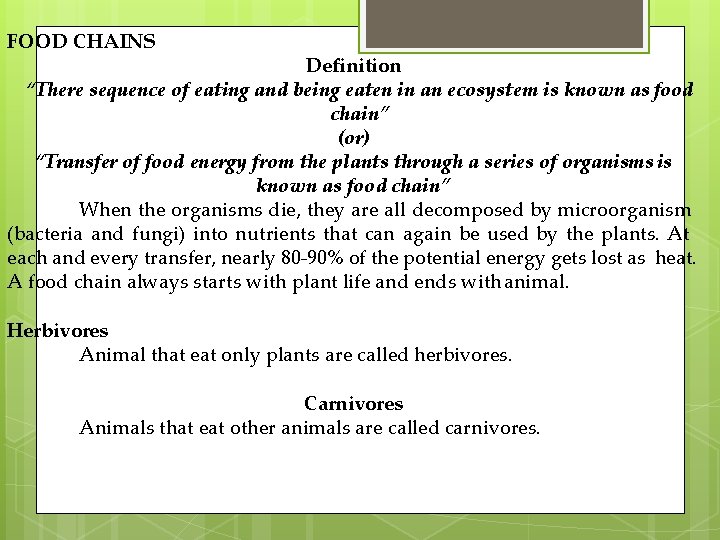
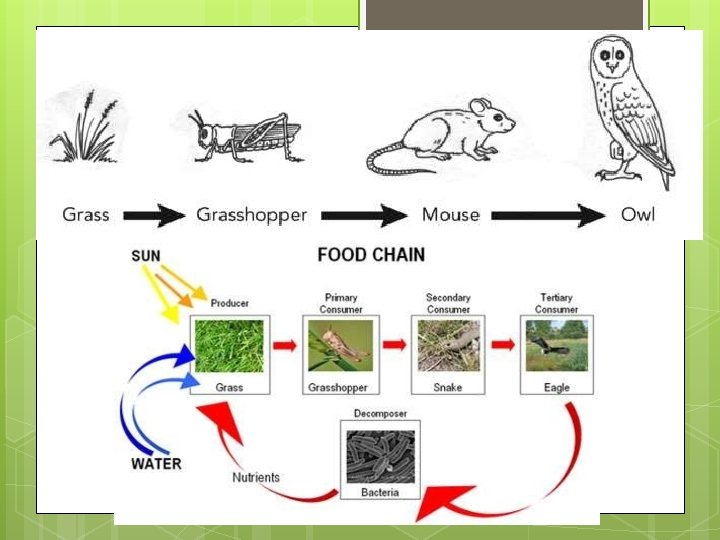
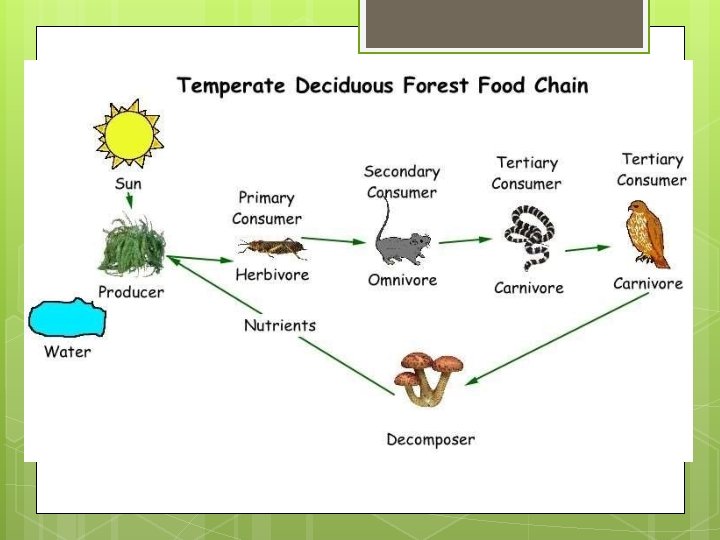
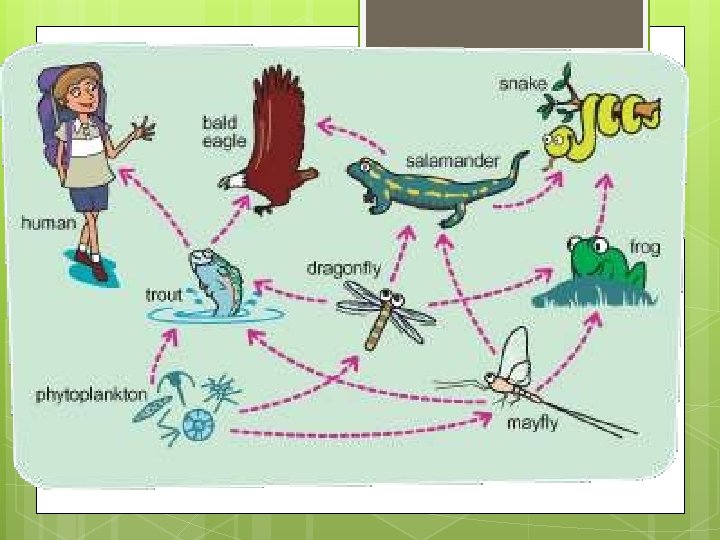
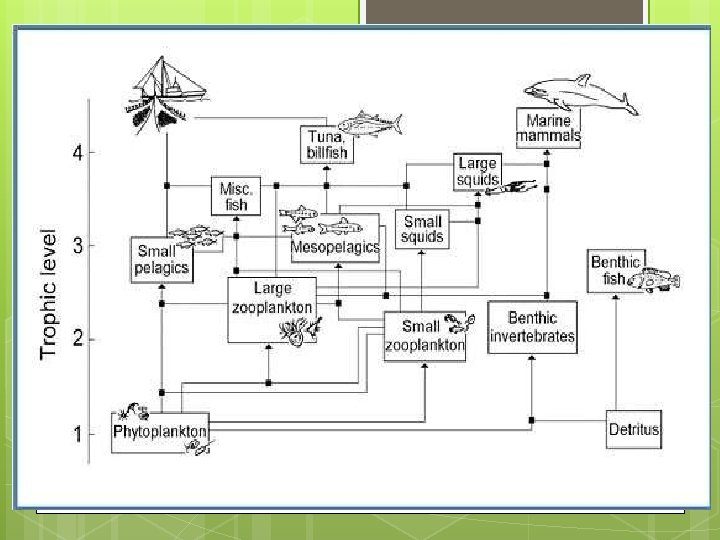
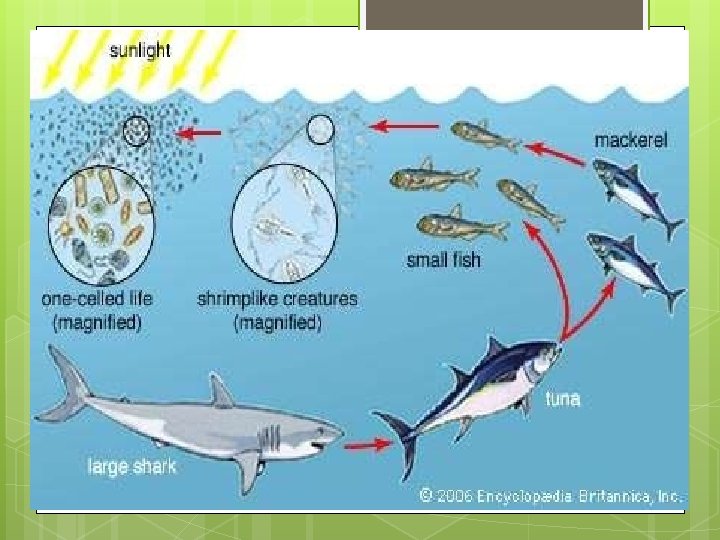
FOOD CHAINS Definition “There sequence of eating and being eaten in an ecosystem is known as food chain” (or) “Transfer of food energy from the plants through a series of organisms is known as food chain” When the organisms die, they are all decomposed by microorganism (bacteria and fungi) into nutrients that can again be used by the plants. At each and every transfer, nearly 80 -90% of the potential energy gets lost as heat. A food chain always starts with plant life and ends with animal. Herbivores Animal that eat only plants are called herbivores. Carnivores Animals that eat other animals are called carnivores.
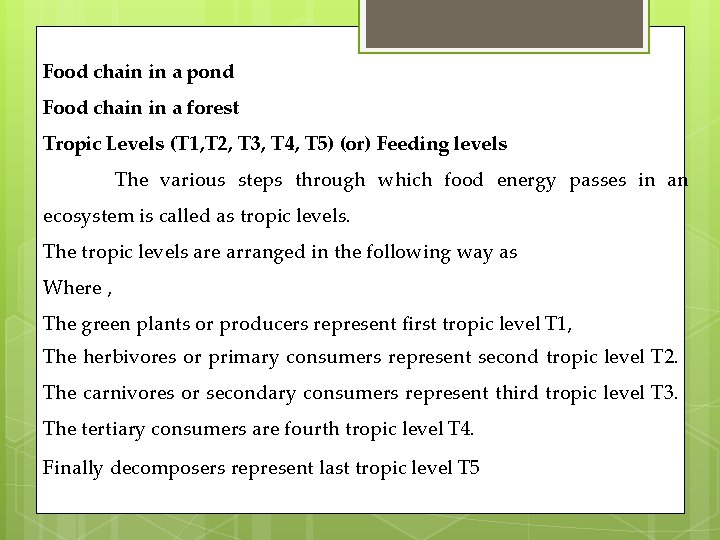
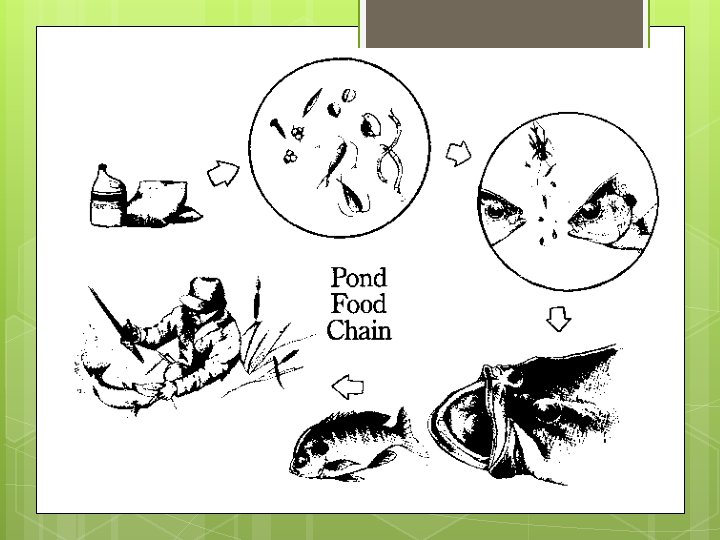
Food chain in a pond Food chain in a forest Tropic Levels (T 1, T 2, T 3, T 4, T 5) (or) Feeding levels The various steps through which food energy passes in an ecosystem is called as tropic levels. The tropic levels are arranged in the following way as Where , The green plants or producers represent first tropic level T 1, The herbivores or primary consumers represent second tropic level T 2. The carnivores or secondary consumers represent third tropic level T 3. The tertiary consumers are fourth tropic level T 4. Finally decomposers represent last tropic level T 5
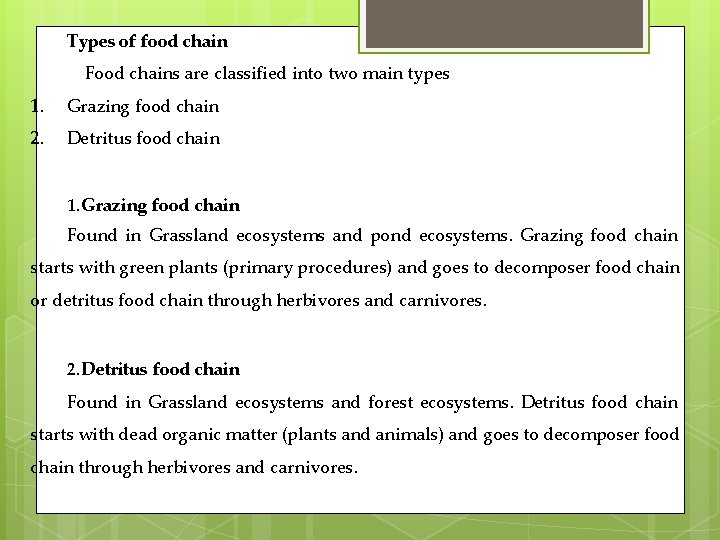
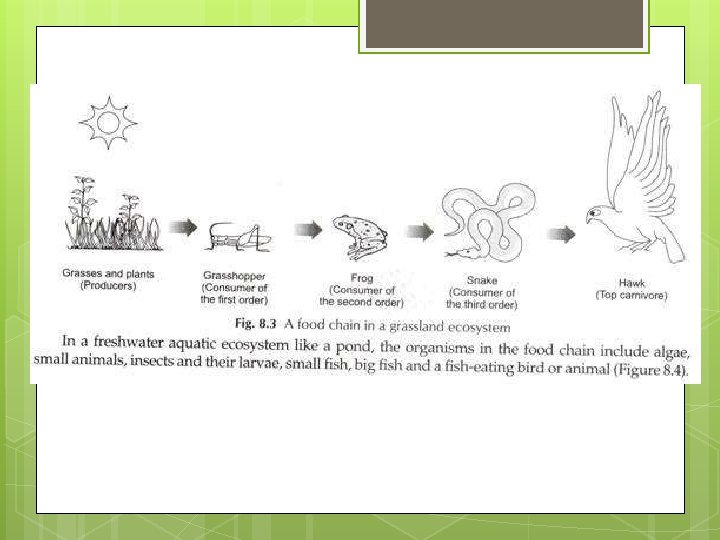
Types of food chain Food chains are classified into two main types 1. Grazing food chain 2. Detritus food chain 1. Grazing food chain Found in Grassland ecosystems and pond ecosystems. Grazing food chain starts with green plants (primary procedures) and goes to decomposer food chain or detritus food chain through herbivores and carnivores. 2. Detritus food chain Found in Grassland ecosystems and forest ecosystems. Detritus food chain starts with dead organic matter (plants and animals) and goes to decomposer food chain through herbivores and carnivores.
Flow diagram The following flow diagram of grazing food chain and detritus food chain shows that they are interconnected to each other but are not isolated.
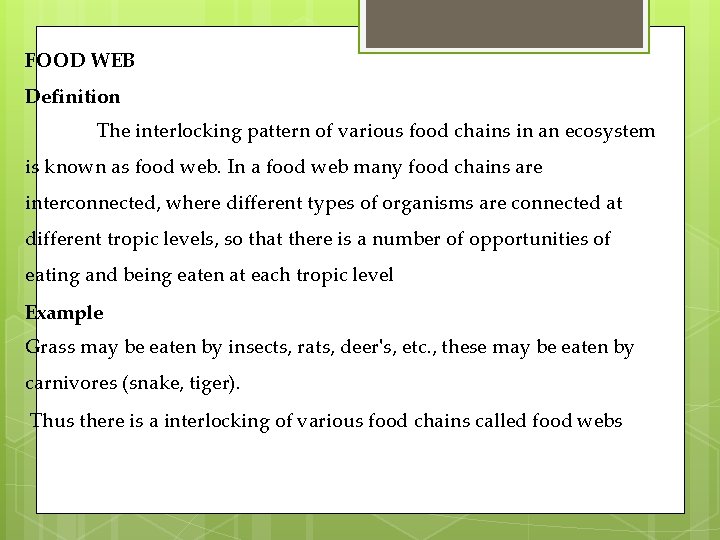
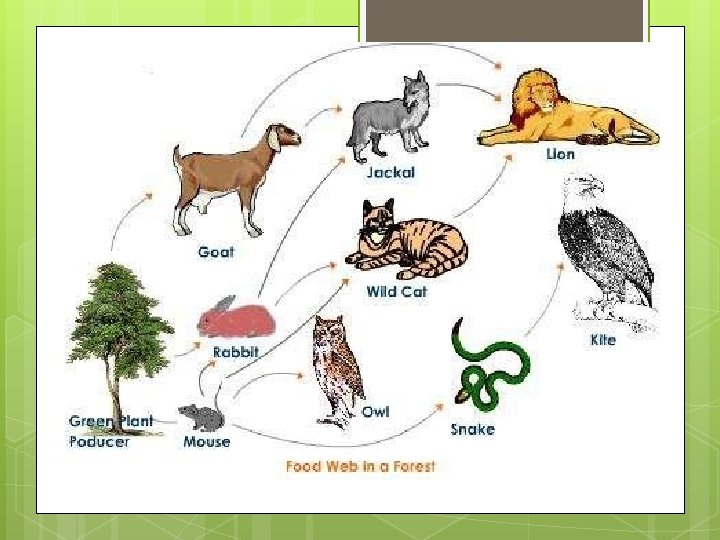
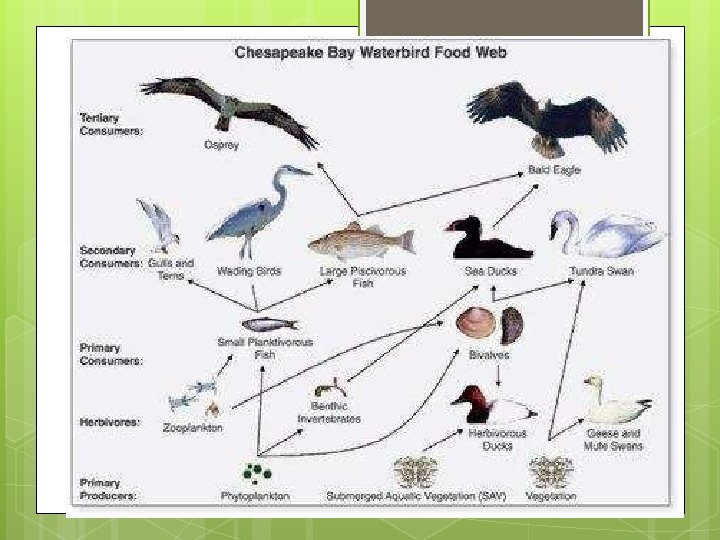
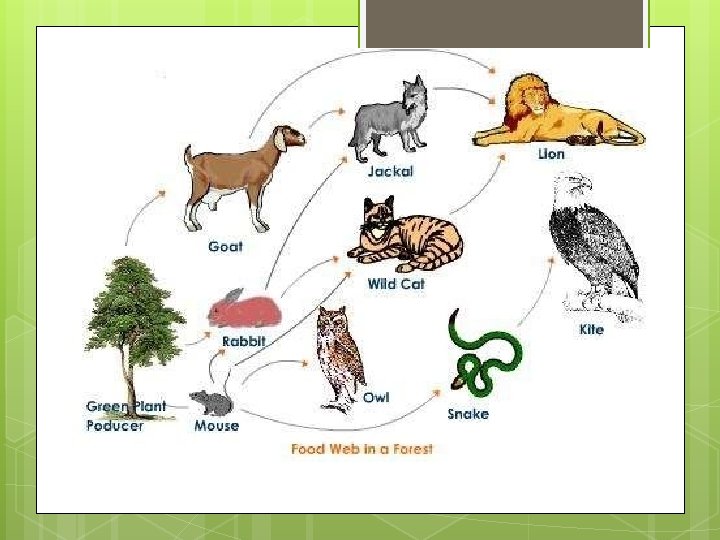
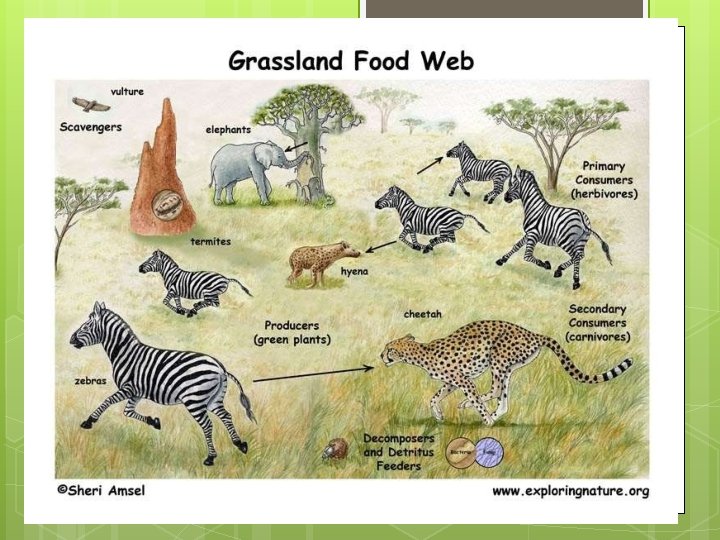
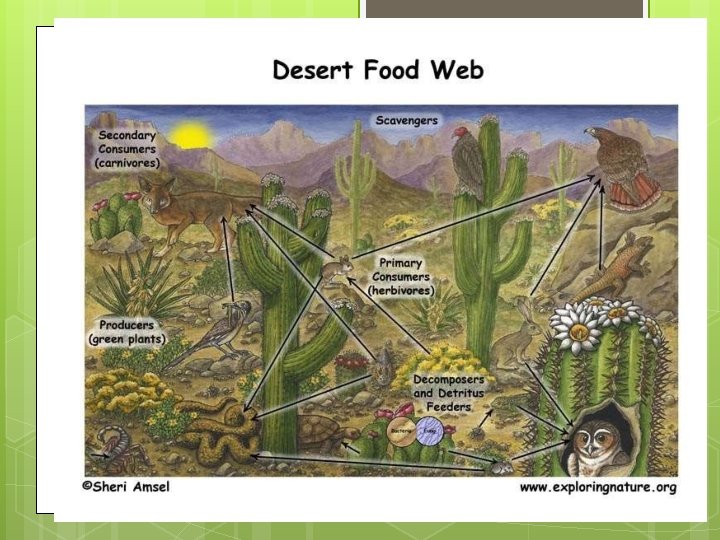
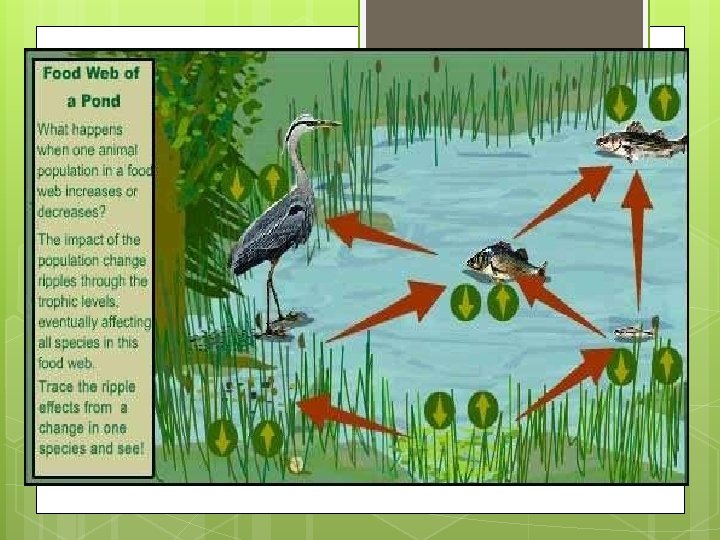
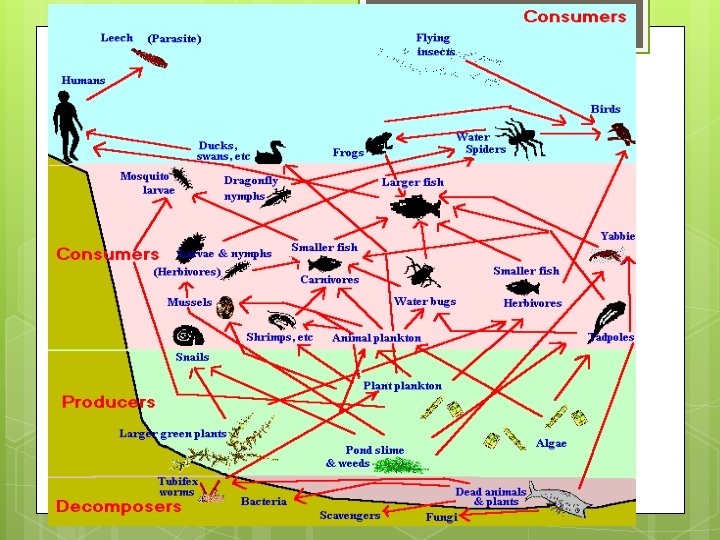
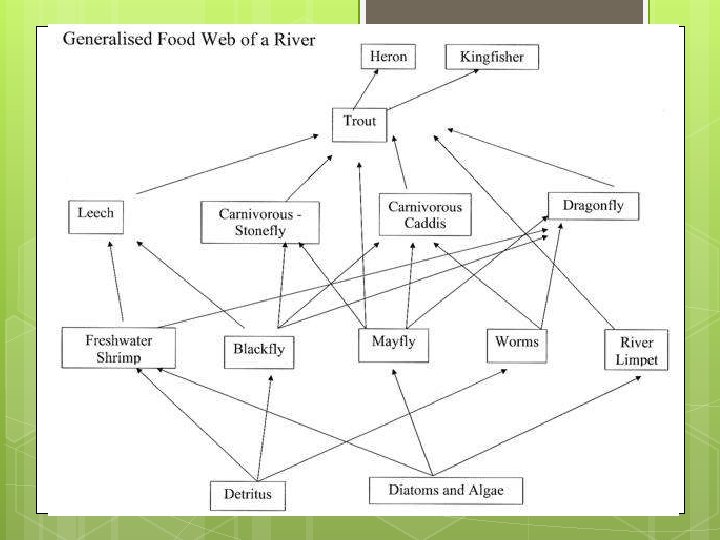
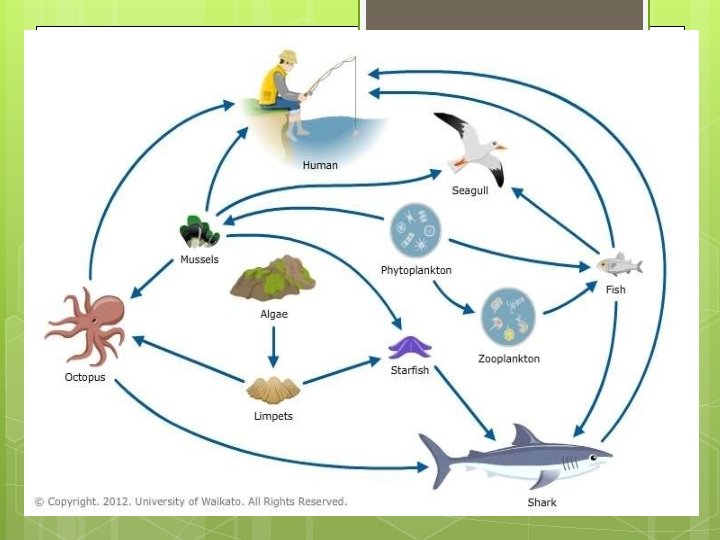
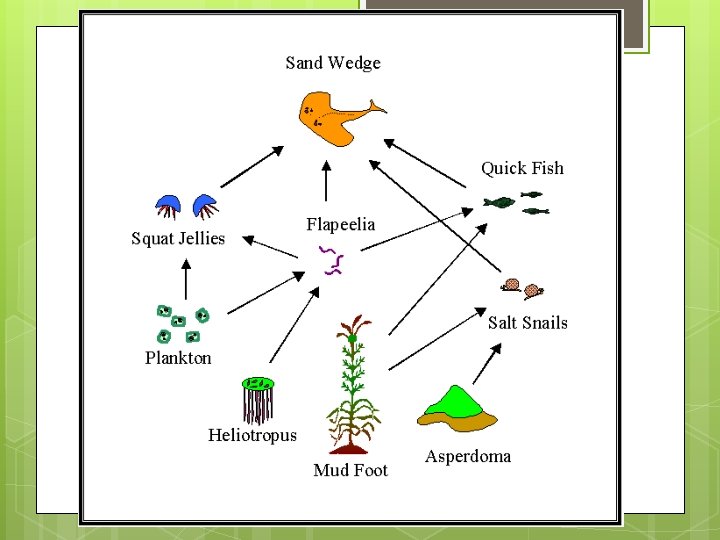
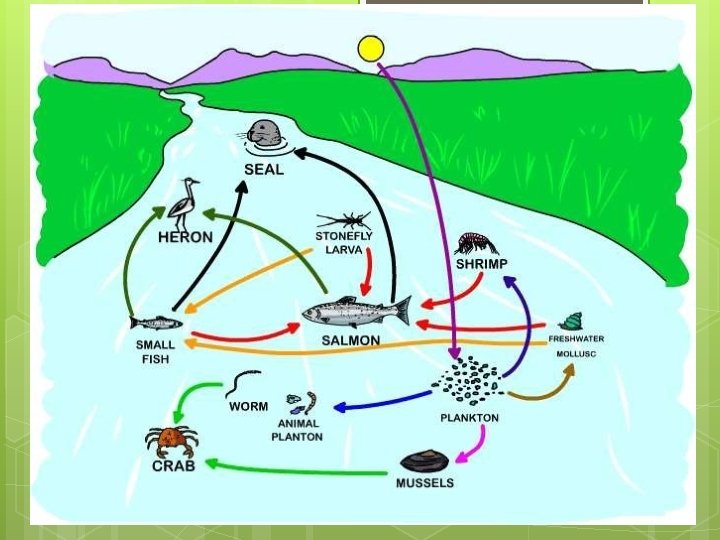
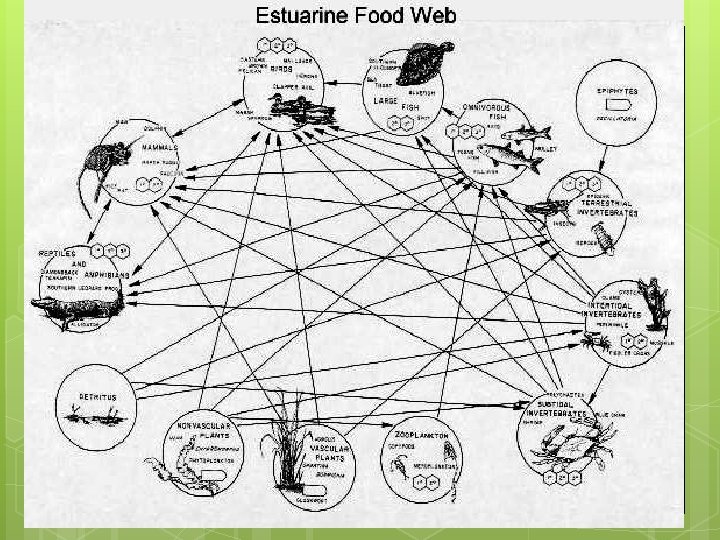
FOOD WEB Definition The interlocking pattern of various food chains in an ecosystem is known as food web. In a food web many food chains are interconnected, where different types of organisms are connected at different tropic levels, so that there is a number of opportunities of eating and being eaten at each tropic level Example Grass may be eaten by insects, rats, deer's, etc. , these may be eaten by carnivores (snake, tiger). Thus there is a interlocking of various food chains called food webs
Difference between food chains and food web In a linear food chains if one species gets affected (or) becomes extinct, then the species in the subsequent tropic levels are also affected. But, in a food web, if one species gets affected, it doest not affect other tropic levels so seriously. There are number of options available at each tropic level.
Significance of food chains and food webs 1. Food chains and food webs play a very important role in the ecosystem. Energy flow and nutrient 2. cycling takes place through them. 3. They maintain and regulate the population size of different tropic levels, and thus help in maintaining ecological balance. 4. They have the property of bio-magnification. The non – biodegradable materials keep on passing from one tropic level to another. At each successive tropic level, the concentration keep on increasing. This process is known as bio-magnification.
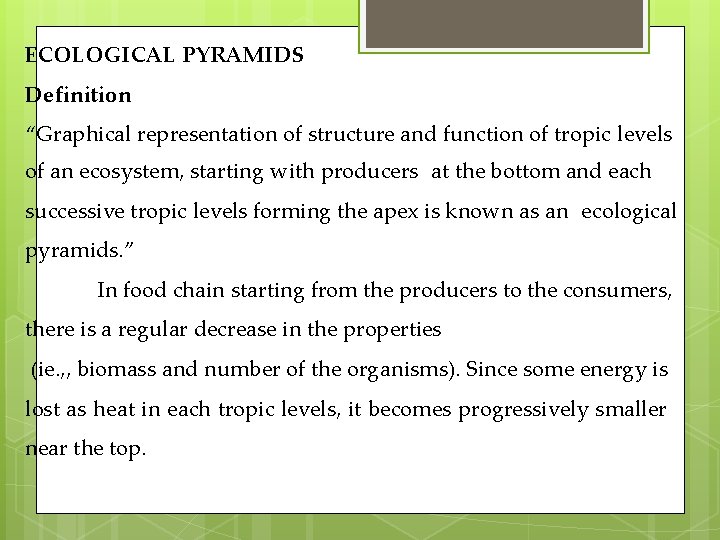
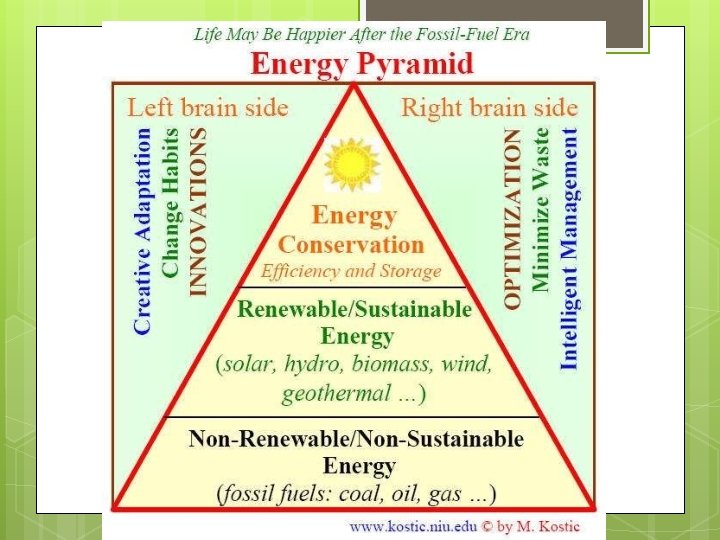
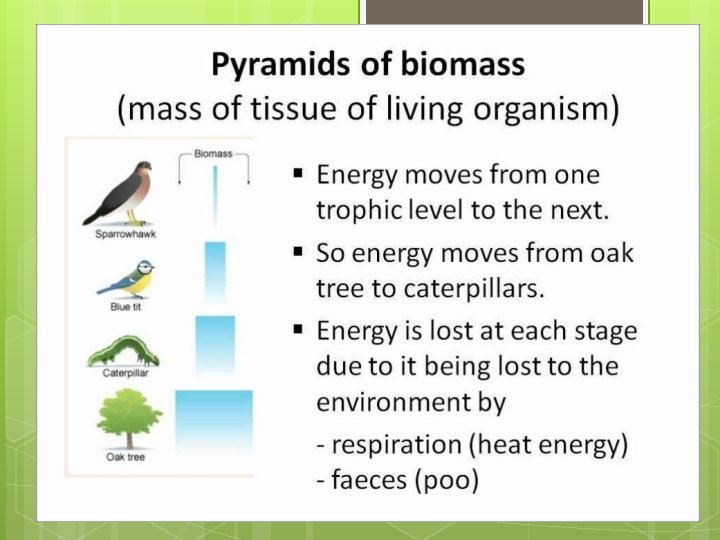
ECOLOGICAL PYRAMIDS Definition “Graphical representation of structure and function of tropic levels of an ecosystem, starting with producers at the bottom and each successive tropic levels forming the apex is known as an ecological pyramids. ” In food chain starting from the producers to the consumers, there is a regular decrease in the properties (ie. , , biomass and number of the organisms). Since some energy is lost as heat in each tropic levels, it becomes progressively smaller near the top.
Types of Ecological pyramids 1. Pyramid of numbers. 2. Pyramid of energy. 3. Pyramid of biomass.
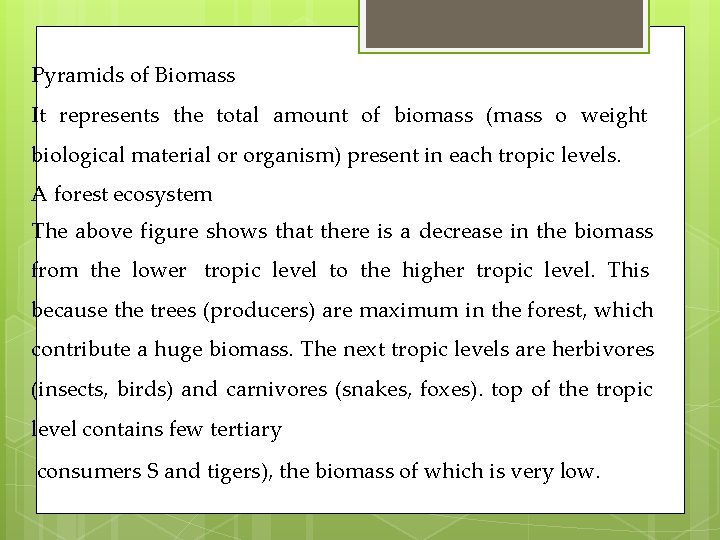
Pyramids of Biomass It represents the total amount of biomass (mass o weight biological material or organism) present in each tropic levels. A forest ecosystem The above figure shows that there is a decrease in the biomass from the lower tropic level to the higher tropic level. This because the trees (producers) are maximum in the forest, which contribute a huge biomass. The next tropic levels are herbivores (insects, birds) and carnivores (snakes, foxes). top of the tropic level contains few tertiary consumers S and tigers), the biomass of which is very low.
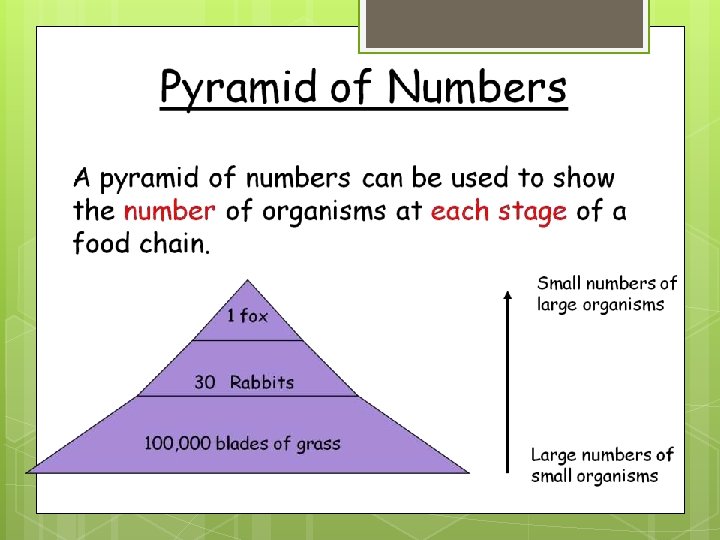
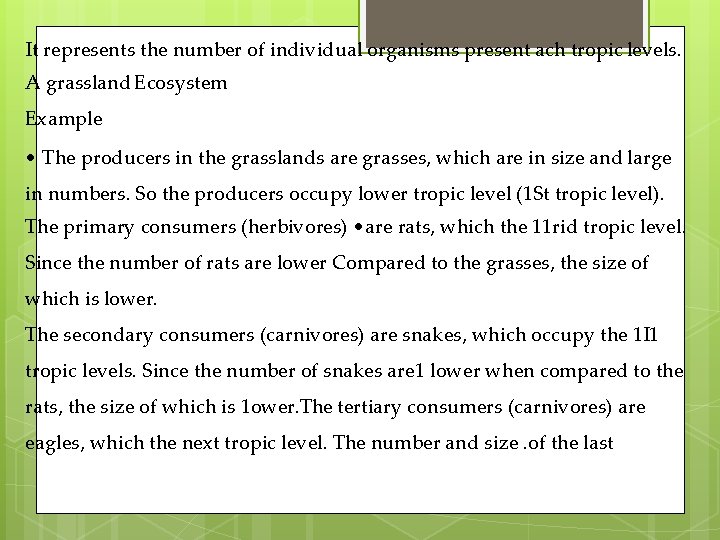
It represents the number of individual organisms present ach tropic levels. A grassland Ecosystem Example • The producers in the grasslands are grasses, which are in size and large in numbers. So the producers occupy lower tropic level (1 St tropic level). The primary consumers (herbivores) • are rats, which the 11 rid tropic level. Since the number of rats are lower Compared to the grasses, the size of which is lower. The secondary consumers (carnivores) are snakes, which occupy the 1 I 1 tropic levels. Since the number of snakes are 1 lower when compared to the rats, the size of which is 1 ower. The tertiary consumers (carnivores) are eagles, which the next tropic level. The number and size. of the last
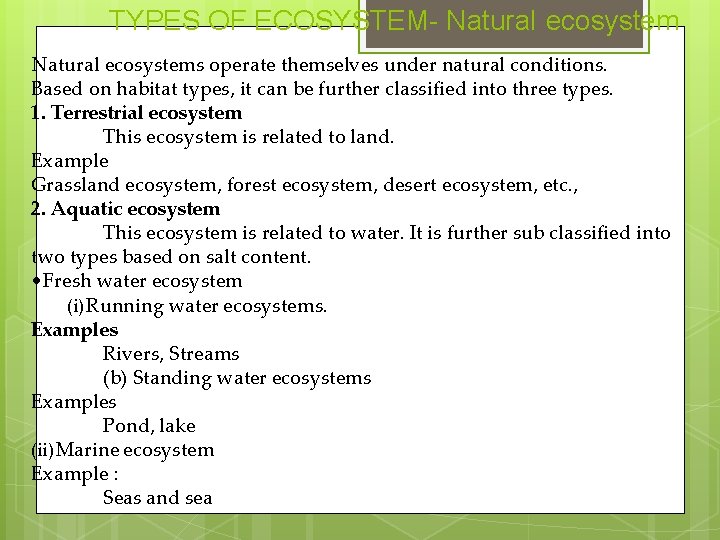
TYPES OF ECOSYSTEM- Natural ecosystems operate themselves under natural conditions. Based on habitat types, it can be further classified into three types. 1. Terrestrial ecosystem This ecosystem is related to land. Example Grassland ecosystem, forest ecosystem, desert ecosystem, etc. , 2. Aquatic ecosystem This ecosystem is related to water. It is further sub classified into two types based on salt content. • Fresh water ecosystem (i) Running water ecosystems. Examples Rivers, Streams (b) Standing water ecosystems Examples Pond, lake (ii)Marine ecosystem Example : Seas and sea
Man – made (or) Artificial ecosystems Artificial ecosystem is operated (or) maintained by man himself. Example Croplands, gardens
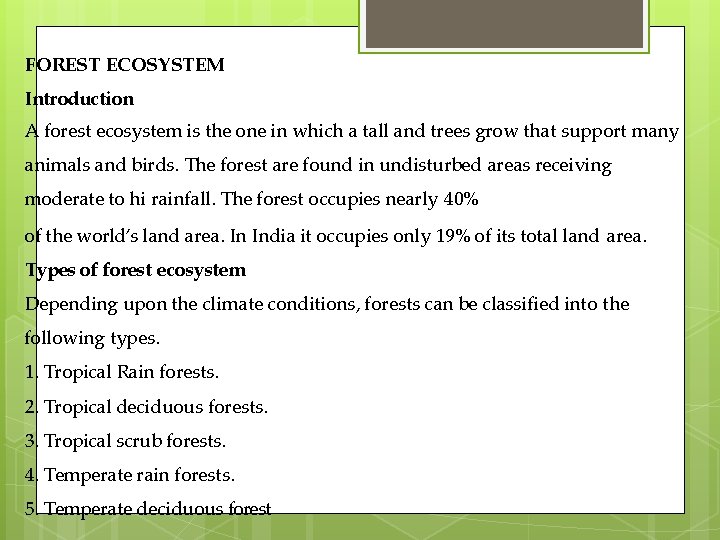
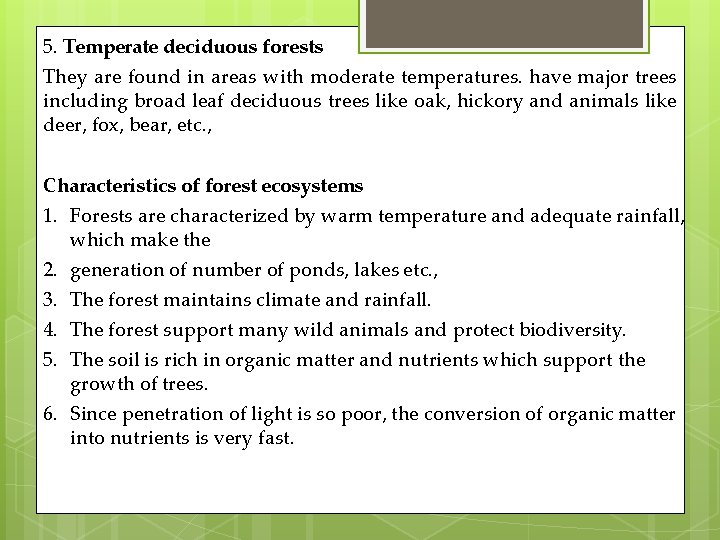
FOREST ECOSYSTEM Introduction A forest ecosystem is the one in which a tall and trees grow that support many animals and birds. The forest are found in undisturbed areas receiving moderate to hi rainfall. The forest occupies nearly 40% of the world’s land area. In India it occupies only 19% of its total land area. Types of forest ecosystem Depending upon the climate conditions, forests can be classified into the following types. 1. Tropical Rain forests. 2. Tropical deciduous forests. 3. Tropical scrub forests. 4. Temperate rain forests. 5. Temperate deciduous forest
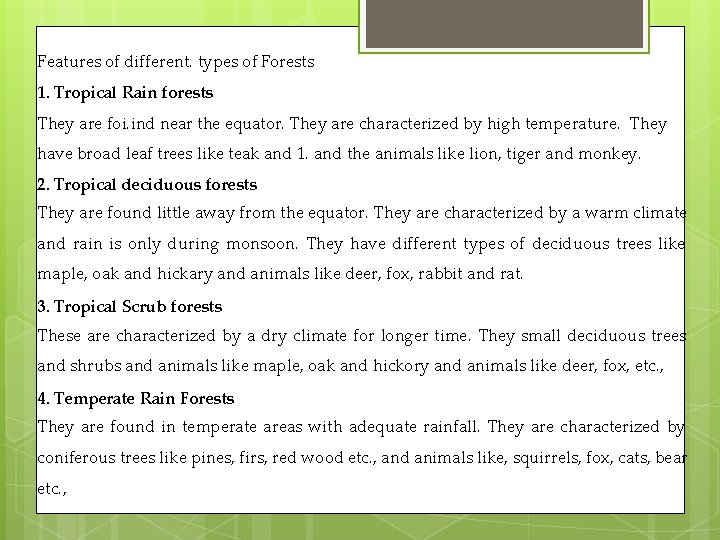
Features of different. types of Forests 1. Tropical Rain forests They are foi. ind near the equator. They are characterized by high temperature. They have broad leaf trees like teak and 1. and the animals like lion, tiger and monkey. 2. Tropical deciduous forests They are found little away from the equator. They are characterized by a warm climate and rain is only during monsoon. They have different types of deciduous trees like maple, oak and hickary and animals like deer, fox, rabbit and rat. 3. Tropical Scrub forests These are characterized by a dry climate for longer time. They small deciduous trees and shrubs and animals like maple, oak and hickory and animals like deer, fox, etc. , 4. Temperate Rain Forests They are found in temperate areas with adequate rainfall. They are characterized by coniferous trees like pines, firs, red wood etc. , and animals like, squirrels, fox, cats, bear etc. ,
5. Temperate deciduous forests They are found in areas with moderate temperatures. have major trees including broad leaf deciduous trees like oak, hickory and animals like deer, fox, bear, etc. , Characteristics of forest ecosystems 1. Forests are characterized by warm temperature and adequate rainfall, which make the 2. generation of number of ponds, lakes etc. , 3. The forest maintains climate and rainfall. 4. The forest support many wild animals and protect biodiversity. 5. The soil is rich in organic matter and nutrients which support the growth of trees. 6. Since penetration of light is so poor, the conversion of organic matter into nutrients is very fast.
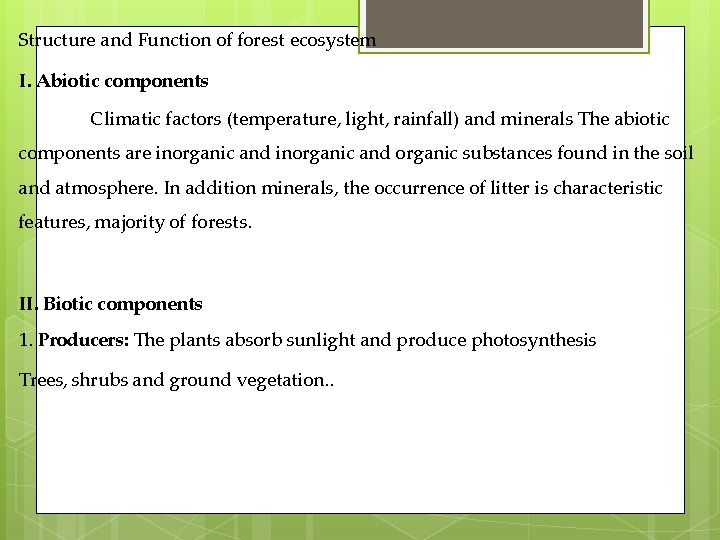
Structure and Function of forest ecosystem I. Abiotic components Climatic factors (temperature, light, rainfall) and minerals The abiotic components are inorganic and organic substances found in the soil and atmosphere. In addition minerals, the occurrence of litter is characteristic features, majority of forests. II. Biotic components 1. Producers: The plants absorb sunlight and produce photosynthesis Trees, shrubs and ground vegetation. .
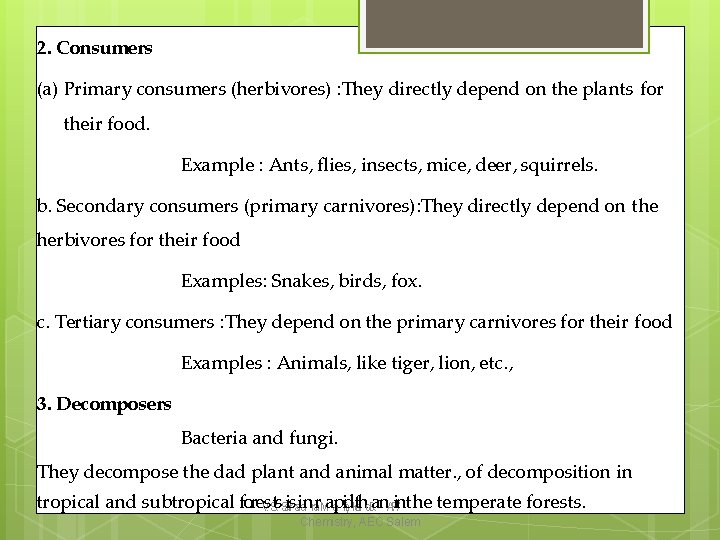
2. Consumers (a) Primary consumers (herbivores) : They directly depend on the plants for their food. Example : Ants, flies, insects, mice, deer, squirrels. b. Secondary consumers (primary carnivores): They directly depend on the herbivores for their food Examples: Snakes, birds, fox. c. Tertiary consumers : They depend on the primary carnivores for their food Examples : Animals, like tiger, lion, etc. , 3. Decomposers Bacteria and fungi. They decompose the dad plant and animal matter. , of decomposition in tropical and subtropical fore. Vs. Sts. Saisr aviannar. Maapnid i, H e athd&an. APin / the temperate forests. Chemistry, AEC Salem
Grassland Ecosystem: Grassland occupies about 20% of earth’s surface addition to grass species, some trees and shrubs are/also pre in grasslands. Limited grazing helps to improve the net primary production of the grasslands. But, overgrazing leads degradation of these grasslands resulting in desertification Types of grassland ecosystem Depending upon the climate conditions grassland can classified into three types 1. Tropical grasslands. 2. Temperate grasslands. 3. Polar grasslands.
Features of different types of grassland 1. Tropical grasslands They are found near the borders of tropical rain. forests. are characterized by high temperature and moderate rainfall (40 to 100 cm). It is also known as Savanna type. They ye tall grasses with scattered shrubs and stunted trees and animals like zebras, giraffes, antelopes, etc. , 2. Temperate grasslands They are usually found in the centers of continents, oil sloped hills. . They are characterized by very cold winters and hot summers: Intense grazing and summer fires, do not W shrubs or trees to grow.
3. Polar grasslands They are found in arctic polar regions. They are characterized by severe cold and strong winds along with ice and snow. In summers several small annual plants grow. They ‘e animals like arctic wolf, weasel, arctic fox, etc. , Characteristics of Grassland Ecosystems Grassland ecosystem is a plain land occupied by grasses. Soil is very rich in nutrients and organic matter. Since it has tall grass, it is ideal place for grazing animals. It is characterized by low or uneven rainfall.
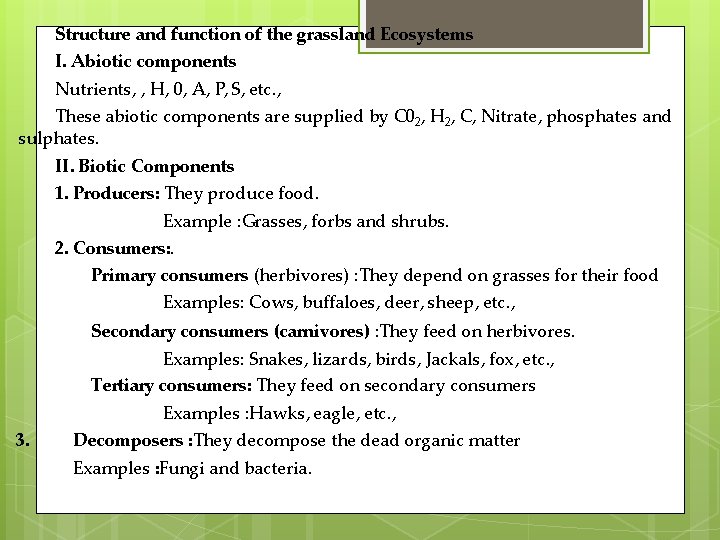
Structure and function of the grassland Ecosystems I. Abiotic components Nutrients, , H, 0, A, P, S, etc. , These abiotic components are supplied by C 02, H 2, C, Nitrate, phosphates and sulphates. II. Biotic Components 1. Producers: They produce food. Example : Grasses, forbs and shrubs. 2. Consumers: . Primary consumers (herbivores) : They depend on grasses for their food Examples: Cows, buffaloes, deer, sheep, etc. , Secondary consumers (carnivores) : They feed on herbivores. Examples: Snakes, lizards, birds, Jackals, fox, etc. , Tertiary consumers: They feed on secondary consumers Examples : Hawks, eagle, etc. , 3. Decomposers : They decompose the dead organic matter Examples : Fungi and bacteria.
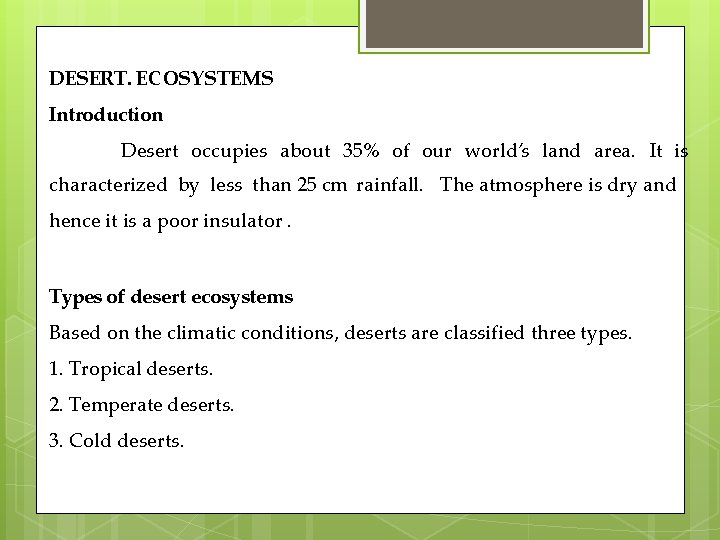
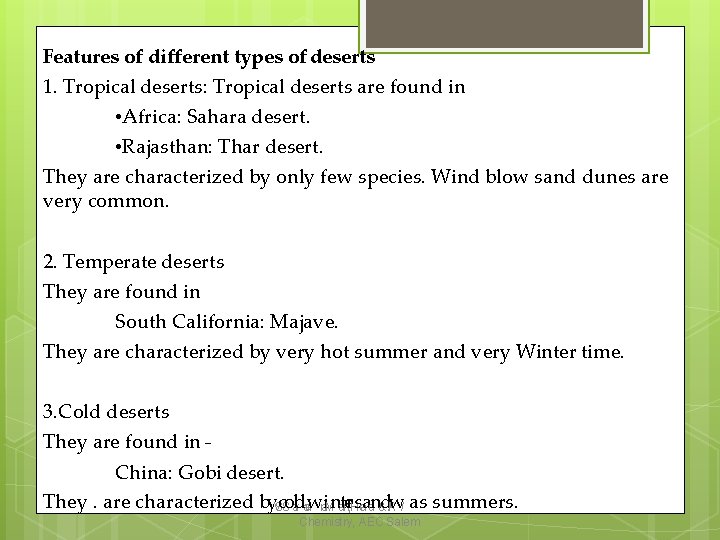
DESERT. ECOSYSTEMS Introduction Desert occupies about 35% of our world’s land area. It is characterized by less than 25 cm rainfall. The atmosphere is dry and hence it is a poor insulator. Types of desert ecosystems Based on the climatic conditions, deserts are classified three types. 1. Tropical deserts. 2. Temperate deserts. 3. Cold deserts.
Features of different types of deserts 1. Tropical deserts: Tropical deserts are found in • Africa: Sahara desert. • Rajasthan: Thar desert. They are characterized by only few species. Wind blow sand dunes are very common. 2. Temperate deserts They are found in South California: Majave. They are characterized by very hot summer and very Winter time. 3. Cold deserts They are found in China: Gobi desert. They. are characterized by. VS. c. S. oald r, Hi seaadn&d. APw/ as summers. r avawnai. Mnatne Chemistry, AEC Salem
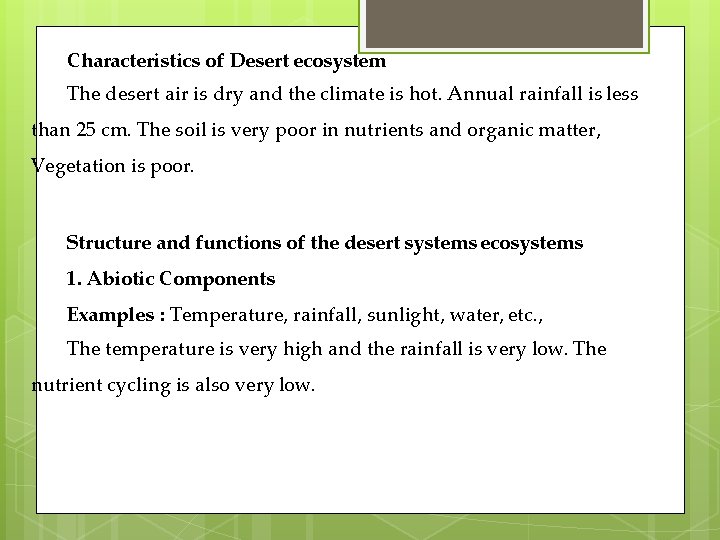
Characteristics of Desert ecosystem The desert air is dry and the climate is hot. Annual rainfall is less than 25 cm. The soil is very poor in nutrients and organic matter, Vegetation is poor. Structure and functions of the desert systems ecosystems 1. Abiotic Components Examples : Temperature, rainfall, sunlight, water, etc. , The temperature is very high and the rainfall is very low. The nutrient cycling is also very low.
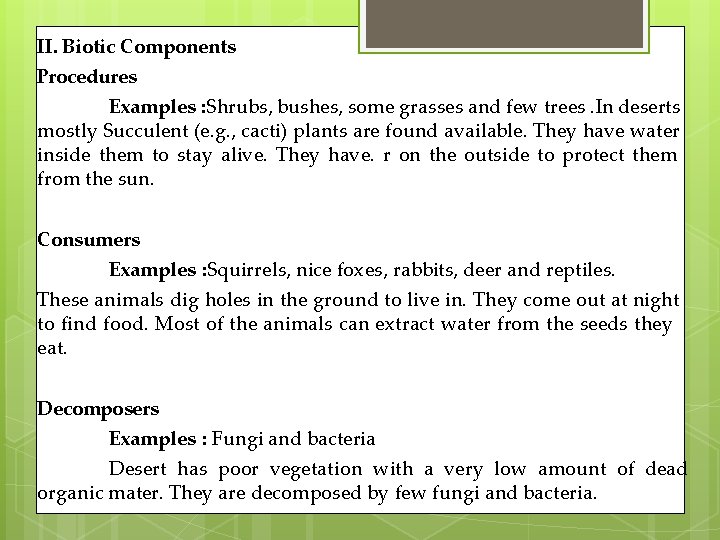
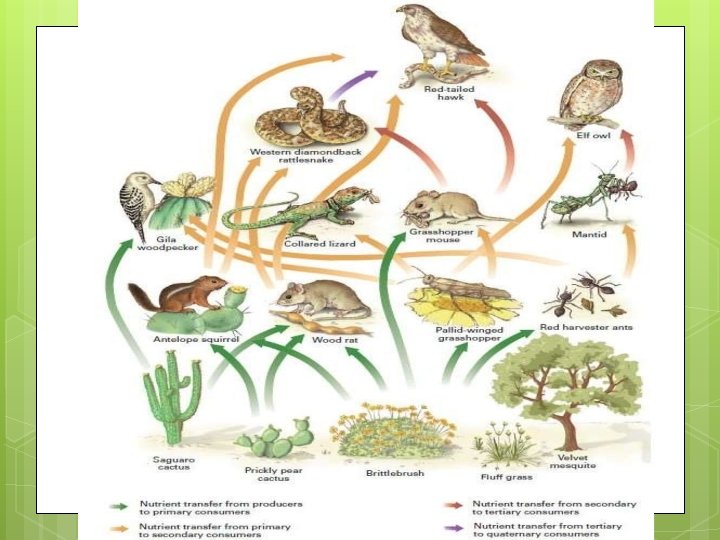
II. Biotic Components Procedures Examples : Shrubs, bushes, some grasses and few trees. In deserts mostly Succulent (e. g. , cacti) plants are found available. They have water inside them to stay alive. They have. r on the outside to protect them from the sun. Consumers Examples : Squirrels, nice foxes, rabbits, deer and reptiles. These animals dig holes in the ground to live in. They come out at night to find food. Most of the animals can extract water from the seeds they eat. Decomposers Examples : Fungi and bacteria Desert has poor vegetation with a very low amount of dead organic mater. They are decomposed by few fungi and bacteria.
AQUATIC ECOSYSTEMS The aquatic ecosystem deals with water bodies. The major types of organism found in aquatic environments are determined by the water’s salinity. Types of aquatic life zone Aquatic life zones are divided into two types. • Fresh water life zones Examples : Pounds, streams, lakes, rivers. • Salt water life zones Examples : Oceans, estuaries.
FRESH WATER ECOSYSTEM POND ECOSYSTEMS Introduction A pond is a fresh water aquatic ecosystems, where water is stagnant. It receives enough water during rainy season. It contains several types of algae, aquatic plants, insects, fishes and birds. Characteristics of pond • Pond is temporary, only seasonal. • It is a stagnant fresh water body. • Ponds get polluted easily due to limited amount of water.
Structure and functions of pond ecosystems I. Abiotic components Examples Temperature, light, water and organic and inorganic compounds II. Biotic Components • Producers These include green photosynthetic organism. They are of two types. • Phytoplankton These are microscopic aquatic plants, which freely float on the surface of water. Example : Algae, small floating plants like volvox, pandorina anabaena, consmarium. Microphytes Examples: Large floating plants and submerged plants like hydrilla, Jussiaea, wolfia, demna.
Consumers • Primary consumers (Zooplanktons): These are microscopic animals which freely float on the surface of water. Zooplanktons are found along with phytoplankton. They feed on plants (phytoplankton). Examples : Protozoa, very small fish, ciliates, flagelaltes and protozoans. • Secondary consumers (Carnivores): They feed on zooplankton Examples : Insects like water beetles and small fish. • Tertiary consumers : They feed on smaller fish Examples : Large fish like game fish. Decomposers: They decompose the dead plant and animal matter and their nutrients are released and reused by the green plants. Examples : Fungi, bacteria and flagellates
LAKE ECOSYSTEM Lakes are large natural shallow water bodies. Lakes are used for various purposes. Lakes are supplied with water from rainfall, melting snow and streams. Types of lakes Some important types of lake are • Oligotrophic lakes : They have low nutrient concentrations • Eutrophic lakes : They are overnourished by nutrients like N and P • Dystrophic lakes : They have low p. H, high humic and content and brown waters. • Volcanic lakes : They receive water from magma after volcanic
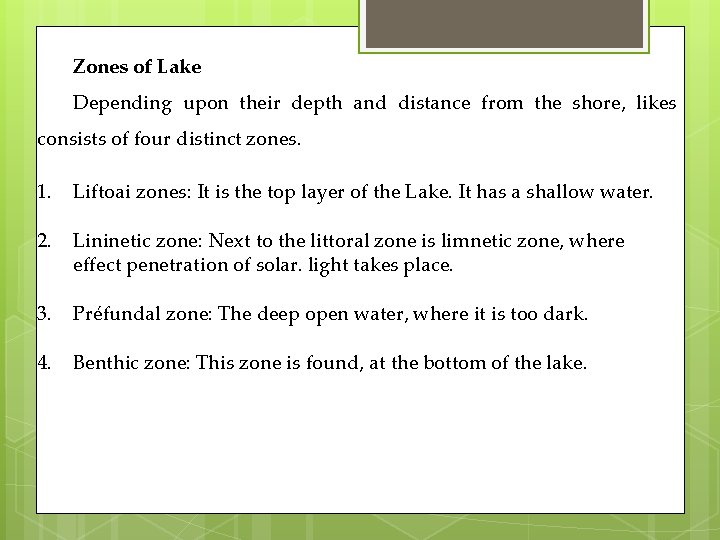
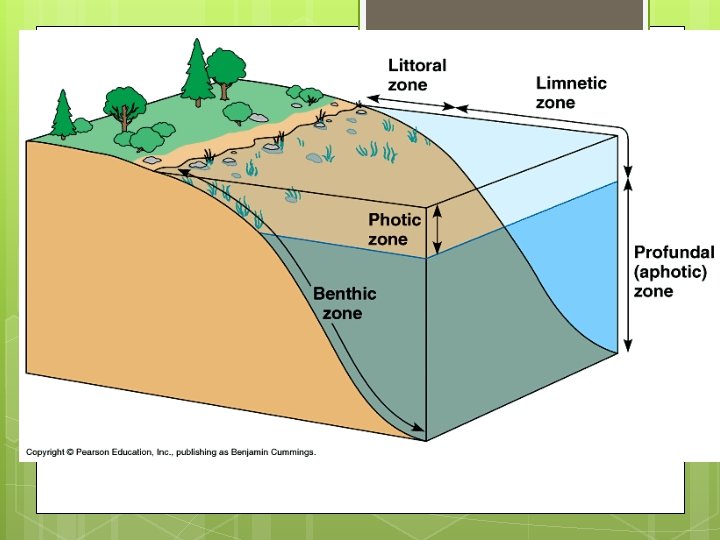
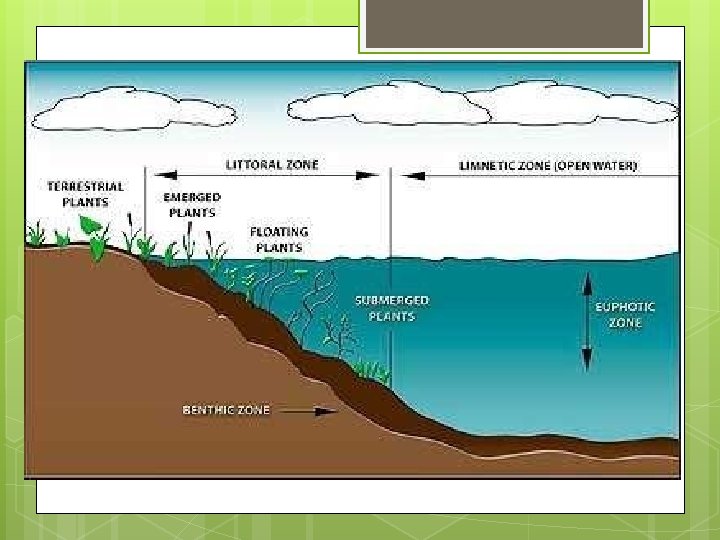
Zones of Lake Depending upon their depth and distance from the shore, likes consists of four distinct zones. 1. Liftoai zones: It is the top layer of the Lake. It has a shallow water. 2. Lininetic zone: Next to the littoral zone is limnetic zone, where effect penetration of solar. light takes place. 3. Préfundal zone: The deep open water, where it is too dark. 4. Benthic zone: This zone is found, at the bottom of the lake.
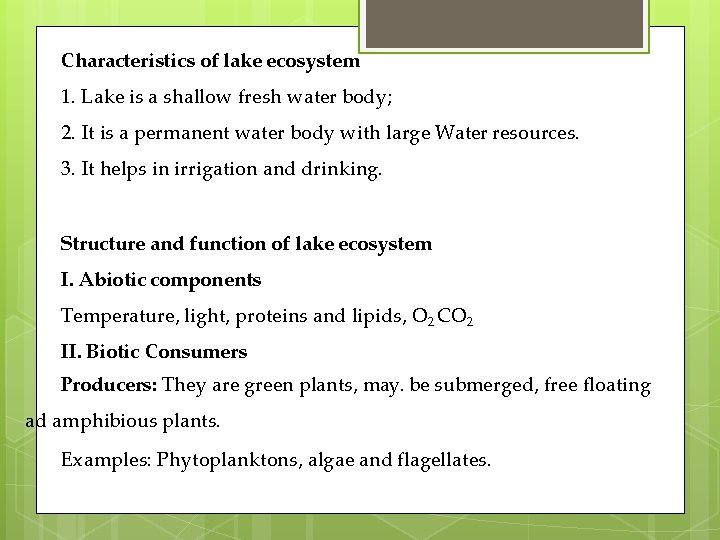
Characteristics of lake ecosystem 1. Lake is a shallow fresh water body; 2. It is a permanent water body with large Water resources. 3. It helps in irrigation and drinking. Structure and function of lake ecosystem I. Abiotic components Temperature, light, proteins and lipids, O 2 CO 2 II. Biotic Consumers Producers: They are green plants, may. be submerged, free floating ad amphibious plants. Examples: Phytoplanktons, algae and flagellates.
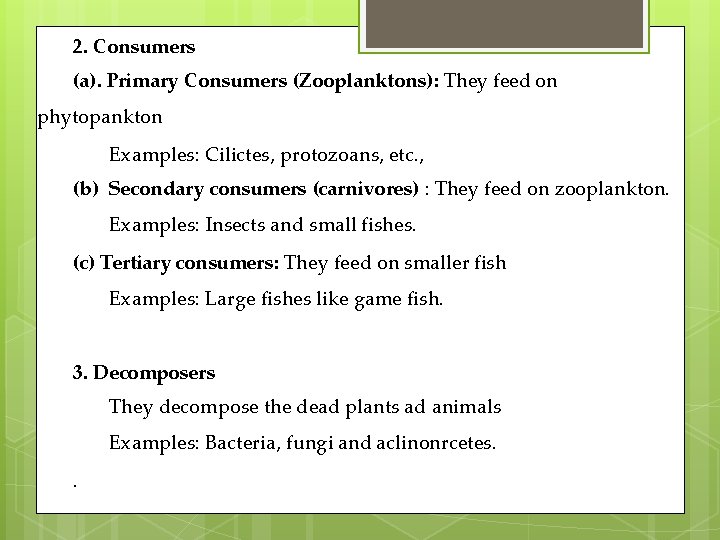
2. Consumers (a). Primary Consumers (Zooplanktons): They feed on phytopankton Examples: Cilictes, protozoans, etc. , (b) Secondary consumers (carnivores) : They feed on zooplankton. Examples: Insects and small fishes. (c) Tertiary consumers: They feed on smaller fish Examples: Large fishes like game fish. 3. Decomposers They decompose the dead plants ad animals Examples: Bacteria, fungi and aclinonrcetes. .
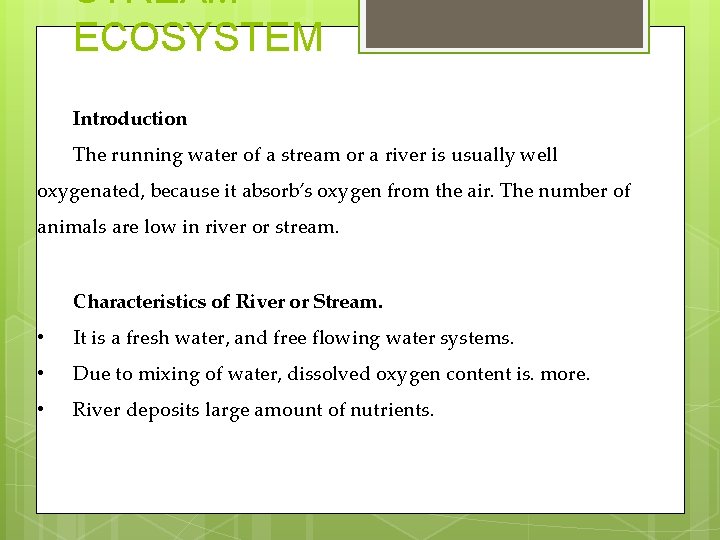
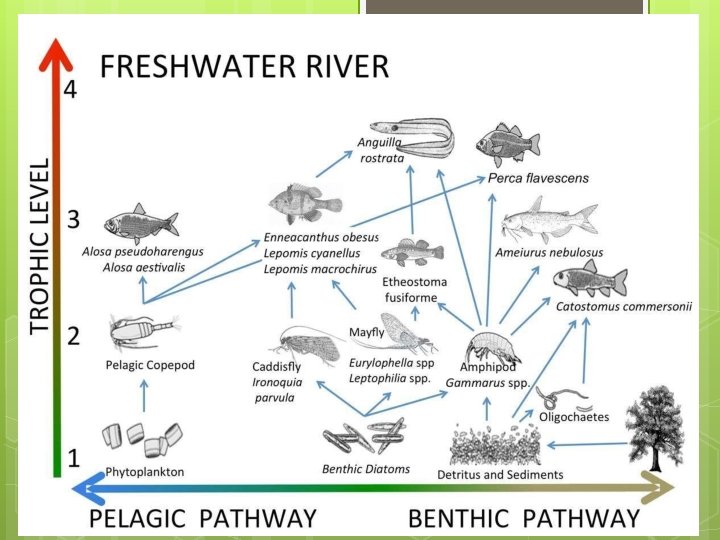
STREAM ECOSYSTEM Introduction The running water of a stream or a river is usually well oxygenated, because it absorb’s oxygen from the air. The number of animals are low in river or stream. Characteristics of River or Stream. • It is a fresh water, and free flowing water systems. • Due to mixing of water, dissolved oxygen content is. more. • River deposits large amount of nutrients.
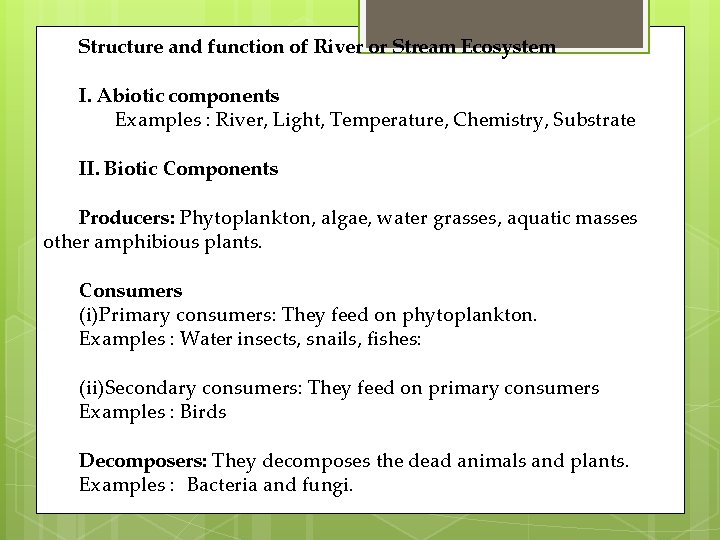
Structure and function of River or Stream Ecosystem I. Abiotic components Examples : River, Light, Temperature, Chemistry, Substrate II. Biotic Components Producers: Phytoplankton, algae, water grasses, aquatic masses other amphibious plants. Consumers (i)Primary consumers: They feed on phytoplankton. Examples : Water insects, snails, fishes: (ii)Secondary consumers: They feed on primary consumers Examples : Birds Decomposers: They decomposes the dead animals and plants. Examples : Bacteria and fungi.
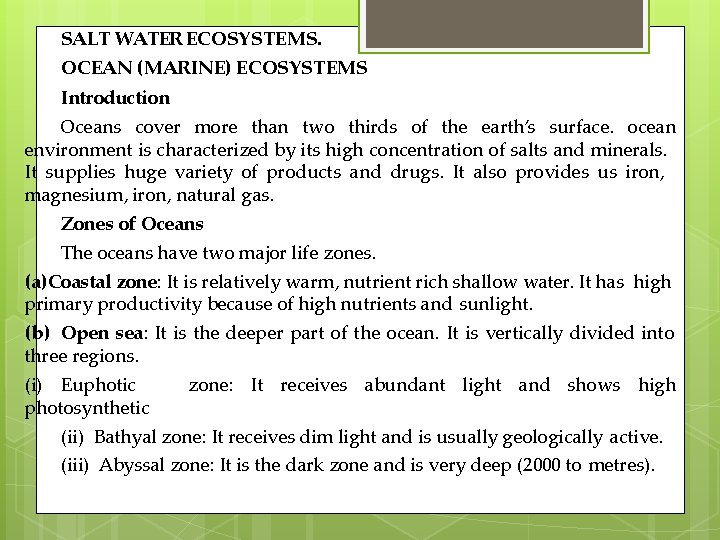
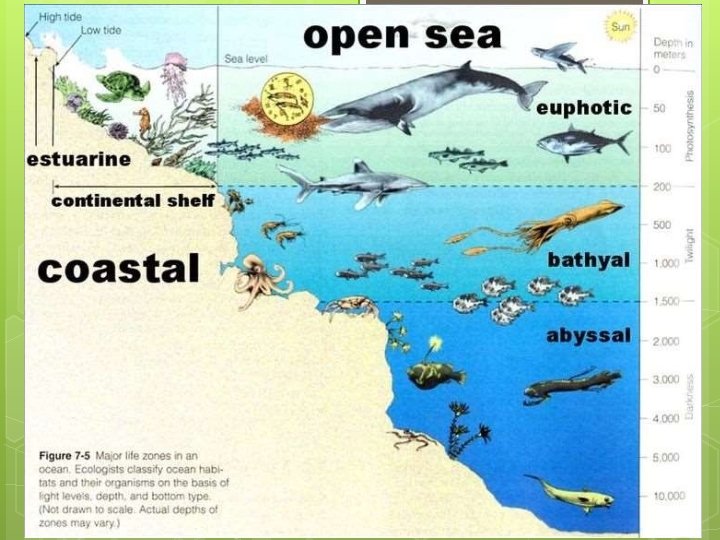
SALT WATER ECOSYSTEMS. OCEAN (MARINE) ECOSYSTEMS Introduction Oceans cover more than two thirds of the earth’s surface. ocean environment is characterized by its high concentration of salts and minerals. It supplies huge variety of products and drugs. It also provides us iron, magnesium, iron, natural gas. Zones of Oceans The oceans have two major life zones. (a)Coastal zone: It is relatively warm, nutrient rich shallow water. It has high primary productivity because of high nutrients and sunlight. (b) Open sea: It is the deeper part of the ocean. It is vertically divided into three regions. (i) Euphotic zone: It receives abundant light and shows high photosynthetic (ii) Bathyal zone: It receives dim light and is usually geologically active. (iii) Abyssal zone: It is the dark zone and is very deep (2000 to metres).
Characteristics of Ocean Ecosystem 1. It occupies a large surface area with saline water. 2. Since ship, submarines can sail in ocean, commercial activities may be earned out. 3. It is rich in biodiversity. 4. It moderates the- temperature
Structure and function Ecosystems I. Abiotic components Examples Temperature, light, Na. Cl, K, Ca, and Mg Salts alkalinity II. Biotic components 1. Producers : Phytoplanktons (diatoms, unicellular algae, etc. , ) and marine plants (sea weeds, chlorophycela, phaeophyceae).
2. Consumers These are heterotrophic macro consumers. They depend on producers for their nutrition. • Primary consumers (herbivores) : They feed on producers Examples : Crustaceans, moiluscs, fish • Secondary consumers (carnivores) : They feed on herbivores Examples : Herring sahd, mackerel, etc. , • Tertiary Consumers: They are the top consumers. They feed on small Examples : Cod, Haddock, -etc. , 3. Decomposers: They decompose the dead organic matter. Example s: Bacteria and some fungi.
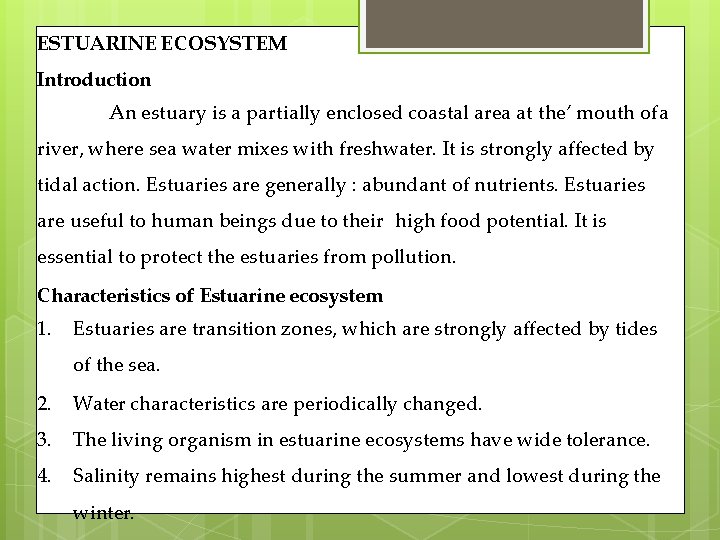
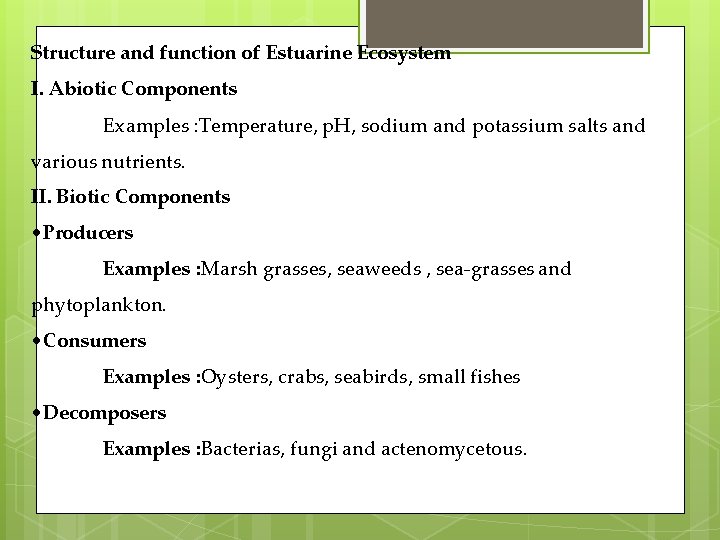
ESTUARINE ECOSYSTEM Introduction An estuary is a partially enclosed coastal area at the’ mouth of a river, where sea water mixes with freshwater. It is strongly affected by tidal action. Estuaries are generally : abundant of nutrients. Estuaries are useful to human beings due to their high food potential. It is essential to protect the estuaries from pollution. Characteristics of Estuarine ecosystem 1. Estuaries are transition zones, which are strongly affected by tides of the sea. 2. Water characteristics are periodically changed. 3. The living organism in estuarine ecosystems have wide tolerance. 4. Salinity remains highest during the summer and lowest during the winter.
Structure and function of Estuarine Ecosystem I. Abiotic Components Examples : Temperature, p. H, sodium and potassium salts and various nutrients. II. Biotic Components • Producers Examples : Marsh grasses, seaweeds , sea-grasses and phytoplankton. • Consumers Examples : Oysters, crabs, seabirds, small fishes • Decomposers Examples : Bacterias, fungi and actenomycetous.
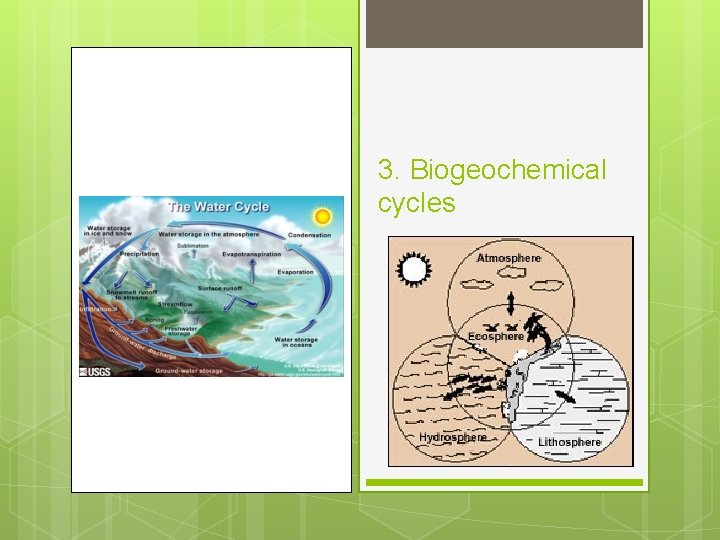
3. Biogeochemical cycles
Hydrological Cycle
Nitrogen cycle
Biodiversity What does “Bio” means? Bio =
Biodiversity What does means? “Diversity” Diversity = Variety
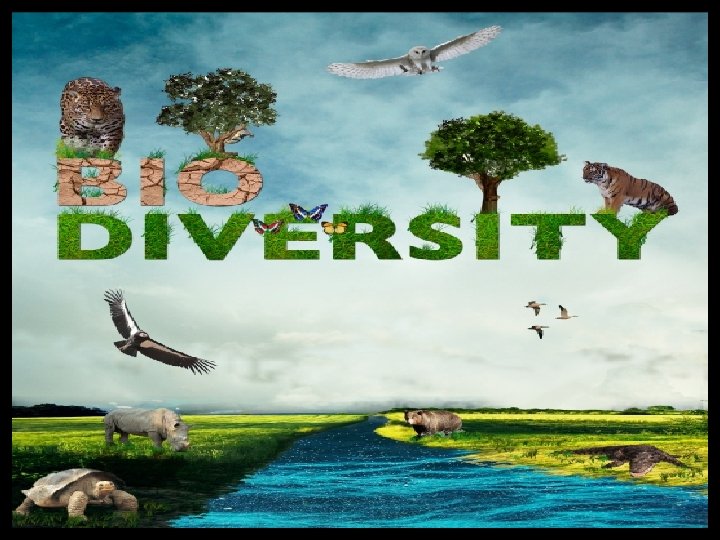
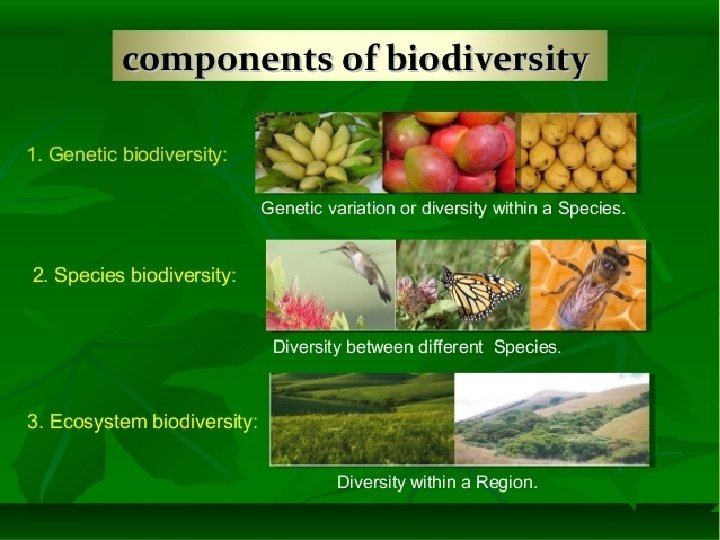
The term Biodiversity was first coined by Walter G. Rosen in 1986. ü The biosphere comprises of a complex collections of innumerable organisms, known as the Biodiversity, which constitute the vital life support for survival of human race. Biological diversity, abbreviated as biodiversity, represent the sum total of various life forms such as unicellular fungi, protozoa, bacteria, and multi cellular organisms such as plants, fishes, and mammals at various biological levels including gens, habitats, and ecosystem.
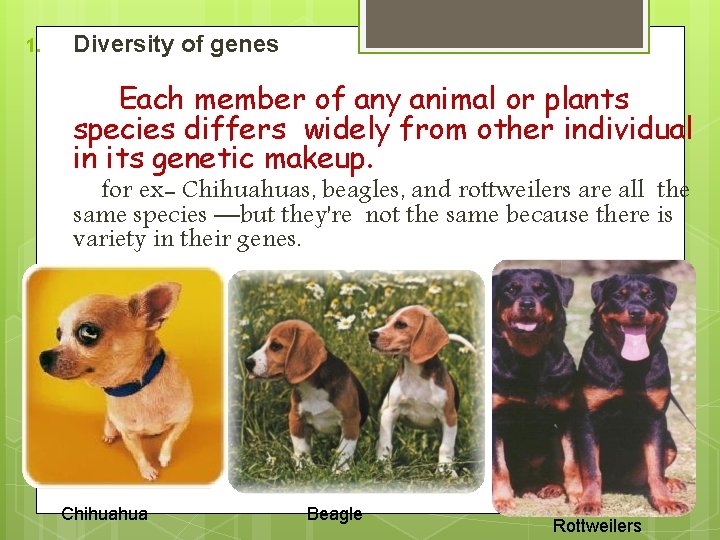
1. Diversity of genes Each member of any animal or plants species differs widely from other individual in its genetic makeup. for ex- Chihuahuas, beagles, and rottweilers are all the same species —but they're not the same because there is variety in their genes. Chihuahua Beagle Rottweilers
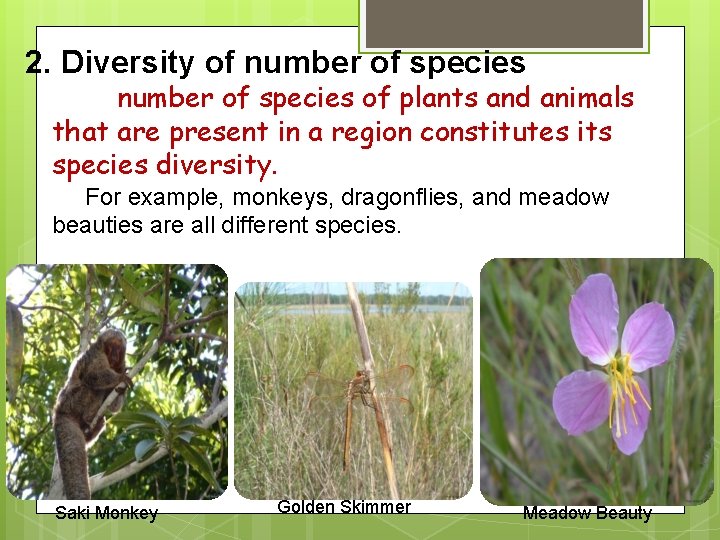
2. Diversity of number of species of plants and animals that are present in a region constitutes its species diversity. For example, monkeys, dragonflies, and meadow beauties are all different species. Saki Monkey Golden Skimmer Meadow Beauty
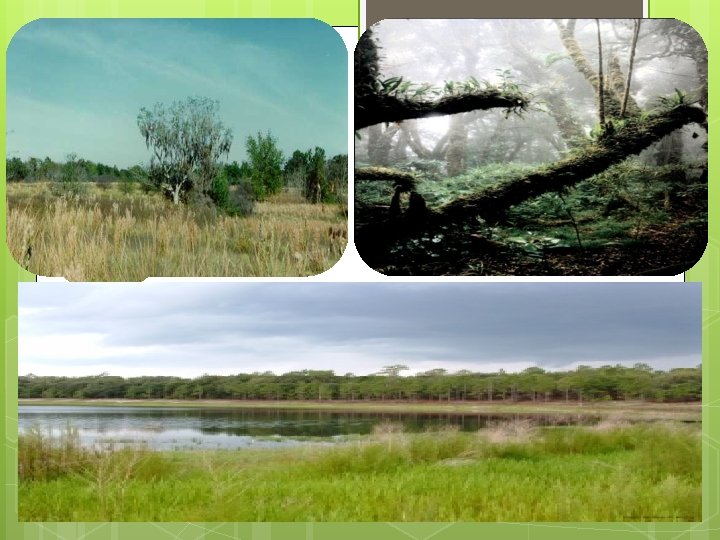
3. Variety of ecosystems There are large variety of different ecosystems on earth. Each having their own complement of distinctive interlinked species based on the differences in the habitat üLakes, Ponds, and Rivers are all Freshwater Ecosystems. ü Rocky coast, Sand Dune, Estuary, Salt Marsh , Coral Reef are all Marine Ecosystems.
BENEFITS OF BIODIVERSITY Consumptive value: Ø Food/Drink Ø Fuel Ø Medicine Ø Batter crop varieties Ø Industrial Material Non-Consumptive Value: Ø Recreation Ø Education and Research Ø Traditional value
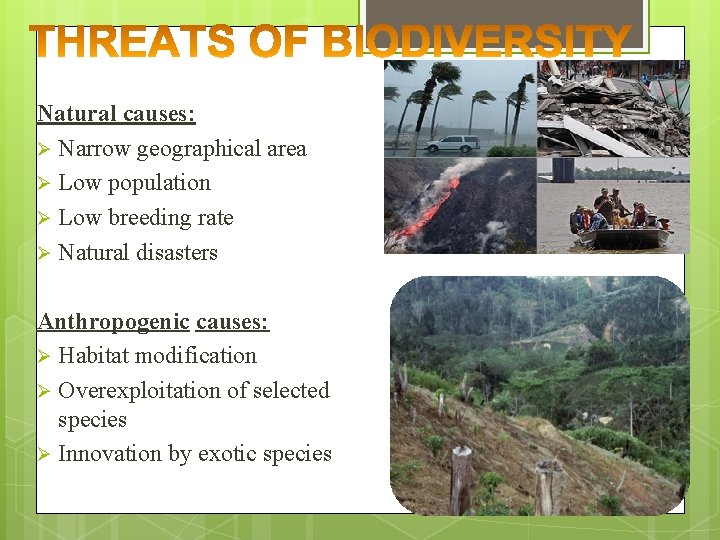
Natural causes: Ø Narrow geographical area Ø Low population Ø Low breeding rate Ø Natural disasters Anthropogenic causes: Ø Habitat modification Ø Overexploitation of selected species Ø Innovation by exotic species
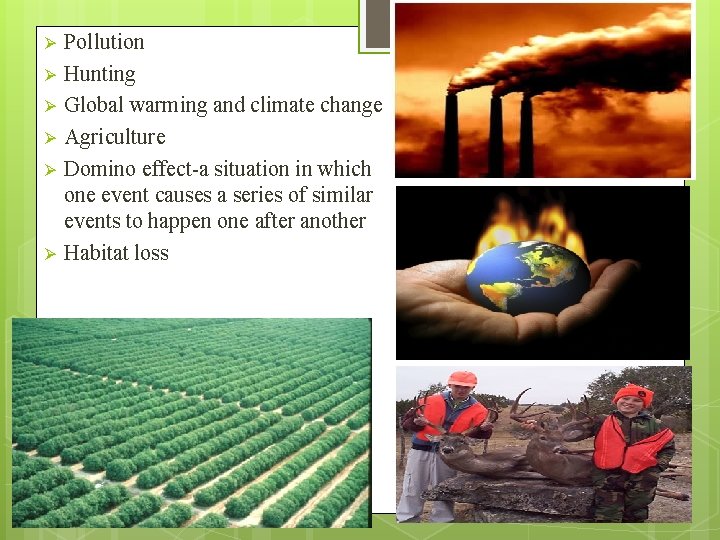
Ø Ø Ø Pollution Hunting Global warming and climate change Agriculture Domino effect-a situation in which one event causes a series of similar events to happen one after another Habitat loss
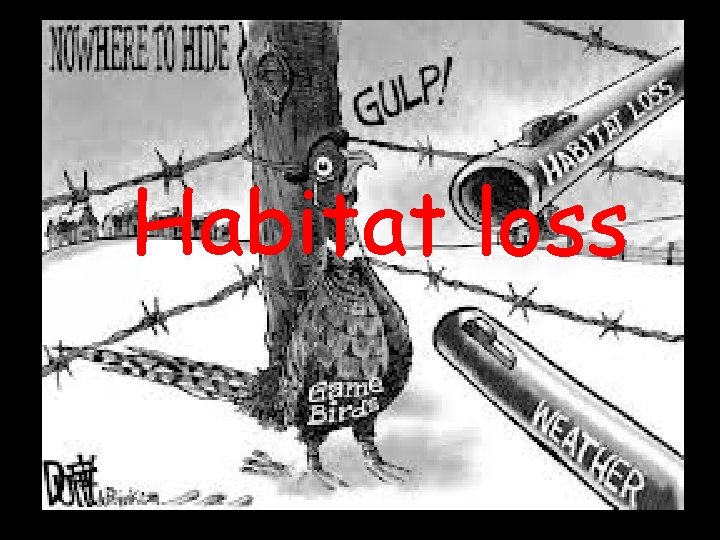
Habitat loss
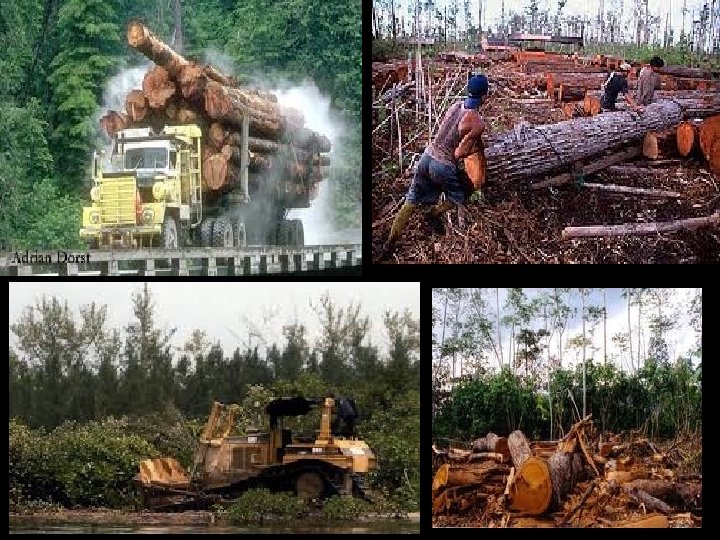
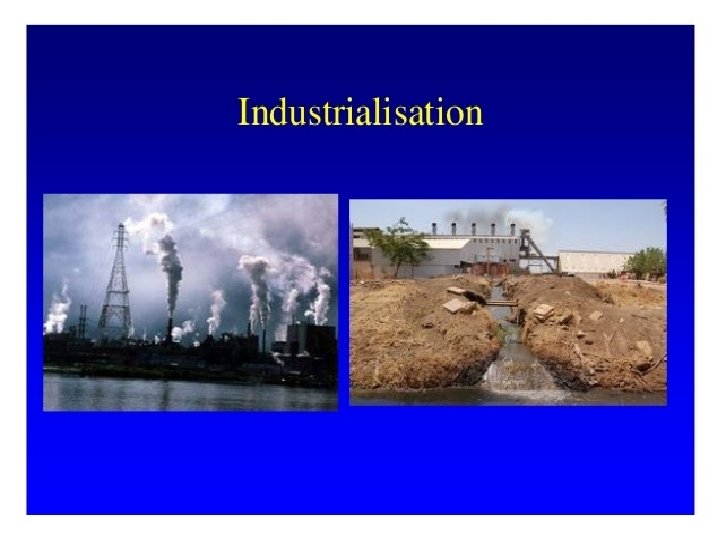
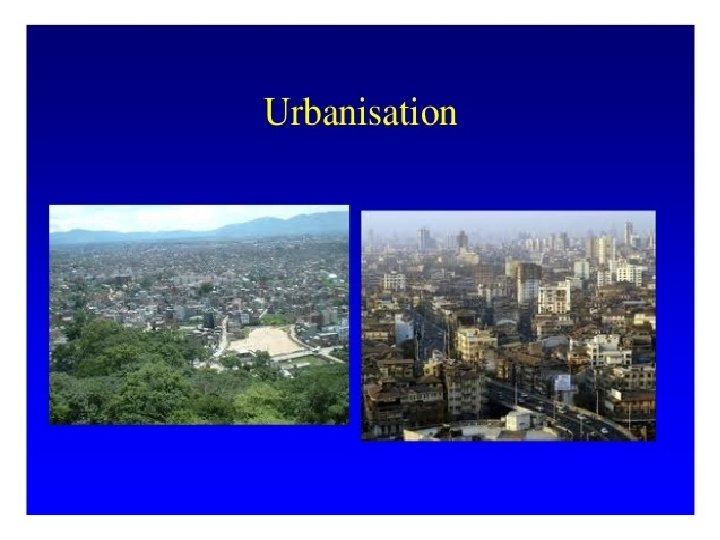
Habitat loss: Habitat loss can be described when an animal loses their home. Every animal in the animal kingdom has a niche, a their in their animal community and without their habitat they no longer have a niche. Reasons of habitat loss by humans: ~ agriculture, farming ~ harvesting natural resources for personal use ~ for industrial and urbanization development – Food demand – Deforestation and thereby land degradation Habitat destruction is currently ranked as the primary causes of species extinction world wide…!!!
Solutions on for this. . ~ Protecting remaining intact section of natural habitat. ~ Reduce human population and expansion of urbanisation and industries. ~ Educating the public about the importance of natural habitat and bio diversity. ~Solutions to habitat loss can include planting trees, planting home gardens so as to reduce need for man to need large lands for agricultural farms which lead to habitat loss.
Poaching
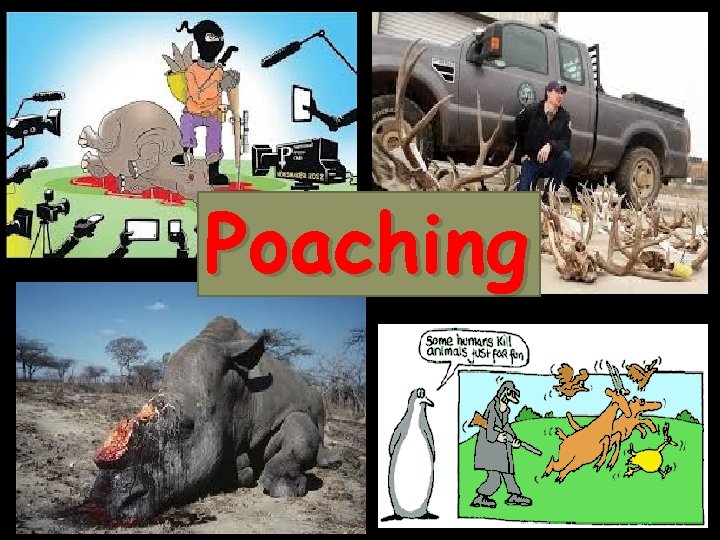
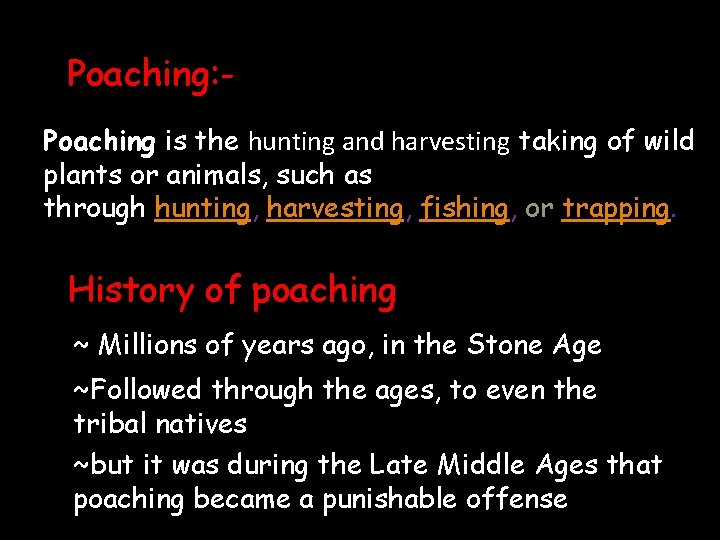
Poaching: Poaching is the hunting and harvesting taking of wild plants or animals, such as through hunting, harvesting, fishing, or trapping. History of poaching ~ Millions of years ago, in the Stone Age ~Followed through the ages, to even the tribal natives ~but it was during the Late Middle Ages that poaching became a punishable offense
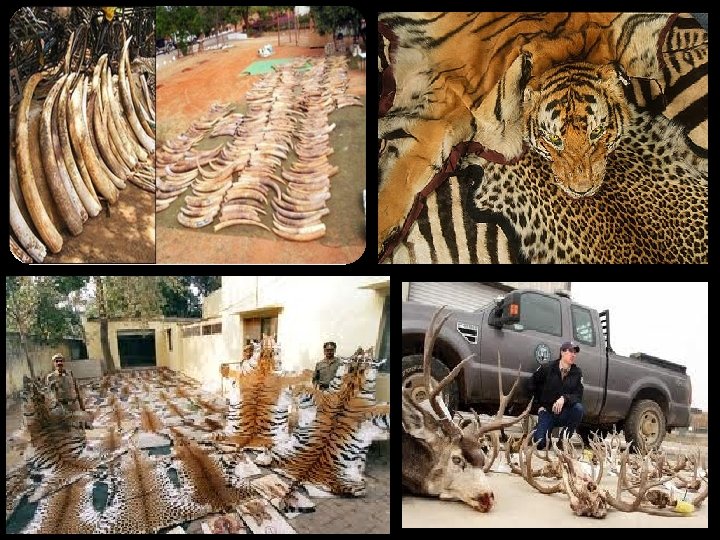
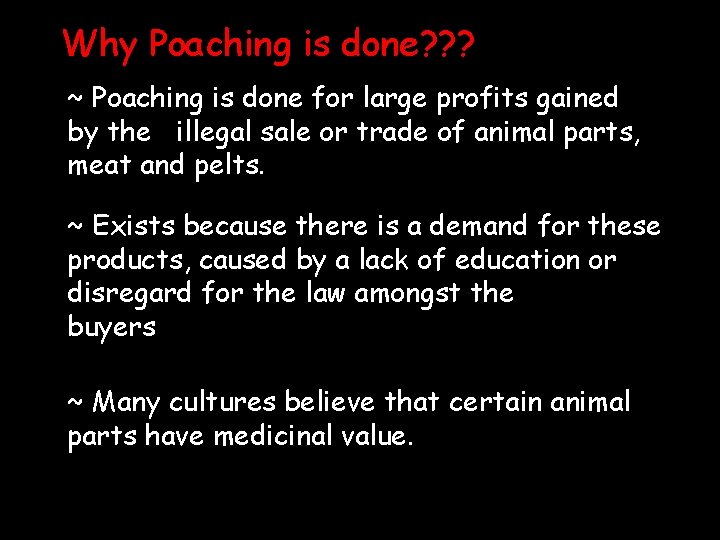
Why Poaching is done? ? ? ~ Poaching is done for large profits gained by the illegal sale or trade of animal parts, meat and pelts. ~ Exists because there is a demand for these products, caused by a lack of education or disregard for the law amongst the buyers ~ Many cultures believe that certain animal parts have medicinal value.
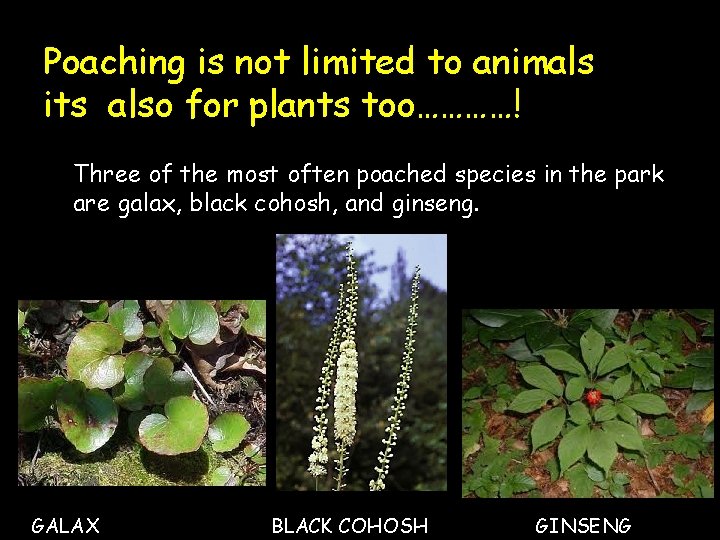
Poaching is not limited to animals its also for plants too…………! Three of the most often poached species in the park are galax, black cohosh, and ginseng. GALAX BLACK COHOSH GINSENG
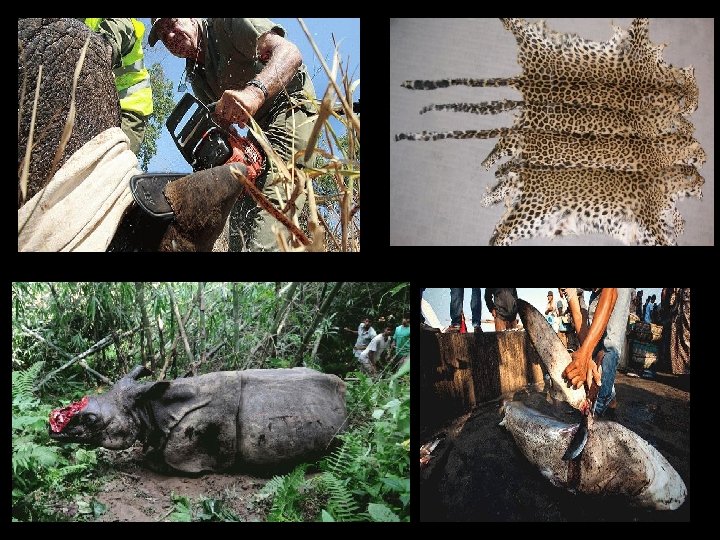
How does poaching affect the environment? ~Poaching or illegal hunting causes animals endangered of being extinct. If more animals becomes extinct there's a disruption in the food chain, and that will cause major problems in our ecosystem, resulting eventually in new adaptations of animals, and or species beyond human control. ~Poaching results in animals being hunted too soon for them to have time to reproduce and repopulate.
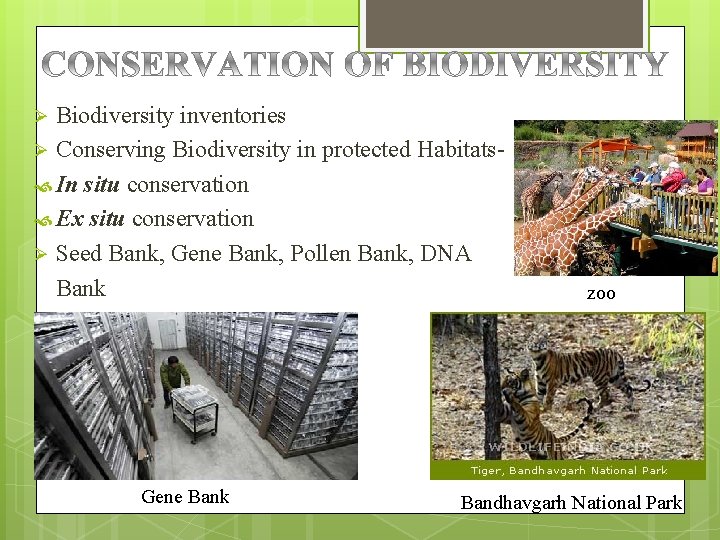
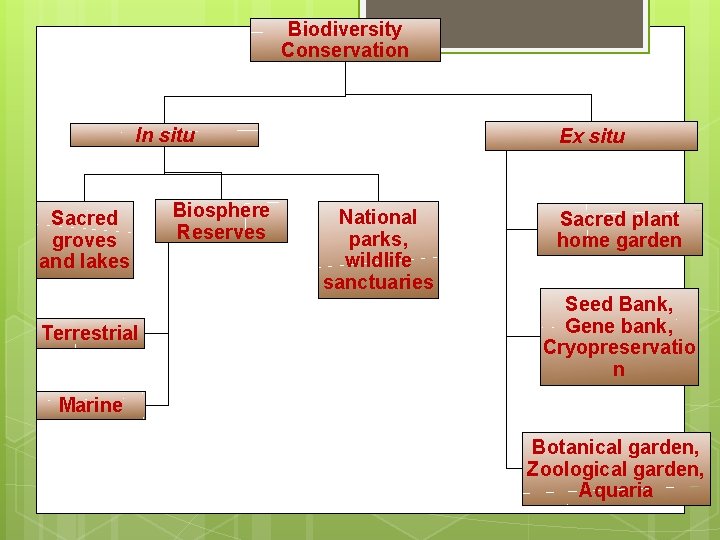
Biodiversity inventories Ø Conserving Biodiversity in protected Habitats In situ conservation Ex situ conservation Ø Seed Bank, Gene Bank, Pollen Bank, DNA Bank Ø Gene Bank zoo Bandhavgarh National Park
INSITU CONSERVATION ü The term insitu conservation denotes conservation of species in its natural habitat , that is where the species is normally found. ü The insitu conservation strategies stress on protection of total ecosystems through a network of protected areas
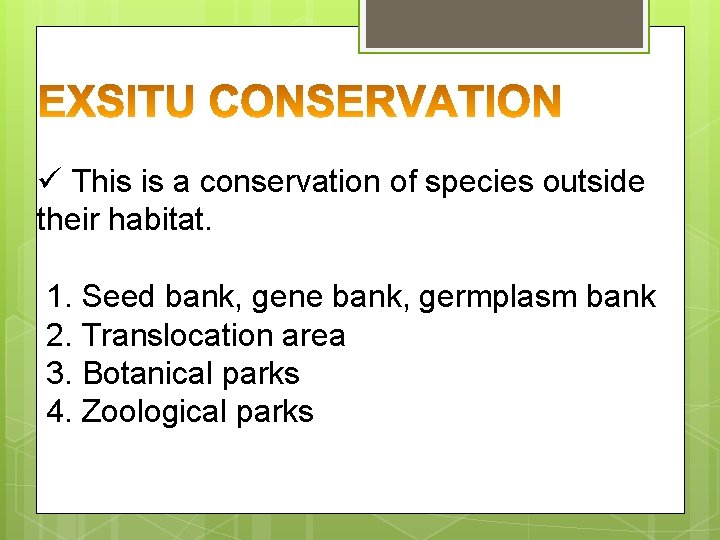
ü This is a conservation of species outside their habitat. 1. Seed bank, gene bank, germplasm bank 2. Translocation area 3. Botanical parks 4. Zoological parks
Biodiversity Conservation In situ Sacred groves and lakes Terrestrial Biosphere Reserves Ex situ National parks, wildlife sanctuaries Sacred plant home garden Seed Bank, Gene bank, Cryopreservatio n Marine Botanical garden, Zoological garden, Aquaria
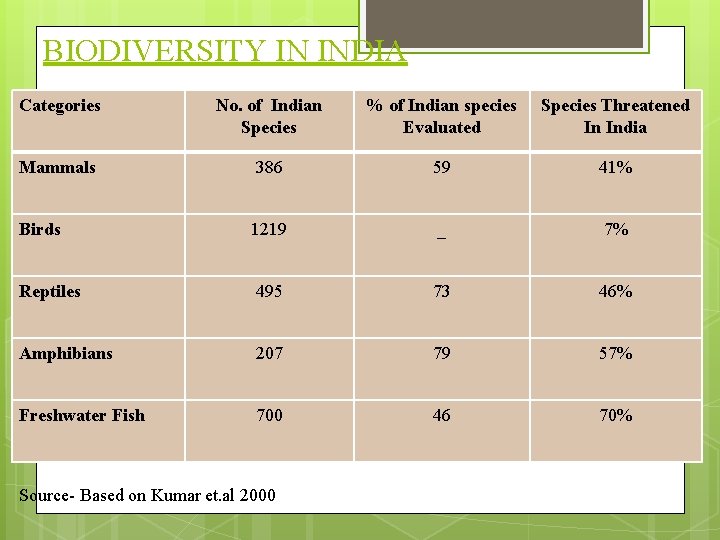
BIODIVERSITY IN INDIA Categories No. of Indian Species % of Indian species Evaluated Species Threatened In India Mammals 386 59 41% Birds 1219 _ 7% Reptiles 495 73 46% Amphibians 207 79 57% Freshwater Fish 700 46 70% Source- Based on Kumar et. al 2000
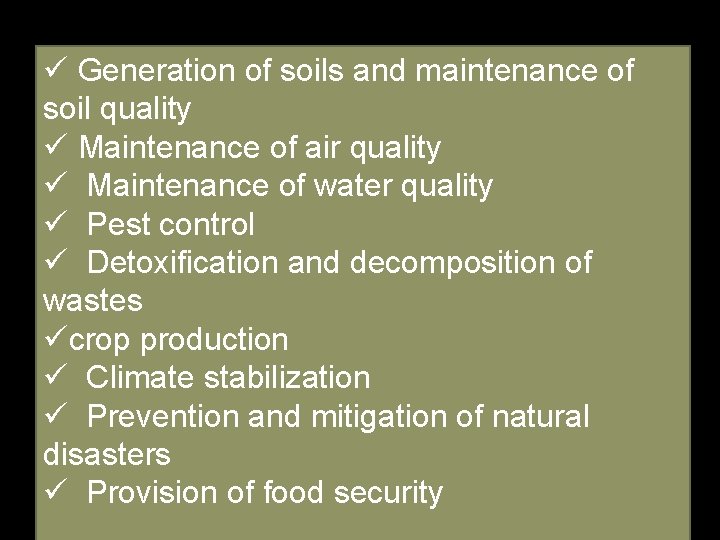
ü Generation of soils and maintenance of soil quality ü Maintenance of air quality ü Maintenance of water quality ü Pest control ü Detoxification and decomposition of wastes ücrop production ü Climate stabilization ü Prevention and mitigation of natural disasters ü Provision of food security
So…. . please conserve the Nature….
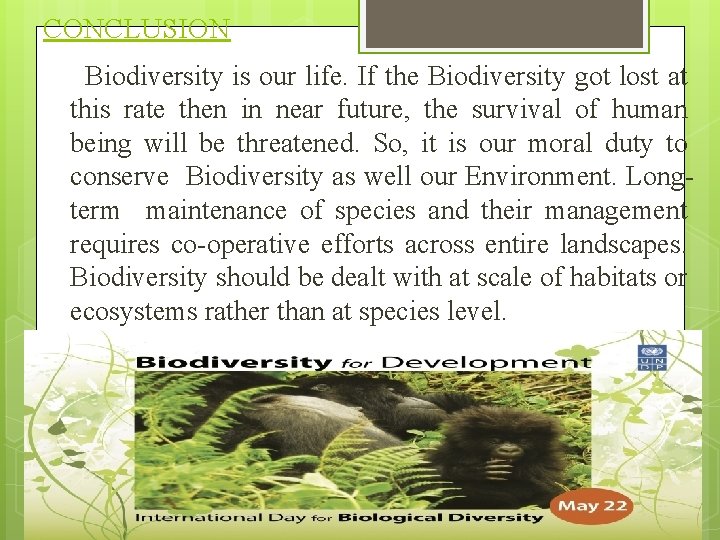
CONCLUSION Biodiversity is our life. If the Biodiversity got lost at this rate then in near future, the survival of human being will be threatened. So, it is our moral duty to conserve Biodiversity as well our Environment. Longterm maintenance of species and their management requires co-operative efforts across entire landscapes. Biodiversity should be dealt with at scale of habitats or ecosystems rather than at species level.