
Environment and Business Part II Environmental Benchmarking Prof
Environment and Business, Part II Environmental Benchmarking Prof. Dr. Ir. Ab Stevels Chair of Applied Eco. Design for Sustainability Dept. Design Engineering, School of Industrial Design Delft University of Technology stevels@xs 4 all. nl 1
Outline 1. Introduction 2. Why environmental benchmarking? 3. Characteristics, issues and procedures 4. To what items to pay attention to? 5. Examples 6. Conclusions September 16, 2005 2
Improvement analysis, industry approach • Address environmental issues which you can influence yourself (internal issues) • Get facts and organize these according to a chosen benchmark procedure • Use information to generate and prioritize design actions against external issues • Check feasibility • Implement in eco(design) specifications and targets September 16, 2005 3
Improvement analysis, scientific approach • Do Life Cycle Analysis, holistic approach • Select internal and external improvement options • Start stakeholder discussion • Come to solutions • Implement in programme September 16, 2005 4

The Environmental Benchmark Method - Thee parts - Well documented - Yields reproducible results September 16, 2005 5
Why environmental benchmarking of products? • Know what you are talking about. • Know where you stand with respect to demands for customers, legislation. • Find out where you can save money. • Know where you stand with respect to competition • Be able to set priorities and to integrate environment into product development process. September 16, 2005 6
Lessons learned from Benchmarking • Tremendous awareness • I never realized that … • my competitor is better in … • Big differences • for ‘new’ products • also for products at end of learning curve • Improvement potential • no brand scores consistently best • All focal area’s affected • Strong basis for improvement / brainstorm September 16, 2005 7
Contributions of benchmarking to basic processes • Creating awareness: What is this all about? • managerial & technical • Making plans, programs support: Where do we stand? • Where do we want to go? • strategy & roadmap • Eco-design: How to realize? • specification/ targets • five focal areas: energy, packaging, materials, substances, end-of life in the market • Supporting/ exploitation: How to enhance business? • communication, marketing & sales September 16, 2005 8
Choice of products -In Philips context: choice of Green Flagships Candidates -Select your own product -Select products from competition -Best commercial competitors -Brands with good expected environmental performance -Be certain of similarity of characteristics regarding: -Functionality -Commercial availability -Price/performance ratio -Size -Product generation September 16, 2005 9
Characteristics of Benchmarking • Comparison with competition; relative not absolute • Technical language and tangible units instead of environmental indicators: W, seconds, kg, %, … • Learning by doing; do it yourself – visible. • Easy to integrate into business process; environmental specification of products September 16, 2005 10
Benchmark Issues • Life cycle perspective • defining product system boundaries (Example : cellphone or also loader? ) • items to be considered (Example: all focal area’s or just energy consumption) • Functionality or embodiment? • Example: ‘ 1 litre orange juice’ or ‘fruit juicer’ • Embodiment as such • Example: CD Radio Cassette Recorders have almost, but never completely identical performance specification/functionality September 16, 2005 11
Benchmark procedure, I (example) • 1. • 2. Starting points and goals Functional description and analysis • functionality • product system boundaries • basic input-output diagram • 3. Energy analysis • power consumption of subassemblies and PWBs - efficiency - 4. Mechanical description and analysis - structure chart - materials application - assembly/disassembly September 16, 2005 12
Benchmark procedure, II (example) 5. Environmental description and analysis • • • application checklist to count, measure, calculate chemical content of product Eco-indicator, Life Cycle Analysis 6. Environmental cost analysis • • cost price breakdown life cycle cost / cost of ownership calculation September 16, 2005 13
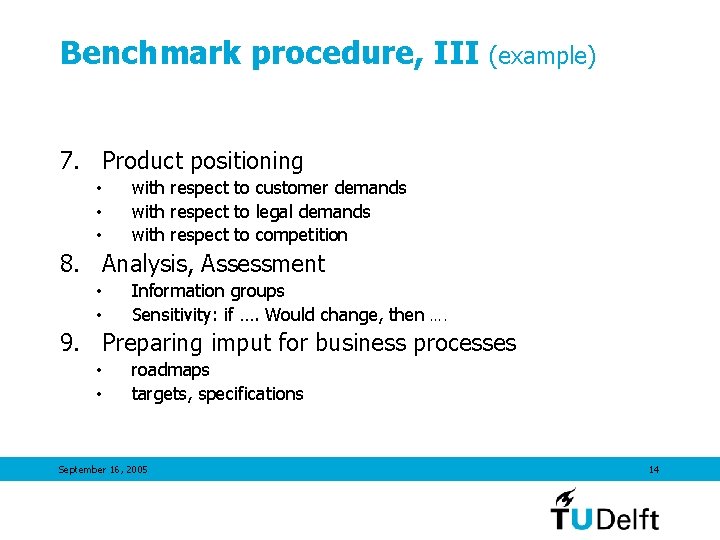
Benchmark procedure, III (example) 7. Product positioning • • • with respect to customer demands with respect to legal demands with respect to competition 8. Analysis, Assessment • • Information groups Sensitivity: if …. Would change, then …. 9. Preparing imput for business processes • • roadmaps targets, specifications September 16, 2005 14
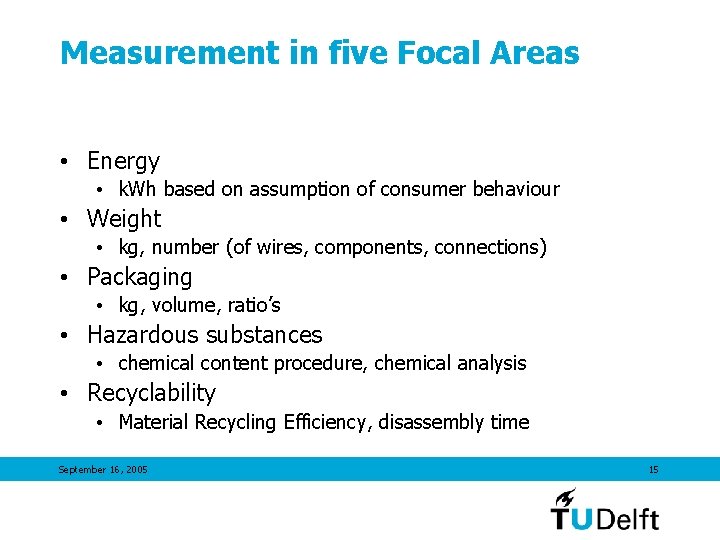
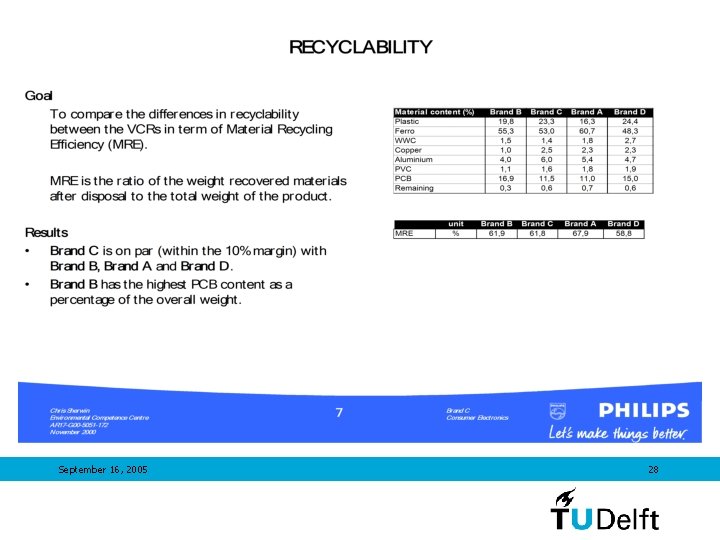
Measurement in five Focal Areas • Energy • k. Wh based on assumption of consumer behaviour • Weight • kg, number (of wires, components, connections) • Packaging • kg, volume, ratio’s • Hazardous substances • chemical content procedure, chemical analysis • Recyclability • Material Recycling Efficiency, disassembly time September 16, 2005 15
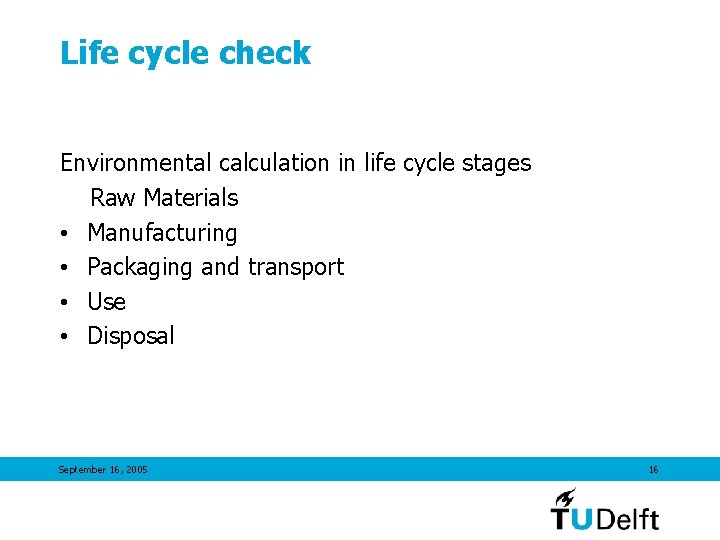
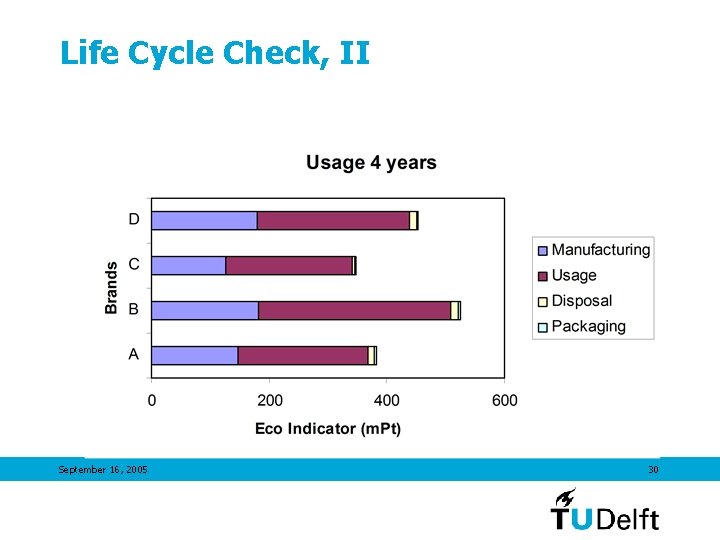
Life cycle check Environmental calculation in life cycle stages Raw Materials • Manufacturing • Packaging and transport • Use • Disposal September 16, 2005 16
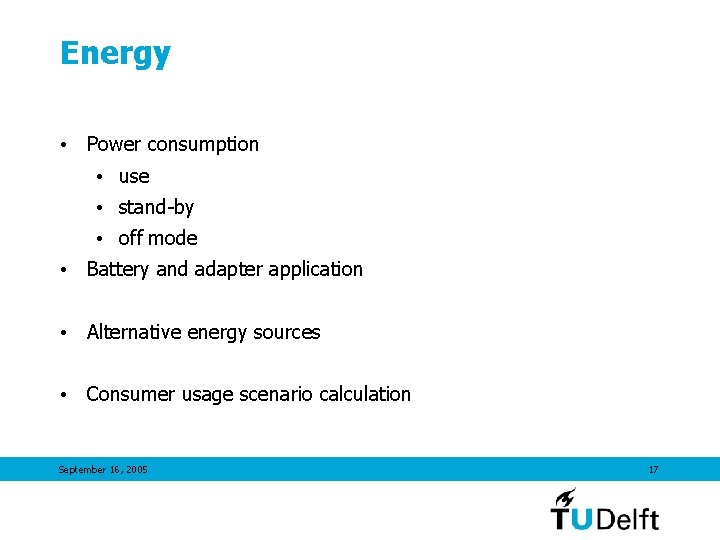
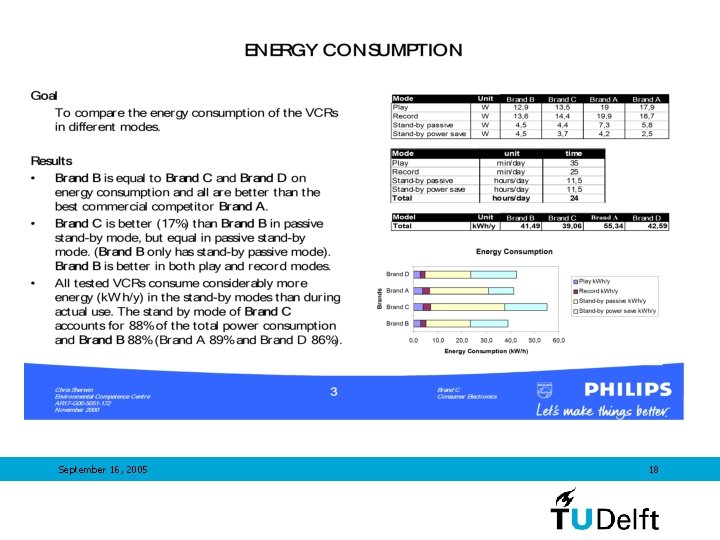
Energy • Power consumption • use • stand-by • off mode • Battery and adapter application • Alternative energy sources • Consumer usage scenario calculation September 16, 2005 17
September 16, 2005 18
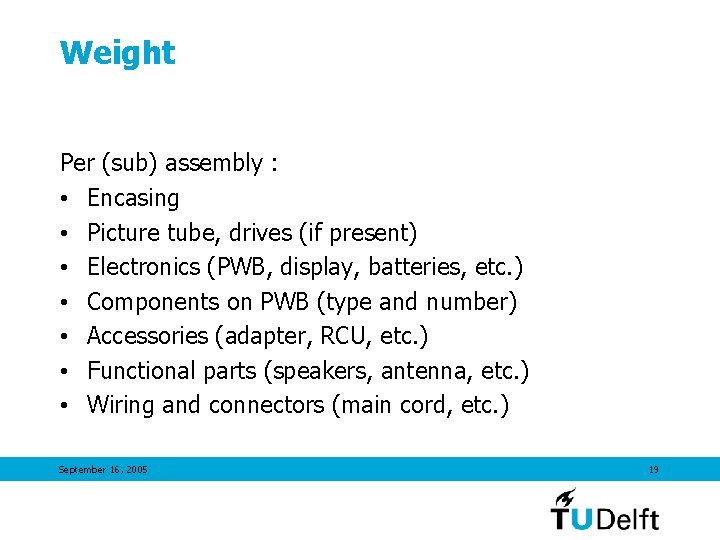
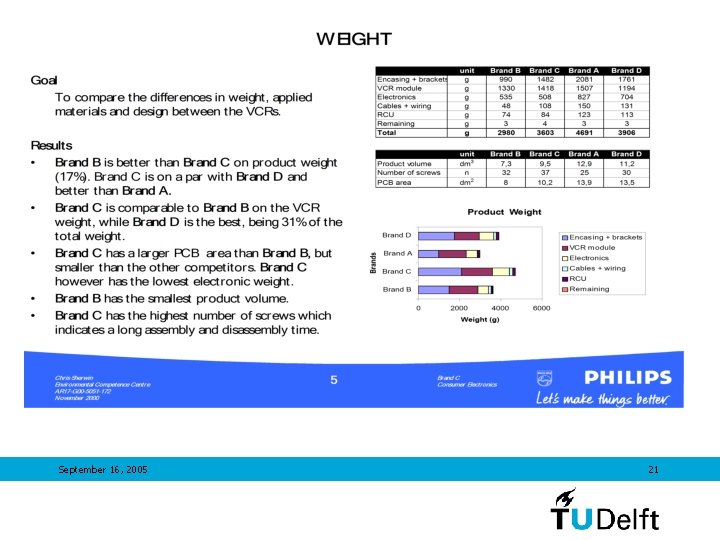
Weight Per (sub) assembly : • Encasing • Picture tube, drives (if present) • Electronics (PWB, display, batteries, etc. ) • Components on PWB (type and number) • Accessories (adapter, RCU, etc. ) • Functional parts (speakers, antenna, etc. ) • Wiring and connectors (main cord, etc. ) September 16, 2005 19
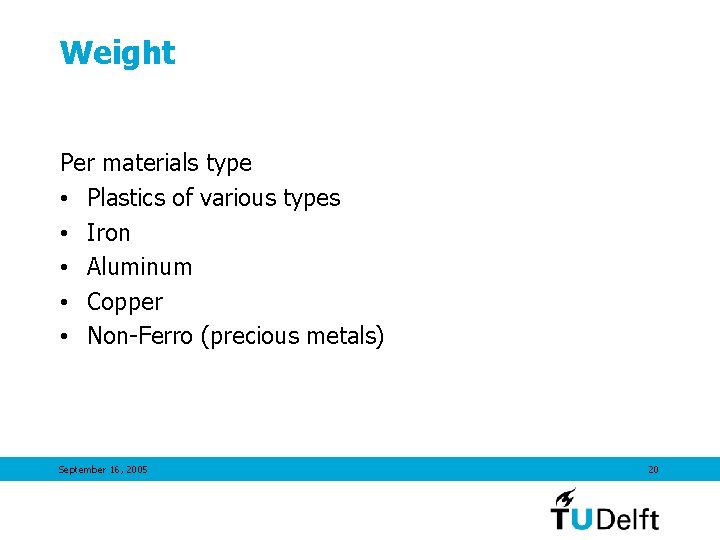
Weight Per materials type • Plastics of various types • Iron • Aluminum • Copper • Non-Ferro (precious metals) September 16, 2005 20
September 16, 2005 21
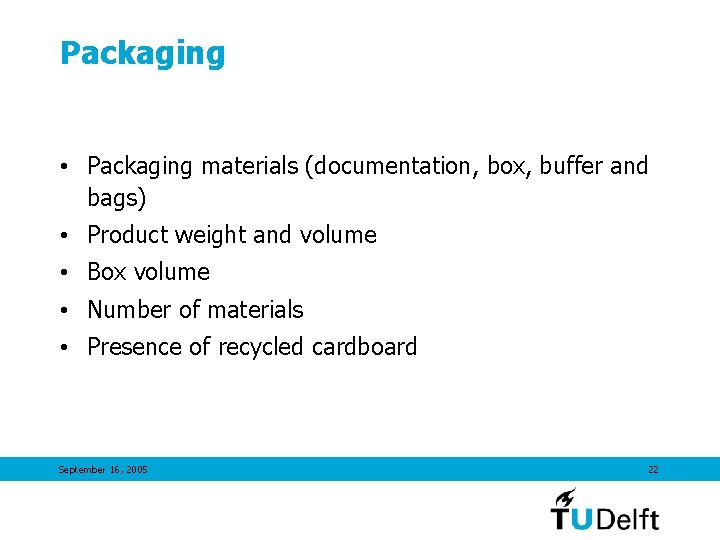
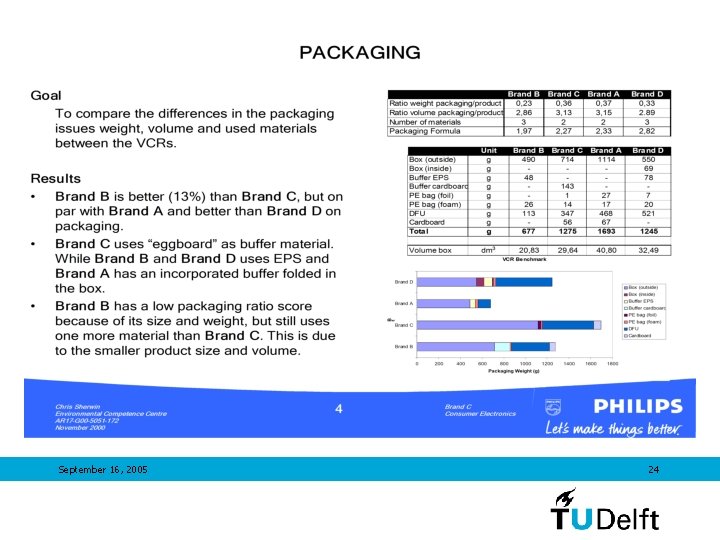
Packaging • Packaging materials (documentation, box, buffer and bags) • Product weight and volume • Box volume • Number of materials • Presence of recycled cardboard September 16, 2005 22
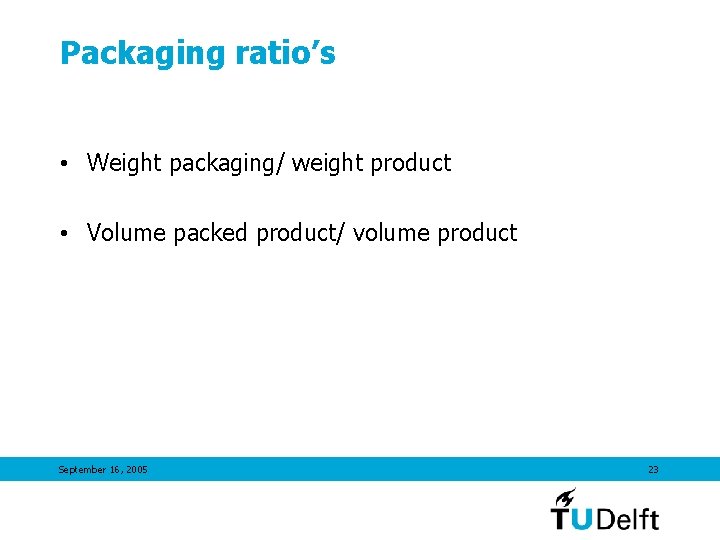
Packaging ratio’s • Weight packaging/ weight product • Volume packed product/ volume product September 16, 2005 23
September 16, 2005 24
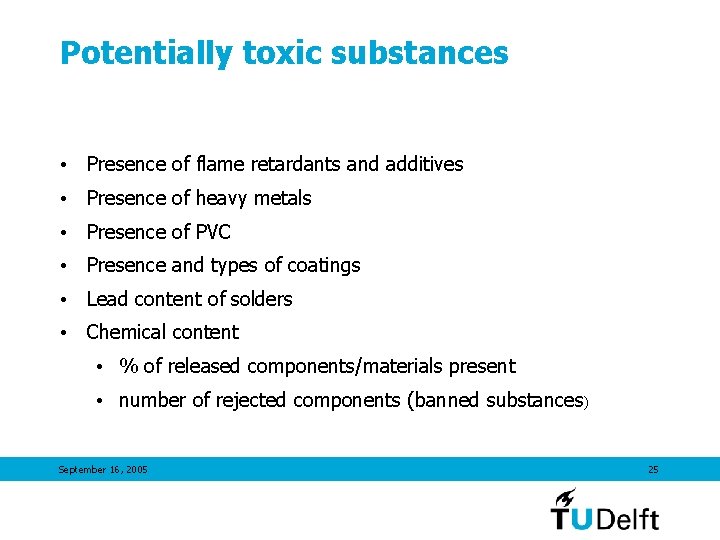
Potentially toxic substances • Presence of flame retardants and additives • Presence of heavy metals • Presence of PVC • Presence and types of coatings • Lead content of solders • Chemical content • % of released components/materials present • number of rejected components (banned substances) September 16, 2005 25
Recyclability • Plastics application • (e. g. mono-materials, halogenated flame retardant) • Connection type • Disassembly time • Material Recycling Efficiency • Costs and revenues of end-of-life treatment September 16, 2005 26
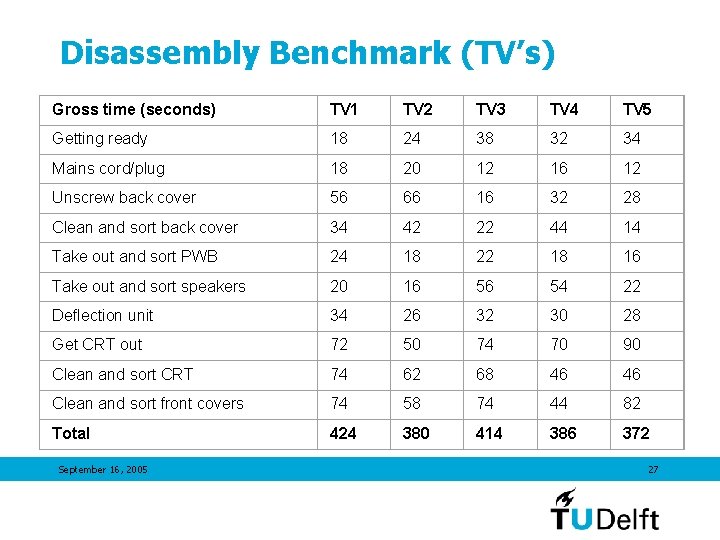
Disassembly Benchmark (TV’s) Gross time (seconds) TV 1 TV 2 TV 3 TV 4 TV 5 Getting ready 18 24 38 32 34 Mains cord/plug 18 20 12 16 12 Unscrew back cover 56 66 16 32 28 Clean and sort back cover 34 42 22 44 14 Take out and sort PWB 24 18 22 18 16 Take out and sort speakers 20 16 56 54 22 Deflection unit 34 26 32 30 28 Get CRT out 72 50 74 70 90 Clean and sort CRT 74 62 68 46 46 Clean and sort front covers 74 58 74 44 82 Total 424 380 414 386 372 September 16, 2005 27
September 16, 2005 28
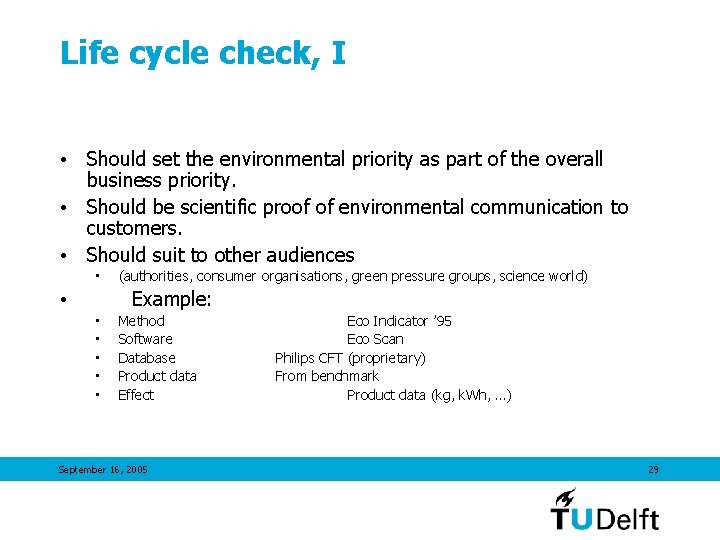
Life cycle check, I • Should set the environmental priority as part of the overall business priority. • Should be scientific proof of environmental communication to customers. • Should suit to other audiences • (authorities, consumer organisations, green pressure groups, science world) Example: • • • Method Software Database Product data Effect September 16, 2005 Eco Indicator ’ 95 Eco Scan Philips CFT (proprietary) From benchmark Product data (kg, k. Wh, …) 29
Life Cycle Check, II September 16, 2005 30
Benchmarking at Philips Consumer Electronics • It is the core of Philips Consumer Electronics ecodesign program • Is mandatory for all product groups and business units • Functions • • • awareness roadmapping brainstorming new product specifications qualifying for “Green Flagship” September 16, 2005 31
It is worthwhile to go environmental benchmarking. Example : EISA Green Awards at the IFA EISA is the European Imaging and Sound Association; Members are the 60 leading magazines in Audio and Video -Awards for all product categories shown at the IFA; selection by EISA panels -Green Awards as of 2005 (TV) and 2009 (cell phones); measurements and proposal for winner by DUT Delft (Netherlands) and NTNU (Norway) September 16, 2005 32
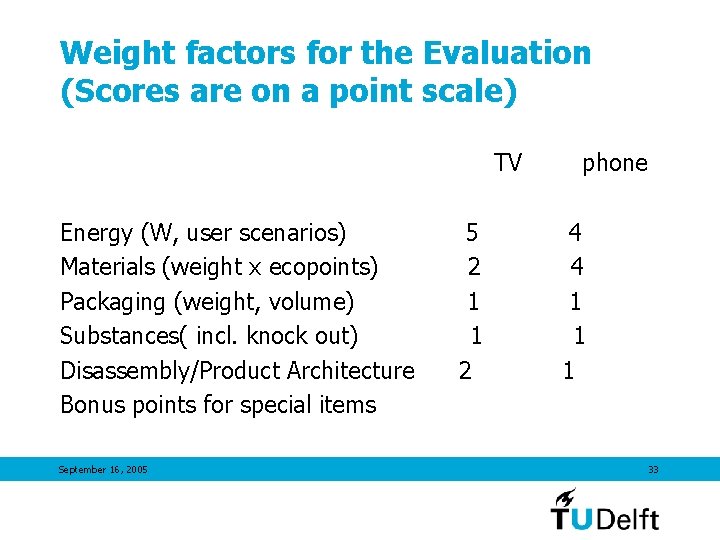
Weight factors for the Evaluation (Scores are on a point scale) TV Energy (W, user scenarios) Materials (weight x ecopoints) Packaging (weight, volume) Substances( incl. knock out) Disassembly/Product Architecture Bonus points for special items September 16, 2005 5 2 1 1 2 phone 4 4 1 1 1 33
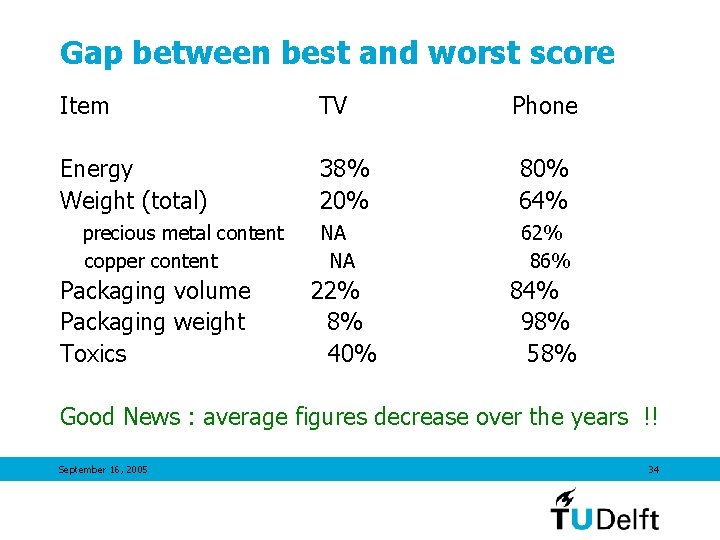
Gap between best and worst score Item TV Phone Energy Weight (total) 38% 20% 80% 64% NA NA 62% 86% precious metal content copper content Packaging volume Packaging weight Toxics 22% 8% 40% 84% 98% 58% Good News : average figures decrease over the years !! September 16, 2005 34
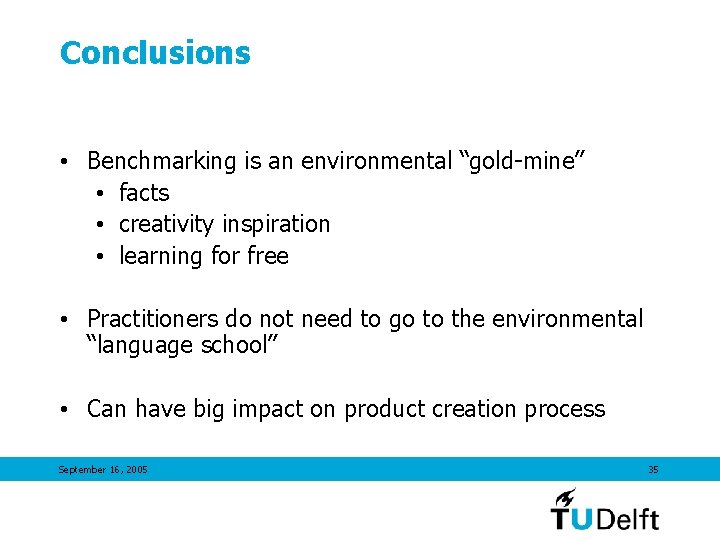
Conclusions • Benchmarking is an environmental “gold-mine” • facts • creativity inspiration • learning for free • Practitioners do not need to go to the environmental “language school” • Can have big impact on product creation process September 16, 2005 35
- Slides: 35