
Envirepel Technology Brief October 29 2020 Envirepel Energy
Envirepel Technology Brief October 29, 2020 Envirepel Energy Confidential
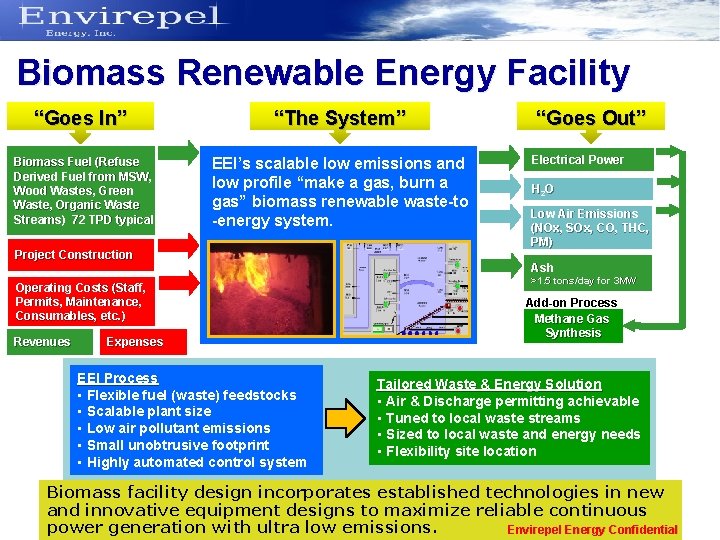
Biomass Renewable Energy Facility “Goes In” Biomass Fuel (Refuse Derived Fuel from MSW, Wood Wastes, Green Waste, Organic Waste Streams) 72 TPD typical “The System” EEI’s scalable low emissions and low profile “make a gas, burn a gas” biomass renewable waste-to -energy system. Project Construction Operating Costs (Staff, Permits, Maintenance, Consumables, etc. ) Revenues Expenses EEI Process • Flexible fuel (waste) feedstocks • Scalable plant size • Low air pollutant emissions • Small unobtrusive footprint • Highly automated control system 1 “Goes Out” Electrical Power H 2 O Low Air Emissions (NOx, SOx, CO, THC, PM) Ash >1. 5 tons/day for 3 MW Add-on Process Methane Gas Synthesis Tailored Waste & Energy Solution • Air & Discharge permitting achievable • Tuned to local waste streams • Sized to local waste and energy needs • Flexibility site location Biomass facility design incorporates established technologies in new and innovative equipment designs to maximize reliable continuous power generation with ultra low emissions. Envirepel Energy Confidential
EEI System Advantages: • Near Zero Emissions – Process generates ultra-low levels of NOx and SOx; thereby, allowing a facility to be permitted in the most stringent regulatory environments. • Low Risk Technology – Utilizes proven combustion technology and exhaust air treatment equipment in conjunction with a control algorithm resulting in high efficiency and near zero emissions performance. • Substantially Improved Efficiency – Process converts all carbon compounds in the biomass and other waste fuels, including those that cannot be broken down in alternative enzymatic conversion processes, to maximize BTU content extraction. • Renewable Energy at Competitive Costs – Facility costs comparable to conventional fossil fuel plant costs. With Renewable Energy incentives, the business model only improves. • Multiple Market Player – Facility operates in the electrical power, waste disposition, and synthetic fuels markets. These revenue sources may be balanced at the project level and location according to market conditions to optimize revenue. 2 Envirepel Energy Confidential
EEI System Advantages: • Near Zero Emissions – Process generates ultra-low levels of NOx and SO 2; thereby, allowing a facility to be permitted in the most stringent regulatory environments. • Low Risk Technology – Utilizes proven combustion technology and exhaust air treatment equipment in conjunction with a control algorithm resulting in high efficiency and near zero emissions performance. • Substantially Improved Efficiency – Process converts all carbon compounds in the biomass and other waste fuels, including those that cannot be broken down in alternative enzymatic conversion processes, to maximize BTU content extraction. • Renewable Energy at Competitive Costs – Facility costs comparable to conventional fossil fuel plant costs. With Renewable Energy incentives, the business model only improves. • Multiple Market Player – Facility operates in the electrical power, waste disposition, and synthetic fuels markets. These revenue sources may be balanced at the project level and location according to market conditions to optimize revenue. 3 Envirepel Energy Confidential
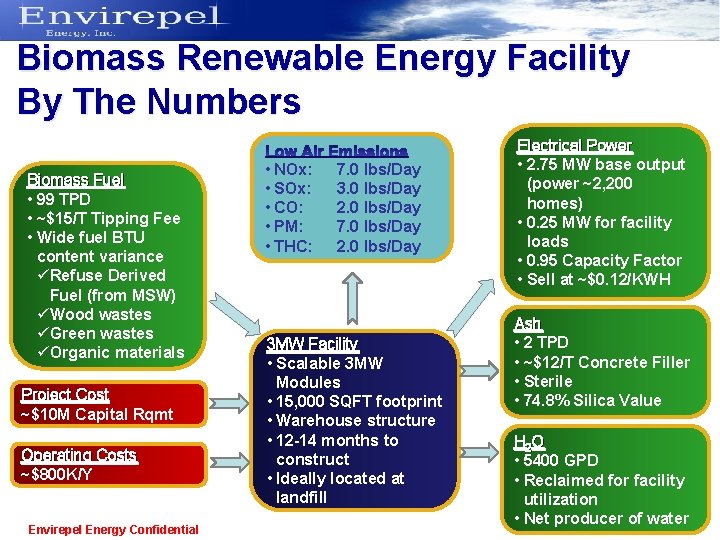
Biomass Renewable Energy Facility By The Numbers Biomass Fuel • 99 TPD • ~$15/T Tipping Fee • Wide fuel BTU content variance üRefuse Derived Fuel (from MSW) üWood wastes üGreen wastes üOrganic materials Project Cost ~$10 M Capital Rqmt Operating Costs ~$800 K/Y 4 Envirepel Energy Confidential • NOx: • SOx: • CO: • PM: • THC: 7. 0 lbs/Day 3. 0 lbs/Day 2. 0 lbs/Day 7. 0 lbs/Day 2. 0 lbs/Day 3 MW Facility • Scalable 3 MW Modules • 15, 000 SQFT footprint • Warehouse structure • 12 -14 months to construct • Ideally located at landfill Electrical Power • 2. 75 MW base output (power ~2, 200 homes) • 0. 25 MW for facility loads • 0. 95 Capacity Factor • Sell at ~$0. 12/KWH Ash • 2 TPD • ~$12/T Concrete Filler • Sterile • 74. 8% Silica Value H 2 O • 5400 GPD • Reclaimed for facility utilization • Net producer of water
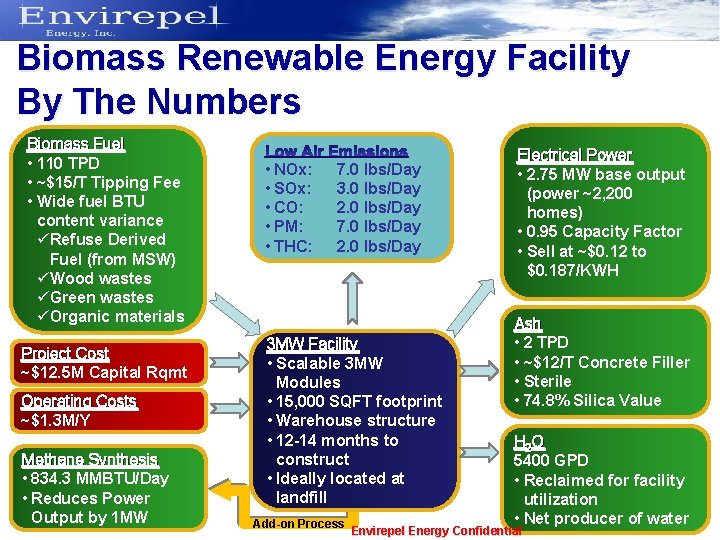
Biomass Renewable Energy Facility By The Numbers Biomass Fuel • 110 TPD • ~$15/T Tipping Fee • Wide fuel BTU content variance üRefuse Derived Fuel (from MSW) üWood wastes üGreen wastes üOrganic materials Project Cost ~$12. 5 M Capital Rqmt Operating Costs ~$1. 3 M/Y Methane Synthesis • 834. 3 MMBTU/Day • Reduces Power Output by 1 MW 5 • NOx: • SOx: • CO: • PM: • THC: 7. 0 lbs/Day 3. 0 lbs/Day 2. 0 lbs/Day 7. 0 lbs/Day 2. 0 lbs/Day 3 MW Facility • Scalable 3 MW Modules • 15, 000 SQFT footprint • Warehouse structure • 12 -14 months to construct • Ideally located at landfill Add-on Process Electrical Power • 2. 75 MW base output (power ~2, 200 homes) • 0. 95 Capacity Factor • Sell at ~$0. 12 to $0. 187/KWH Ash • 2 TPD • ~$12/T Concrete Filler • Sterile • 74. 8% Silica Value H 2 O 5400 GPD • Reclaimed for facility utilization • Net producer of water Envirepel Energy Confidential
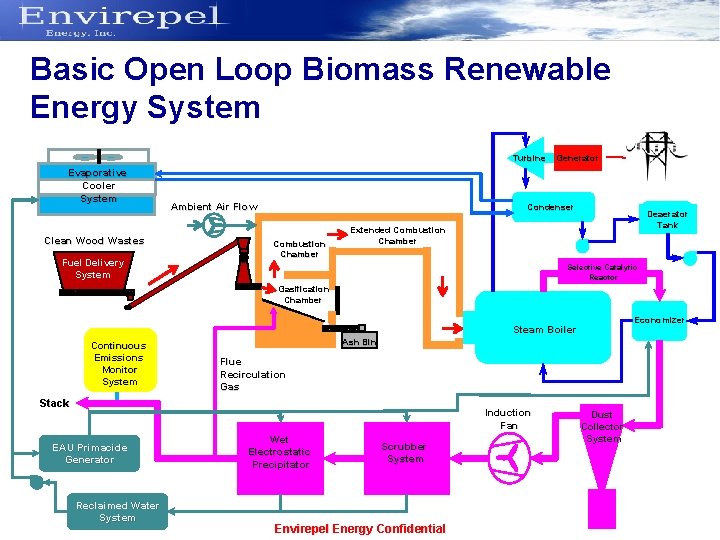
Basic Open Loop Biomass Renewable Energy System Turbine Evaporative Cooler System Clean Wood Wastes Fuel Delivery System Ambient Air Flow Generator Condenser Combustion Chamber Deaerator Tank Extended Combustion Chamber Selective Catalytic Reactor Gasification Chamber Economizer Steam Boiler Continuous Emissions Monitor System Ash Bin Flue Recirculation Gas Stack Induction Fan EAU Primacide Generator 6 Reclaimed Water System Wet Electrostatic Precipitator Scrubber System Envirepel Energy Confidential Dust Collector System
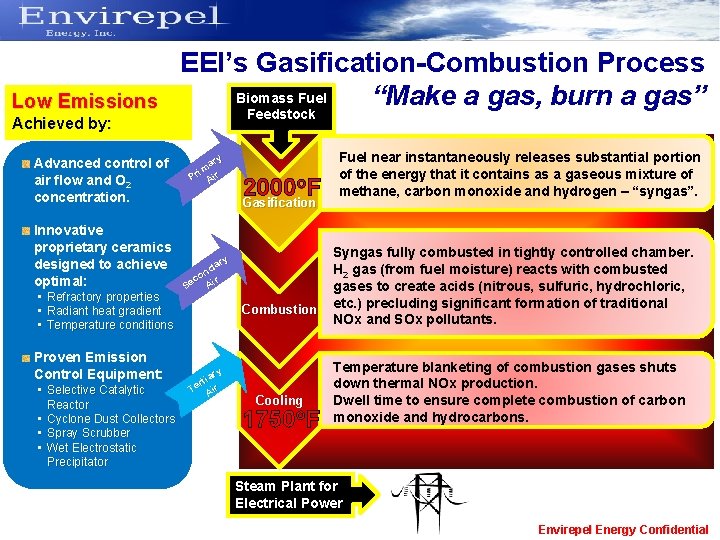
Low Emissions EEI’s Gasification-Combustion Process Biomass Fuel “Make a gas, burn a gas” Feedstock Achieved by: Advanced control of air flow and O 2 concentration. Innovative proprietary ceramics designed to achieve optimal: • Refractory properties • Radiant heat gradient • Temperature conditions Proven Emission Control Equipment: • Selective Catalytic Reactor • Cyclone Dust Collectors • Spray Scrubber • Wet Electrostatic Precipitator y ar im Pr Air o. F 2000 Gasification y ar d n co ir e A S Combustion y ar i t r Te Air Cooling 1750 o. F Fuel near instantaneously releases substantial portion of the energy that it contains as a gaseous mixture of methane, carbon monoxide and hydrogen – “syngas”. Syngas fully combusted in tightly controlled chamber. H 2 gas (from fuel moisture) reacts with combusted gases to create acids (nitrous, sulfuric, hydrochloric, etc. ) precluding significant formation of traditional NOx and SOx pollutants. Temperature blanketing of combustion gases shuts down thermal NOx production. Dwell time to ensure complete combustion of carbon monoxide and hydrocarbons. Steam Plant for Electrical Power 7 Envirepel Energy Confidential
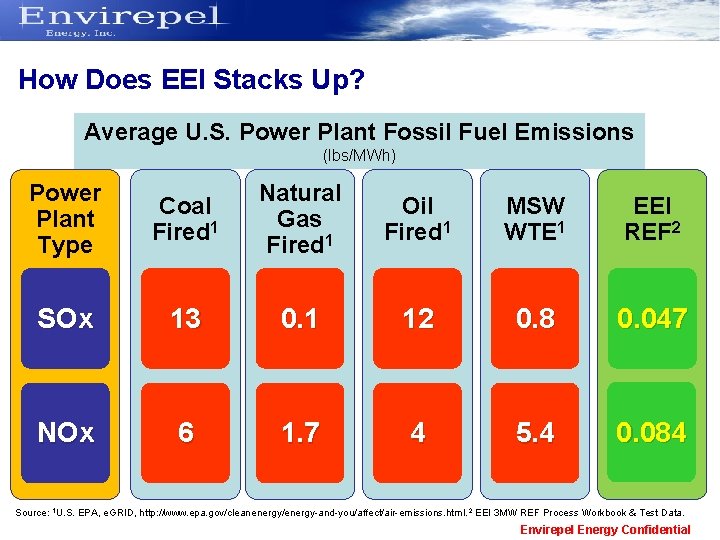
How Does EEI Stacks Up? Average U. S. Power Plant Fossil Fuel Emissions (lbs/MWh) Power Plant Type Coal Fired 1 Natural Gas Fired 1 Oil Fired 1 MSW WTE 1 EEI REF 2 SOx 13 0. 1 12 0. 8 0. 047 NOx 6 1. 7 4 5. 4 0. 084 Source: 1 U. S. EPA, e. GRID, http: //www. epa. gov/cleanenergy/energy-and-you/affect/air-emissions. html. 2 EEI 3 MW REF Process Workbook & Test Data. 8 Envirepel Energy Confidential
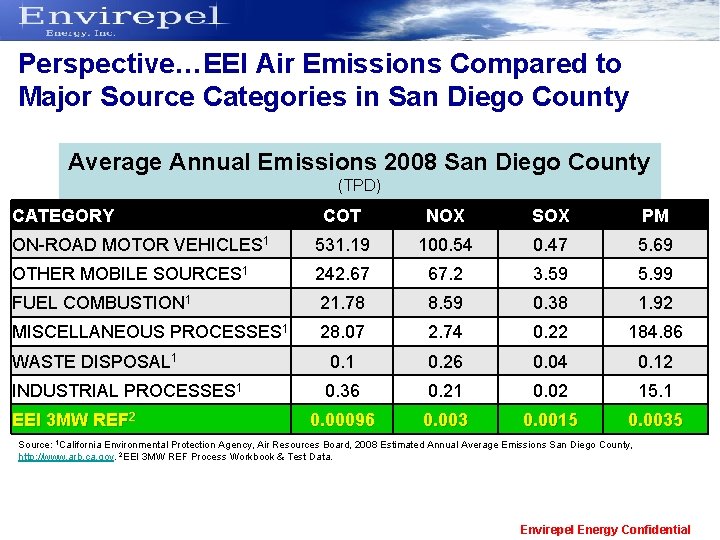
Perspective…EEI Air Emissions Compared to Major Source Categories in San Diego County Average Annual Emissions 2008 San Diego County (TPD) CATEGORY COT NOX SOX PM ON-ROAD MOTOR VEHICLES 1 531. 19 100. 54 0. 47 5. 69 OTHER MOBILE SOURCES 1 242. 67 67. 2 3. 59 5. 99 FUEL COMBUSTION 1 21. 78 8. 59 0. 38 1. 92 MISCELLANEOUS PROCESSES 1 28. 07 2. 74 0. 22 184. 86 WASTE DISPOSAL 1 0. 26 0. 04 0. 12 INDUSTRIAL PROCESSES 1 0. 36 0. 21 0. 02 15. 1 0. 00096 0. 003 0. 0015 0. 0035 EEI 3 MW REF 2 Source: 1 California Environmental Protection Agency, Air Resources Board, 2008 Estimated Annual Average Emissions San Diego County, http: //www. arb. ca. gov. 2 EEI 3 MW REF Process Workbook & Test Data. 9 Envirepel Energy Confidential
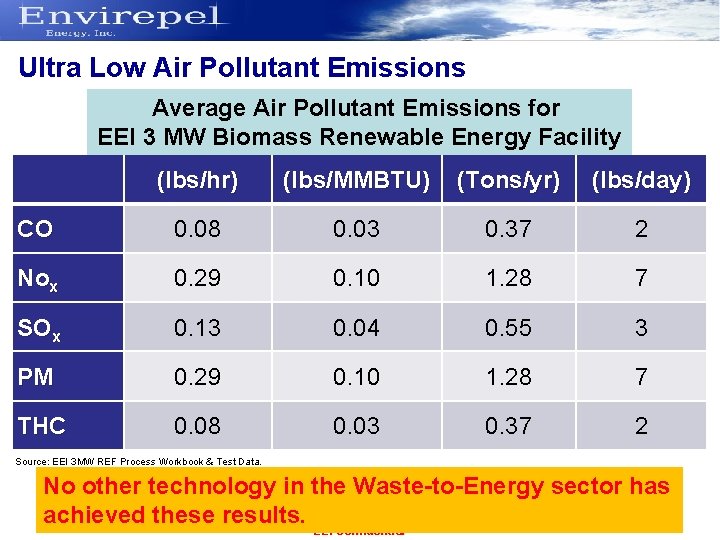
Ultra Low Air Pollutant Emissions Average Air Pollutant Emissions for EEI 3 MW Biomass Renewable Energy Facility (lbs/hr) (lbs/MMBTU) (Tons/yr) (lbs/day) CO 0. 08 0. 03 0. 37 2 Nox 0. 29 0. 10 1. 28 7 SOx 0. 13 0. 04 0. 55 3 PM 0. 29 0. 10 1. 28 7 THC 0. 08 0. 03 0. 37 2 Source: EEI 3 MW REF Process Workbook & Test Data. 10 No other technology in the Waste-to-Energy sector has achieved these results. EEI Confidential
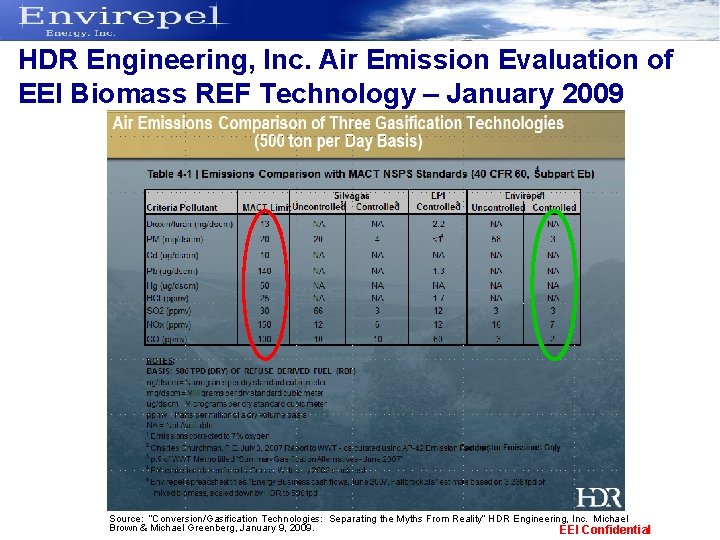
HDR Engineering, Inc. Air Emission Evaluation of EEI Biomass REF Technology – January 2009 11 Source: “Conversion/Gasification Technologies: Separating the Myths From Reality” HDR Engineering, Inc. Michael Brown & Michael Greenberg, January 9, 2009. EEI Confidential
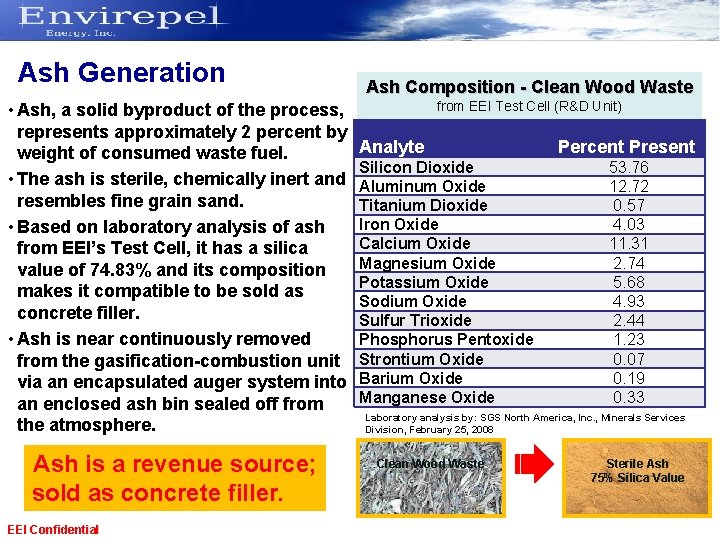
Ash Generation • Ash, a solid byproduct of the process, represents approximately 2 percent by weight of consumed waste fuel. • The ash is sterile, chemically inert and resembles fine grain sand. • Based on laboratory analysis of ash from EEI’s Test Cell, it has a silica value of 74. 83% and its composition makes it compatible to be sold as concrete filler. • Ash is near continuously removed from the gasification-combustion unit via an encapsulated auger system into an enclosed ash bin sealed off from the atmosphere. Ash is a revenue source; sold as concrete filler. 12 EEI Confidential Ash Composition - Clean Wood Waste from EEI Test Cell (R&D Unit) Analyte Silicon Dioxide Aluminum Oxide Titanium Dioxide Iron Oxide Calcium Oxide Magnesium Oxide Potassium Oxide Sodium Oxide Sulfur Trioxide Phosphorus Pentoxide Strontium Oxide Barium Oxide Manganese Oxide Percent Present 53. 76 12. 72 0. 57 4. 03 11. 31 2. 74 5. 68 4. 93 2. 44 1. 23 0. 07 0. 19 0. 33 Laboratory analysis by: SGS North America, Inc. , Minerals Services Division, February 25, 2008 Clean Wood Waste Sterile Ash 75% Silica Value
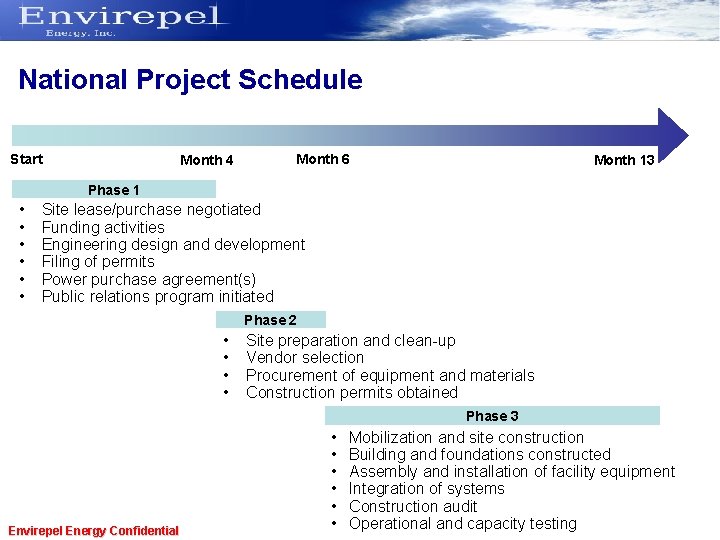
National Project Schedule Start Month 4 Month 6 Month 13 Phase 1 • • • Site lease/purchase negotiated Funding activities Engineering design and development Filing of permits Power purchase agreement(s) Public relations program initiated Phase 2 • • Site preparation and clean-up Vendor selection Procurement of equipment and materials Construction permits obtained Phase 3 13 Envirepel Energy Confidential • • • Mobilization and site construction Building and foundations constructed Assembly and installation of facility equipment Integration of systems Construction audit Operational and capacity testing
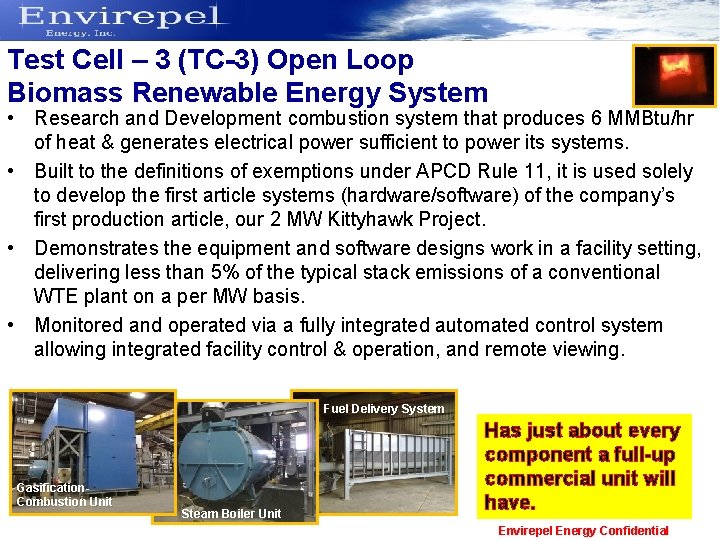
Test Cell – 3 (TC-3) Open Loop Biomass Renewable Energy System • Research and Development combustion system that produces 6 MMBtu/hr of heat & generates electrical power sufficient to power its systems. • Built to the definitions of exemptions under APCD Rule 11, it is used solely to develop the first article systems (hardware/software) of the company’s first production article, our 2 MW Kittyhawk Project. • Demonstrates the equipment and software designs work in a facility setting, delivering less than 5% of the typical stack emissions of a conventional WTE plant on a per MW basis. • Monitored and operated via a fully integrated automated control system allowing integrated facility control & operation, and remote viewing. Fuel Delivery System Gasification. Combustion Unit 14 Steam Boiler Unit Has just about every component a full-up commercial unit will have. Envirepel Energy Confidential
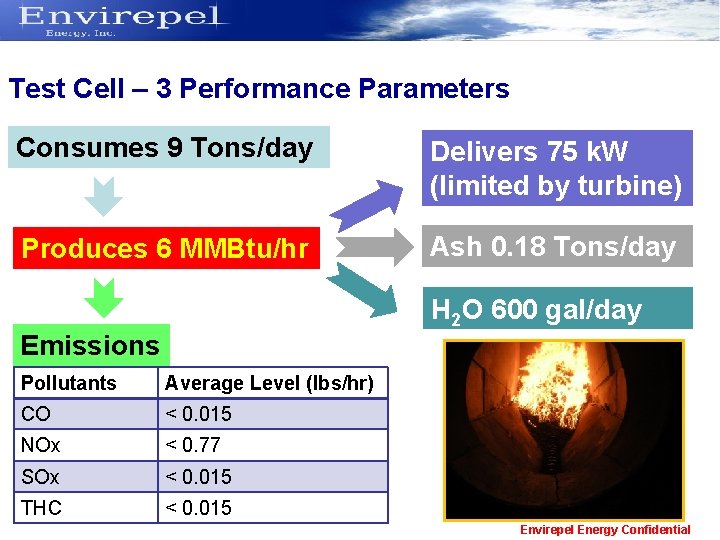
Test Cell – 3 Performance Parameters Consumes 9 Tons/day Delivers 75 k. W (limited by turbine) Produces 6 MMBtu/hr Ash 0. 18 Tons/day H 2 O 600 gal/day Emissions Pollutants Average Level (lbs/hr) CO < 0. 015 NOx < 0. 77 SOx < 0. 015 THC < 0. 015 15 Envirepel Energy Confidential
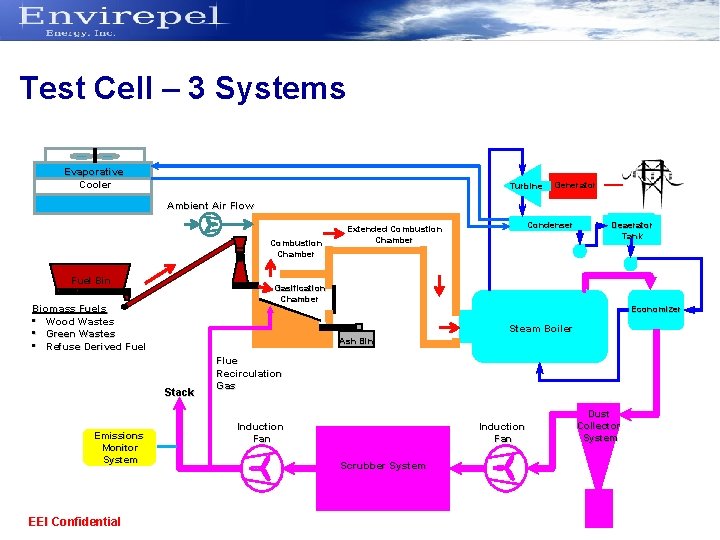
Test Cell – 3 Systems Evaporative Cooler Turbine Generator Ambient Air Flow Combustion Chamber Fuel Bin Deaerator Tank Economizer Steam Boiler Ash Bin Stack 16 EEI Confidential Condenser Gasification Chamber Biomass Fuels • Wood Wastes • Green Wastes • Refuse Derived Fuel Emissions Monitor System Extended Combustion Chamber Flue Recirculation Gas Induction Fan Scrubber System Dust Collector System
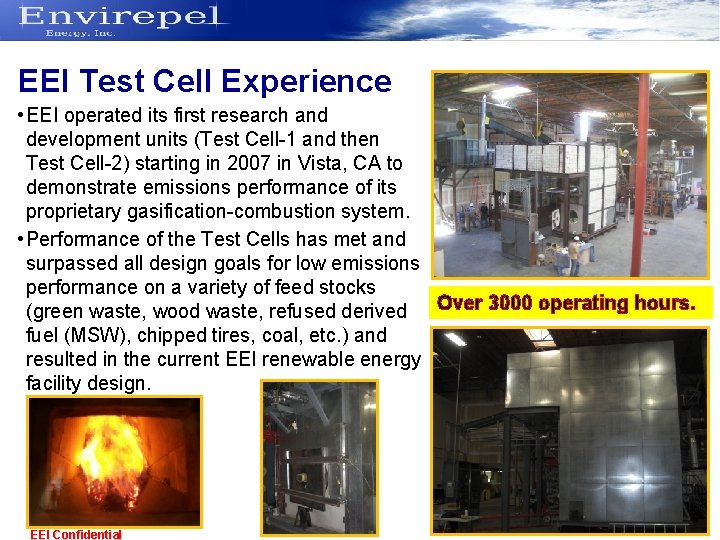
EEI Test Cell Experience • EEI operated its first research and development units (Test Cell-1 and then Test Cell-2) starting in 2007 in Vista, CA to demonstrate emissions performance of its proprietary gasification-combustion system. • Performance of the Test Cells has met and surpassed all design goals for low emissions performance on a variety of feed stocks (green waste, wood waste, refused derived Over 3000 operating hours. fuel (MSW), chipped tires, coal, etc. ) and resulted in the current EEI renewable energy facility design. 17 EEI Confidential
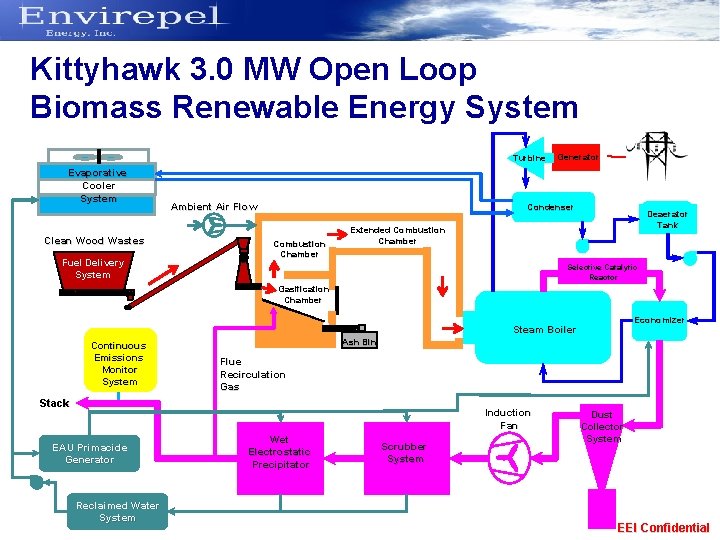
Kittyhawk 3. 0 MW Open Loop Biomass Renewable Energy System Turbine Evaporative Cooler System Clean Wood Wastes Fuel Delivery System Ambient Air Flow Generator Condenser Combustion Chamber Deaerator Tank Extended Combustion Chamber Selective Catalytic Reactor Gasification Chamber Economizer Steam Boiler Continuous Emissions Monitor System Ash Bin Flue Recirculation Gas Stack Induction Fan EAU Primacide Generator 18 Reclaimed Water System Wet Electrostatic Precipitator Scrubber System Dust Collector System EEI Confidential
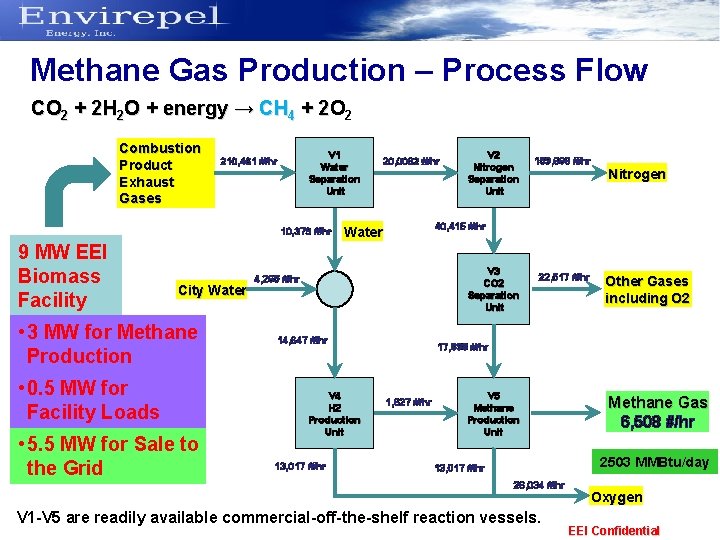
Methane Gas Production – Process Flow CO 2 + 2 H 2 O + energy → CH 4 + 2 O + 2 2 Combustion Product Exhaust Gases V 1 Water Separation Unit 210, 461 #/hr 10, 379 #/hr 9 MW EEI Biomass Facility City Water • 3 MW for Methane Production • 0. 5 MW for Facility Loads • 5. 5 MW for Sale to the Grid 20, 0082 #/hr V 2 Nitrogen Separation Unit V 3 CO 2 Separation Unit 4, 265 #/hr 14, 647 #/hr 13, 017 #/hr Nitrogen 40, 415 #/hr Water V 4 H 2 Production Unit 159, 666 #/hr 22, 517 #/hr Other Gases including O 2 17, 898 #/hr 1, 627 #/hr V 5 Methane Production Unit Methane Gas 6, 508 #/hr 2503 MMBtu/day 13, 017 #/hr 26, 034 #/hr V 1 -V 5 are readily available commercial-off-the-shelf reaction vessels. 19 Oxygen EEI Confidential
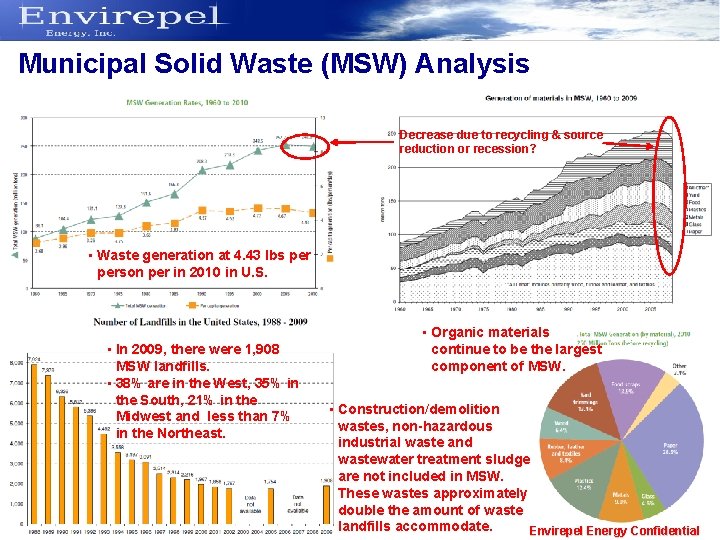
Municipal Solid Waste (MSW) Analysis Decrease due to recycling & source reduction or recession? • Waste generation at 4. 43 lbs person per in 2010 in U. S. • In 2009, there were 1, 908 MSW landfills. • 38% are in the West, 35% in the South, 21% in the Midwest and less than 7% in the Northeast. 20 • Organic materials continue to be the largest component of MSW. • Construction/demolition wastes, non-hazardous industrial waste and wastewater treatment sludge are not included in MSW. These wastes approximately double the amount of waste landfills accommodate. Envirepel Energy Confidential
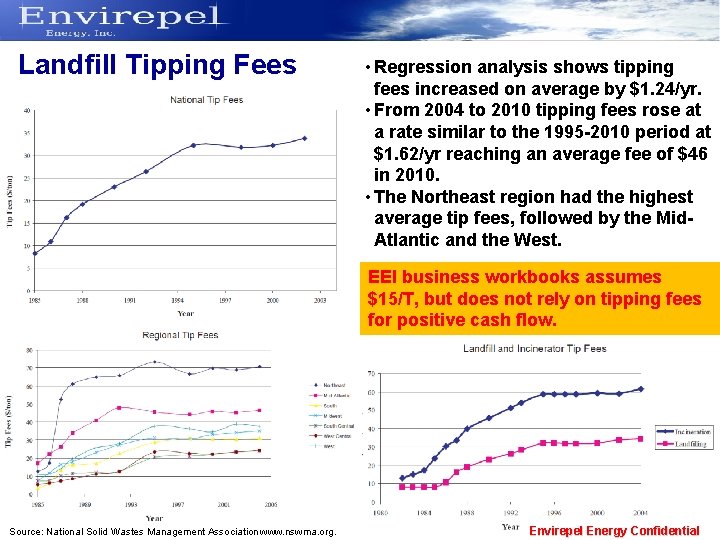
Landfill Tipping Fees • Regression analysis shows tipping fees increased on average by $1. 24/yr. • From 2004 to 2010 tipping fees rose at a rate similar to the 1995 -2010 period at $1. 62/yr reaching an average fee of $46 in 2010. • The Northeast region had the highest average tip fees, followed by the Mid. Atlantic and the West. EEI business workbooks assumes $15/T, but does not rely on tipping fees for positive cash flow. 21 Source: National Solid Wastes Management Association www. nswma. org. Envirepel Energy Confidential
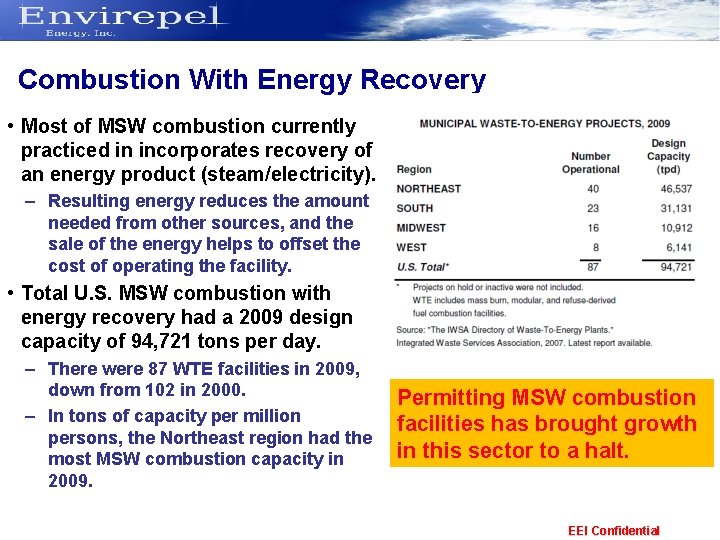
Combustion With Energy Recovery • Most of MSW combustion currently practiced in incorporates recovery of an energy product (steam/electricity). – Resulting energy reduces the amount needed from other sources, and the sale of the energy helps to offset the cost of operating the facility. • Total U. S. MSW combustion with energy recovery had a 2009 design capacity of 94, 721 tons per day. – There were 87 WTE facilities in 2009, down from 102 in 2000. – In tons of capacity per million persons, the Northeast region had the most MSW combustion capacity in 2009. 22 Permitting MSW combustion facilities has brought growth in this sector to a halt. EEI Confidential
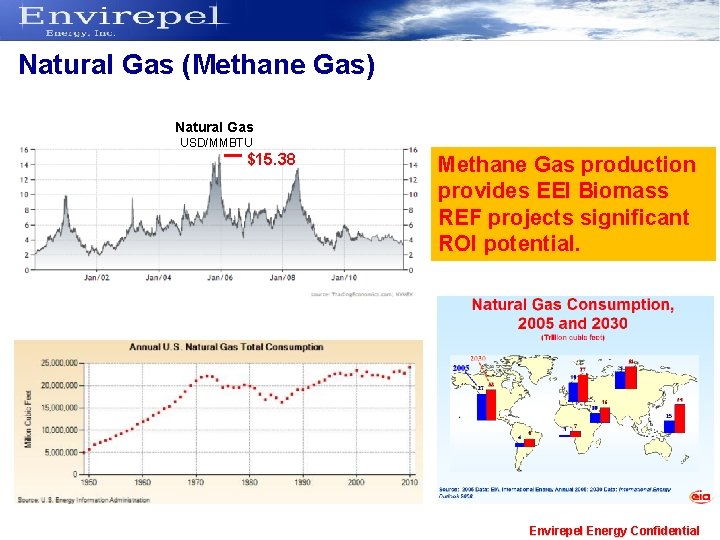
Natural Gas (Methane Gas) Natural Gas USD/MMBTU $15. 38 23 Methane Gas production provides EEI Biomass REF projects significant ROI potential. Envirepel Energy Confidential
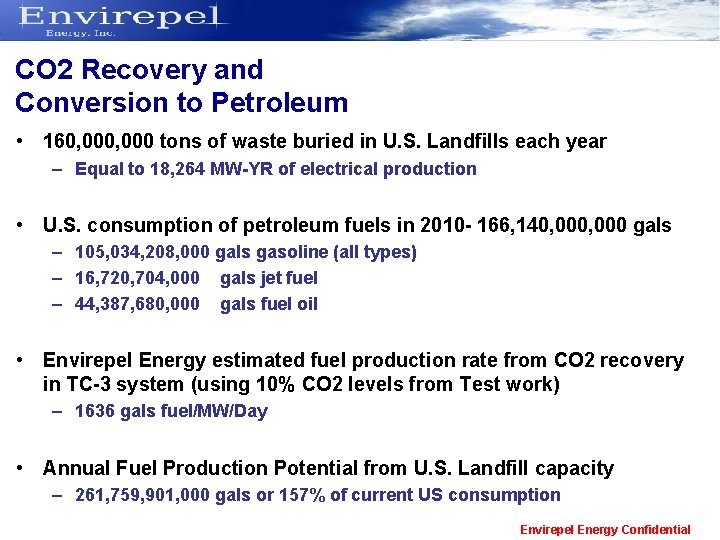
CO 2 Recovery and Conversion to Petroleum • 160, 000 tons of waste buried in U. S. Landfills each year – Equal to 18, 264 MW-YR of electrical production • U. S. consumption of petroleum fuels in 2010 - 166, 140, 000 gals – 105, 034, 208, 000 gals gasoline (all types) – 16, 720, 704, 000 gals jet fuel – 44, 387, 680, 000 gals fuel oil • Envirepel Energy estimated fuel production rate from CO 2 recovery in TC-3 system (using 10% CO 2 levels from Test work) – 1636 gals fuel/MW/Day • Annual Fuel Production Potential from U. S. Landfill capacity – 261, 759, 901, 000 gals or 157% of current US consumption 24 Envirepel Energy Confidential
Permitting Issues for Mass Burn Facilities • Some of major issues associated with mass burn facilities include: – – – – Ability to meet air quality requirements Possible conflict with adjacent land uses Disturbances to biological resources Disposal of ash and other by-products Possible classification of the ash as a hazardous material Use of large amounts of water for cooling (if wet cooling towers are used) Visual quality changes due to power plant structures and traffic patterns Transportation impacts from numerous truck trips from refuse source to the mass burn facility (collection and transportation would already be occurring, so facility would only cause a change in traffic patterns) – Likely public opposition because of uncertainties over health, safety, odor, and traffic impacts (since it is most economical for the facility to be located near urban centers where the waste is generated) – Possible conflicts between using MSW for electricity generation and programs/goals for waste reduction techniques and recycling – Possible hazardous materials leakage that may necessitate site cleanup EEI has comprehensively addressed each of these issues in its design and in most cases turned them into assets. EEI Confidential 25 EEI Confidential
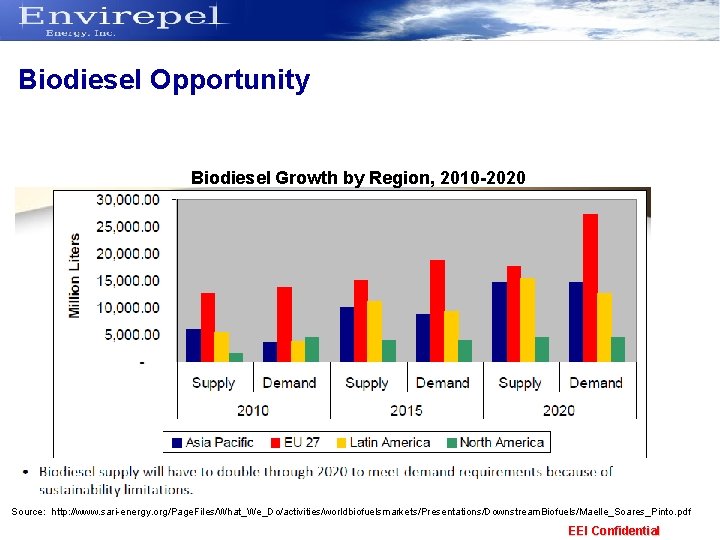
Biodiesel Opportunity Biodiesel Growth by Region, 2010 -2020 Source: http: //www. sari-energy. org/Page. Files/What_We_Do/activities/worldbiofuelsmarkets/Presentations/Downstream. Biofuels/Maelle_Soares_Pinto. pdf 26 EEI Confidential
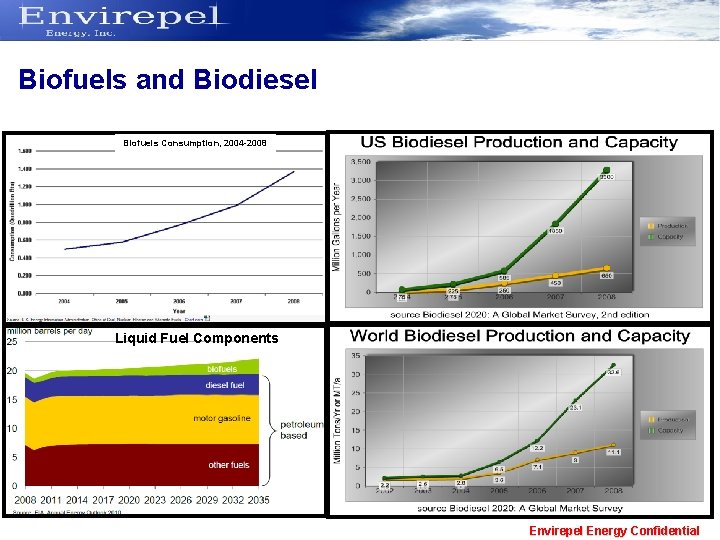
Biofuels and Biodiesel Biofuels Consumption, 2004 -2008 Liquid Fuel Components 27 Envirepel Energy Confidential
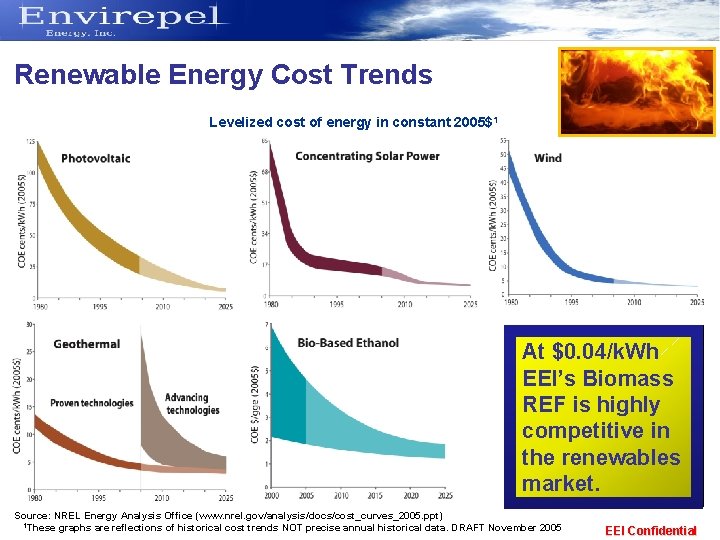
Renewable Energy Cost Trends Levelized cost of energy in constant 2005$1 At $0. 04/k. Wh EEI’s Biomass REF is highly competitive in the renewables market. Source: NREL Energy Analysis Office (www. nrel. gov/analysis/docs/cost_curves_2005. ppt) 1 These graphs are reflections of historical cost trends NOT precise annual historical data. DRAFT November 2005 28 EEI Confidential
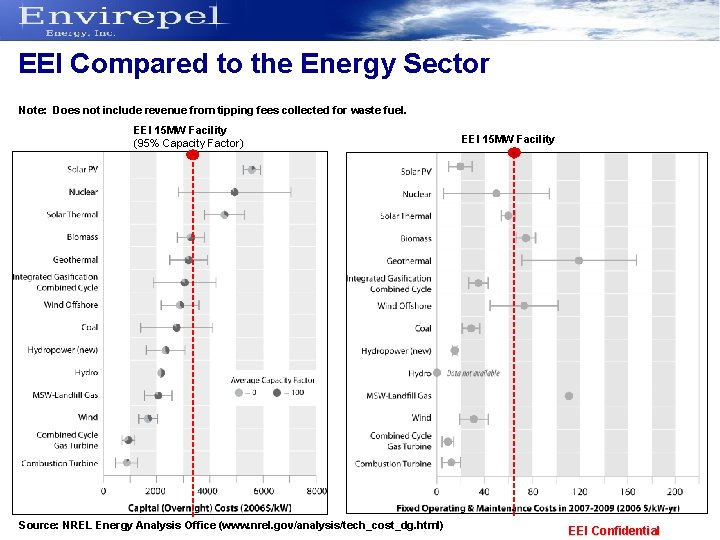
EEI Compared to the Energy Sector Note: Does not include revenue from tipping fees collected for waste fuel. EEI 15 MW Facility (95% Capacity Factor) Source: NREL Energy Analysis Office (www. nrel. gov/analysis/tech_cost_dg. html) 29 EEI 15 MW Facility EEI Confidential
Key Take Aways • EEI’s combustion and emissions control technology: – Supports responsible and sustainable solid waste disposal – Provides cost effective renewable energy – Promotes distributed grid development enhancing reliability and reducing transmission losses • EEI has demonstrated its technology through its Test Cell R&D Prototype Units – Over 8, 000 hours of operating experience – Performance met and surpassed all design goals for low emissions on a variety of feed stocks (green waste, wood waste, refused derived fuel (MSW), chipped tires, coal, etc. ) – EEI design based on actual operating experience • EEI ready to proceed with 3 Mw commercial project under Bio. Mat Tariff – Approximately 3 MW gross output system – Site lease signed, feed stock supply agreement signed, PPA to be signed in Feb 2018 – 30 Construction permits in process Envirepel Energy Confidential
- Slides: 31