
Envelops of body Biochemistry of Skin Functions Like
Envelops of body Biochemistry of Skin
Functions • Like air conditioner: remove heat • Like blanket : retain heat • Like a chemical factory: prepare vitamin D with sunlight • Like umbrella: Protect from dehydration and friction
human body has three concentric coverings • 1. The outermost layer is the integument proper (skin) • 2. beneath the skin is the subcutaneous layer • 3. Beneath this layer investing deep fascia, a membrane which completely covers the remaining structures of the body • Appendages: • hairs, nails , glands (sweat , Sebaceous-oil producing)
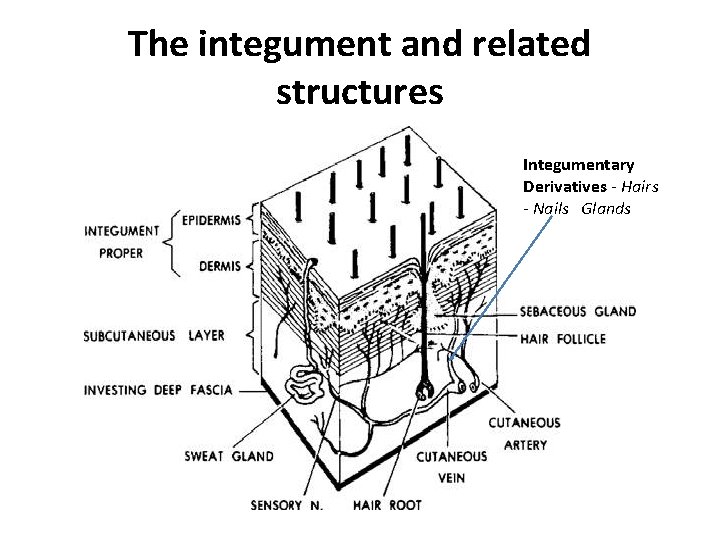
The integument and related structures Integumentary Derivatives - Hairs - Nails Glands
REDUCTION OF FRICTION AND ITS EFFECTS • Hairs minimize friction by allowing surfaces to slip or slide over each other. • Outer Dead Cells. Where there is no hair (glabrous condition), the outer dead squamous cells rub off to reduce frictional forces • Thickening of the Integument. The dermis and epidermis tend to become thicker whenever they are subjected to forces of pressures greater than average
BODY TEMPERATURE CONTROL • In order to function properly without disease, the human body must be maintained within a relatively narrow range of temperature
SOURCES OF BODY HEAT • • • 1. Muscle Contractions 2. Metabolic Activity 3. Solar Radiation • Core Temperature. The core temperature is the temperature within the body proper. Normally, the core temperature is maintained within narrow limits • Peripheral Body Temperature. The temperature of the body surface and the upper and lower members is called the peripheral body temperature. Peripheral body temperature can vary widely.

Removal and conservation of heat • • • Sweating Solar Radiation Shivering Proper clothing External source of heat
VITAMIN D PRODUCTION • Vitamin D is a fat-soluble vitamin. It is required by the body in relation to calcium metabolism. • The human body produces vitamin D in the integument. An organic compound known as ergosterol is converted into vitamin D by ultraviolet solar radiation. • Excessive production of vitamin D can become lethal to a human being. The main purpose of skin pigmentation seems to be the limitation of vitamin D production.

SUPERFICIAL WOUND HEALING • A wound of the integument creates an opening. This opening is an avenue for infection and water loss. • A wound crossing the split lines of the dermis tends to gape open. A wound parallel to the split lines closes easily. For this reason, when a surgeon can choose an incision, he tends to follow the split lines. • A wound is healed by the reuniting of the margins. This is accomplished by the growth and multiplication of the cells at the margins of the wound. • Scars result from the healing process. In some human groups (for example, Orientals), scars can become quite large and are called keloids. For all groups, the scar (cicatrix) is much less prominent for wounds that parallel the split lines
Hands and Feet adaptations • The epidermis and dermis are quite thickened in these areas. • These two areas are hairless (glabrous). • The dermal papillae holding the dermis and epidermis together are increased in number and size. • The surface of the skin has many ridges and grooves. These, in effect, form miniature suction cups. • Deep in the palm and sole, there is a very dense FCT, (Fibrous connective tissues) referred to as the palmar aponeurosis and plantar aponeurosis.
Variations in infants and adult penetration • In infants and the elderly, substances more readily penetrate the skin than with other age groups. One such substance is hexachlorophene. Hexachlorophene is an ingredient in some soaps and detergents used to maintain a germ-free environment in the hospital. If the skin of the infant or elderly person is not thoroughly rinsed after the use of such soaps or detergents, the skin of these individuals will readily absorb the residual hexachlorophene. This may produce neurological damage. • VARIATIONS ACCORDING TO BODY AREA • This condition may also exist in other age groups in those areas where the skin is thinnest. These areas include the inner surfaces of the flexing joints, axillae (under arm area), and groin (Under legs)and particularly the areas between the fingers and toes.
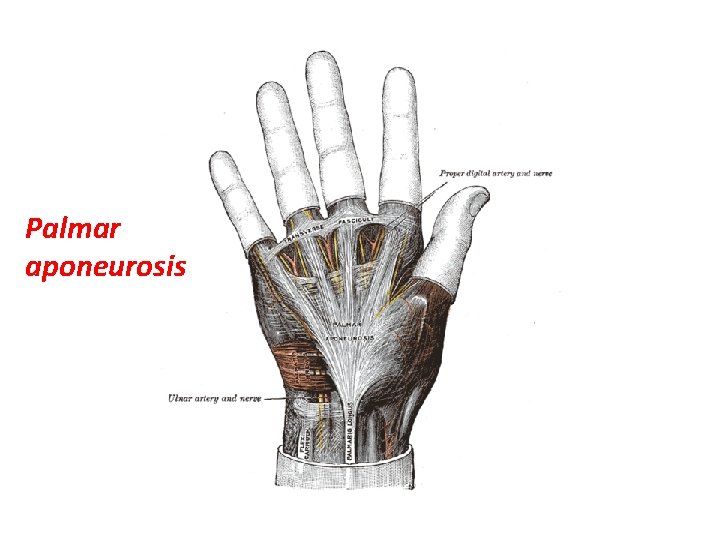
Palmar aponeurosis
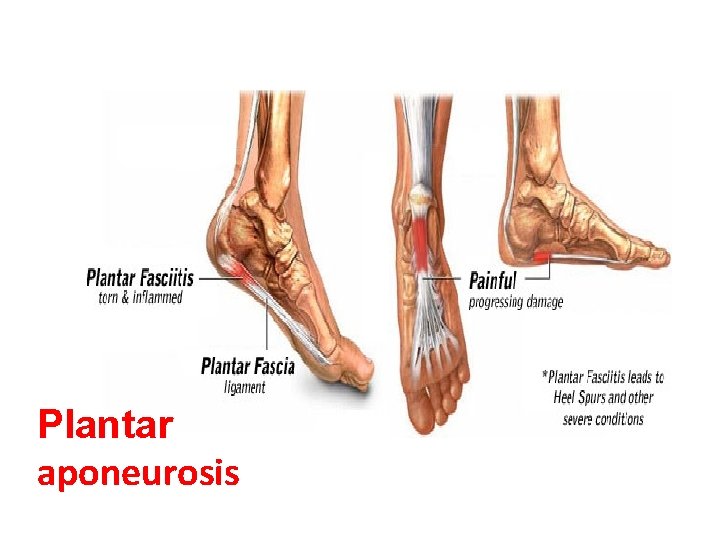
Plantar aponeurosis
- Slides: 14