
ENV 205 Occupational Health Class 1 Introduction to




- Slides: 67
ENV 205: Occupational Health Class 1 - Introduction to Safety, Health and Environment Slide # 1 ENV 205: Occupational Health
Course Instructor Term: Instructor: Telephone: Email: Spring 2015 Dave Neeley (573) 774 -5844 (home) (573) 528 -4522 (cell) neeleyd@otc. edu Slide # 2 ENV 205: Occupational Health
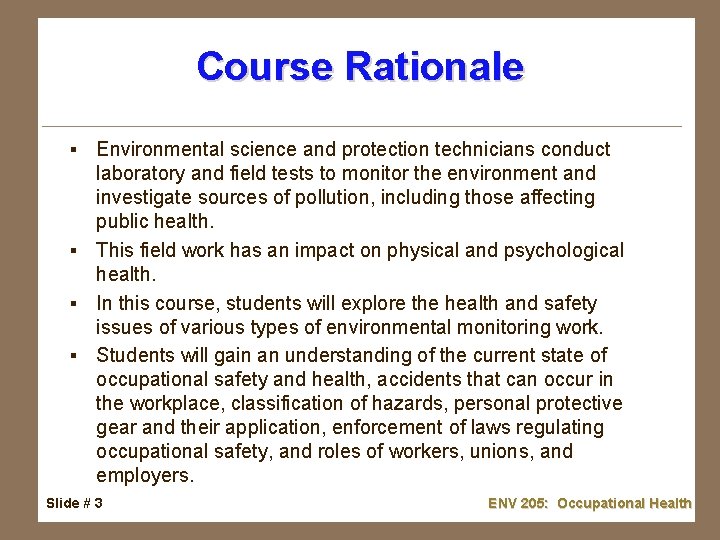
Course Rationale Environmental science and protection technicians conduct laboratory and field tests to monitor the environment and investigate sources of pollution, including those affecting public health. § This field work has an impact on physical and psychological health. § In this course, students will explore the health and safety issues of various types of environmental monitoring work. § Students will gain an understanding of the current state of occupational safety and health, accidents that can occur in the workplace, classification of hazards, personal protective gear and their application, enforcement of laws regulating occupational safety, and roles of workers, unions, and employers. § Slide # 3 ENV 205: Occupational Health
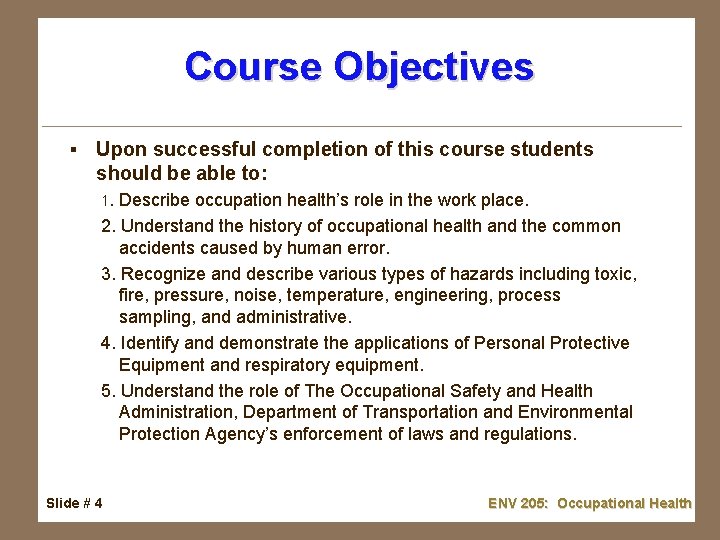
Course Objectives § Upon successful completion of this course students should be able to: 1. Describe occupation health’s role in the work place. 2. Understand the history of occupational health and the common accidents caused by human error. 3. Recognize and describe various types of hazards including toxic, fire, pressure, noise, temperature, engineering, process sampling, and administrative. 4. Identify and demonstrate the applications of Personal Protective Equipment and respiratory equipment. 5. Understand the role of The Occupational Safety and Health Administration, Department of Transportation and Environmental Protection Agency’s enforcement of laws and regulations. Slide # 4 ENV 205: Occupational Health
Intro Course Administration Slide # 5 ENV 205: Occupational Health
Introductions Name: Occupation: Experience: Training/Education: What Do You Want to Do: Slide # 6 ENV 205: Occupational Health
Course Texts § Safety, Health, and Environmental Concepts for the Process Industry. Michael Speegle. 2 nd Ed. ISBN: 978 -1 -133 -01347 -1. Delmar Cengage Learning. § Occupational Safety and Health Administration (OSHA) Website, https: //www. osha. gov § 29 Code of Federal Regulations (CFR) 1910 - General Industry Slide # 7 ENV 205: Occupational Health
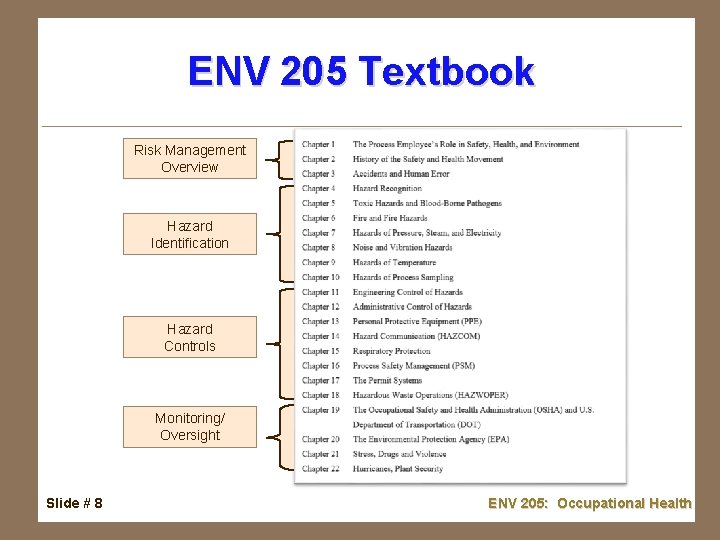
ENV 205 Textbook Risk Management Overview Hazard Identification Hazard Controls Monitoring/ Oversight Slide # 8 ENV 205: Occupational Health
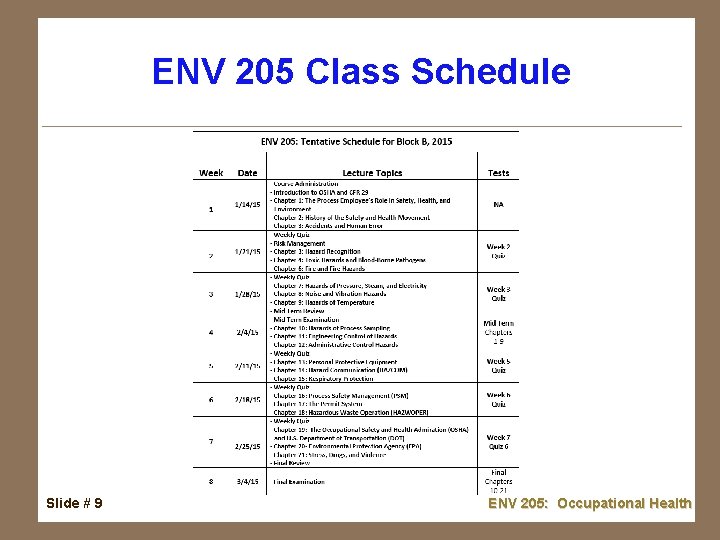
ENV 205 Class Schedule Slide # 9 ENV 205: Occupational Health
Course Grading Weekly Quizzes Participation/Discussion Case/Brief Mid Term Exam Final Exam Slide # 10 5 @ 4 points 8 @ 1 points 1 @ 12 points Classes 1 -3 Classes 4 -7 20 points 8 points 12 points 25 points 35 points 100 points ENV 205: Occupational Health
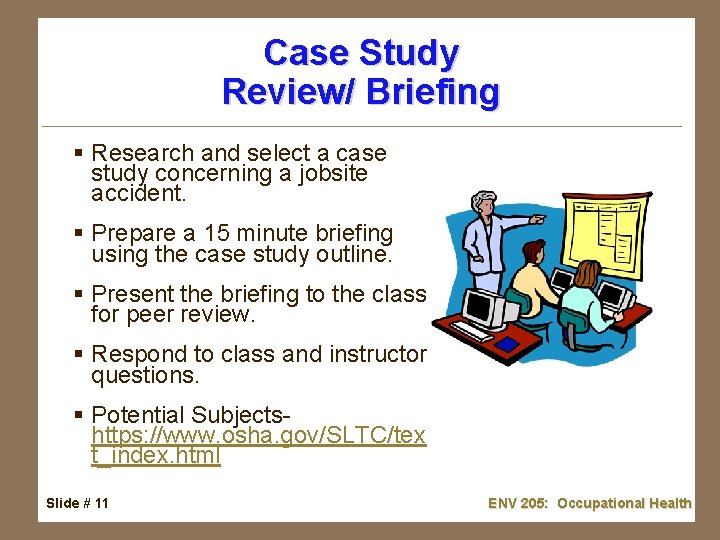
Case Study Review/ Briefing § Research and select a case study concerning a jobsite accident. § Prepare a 15 minute briefing using the case study outline. § Present the briefing to the class for peer review. § Respond to class and instructor questions. § Potential Subjectshttps: //www. osha. gov/SLTC/tex t_index. html Slide # 11 ENV 205: Occupational Health
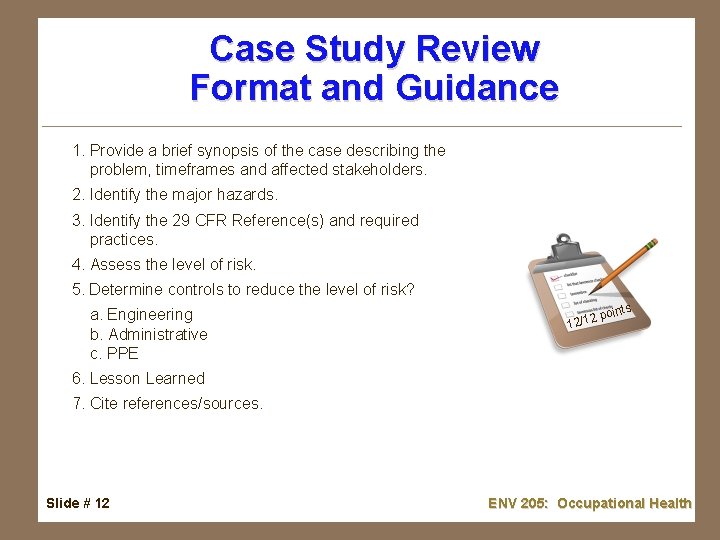
Case Study Review Format and Guidance 1. Provide a brief synopsis of the case describing the problem, timeframes and affected stakeholders. 2. Identify the major hazards. 3. Identify the 29 CFR Reference(s) and required practices. 4. Assess the level of risk. 5. Determine controls to reduce the level of risk? a. Engineering b. Administrative c. PPE 2 12/1 s point 6. Lesson Learned 7. Cite references/sources. Slide # 12 ENV 205: Occupational Health
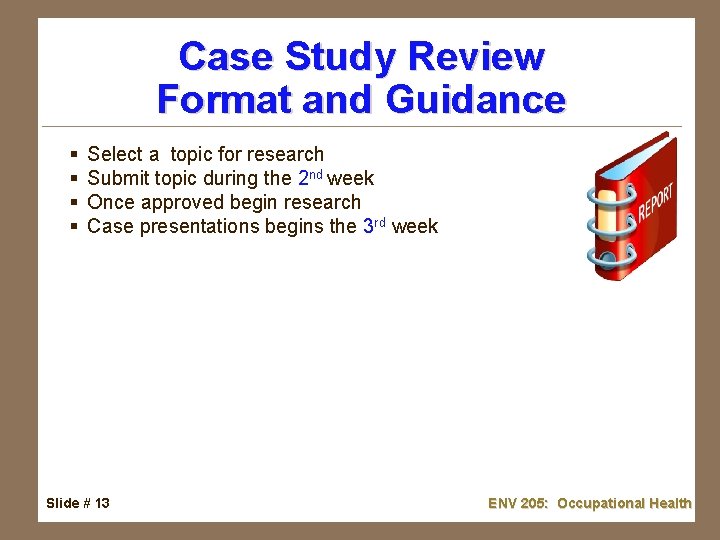
Case Study Review Format and Guidance § § Select a topic for research Submit topic during the 2 nd week Once approved begin research Case presentations begins the 3 rd week Slide # 13 ENV 205: Occupational Health
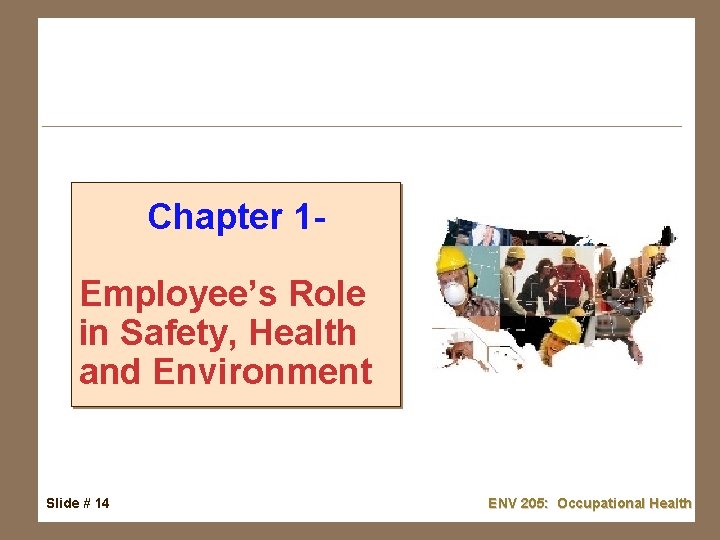
Chapter 1 - Employee’s Role in Safety, Health and Environment Slide # 14 ENV 205: Occupational Health
Chapter 1 - Objectives Upon completion of this chapter the student should be able to: § § § Describe how the process employee’s role has changed in the last 30 years. Discuss the importance of employee safety to the process industries. List the roles of today’s process employees in safety, health, and the environment. Explain what has caused the roles of process employees to change from what they were 30 years ago. Explain why all risk cannot be removed from process industry jobs. Slide # 15 ENV 205: Occupational Health
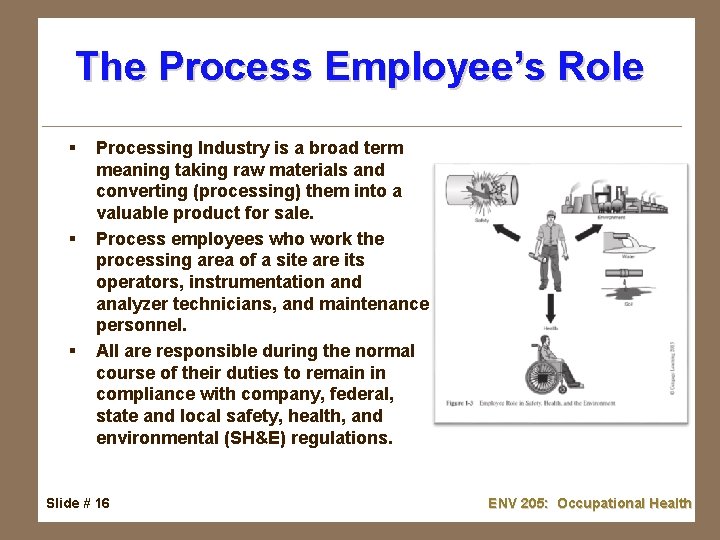
The Process Employee’s Role § § § Processing Industry is a broad term meaning taking raw materials and converting (processing) them into a valuable product for sale. Process employees who work the processing area of a site are its operators, instrumentation and analyzer technicians, and maintenance personnel. All are responsible during the normal course of their duties to remain in compliance with company, federal, state and local safety, health, and environmental (SH&E) regulations. Slide # 16 ENV 205: Occupational Health
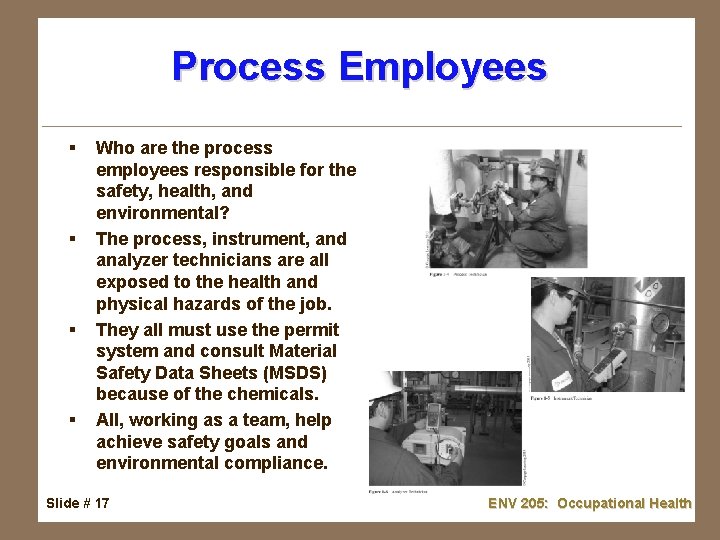
Process Employees § § Who are the process employees responsible for the safety, health, and environmental? The process, instrument, and analyzer technicians are all exposed to the health and physical hazards of the job. They all must use the permit system and consult Material Safety Data Sheets (MSDS) because of the chemicals. All, working as a team, help achieve safety goals and environmental compliance. Slide # 17 ENV 205: Occupational Health
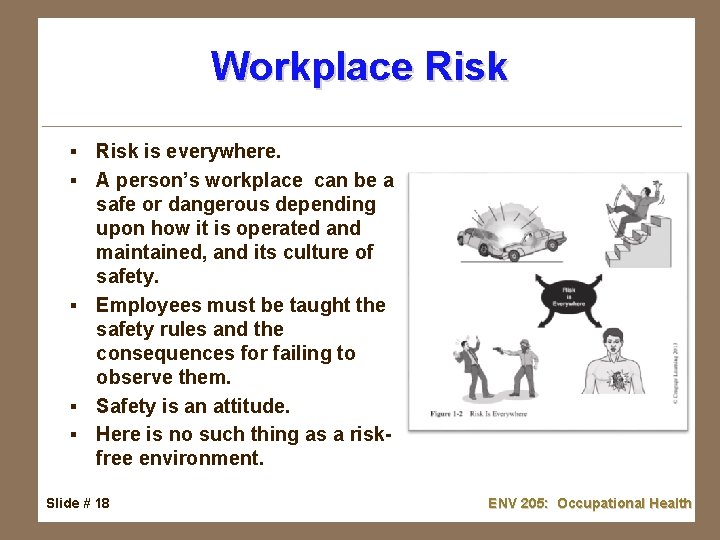
Workplace Risk § § § Risk is everywhere. A person’s workplace can be a safe or dangerous depending upon how it is operated and maintained, and its culture of safety. Employees must be taught the safety rules and the consequences for failing to observe them. Safety is an attitude. Here is no such thing as a riskfree environment. Slide # 18 ENV 205: Occupational Health
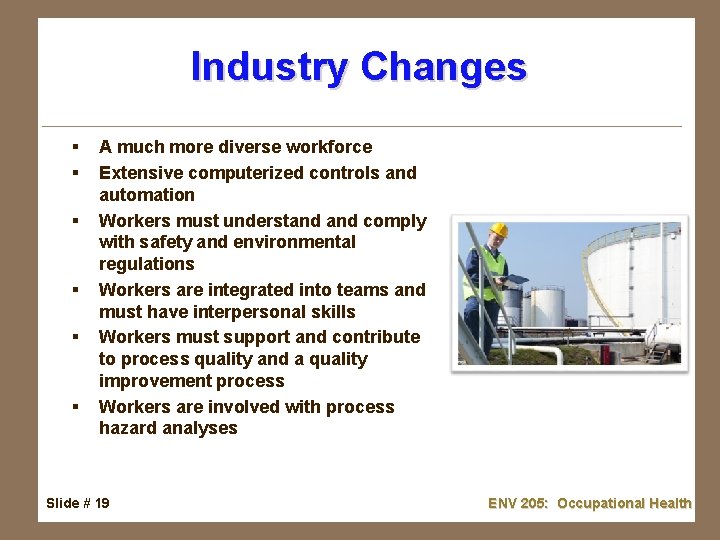
Industry Changes § § § A much more diverse workforce Extensive computerized controls and automation Workers must understand comply with safety and environmental regulations Workers are integrated into teams and must have interpersonal skills Workers must support and contribute to process quality and a quality improvement process Workers are involved with process hazard analyses Slide # 19 ENV 205: Occupational Health
Chapter 1 - Key Concepts § § § The purpose of this chapter is to discuss the role of the process employee in terms of their compliance with federal, state and local safety, health, and environmental (SH&E) regulations. Concern for the safety of personnel and equipment is vital to employees and management alike. Each has a personal stake in safety. The company (management) is concerned about safety because it is (1) an ethical responsibility and (2) it affects the bottom-line (profits). Employees are concerned because, after years of service, they would like to retire healthy and vigorous enough to enjoy their retirement. Most companies have continuous safety programs which deal with day-to-day precautions that must be taken while performing work. They also have mandates from certain federal, state, and local regulatory agencies that require periodic training and testing on specific safety topics Slide # 20 ENV 205: Occupational Health
Chapter 1 - Key Concepts (2) § § § Process safety decisions are often risk-based because they concern issues that are not often amenable to simple rules or covered by existing codes or regulations. A risk-based decision inherently includes economics as one consideration. The processing Industry must learn to manage risk. Historically, safety had been regarded as a low-tech job but in today’s business environment, safety must be managed just like any other business function. Managers recognize that a safe worker is productive worker. Better safety records translate into real dollar savings in terms of lower insurance premiums, and lower workman compensation costs. Slide # 21 ENV 205: Occupational Health
Review Questions 1. The three process employees responsible for safety and environmental compliance on a processing unit are? 2. List five roles of a process employee today. 3. (T/F) Safety is an attitude. 4. Explain the importance of those five roles to the process industry. 5. Explain what is meant by “reasonable risk. ” 6. (Choose the two best) Better safety performance translates into dollar savings by: a. Lower site insurance premiums b. Reduced firefighting c. Lower workman compensation costs d. Less fines from government agencies Slide # 22 ENV 205: Occupational Health
Review Questions 7. Explain why working in the processing industry is a lot like playing in a football game. 8. Two reasons environmental compliance is important to a processing site are ________ and _________. 9. Three reasons for an employee to be computer literate are ________, ________ and ________. 10. ____________ are important because you will be assigned to a crew that you will have to get along with for 20 or more years. Slide # 23 ENV 205: Occupational Health
Chapter 2 History of the Safety and Health Movement Slide # 24 ENV 205: Occupational Health
Chapter 2 - Objectives Upon completion of this chapter the student should be able to: § § § § List three reasons for improvements in industrial safety. List four important events in the history of the safety movement after 1900. Discuss how settlement houses played a part in occupational safety. Discuss organized labor’s part in the safety movement. List five occupational diseases and their causes. List the Three E’s of safety and explain the function of each. Identify three important safety organizations and explain their roles in safety. Slide # 25 ENV 205: Occupational Health
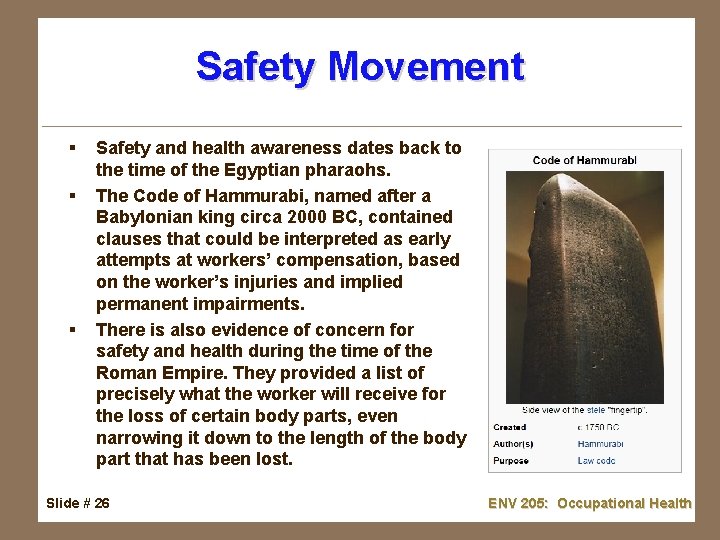
Safety Movement § § § Safety and health awareness dates back to the time of the Egyptian pharaohs. The Code of Hammurabi, named after a Babylonian king circa 2000 BC, contained clauses that could be interpreted as early attempts at workers’ compensation, based on the worker’s injuries and implied permanent impairments. There is also evidence of concern for safety and health during the time of the Roman Empire. They provided a list of precisely what the worker will receive for the loss of certain body parts, even narrowing it down to the length of the body part that has been lost. Slide # 26 ENV 205: Occupational Health
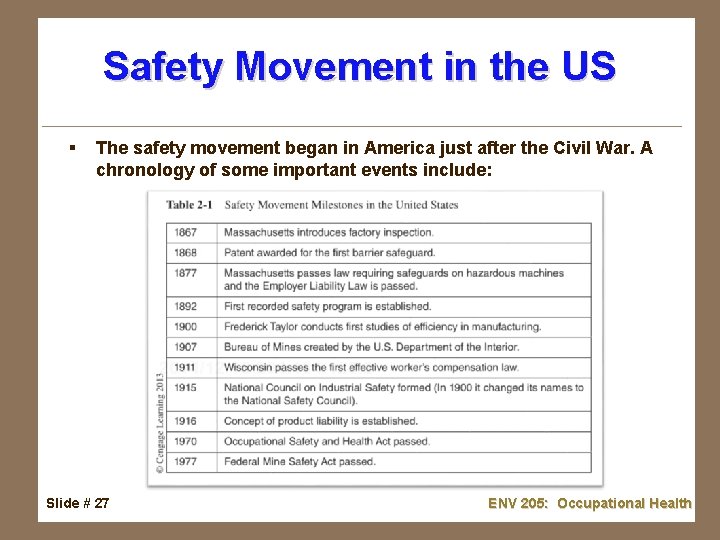
Safety Movement in the US § The safety movement began in America just after the Civil War. A chronology of some important events include: Slide # 27 ENV 205: Occupational Health
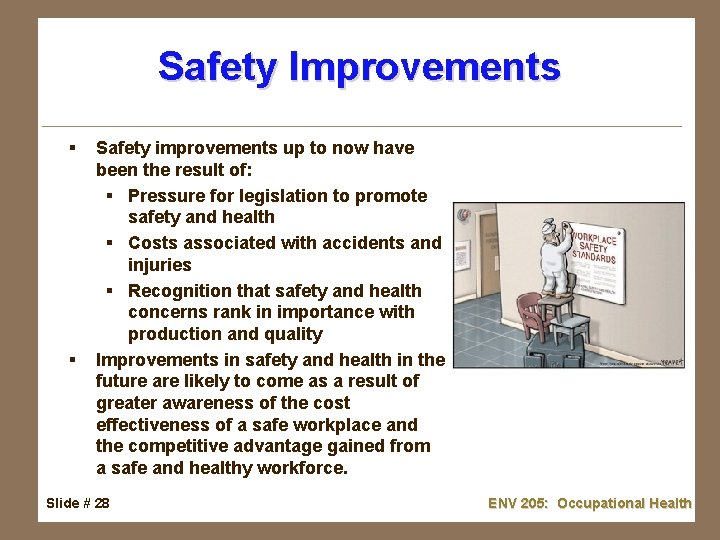
Safety Improvements § § Safety improvements up to now have been the result of: § Pressure for legislation to promote safety and health § Costs associated with accidents and injuries § Recognition that safety and health concerns rank in importance with production and quality Improvements in safety and health in the future are likely to come as a result of greater awareness of the cost effectiveness of a safe workplace and the competitive advantage gained from a safe and healthy workforce. Slide # 28 ENV 205: Occupational Health
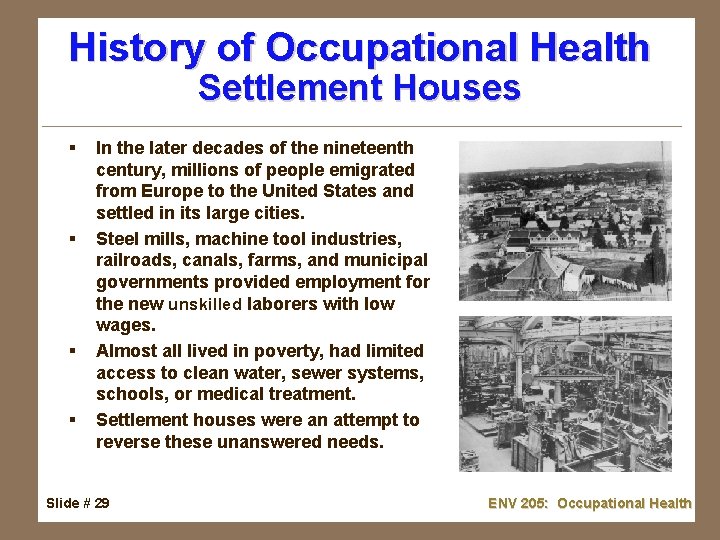
History of Occupational Health Settlement Houses § § In the later decades of the nineteenth century, millions of people emigrated from Europe to the United States and settled in its large cities. Steel mills, machine tool industries, railroads, canals, farms, and municipal governments provided employment for the new unskilled laborers with low wages. Almost all lived in poverty, had limited access to clean water, sewer systems, schools, or medical treatment. Settlement houses were an attempt to reverse these unanswered needs. Slide # 29 ENV 205: Occupational Health
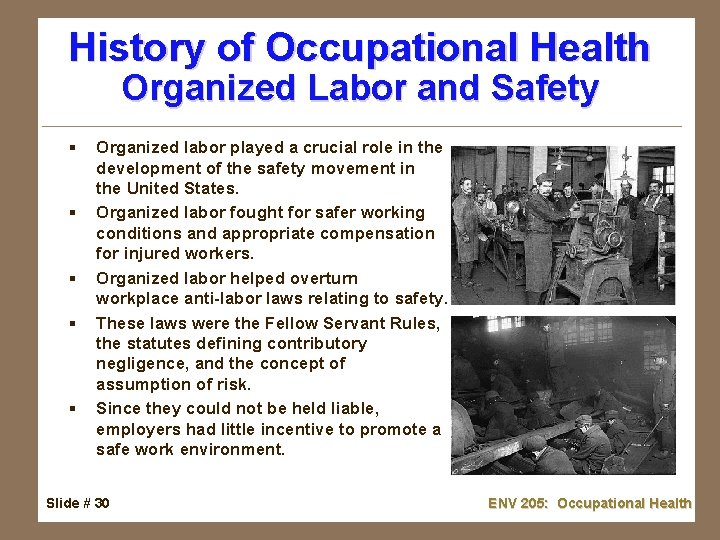
History of Occupational Health Organized Labor and Safety § § § Organized labor played a crucial role in the development of the safety movement in the United States. Organized labor fought for safer working conditions and appropriate compensation for injured workers. Organized labor helped overturn workplace anti-labor laws relating to safety. These laws were the Fellow Servant Rules, the statutes defining contributory negligence, and the concept of assumption of risk. Since they could not be held liable, employers had little incentive to promote a safe work environment. Slide # 30 ENV 205: Occupational Health
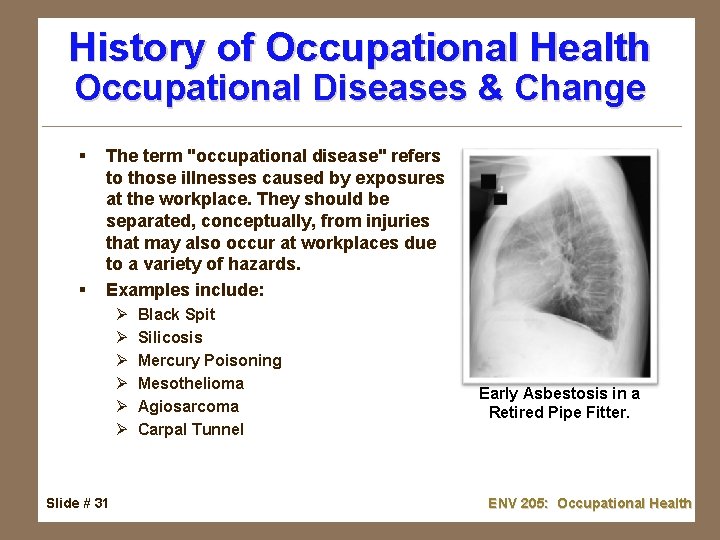
History of Occupational Health Occupational Diseases & Change § § The term "occupational disease" refers to those illnesses caused by exposures at the workplace. They should be separated, conceptually, from injuries that may also occur at workplaces due to a variety of hazards. Examples include: Ø Ø Ø Slide # 31 Black Spit Silicosis Mercury Poisoning Mesothelioma Agiosarcoma Carpal Tunnel Early Asbestosis in a Retired Pipe Fitter. ENV 205: Occupational Health
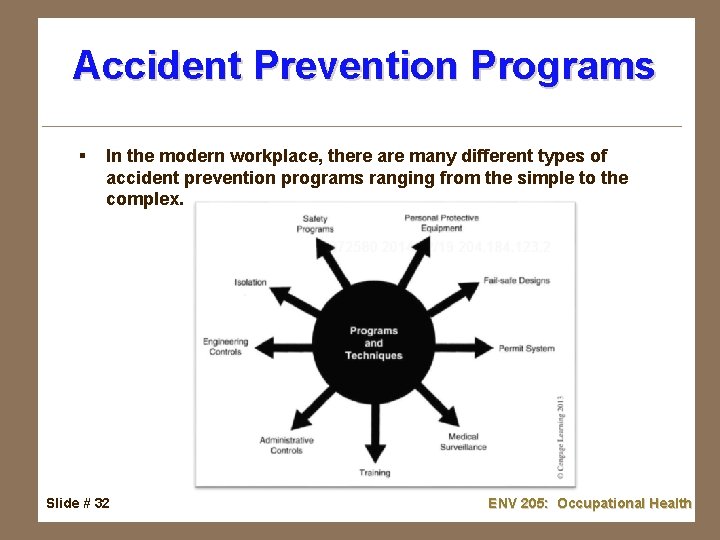
Accident Prevention Programs § In the modern workplace, there are many different types of accident prevention programs ranging from the simple to the complex. Slide # 32 ENV 205: Occupational Health
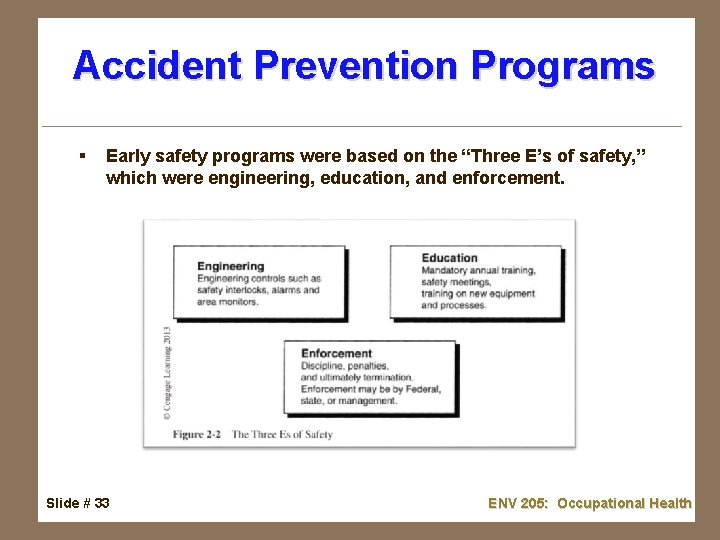
Accident Prevention Programs § Early safety programs were based on the “Three E’s of safety, ” which were engineering, education, and enforcement. Slide # 33 ENV 205: Occupational Health
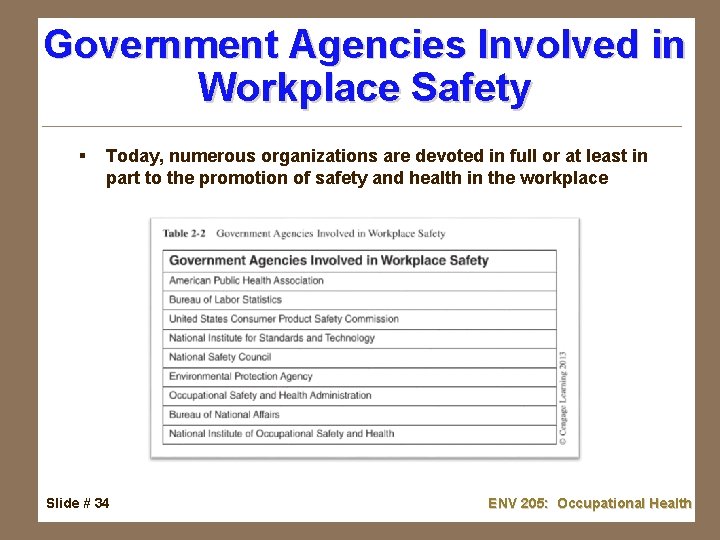
Government Agencies Involved in Workplace Safety § Today, numerous organizations are devoted in full or at least in part to the promotion of safety and health in the workplace Slide # 34 ENV 205: Occupational Health
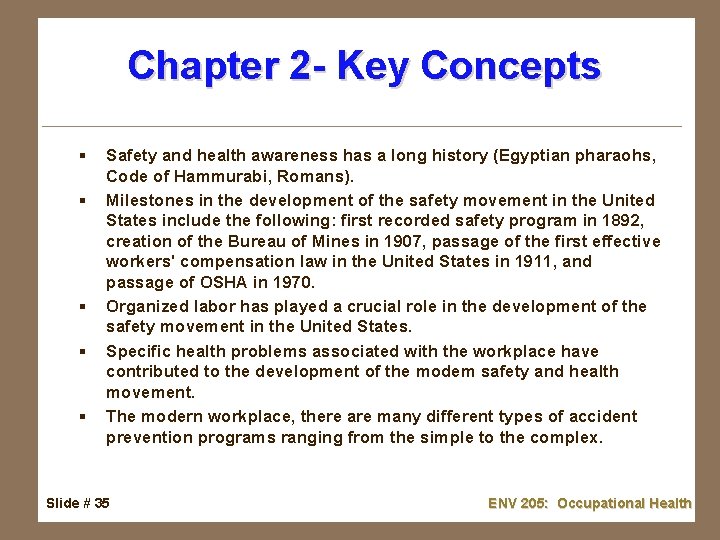
Chapter 2 - Key Concepts § § § Safety and health awareness has a long history (Egyptian pharaohs, Code of Hammurabi, Romans). Milestones in the development of the safety movement in the United States include the following: first recorded safety program in 1892, creation of the Bureau of Mines in 1907, passage of the first effective workers' compensation law in the United States in 1911, and passage of OSHA in 1970. Organized labor has played a crucial role in the development of the safety movement in the United States. Specific health problems associated with the workplace have contributed to the development of the modem safety and health movement. The modern workplace, there are many different types of accident prevention programs ranging from the simple to the complex. Slide # 35 ENV 205: Occupational Health
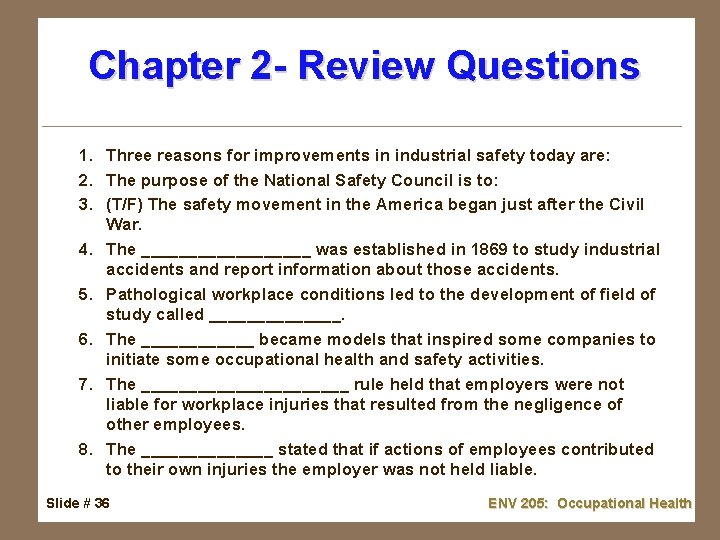
Chapter 2 - Review Questions 1. Three reasons for improvements in industrial safety today are: 2. The purpose of the National Safety Council is to: 3. (T/F) The safety movement in the America began just after the Civil War. 4. The _________ was established in 1869 to study industrial accidents and report information about those accidents. 5. Pathological workplace conditions led to the development of field of study called _______. 6. The ______ became models that inspired some companies to initiate some occupational health and safety activities. 7. The ___________ rule held that employers were not liable for workplace injuries that resulted from the negligence of other employees. 8. The _______ stated that if actions of employees contributed to their own injuries the employer was not held liable. Slide # 36 ENV 205: Occupational Health
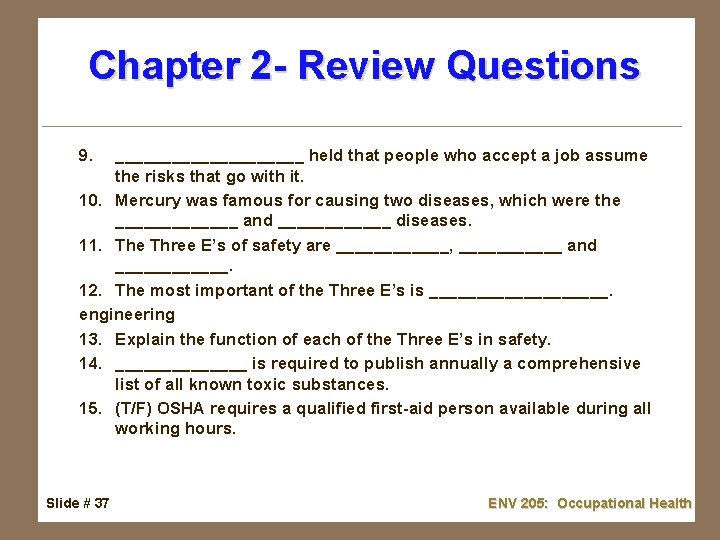
Chapter 2 - Review Questions 9. __________ held that people who accept a job assume the risks that go with it. 10. Mercury was famous for causing two diseases, which were the _______ and ______ diseases. 11. The Three E’s of safety are ______, ______ and ______. 12. The most important of the Three E’s is __________. engineering 13. Explain the function of each of the Three E’s in safety. 14. _______ is required to publish annually a comprehensive list of all known toxic substances. 15. (T/F) OSHA requires a qualified first-aid person available during all working hours. Slide # 37 ENV 205: Occupational Health
Chapter 2 Supplemental Introduction to OSHA Slide # 38 ENV 205: Occupational Health
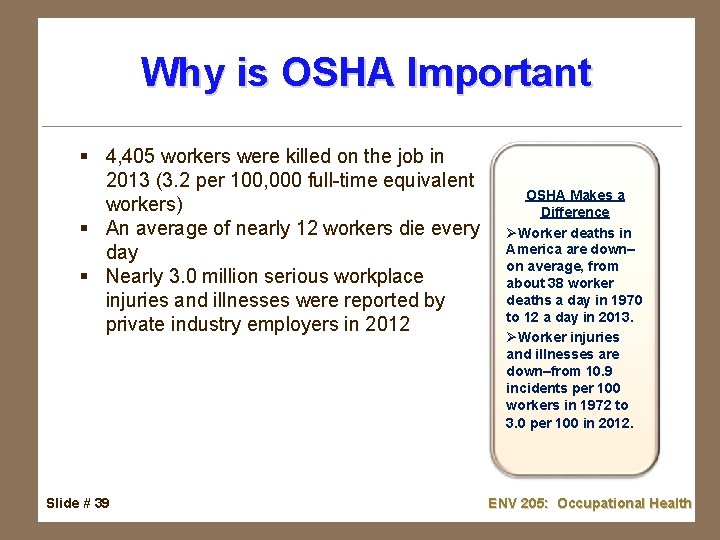
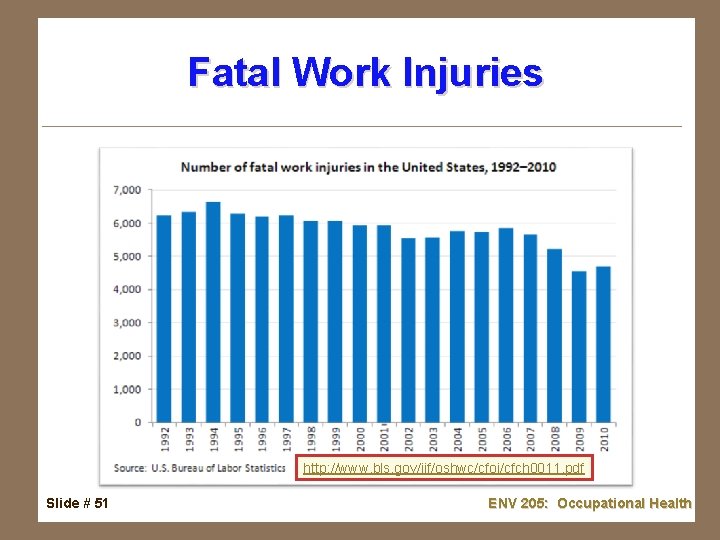
Why is OSHA Important § 4, 405 workers were killed on the job in 2013 (3. 2 per 100, 000 full-time equivalent workers) § An average of nearly 12 workers die every day § Nearly 3. 0 million serious workplace injuries and illnesses were reported by private industry employers in 2012 Slide # 39 OSHA Makes a Difference ØWorker deaths in America are down– on average, from about 38 worker deaths a day in 1970 to 12 a day in 2013. ØWorker injuries and illnesses are down–from 10. 9 incidents per 100 workers in 1972 to 3. 0 per 100 in 2012. ENV 205: Occupational Health
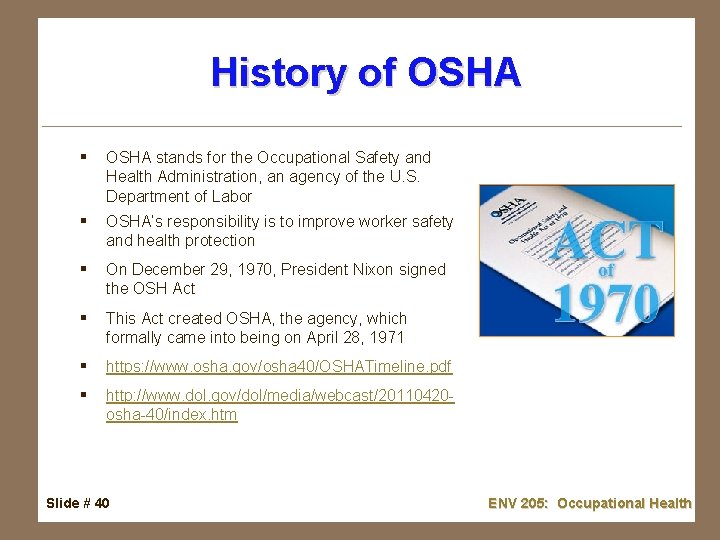
History of OSHA § OSHA stands for the Occupational Safety and Health Administration, an agency of the U. S. Department of Labor § OSHA’s responsibility is to improve worker safety and health protection § On December 29, 1970, President Nixon signed the OSH Act § This Act created OSHA, the agency, which formally came into being on April 28, 1971 § https: //www. osha. gov/osha 40/OSHATimeline. pdf § http: //www. dol. gov/dol/media/webcast/20110420 osha-40/index. htm Slide # 40 ENV 205: Occupational Health
OSHA’s Mission § The mission of OSHA is to assure safe and healthful working conditions for working men and women by setting and enforcing standards and by providing training, outreach, education and assistance. § Some of the things OSHA does to carry out its mission are: Ø Developing job safety and health standards and enforcing them through worksite inspections Ø Providing training programs to increase knowledge about occupational safety and health Slide # 41 ENV 205: Occupational Health
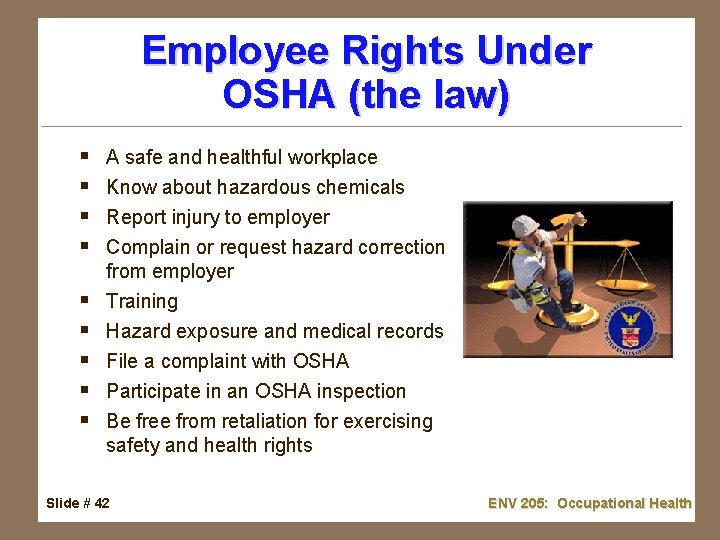
Employee Rights Under OSHA (the law) § § § § § A safe and healthful workplace Know about hazardous chemicals Report injury to employer Complain or request hazard correction from employer Training Hazard exposure and medical records File a complaint with OSHA Participate in an OSHA inspection Be free from retaliation for exercising safety and health rights Slide # 42 ENV 205: Occupational Health
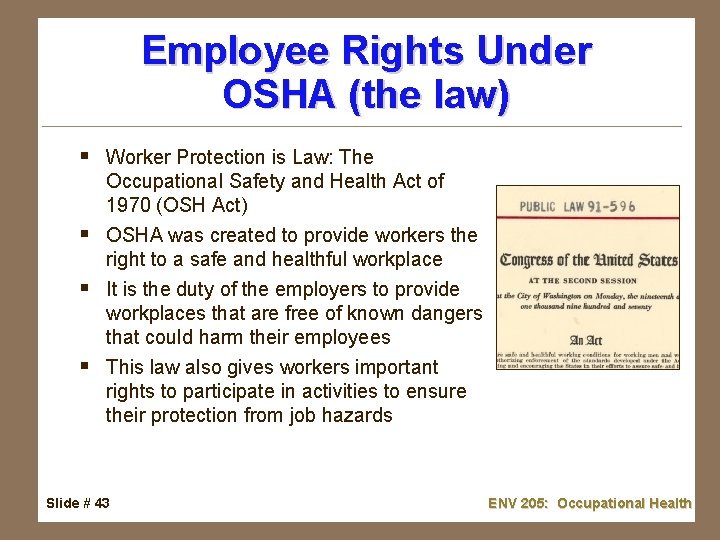
Employee Rights Under OSHA (the law) § Worker Protection is Law: The Occupational Safety and Health Act of 1970 (OSH Act) § OSHA was created to provide workers the right to a safe and healthful workplace § It is the duty of the employers to provide workplaces that are free of known dangers that could harm their employees § This law also gives workers important rights to participate in activities to ensure their protection from job hazards Slide # 43 ENV 205: Occupational Health
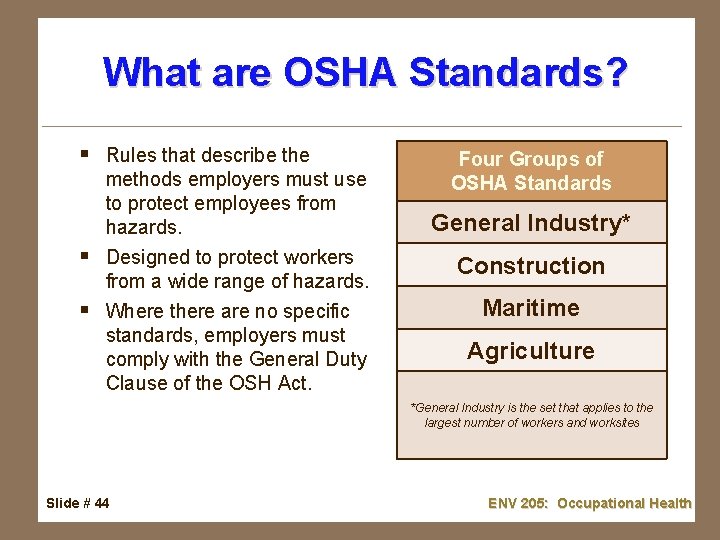
What are OSHA Standards? § Rules that describe the methods employers must use to protect employees from hazards. § Designed to protect workers from a wide range of hazards. § Where there are no specific standards, employers must comply with the General Duty Clause of the OSH Act. Four Groups of OSHA Standards General Industry* Construction Maritime Agriculture *General Industry is the set that applies to the largest number of workers and worksites Slide # 44 ENV 205: Occupational Health
What are OSHA Standards? (2) § Limit the amount of hazardous chemicals, substances, or noise that workers can be exposed. § Require the use of certain safe work practices and equipment. § Require employers to monitor certain hazards and keep records of workplace injuries and illnesses. Slide # 45 www. osha. gov ENV 205: Occupational Health
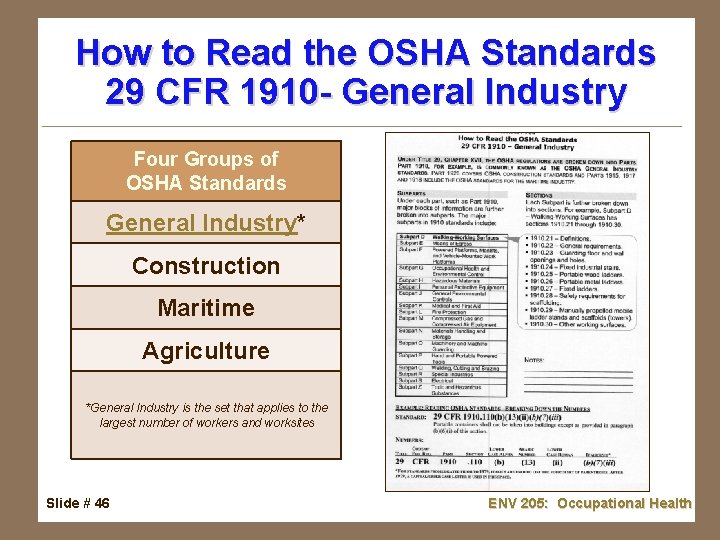
How to Read the OSHA Standards 29 CFR 1910 - General Industry Four Groups of OSHA Standards General Industry* Construction Maritime Agriculture *General Industry is the set that applies to the largest number of workers and worksites Slide # 46 ENV 205: Occupational Health
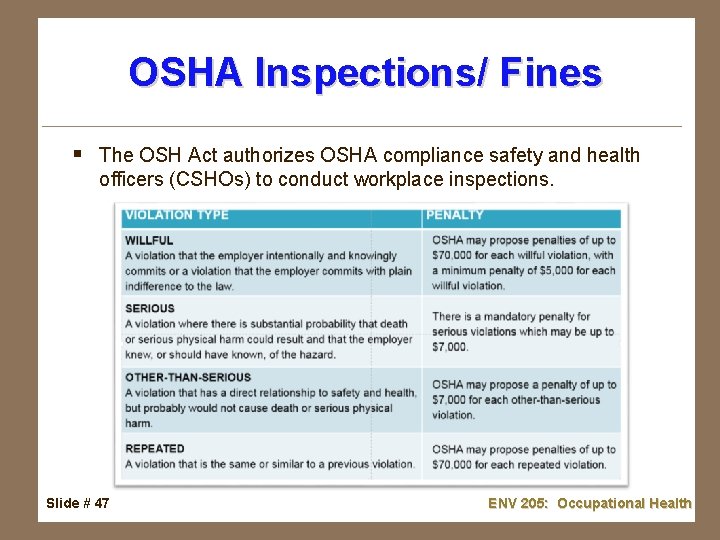
OSHA Inspections/ Fines § The OSH Act authorizes OSHA compliance safety and health officers (CSHOs) to conduct workplace inspections. Slide # 47 ENV 205: Occupational Health
Chapter 3 Accidents and Human Error Slide # 48 ENV 205: Occupational Health
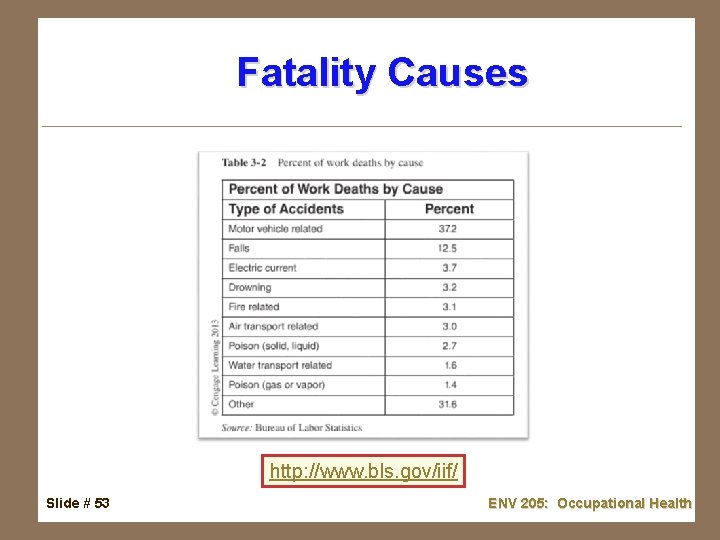
Chapter 3 - Objectives Upon completion of this chapter the student should be able to: § § § § List the benefits of accident investigations List the five leading causes of accidental death in the United States List the elements that make up the overall cost of an accident List the five leading causes of work deaths in the United States List four types of fatigue-producing designs. Explain four ways to minimize procedural errors. Explain the two-person concept. Describe three ways that workers can be involved in safety. Slide # 49 ENV 205: Occupational Health
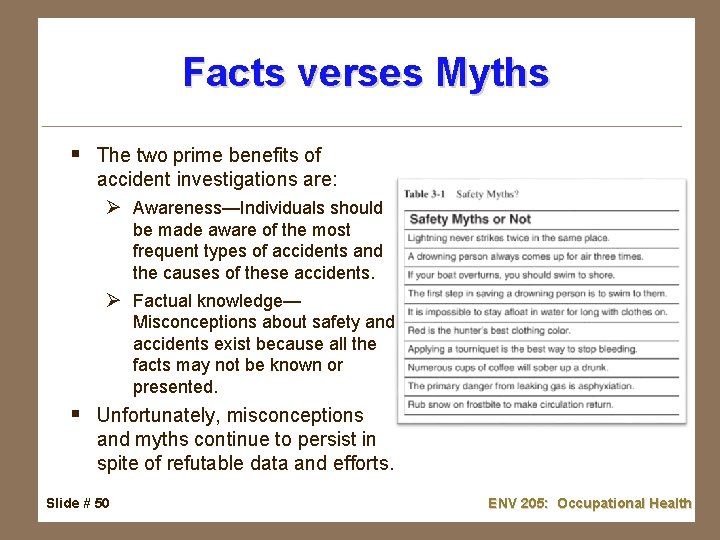
Facts verses Myths § The two prime benefits of accident investigations are: Ø Awareness—Individuals should be made aware of the most frequent types of accidents and the causes of these accidents. Ø Factual knowledge— Misconceptions about safety and accidents exist because all the facts may not be known or presented. § Unfortunately, misconceptions and myths continue to persist in spite of refutable data and efforts. Slide # 50 ENV 205: Occupational Health
Fatal Work Injuries http: //www. bls. gov/iif/oshwc/cfoi/cfch 0011. pdf Slide # 51 ENV 205: Occupational Health
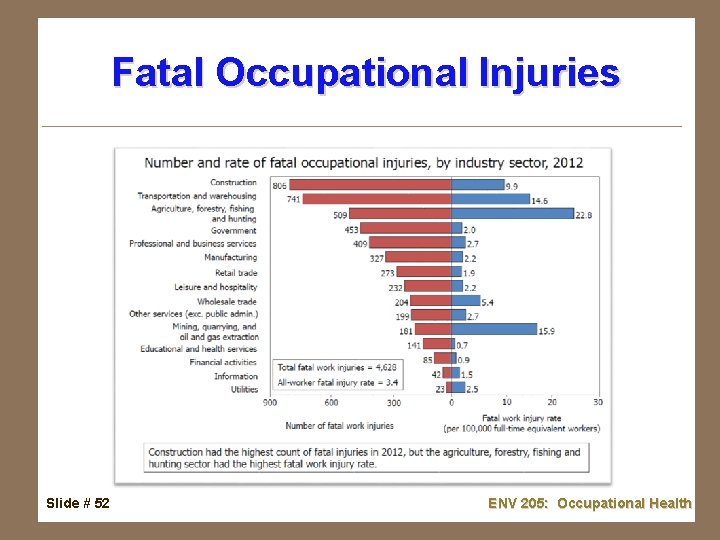
Fatal Occupational Injuries Slide # 52 ENV 205: Occupational Health
Fatality Causes http: //www. bls. gov/iif/ Slide # 53 ENV 205: Occupational Health
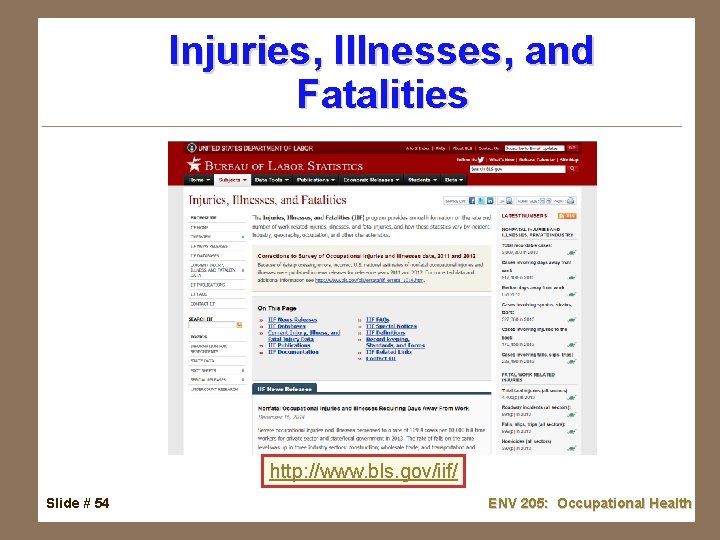
Injuries, Illnesses, and Fatalities http: //www. bls. gov/iif/ Slide # 54 ENV 205: Occupational Health
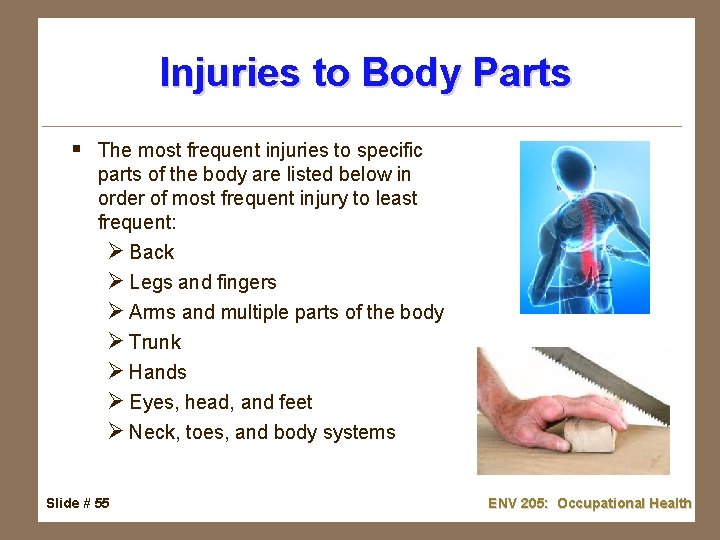
Injuries to Body Parts § The most frequent injuries to specific parts of the body are listed below in order of most frequent injury to least frequent: Ø Back Ø Legs and fingers Ø Arms and multiple parts of the body Ø Trunk Ø Hands Ø Eyes, head, and feet Ø Neck, toes, and body systems Slide # 55 ENV 205: Occupational Health
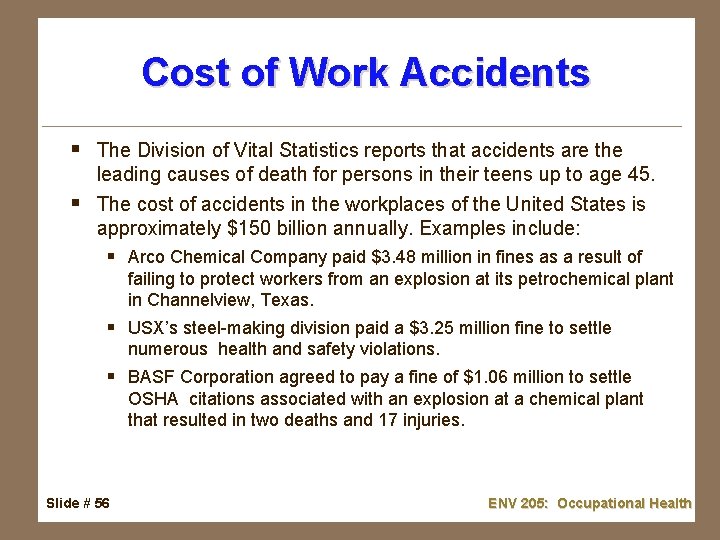
Cost of Work Accidents § The Division of Vital Statistics reports that accidents are the leading causes of death for persons in their teens up to age 45. § The cost of accidents in the workplaces of the United States is approximately $150 billion annually. Examples include: § Arco Chemical Company paid $3. 48 million in fines as a result of failing to protect workers from an explosion at its petrochemical plant in Channelview, Texas. § USX’s steel-making division paid a $3. 25 million fine to settle numerous health and safety violations. § BASF Corporation agreed to pay a fine of $1. 06 million to settle OSHA citations associated with an explosion at a chemical plant that resulted in two deaths and 17 injuries. Slide # 56 ENV 205: Occupational Health
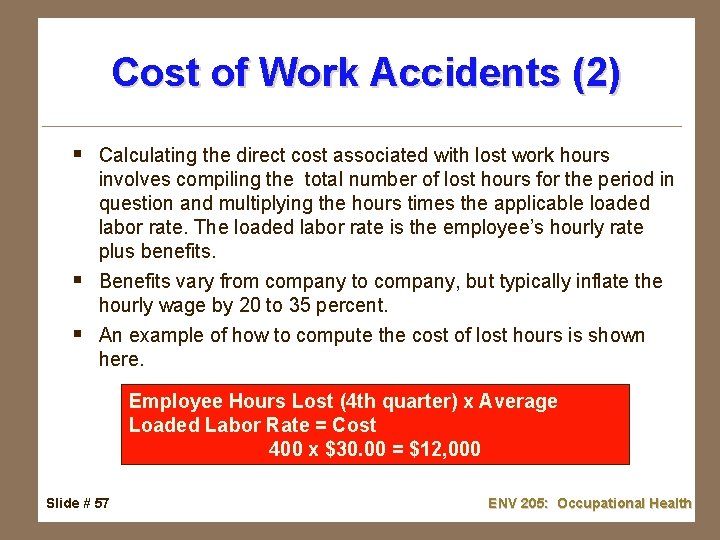
Cost of Work Accidents (2) § Calculating the direct cost associated with lost work hours involves compiling the total number of lost hours for the period in question and multiplying the hours times the applicable loaded labor rate. The loaded labor rate is the employee’s hourly rate plus benefits. § Benefits vary from company to company, but typically inflate the hourly wage by 20 to 35 percent. § An example of how to compute the cost of lost hours is shown here. Employee Hours Lost (4 th quarter) x Average Loaded Labor Rate = Cost 400 x $30. 00 = $12, 000 Slide # 57 ENV 205: Occupational Health
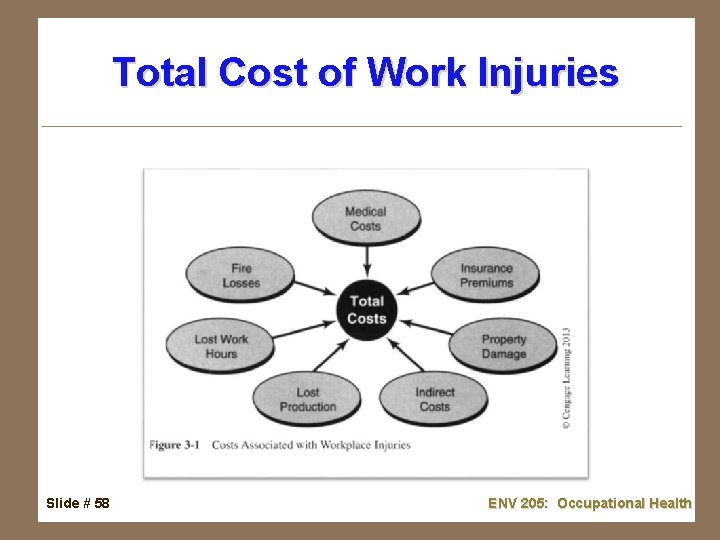
Total Cost of Work Injuries Slide # 58 ENV 205: Occupational Health
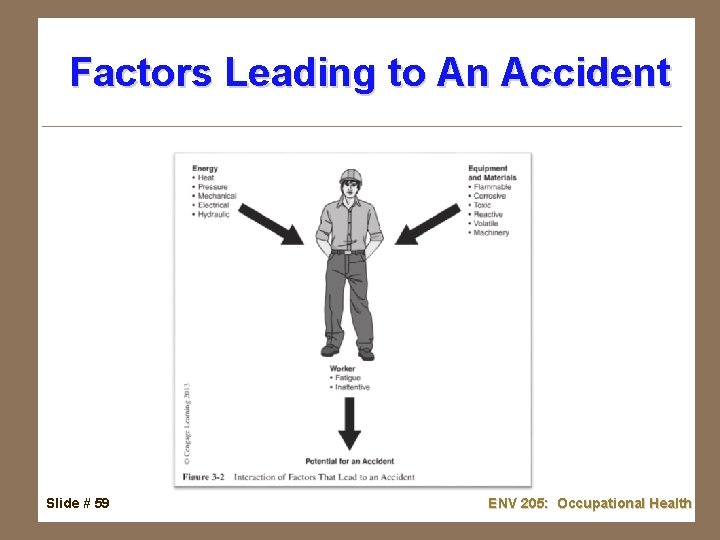
Factors Leading to An Accident Slide # 59 ENV 205: Occupational Health
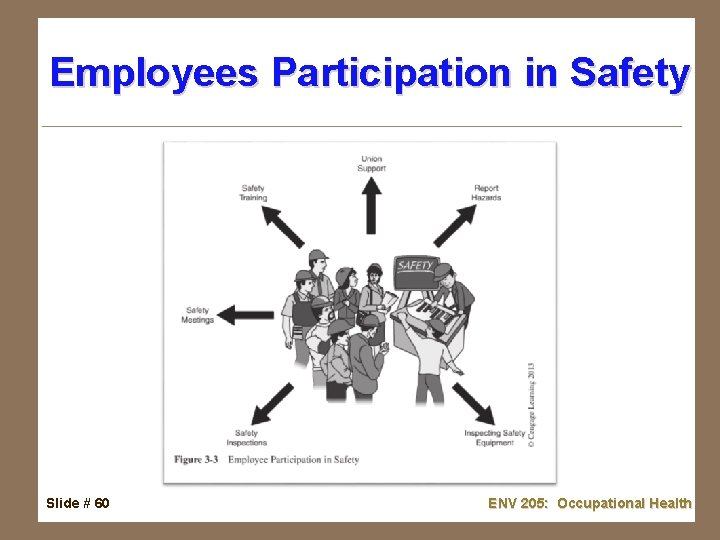
Employees Participation in Safety Slide # 60 ENV 205: Occupational Health
Chapter 3 - Key Concepts § § § Accidents are the leading causes of death for persons in their teens and up to age 45. The cost of accidents in the workplaces of the United States is approximately $150 billion annually. Work accidents are expensive (fines, costs for safety corrections, medical treatment, survivor benefits, death and burial costs, etc. ). The value of lost production due to accidents can exceed those listed above. Most industrial accidents are caused by human error. Slide # 61 ENV 205: Occupational Health
Chapter 3 - Key Concepts (2) § § It is important to have a general understanding of how and why accidents occur, how people are affected by accidents, and how they can be prevented. Errors can be divided into two categories: predictable and random. Because all hazards cannot be eliminated by design, companies must rely on the safe work practices of their employees. To ensure safe work practices of their employees, companies will have to have an effective safety promotion plan. The plan should include employee participation in safety and safety training. Slide # 62 ENV 205: Occupational Health
Chapter 3 - Review Questions 1. Two benefits of accident investigations are ______ and ______. 2. Explain why the injuries keep happening from the same incidents at the same plant. 3. List the five leading causes of accidental death in the United States. 4. List four elements that contribute to the overall cost of an accident. 5. In a typical year there are ______ work deaths in the United States. 6. Most worldwide industrial accidents are caused by _______. 7. The three most frequent injuries to the body are to the _____, _____ and ______. 8. (T/F) Errors and accidents frequently occur because equipment is designed for a statistical (average) worker. 9. ___________ is an action that is inconsistent with the established behavioral patterns considered normal or that differs from prescribed procedures. Slide # 63 ENV 205: Occupational Health
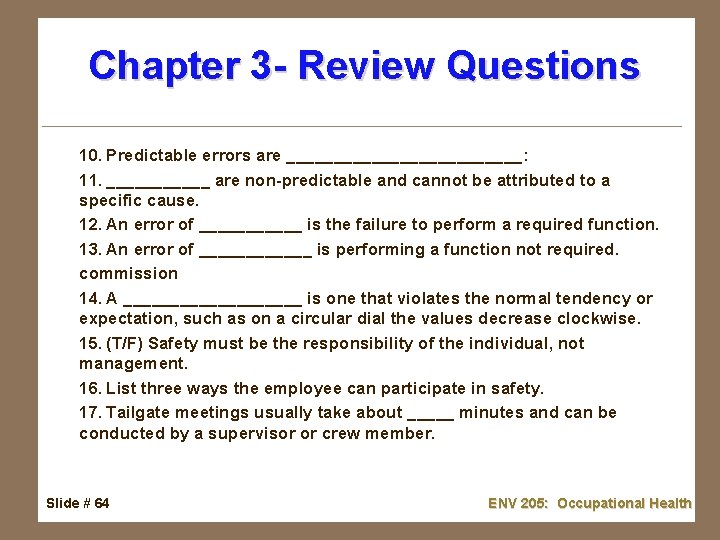
Chapter 3 - Review Questions 10. Predictable errors are _____________: 11. ______ are non-predictable and cannot be attributed to a specific cause. 12. An error of ______ is the failure to perform a required function. 13. An error of ______ is performing a function not required. commission 14. A __________ is one that violates the normal tendency or expectation, such as on a circular dial the values decrease clockwise. 15. (T/F) Safety must be the responsibility of the individual, not management. 16. List three ways the employee can participate in safety. 17. Tailgate meetings usually take about _____ minutes and can be conducted by a supervisor or crew member. Slide # 64 ENV 205: Occupational Health
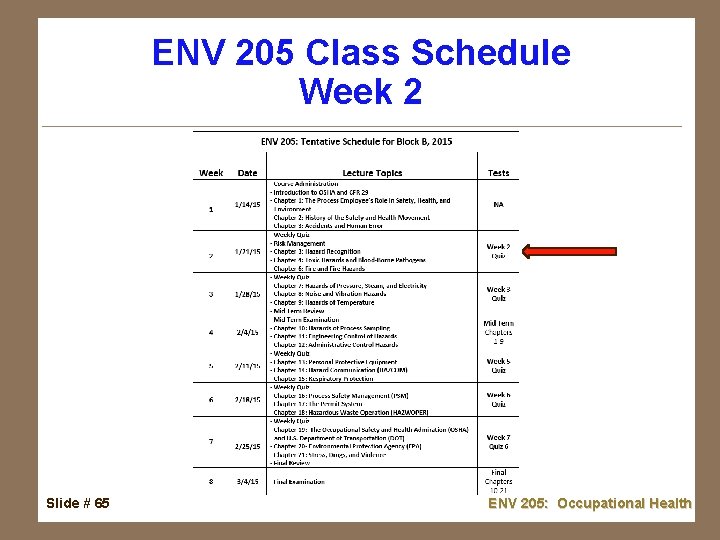
ENV 205 Class Schedule Week 2 Slide # 65 ENV 205: Occupational Health
Next Class Slide # 66 ENV 205: Occupational Health
This document is 100% funded by a $2. 2 million grant from the U. S. Department of Labor, Employment and Training Administration (TAACCCT). The product was created by the grantee and does not necessarily reflect the official position of the U. S. Department of Labor. The Department of Labor makes no guarantees, warranties or assurances of any kind, express or implied, with respect to such information, including any information on linked sites and including, but not limited to, accuracy of the information or its completeness, timeliness, usefulness, adequacy, continued availability, or ownership. This work is licensed under a Creative Commons Attribution 4. 0 International License. Slide # 67 ENV 205: Occupational Health