
Enumerated Powers These powers are expressly written in
- Slides: 24
Enumerated Powers • These powers are expressly written in the Constitution for CONGRESS. • In Article 1 Section 8 • Examples – powers to tax, raise an army, coin money
Implied Powers/Necessary and Proper Clause • These powers are not expressly written in the Constitution • “Congress shall have Power … To make all Laws which shall be “necessary and proper” for carrying into Execution” its powers. • They are IMPLIED b/c they are powers that Congress NEEDS in order to do its job • Examples – income tax, creating a National Bank
Mc. Culloch v. Maryland • Bank is not an enumerated power • Maryland gave a tax of $15, 000 on the National Bank. • Lawyers basically argued that the National Bank could NOT be taxed because it is trying to carry out its expressed powers (like power to collect taxes)
US Representative • Qualifications • 3 – 25 years old – 7 years a citizen – Resident of state they are running in
Impeachment • Impeachment means – a formal accusation of wrongdoing against a public office (i. e The president). • The House of Representatives has the SOLE POWER TO IMPEACH
Senator • Qualifications • 3 – 30 years old – 9 years a citizen – Resident of state they are running in
President of the Senate • Is the Vice President • He can ONLY vote if there is a tie in the Senators vote
Impeachment Trial • The Senate resides over the Impeachment trial.
Quorum • The Constitution requires a quorum, or majority, of Senators (51 out of 100) in order to conduct business. • This is done by a role call. • Usually the Senate does NOT have that many Senators in the room but presumes that a quorum is present.
Holding Another Office • No, a Senator/Representative cannot hold another federal office while serving Congress. • Why? • This is to make sure that the Constitutional Principle of SEPARATION OF POWERS is respected.
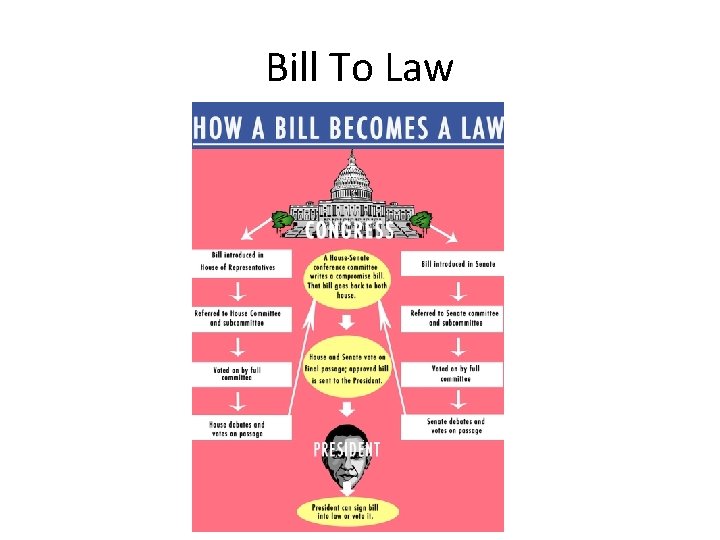
Bill To Law
Enumerated Powers Address Ao. C • The weaknesses of the Articles of Confederation are numerous. • Look at the attached chart on my website.
Ex Post Facto Laws • This simply means that NOBODY can be tried for a crime if the law didn’t already exist when the crime was committed. • Remember we make new laws every year (in fed, state, and local government)… • Example – You are walking down the sidewalk on Monday. You are stepping on the cracks in the sidewalk. Then on Wednesday, North Carolina makes a law that says it’s illegal to step on the cracks on sidewalks. Then the come and arrest you for it. • This would be UNFAIR – b/c you weren’t warned ahead of time that this was illegal.
Electoral College Process • http: //www. huffingtonpost. com/2012/11/06/ what-is-the-electoral-college_n_2078970. html • The number of electors in each state varies – it is the number of their representatives + senators. North Carolina’s is currently 15 • 270 electoral votes to win election
Presidential Qualifications • Natural born citizen • 35 years old • 14 years a resident of the US • Cannot serve more than twice
Presidential Oath • "I do solemnly swear (or affirm) that I will faithfully execute the Office of President of the United States, and will to the best of my ability, preserve, protect and defend the Constitution of the United States. "
Supreme Court Justices Requirements • No specifications outlined in the Constitution as with Presidents/Senators/Representatives • Doesn’t have to be a U. S. citizen • Doesn’t have to be a lawyer • Didn’t have to attend Law School
Supreme Court Justice Term • Are appointed by the President and confirmed (okayed) by the Senate • Serve for LIFE • Can be impeached (only 1 ever was) • Can resign
Supreme Court Cases • Most cases start in lower federal district courts. • They then need to be appealed. • Then if the Supreme Court wants to… they can hear the case (ONLY if 4 out of the 9 justices agree to hear it) • They hear around 80 cases a year.
Treason • The only crime spelled out in the Constitution • You cannot be convicted of treason unless 1 of 2 things happen • 1. You admit it in open court • 2. 2 witnesses testify against you on the same overt act
Article 4 Sect. 4 • Guarantee Clause • Guarantees that Congress will protect the states
Article 5 – Amendment Process • Can be offered in ½ ways • 1. 2/3 rds of Senate (67/100) and 2/3 of the Ho. R (290/435) call for a change to be made • 2. 2/3 rds of the states (34/50) call for a change • Once amendment is proposed, ¾ of the states (38/50) have to approve it for it to become an amendment
Supremacy Clause • The Constitution and the federal laws are the SUPREME LAW OF THE LAND • If STATE laws conflict with The Constitution they are immediately thrown out
NC & The Constitution • • 12 th state to ratify Only took 9 to make it law Why did NC wait until November 21, 1789? They wanted a Bill of Rights!