
Entry points for gender equality womens empowerment concepts

- Slides: 19
Entry points for gender equality & women’s empowerment concepts in REDD+
Moving forward, we will discuss in more detail how the following common elements of REDD+ can be made gender sensitive: • Stakeholder engagement • Safeguards • Free, prior and informed consent • Governance • Incentive/Benefit Structures • Financing / Fund Management • National forest monitoring system
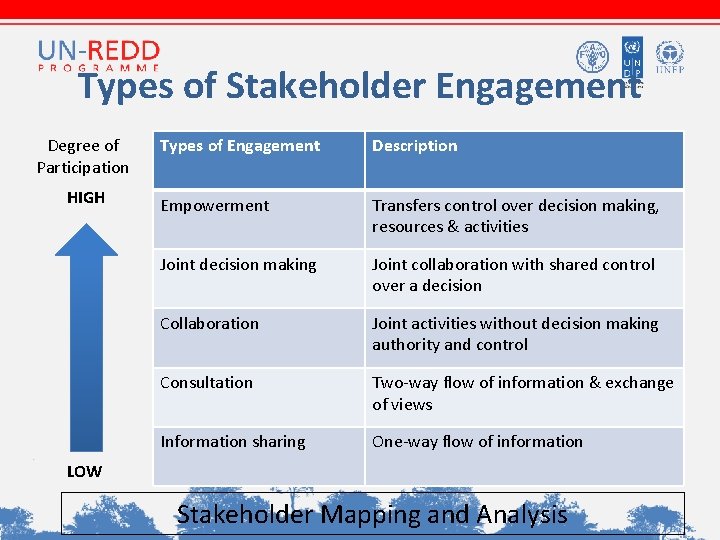
Types of Stakeholder Engagement Degree of Participation HIGH Types of Engagement Description Empowerment Transfers control over decision making, resources & activities Joint decision making Joint collaboration with shared control over a decision Collaboration Joint activities without decision making authority and control Consultation Two-way flow of information & exchange of views Information sharing One-way flow of information LOW Stakeholder Mapping and Analysis
Gender Sensitive Stakeholder Engagement • • • Conduct gender responsive stakeholder mapping Identify women’s & men’s barriers to participation, & address such barriers in capacity building efforts on safeguards Mobilize organizations & networks supporting women’s rights & gender in forestry & REDD+ processes In management arrangements, involve gender expertise & national entities focused on gender Create indicators that measure the gender-sensitivity of activities.
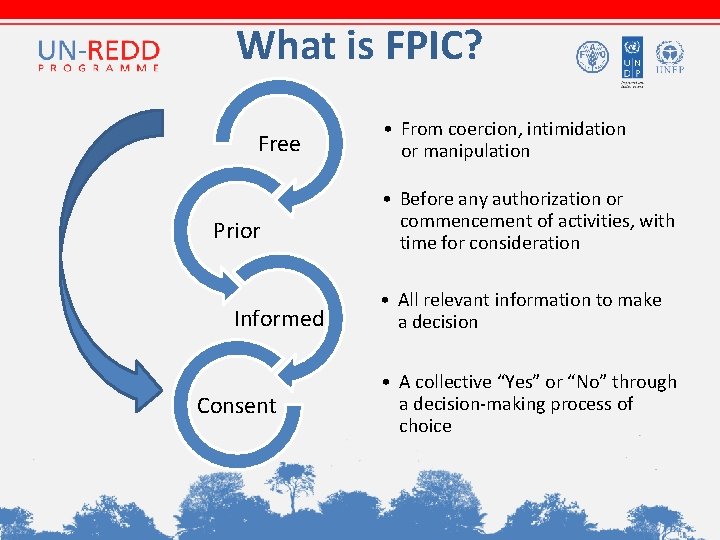
What is FPIC? Free Prior Informed Consent • From coercion, intimidation or manipulation • Before any authorization or commencement of activities, with time for consideration • All relevant information to make a decision • A collective “Yes” or “No” through a decision-making process of choice
Free, Prior and Informed Consent (FPIC) • Host capacity building sessions on FPIC process for women to ensure they understand FPIC • Undertake a survey of women’s needs & preferences related to FPIC • Create a safe & democratic voting process so women’s & men’s views & voices have equal value. – Suggestions: Separate meeting spaces or closed voting schemes • When defining FPIC stakeholders, consider including indigenous groups, communities and individuals (incl. women & marginalized groups), who may not own land, but instead have either use rights or are primary users of forested lands.
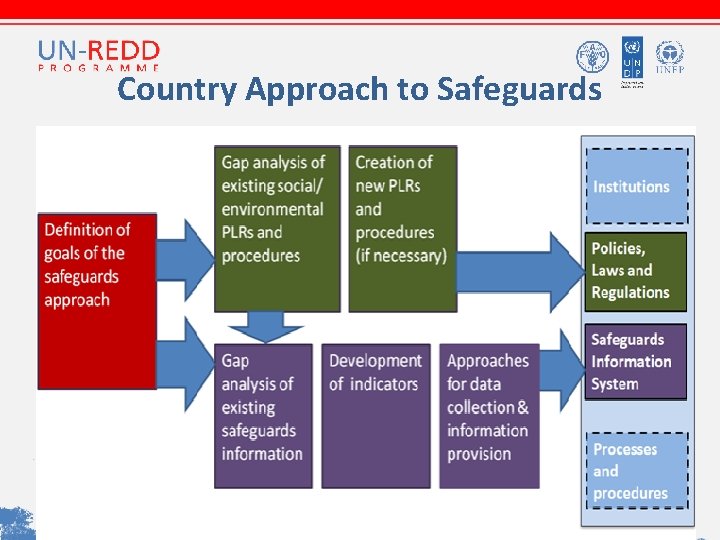
Country Approach to Safeguards
Gender Sensitive Safeguards 1. Safeguard policies, laws and regulations review & development • • • Review policies & laws to see if there any gaps which limit women’s rights & take steps to remove these barriers. Review latest CEDAW country report to help identify gaps in women’s rights in the country. Liaise with organizations from government & civil society to identify women’s issues relevant to REDD+. 2. Safeguards approach and work plan development • • • Women & men taken into account during all phases of national safeguards approach & work plan Utilize gender sensitive approach when defining social & environmental issues, risks & benefits Develop gender responsive indicators
What is a Grievance Mechanism? • Equally accessible, fair, collaborative, expeditious and effective in resolving concerns through dialogue, joint fact-finding, negotiation, and problem-solving. • First line of response to stakeholder concerns that have not been prevented by proactive stakeholder engagement. • Complement, rather than replace, formal legal channels. • Does not address complaints that allege corruption, coercion, or major and systematic violations of rights and / or policies.
Gender Sensitive Grievance Mechanism • Legitimacy – Does it operate independently of interested parties? • Accessibility – What are the barriers or constraints, e. g. , cultural, social, capacity? • Fairness – Will grievances be treated confidentially, assessed impartially, and handled transparently regardless of gender?
Governance • Governance structures of REDD+ & supporting policies, laws & regulations should be: – Accountable – Encourage transparency – Promote access to information for all stakeholders • Consider gender balance in any REDD+ governing bodies – Are women represented on REDD+ entities & management structures? (national & provincial) • Be aware of gender balance in government institutions – Women are often under-represented in Forestry Agencies, in both administrative & management positions
Governance (cont. ) What does this look like in practice? – If revision of legal frameworks part of national REDD+ process (e. g. land tenure), ensure it is gender sensitive – Women actively involved in & can influence decisionmaking processes, & that their gendered roles, contributions & constraints are taken into account in consultations. – Link up with & involve government ministries responsible for women’s empowerment & gender issues as well as with women’s organizations • Provide them with capacity-building on REDD+, if necessary
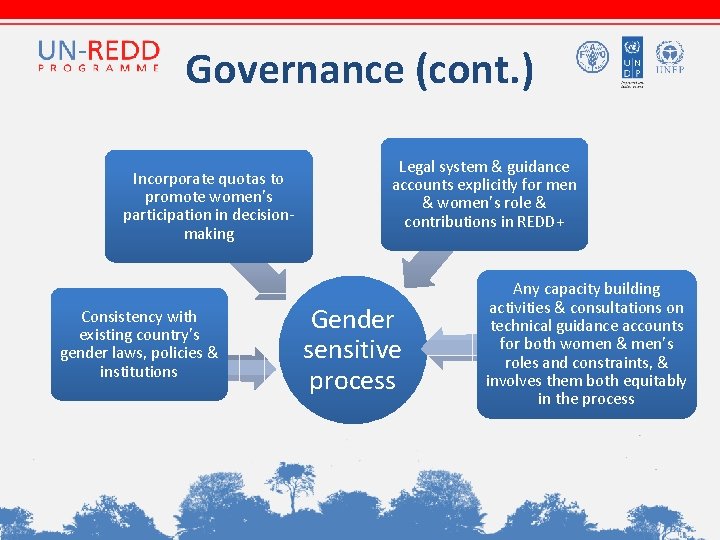
Governance (cont. ) Incorporate quotas to promote women’s participation in decisionmaking Consistency with existing country's gender laws, policies & institutions Legal system & guidance accounts explicitly for men & women’s role & contributions in REDD+ Gender sensitive process Any capacity building activities & consultations on technical guidance accounts for both women & men’s roles and constraints, & involves them both equitably in the process
Incentive/Benefit Structures • As women & men rely on forests, & engage in economic activities critical for survival, consideration of gender when defining & sharing REDD+ benefits is critical. • However, women may be disadvantaged or marginalized in traditional or formal processes, particularly land tenure, which can lead to them: – Having unequal access to information & legal processes – Not being involved in decision-making processes on benefit sharing mechanisms & structures – Being excluded from REDD+ benefits due to weak right to land & trees
Incentive/Benefit Structures (cont. ) Some questions to ask, and help guide this work…. – Is the land tenure & resource use system equitable with regards to gender? – Is there transparency with regards to financial transfers to & within communities? – Is there a strong national law on gender in environmental impact assessments? – Is there a fair & accessible system to address grievances & conflict? – Do women have the same legal rights to resources as men?
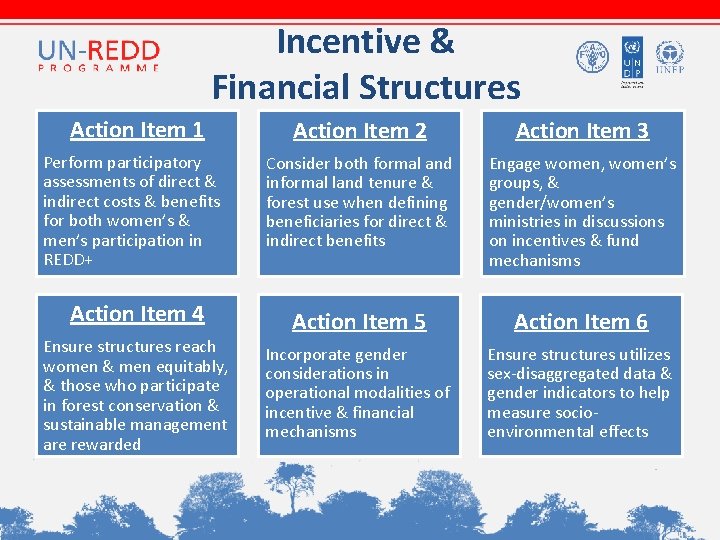
Incentive & Financial Structures Action Item 1 Action Item 2 Action Item 3 Consider both formal and informal land tenure & forest use when defining beneficiaries for direct & indirect benefits Engage women, women’s groups, & gender/women’s ministries in discussions on incentives & fund mechanisms Action Item 4 Action Item 5 Action Item 6 Ensure structures reach women & men equitably, & those who participate in forest conservation & sustainable management are rewarded Incorporate gender considerations in operational modalities of incentive & financial mechanisms Ensure structures utilizes sex-disaggregated data & gender indicators to help measure socioenvironmental effects Perform participatory assessments of direct & indirect costs & benefits for both women’s & men’s participation in REDD+
Financing & Fund Management In development of a REDD+ financing plan or fund management arrangement and disbursement, recommend to: • Look beyond just forest owners, but rather also look at forest user rights as well • Build capacity on gender concepts with fund management staff • Ensure financial and other benefit compensation reaches women & men equitably, wherein those who participate in forest conservation & sustainable management are rewarded • In monitoring of financial management, promote the participation of government ministries responsible for women’s empowerment & gender issues as well as women’s organizations
National Forest Monitoring • Forest monitoring activities should be gender sensitive & include indigenous peoples & local communities (both women & men) • Awareness raising & capacity building activities should be undertaken to help in this effort. • When establishing monitoring framework, safeguards should be put in place to ensure that women: – Have equal access to training & employment opportunities – Are compensated equitably with men forest protection & carbon monitoring activities • Benefits of a gender sensitive approach include: – Improving local communities, including both women’s & men’s, understanding & ownership of REDD+ – Employment & training
Thank You Elizabeth Eggerts elizabeth. eggerts@undp. org