
Entropy 2021 Porto Portugal Action and entropy in
- Slides: 19
Entropy 2021 Porto, Portugal Action and entropy in heat engines: A modern revision of the Carnot cycle Ivan R Kennedy and Migdat Hodzic University of Sydney, Sydney NSW Australia American University in Bosnia and Herzogovina, Sarajevo Kennedy et al 2019, Entropy 21, 454 A simple method to estimate entropy and free energy of atmospheric gases from their action
Making thermodynamics easier using the least action principle Kennedy IR Action in Ecosystems Wiley 2001 Least action is nature’s statistical means for economy of energy resources S = ʃ(T – V)dt - integrating the Lagrangian w/r time Partition functions of statistical mechanics can be interpreted as ratios of action compared to Planck’s quantum of action ћ In revising the Carnot cycle, can we discover anything new from the idea of action to apply to the greatest issue of our time – climate change
Sadi Carnot’s legacy • Carnot’s legacy is often still misunderstood, given Lord Kelvin was misled by Clapeyron’s paper that the cycle assumed conservation of caloric between the extremes of temperature. Clausius was deceived too, but generously corrected Carnot’s “error” in 1850 • In fact, as we will show here, there was no such error. Richard Feynman in his lectures also concluded there was no error and that the Clausius Clapeyron equation should really be called the Carnot equation, since it was already described in Carnot’s 1824 memoire • Using an action revision can we obtain a better understanding of Carnot’s cycle?
• “The motive power of heat is independent of the agents employed to realize it; its quantity is fixed solely by the temperatures between which is effected, finally, the transfer of caloric” Carnot’s postulates • “When a gas varies in volume without change in temperature the quantity of heat absorbed or liberated are in arithmetical progression if the increments or decrements of volume are in geometrical progression” • “The temperature is higher during the movements of dilatation than during the movements of compression. During the former the elastic force of air is found to be greater and consequently the quantity of motive power during dilatation is more considerable than that consumed to produce movements of compression” • “The quantities of heat absorbed or set free in these different transformations are exactly compensated”
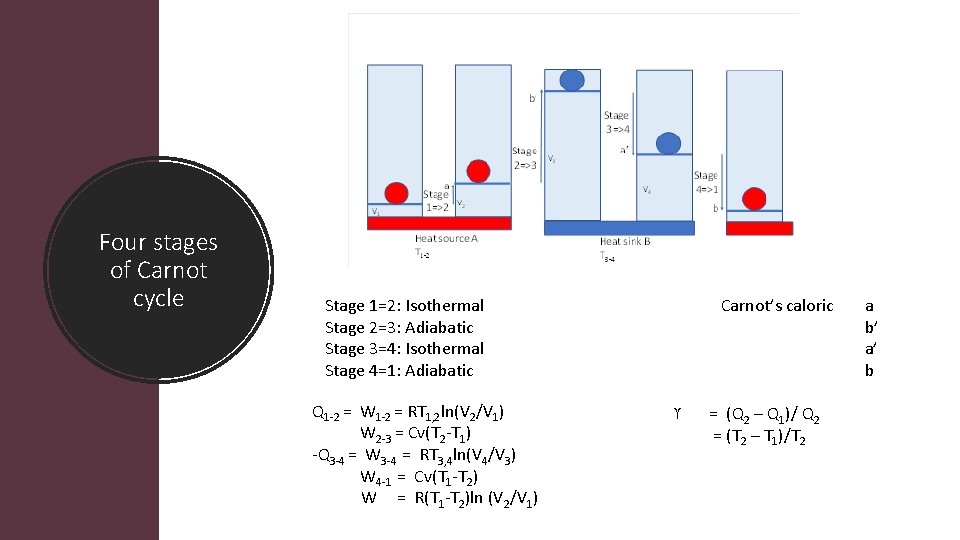
Four stages of Carnot cycle Stage 1=2: Isothermal Stage 2=3: Adiabatic Stage 3=4: Isothermal Stage 4=1: Adiabatic Q 1 2 = W 1 2 = RT 1, 2 ln(V 2/V 1) W 2 3 = Cv(T 2 T 1) Q 3 4 = W 3 4 = RT 3, 4 ln(V 4/V 3) W 4 1 = Cv(T 1 T 2) W = R(T 1 T 2)ln (V 2/V 1) Carnot’s caloric ϒ = (Q 2 – Q 1)/ Q 2 = (T 2 – T 1)/T 2 a b’ a’ b
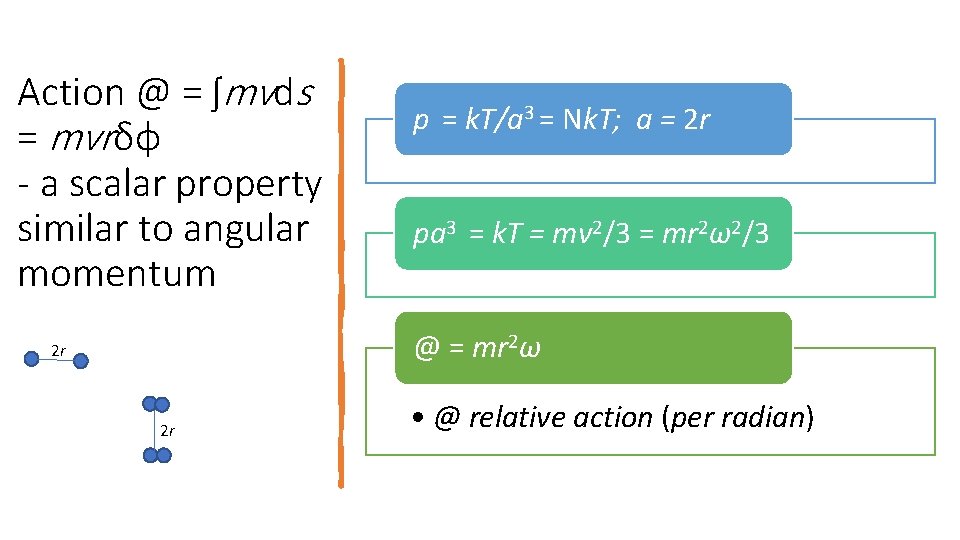
Action @ = ʃmvds = mvrδφ - a scalar property similar to angular momentum p = k. T/a 3 = Nk. T; a = 2 r pa 3 = k. T = mv 2/3 = mr 2ω2/3 @ = mr 2ω 2 r 2 r • @ relative action (per radian)
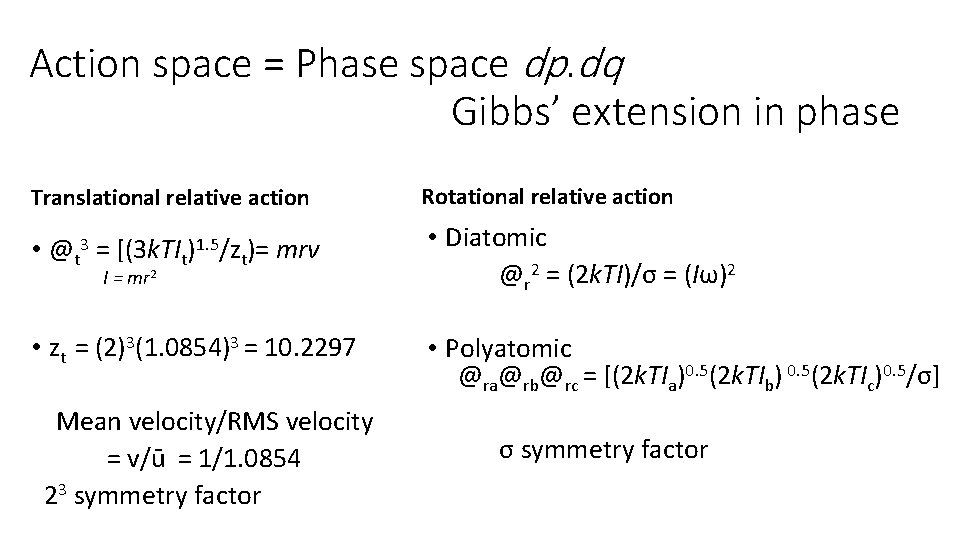
Action space = Phase space dp. dq Gibbs’ extension in phase Translational relative action Rotational relative action • @t 3 = [(3 k. TIt)1. 5/zt)= mrv • Diatomic @r 2 = (2 k. TI)/σ = (Iω)2 • zt = (2)3(1. 0854)3 = 10. 2297 • Polyatomic @ra@rb@rc = [(2 k. TIa)0. 5(2 k. TIb) 0. 5(2 k. TIc)0. 5/σ] I = mr 2 Mean velocity/RMS velocity = v/ū = 1/1. 0854 23 symmetry factor σ symmetry factor
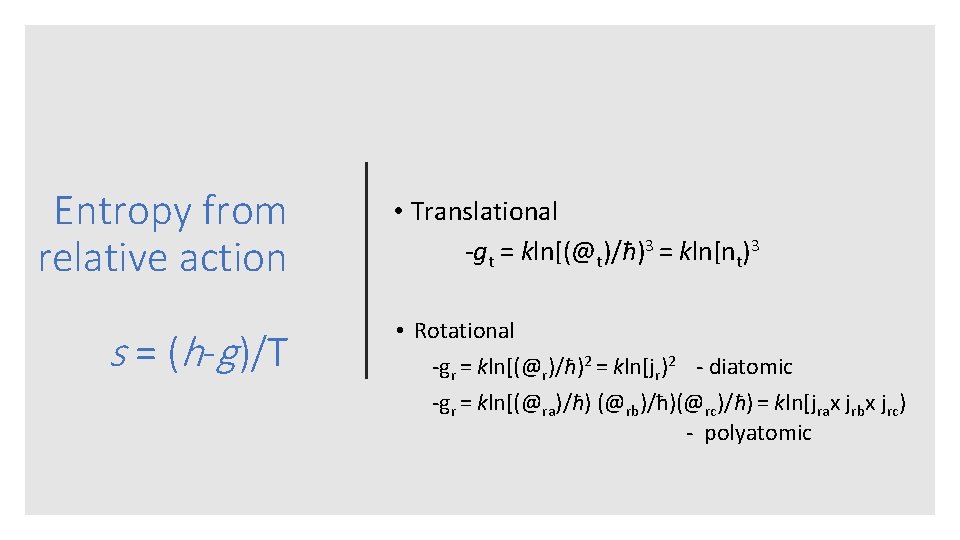
Entropy from relative action s = (h-g )/T • Translational gt = kln[(@t)/ħ)3 = kln[nt)3 • Rotational gr = kln[(@r)/ħ)2 = kln[jr)2 diatomic gr = kln[(@ra)/ħ) (@rb)/ħ)(@rc)/ħ) = kln[jrax jrbx jrc) polyatomic
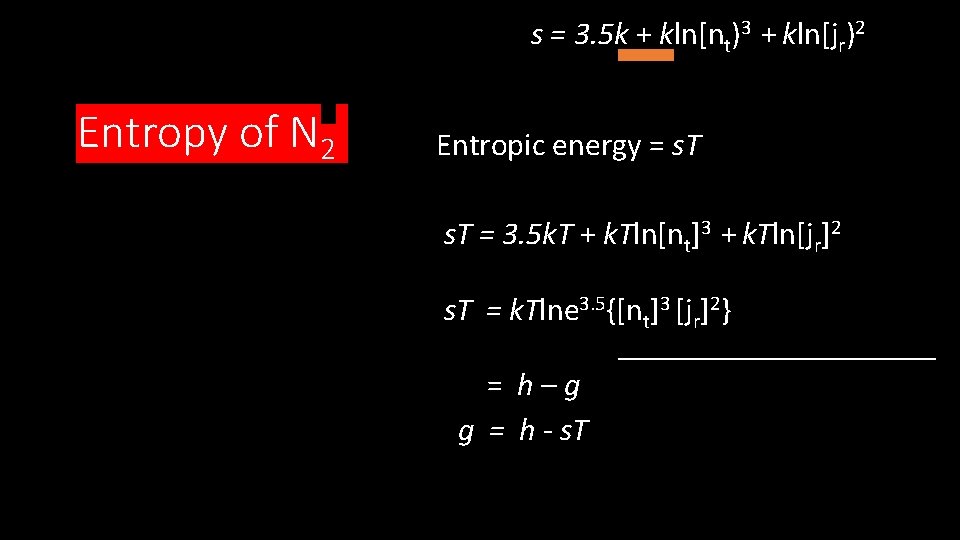
s = 3. 5 k + kln[nt)3 + kln[jr)2 Entropy of N 2 Entropic energy = s. T = 3. 5 k. T + k. Tln[nt]3 + k. Tln[jr]2 s. T = k. Tlne 3. 5{[nt]3 [jr]2} = h–g g = h - s. T
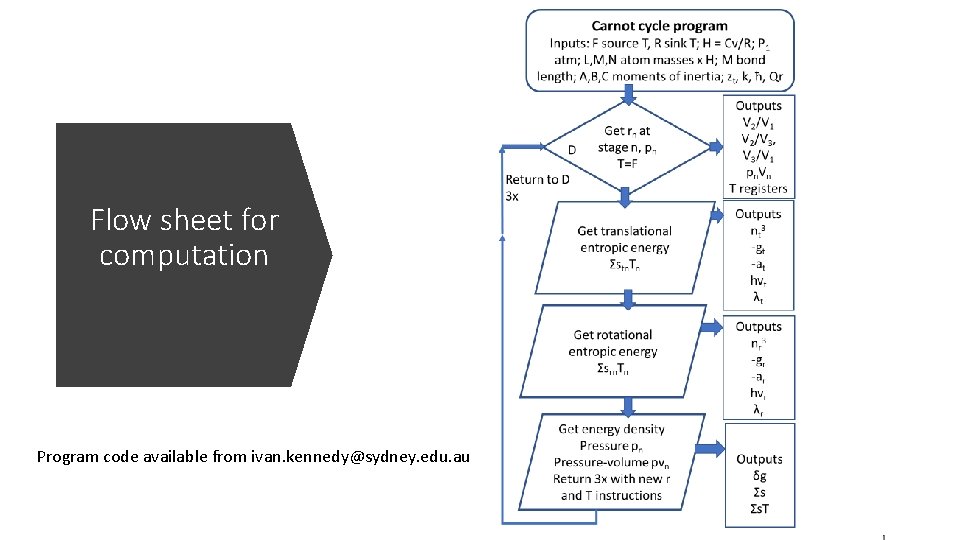
Flow sheet for computation Program code available from ivan. kennedy@sydney. edu. au
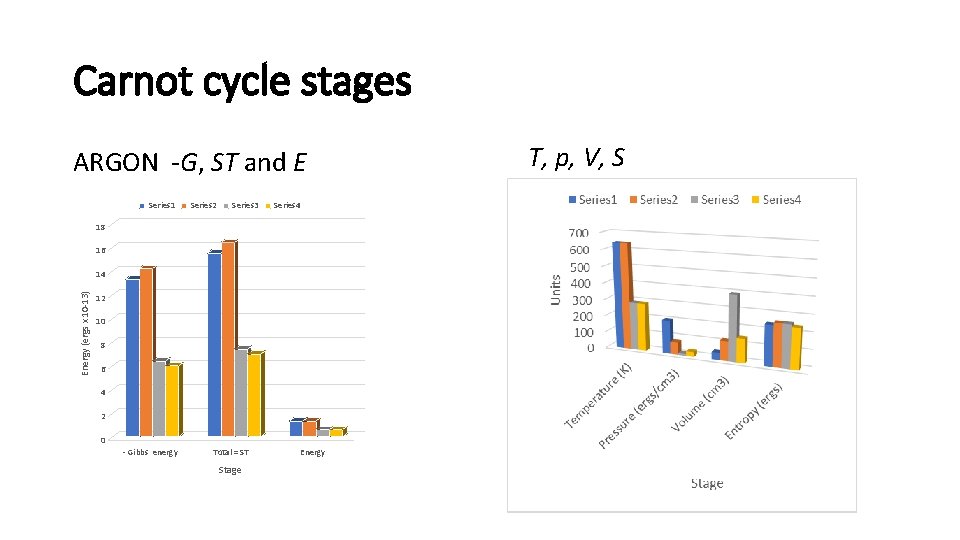
Carnot cycle stages ARGON G, ST and E Series 1 Series 2 Series 3 Series 4 18 16 Energy (ergs x 10 13) 14 12 10 8 6 4 2 0 Gibbs energy Total = ST Stage Energy T, p, V, S
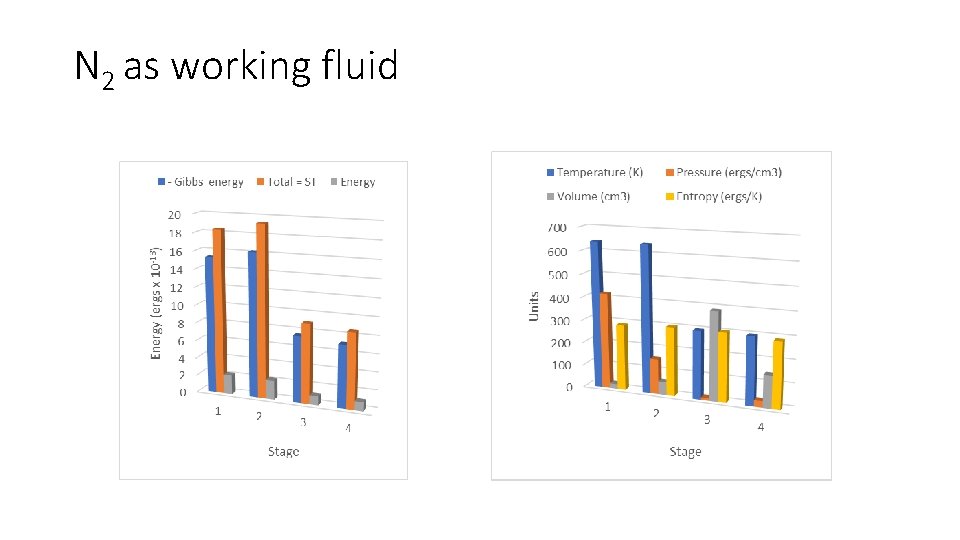
N 2 as working fluid
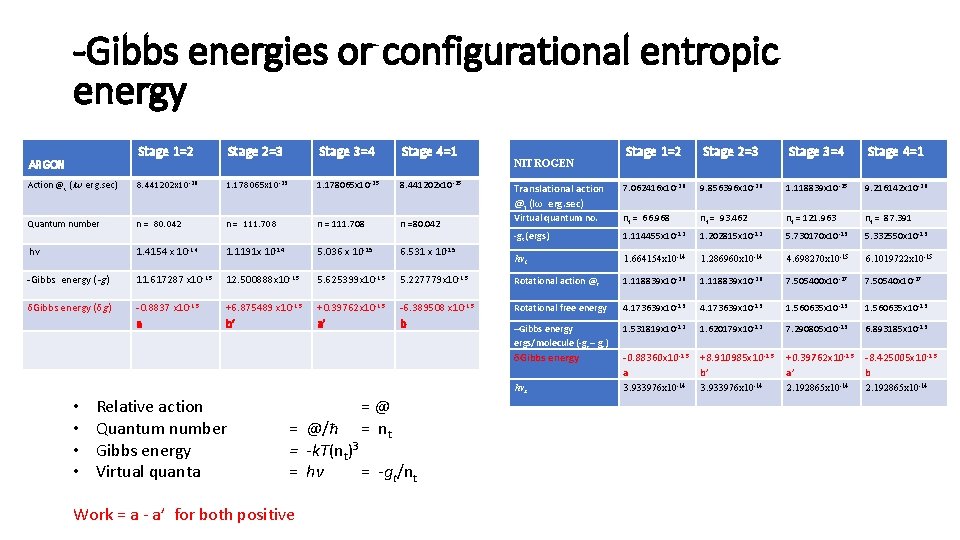
-Gibbs energies or configurational entropic energy Stage 1=2 Stage 2=3 Stage 3=4 Stage 4=1 Action @t (Iω erg. sec) 8. 441202 x 10 -26 1. 178065 x 10 -25 1. 178065 x 10 25 8. 441202 x 10 25 Quantum number n = 80. 042 n = 111. 708 n =80. 042 hv 1. 4154 x 10 -14 1. 1191 x 10 14 5. 036 x 10 15 6. 531 x 10 15 -Gibbs energy (-g ) 11. 617287 x 10 -13 12. 500888 x 10 -13 5. 625399 x 10 -13 δGibbs energy (δg ) -0. 8837 x 10 -13 +6. 875489 x 10 -13 a b’ ARGON • • Relative action Quantum number Gibbs energy Virtual quanta Stage 1=2 Stage 2=3 Stage 3=4 Stage 4=1 Translational action @t (Iω erg. sec) 7. 062416 x 10 26 9. 856396 x 10 26 1. 118839 x 10 25 9. 216142 x 10 26 Virtual quantum no. nt = 66. 968 nt = 93. 462 nt = 121. 963 nt = 87. 391 -gt (ergs) 1. 114455 x 10 12 1. 202815 x 10 12 5. 730170 x 10 13 5. 332550 x 10 13 hvt 1. 664154 x 10 -14 1. 286960 x 10 -14 4. 698270 x 10 -15 6. 1019722 x 10 -15 5. 227779 x 10 -13 Rotational action @r 1. 118839 x 10 26 7. 505400 x 10 27 7. 50540 x 10 27 +0. 39762 x 10 -13 -6. 389508 x 10 -13 Rotational free energy 4. 173639 x 10 13 1. 560635 x 10 13 a’ b –Gibbs energy ergs/molecule (-gt – gr) 1. 531819 x 10 12 1. 620179 x 10 12 7. 290805 x 10 13 6. 893185 x 10 13 δGibbs energy 0. 88360 x 10 13 a +8. 910985 x 10 13 b’ +0. 39762 x 10 13 a’ 8. 425005 x 10 13 b hvr 3. 933976 x 10 -14 2. 192865 x 10 -14 =@ = nt = @/ħ = -k. T(nt)3 = hv = -gt/nt Work = a a’ for both positive NITROGEN
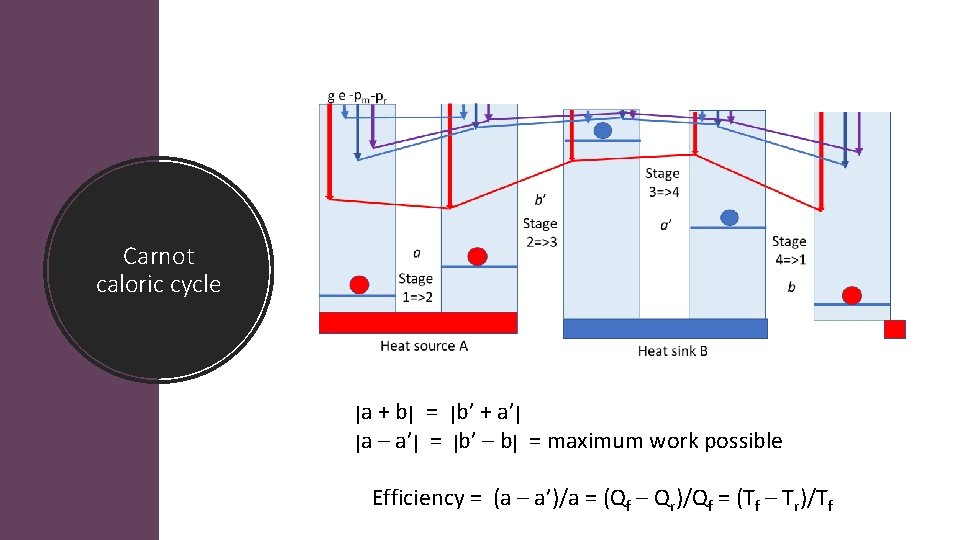
Carnot caloric cycle ן a + b ן = ן b’ + a’ ן ן a – a’ ן = ן b’ – b = ן maximum work possible Efficiency = (a – a’)/a = (Qf – Qr)/Qf = (Tf – Tr)/Tf
Carnot’s legacy is confirmed by this action based analysis Carnot’s postulates of the independence of working fluid, the importance of temperature gradient and the logarithmic effect of volume on specific heat are all logically modelled as action thermodynamics. Carnot’s (Clausius Clapeyron) equation regarding the heat of vaporization even predicted the difference in vapour pressure of water at different temperatures, an important feature of climate science Consistency of his analysis with action thermodynamics suggests that all ensembles of molecules in relative action should infer sustaining negative Gibbs energy or entropic energy Can we recognise the heat work heat processes of a Carnot cycles in climate
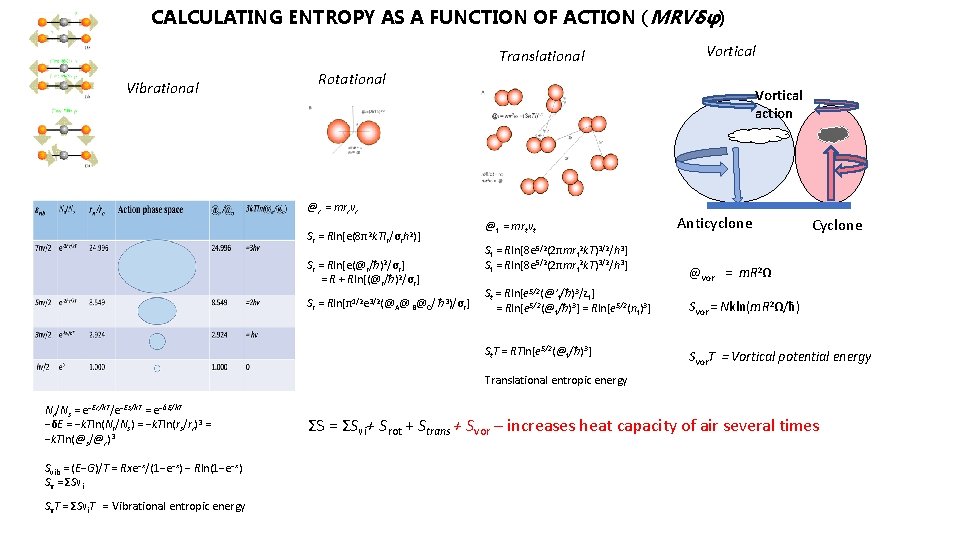
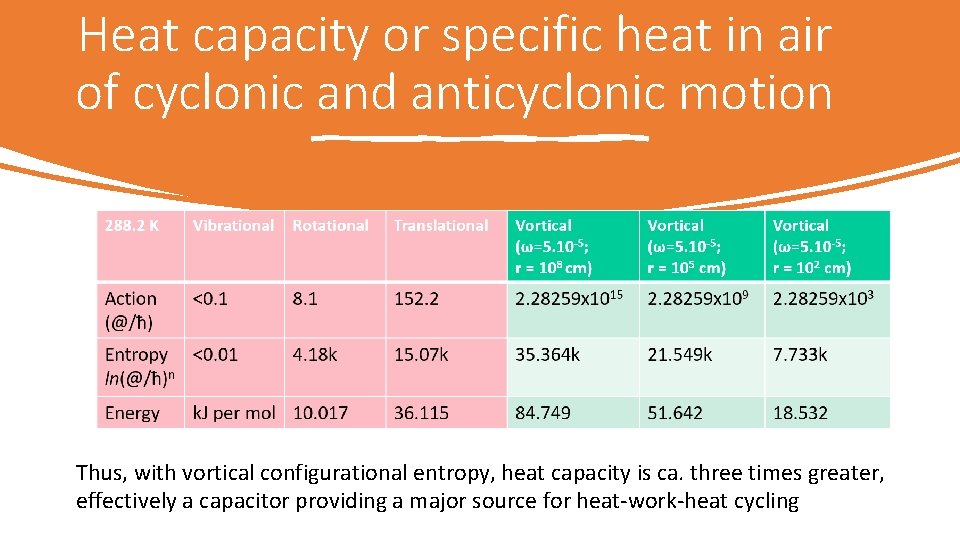
CALCULATING ENTROPY AS A FUNCTION OF ACTION (MRVδφ) Translational Vibrational Vortical Rotational Vortical action @r = mrrvr Sr = Rln[e(8π2 k. TIr/σrh 2)] Sr = Rln[e(@r/ħ)2/σr] = R + Rln[(@r/ħ)2/σr] Sr = Rln[π1/2 e 3/2(@A@ B@C/ ħ 3)/σr] @t = mrtvt St = Rln[8 e 5/2(2πmrt 2 k. T)3/2/h 3] Anticyclone Cyclone @vor = m. R 2Ω St = Rln[e 5/2(@’t/ħ)3/zt] = Rln[e 5/2(@t/ħ)3] = Rln[e 5/2(nt)3] Svor = Nkln(m. R 2Ω/ħ) St. T = RTln[e 5/2(@t/ħ)3] Svor. T = Vortical potential energy Translational entropic energy Nr/Ns = e−Er/k. T/e−Es/k. T = e−δE/k. T −δE = −k. Tln(Nr/Ns) = −k. Tln(rs/rr)3 = −k. Tln(@s/@r)3 Svib = (E−G)/T = Rxe−x/(1−e−x) − Rln(1−e−x) Sν = ΣSνi SνT = ΣSνi. T = Vibrational entropic energy ΣS = ΣSνi+ Srot + Strans + Svor – increases heat capacity of air several times
Heat capacity or specific heat in air of cyclonic and anticyclonic motion Thus, with vortical configurational entropy, heat capacity is ca. three times greater, effectively a capacitor providing a major source for heat work heat cycling
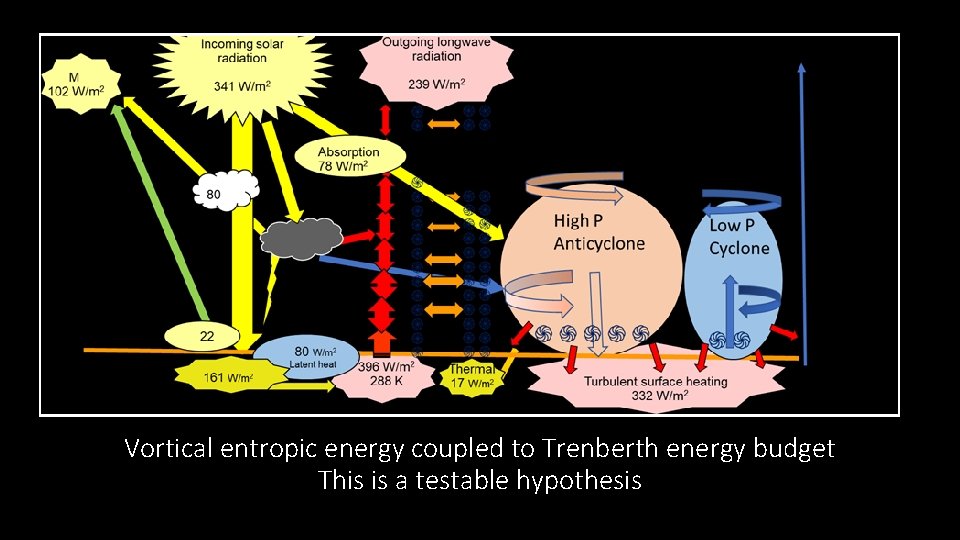
Vortical entropic energy coupled to Trenberth energy budget This is a testable hypothesis
Conclusions • Not only is his establishment of the second law of thermodynamics clear, but the first conservation law of reversible heat and work is established in his equation for caloric establishing the pussiance motrice = (a – a’) • Carnot’s temperature sensitive caloric can be taken as a primitive view of the work of Clausius, Boltzmann, Gibbs, Planck and Einstein’s quantum or action field • The second law of increasing entropy and energy dissipation is also recognised in the proposing cyclonic vortical entropy as a heat work heat cycle, as proposed in this presentation