
Entrepreneurship Education Strategic Sustainable Development Researchers Peter Sims
Entrepreneurship Education & Strategic Sustainable Development Researchers: Peter Sims Xiaoou Huang Jason Niles
Our programme – S. L. t. S. • Whole systems view – Interconnected relationships among a diversity of societal members over short-term & long-term timeframes • Transdisciplinary – diverse cultures and prof. backgrounds • Leadership – learning organization & team focus
Being Strategic in Complex Systems • Sustainability principles § § § Peer-reviewed Clear definition of success “Creativity within constraints” Learn the rules, then “play chess” Transferable between cultures, professions and levels of perspective
Sustainability Principles cont’d In a sustainable society, nature is not subject to… 1. Systematic increases in concentrations of substances extracted from the earth’s crust. 2. . Systematic increases in concentrations of substances created by society 3. Systematically increasing degration of natural systems by physical means …and in a sustainable society, 4. Humanity’s capacity to meet their needs is not systematically being undermined
Why entrepreneurship & SSD? • Societal need for new start-ups, ideas and innovations • Bring-in SSD at conceptual stage of the venture • Growing force within society But, where should we target entrepreneurs with our message…? Where and how do entrepreneurs learn in general…?

Topic Background Examples of Entrepreneur Hubs Suited for SSD Outreach Ven. Cap. & Finance Biz Plan Competition Education Business Incubator SME networks Entrepreneurship Education at University level Innovative/Applied -Engineering - Design, etc Business Schools - Traditional schools Action Led - Kaos Pilots, Team Academy, others
Our idea and the Kaos Pilots… Applying Strategic Sustainable Development with entrepreneurs and start-ups. So what are our questions ? ? ?
Thesis Research Questions Overarching Question: In which way do the Scandinavian Entrepreneurial Schools, Team Academy and Kaos Pilots, effectively promote SSD to their students, and succeed in promoting sustainable venture creation?
Thesis Research Questions Secondary Questions: o Q #1. What are the goals of the school for students’ understanding of “sustainability”? o Q #2. What projects do the students engage in and to what extent are they aligned with SSD? o Q #3. What are some enabling and constraining factors for their alignment with SSD? o Q#4. What tools/methods/processes, currently used by the schools, would be most effective in the strategically creating sustainable ventures?
Collaboration • Project review • Interviews and good conversation • Project collaboration It’s up to us. Let’s change the game!
Our strategic tools… q. ABCD, q. Backcasting from principles q 5 -level FW q. System conditions q. Human Needs Matrix …. help your organization form effective strategies to lead them towards sustainability
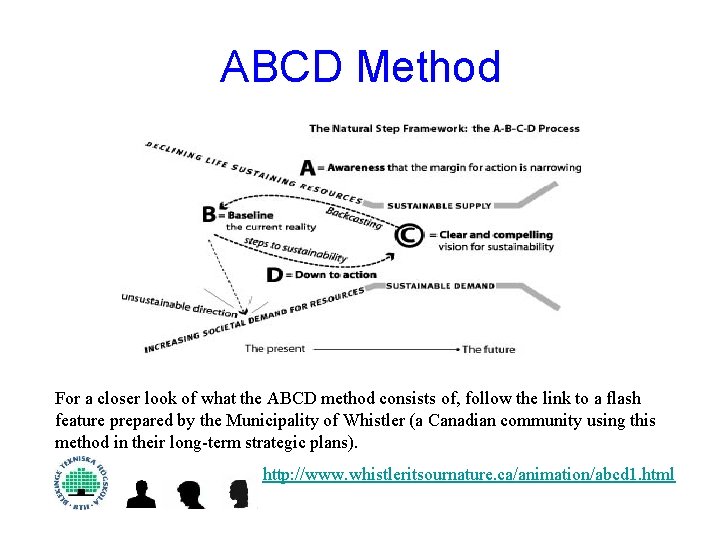
ABCD Method For a closer look of what the ABCD method consists of, follow the link to a flash feature prepared by the Municipality of Whistler (a Canadian community using this method in their long-term strategic plans). http: //www. whistleritsournature. ca/animation/abcd 1. html
A = Awareness • the first phase involves aligning your organization around a common understanding of sustainability and the 'whole-systems' context for their organization. • a presentation of strategic sustainability principles (basic science and whole-systems approach)
B = Baseline Mapping What does your organization look like today? • Conducting a Sustainability Gap Analysis using the Systems Conditions (1 -4), to see how their activities violate sustainability principles. • Along with Gap Analysis, SWOT is conducted to assess current ability to align activities with sustainability principles.
C = Creating a Vision What does your organization look like in a sustainable society? • Key decision-makers and stakeholders work together to create a compelling long-term vision for a sustainable enterprise. • From this vision, organizations develop a strategy and exhaustive list of possible measures for moving towards sustainability. Strategies are based on "backcasting" from principles.
D = Down to Action Supporting Effective, Step-by-Step Implementation Organizations prioritize their C-step list of measures based on 3 criteria: I. Right Direction? (compliance with sustainability principles) II. Flexible platform? (can the measure be easily built-upon? ) III. Sufficient R. O. I. ? (Economics, political and social investment) • Capacity building for sustainability: – – appropriate training, techniques, & tools for implementation, followed by measuring progress towards goals & suggesting modifications as needed. approach is fundamentally based on systems thinking, setting ambitious goals, & developing realistic strategies for moving forward.
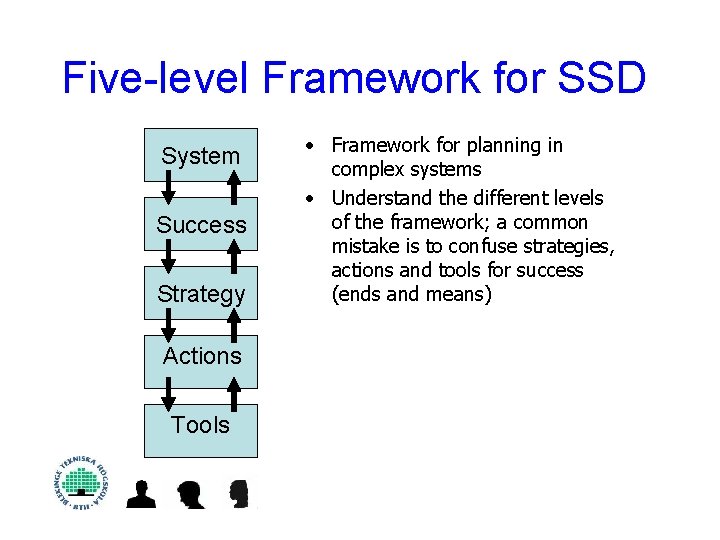
Five-level Framework for SSD System Success Strategy Actions Tools • Framework for planning in complex systems • Understand the different levels of the framework; a common mistake is to confuse strategies, actions and tools for success (ends and means)
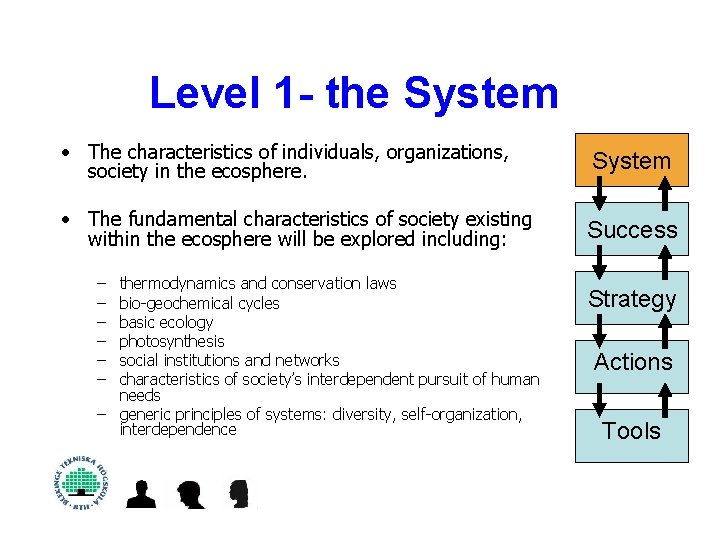
Level 1 - the System • The characteristics of individuals, organizations, society in the ecosphere. System • The fundamental characteristics of society existing within the ecosphere will be explored including: Success – – – thermodynamics and conservation laws bio-geochemical cycles basic ecology photosynthesis social institutions and networks characteristics of society’s interdependent pursuit of human needs – generic principles of systems: diversity, self-organization, interdependence Strategy Actions Tools
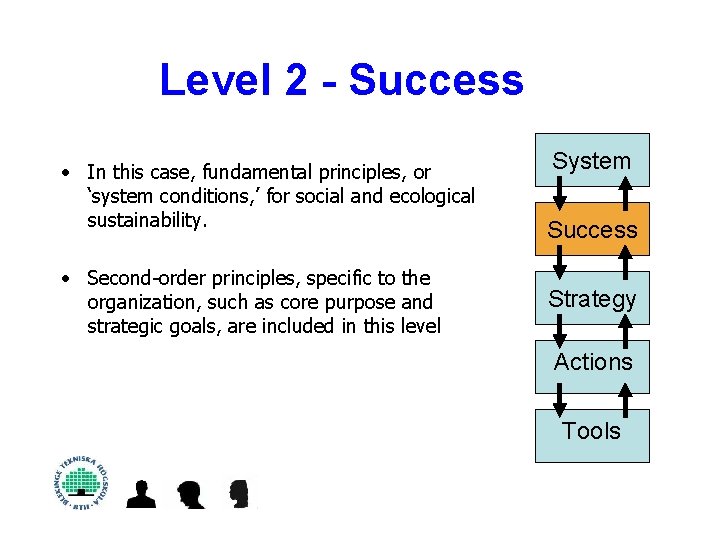
Level 2 - Success • In this case, fundamental principles, or ‘system conditions, ’ for social and ecological sustainability. • Second-order principles, specific to the organization, such as core purpose and strategic goals, are included in this level System Success Strategy Actions Tools
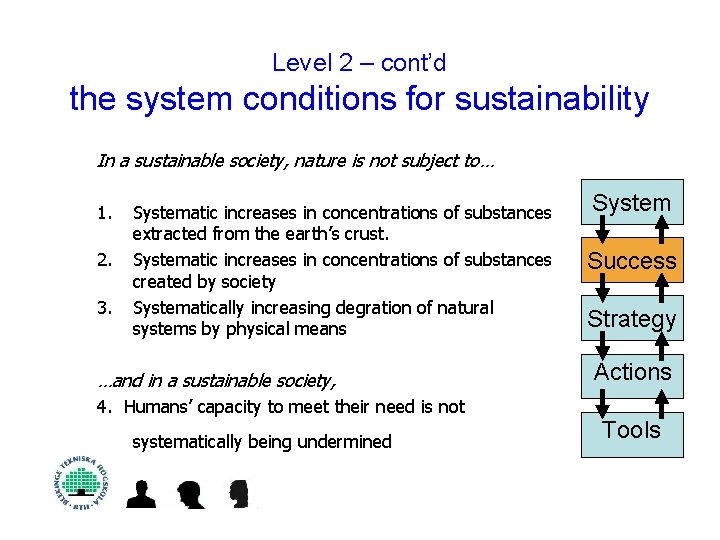
Level 2 – cont’d the system conditions for sustainability In a sustainable society, nature is not subject to… 1. 2. 3. Systematic increases in concentrations of substances extracted from the earth’s crust. Systematic increases in concentrations of substances created by society Systematically increasing degration of natural systems by physical means Success Strategy Actions …and in a sustainable society, 4. Humans’ capacity to meet their need is not systematically being undermined System Tools
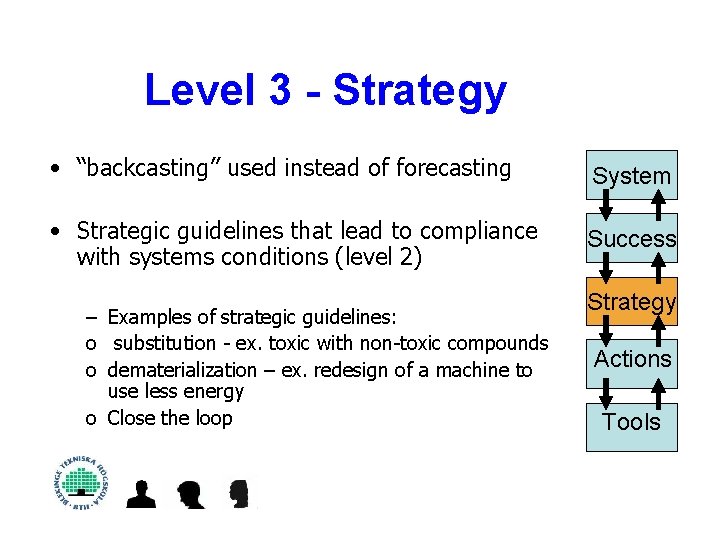
Level 3 - Strategy • “backcasting” used instead of forecasting System • Strategic guidelines that lead to compliance with systems conditions (level 2) Success – Examples of strategic guidelines: o substitution - ex. toxic with non-toxic compounds o dematerialization – ex. redesign of a machine to use less energy o Close the loop Strategy Actions Tools
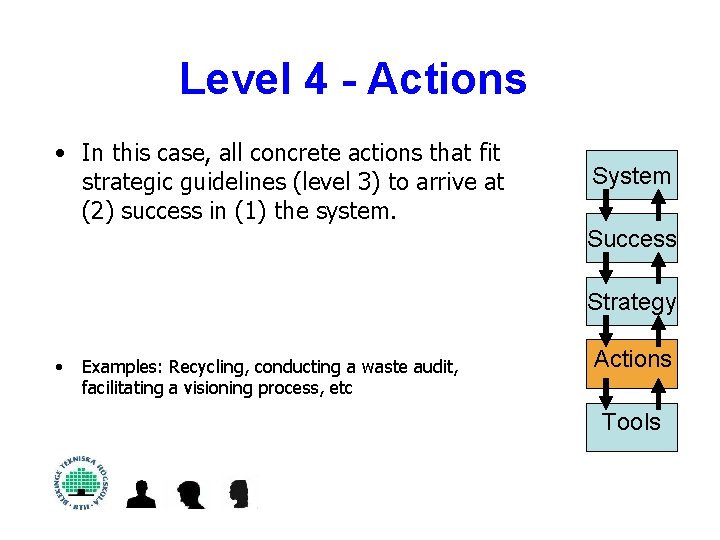
Level 4 - Actions • In this case, all concrete actions that fit strategic guidelines (level 3) to arrive at (2) success in (1) the system. System Success Strategy • Examples: Recycling, conducting a waste audit, facilitating a visioning process, etc Actions Tools
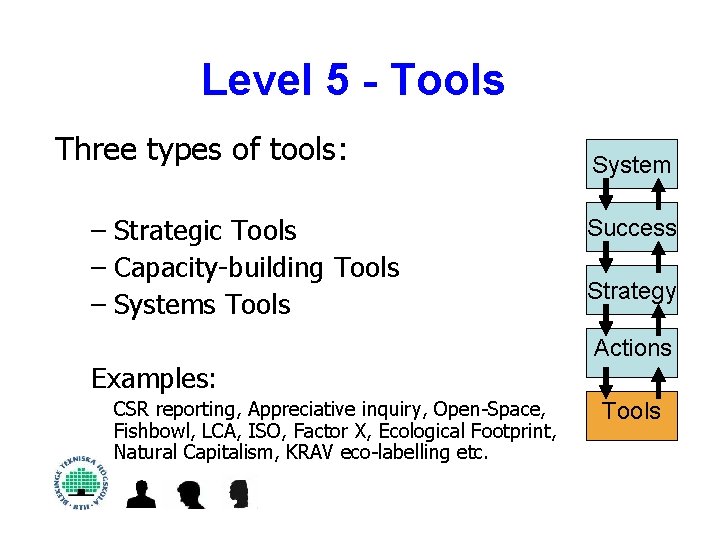
Level 5 - Tools Three types of tools: – Strategic Tools – Capacity-building Tools – Systems Tools Examples: CSR reporting, Appreciative inquiry, Open-Space, Fishbowl, LCA, ISO, Factor X, Ecological Footprint, Natural Capitalism, KRAV eco-labelling etc. System Success Strategy Actions Tools
Animations of our tools ABCD and system conditions adopted by municipality of Whistler: ABCD http: //www. whistleritsournature. ca/animation/abcd 1. html Systems Conditions http: //www. whistleritsournature. ca/animation/4 systemconditions. html
Social Sustainability • Sustainability Principle # 4 In a sustainable society, Humanity’s capacity to meet their needs is not systematically being undermined What are Human Needs?
Human Needs Matrix • Developed by Chilean Economist Manfred Max-Neef • Human Needs are. . . – Classifiable, – Universal to all cultures throughout history
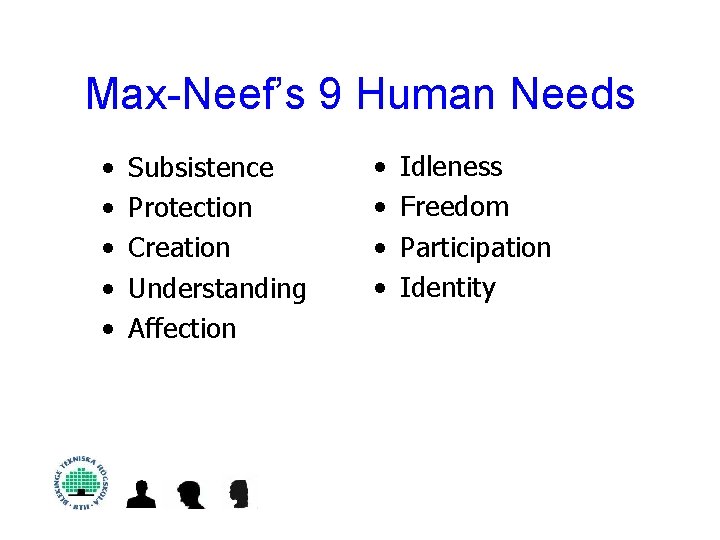
Max-Neef’s 9 Human Needs • • • Subsistence Protection Creation Understanding Affection • • Idleness Freedom Participation Identity
Needs vs. Satisfiers • While human needs do not change throughout history and culture, the way in which they are satisfied does change • Do not confuse satisfiers with needs Ex. Universities are not, in themselves, a human need. They may, or may not, act effectively as satisfiers of the need for UNDERSTANDING
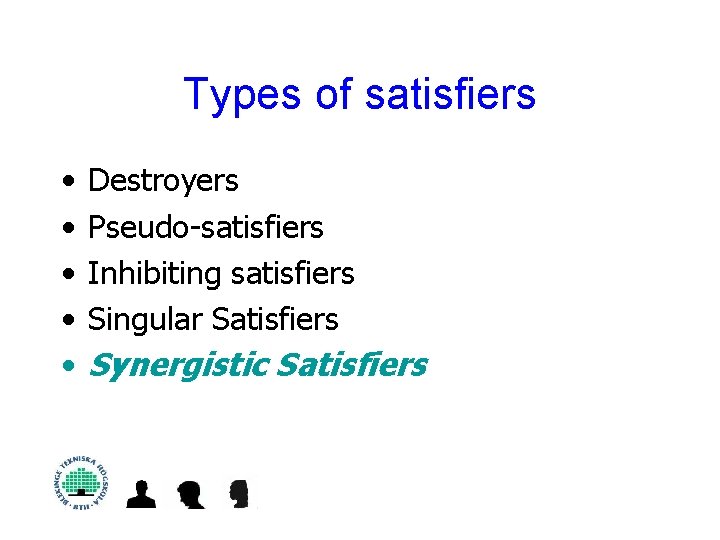
Types of satisfiers • • • Destroyers Pseudo-satisfiers Inhibiting satisfiers Singular Satisfiers Synergistic Satisfiers
Synergistic Satisfiers that satisfier more than one of the human needs at once. Ex. Breastfeading – Needs satisfied: • Baby : Subsistence, Protection, Affection, Identity • Mother: Affection, Identity, Idleness, Participation
Resources Online • Master’s programme – http: //www. bth. se/stmls • The Natural Step – http: //www. naturalstep. org/com/Start/ Human Needs Max-Neef, M. (1991) Human-Scale Development
- Slides: 31