
ENTREPRENEURSHIP DEVELOPMENT Strategic Management and the Entrepreneur www

- Slides: 24
ENTREPRENEURSHIP DEVELOPMENT Strategic Management and the Entrepreneur www. Assignment. Point. com
Few activities in the life of a business are as vital or as overlooked – as that of developing a strategy for success. Too often, entrepreneurs overflowing with optimism and enthusiasm launch their businesses destined for failure because their founders never stop to define a workable strategy that sets them apart from their competitions. www. Assignment. Point. com
Companies lacking clear strategies may achieve some success in the short run, but as soon as competitive conditions stiffen or an unanticipated threat arises, they usually “hit the wall” and fold. www. Assignment. Point. com
A Major Shift…. Without strategic plan a company can have success for a short time. Shift in the world economy from a base of financial capital to intellectual capital. Human talents, skills, abilities of a company’s workforce. Structural- accumulated knowledge and experience such as processes, patents, copyrights, knowledge and experience of the people in the company. Customer customer base, positive reputation, ongoing relationship and goodwill a company builds up over time with its customers. www. Assignment. Point. com
Strategic Management Is crucial Involves to building a successful business. developing a game plan to guide a company as it strives to accomplish its mission, goals , and objectives, and to keep it on its desired course. The idea is to give the owner a blueprint for matching the company’s strengths and weaknesses to the opportunities and threats in the environment. www. Assignment. Point. com
Strategic Management and Competitive Advantage The goal of developing a strategic plan is to create for the small company a competitive advantage, the aggregation of factors that sets a company apart from its competitors and gives it a unique position in the market. www. Assignment. Point. com
Key: Core Competencies Only building competitive advantage is not enough sustainable competitive advantage can be built by developing set of core competencies Unique set of capabilities a company develops in key areas, (such as superior quality, customer service, innovation, team-building, flexibility, responsiveness, and others) that allow it to vault past competitors. They are what a company does best. Best to rely on a natural advantage (often linked to a company’s smallness). www. Assignment. Point. com
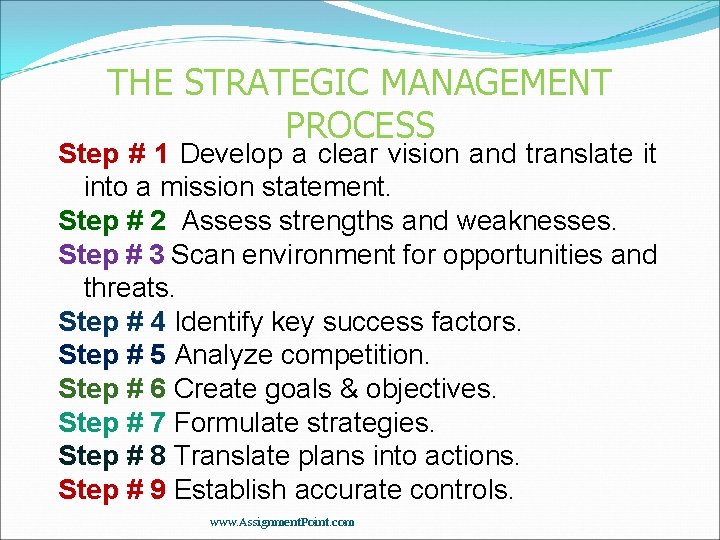
THE STRATEGIC MANAGEMENT PROCESS Step # 1 Develop a clear vision and translate it into a mission statement. Step # 2 Assess strengths and weaknesses. Step # 3 Scan environment for opportunities and threats. Step # 4 Identify key success factors. Step # 5 Analyze competition. Step # 6 Create goals & objectives. Step # 7 Formulate strategies. Step # 8 Translate plans into actions. Step # 9 Establish accurate controls. www. Assignment. Point. com
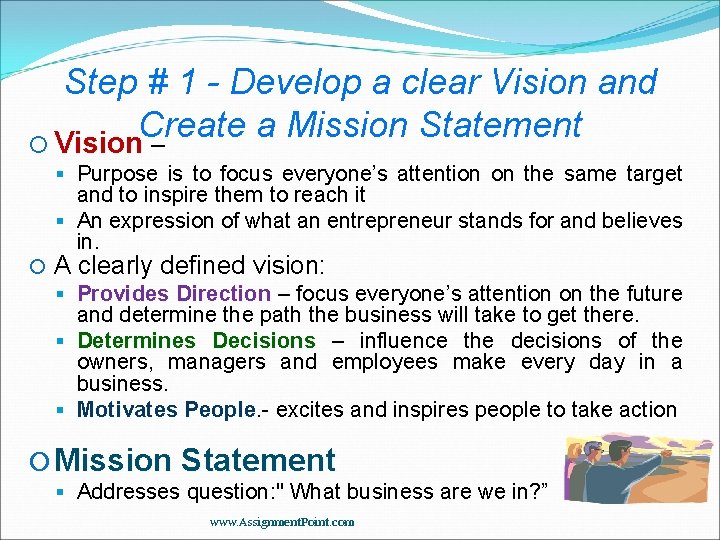
Step # 1 - Develop a clear Vision and Create a Mission Statement Vision – Purpose is to focus everyone’s attention on the same target and to inspire them to reach it An expression of what an entrepreneur stands for and believes in. A clearly defined vision: Provides Direction – focus everyone’s attention on the future and determine the path the business will take to get there. Determines Decisions – influence the decisions of the owners, managers and employees make every day in a business. Motivates People excites and inspires people to take action Mission Statement Addresses question: " What business are we in? ” www. Assignment. Point. com
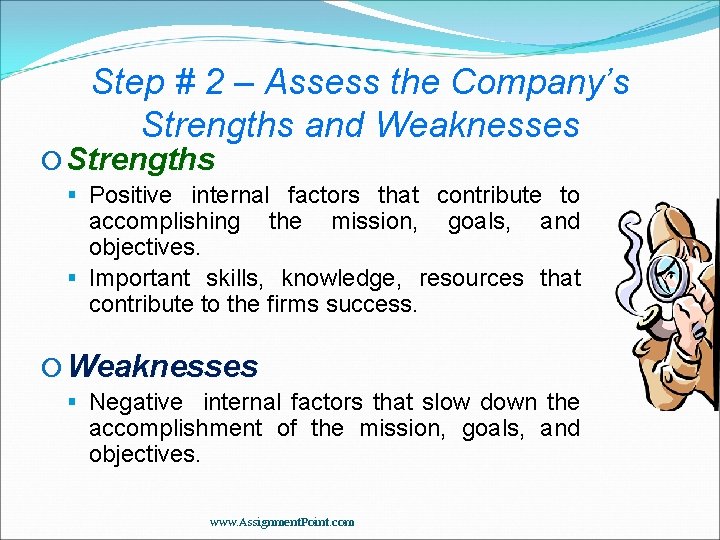
Step # 2 – Assess the Company’s Strengths and Weaknesses Strengths Positive internal factors that contribute to accomplishing the mission, goals, and objectives. Important skills, knowledge, resources that contribute to the firms success. Weaknesses Negative internal factors that slow down the accomplishment of the mission, goals, and objectives. www. Assignment. Point. com
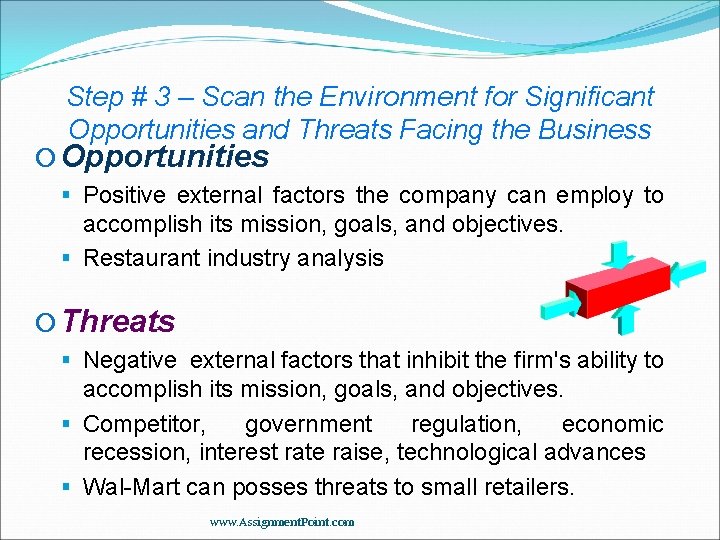
Step # 3 – Scan the Environment for Significant Opportunities and Threats Facing the Business Opportunities Positive external factors the company can employ to accomplish its mission, goals, and objectives. Restaurant industry analysis Threats Negative external factors that inhibit the firm's ability to accomplish its mission, goals, and objectives. Competitor, government regulation, economic recession, interest rate raise, technological advances Wal-Mart can posses threats to small retailers. www. Assignment. Point. com
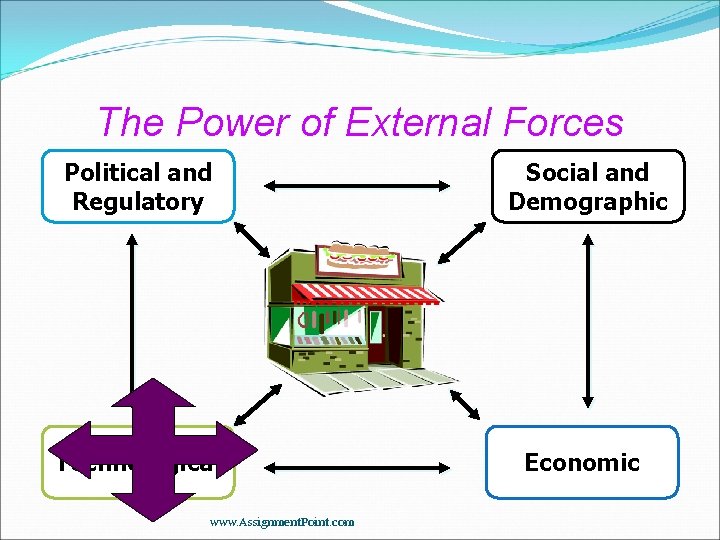
The Power of External Forces Political and Regulatory Social and Demographic Technological Economic www. Assignment. Point. com
Step # 4 – Identify the Key Factors for Success in the Business Every business is characterized by controllable variables that determine the relative success of market participants. Identifying and manipulating these variables is how a small business gains a competitive advantage. Key success factors come in a variety of different patterns depending on the industry. Many of these sources of competitive advantages are based on cost factors such as: v manufacturing cost per unit v superior product quality v distribution cost per unit v solid relationships with v development cost per unit dependable suppliers www. Assignment. Point. com
Step # 5 – Analyze the Competition Analyzing key competitors allows an entrepreneur to: Avoid surprises from existing competitors’ new strategies and tactics. Identify potential new competitors and the threats they pose. Improve reaction time to competitors’ actions. Anticipate rivals’ next strategic moves. www. Assignment. Point. com
Step # 6 – Create Company Goals and Objectives Goals and objectives give them target to aim for and provide a basis for evaluating performance. Goals - broad, long-range attributes to be accomplished. Objectives - more detailed, specific targets of performance that are S. M. A. R. T. Specific Measurable Attainable Realistic (yet challenging) Timely www. Assignment. Point. com
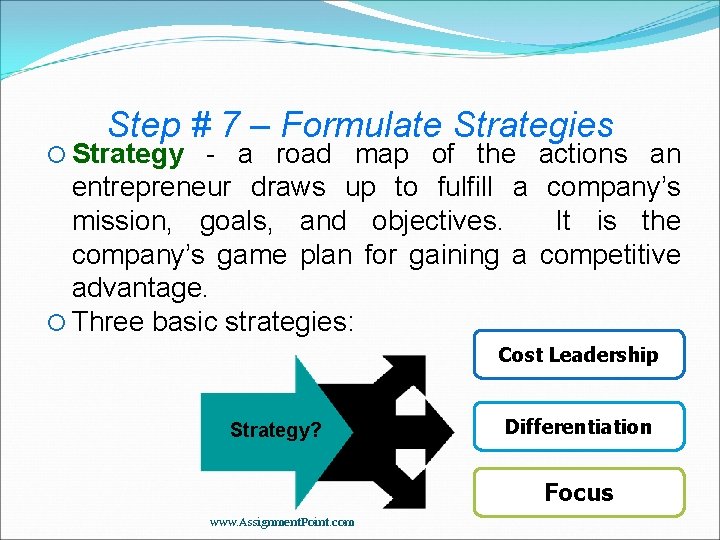
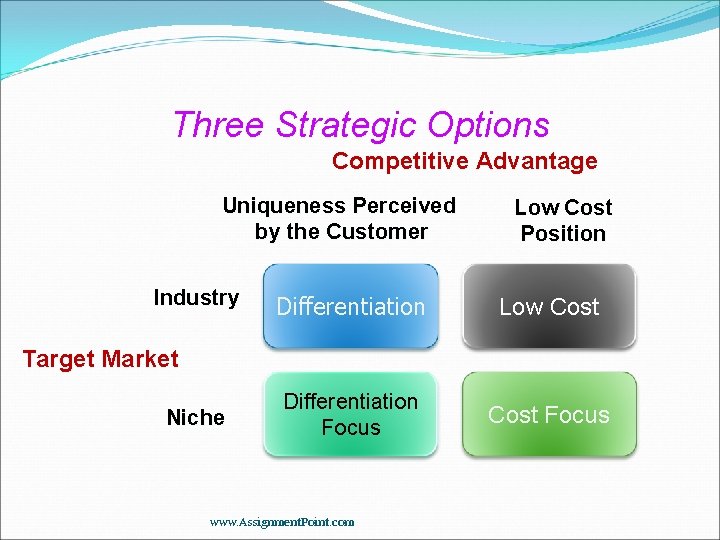
Step # 7 – Formulate Strategies Strategy - a road map of the entrepreneur draws up to fulfill a mission, goals, and objectives. company’s game plan for gaining a advantage. Three basic strategies: actions an company’s It is the competitive Cost Leadership Strategy? Differentiation Focus www. Assignment. Point. com
Three Strategic Options Competitive Advantage Uniqueness Perceived by the Customer Industry Low Cost Position Differentiation Low Cost Differentiation Focus Cost Focus Target Market Niche www. Assignment. Point. com
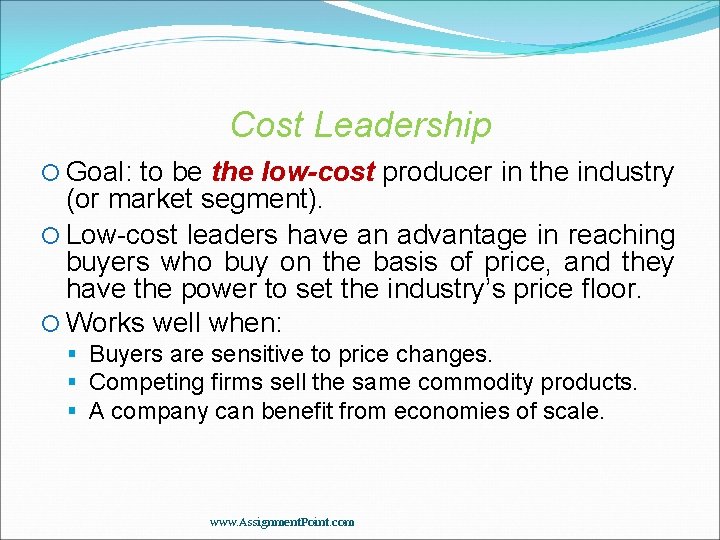
Cost Leadership Goal: to be the low-cost producer in the industry (or market segment). Low-cost leaders have an advantage in reaching buyers who buy on the basis of price, and they have the power to set the industry’s price floor. Works well when: Buyers are sensitive to price changes. Competing firms sell the same commodity products. A company can benefit from economies of scale. www. Assignment. Point. com
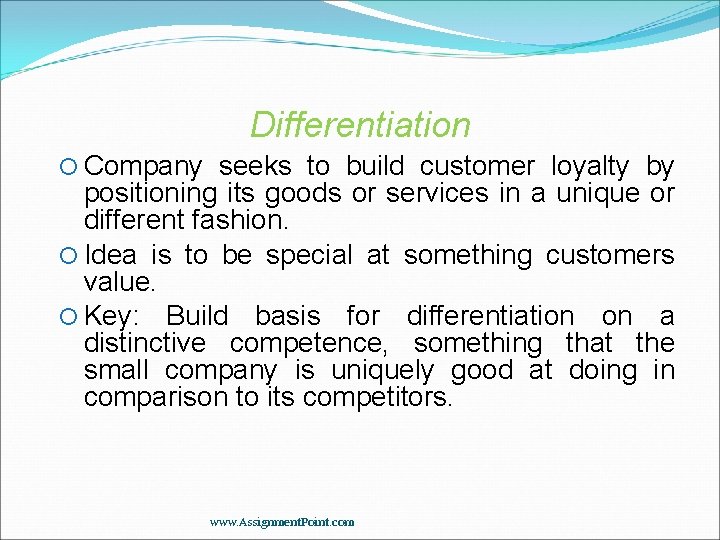
Differentiation Company seeks to build customer loyalty by positioning its goods or services in a unique or different fashion. Idea is to be special at something customers value. Key: Build basis for differentiation on a distinctive competence, something that the small company is uniquely good at doing in comparison to its competitors. www. Assignment. Point. com
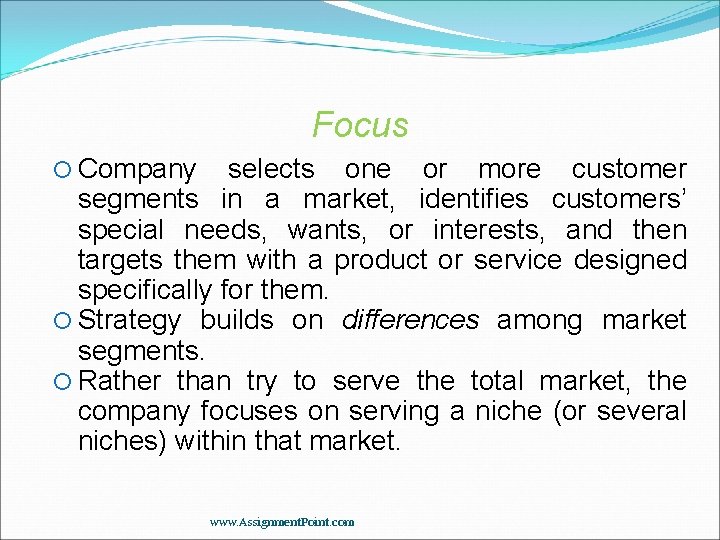
Focus Company selects one or more customer segments in a market, identifies customers’ special needs, wants, or interests, and then targets them with a product or service designed specifically for them. Strategy builds on differences among market segments. Rather than try to serve the total market, the company focuses on serving a niche (or several niches) within that market. www. Assignment. Point. com
Step # 8 – Translate Strategic Plans into Action Plans Create projects by defining: Purpose Scope Contribution Resource requirements Timing www. Assignment. Point. com
Step # 9 – Establish Accurate Controls The plan establishes the standards against which actual performance is measured. Entrepreneur must: Identify and track key performance indicators. Take corrective action. www. Assignment. Point. com
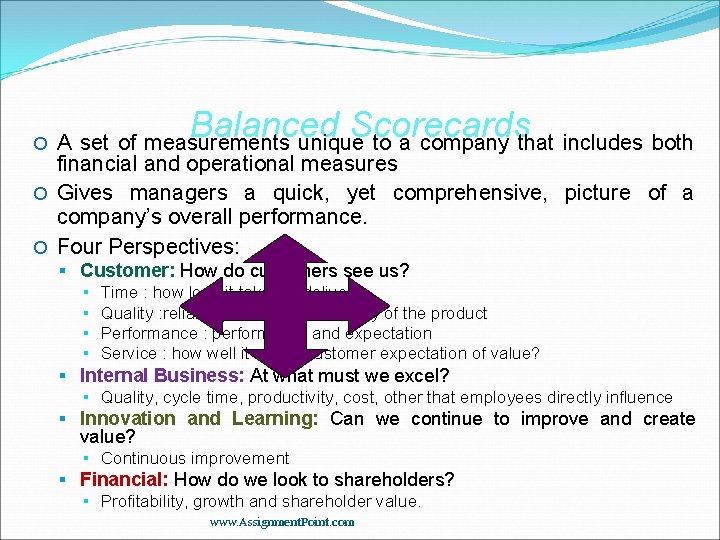
Balanced Scorecards A set of measurements unique to a company that includes both financial and operational measures Gives managers a quick, yet comprehensive, picture of a company’s overall performance. Four Perspectives: Customer: How do customers see us? ▪ Time : how long it takes to deliver ▪ Quality : reliability, durability accuracy of the product ▪ Performance : performance and expectation ▪ Service : how well it meets customer expectation of value? Internal Business: At what must we excel? ▪ Quality, cycle time, productivity, cost, other that employees directly influence Innovation and Learning: Can we continue to improve and create value? ▪ Continuous improvement Financial: How do we look to shareholders? ▪ Profitability, growth and shareholder value. www. Assignment. Point. com
END OF THE CHAPTER www. Assignment. Point. com