
Entrepreneurship Chapter 8 Using Financial Statements to Guide

- Slides: 22
Entrepreneurship Chapter 8 Using Financial Statements to Guide a Business
Entrepreneurs Use Financial Statements Income statement Cash flow statement Balance sheet § § § Entrepreneurship, 2 nd Edition Data for the financial statements comes from the accounting journal. The statements show the health of the business at a glance. Mariotti and Glackin with NFTE 2 © 2010 Pearson Education, Upper Saddle River, NJ 07458. All Rights Reserved.
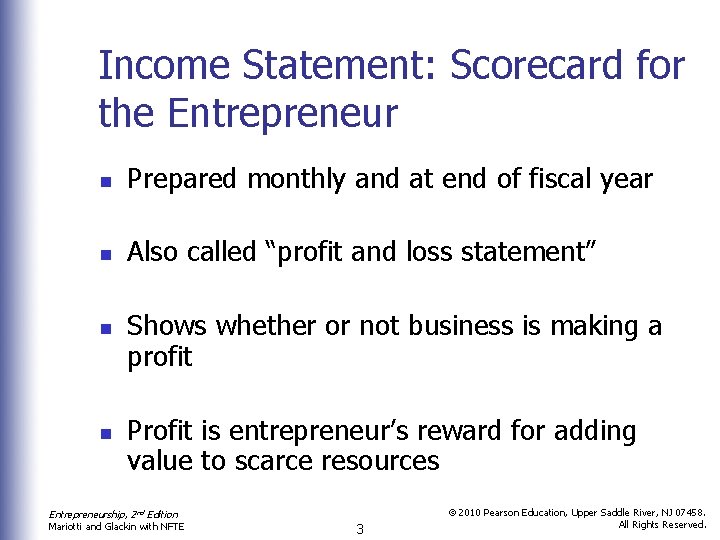
Income Statement: Scorecard for the Entrepreneur n Prepared monthly and at end of fiscal year n Also called “profit and loss statement” n n Shows whether or not business is making a profit Profit is entrepreneur’s reward for adding value to scarce resources Entrepreneurship, 2 nd Edition Mariotti and Glackin with NFTE 3 © 2010 Pearson Education, Upper Saddle River, NJ 07458. All Rights Reserved.
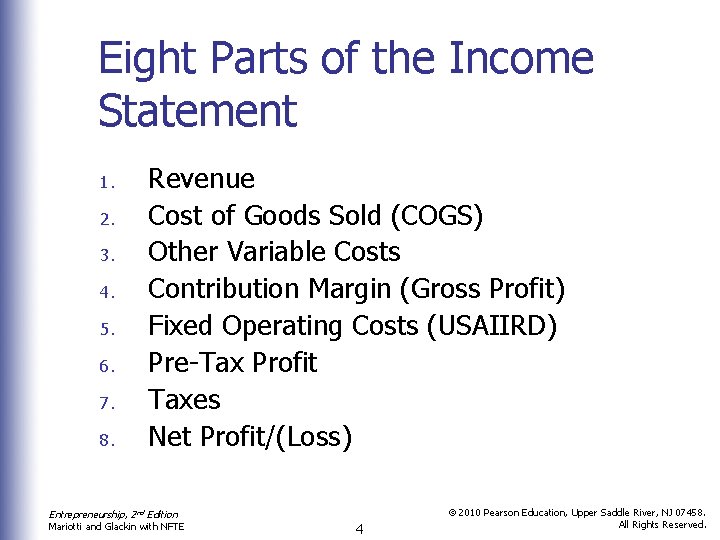
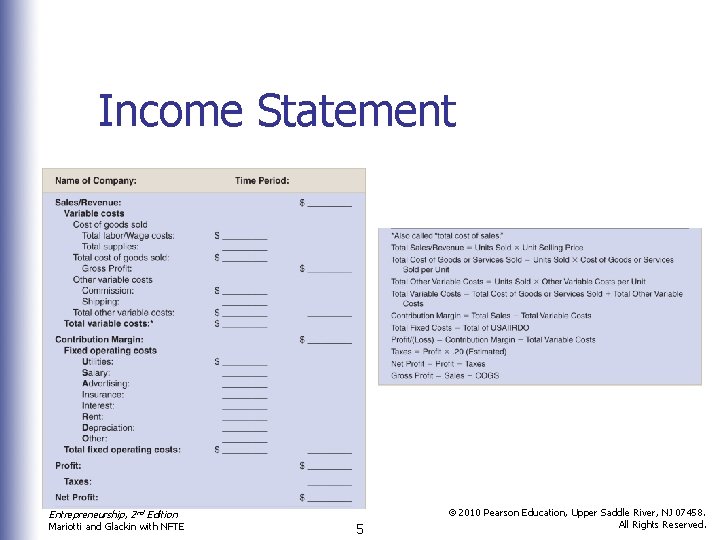
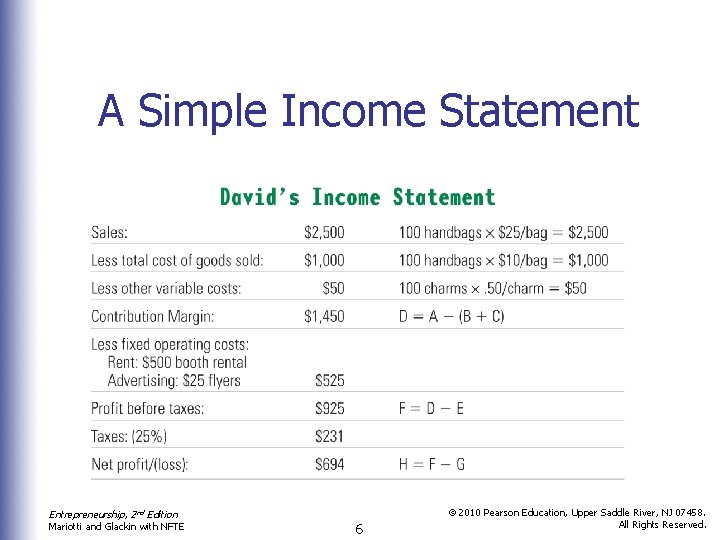
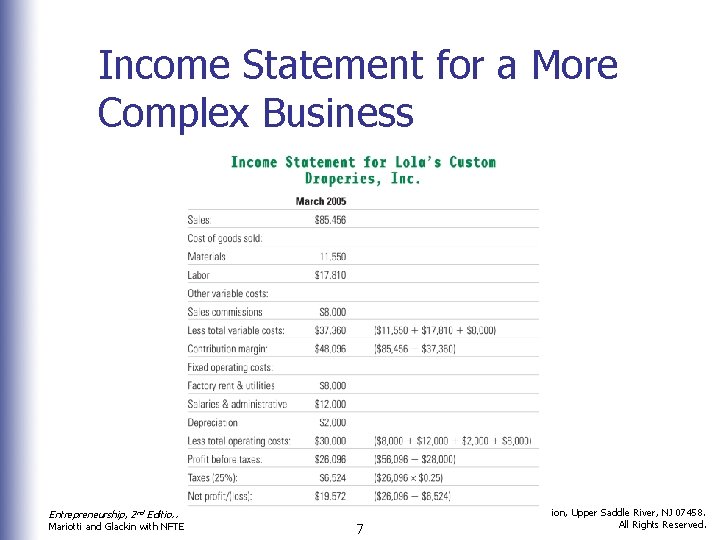
Eight Parts of the Income Statement 1. 2. 3. 4. 5. 6. 7. 8. Revenue Cost of Goods Sold (COGS) Other Variable Costs Contribution Margin (Gross Profit) Fixed Operating Costs (USAIIRD) Pre-Tax Profit Taxes Net Profit/(Loss) Entrepreneurship, 2 nd Edition Mariotti and Glackin with NFTE 4 © 2010 Pearson Education, Upper Saddle River, NJ 07458. All Rights Reserved.
Income Statement Entrepreneurship, 2 nd Edition Mariotti and Glackin with NFTE 5 © 2010 Pearson Education, Upper Saddle River, NJ 07458. All Rights Reserved.
A Simple Income Statement Entrepreneurship, 2 nd Edition Mariotti and Glackin with NFTE 6 © 2010 Pearson Education, Upper Saddle River, NJ 07458. All Rights Reserved.
Income Statement for a More Complex Business Entrepreneurship, 2 nd Edition Mariotti and Glackin with NFTE 7 © 2010 Pearson Education, Upper Saddle River, NJ 07458. All Rights Reserved.
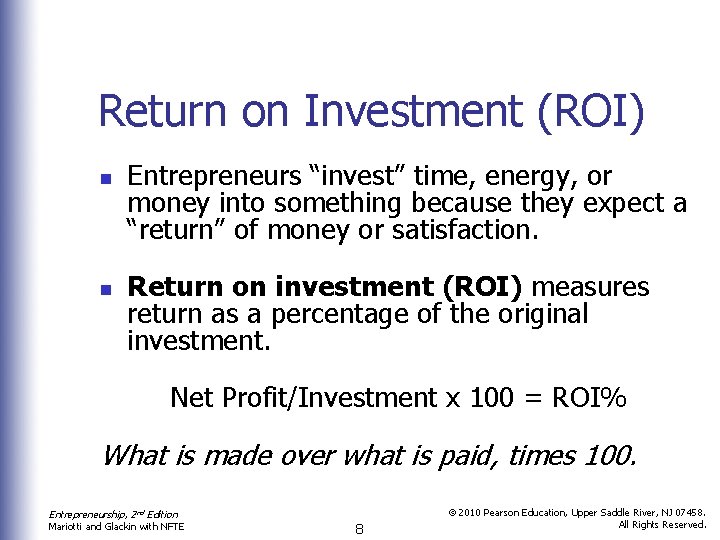
Return on Investment (ROI) n n Entrepreneurs “invest” time, energy, or money into something because they expect a “return” of money or satisfaction. Return on investment (ROI) measures return as a percentage of the original investment. Net Profit/Investment x 100 = ROI% What is made over what is paid, times 100. Entrepreneurship, 2 nd Edition Mariotti and Glackin with NFTE 8 © 2010 Pearson Education, Upper Saddle River, NJ 07458. All Rights Reserved.
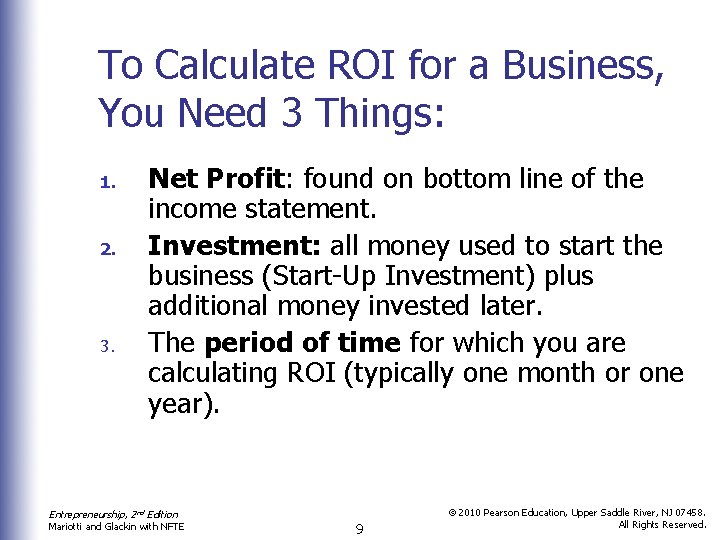
To Calculate ROI for a Business, You Need 3 Things: 1. 2. 3. Net Profit: found on bottom line of the income statement. Investment: all money used to start the business (Start-Up Investment) plus additional money invested later. The period of time for which you are calculating ROI (typically one month or one year). Entrepreneurship, 2 nd Edition Mariotti and Glackin with NFTE 9 © 2010 Pearson Education, Upper Saddle River, NJ 07458. All Rights Reserved.
Income Statement Ratios n n Express each line of the income statement as a percentage by dividing sales into it and multiplying by 100. This makes it easy to see how each item is affecting the business’s profit. Return on Sales (ROS) = Net Income/Sales Operating Ratio = Fixed Operating Costs/Sales Entrepreneurship, 2 nd Edition Mariotti and Glackin with NFTE 10 © 2010 Pearson Education, Upper Saddle River, NJ 07458. All Rights Reserved.
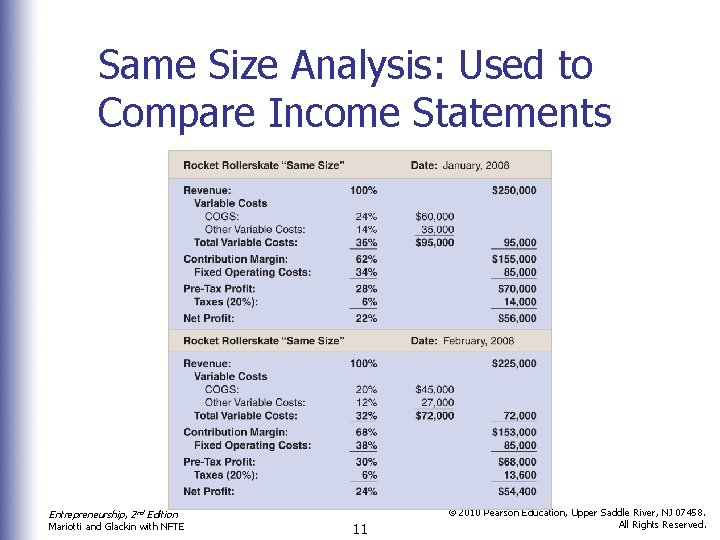
Same Size Analysis: Used to Compare Income Statements Entrepreneurship, 2 nd Edition Mariotti and Glackin with NFTE 11 © 2010 Pearson Education, Upper Saddle River, NJ 07458. All Rights Reserved.
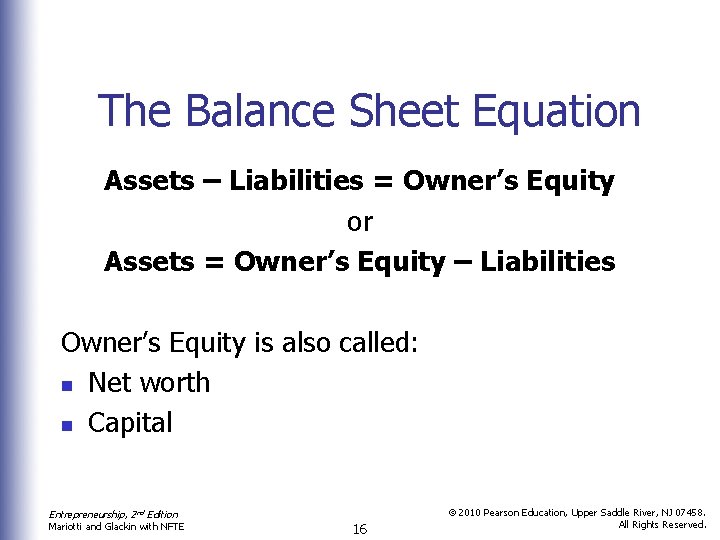
The Balance Sheet n n n A “point-in-time” statement Shows how a business is financed Prepared at end of fiscal year 3 items § Assets = things a company owns that are worth money § Liabilities = debts a company must pay, including unpaid bills § Owner’s Equity (OE) = Assets-Liabilities, also called “net worth” Entrepreneurship, 2 nd Edition Mariotti and Glackin with NFTE 12 © 2010 Pearson Education, Upper Saddle River, NJ 07458. All Rights Reserved.
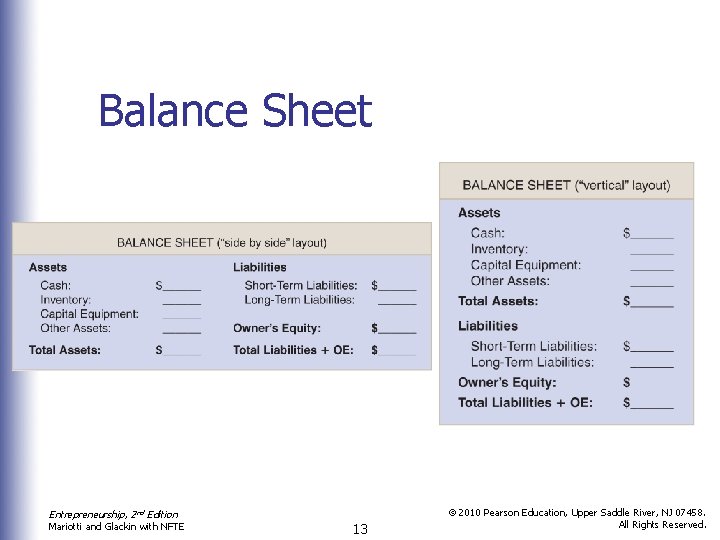
Balance Sheet Entrepreneurship, 2 nd Edition Mariotti and Glackin with NFTE 13 © 2010 Pearson Education, Upper Saddle River, NJ 07458. All Rights Reserved.
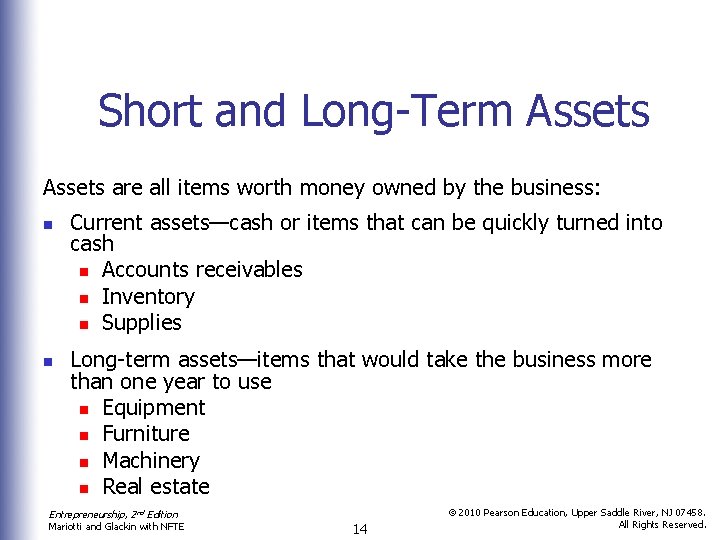
Short and Long-Term Assets are all items worth money owned by the business: n n Current assets—cash or items that can be quickly turned into cash n Accounts receivables n Inventory n Supplies Long-term assets—items that would take the business more than one year to use n Equipment n Furniture n Machinery n Real estate Entrepreneurship, 2 nd Edition Mariotti and Glackin with NFTE 14 © 2010 Pearson Education, Upper Saddle River, NJ 07458. All Rights Reserved.
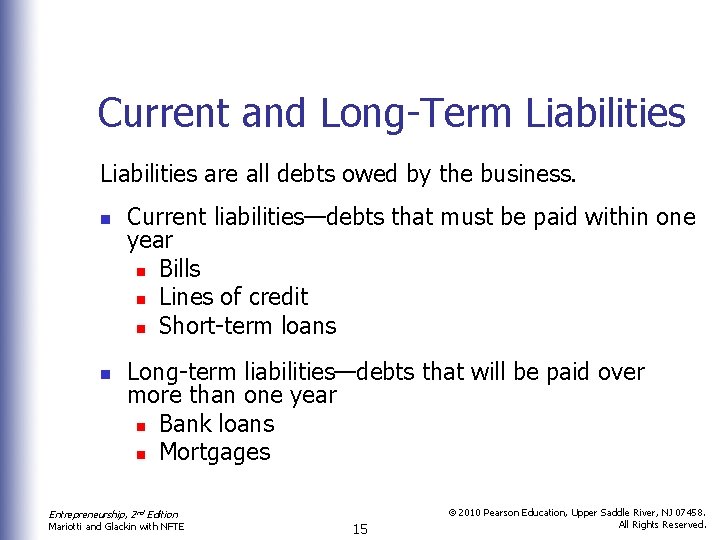
Current and Long-Term Liabilities are all debts owed by the business. n n Current liabilities—debts that must be paid within one year n Bills n Lines of credit n Short-term loans Long-term liabilities—debts that will be paid over more than one year n Bank loans n Mortgages Entrepreneurship, 2 nd Edition Mariotti and Glackin with NFTE 15 © 2010 Pearson Education, Upper Saddle River, NJ 07458. All Rights Reserved.
The Balance Sheet Equation Assets – Liabilities = Owner’s Equity or Assets = Owner’s Equity – Liabilities Owner’s Equity is also called: n Net worth n Capital Entrepreneurship, 2 nd Edition Mariotti and Glackin with NFTE 16 © 2010 Pearson Education, Upper Saddle River, NJ 07458. All Rights Reserved.
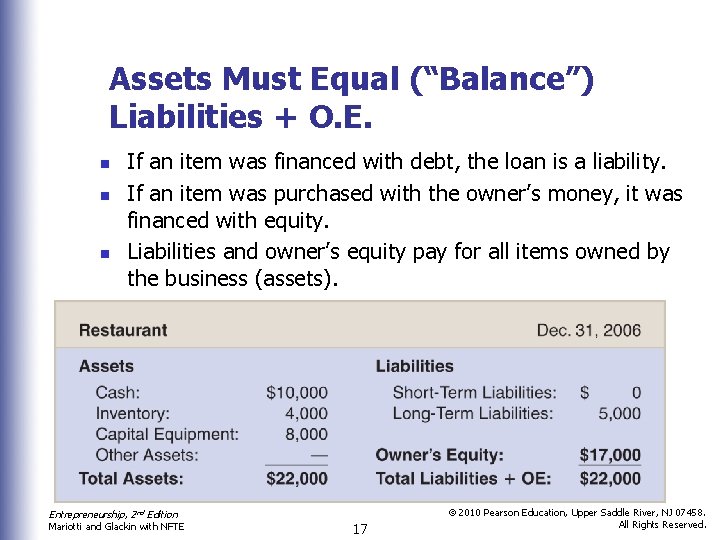
Assets Must Equal (“Balance”) Liabilities + O. E. n n n If an item was financed with debt, the loan is a liability. If an item was purchased with the owner’s money, it was financed with equity. Liabilities and owner’s equity pay for all items owned by the business (assets). Entrepreneurship, 2 nd Edition Mariotti and Glackin with NFTE 17 © 2010 Pearson Education, Upper Saddle River, NJ 07458. All Rights Reserved.
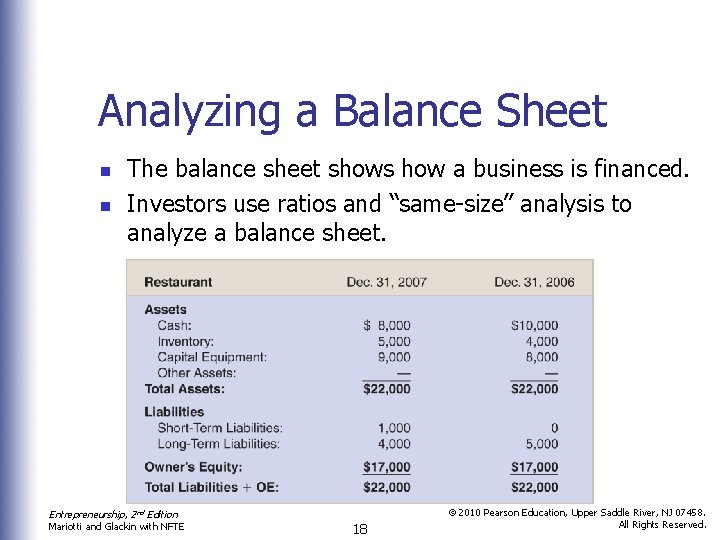
Analyzing a Balance Sheet n n The balance sheet shows how a business is financed. Investors use ratios and “same-size” analysis to analyze a balance sheet. Entrepreneurship, 2 nd Edition Mariotti and Glackin with NFTE 18 © 2010 Pearson Education, Upper Saddle River, NJ 07458. All Rights Reserved.
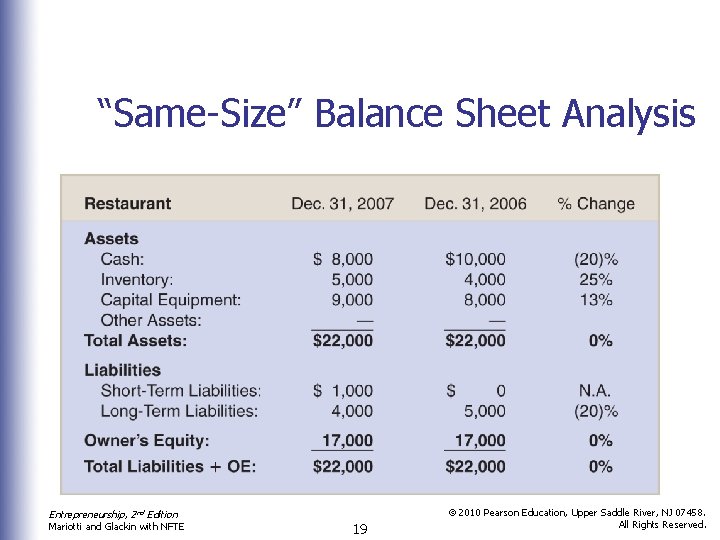
“Same-Size” Balance Sheet Analysis Entrepreneurship, 2 nd Edition Mariotti and Glackin with NFTE 19 © 2010 Pearson Education, Upper Saddle River, NJ 07458. All Rights Reserved.
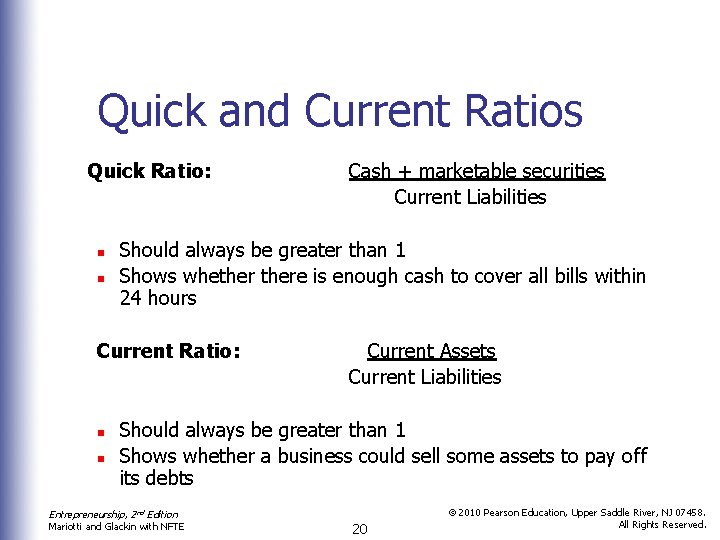
Quick and Current Ratios Quick Ratio: n n Should always be greater than 1 Shows whethere is enough cash to cover all bills within 24 hours Current Ratio: n n Cash + marketable securities Current Liabilities Current Assets Current Liabilities Should always be greater than 1 Shows whether a business could sell some assets to pay off its debts Entrepreneurship, 2 nd Edition Mariotti and Glackin with NFTE 20 © 2010 Pearson Education, Upper Saddle River, NJ 07458. All Rights Reserved.
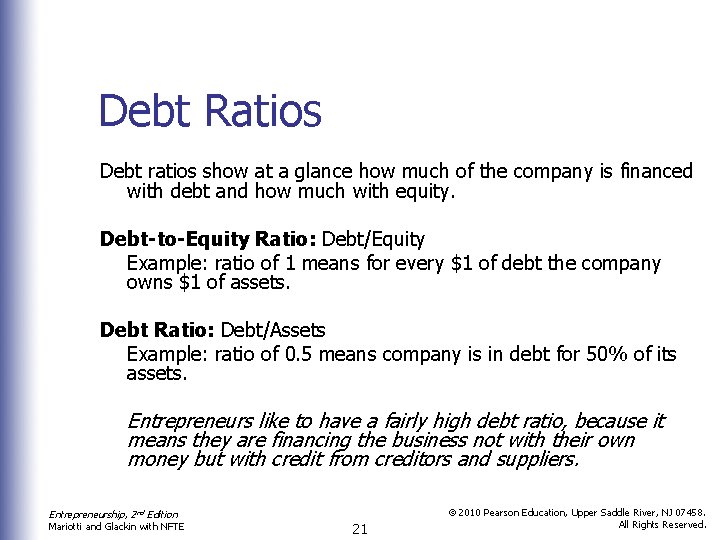
Debt Ratios Debt ratios show at a glance how much of the company is financed with debt and how much with equity. Debt-to-Equity Ratio: Debt/Equity Example: ratio of 1 means for every $1 of debt the company owns $1 of assets. Debt Ratio: Debt/Assets Example: ratio of 0. 5 means company is in debt for 50% of its assets. Entrepreneurs like to have a fairly high debt ratio, because it means they are financing the business not with their own money but with credit from creditors and suppliers. Entrepreneurship, 2 nd Edition Mariotti and Glackin with NFTE 21 © 2010 Pearson Education, Upper Saddle River, NJ 07458. All Rights Reserved.
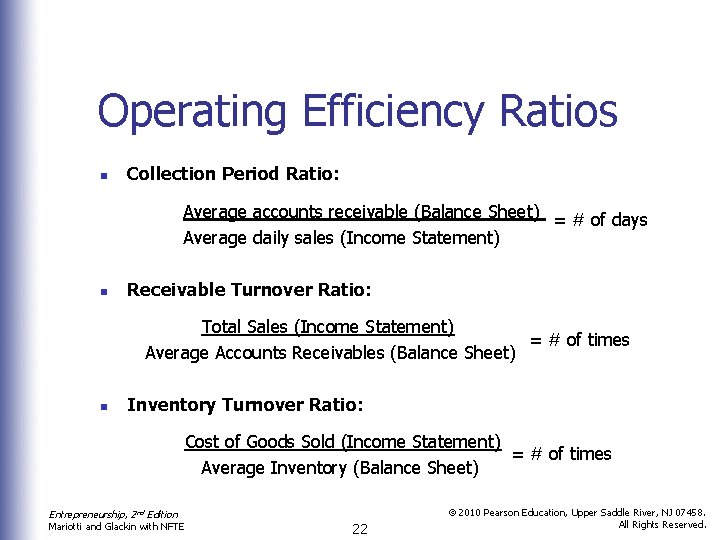
Operating Efficiency Ratios n Collection Period Ratio: Average accounts receivable (Balance Sheet) = # of days Average daily sales (Income Statement) n Receivable Turnover Ratio: Total Sales (Income Statement) = # of times Average Accounts Receivables (Balance Sheet) n Inventory Turnover Ratio: Cost of Goods Sold (Income Statement) = # of times Average Inventory (Balance Sheet) Entrepreneurship, 2 nd Edition Mariotti and Glackin with NFTE 22 © 2010 Pearson Education, Upper Saddle River, NJ 07458. All Rights Reserved.