
Entrepreneurship Business Management N 4 Module 1 The
Entrepreneurship & Business Management N 4
Module 1: The entrepreneur INTRODUCTION An entrepreneur is a person who is able to recognise an unfulfilled need in the community, and use this opportunity to start a profitable business. Success is not guaranteed (uncertainty), but an entrepreneur is prepared to take the risk. www. futuremanagers. com
Module 1: The entrepreneur (continued) ADVANTAGES AND DISADVANTAGES OF ENTREPRENEURSHIP The advantages: The disadvantages and reason for failure: • You reach your full potential; • Management incompetence; • You reap profits; • Inexperience; • You contribute to society and are • Bad financial control; and recognised for your efforts; and • Change in the business environment. • You gain control over your own destiny. www. futuremanagers. com
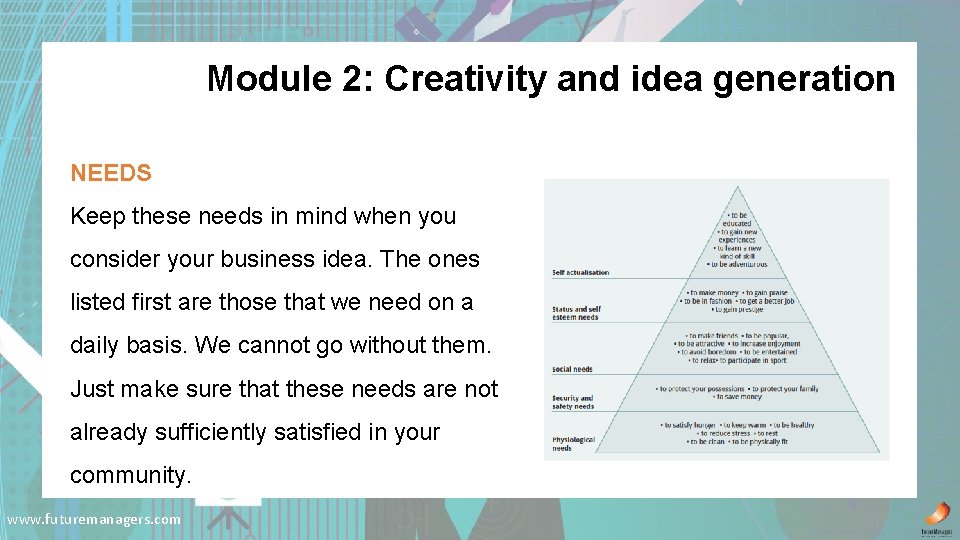
Module 2: Creativity and idea generation NEEDS Keep these needs in mind when you consider your business idea. The ones listed first are those that we need on a daily basis. We cannot go without them. Just make sure that these needs are not already sufficiently satisfied in your community. www. futuremanagers. com
Module 2: Creativity and idea generation (continued) INNOVATION AND CREATIVITY Creativity is that ability that helps us to do something new, original and different. Creativity also refers to the ability to do the same old thing in a new way. An entrepreneur knows the art of being on the look-out, listening to what people say and then doing something about it. www. futuremanagers. com
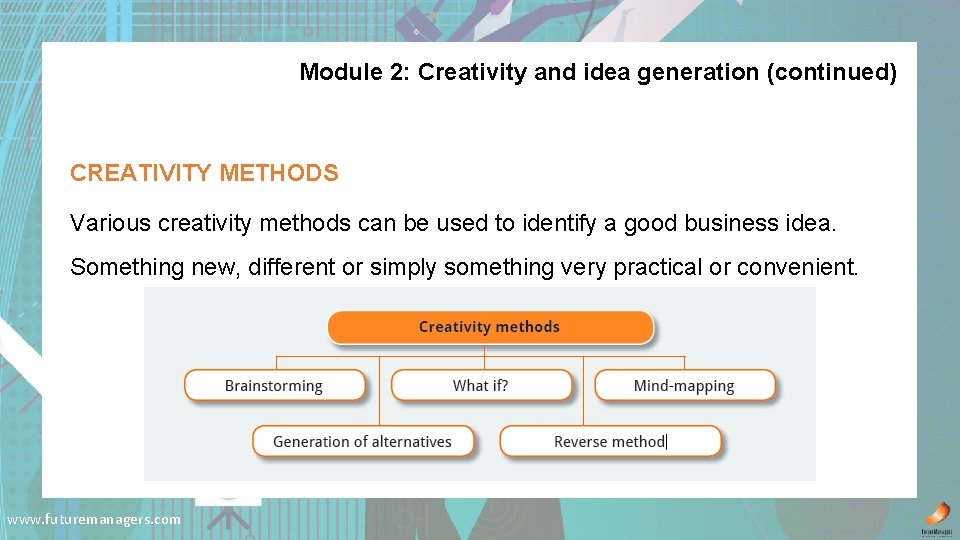
Module 2: Creativity and idea generation (continued) CREATIVITY METHODS Various creativity methods can be used to identify a good business idea. Something new, different or simply something very practical or convenient. www. futuremanagers. com
Module 2: Creativity and idea generation (continued) IS IT A GOOD BUSINESS IDEA? 1. Do I have any knowledge or skills relevant to this idea? 2. Which business contacts can I use? (name them) 3. Will I be able to get enough money together to start this? (How? ) 4. What is/are the critical success factor(s) for this idea? 5. In what way do I meet these requirements? 6. How can I overcome them? (if you don’t meet them) 7. Will I make a profit from this idea? www. futuremanagers. com
Module 2: Creativity and idea generation (continued) PROTECTING YOUR IDEAS It is possible to protect your idea but it is neither easy nor cheap. This can be done by using the following: • Secrecy; • Patents; • Trademarks; and • Copyrights. www. futuremanagers. com
Module 2: Creativity and idea generation (continued) COMPILE A PERSONAL SWOT ANALYSIS SWOT is the acronym for: Strengths, Weaknesses, Opportunities and Threat. Compiling a personal list of these attributes is critical for the success of any entrepreneur's business. Draw up a list of each of these characteristics and how they could impact your business. www. futuremanagers. com
Module 3: Market feasibility study INTRODUCTION It is important for an entrepreneur to try to determine before building a business whether a market exists or not. Before starting out, a sales forecast is needed for the following reasons: • Determine whether your future business can make a profit; • Plan your purchases that are needed given your sales forecast; and • Calculate the finance needed for your business www. futuremanagers. com
Module 3: Market feasibility study (continued) MARKET FEASIBILITY STUDY A market feasibility study involves the following four components namely: • Product description; • Market position; • Market information; and • SWOT analysis www. futuremanagers. com
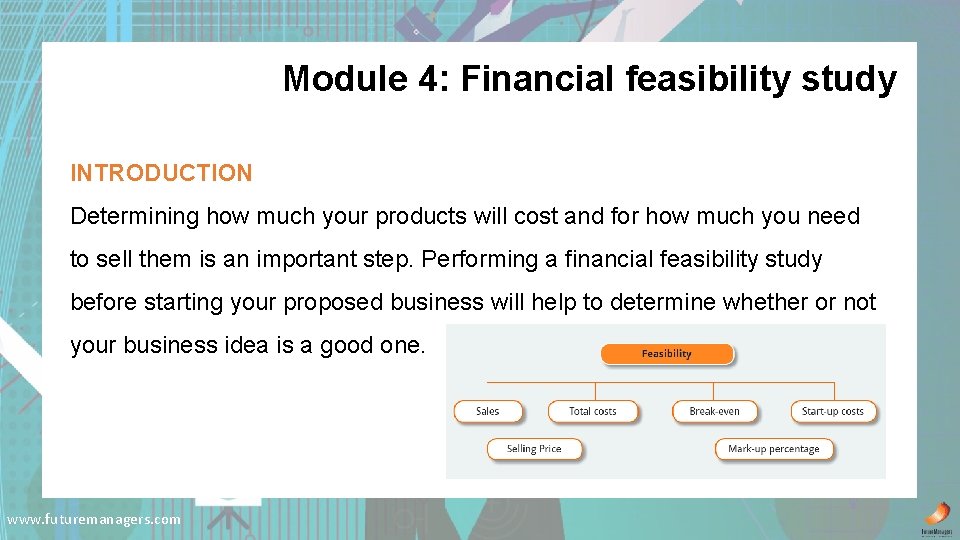
Module 4: Financial feasibility study INTRODUCTION Determining how much your products will cost and for how much you need to sell them is an important step. Performing a financial feasibility study before starting your proposed business will help to determine whether or not your business idea is a good one. www. futuremanagers. com
Module 4: Financial feasibility study (continued) FINANCIAL TERMINOLOGY The financial terminology to consider includes terms such as: • Sales; • Gross profit percentage; • Costs; • Net profit percentage; • Selling price; • Weighted average gross profit percentage; and • Profit; • Break-even point. www. futuremanagers. com
Module 4: Financial feasibility study (continued) START-UP COSTS Your start-up costs can be divided into two categories: • Fixed assets; and • Pre-operating costs. www. futuremanagers. com
Module 4: Financial feasibility study (continued) METHODS OF FINANCING YOUR BUSINESS There are different ways of financing your business. These can include sources from: • Own funding; • Loans; • Leases; • Hire purchasing; and • Trade credit. www. futuremanagers. com
Module 4: Financial feasibility study (continued) SALE FORECASTING AND SALE SCENARIOS Certain factors might influence your sales forecast. In other words, you predict future possibilities. Possibilities that might influence your sales are: • Cost price of your product or service; • Whether you have costed your product correctly; • Suppliers; • Competition; and • Selling price. www. futuremanagers. com
Module 5: The business plan – completing the business plan THE BUSINESS PLAN A business plan is your first step in starting a business. It is a creative process; you are planning your future business. The first part is to put your business ideas or dreams on paper. The second part is to change a business idea into a business plan and in doing so move a step closer to making your dreams a reality. www. futuremanagers. com
Module 5: The business plan – completing the business plan (continued) BUSINESS PLAN QUESTIONS Asking the right questions help make decision about a business idea. These questions can include: 1. How can you describe the business? 2. What is your product, or service? 3. Who will buy it? 4. Where should you locate the business? 5. How can you attract customers? www. futuremanagers. com
Module 6: The marketing plan PRODUCT A product is an item, tangible or intangible that has the potential to satisfy customer needs. The concept “products” therefore includes services provided by some businesses. www. futuremanagers. com
Module 6: The marketing plan (continued) PRICING A PRODUCT The following different factors must be taken into consideration when determining the selling price of your products: • Your target market; • Competitors; • Convenience; • Costing; and • Break-even point. www. futuremanagers. com
Module 6: The marketing plan (continued) PROMOTION Promotion is the process of informing your potential customers about your products and why they should buy them (benefits). It is often seen as the creative, visual and fun part of marketing. www. futuremanagers. com
Module 6: The marketing plan (continued) PLACE IS THE FOURTH “P” OF THE MARKETING MIX The success of certain types of businesses depends to a large extent on where they are situated. Convenience is a very important consideration for most customers. Choosing the place from where you are going to provide your service, sell your products or manufacture them is very important. www. futuremanagers. com
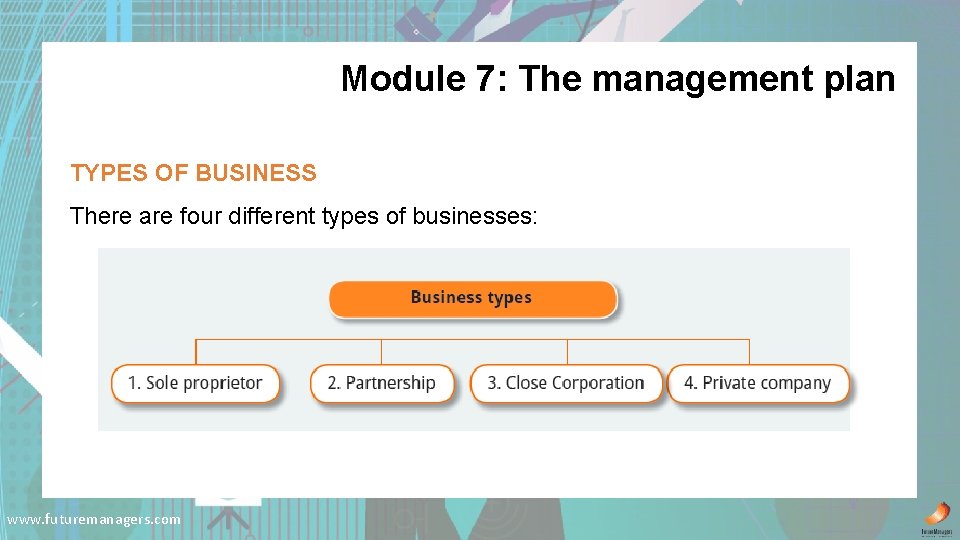
Module 7: The management plan TYPES OF BUSINESS There are four different types of businesses: www. futuremanagers. com
Module 7: The management plan (continued) LEGAL FORMALITIES WHEN ESTABLISHING YOUR BUSINESS There are different laws that need to be considered when it comes to the different types of businesses. In order to find out about the different formalities, approach your local authority. www. futuremanagers. com
Module 7: The management plan (continued) OWN INVOLVEMENT Starting a business implies that a person owns the business. With that comes the responsibility to make a success of it. The responsibility includes: • Managing people in your business; • Dealing with your business environment in a socially responsible way; and • Making a profit www. futuremanagers. com
Module 7: The management plan (continued) PERSONNEL AND THEIR RESPONSIBILITIES Human resources are the most important resources in a small business. It’s the workers who determine how well everything in your business is being done. Managing the people in your business well is very important while recruiting the right type of people is just as important. www. futuremanagers. com
Module 7: The management plan (continued) OPERATING PLAN The operating end of a business is where resources are transformed into goods and services. A plan must be put in place in order to ensure operations run smoothly. This includes: • Supplier analysis; • Selecting the right supplier; and • Finding the suppliers. www. futuremanagers. com
Module 7: The management plan (continued) OFFICE ADMINISTRATION Office administration includes certain aspects of ‘behind-the-scenes’ work such as: • Keeping financial records; and • Filing equipment and methods. www. futuremanagers. com
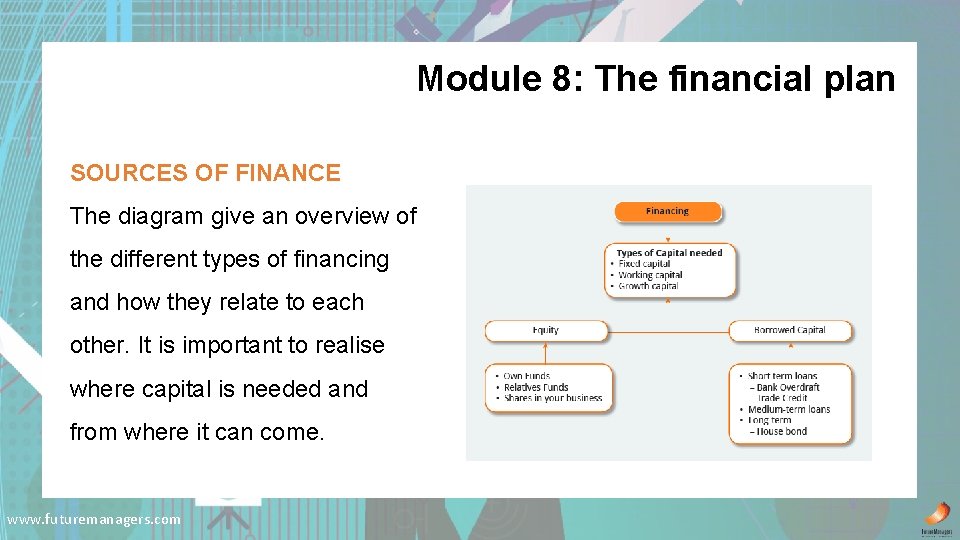
Module 8: The financial plan SOURCES OF FINANCE The diagram give an overview of the different types of financing and how they relate to each other. It is important to realise where capital is needed and from where it can come. www. futuremanagers. com
Module 8: The financial plan (continued) FINANCIAL MANAGEMENT The “Financial Management Plan” is often compared with a map. It tells you how to get to your destination. Your financial management system will also assist you in arriving at your destination. Your business’s chances of success will be much higher provided you keep adequate financial records. www. futuremanagers. com
Module 8: The financial plan (continued) OWNERS’ EQUITY These are amounts invested in the business by the owners or, they are accumulated profits from previous years. www. futuremanagers. com
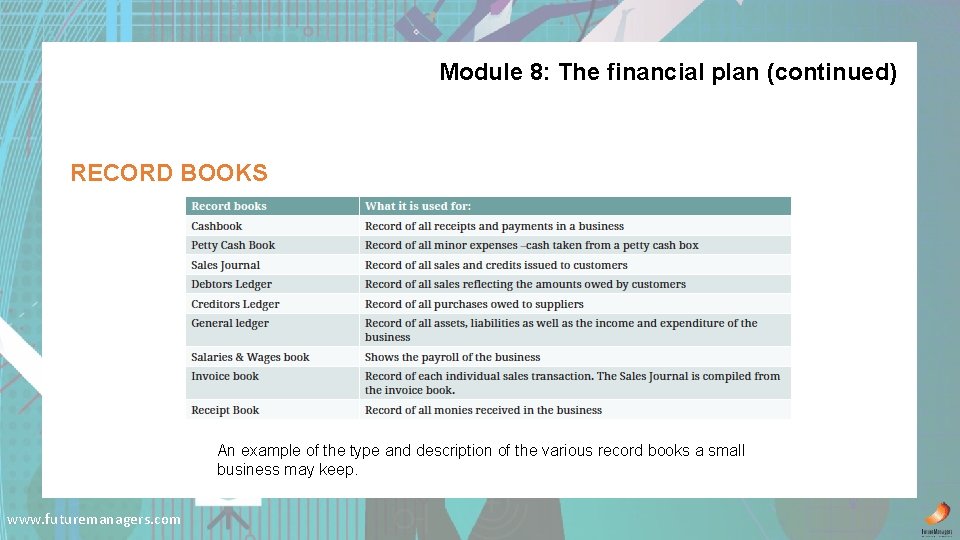
Module 8: The financial plan (continued) RECORD BOOKS An example of the type and description of the various record books a small business may keep. www. futuremanagers. com
Module 8: The financial plan (continued) FINANCIAL STATEMENTS There are different types of financial statements to consider. These include: • Income statements; • Budgets; and • Cash-flow statements. www. futuremanagers. com
Module 8: The financial plan (continued) LOAN REQUIREMENTS In order to determine your loan requirements you need to calculate the following: • Total start-up requirements; • Your own contribution to the business; and • Securities that you can offer as collateral for a possible loan. www. futuremanagers. com
- Slides: 34