
Entity vs Aggregate Treatment Entity PSH treated as
- Slides: 17
Entity vs. Aggregate Treatment • Entity: PSH treated as an entity separate from its Ps Ø Ø • Ps have a basis in their PSH interests; PSH has separate basis in PSH property PSH calculates PSH items Ps and PSH may have separate MOA and TYs Sale of PSH interest generally treated as sale of capital asset Aggregate: Ps treated as owning undivided interests in PSH property Ø Ø PSH_Formation_15 Ps report their separate share of PSH items Distributions of cash tax free to the extent of a P’s basis in his PSH interest Distributions and contributions of property generally tax free to PSH and Ps Sale of PSH interest that has unrealized receivables or inventory is treated partially as OI 1
Partnership Contributions • No G/L to PSH or Ps upon the transfer of property to a PSH by a person in exchange for a PSH interest (except for certain transfers to investment PSHs). (§ 721(a)) ØCompare sections 351(a) and 368(c) • P’s basis in its PSH interest (Outside basis) is the sum of the money and AB basis of property contributed, plus any gain recognized under section 721(b). (§ 722) ØPs have unitary bases in their PSH interests. (Rev. Rul. 84 -53); Compare shareholders’ basis in shares • PSH’s basis in the property contributed (Inside basis) is the same as the AB of the property in the hands of the contributor, plus any gain recognized under section 721(b). (§ 723) PSH_Formation_15 2
Contributions of “Property” • Section 721 does not apply to the transfer of services to a PSH in exchange for a capital interest in a PSH: Ø • “To the extent that any of the partners gives up any part of his right to be repaid his contributions (as distinguished from a share in partnership profits) in favor of another partner as compensation for services. . . , section 721 does not apply. The value of an interest in such partnership. . . constitutes income to the partner under section 61. ” (§ 1. 721 -1(b)) Property for purposes of section 721 is expansively defined (see also section 351) Ø Ø Stafford v. U. S. (unenforceable letter of intent) Oden v. CIR (personal note); Vision. Monitor Software v. CIR, T. C. Memo. 2014 -182 (2014) (same) PSH_Formation_15 3
Capital and Profits Interests • Capital Interest: an interest that gives the holder a share of the proceeds if the PSH's assets were sold at FMV and then the proceeds were distributed in a complete liquidation of the PSH. This determination generally is made at the time of receipt of the PSH interest. See § 1. 704 -1(e)(1)(v). • Profits Interest: a PSH interest other than a capital interest. Rev. Proc. 93 -27. PSH_Formation_15 4
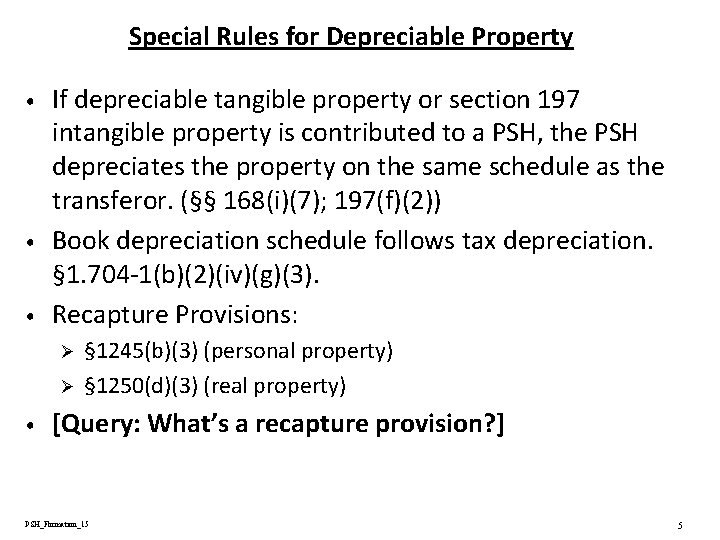
Special Rules for Depreciable Property • • • If depreciable tangible property or section 197 intangible property is contributed to a PSH, the PSH depreciates the property on the same schedule as the transferor. (§§ 168(i)(7); 197(f)(2)) Book depreciation schedule follows tax depreciation. § 1. 704 -1(b)(2)(iv)(g)(3). Recapture Provisions: Ø Ø • § 1245(b)(3) (personal property) § 1250(d)(3) (real property) [Query: What’s a recapture provision? ] PSH_Formation_15 5
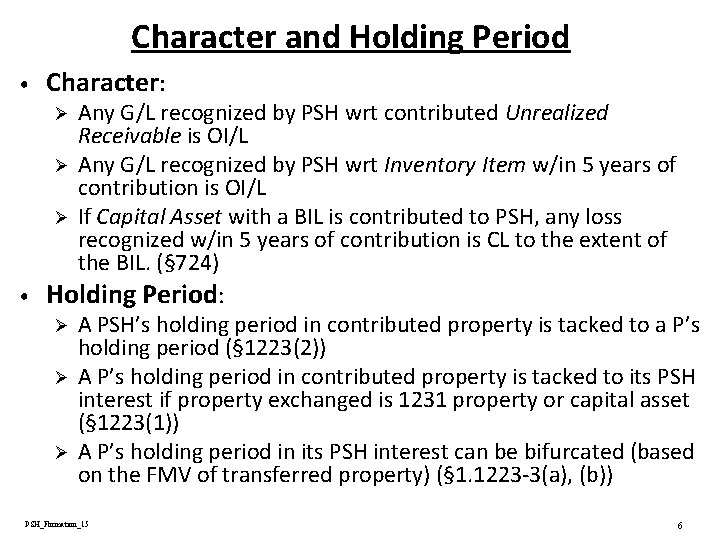
Character and Holding Period • Character: Any G/L recognized by PSH wrt contributed Unrealized Receivable is OI/L Ø Any G/L recognized by PSH wrt Inventory Item w/in 5 years of contribution is OI/L Ø If Capital Asset with a BIL is contributed to PSH, any loss recognized w/in 5 years of contribution is CL to the extent of the BIL. (§ 724) • Holding Period: Ø A PSH’s holding period in contributed property is tacked to a P’s holding period (§ 1223(2)) Ø A P’s holding period in contributed property is tacked to its PSH interest if property exchanged is 1231 property or capital asset (§ 1223(1)) Ø A P’s holding period in its PSH interest can be bifurcated (based on the FMV of transferred property) (§ 1. 1223 -3(a), (b)) Ø PSH_Formation_15 6
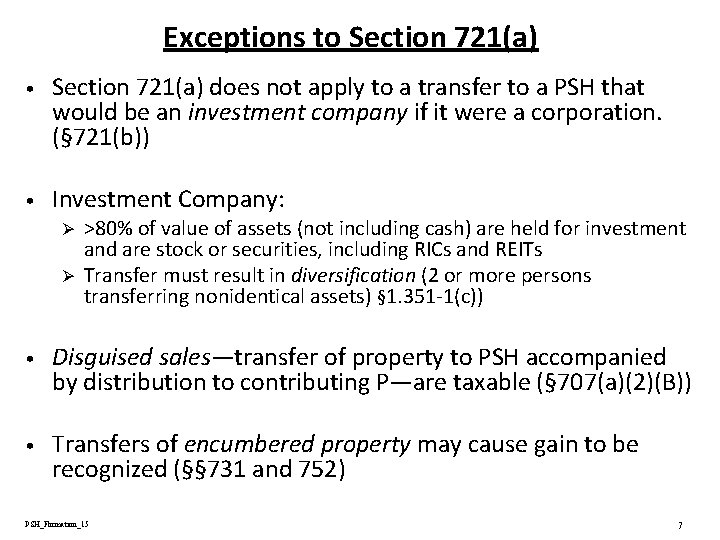
Exceptions to Section 721(a) • Section 721(a) does not apply to a transfer to a PSH that would be an investment company if it were a corporation. (§ 721(b)) • Investment Company: Ø Ø >80% of value of assets (not including cash) are held for investment and are stock or securities, including RICs and REITs Transfer must result in diversification (2 or more persons transferring nonidentical assets) § 1. 351 -1(c)) • Disguised sales—transfer of property to PSH accompanied by distribution to contributing P—are taxable (§ 707(a)(2)(B)) • Transfers of encumbered property may cause gain to be recognized (§§ 731 and 752) PSH_Formation_15 7
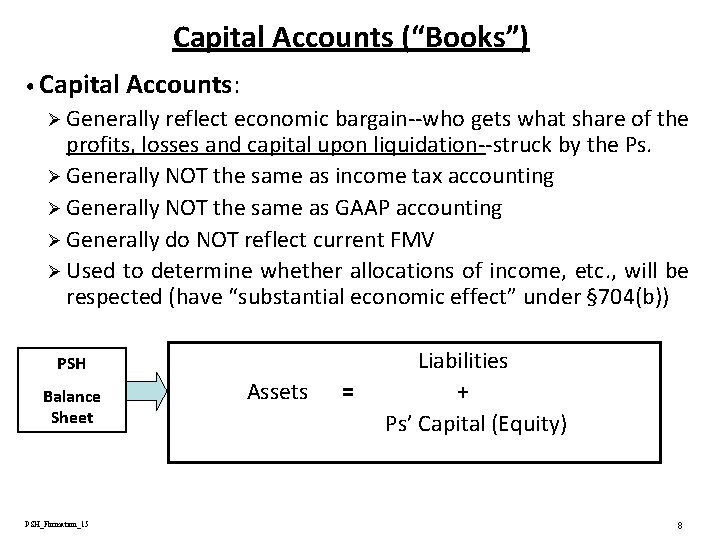
Capital Accounts (“Books”) • Capital Accounts: Ø Generally reflect economic bargain--who gets what share of the profits, losses and capital upon liquidation--struck by the Ps. Ø Generally NOT the same as income tax accounting Ø Generally NOT the same as GAAP accounting Ø Generally do NOT reflect current FMV Ø Used to determine whether allocations of income, etc. , will be respected (have “substantial economic effect” under § 704(b)) PSH Balance Sheet PSH_Formation_15 Assets = Liabilities + Ps’ Capital (Equity) 8
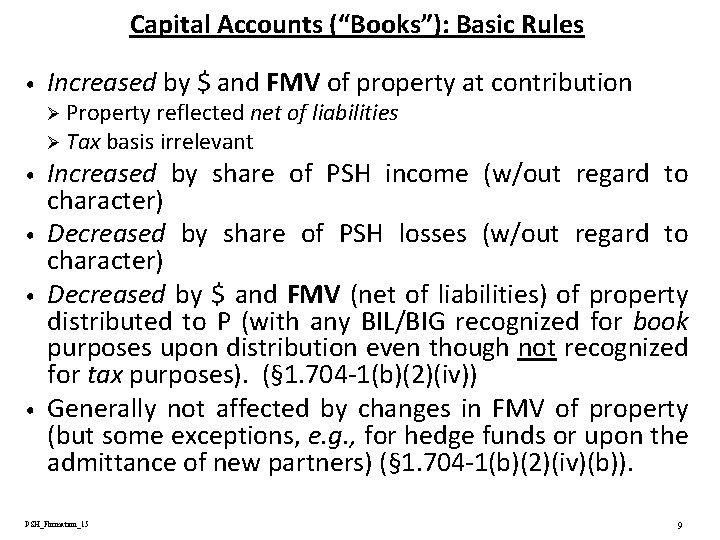
Capital Accounts (“Books”): Basic Rules • Increased by $ and FMV of property at contribution Ø Property reflected net of liabilities Ø Tax basis irrelevant • • Increased by share of PSH income (w/out regard to character) Decreased by share of PSH losses (w/out regard to character) Decreased by $ and FMV (net of liabilities) of property distributed to P (with any BIL/BIG recognized for book purposes upon distribution even though not recognized for tax purposes). (§ 1. 704 -1(b)(2)(iv)) Generally not affected by changes in FMV of property (but some exceptions, e. g. , for hedge funds or upon the admittance of new partners) (§ 1. 704 -1(b)(2)(iv)(b)). PSH_Formation_15 9
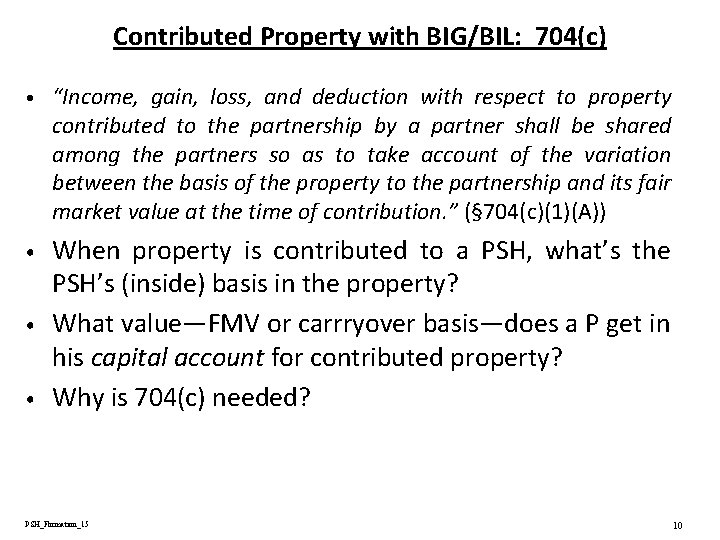
Contributed Property with BIG/BIL: 704(c) • “Income, gain, loss, and deduction with respect to property contributed to the partnership by a partner shall be shared among the partners so as to take account of the variation between the basis of the property to the partnership and its fair market value at the time of contribution. ” (§ 704(c)(1)(A)) • When property is contributed to a PSH, what’s the PSH’s (inside) basis in the property? What value—FMV or carrryover basis—does a P get in his capital account for contributed property? Why is 704(c) needed? • • PSH_Formation_15 10
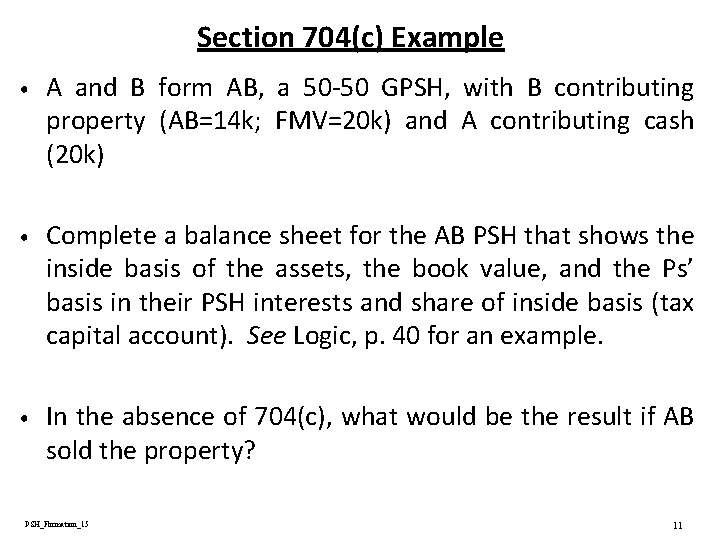
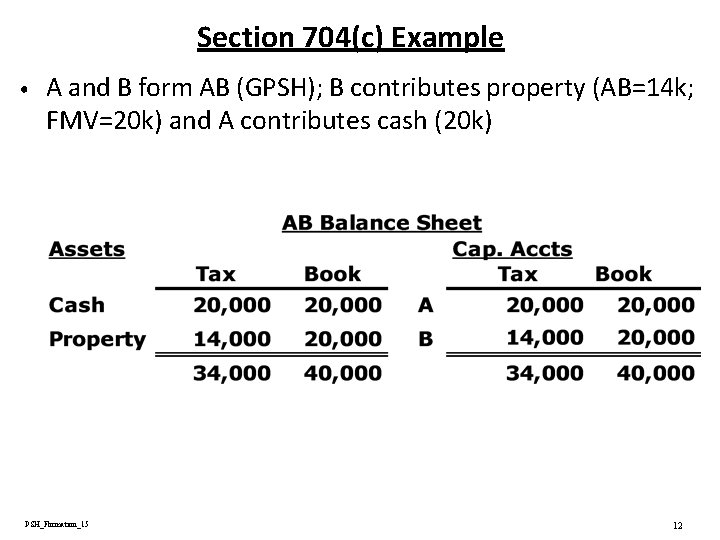
Section 704(c) Example • A and B form AB, a 50 -50 GPSH, with B contributing property (AB=14 k; FMV=20 k) and A contributing cash (20 k) • Complete a balance sheet for the AB PSH that shows the inside basis of the assets, the book value, and the Ps’ basis in their PSH interests and share of inside basis (tax capital account). See Logic, p. 40 for an example. • In the absence of 704(c), what would be the result if AB sold the property? PSH_Formation_15 11
Section 704(c) Example • A and B form AB (GPSH); B contributes property (AB=14 k; FMV=20 k) and A contributes cash (20 k) PSH_Formation_15 12
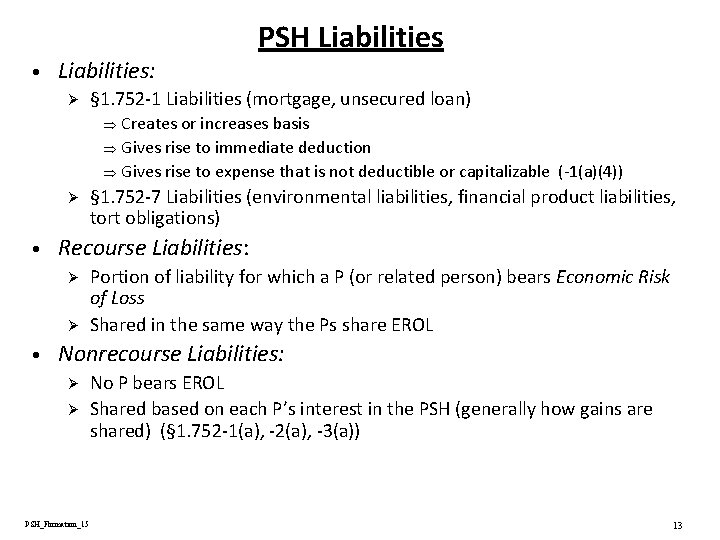
• Liabilities: Ø PSH Liabilities § 1. 752 -1 Liabilities (mortgage, unsecured loan) Creates or increases basis Þ Gives rise to immediate deduction Þ Gives rise to expense that is not deductible or capitalizable (-1(a)(4)) Þ Ø • Recourse Liabilities: Ø Ø • § 1. 752 -7 Liabilities (environmental liabilities, financial product liabilities, tort obligations) Portion of liability for which a P (or related person) bears Economic Risk of Loss Shared in the same way the Ps share EROL Nonrecourse Liabilities: Ø Ø PSH_Formation_15 No P bears EROL Shared based on each P’s interest in the PSH (generally how gains are shared) (§ 1. 752 -1(a), -2(a), -3(a)) 13
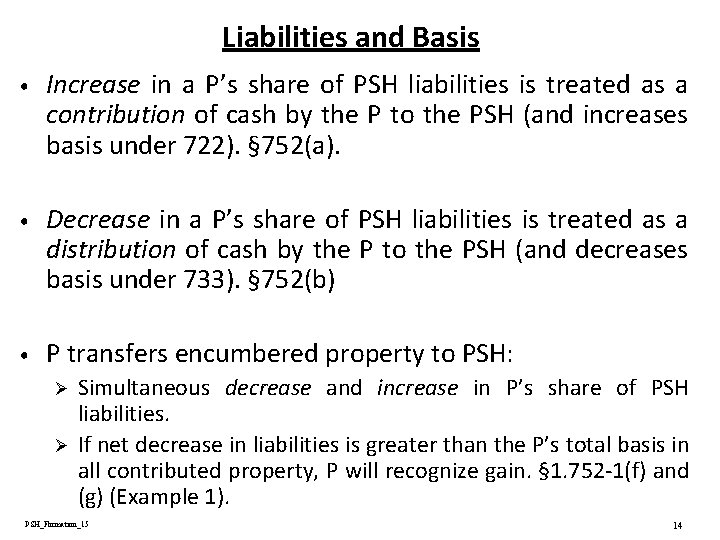
Liabilities and Basis • Increase in a P’s share of PSH liabilities is treated as a contribution of cash by the P to the PSH (and increases basis under 722). § 752(a). • Decrease in a P’s share of PSH liabilities is treated as a distribution of cash by the P to the PSH (and decreases basis under 733). § 752(b) • P transfers encumbered property to PSH: Ø Ø Simultaneous decrease and increase in P’s share of PSH liabilities. If net decrease in liabilities is greater than the P’s total basis in all contributed property, P will recognize gain. § 1. 752 -1(f) and (g) (Example 1). PSH_Formation_15 14
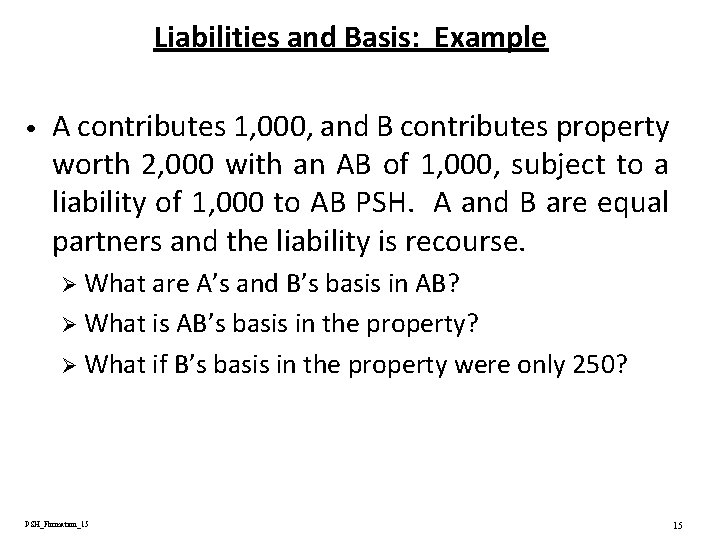
Liabilities and Basis: Example • A contributes 1, 000, and B contributes property worth 2, 000 with an AB of 1, 000, subject to a liability of 1, 000 to AB PSH. A and B are equal partners and the liability is recourse. Ø What are A’s and B’s basis in AB? Ø What is AB’s basis in the property? Ø What if B’s basis in the property were only 250? PSH_Formation_15 15
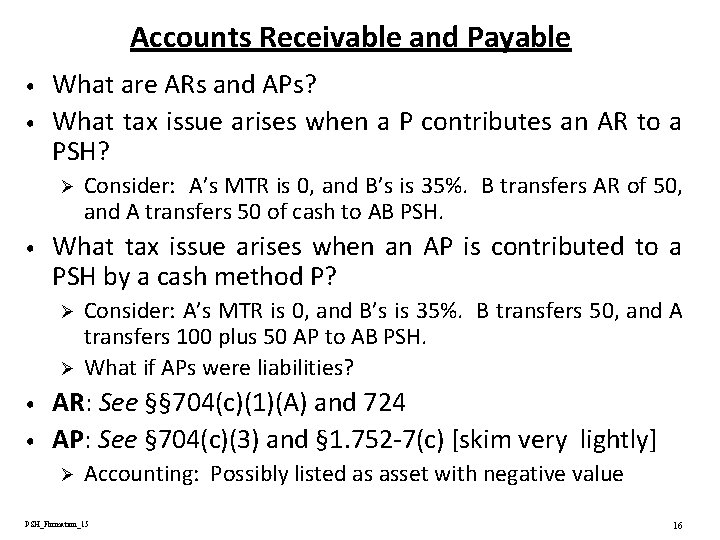
Accounts Receivable and Payable • • What are ARs and APs? What tax issue arises when a P contributes an AR to a PSH? Ø • What tax issue arises when an AP is contributed to a PSH by a cash method P? Ø Ø • • Consider: A’s MTR is 0, and B’s is 35%. B transfers AR of 50, and A transfers 50 of cash to AB PSH. Consider: A’s MTR is 0, and B’s is 35%. B transfers 50, and A transfers 100 plus 50 AP to AB PSH. What if APs were liabilities? AR: See §§ 704(c)(1)(A) and 724 AP: See § 704(c)(3) and § 1. 752 -7(c) [skim very lightly] Ø Accounting: Possibly listed as asset with negative value PSH_Formation_15 16
Organization and Syndication Expenses • PSH can elect to amortize PSH organizational expenses over 15 years. Ø Ø Ø • Incident to creation of PSH Chargeable to capital account Of a character which, if expended incident to the creation of a PSH having an ascertainable life, would be amortized over such life. Examples: legal fees for negotiation and preparation of PSH agreement, and filing fees. Not OEs: acquiring assets for PSH or administration or removal of Ps. § 1. 709 -2(a). Syndication expenses are nondeductible. § 709(a) and (b). Ø Brokerage fees, legal fees for securities advice and for advice pertaining to adequacy of tax disclosures in the prospectus or placement memo; printing costs of prospectus. § 1. 709 -2(b). PSH_Formation_15 17