
Entity Relationship ER Model in DBMS Presented By
Entity Relationship (ER) Model in DBMS Presented By Rubel Sheikh rubel. cse@diu. edu. bd
Learning Outcome Data Model Entity Relationship Model? Symbols for Entity Type Relationship Type and Relationship Set
Data Model: an abstraction of a real-world object or event Useful in understanding complexities of the real-world environment Data model A diagram that displays a set of tables and the relationships between them
Importance of Data Model Blue print: official documentation Blue print of house Employee’s w/o DB knowledge can understand a data model diagram vs. a list of tables Used as an effective Communication Tool Improve interaction among the managers, the designers, and the end users Independence from a particular DBMS Network DB, Object-oriented DB, etc.

Steps in developing a Database Requirements analysis → Conceptual Database design → Logical Database design → Schema refinement → Physical Database design Applications and security
Conceptual design: (ER Model is used at this stage. ) The ER data mode was developed to facilitate database design by allowing specification of an enterprise schema that represents the overall logical structure of a database. The ER data model employs three basic concepts: entity sets, relationship sets, attributes. The ER model also has an associated diagrammatic representation, the ER diagram, which can express the overall logical structure of a database graphically.
ERD is a data modeling technique used in software engineering to produce a conceptual data model of an information system. So, ERDs illustrate the logical structure of databases.
How to find entities? Entity: ". . . anything (people, places, objects, events, etc. ) about which we store information (e. g. supplier, machine tool, employee, utility pole, airline seat, etc. ). ” Tangible: customer, product Intangible: order, accounting receivable Look for singular nouns (beginner) BUT a proper noun is not a good candidate…. 8
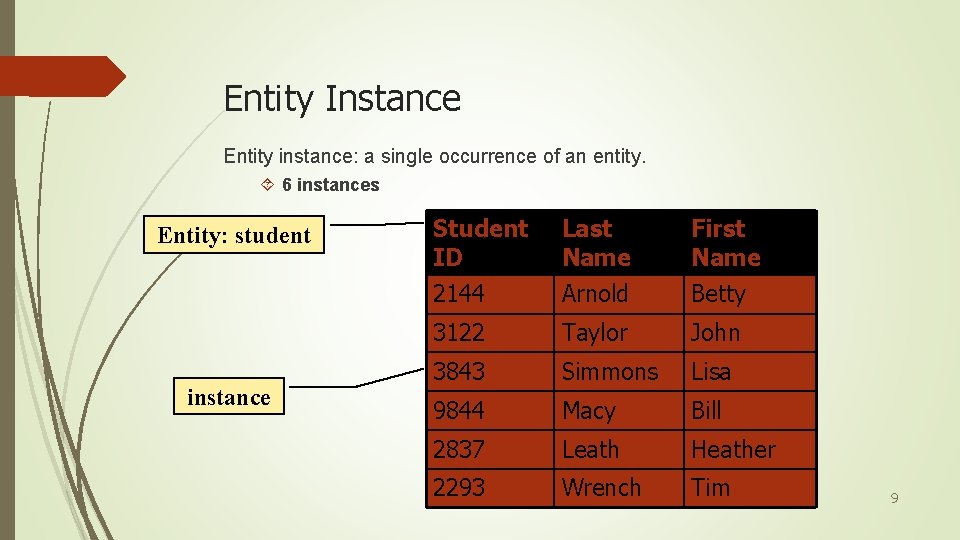
Entity Instance Entity instance: a single occurrence of an entity. 6 instances Entity: student instance Student ID 2144 Last Name Arnold First Name Betty 3122 Taylor John 3843 Simmons Lisa 9844 Macy Bill 2837 Leath Heather 2293 Wrench Tim 9
How to find attributes? Attribute: Attributes are data objects that either identify or describe entities (property of an entity). In other words, it is a descriptor whose values are associated with individual entities of a specific entity type The process for identifying attributes is similar except now you want to look for and extract those names that appear to be descriptive noun phrases. 10
How to find relationships? Relationship: Relationships are associations between entities. Typically, a relationship is indicated by a verb connecting two or more entities. Employees are assigned to projects Relationships should be classified in terms of cardinality. One-to-one, one-to-many, etc. 11

How to find cardinalities? Cardinality: The cardinality is the number of occurrences in one entity which are associated to the number of occurrences in another. There are three basic cardinalities (degrees of relationship). one-to-one (1: 1), one-to-many (1: M), and many-tomany (M: N) 12
Identifier “attributes that uniquely identify entity instances” Becomes a PK in RDS Composite identifiers are identifiers that consist of two or more attributes Identifiers are represented by underlying the name of the attribute(s) Employee (Employee_ID), student (Student_ID) 13
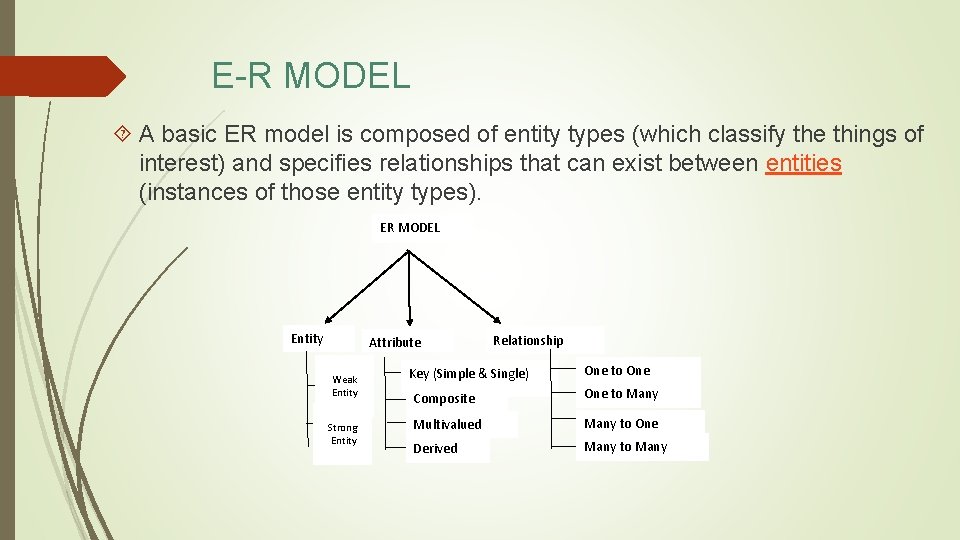
E-R MODEL A basic ER model is composed of entity types (which classify the things of interest) and specifies relationships that can exist between entities (instances of those entity types). ER MODEL Entity Attribute Weak Entity Strong Entity Relationship Key (Simple & Single) valued) Composite One to Many Multivalued Many to One Derived Many to Many
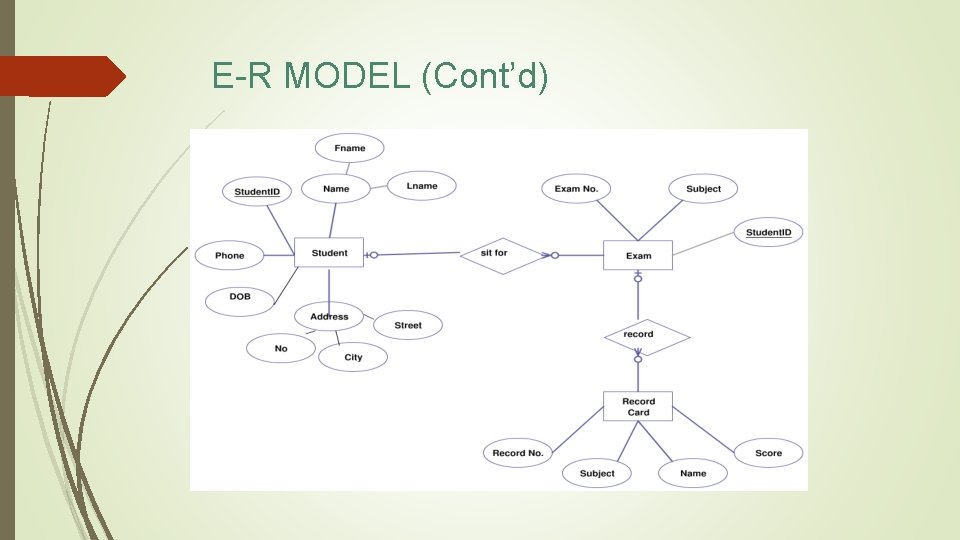
E-R MODEL (Cont’d)
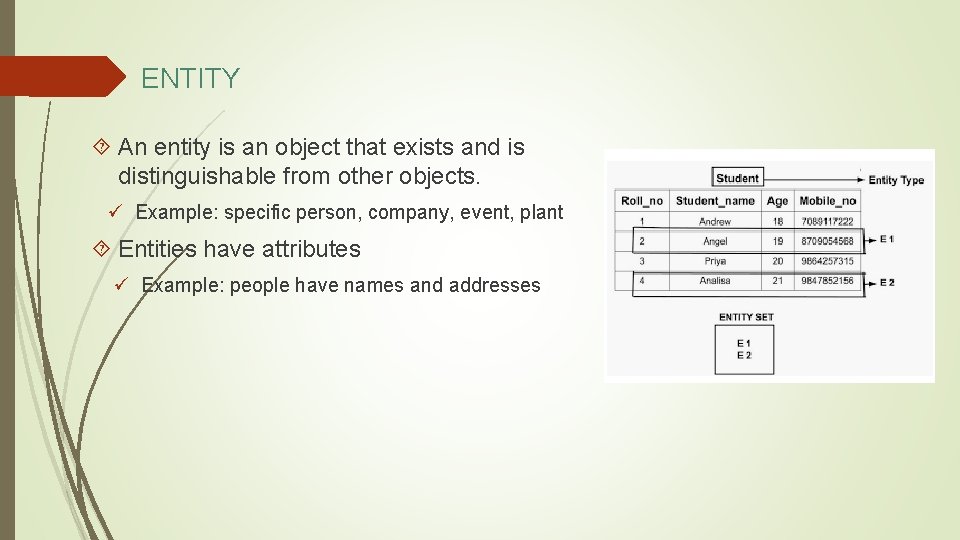
ENTITY An entity is an object that exists and is distinguishable from other objects. ü Example: specific person, company, event, plant Entities have attributes ü Example: people have names and addresses
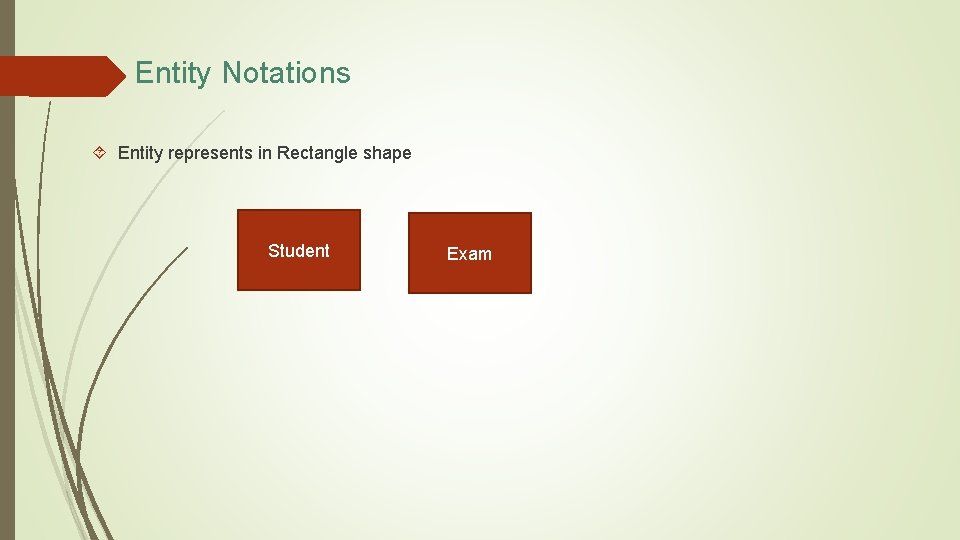
Entity Notations Entity represents in Rectangle shape Student Exam
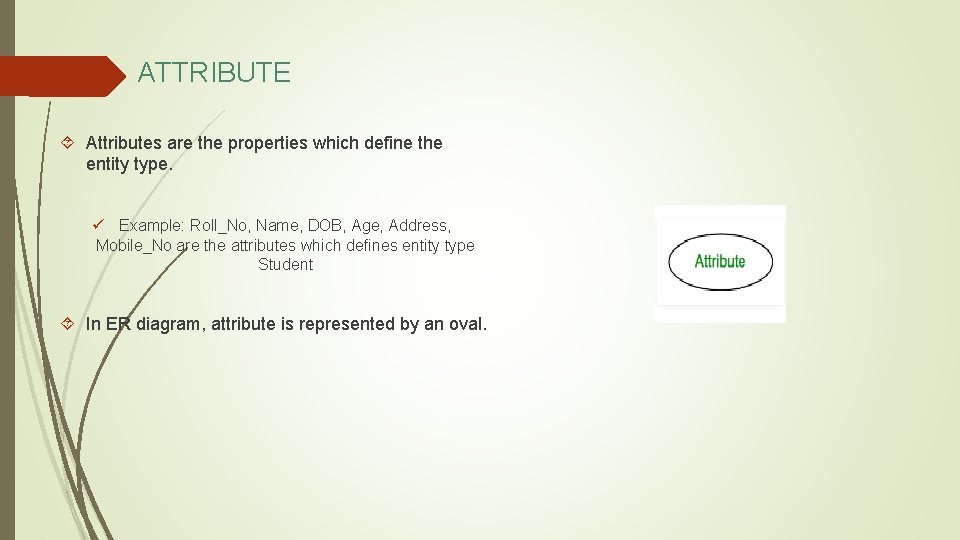
ATTRIBUTE Attributes are the properties which define the entity type. ü Example: Roll_No, Name, DOB, Age, Address, Mobile_No are the attributes which defines entity type Student In ER diagram, attribute is represented by an oval.
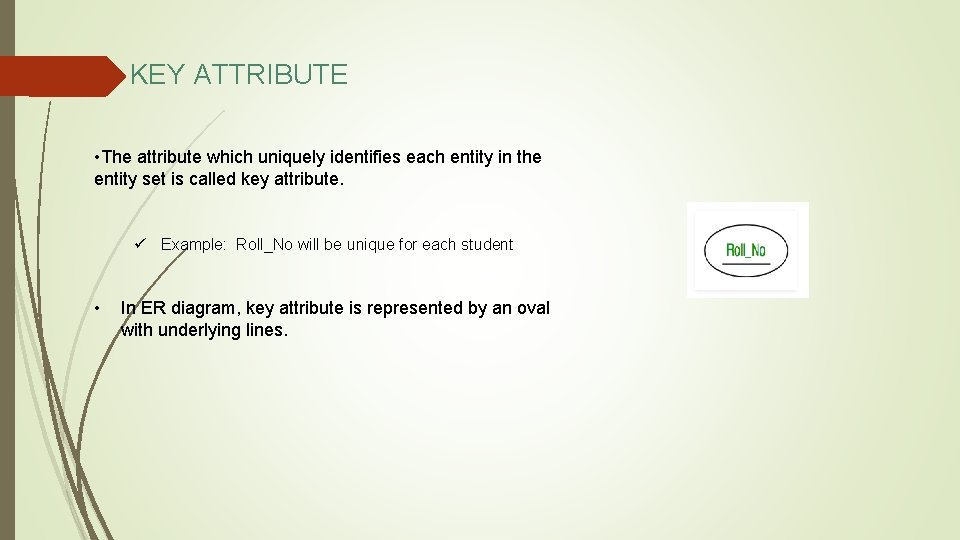
KEY ATTRIBUTE • The attribute which uniquely identifies each entity in the entity set is called key attribute. ü Example: Roll_No will be unique for each student • In ER diagram, key attribute is represented by an oval with underlying lines.
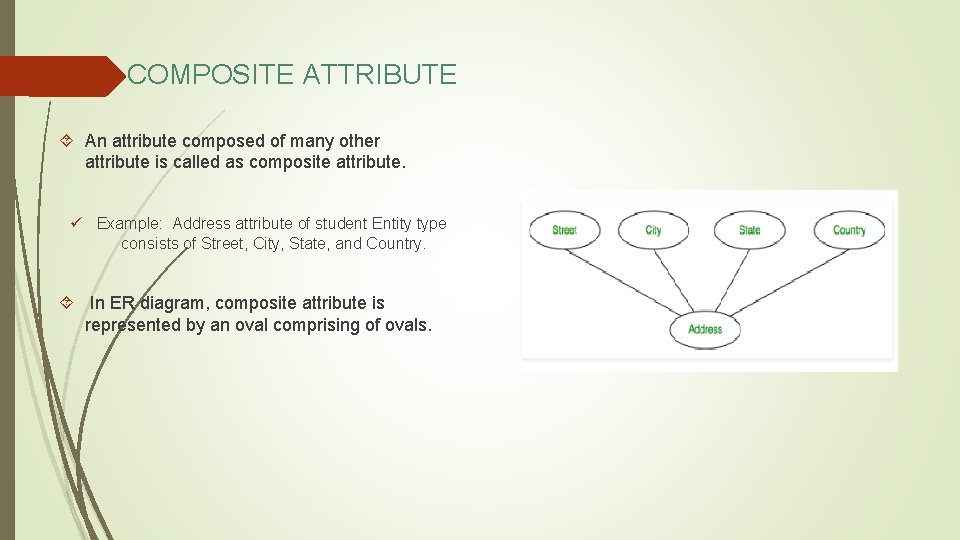
COMPOSITE ATTRIBUTE An attribute composed of many other attribute is called as composite attribute. ü Example: Address attribute of student Entity type consists of Street, City, State, and Country. In ER diagram, composite attribute is represented by an oval comprising of ovals.
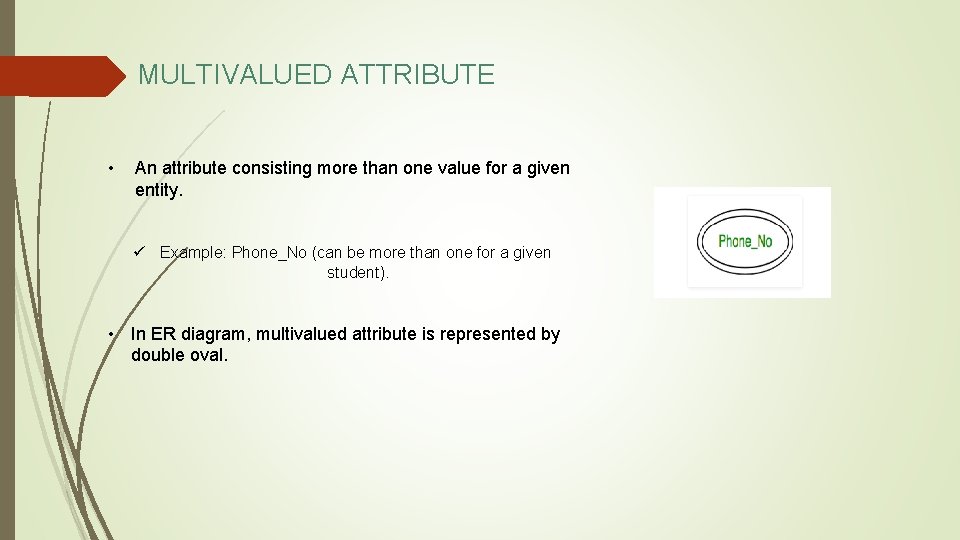
MULTIVALUED ATTRIBUTE • An attribute consisting more than one value for a given entity. ü Example: Phone_No (can be more than one for a given student). • In ER diagram, multivalued attribute is represented by double oval.
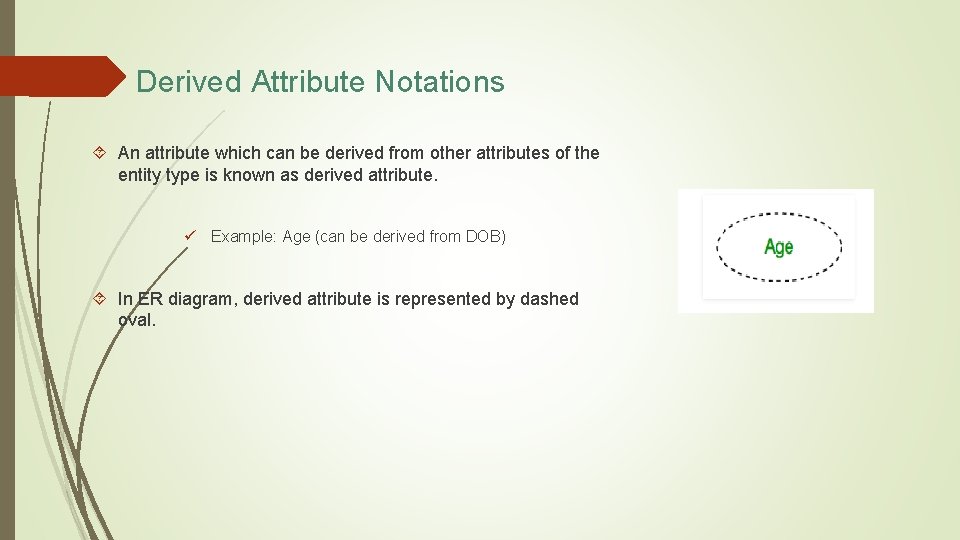
Derived Attribute Notations An attribute which can be derived from other attributes of the entity type is known as derived attribute. ü Example: Age (can be derived from DOB) In ER diagram, derived attribute is represented by dashed oval.
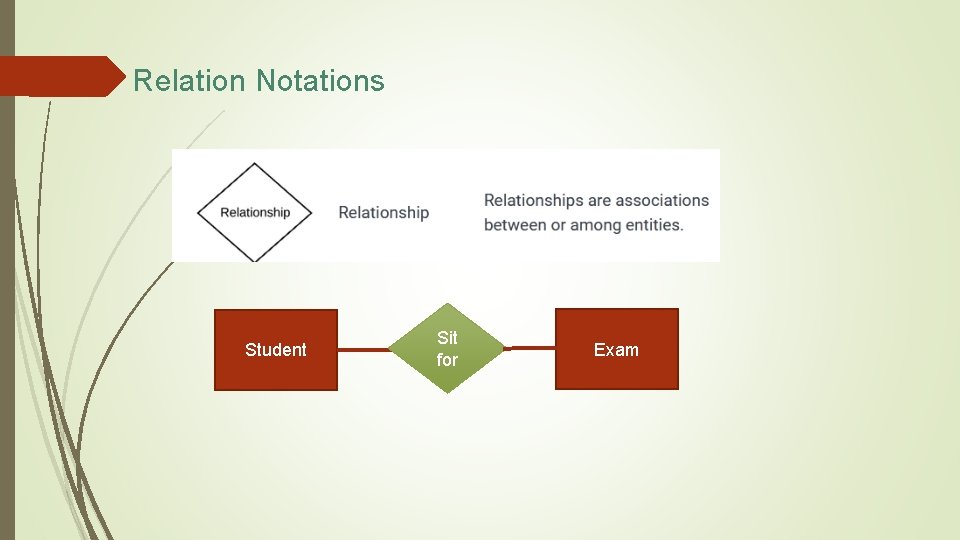
Relation Notations Student Sit for Exam
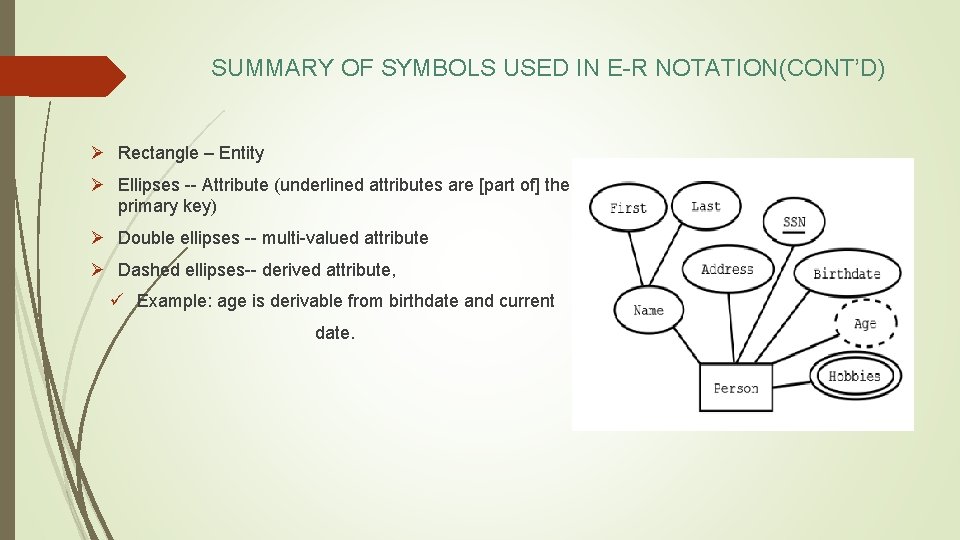
SUMMARY OF SYMBOLS USED IN E-R NOTATION(CONT’D) Ø Rectangle – Entity Ø Ellipses -- Attribute (underlined attributes are [part of] the primary key) Ø Double ellipses -- multi-valued attribute Ø Dashed ellipses-- derived attribute, ü Example: age is derivable from birthdate and current date.
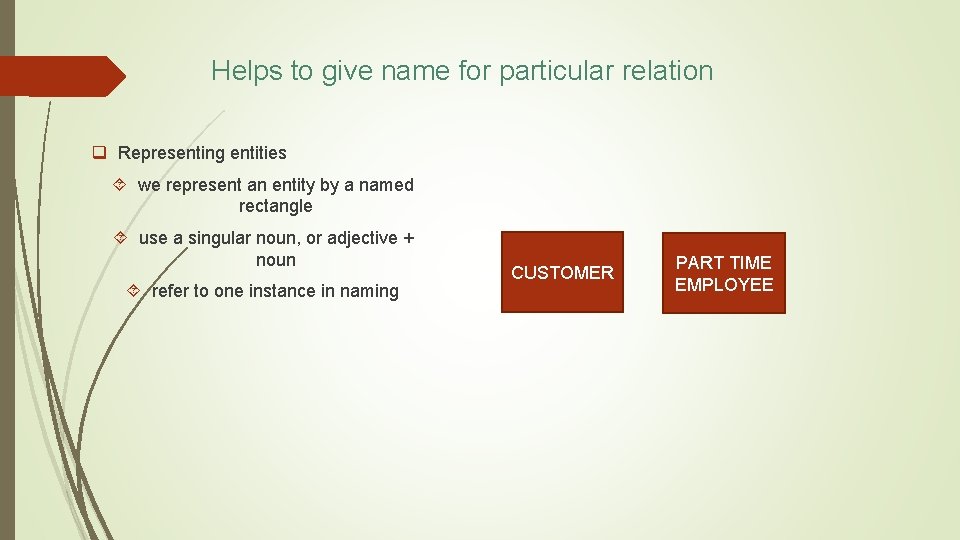
Helps to give name for particular relation q Representing entities we represent an entity by a named rectangle use a singular noun, or adjective + noun refer to one instance in naming CUSTOMER PART TIME EMPLOYEE
Types of Relationships in ER Model q Types of Relationships Three types of relationships can exist between entities One-to-one relationship (1: 1): One instance in an entity (parent) refers to one and only one instance in the related entity (child). One-to-many relationship (1: M): One instance in an entity (parent) refers to one or more instances in the related entity (child) Many-to-many relationship (M: N): exists when one instance of the first entity (parent) can relate to many instances of the second entity (child), and one instance of the second entity can relate to many instances of the first entity.
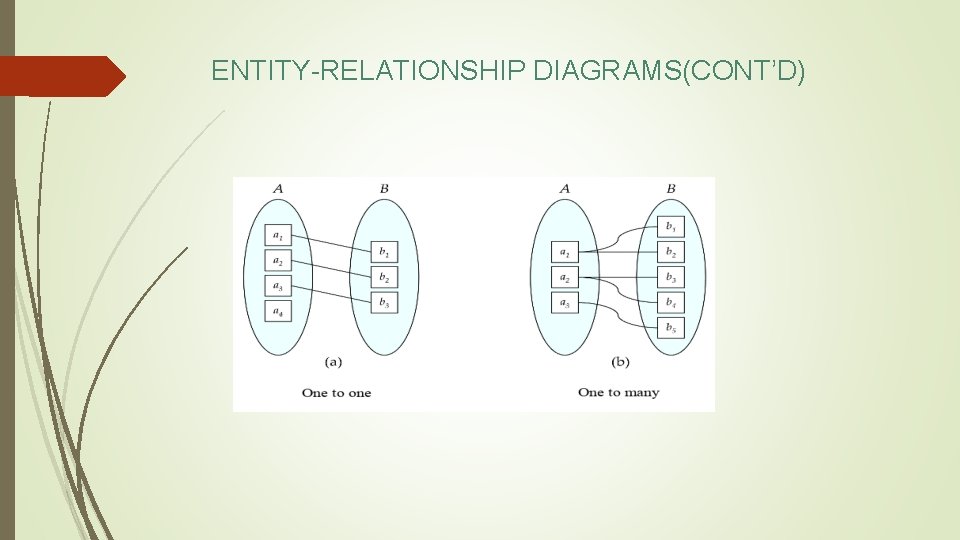
ENTITY-RELATIONSHIP DIAGRAMS(CONT’D)
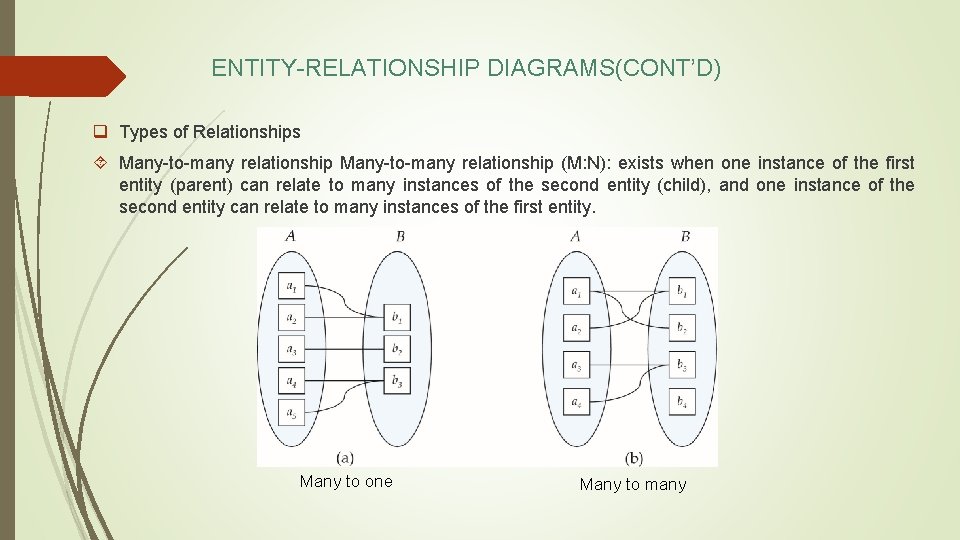
ENTITY-RELATIONSHIP DIAGRAMS(CONT’D) q Types of Relationships Many-to-many relationship (M: N): exists when one instance of the first entity (parent) can relate to many instances of the second entity (child), and one instance of the second entity can relate to many instances of the first entity. Many to one Many to many
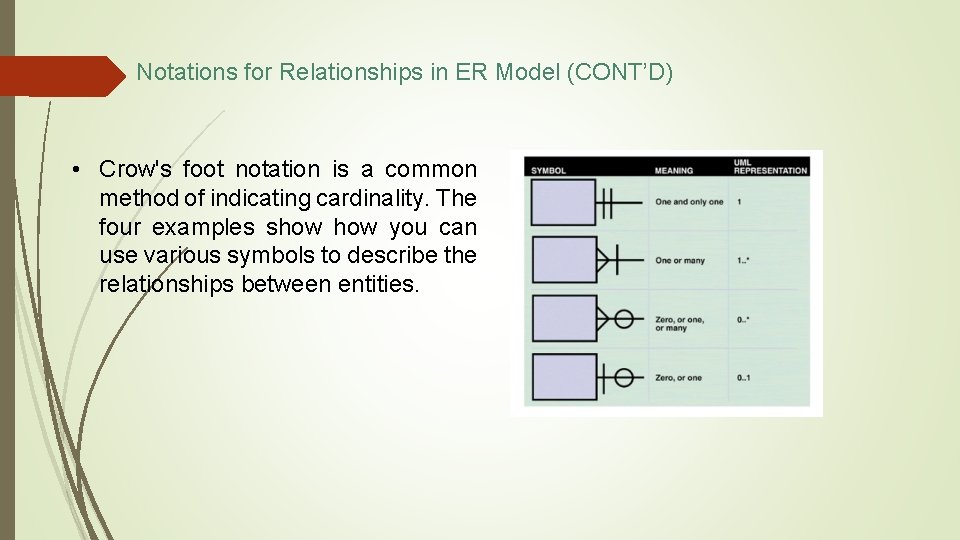
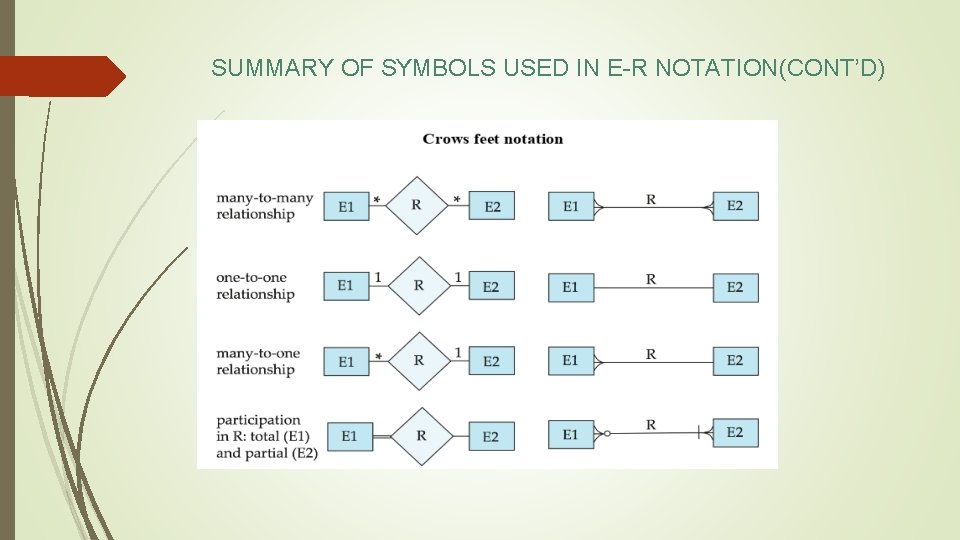
Notations for Relationships in ER Model (CONT’D) • Crow's foot notation is a common method of indicating cardinality. The four examples show you can use various symbols to describe the relationships between entities.
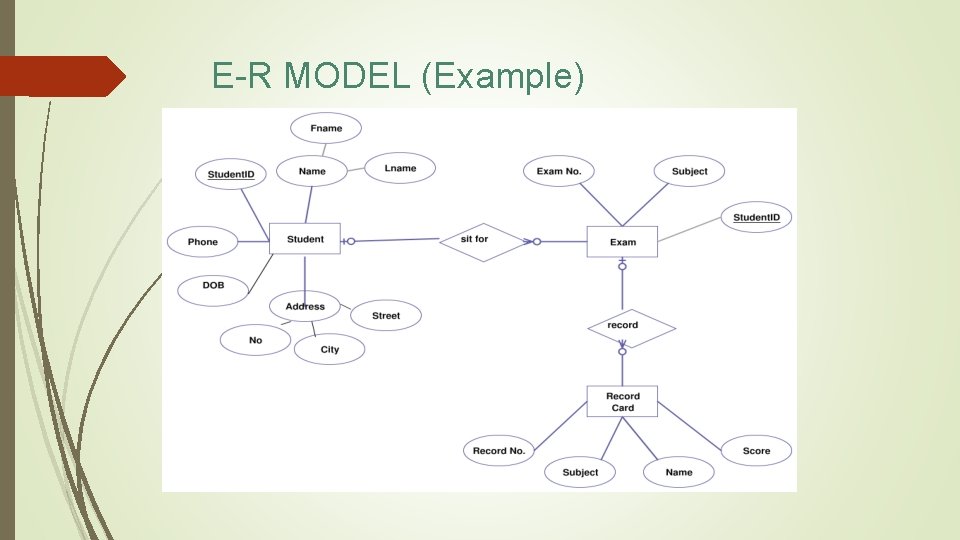
E-R MODEL (Example)
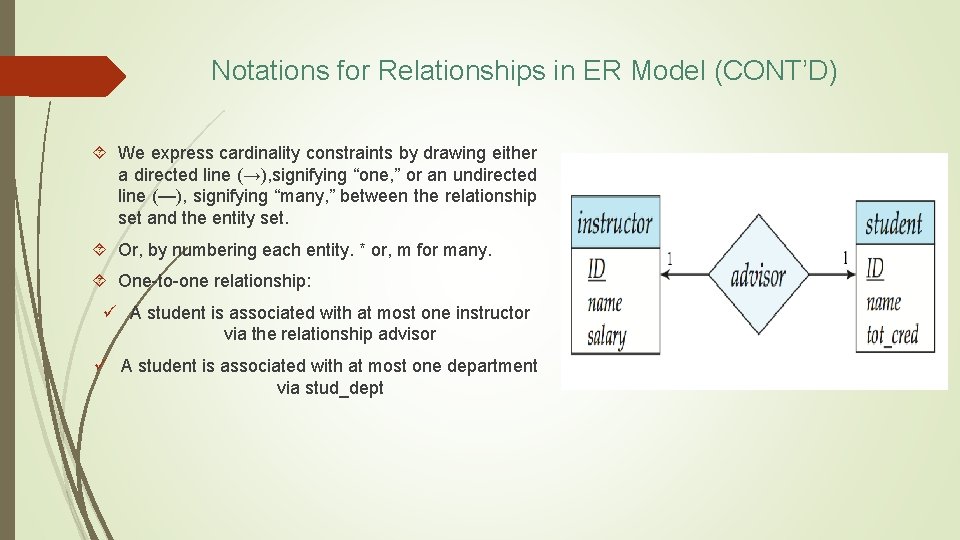
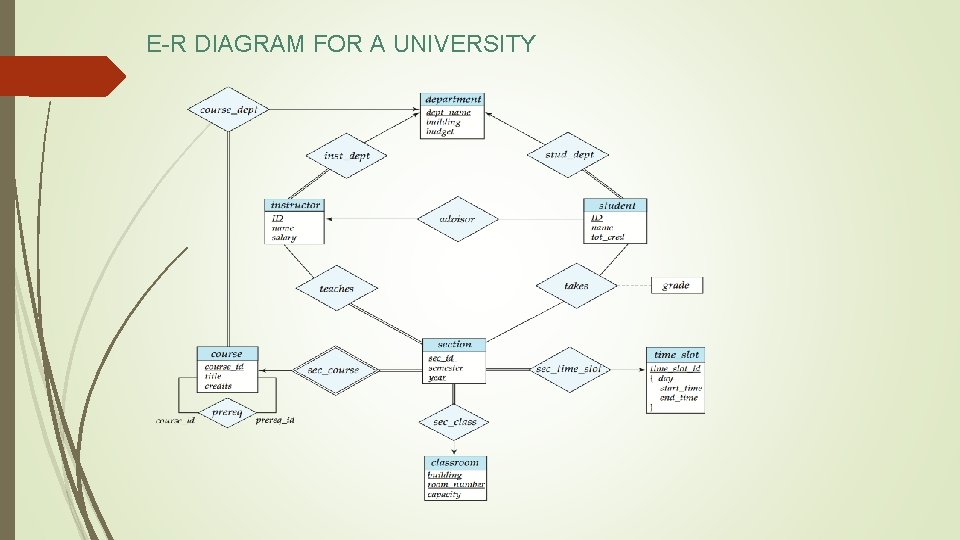
Notations for Relationships in ER Model (CONT’D) We express cardinality constraints by drawing either a directed line (→), signifying “one, ” or an undirected line (—), signifying “many, ” between the relationship set and the entity set. Or, by numbering each entity. * or, m for many. One-to-one relationship: ü A student is associated with at most one instructor via the relationship advisor ü A student is associated with at most one department via stud_dept
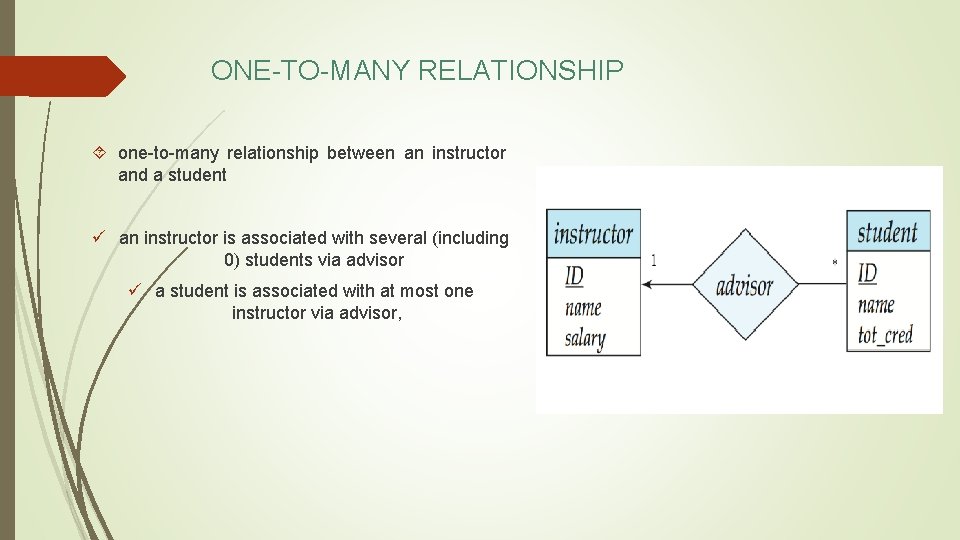
ONE-TO-MANY RELATIONSHIP one-to-many relationship between an instructor and a student ü an instructor is associated with several (including 0) students via advisor ü a student is associated with at most one instructor via advisor,
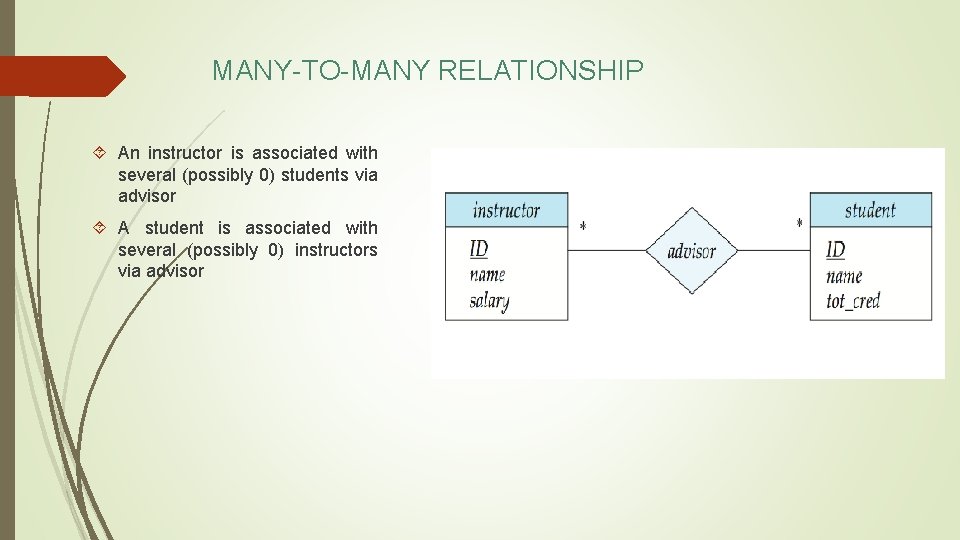
MANY-TO-MANY RELATIONSHIP An instructor is associated with several (possibly 0) students via advisor A student is associated with several (possibly 0) instructors via advisor
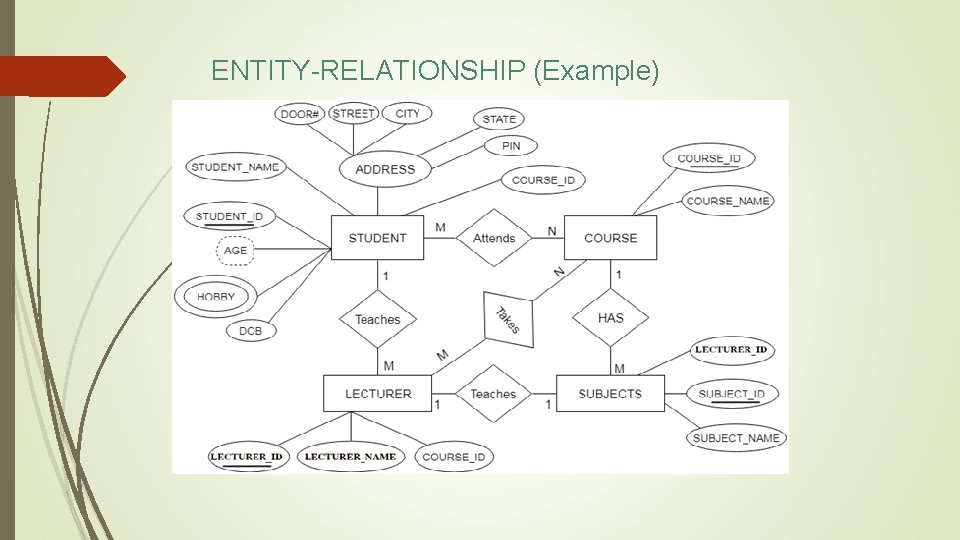
ENTITY-RELATIONSHIP (Example)
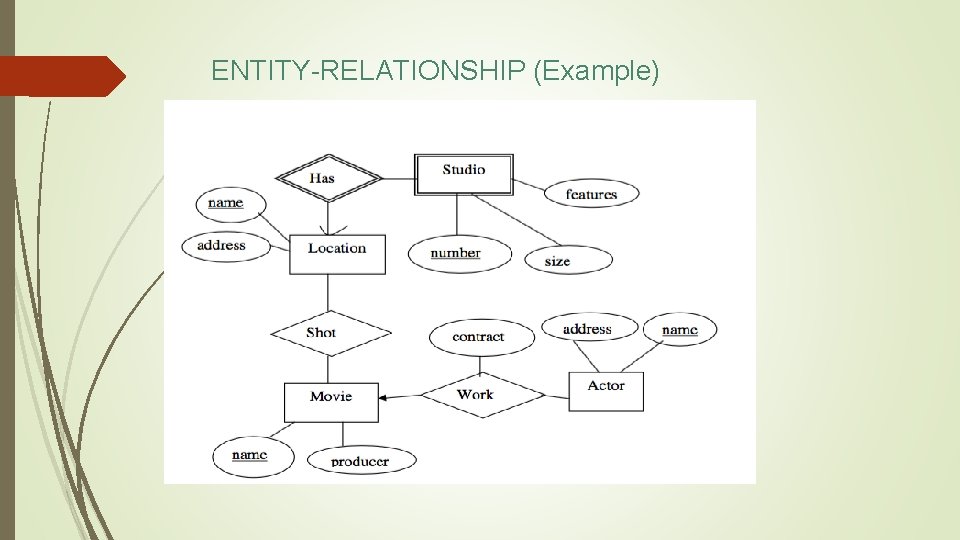
ENTITY-RELATIONSHIP (Example)
PARTICIPATION CONSTRAINT Participation Constraint is applied on the entity participating in the relationship set. Total Participation – Each entity in the entity set must participate in the relationship. If each student must enroll in a course, the participation of student will be total. Total participation is shown by double line in ER diagram. Partial Participation – The entity in the entity set may or may NOT participate in the relationship. If some courses are not enrolled by any of the student, the participation of course will be partial. The diagram depicts the ‘Enrolled in’ relationship set with Student Entity set having total participation and Course Entity set having partial participation.
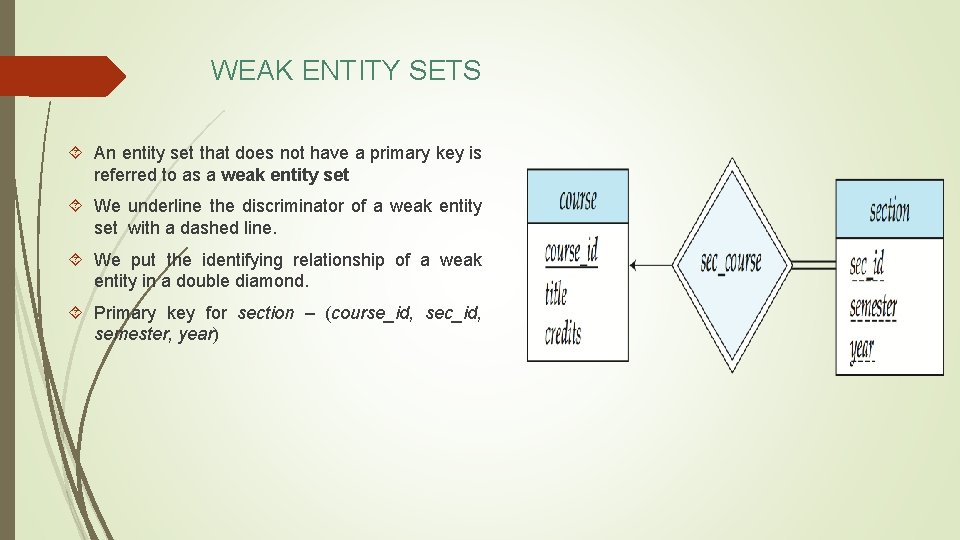
WEAK ENTITY SETS An entity set that does not have a primary key is referred to as a weak entity set We underline the discriminator of a weak entity set with a dashed line. We put the identifying relationship of a weak entity in a double diamond. Primary key for section – (course_id, sec_id, semester, year)
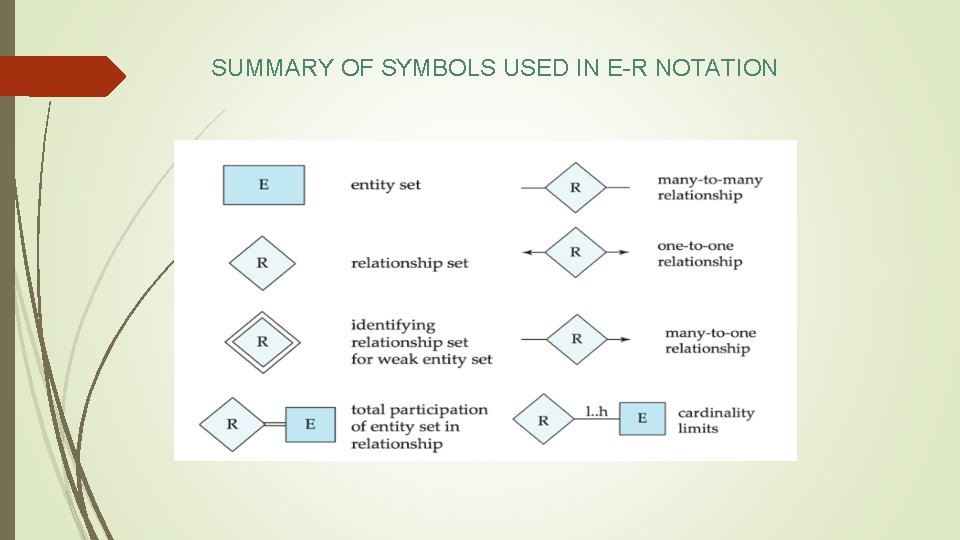
SUMMARY OF SYMBOLS USED IN E-R NOTATION
SUMMARY OF SYMBOLS USED IN E-R NOTATION(CONT’D)
E-R DIAGRAM FOR A UNIVERSITY

Thank You
- Slides: 41