
Enterprise Risk Management and the Casualty Actuary Midwest

- Slides: 37
Enterprise Risk Management and the Casualty Actuary Midwest Actuarial Forum March 22, 2005 Kevin Dickson, FCAS, MAAA Allstate
ERM and the Casualty Actuary Objectives 1. History – CAS Activities – SOA Activities – ERM Symposium 2. Define Terms 3. Implications – how does this impact me? 4. The case for involvement 1
CAS ERM Activities
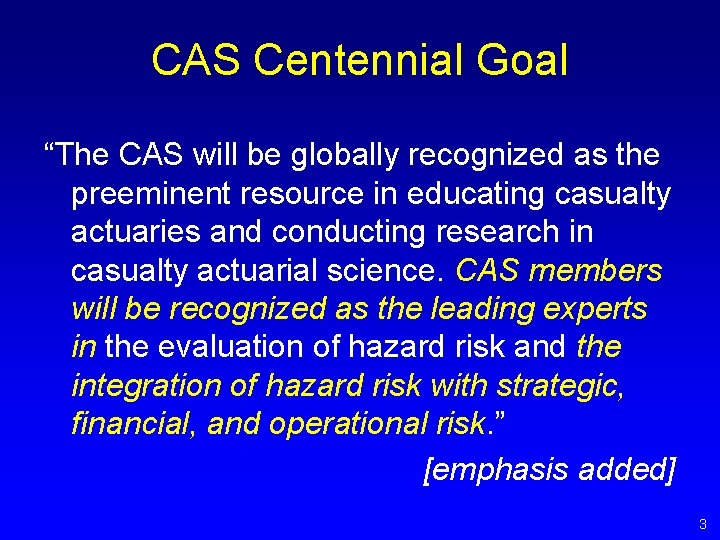
CAS Centennial Goal “The CAS will be globally recognized as the preeminent resource in educating casualty actuaries and conducting research in casualty actuarial science. CAS members will be recognized as the leading experts in the evaluation of hazard risk and the integration of hazard risk with strategic, financial, and operational risk. ” [emphasis added] 3
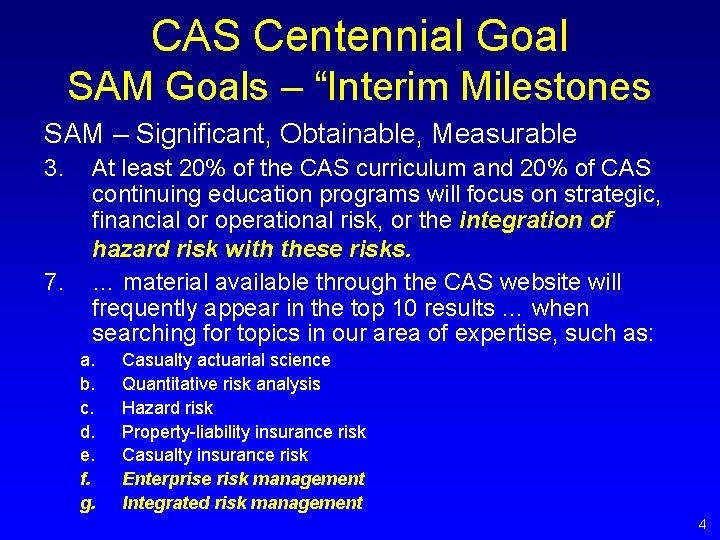
CAS Centennial Goal SAM Goals – “Interim Milestones SAM – Significant, Obtainable, Measurable 3. 7. At least 20% of the CAS curriculum and 20% of CAS continuing education programs will focus on strategic, financial or operational risk, or the integration of hazard risk with these risks. … material available through the CAS website will frequently appear in the top 10 results … when searching for topics in our area of expertise, such as: a. b. c. d. e. f. g. Casualty actuarial science Quantitative risk analysis Hazard risk Property-liability insurance risk Casualty insurance risk Enterprise risk management Integrated risk management 4
CAS Efforts to Date • CAS ERM Advisory Committee (2000/1) – ERM Definition and Framework – CAS Research & Education Priorities • CAS ERM Research Committee (2002 -) – Research Priorities – Progress to Date • Original Research • Directed Research – Future Plans 5
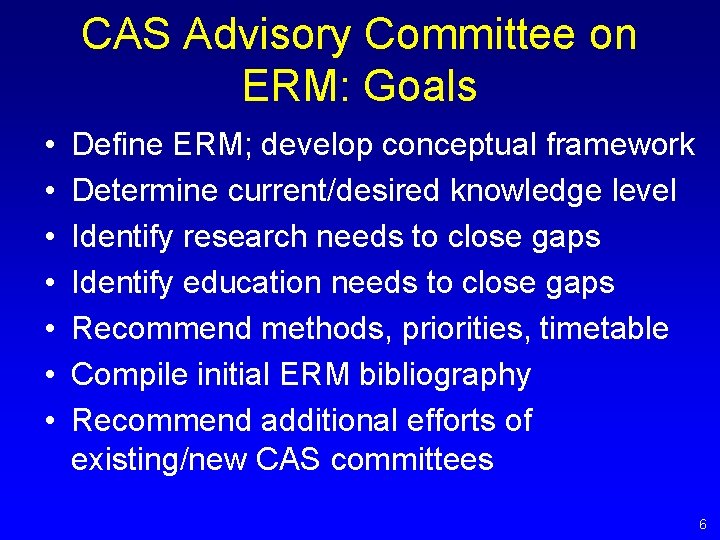
CAS Advisory Committee on ERM: Goals • • Define ERM; develop conceptual framework Determine current/desired knowledge level Identify research needs to close gaps Identify education needs to close gaps Recommend methods, priorities, timetable Compile initial ERM bibliography Recommend additional efforts of existing/new CAS committees 6
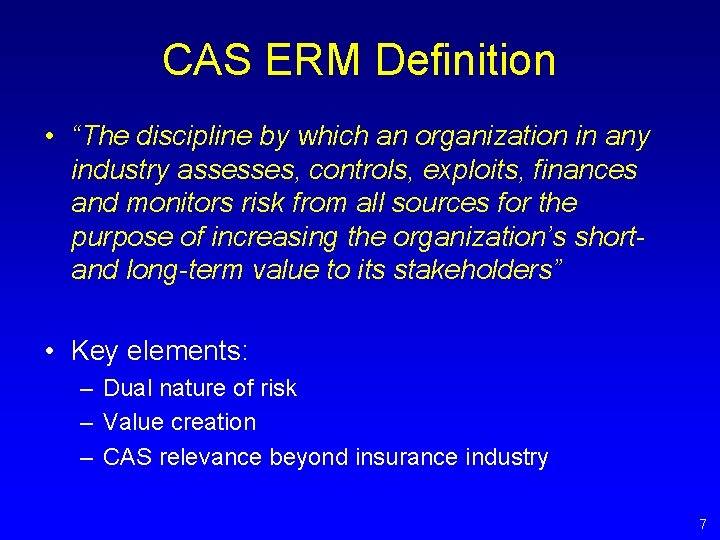
CAS ERM Definition • “The discipline by which an organization in any industry assesses, controls, exploits, finances and monitors risk from all sources for the purpose of increasing the organization’s shortand long-term value to its stakeholders” • Key elements: – Dual nature of risk – Value creation – CAS relevance beyond insurance industry 7
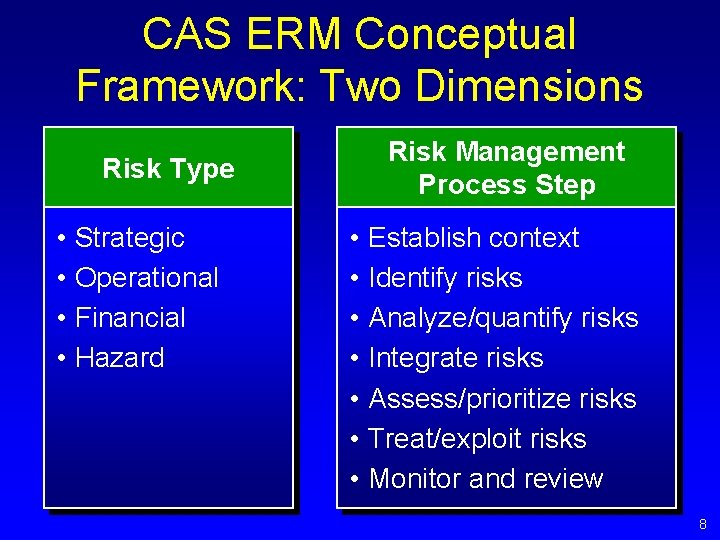
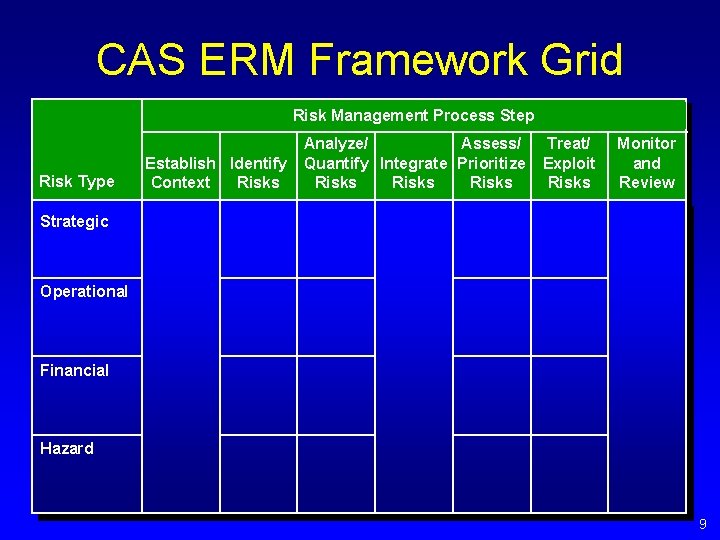
CAS ERM Conceptual Framework: Two Dimensions Risk Management Process Step Risk Type • • Strategic Operational Financial Hazard • • Establish context Identify risks Analyze/quantify risks Integrate risks Assess/prioritize risks Treat/exploit risks Monitor and review 8
CAS ERM Framework Grid Risk Management Process Step Risk Type Establish Identify Context Risks Analyze/ Assess/ Quantify Integrate Prioritize Risks Treat/ Exploit Risks Monitor and Review Strategic Operational Financial Hazard 9
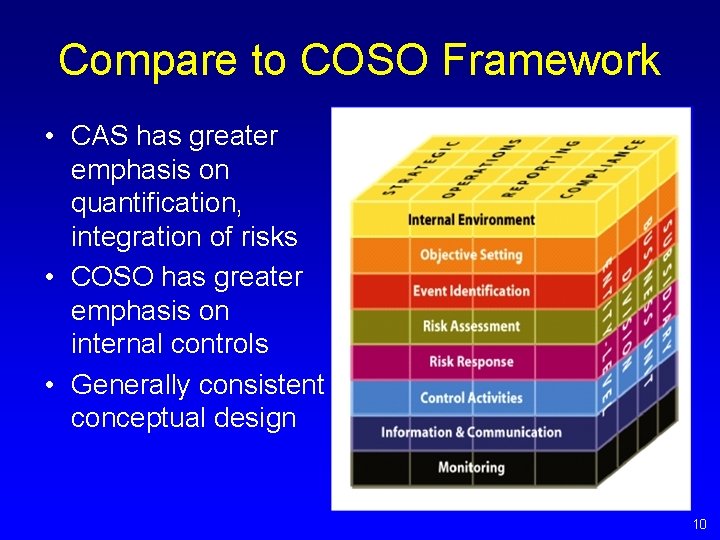
Compare to COSO Framework • CAS has greater emphasis on quantification, integration of risks • COSO has greater emphasis on internal controls • Generally consistent conceptual design 10
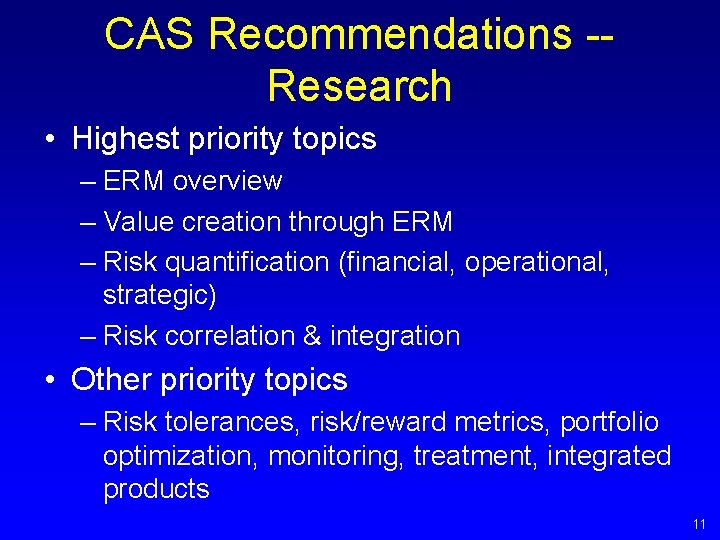
CAS Recommendations -Research • Highest priority topics – ERM overview – Value creation through ERM – Risk quantification (financial, operational, strategic) – Risk correlation & integration • Other priority topics – Risk tolerances, risk/reward metrics, portfolio optimization, monitoring, treatment, integrated products 11
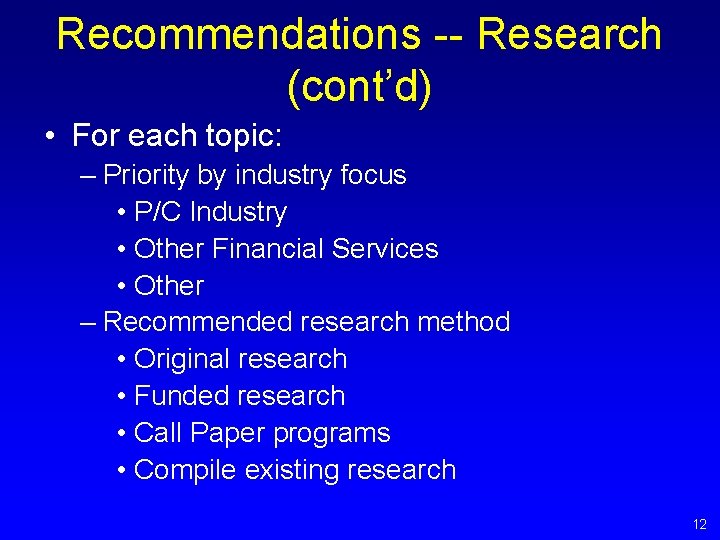
Recommendations -- Research (cont’d) • For each topic: – Priority by industry focus • P/C Industry • Other Financial Services • Other – Recommended research method • Original research • Funded research • Call Paper programs • Compile existing research 12
CAS Recommendations -Research (cont’d) • Form standing ERM Research Committee – Direct & monitor research per above – Expand, update, organize, maintain ERM bibliography – Work with other CAS committees to coordinate ERM research and provide content for education – Partner with other organizations – Develop internal and external communications, designate spokespersons 13
CAS Recommendations -Education • Codified 2005 CAS ERM education needs – For each element of ERM framework – By degree of desired knowledge level – By type of education vehicle • Syllabus • Continuing Education • Developed detailed Learning Objectives for each element of ERM framework • Publish ERM bibliography • Accomplish through existing committees 14
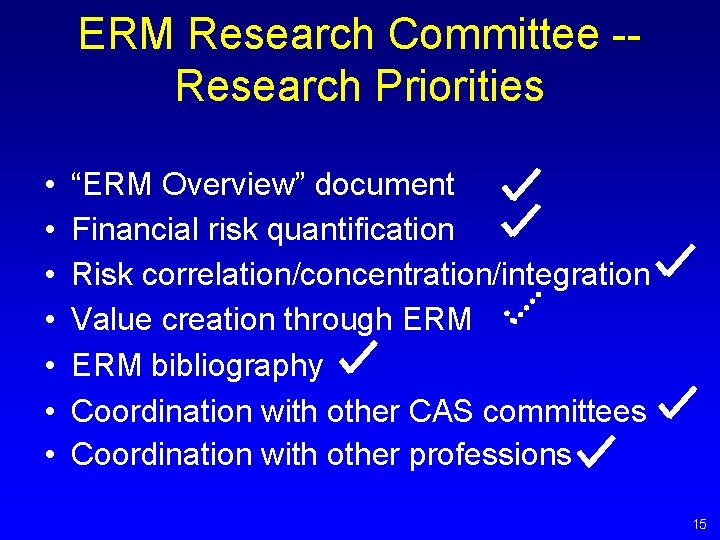
ERM Research Committee -Research Priorities • • “ERM Overview” document Financial risk quantification Risk correlation/concentration/integration Value creation through ERM bibliography Coordination with other CAS committees Coordination with other professions 15
“ERM Overview” Document • Associate-level exam material • Contents – History/evolution of risk management – Reasons/motivations for ERM – ERM definition/framework – Language/measures/models/tools – Applications/case studies – Practical considerations in implementation – Bibliography • Published May 2003 16
Financial Risk Quantification • Literature review: wealth of existing material • Road map/reviews – The Practice of Risk Management – Goldman Sachs & SBC Warburg Dillon Read – Risk Management – Crouhy, Galai and Mark – FRM Handbook, Jorion – Market Models: A Guide to Financial Data Analysis Alexander • Reviews on CAS – ERM Website 17
Risk Correlation/ Concentration/Integration • • Literature review: limited material available Call for papers Coordination with other CAS committees Call Papers published July, 2003 – Advanced Modeling for the New Risk Landscape – Lee Smith and Lilli Segre-Tossani – ERM and DFA using Active Knowledge Structures – James Brander and Sam Manoff – The Aggregation and Correlation of Insurance Exposure – Glenn Meyers, Fredrick Klinker and David Lalonde • Additional Research 18
Other Priority Topics • • Operational & Strategic Risk Quantification Risk Tolerances Optimization, Risk-Reward Metrics Preliminary Findings – Material exists – Not consolidated – May or may not need additional research • Next Steps – develop roadmaps 19
Coordination with Other CAS, AAA Committees • DRMC: joint meetings, joint call for papers • VFIC: joint research project • Syllabus/Ed Policy/Continuing Ed/SIS/etc. : working to develop syllabus materials • RCMS: ERM Symposium • COTOR – Risk Measurement • AAA P/C Extreme Events Committee • AAA ERM Committee • SOA Risk Management Section 20
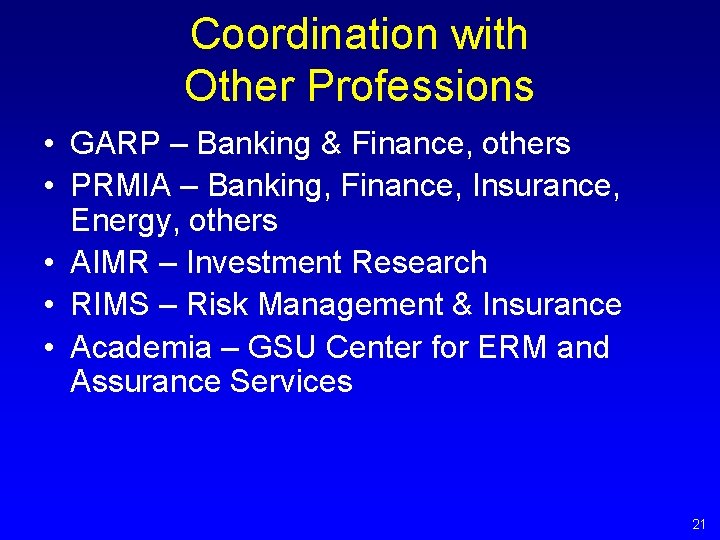
Coordination with Other Professions • GARP – Banking & Finance, others • PRMIA – Banking, Finance, Insurance, Energy, others • AIMR – Investment Research • RIMS – Risk Management & Insurance • Academia – GSU Center for ERM and Assurance Services 21
ERM Research Committee -Future Plans • Continue research material production orientation of committee • Pursue remaining research priorities established by ERM Advisory Committee • Monitor research activities of other professional organizations, academia 22
SOA ERM Activities
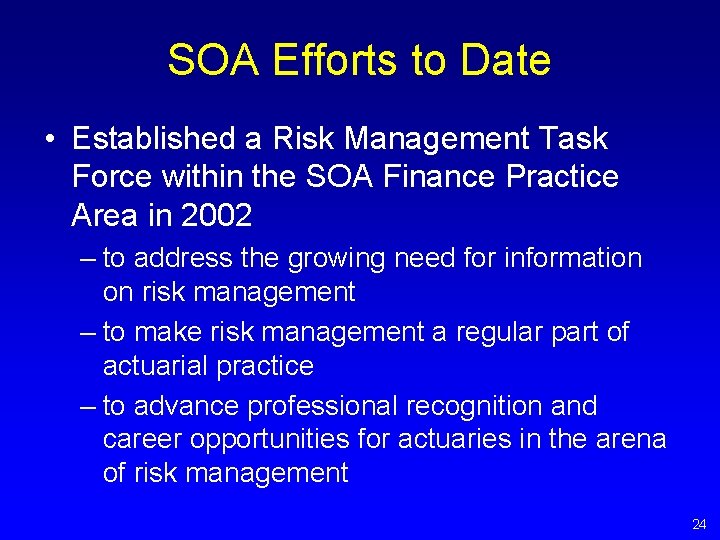
SOA Efforts to Date • Established a Risk Management Task Force within the SOA Finance Practice Area in 2002 – to address the growing need for information on risk management – to make risk management a regular part of actuarial practice – to advance professional recognition and career opportunities for actuaries in the arena of risk management 24
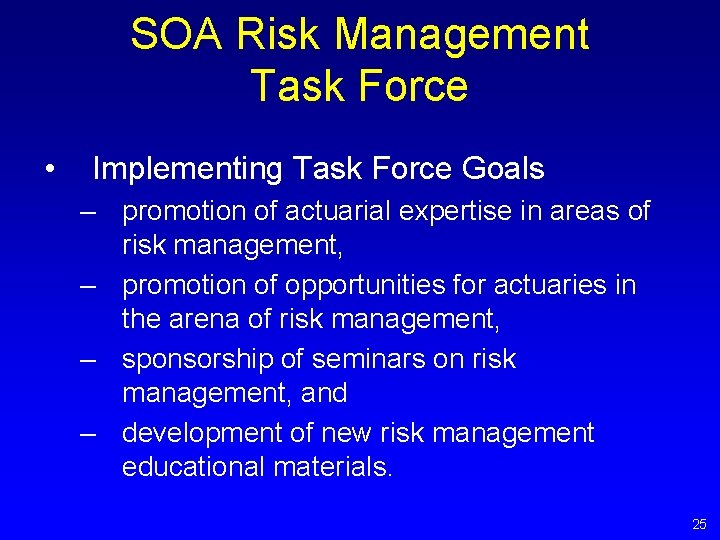
SOA Risk Management Task Force • Implementing Task Force Goals – promotion of actuarial expertise in areas of risk management, – promotion of opportunities for actuaries in the arena of risk management, – sponsorship of seminars on risk management, and – development of new risk management educational materials. 25
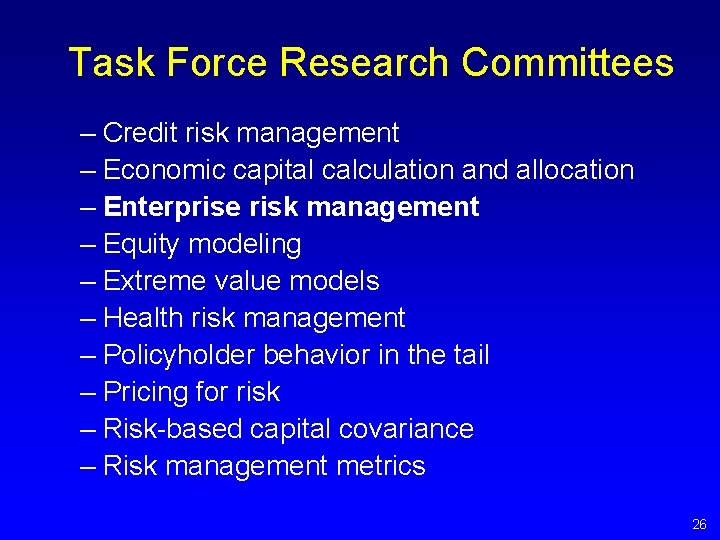
Task Force Research Committees – Credit risk management – Economic capital calculation and allocation – Enterprise risk management – Equity modeling – Extreme value models – Health risk management – Policyholder behavior in the tail – Pricing for risk – Risk-based capital covariance – Risk management metrics 26
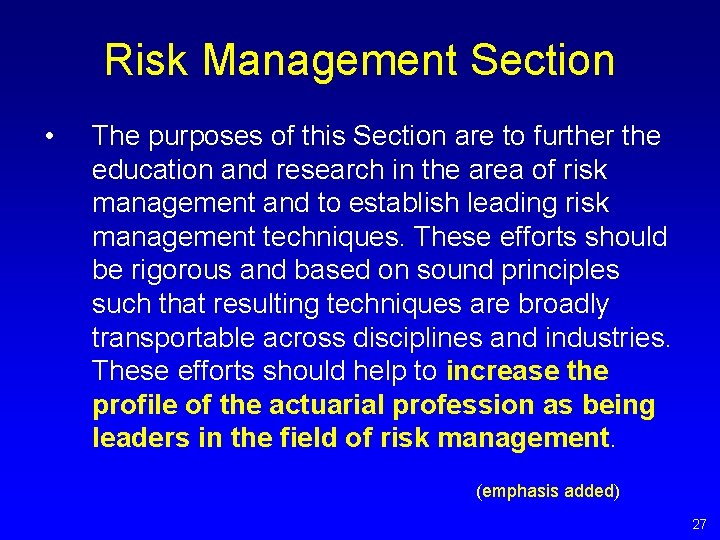
Risk Management Section • The purposes of this Section are to further the education and research in the area of risk management and to establish leading risk management techniques. These efforts should be rigorous and based on sound principles such that resulting techniques are broadly transportable across disciplines and industries. These efforts should help to increase the profile of the actuarial profession as being leaders in the field of risk management. (emphasis added) 27
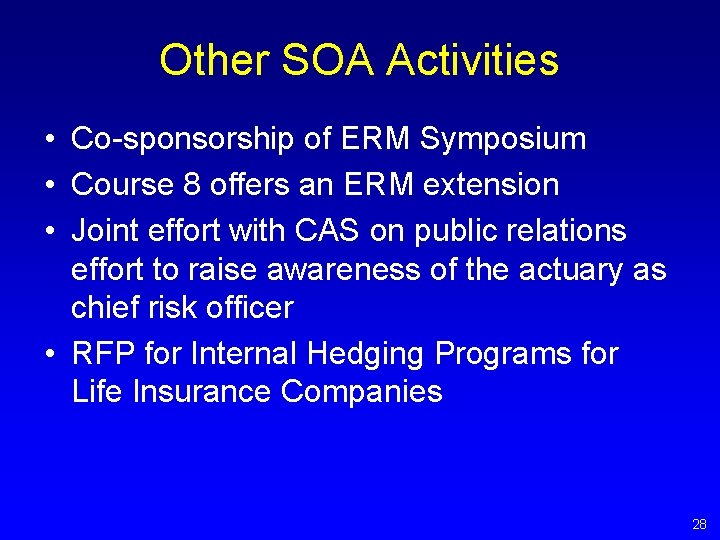
Other SOA Activities • Co-sponsorship of ERM Symposium • Course 8 offers an ERM extension • Joint effort with CAS on public relations effort to raise awareness of the actuary as chief risk officer • RFP for Internal Hedging Programs for Life Insurance Companies 28
ERM Symposium • Joint sponsorship of ERM Symposium SOA and CAS • Participation of Bowles Foundation and PRMIA (Professional Risk Managers International Association) • 2003 – Washington D. C. • 2004 – Chicago • Developed into world-class event • 2005 – May 2 & 3, Chicago Sheraton – ermsymposium. org 29
How does this impact me? • It might not! • Need to know – industry developments “integration of hazard risk with strategic, financial, and operational risk” • Opens up new career possibilities – - CRO - CFO - Risk Aggregators - Risk Coordinators 30
Why actuaries are prime candidates to be ERM leaders (& other reasons actuaries ought to take interest) 1. Don Mango argument – ‘we’re already practicing risk management’ 2. Educational background 3. Currently, no clear professional leaders 4. Expands career opportunities 5. Professionally challenging, rewarding 31
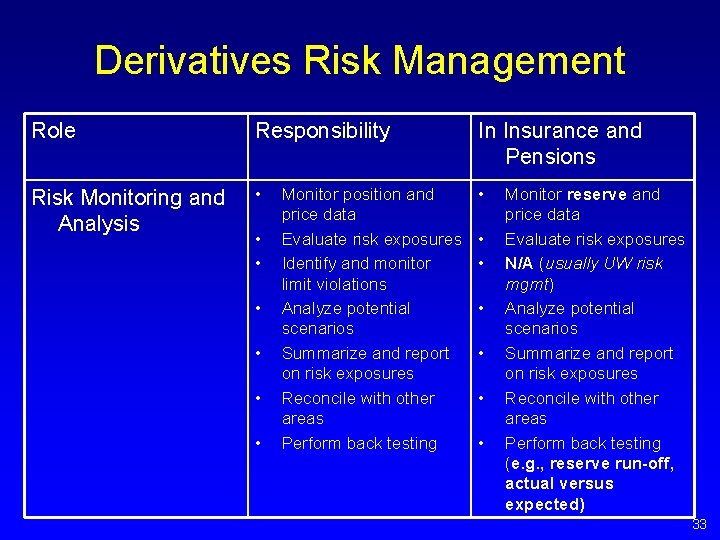
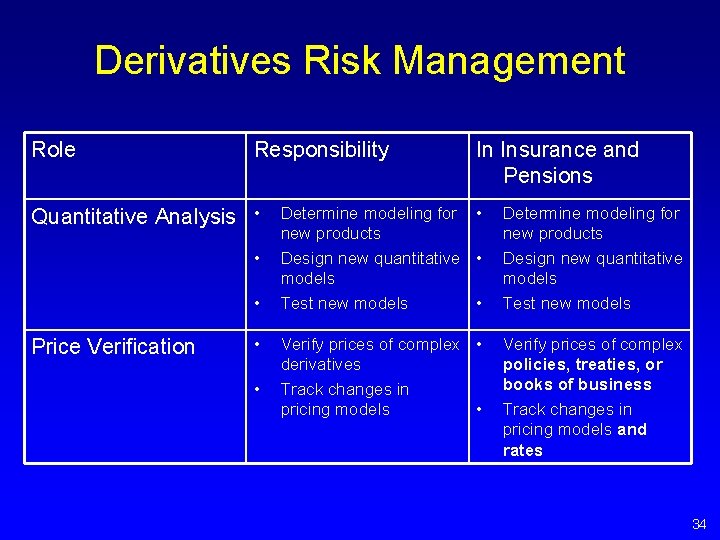
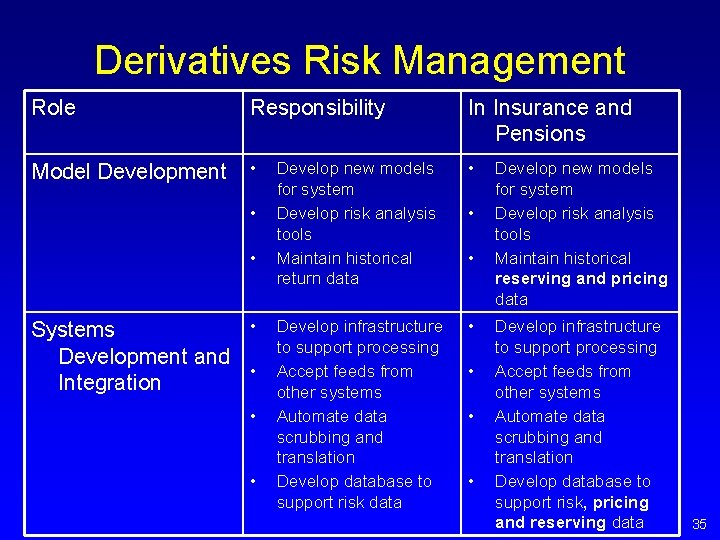
GS: Structure and Skills of Centralized Risk Mgmt Group 1. 2. 3. 4. 5. Risk Monitoring and Analysis Quantitative Analysis Price Verification Model Development Systems Development and Integration 32
Derivatives Risk Management Role Responsibility In Insurance and Pensions Risk Monitoring and Analysis • • Monitor position and price data Evaluate risk exposures Identify and monitor limit violations Analyze potential scenarios Summarize and report on risk exposures Reconcile with other areas Perform back testing • • • Monitor reserve and price data Evaluate risk exposures N/A (usually UW risk mgmt) Analyze potential scenarios Summarize and report on risk exposures Reconcile with other areas Perform back testing (e. g. , reserve run-off, actual versus expected) 33
Derivatives Risk Management Role Responsibility Quantitative Analysis • • • Price Verification • • In Insurance and Pensions Determine modeling for • new products Design new quantitative • models Test new models • Determine modeling for new products Design new quantitative models Test new models Verify prices of complex • derivatives Track changes in • pricing models Verify prices of complex policies, treaties, or books of business Track changes in pricing models and rates 34
Derivatives Risk Management Role Responsibility In Insurance and Pensions Model Development • Develop new models for system Develop risk analysis tools Maintain historical return data • Develop infrastructure to support processing Accept feeds from other systems Automate data scrubbing and translation Develop database to support risk data • • • Systems Development and Integration • • • Develop new models for system Develop risk analysis tools Maintain historical reserving and pricing data Develop infrastructure to support processing Accept feeds from other systems Automate data scrubbing and translation Develop database to support risk, pricing and reserving data 35
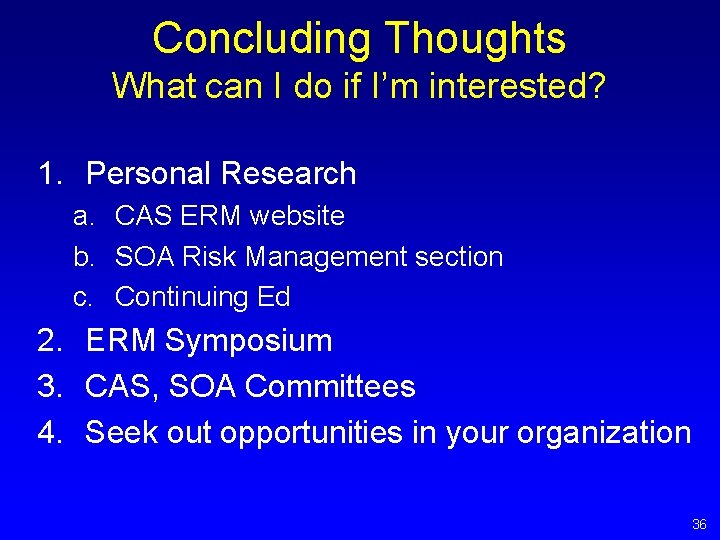
Concluding Thoughts What can I do if I’m interested? 1. Personal Research a. CAS ERM website b. SOA Risk Management section c. Continuing Ed 2. ERM Symposium 3. CAS, SOA Committees 4. Seek out opportunities in your organization 36