
Enterprise Resource Planning Research Enterprise Systems Research Center

- Slides: 51
Enterprise Resource Planning Research Enterprise Systems Research Center University of Arkansas Paul Cronan, David Douglas, & Pam Schmidt Information Systems Walton College of Business Cronan, Douglas and Schmidt HICSS-43 2010 1
ERP Learning & Attitudes Paul Cronan & David Douglas (with Pam Schmidt & Omar Alnuaimi) ERP Learning – traditional classroom approach includes in examples and exercises Learners follow examples and then use SAP to learn functionality Attitudes – in our experience What if – Real world experiences – real problems Demonstrate and utilize integration Higher level of learning Attitudes toward SAP Cronan, Douglas and Schmidt HICSS-43 2010 2
ERP Learning & Attitudes ERP implementations run into the many millions of dollars Many fail because of attitude and change management The impact is not totally accounted for because of all the people who interface with the system Benefits – more/better system usage and better decision making Cronan, Douglas and Schmidt HICSS-43 2010 3
ERP Simulation Game – Learning & Attitudes ERP Simulation used at the Walton College (UA) to learn ERP & SAP Cereals -- made to order manufacturing supply chain; sales process, procurement process, production process, entire cash-to-cash cycle ERP Simulation reacts real-time to multiple teams’ decisions – SAP is the interface between simulator and participants Cronan, Douglas and Schmidt HICSS-43 2010 4
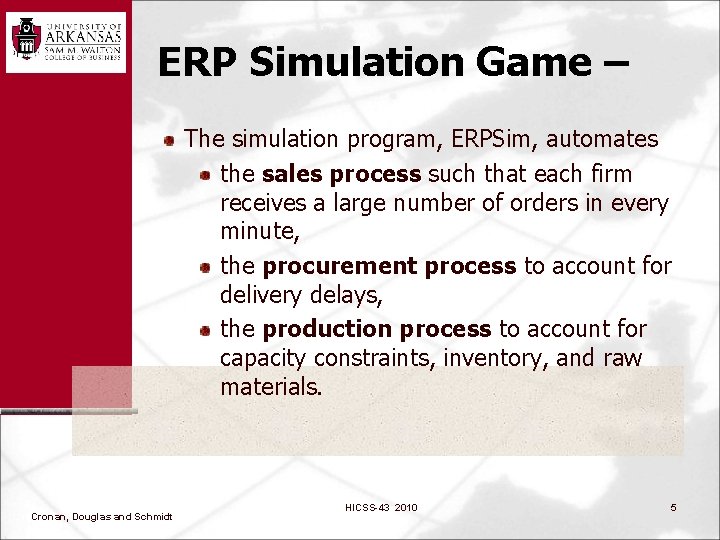
ERP Simulation Game – The simulation program, ERPSim, automates the sales process such that each firm receives a large number of orders in every minute, the procurement process to account for delivery delays, the production process to account for capacity constraints, inventory, and raw materials. Cronan, Douglas and Schmidt HICSS-43 2010 5
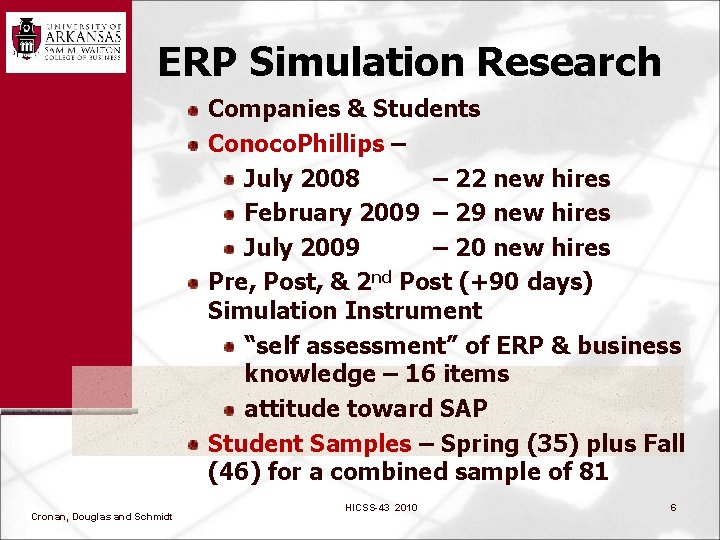
ERP Simulation Research Companies & Students Conoco. Phillips – July 2008 – 22 new hires February 2009 – 29 new hires July 2009 – 20 new hires Pre, Post, & 2 nd Post (+90 days) Simulation Instrument “self assessment” of ERP & business knowledge – 16 items attitude toward SAP Student Samples – Spring (35) plus Fall (46) for a combined sample of 81 Cronan, Douglas and Schmidt HICSS-43 2010 6
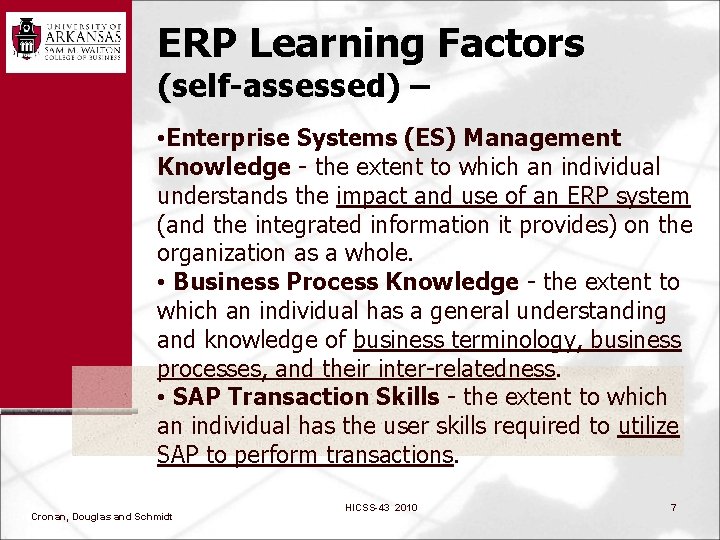
ERP Learning Factors (self-assessed) – • Enterprise Systems (ES) Management Knowledge - the extent to which an individual understands the impact and use of an ERP system (and the integrated information it provides) on the organization as a whole. • Business Process Knowledge - the extent to which an individual has a general understanding and knowledge of business terminology, business processes, and their inter-relatedness. • SAP Transaction Skills - the extent to which an individual has the user skills required to utilize SAP to perform transactions. Cronan, Douglas and Schmidt HICSS-43 2010 7
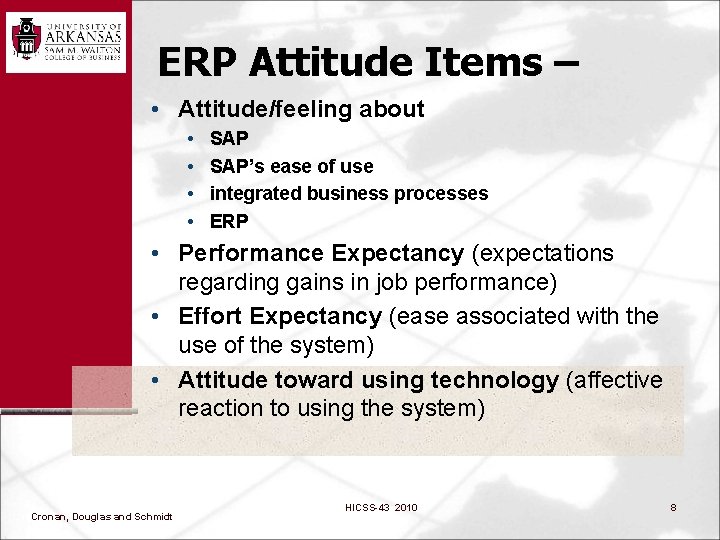
ERP Attitude Items – • Attitude/feeling about • • SAP’s ease of use integrated business processes ERP • Performance Expectancy (expectations regarding gains in job performance) • Effort Expectancy (ease associated with the use of the system) • Attitude toward using technology (affective reaction to using the system) Cronan, Douglas and Schmidt HICSS-43 2010 8
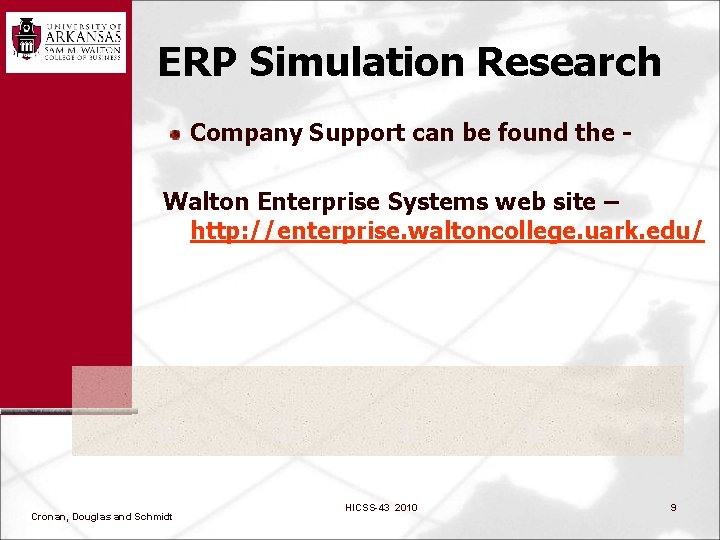
ERP Simulation Research Company Support can be found the Walton Enterprise Systems web site – http: //enterprise. waltoncollege. uark. edu/ Cronan, Douglas and Schmidt HICSS-43 2010 9
July 2008 New Hires Sample Cronan, Douglas and Schmidt HICSS-43 2010 10
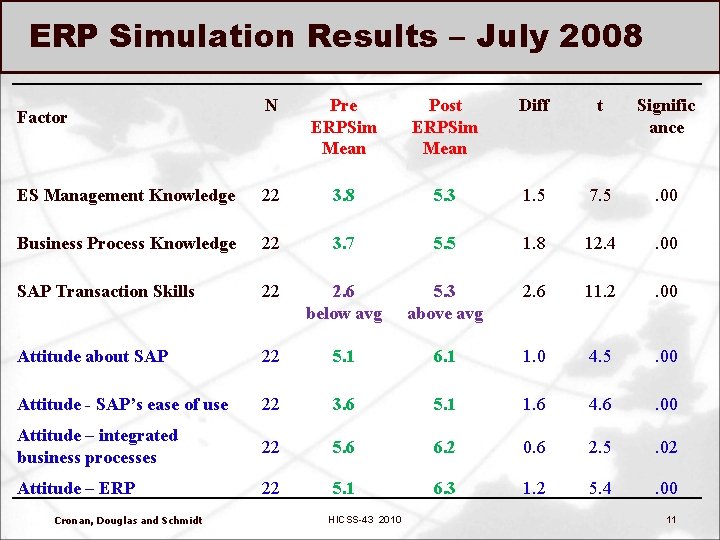
ERP Simulation Results – July 2008 N Pre ERPSim Mean Post ERPSim Mean Diff t Signific ance ES Management Knowledge 22 3. 8 5. 3 1. 5 7. 5 . 00 Business Process Knowledge 22 3. 7 5. 5 1. 8 12. 4 . 00 SAP Transaction Skills 22 2. 6 below avg 5. 3 above avg 2. 6 11. 2 . 00 Attitude about SAP 22 5. 1 6. 1 1. 0 4. 5 . 00 Attitude - SAP’s ease of use 22 3. 6 5. 1 1. 6 4. 6 . 00 Attitude – integrated business processes 22 5. 6 6. 2 0. 6 2. 5 . 02 Attitude – ERP 22 5. 1 6. 3 1. 2 5. 4 . 00 Factor Cronan, Douglas and Schmidt HICSS-43 2010 11
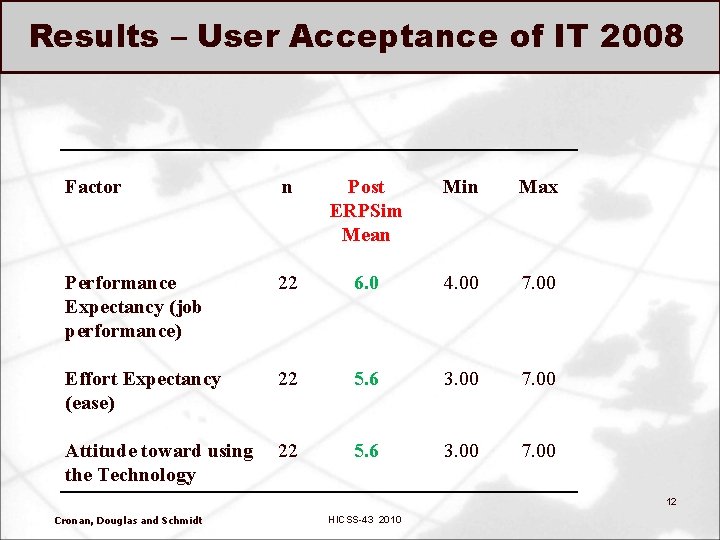
Table 3: User Acceptance of IT (Post ERP Simulation – Conoco Phillips) Results – User Acceptance of IT 2008 Factor n Post ERPSim Mean Min Max Performance Expectancy (job performance) 22 6. 0 4. 00 7. 00 Effort Expectancy (ease) 22 5. 6 3. 00 7. 00 Attitude toward using the Technology 22 5. 6 3. 00 7. 00 12 Cronan, Douglas and Schmidt HICSS-43 2010
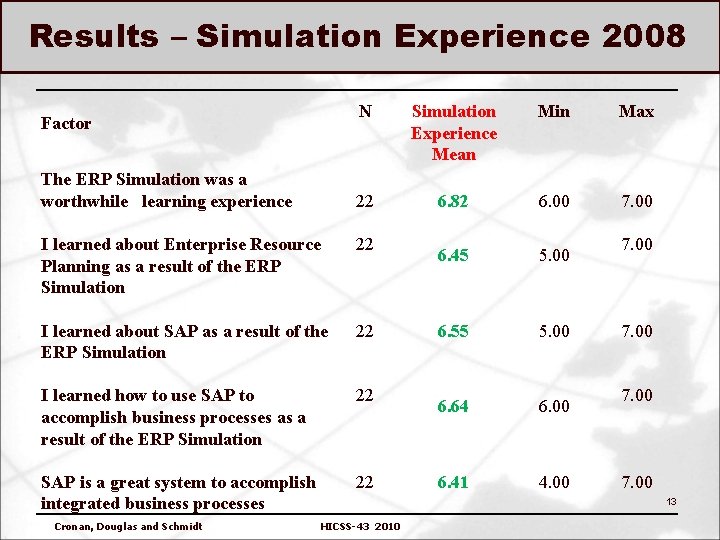
Table 3: User Acceptance of IT (Post ERP Simulation – Conoco Phillips) Results – Simulation Experience 2008 Factor The ERP Simulation was a worthwhile learning experience N Simulation Experience Mean Min Max 22 6. 82 6. 00 7. 00 6. 45 5. 00 6. 55 5. 00 6. 64 6. 00 6. 41 4. 00 I learned about Enterprise Resource Planning as a result of the ERP Simulation 22 I learned about SAP as a result of the ERP Simulation 22 I learned how to use SAP to accomplish business processes as a result of the ERP Simulation 22 SAP is a great system to accomplish integrated business processes 22 Cronan, Douglas and Schmidt 7. 00 13 HICSS-43 2010
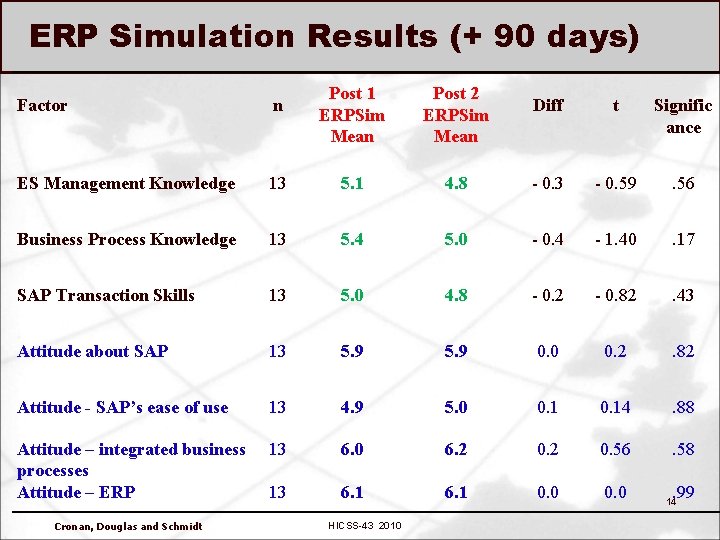
ERP Simulation Results (+ 90 days) Post 1 ERPSim Mean Post 2 ERPSim Mean 13 5. 1 Business Process Knowledge 13 SAP Transaction Skills Factor n Diff t Signific ance ES Management Knowledge 4. 8 - 0. 3 - 0. 59 . 56 5. 4 5. 0 - 0. 4 - 1. 40 . 17 13 5. 0 4. 8 - 0. 2 - 0. 82 . 43 Attitude about SAP 13 5. 9 0. 0 0. 2 . 82 Attitude - SAP’s ease of use 13 4. 9 5. 0 0. 14 . 88 Attitude – integrated business processes Attitude – ERP 13 6. 0 6. 2 0. 56 . 58 13 6. 1 0. 0 Cronan, Douglas and Schmidt HICSS-43 2010 . 99 14
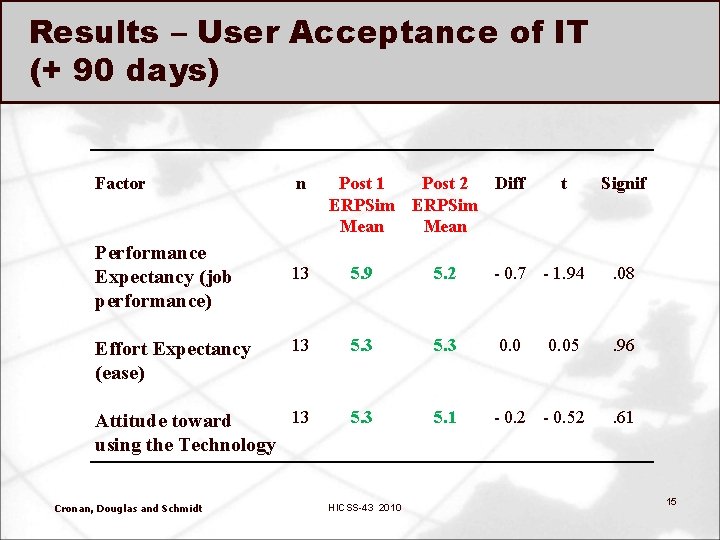
Results – User Acceptance of IT (+ 90 days) Factor n Performance Expectancy (job performance) 13 5. 9 5. 2 - 0. 7 - 1. 94 . 08 13 5. 3 0. 05 . 96 13 Attitude toward using the Technology 5. 3 5. 1 - 0. 2 - 0. 52 . 61 Effort Expectancy (ease) Cronan, Douglas and Schmidt Post 1 Post 2 Diff ERPSim Mean HICSS-43 2010 t Signif 15
February 2009 New Hires Sample Cronan, Douglas and Schmidt HICSS-43 2010 16
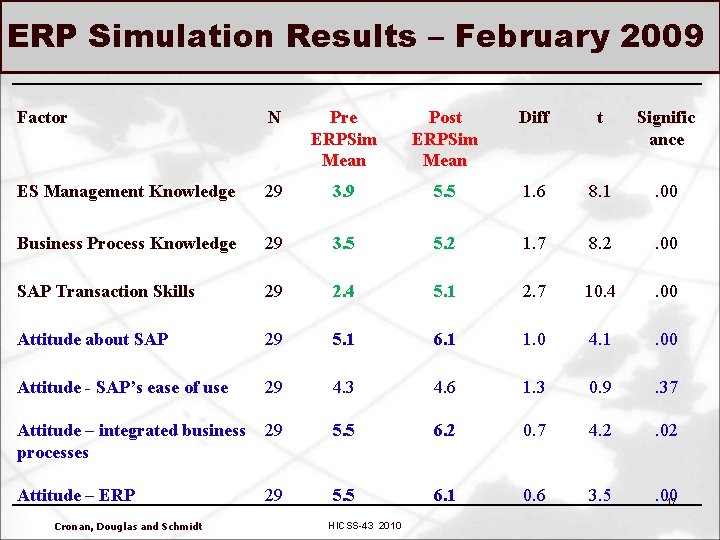
ERP Simulation Results – February 2009 Factor N Pre ERPSim Mean Post ERPSim Mean Diff t Signific ance ES Management Knowledge 29 3. 9 5. 5 1. 6 8. 1 . 00 Business Process Knowledge 29 3. 5 5. 2 1. 7 8. 2 . 00 SAP Transaction Skills 29 2. 4 5. 1 2. 7 10. 4 . 00 Attitude about SAP 29 5. 1 6. 1 1. 0 4. 1 . 00 Attitude - SAP’s ease of use 29 4. 3 4. 6 1. 3 0. 9 . 37 Attitude – integrated business processes 29 5. 5 6. 2 0. 7 4. 2 . 02 Attitude – ERP 29 5. 5 6. 1 0. 6 3. 5 . 00 17 Cronan, Douglas and Schmidt HICSS-43 2010
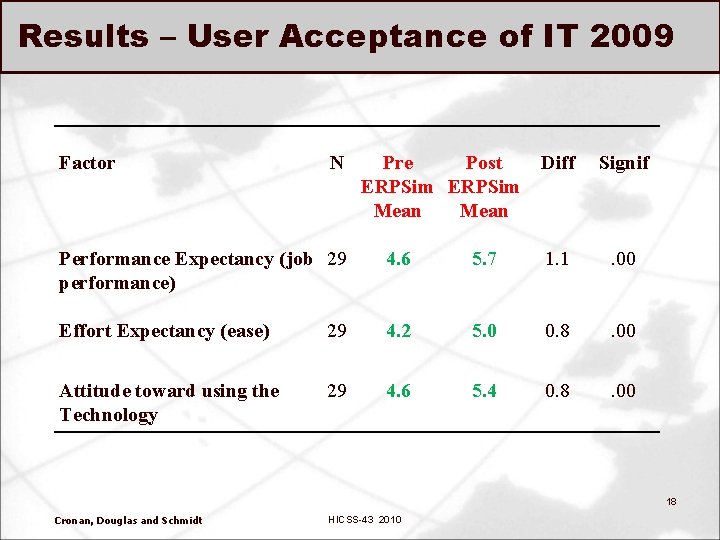
Table 3: User Acceptance of IT (Post ERP Simulation – Conoco Phillips) Results – User Acceptance of IT 2009 Factor N Pre Post Diff ERPSim Mean Signif Performance Expectancy (job 29 performance) 4. 6 5. 7 1. 1 . 00 Effort Expectancy (ease) 29 4. 2 5. 0 0. 8 . 00 Attitude toward using the Technology 29 4. 6 5. 4 0. 8 . 00 18 Cronan, Douglas and Schmidt HICSS-43 2010
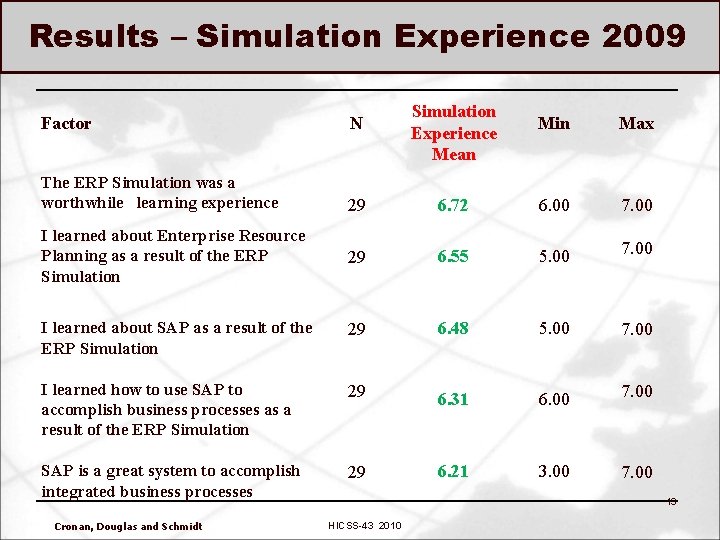
Table 3: User Acceptance of IT (Post ERP Simulation – Conoco Phillips) Results – Simulation Experience 2009 Factor N The ERP Simulation was a worthwhile learning experience 29 I learned about Enterprise Resource Planning as a result of the ERP Simulation Experience Mean Min Max 6. 72 6. 00 7. 00 29 6. 55 5. 00 7. 00 I learned about SAP as a result of the ERP Simulation 29 6. 48 5. 00 7. 00 I learned how to use SAP to accomplish business processes as a result of the ERP Simulation 29 6. 31 6. 00 7. 00 SAP is a great system to accomplish integrated business processes 29 6. 21 3. 00 7. 00 Cronan, Douglas and Schmidt 19 HICSS-43 2010
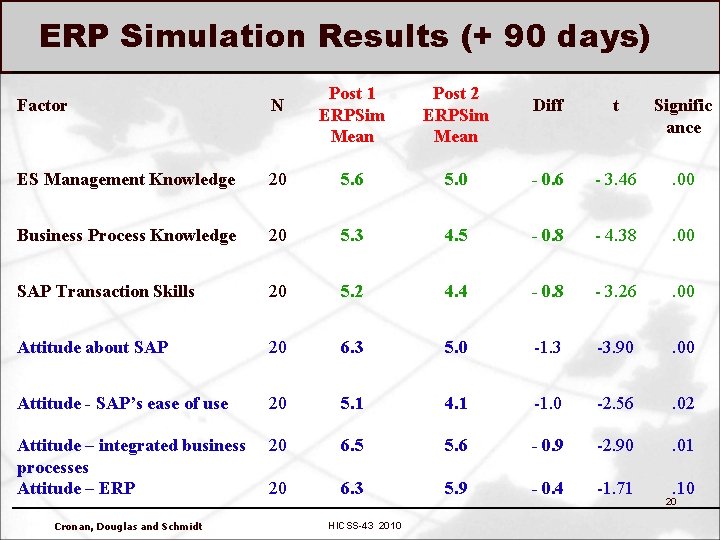
ERP Simulation Results (+ 90 days) Post 1 ERPSim Mean Post 2 ERPSim Mean 20 5. 6 Business Process Knowledge 20 SAP Transaction Skills Factor N Diff t Signific ance ES Management Knowledge 5. 0 - 0. 6 - 3. 46 . 00 5. 3 4. 5 - 0. 8 - 4. 38 . 00 20 5. 2 4. 4 - 0. 8 - 3. 26 . 00 Attitude about SAP 20 6. 3 5. 0 -1. 3 -3. 90 . 00 Attitude - SAP’s ease of use 20 5. 1 4. 1 -1. 0 -2. 56 . 02 Attitude – integrated business processes Attitude – ERP 20 6. 5 5. 6 - 0. 9 -2. 90 . 01 20 6. 3 5. 9 - 0. 4 -1. 71 Cronan, Douglas and Schmidt HICSS-43 2010 . 10 20
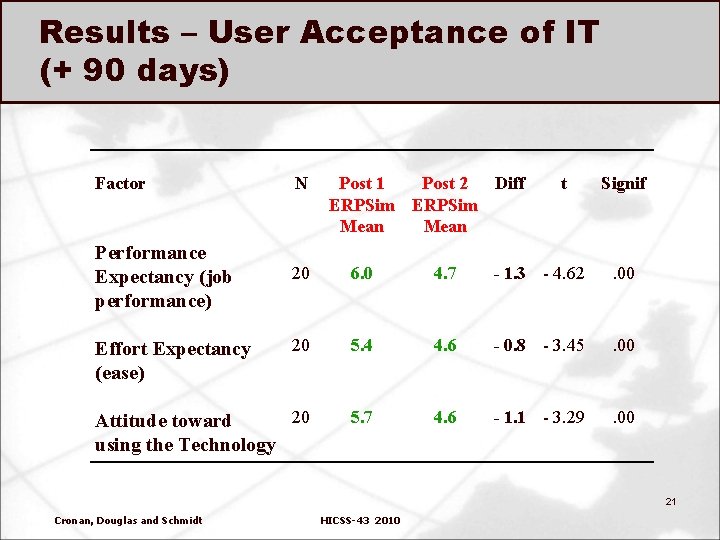
Results – User Acceptance of IT (+ 90 days) Factor N Performance Expectancy (job performance) 20 6. 0 4. 7 - 1. 3 - 4. 62 . 00 20 5. 4 4. 6 - 0. 8 - 3. 45 . 00 20 Attitude toward using the Technology 5. 7 4. 6 - 1. 1 - 3. 29 . 00 Effort Expectancy (ease) Post 1 Post 2 Diff ERPSim Mean t Signif 21 Cronan, Douglas and Schmidt HICSS-43 2010
July 2009 New Hires Sample Cronan, Douglas and Schmidt HICSS-43 2010 22
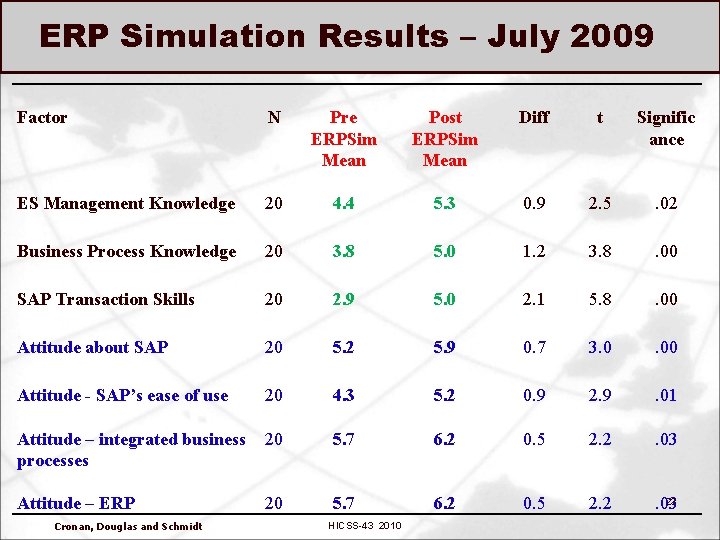
ERP Simulation Results – July 2009 Factor N Pre ERPSim Mean Post ERPSim Mean Diff t Signific ance ES Management Knowledge 20 4. 4 5. 3 0. 9 2. 5 . 02 Business Process Knowledge 20 3. 8 5. 0 1. 2 3. 8 . 00 SAP Transaction Skills 20 2. 9 5. 0 2. 1 5. 8 . 00 Attitude about SAP 20 5. 2 5. 9 0. 7 3. 0 . 00 Attitude - SAP’s ease of use 20 4. 3 5. 2 0. 9 2. 9 . 01 Attitude – integrated business processes 20 5. 7 6. 2 0. 5 2. 2 . 03 Attitude – ERP 20 5. 7 6. 2 0. 5 2. 2 23. 03 Cronan, Douglas and Schmidt HICSS-43 2010
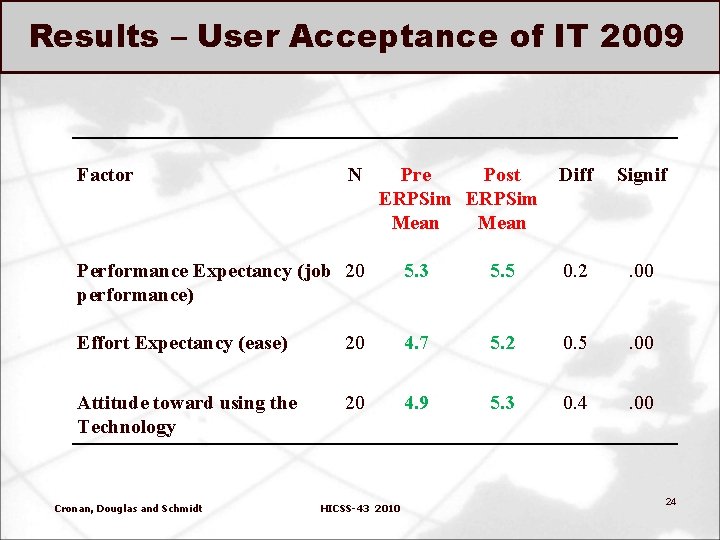
Table 3: User Acceptance of IT (Post ERP Simulation – Conoco Phillips) Results – User Acceptance of IT 2009 Factor N Pre Post Diff ERPSim Mean Signif Performance Expectancy (job 20 performance) 5. 3 5. 5 0. 2 . 00 Effort Expectancy (ease) 20 4. 7 5. 2 0. 5 . 00 Attitude toward using the Technology 20 4. 9 5. 3 0. 4 . 00 Cronan, Douglas and Schmidt HICSS-43 2010 24
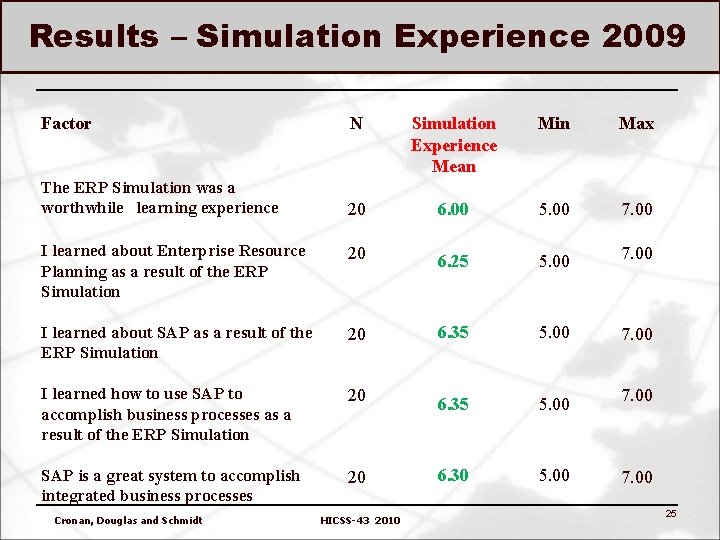
Table 3: User Acceptance of IT (Post ERP Simulation – Conoco Phillips) Results – Simulation Experience 2009 Factor N Simulation Experience Mean Min Max The ERP Simulation was a worthwhile learning experience 20 6. 00 5. 00 7. 00 I learned about Enterprise Resource Planning as a result of the ERP Simulation 20 6. 25 5. 00 7. 00 I learned about SAP as a result of the ERP Simulation 20 6. 35 5. 00 7. 00 I learned how to use SAP to accomplish business processes as a result of the ERP Simulation 20 6. 35 5. 00 7. 00 SAP is a great system to accomplish integrated business processes 20 6. 30 5. 00 7. 00 Cronan, Douglas and Schmidt HICSS-43 2010 25
Student Sample Cronan, Douglas and Schmidt HICSS-43 2010 26
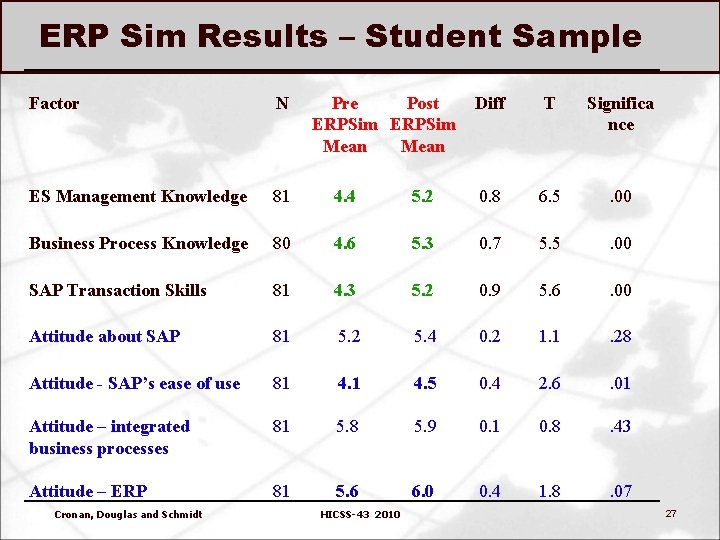
ERP Sim Results – Student Sample Factor N Diff T Significa nce ES Management Knowledge 81 4. 4 5. 2 0. 8 6. 5 . 00 Business Process Knowledge 80 4. 6 5. 3 0. 7 5. 5 . 00 SAP Transaction Skills 81 4. 3 5. 2 0. 9 5. 6 . 00 Attitude about SAP 81 5. 2 5. 4 0. 2 1. 1 . 28 Attitude - SAP’s ease of use 81 4. 5 0. 4 2. 6 . 01 Attitude – integrated business processes 81 5. 8 5. 9 0. 1 0. 8 . 43 Attitude – ERP 81 5. 6 6. 0 0. 4 1. 8 . 07 Cronan, Douglas and Schmidt Pre Post ERPSim Mean HICSS-43 2010 27
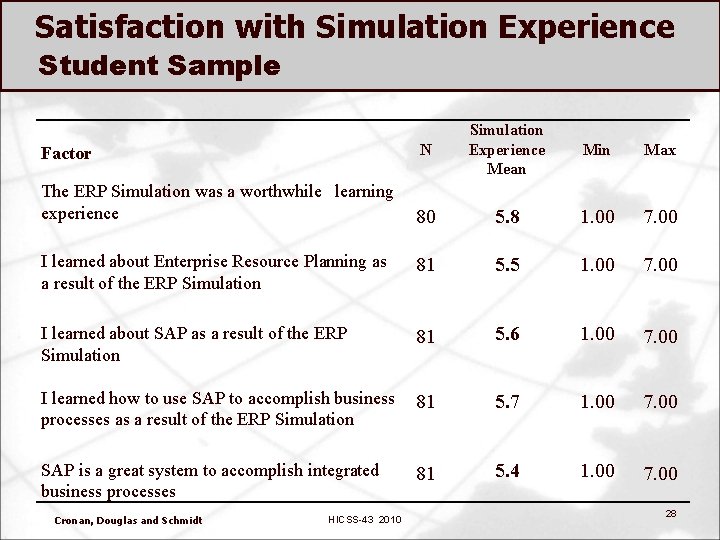
Satisfaction with Simulation Experience Student Sample Factor N Simulation Experience Mean The ERP Simulation was a worthwhile learning experience 80 5. 8 1. 00 7. 00 I learned about Enterprise Resource Planning as a result of the ERP Simulation 81 5. 5 1. 00 7. 00 I learned about SAP as a result of the ERP Simulation 81 5. 6 1. 00 7. 00 I learned how to use SAP to accomplish business processes as a result of the ERP Simulation 81 5. 7 1. 00 7. 00 SAP is a great system to accomplish integrated business processes 81 5. 4 1. 00 7. 00 Cronan, Douglas and Schmidt HICSS-43 2010 Min Max 28
ERP Simulation Research Conoco. Phillips – how do these new hires feel about SAP today (one year on the job)? Other Company Samples Hitachi Consulting Tyson Foods Wal-Mart Canadian Company Samples What about employees who have been using SAP/ERP – can we influence their attitude about ERP/SAP and its role in the company? Cronan, Douglas and Schmidt HICSS-43 2010 29
ERP Simulation Research More information regarding these studies can be found at: Information Technology Research Institute Working papers at the Walton College Web site - http: //itri. uark. edu/ ‘New Hires’ WP 122 -1008 (11 -15 -2009) ‘Students’ WP 123 -1008 (8 -25 -2009) Slides can be downloaded from Walton Enterprise Systems web site – http: //enterprise. waltoncollege. uark. edu/ Cronan, Douglas and Schmidt HICSS-43 2010 30
ERP Competencies Research Project (w/HECM) Objective - What learner characteristics (factors) determine competency and knowledge transfer? Link between performance and characteristics. Measures – Objective measures (knowledge, transactions, process, etc. ) Self assessment Usage (ERPSim game) Performance data (assessing competency within a situation adding complexity) Cronan, Douglas and Schmidt HICSS-43 2010 31
ERP Simulation Research Learning Studies - Compare “ERP Simulation approach” to “traditional lab exercise approach” for ERP Learning and Attitude ERP Knowledge and Adaptation Research (Pam Schmidt) Decision Making - ERPSim Performance (profit, etc. ) ERP Implementations User Acceptance Virtual Teams Cronan, Douglas and Schmidt HICSS-43 2010 32
ERP Knowledge and Adaptation Research Pamela J. Schmidt University of Arkansas • • Cronan, Douglas and Schmidt ERP Hierarchy of Knowledge Types ERPsim attributes that promote learning Research Model of ERP Adaptation Preliminary Results HICSS-43 2010 33
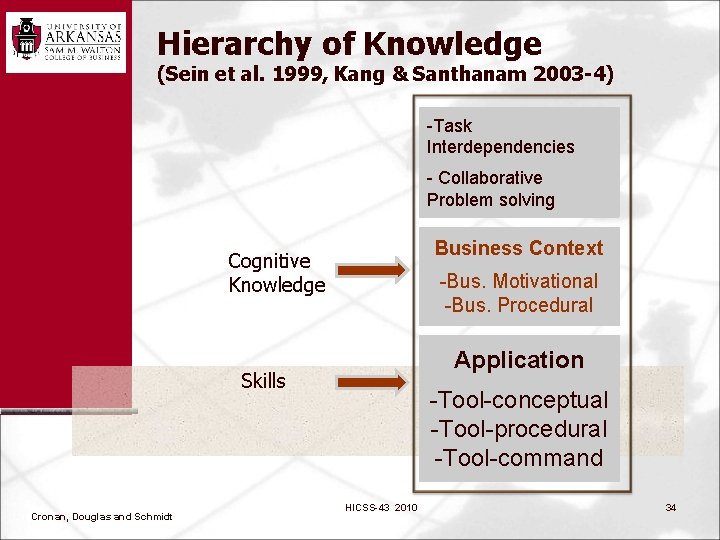
Hierarchy of Knowledge (Sein et al. 1999, Kang & Santhanam 2003 -4) -Task Interdependencies - Collaborative Problem solving Business Context Cognitive Knowledge -Bus. Motivational -Bus. Procedural Application Skills Cronan, Douglas and Schmidt -Tool-conceptual -Tool-procedural -Tool-command HICSS-43 2010 34
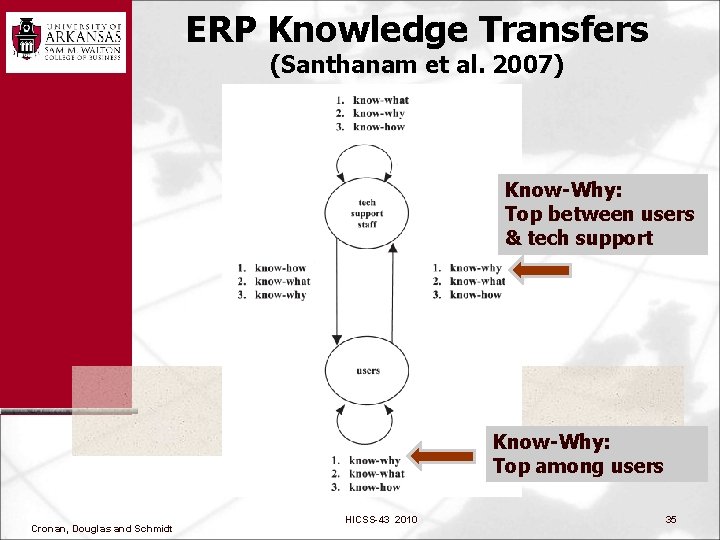
ERP Knowledge Transfers (Santhanam et al. 2007) Know-Why: Top between users & tech support Know-Why: Top among users Cronan, Douglas and Schmidt HICSS-43 2010 35
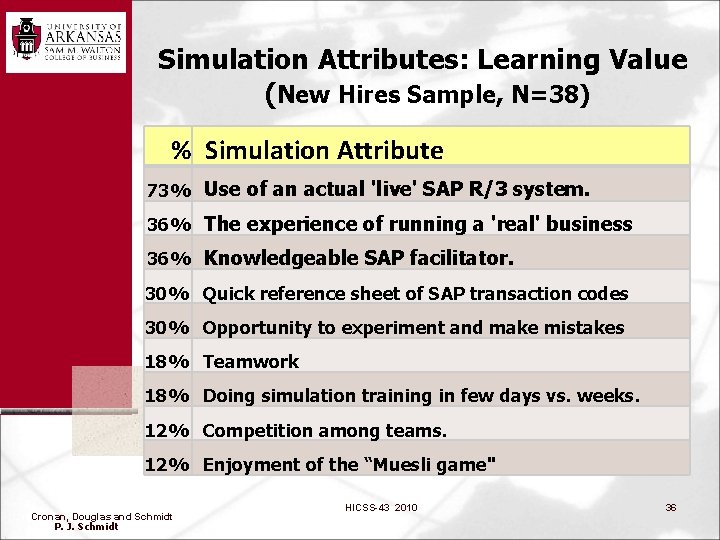
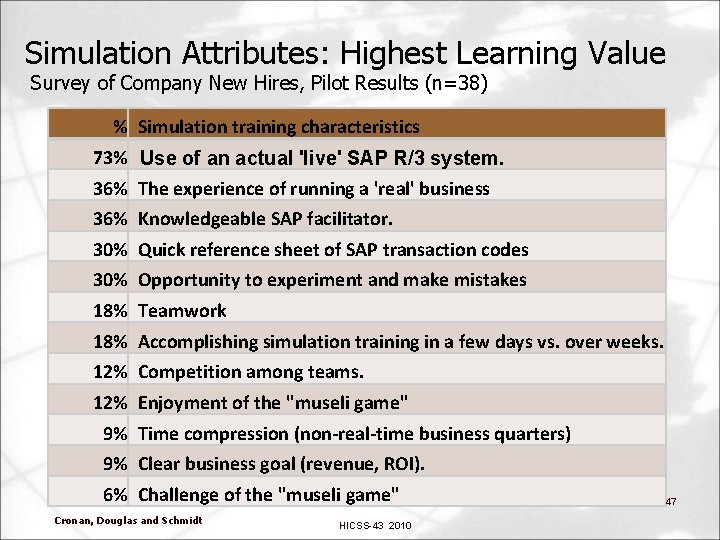
Simulation Attributes: Learning Value (New Hires Sample, N=38) % Simulation Attribute 73% Use of an actual 'live' SAP R/3 system. 36% The experience of running a 'real' business 36% Knowledgeable SAP facilitator. 30% Quick reference sheet of SAP transaction codes 30% Opportunity to experiment and make mistakes 18% Teamwork 18% Doing simulation training in few days vs. weeks. 12% Competition among teams. 12% Enjoyment of the “Muesli game" Cronan, Douglas and Schmidt P. J. Schmidt HICSS-43 2010 36
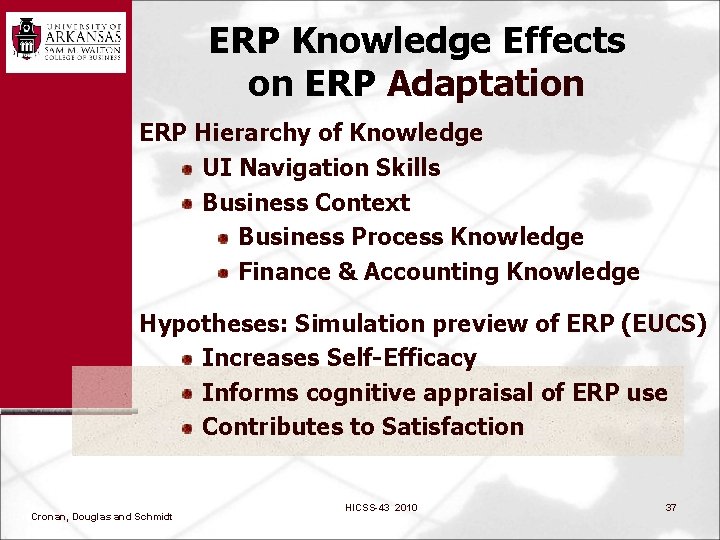
ERP Knowledge Effects on ERP Adaptation ERP Hierarchy of Knowledge UI Navigation Skills Business Context Business Process Knowledge Finance & Accounting Knowledge Hypotheses: Simulation preview of ERP (EUCS) Increases Self-Efficacy Informs cognitive appraisal of ERP use Contributes to Satisfaction Cronan, Douglas and Schmidt HICSS-43 2010 37
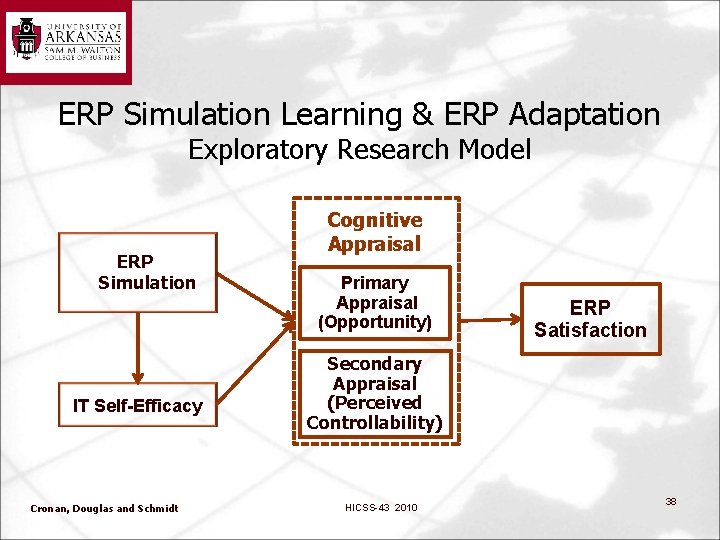
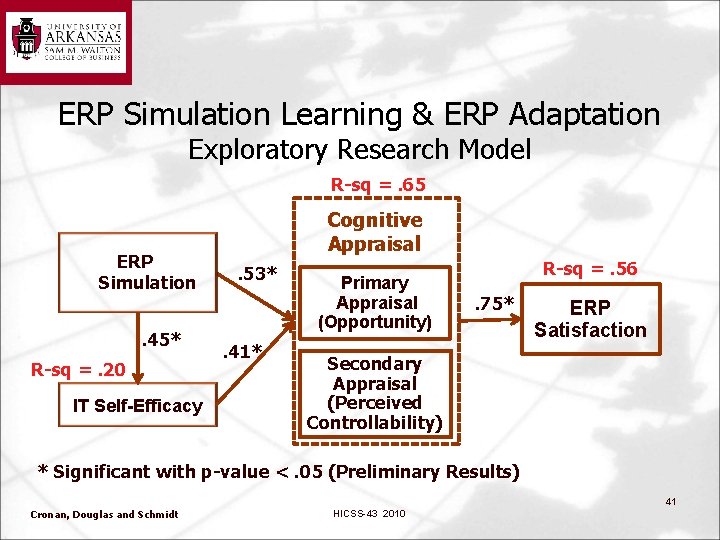
ERP Simulation Learning & ERP Adaptation Exploratory Research Model ERP Simulation IT Self-Efficacy Cronan, Douglas and Schmidt Cognitive Appraisal Primary Appraisal (Opportunity) ERP Satisfaction Secondary Appraisal (Perceived Controllability) HICSS-43 2010 38
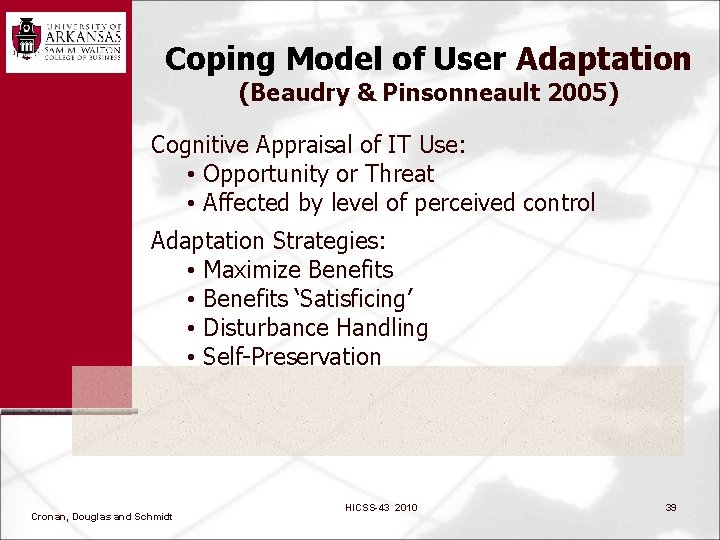
Coping Model of User Adaptation (Beaudry & Pinsonneault 2005) Cognitive Appraisal of IT Use: • Opportunity or Threat • Affected by level of perceived control Adaptation Strategies: • Maximize Benefits • Benefits ‘Satisficing’ • Disturbance Handling • Self-Preservation Cronan, Douglas and Schmidt HICSS-43 2010 39
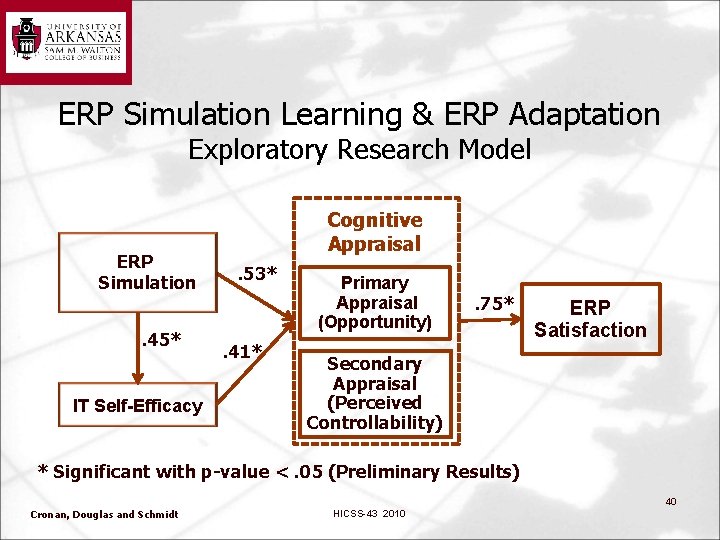
ERP Simulation Learning & ERP Adaptation Exploratory Research Model ERP Simulation. 45* IT Self-Efficacy Cognitive Appraisal. 53* . 41* Primary Appraisal (Opportunity) . 75* ERP Satisfaction Secondary Appraisal (Perceived Controllability) * Significant with p-value <. 05 (Preliminary Results) 40 Cronan, Douglas and Schmidt HICSS-43 2010
ERP Simulation Learning & ERP Adaptation Exploratory Research Model R-sq =. 65 ERP Simulation. 45* R-sq =. 20 IT Self-Efficacy Cognitive Appraisal. 53* . 41* Primary Appraisal (Opportunity) R-sq =. 56. 75* ERP Satisfaction Secondary Appraisal (Perceived Controllability) * Significant with p-value <. 05 (Preliminary Results) 41 Cronan, Douglas and Schmidt HICSS-43 2010
Thank you to participating Universities! Ball State University California State University, Chico Emporia State University Georgia Southern University So. Illinois State Univ. , Edwardsville Ted Rogers School of IT Management University of Arkansas University of Delaware University of Houston University of Nevada, Reno University of Southern California University of Tampa A request to traditional ERP and ERPsim instructors: Please participate in Spring 2010 ERP survey (ERPsim) by contacting Pam Schmidt at pschmidt@uark. edu Cronan, Douglas and Schmidt HICSS-43 2010 42
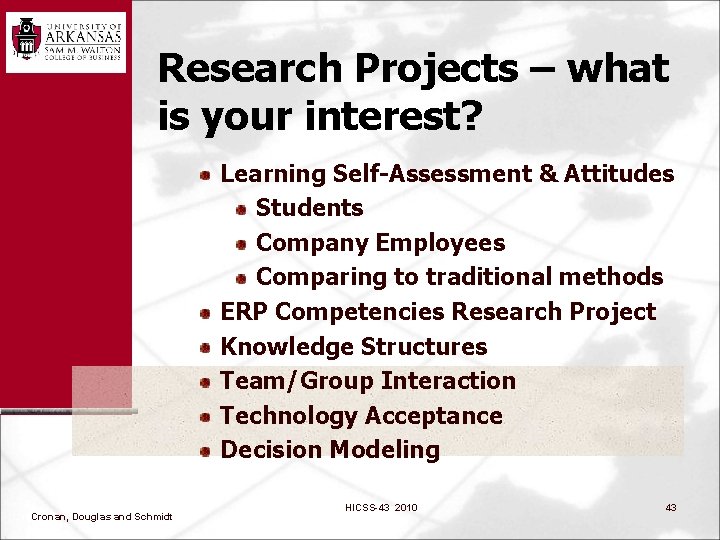
Research Projects – what is your interest? Learning Self-Assessment & Attitudes Students Company Employees Comparing to traditional methods ERP Competencies Research Project Knowledge Structures Team/Group Interaction Technology Acceptance Decision Modeling Cronan, Douglas and Schmidt HICSS-43 2010 43
Enterprise Resource Planning Research Thank you ! Cronan, Douglas and Schmidt HICSS-43 2010 44
Cronan, Douglas and Schmidt HICSS-43 2010 45
Backup Slides Cronan, Douglas and Schmidt HICSS-43 2010 46
Simulation Attributes: Highest Learning Value Survey of Company New Hires, Pilot Results (n=38) % Simulation training characteristics 73% Use of an actual 'live' SAP R/3 system. 36% The experience of running a 'real' business 36% Knowledgeable SAP facilitator. 30% Quick reference sheet of SAP transaction codes 30% Opportunity to experiment and make mistakes 18% Teamwork 18% Accomplishing simulation training in a few days vs. over weeks. 12% Competition among teams. 12% Enjoyment of the "museli game" 9% Time compression (non-real-time business quarters) 9% Clear business goal (revenue, ROI). 6% Challenge of the "museli game" Cronan, Douglas and Schmidt HICSS-43 2010 47
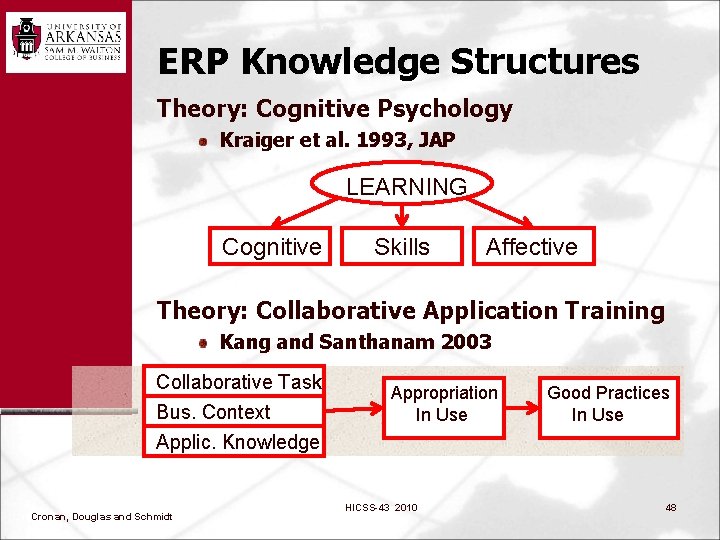
ERP Knowledge Structures Theory: Cognitive Psychology Kraiger et al. 1993, JAP LEARNING Cognitive Skills Affective Theory: Collaborative Application Training Kang and Santhanam 2003 Collaborative Task Bus. Context Applic. Knowledge Cronan, Douglas and Schmidt Appropriation In Use HICSS-43 2010 Good Practices In Use 48
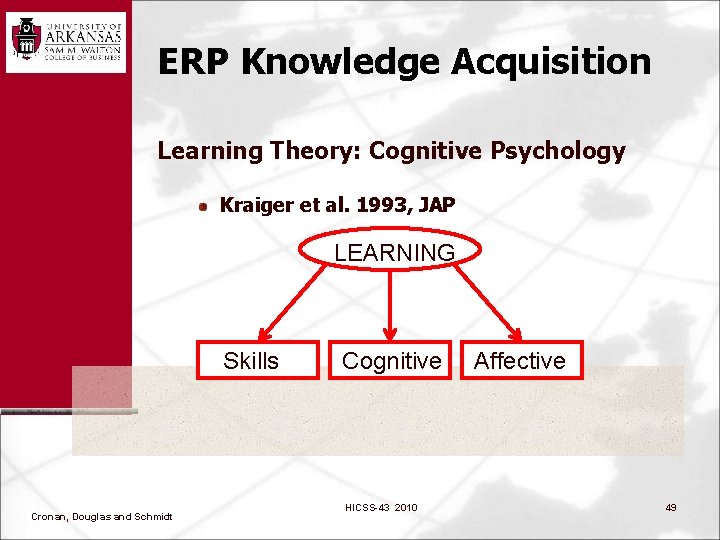
ERP Knowledge Acquisition Learning Theory: Cognitive Psychology Kraiger et al. 1993, JAP LEARNING Skills Cronan, Douglas and Schmidt Cognitive HICSS-43 2010 Affective 49
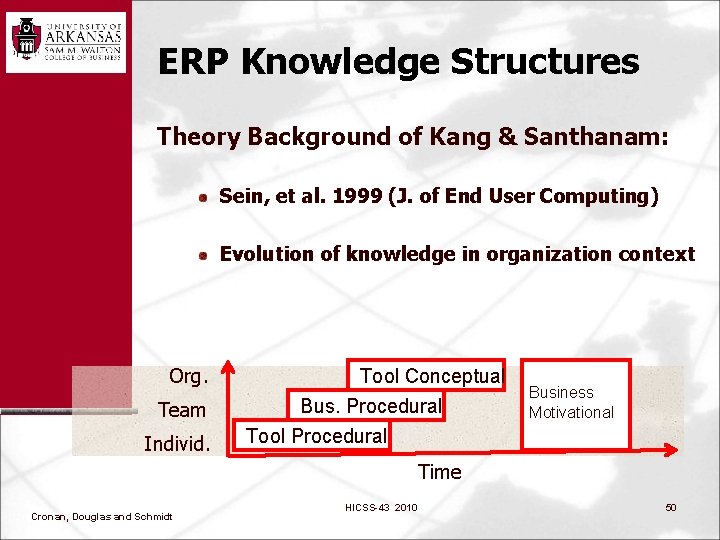
ERP Knowledge Structures Theory Background of Kang & Santhanam: Sein, et al. 1999 (J. of End User Computing) Evolution of knowledge in organization context Org. Team Individ. Tool Conceptual Bus. Procedural Tool Procedural Business Motivational Time Cronan, Douglas and Schmidt HICSS-43 2010 50
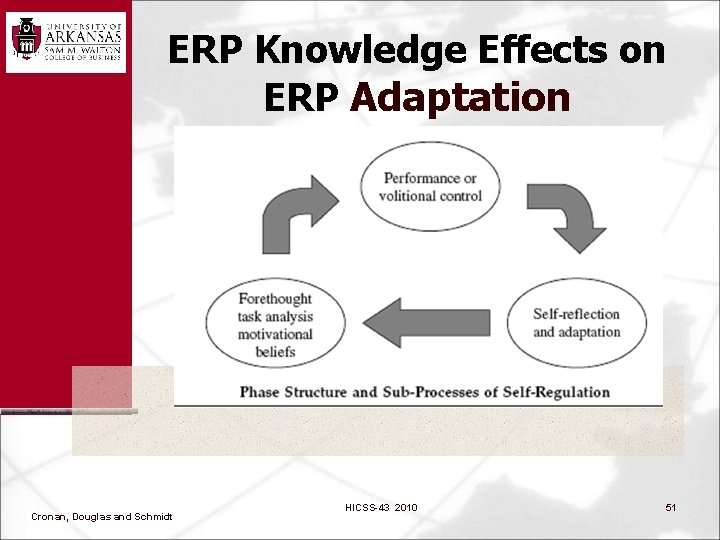
ERP Knowledge Effects on ERP Adaptation Cronan, Douglas and Schmidt HICSS-43 2010 51