
Enterprise Resource Planning IST 421 Spring 2007 ERP


- Slides: 26
Enterprise Resource Planning IST 421 Spring 2007
ERP Evolution Integrated applications seem obvious today n Complex hardware and software system not feasible until the 1990’s n ERP systems evolved as a result n – Development of hardware & software technology – Development of a vision of integrated information systems
ERP Evolution n Integrated Vision: – Materials Requirements Planning (MRP) used for inventory tracking n Electronic Data Interchange (EDI) – enabled processing of purchases – avoided paper purchase orders & invoicing systems n Start of Supply-Chain Management
ERP Evolution Business model started in 1930’s by Alfred P. Sloan – Functional Model of Business Organization n During economic problems of 1980’s and 1990’s, view changed to cross-functional processes. n Michael Hammer’s 1993 book, Reengineering the Corporation: A Manifesto for Business Revolution n
ERP Evolution ERP software was seen as a solution to business problems n Number of ERP vendors: n – SAP (Systems, Applications, and Products in Data Processing ) – People. Soft – Oracle – Baan – J. D. Edwards
ERP Applications n Best-of-Breed approach n Each ERP vendor had perceived specialty – SAP – Production Planning & Materials Management – People. Soft – Human Resources n As is install or customize?
ERP Applications n Failed package installation projects – Dell Computers cancelled implementation – Owens-Corning lengthy implementation – Fox. Meyer drug company (bankrupt) lawsuit n In a fortune 500 company, software, hardware and consulting fees exceed $100 million and take years to fully implement
ERP Applications n Most use three-tier architecture – Presentation layer – Application server layer – Database layer n Various integration techniques – Proprietary – EDI, COM, CORBA, Java
ERP Applications n Business Vision – What business problem is being addressed? n Adopt “best practices” addressed by software vs. customization?
ERP Applications n Returns expected? – 33% of companies saw a cost savings in sales order management – 34% reduced personnel needs – More sales can be generated through streamlined process – Reduced frustration n Realized returns?
Supply Chain Management
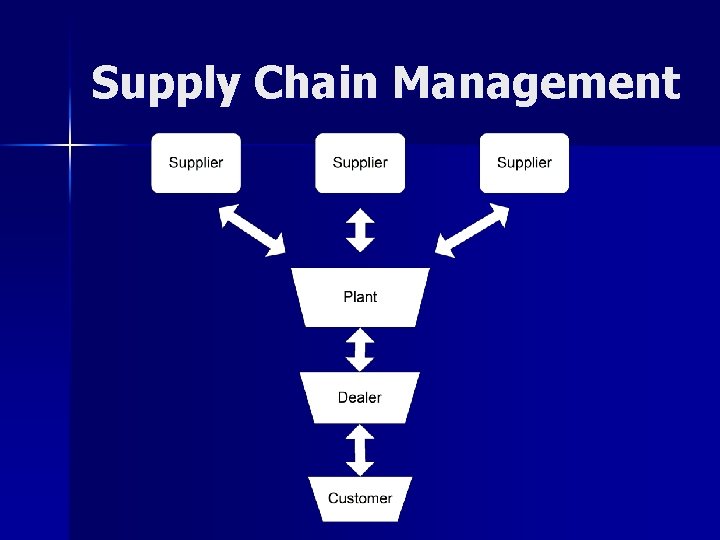
Supply Chain Management n Supply chains support the flow of goods and services from their origin to their endpoint – the customer.
Supply Chain Management
Supply Chain Management n Supply Chain Management (SCM) comprises – business-management applications that provide guidance on which products to manufacture, – when, – and where they should be distributed.
Supply Chain Management n The category includes software that: – manages plant scheduling, – demand forecasting, – ordering raw materials and – related functions
Supply Chain Management n Plant automation applications are involved in the actual manufacturing processes, such as: – machining, – material movement, – blending, – heating, – cooling, etc.
Supply Chain Management n These applications are generally hosted on small, independent controllers, on Supervisory Control and Data Acquisition systems running on PCs, or on complex and elaborate distributed control systems.
Supply Chain Management n Prior to 1999, most companies were looking at the supply chain from an internal perspective. n The emphasis was on bringing together the operations of manufacturing, planning and scheduling with sales and marketing. n Many companies turned to Enterprise Resource Planning (ERP) and advance planning and scheduling systems to bring together the procurement process internally.
Integrated Supply Chain n Step 1: automate and optimize major business processes within each member organization. n Step 2: Extend the enterprise to all members in the supply chain
Integrated Supply Chain n Standards: – Process-based standards: n eb. XML & Rosetta. Net n Create common processes that span enterprises n Provide common metadata n Information exchange infrastructures
Integrated Supply Chain – Service-based standards: n Common services to support trading community n Example: web service globally accessible to calculate shipping costs n Share common processes and application services span multiple companies n Services need to be accessible and neutral
Integrated Supply Chain – Message-based standards: n Focus on exchange of information between organizations n EDI example of format n Easy to implement n Doesn’t address common processes
EDI
EDI n Short for Electronic Data Interchange – the transfer of data between different companies using networks, such as the Internet. – ANSI has approved a set of EDI standards known as the X 12 standards. Source: www. webopedia. com/TERM/E/EDI. html - 46 k - Sep 14, 2005
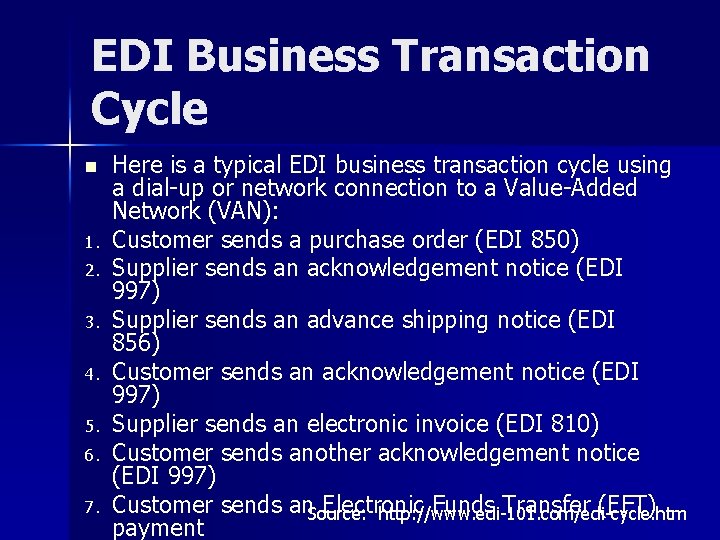
EDI Business Transaction Cycle n 1. 2. 3. 4. 5. 6. 7. Here is a typical EDI business transaction cycle using a dial-up or network connection to a Value-Added Network (VAN): Customer sends a purchase order (EDI 850) Supplier sends an acknowledgement notice (EDI 997) Supplier sends an advance shipping notice (EDI 856) Customer sends an acknowledgement notice (EDI 997) Supplier sends an electronic invoice (EDI 810) Customer sends another acknowledgement notice (EDI 997) Customer sends an. Source: Electronic Funds Transfer (EFT) http: //www. edi-101. com/edi-cycle. htm payment
Sample n http: //www. edi-service. com/stds_rqst. htm