
Enterprise Operations Strategic Planning Overview EGN 5622 Enterprise


- Slides: 65
Enterprise Operations & Strategic Planning Overview EGN 5622 Enterprise Systems Integration Spring, 2012
Enterprise Operations & Strategic Planning Overview Theories & Concepts EGN 5622 Enterprise Systems Integration
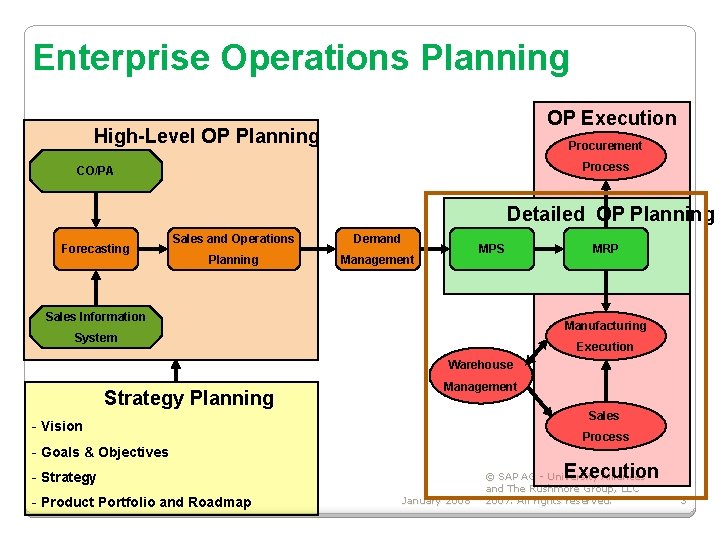
Enterprise Operations Planning OP Execution High-Level OP Planning Procurement Process CO/PA Detailed OP Planning Forecasting Sales and Operations Demand Planning Management MPS Sales Information MRP Manufacturing System Execution Warehouse Strategy Planning Management Sales - Vision Process - Goals & Objectives Execution - Strategy - Product Portfolio and Roadmap January 2008 © SAP AG - University Alliances and The Rushmore Group, LLC 2007. All rights reserved. 3
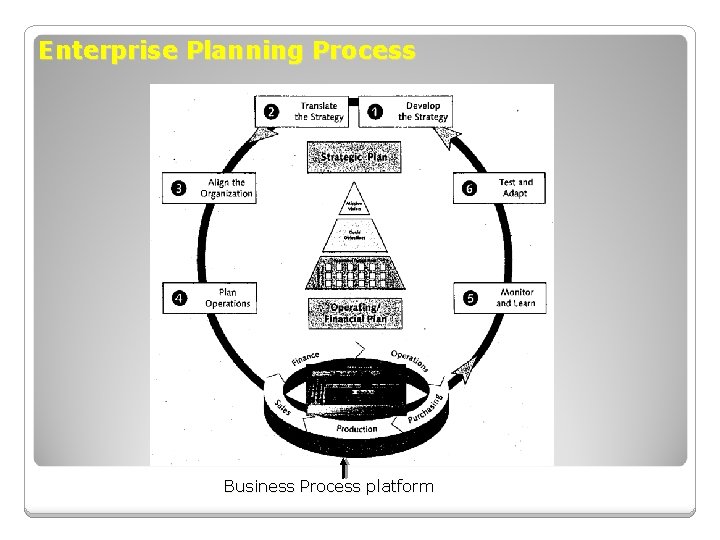
Enterprise Planning Process Business Process platform
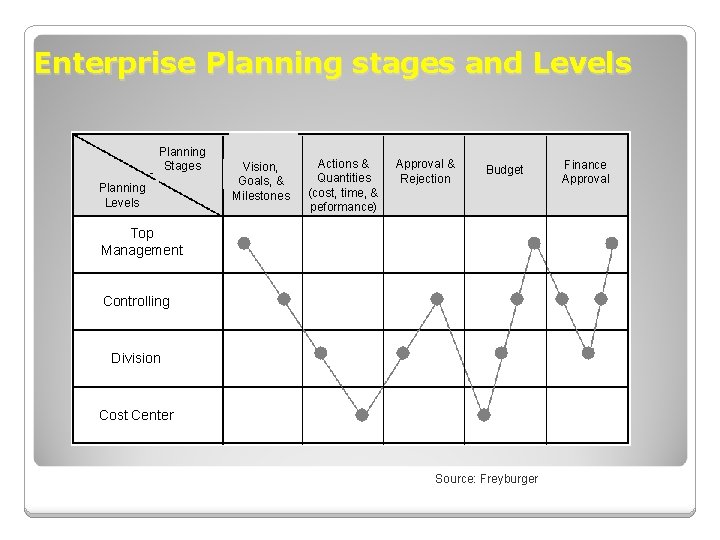
Enterprise Planning stages and Levels Planning Stages Planning Levels Vision, Goals, & Milestones Actions & Quantities (cost, time, & peformance) Approval & Rejection Budget Top Management Controlling Division Cost Center Source: Freyburger Finance Approval
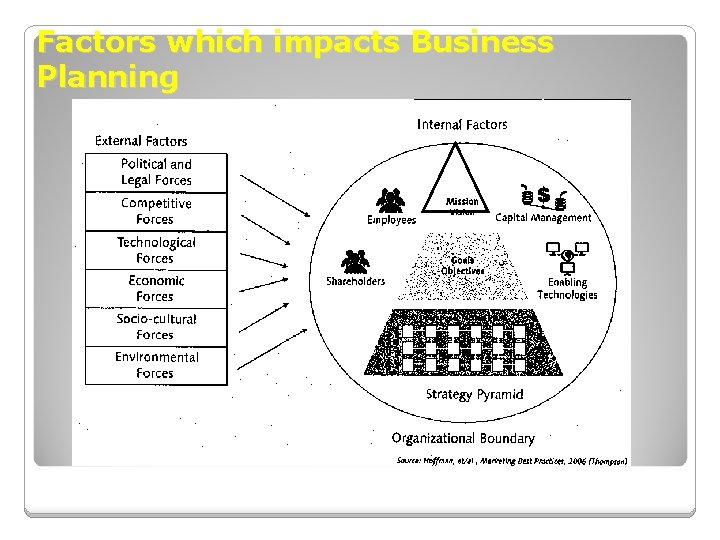
Factors which impacts Business Planning
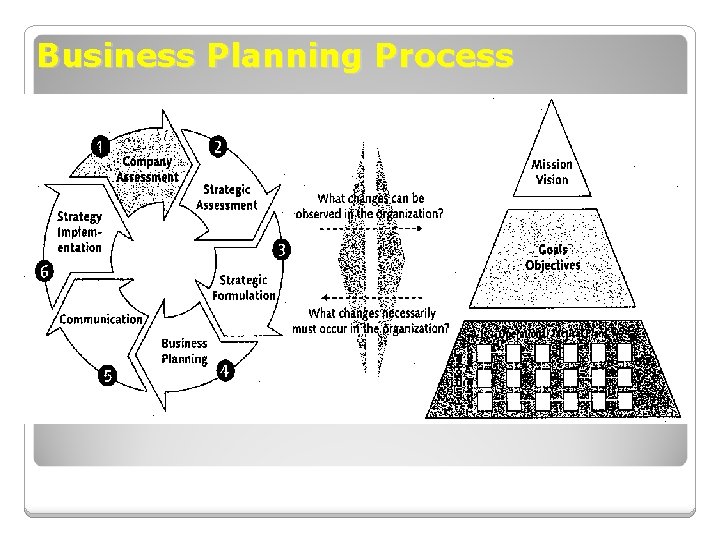
Business Planning Process
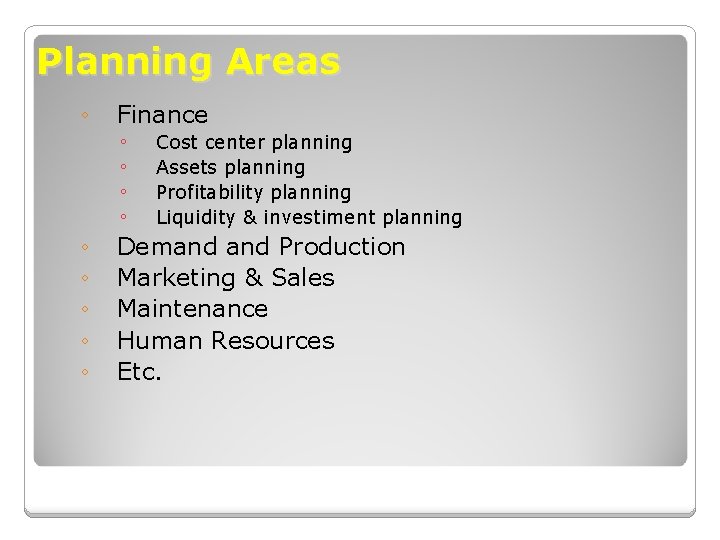
Planning Areas ◦ ◦ ◦ Finance ◦ ◦ Cost center planning Assets planning Profitability planning Liquidity & investiment planning Demand Production Marketing & Sales Maintenance Human Resources Etc.
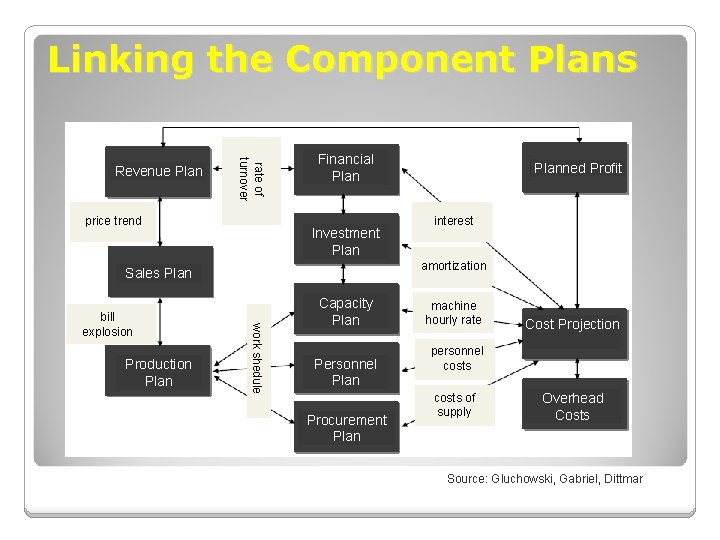
Linking the Component Plans rate of turnover Revenue Plan price trend Financial Plan Investment Plan work shedule Production Plan interest amortization Sales Plan bill explosion Planned Profit Capacity Plan Personnel Plan Procurement Plan machine hourly rate Cost Projection personnel costs of supply Overhead Costs Source: Gluchowski, Gabriel, Dittmar
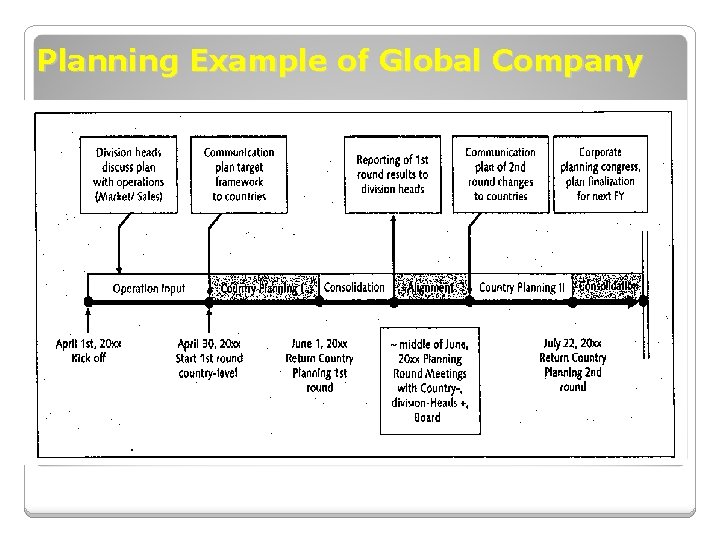
Planning Example of Global Company
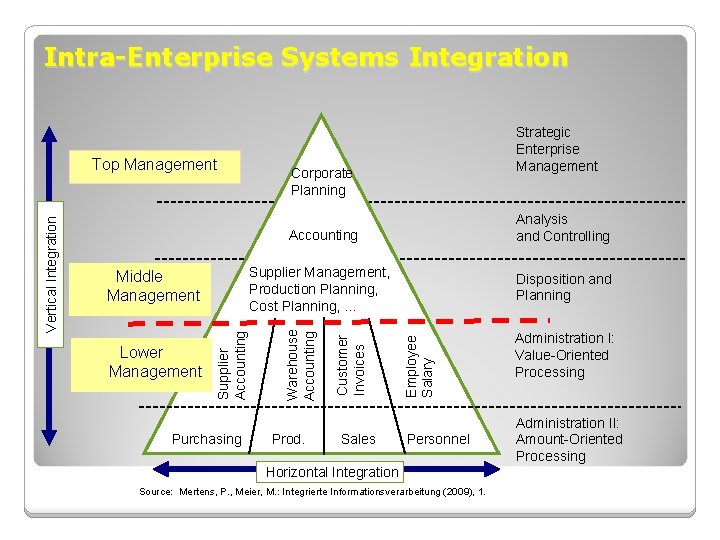
Intra-Enterprise Systems Integration Corporate Planning Analysis and Controlling Accounting Purchasing Prod. Sales Disposition and Planning Employee Salary Customer Invoices Lower Management Warehouse Accounting Supplier Management, Production Planning, Cost Planning, … Middle Management Supplier Accounting Vertical Integration Top Management Strategic Enterprise Management Personnel Horizontal Integration Source: Mertens, P. , Meier, M. : Integrierte Informationsverarbeitung (2009), 1. Administration I: Value-Oriented Processing Administration II: Amount-Oriented Processing
Enterprise Operations & Strategic Planning Overview Theories & Concepts EGN 5622 Enterprise Systems Integration
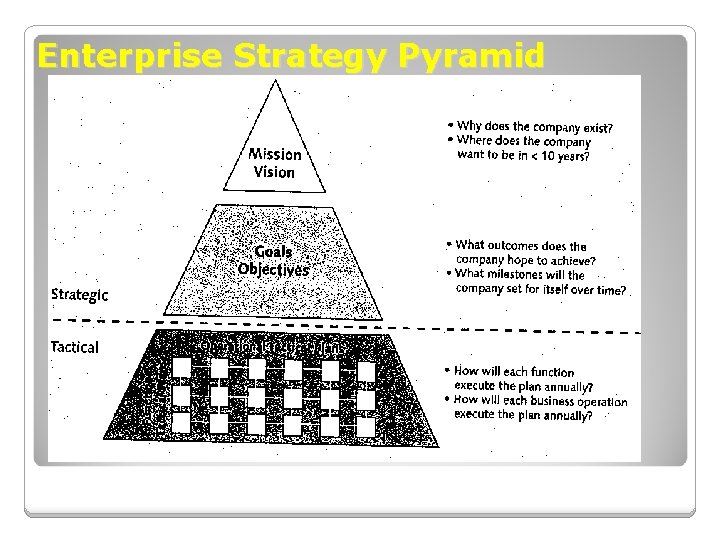
Enterprise Strategy Pyramid
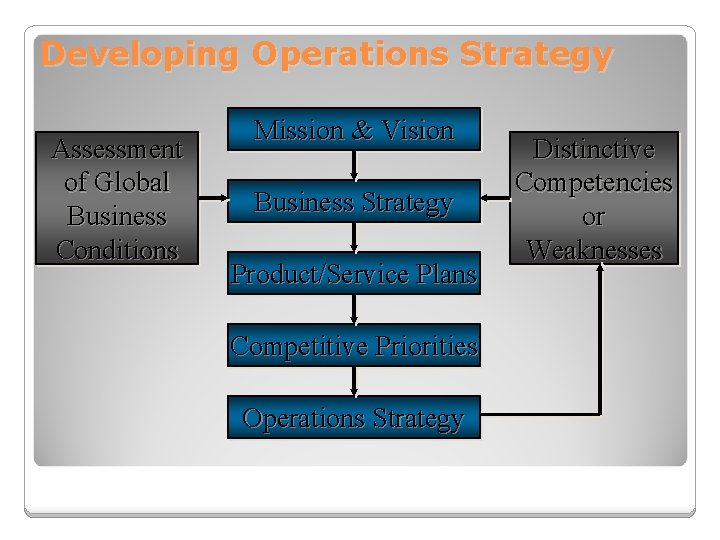
Developing Operations Strategy Assessment of Global Business Conditions Mission & Vision Business Strategy Product/Service Plans Competitive Priorities Operations Strategy Distinctive Competencies or Weaknesses
Corporate Mission & Vision l. A corporate mission is a set of long-range goals and including statements about: lthe kind of business the company wants to be in lwho its customers are lits basic beliefs about business l. Its goals of survival, growth, and profitability l. A corporate vision is a description of where the company ought to be in the future (i. e. , positioning itself in the future)
Business Strategy l Business strategy is a long-range game plan of an organization and provides a road map of how to achieve the corporate mission (or vision). l Inputs to the business strategy are l. Assessment of global business conditions social, economic, political, technological, competitive l. Distinctive competencies or weaknesses workers, sales force, R&D, technology, management
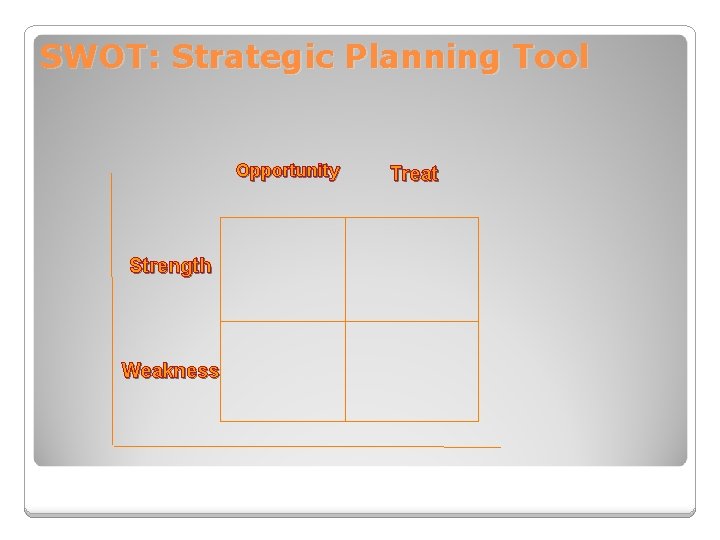
SWOT: Strategic Planning Tool Opportunity Strength Weakness Treat
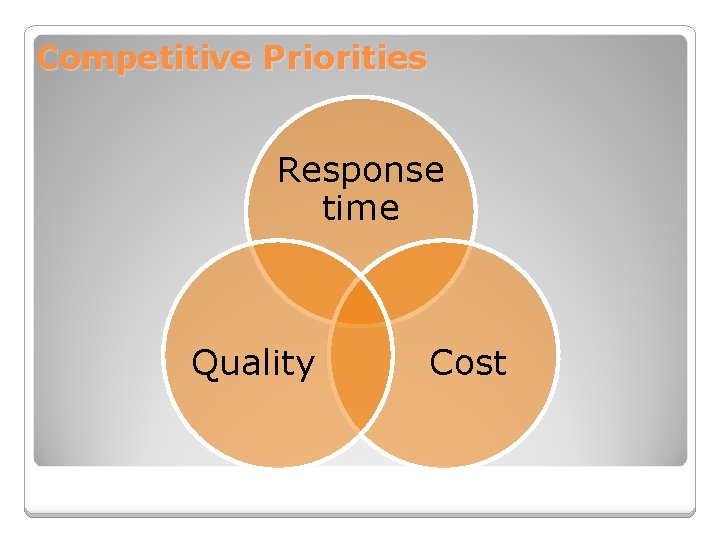
Competitive Priorities Response time Quality Cost
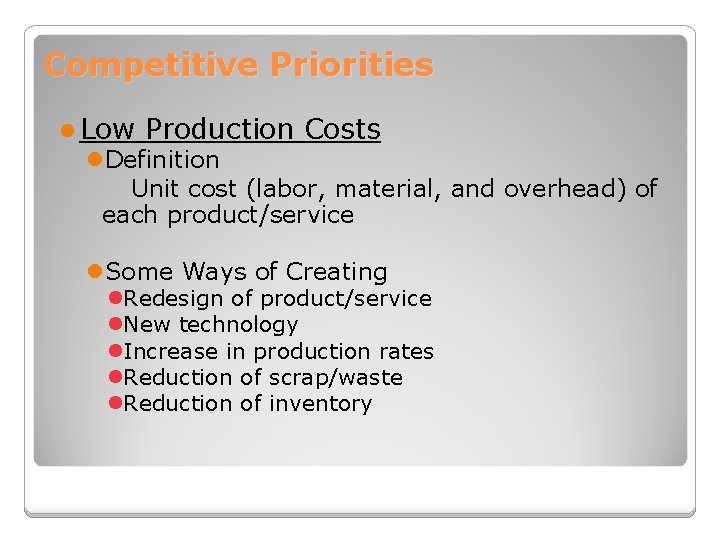
Competitive Priorities l Low Production Costs l. Definition Unit cost (labor, material, and overhead) of each product/service l. Some Ways of Creating l. Redesign of product/service l. New technology l. Increase in production rates l. Reduction of scrap/waste l. Reduction of inventory
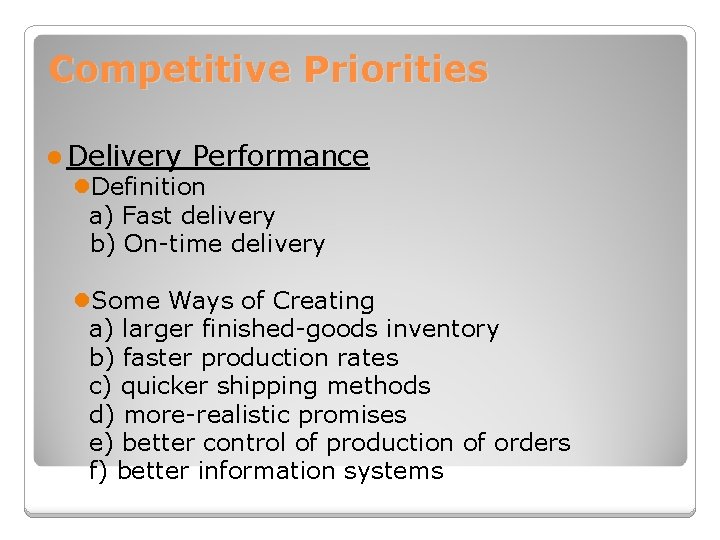
Competitive Priorities l Delivery Performance l. Definition a) Fast delivery b) On-time delivery l. Some Ways of Creating a) larger finished-goods inventory b) faster production rates c) quicker shipping methods d) more-realistic promises e) better control of production of orders f) better information systems
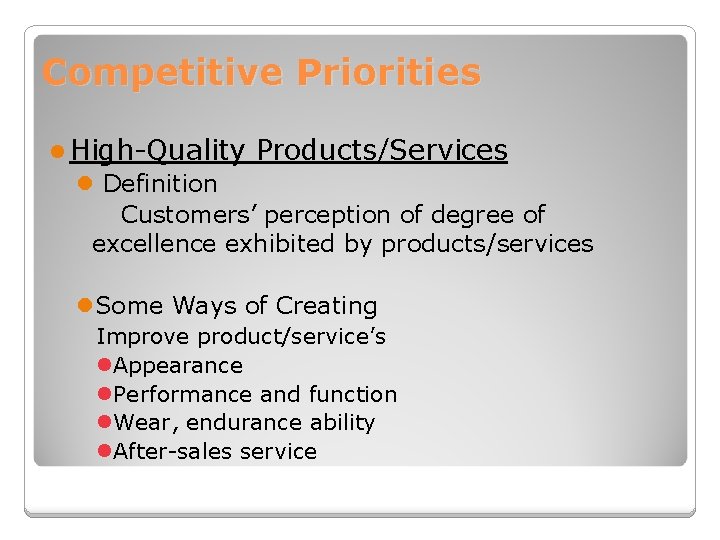
Competitive Priorities l High-Quality Products/Services l Definition Customers’ perception of degree of excellence exhibited by products/services l. Some Ways of Creating Improve product/service’s l. Appearance l. Performance and function l. Wear, endurance ability l. After-sales service
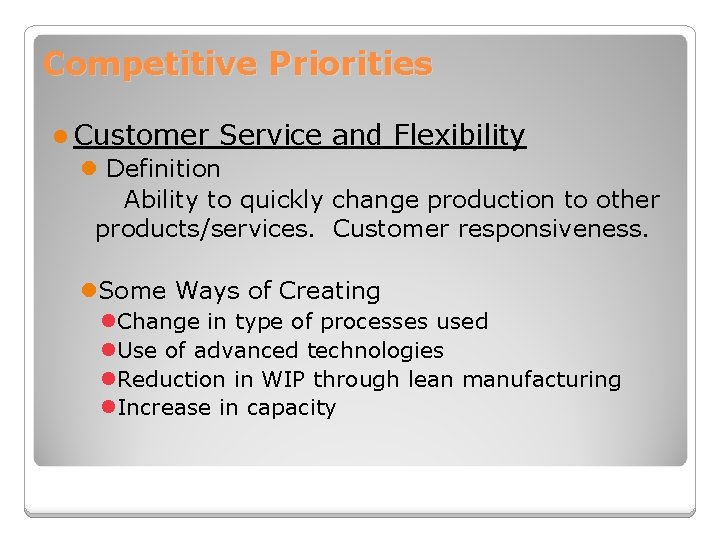
Competitive Priorities l Customer Service and Flexibility l Definition Ability to quickly change production to other products/services. Customer responsiveness. l. Some Ways of Creating l. Change in type of processes used l. Use of advanced technologies l. Reduction in WIP through lean manufacturing l. Increase in capacity
Operations Strategy l Operations strategy is a long-range game plan for the production of a company’s products/services, and provides a road map for the production function in helping to achieve the business strategy.
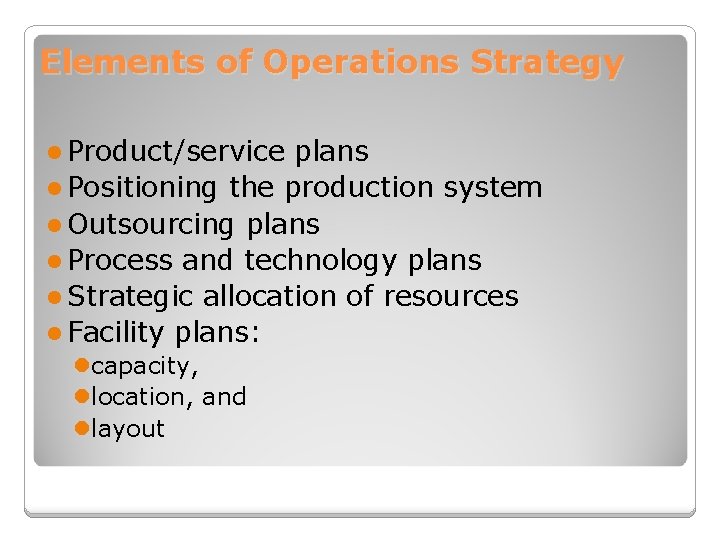
Elements of Operations Strategy l Product/service plans l Positioning the production system l Outsourcing plans l Process and technology plans l Strategic allocation of resources l Facility plans: lcapacity, llocation, and llayout
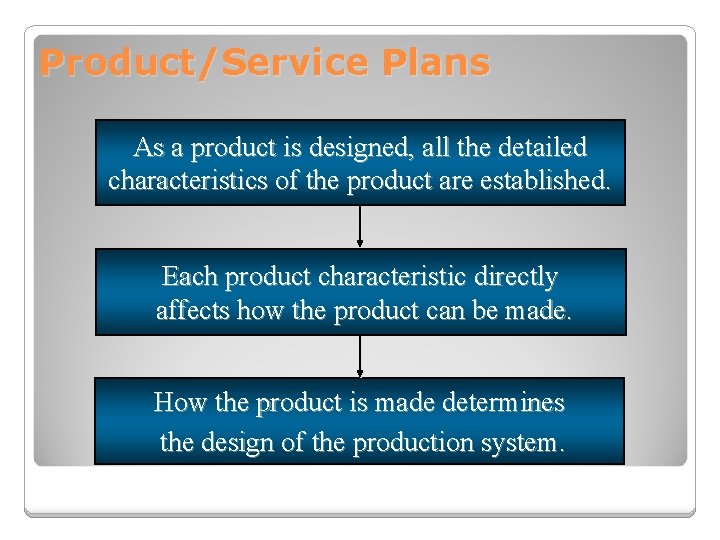
Product/Service Plans As a product is designed, all the detailed characteristics of the product are established. Each product characteristic directly affects how the product can be made. How the product is made determines the design of the production system.
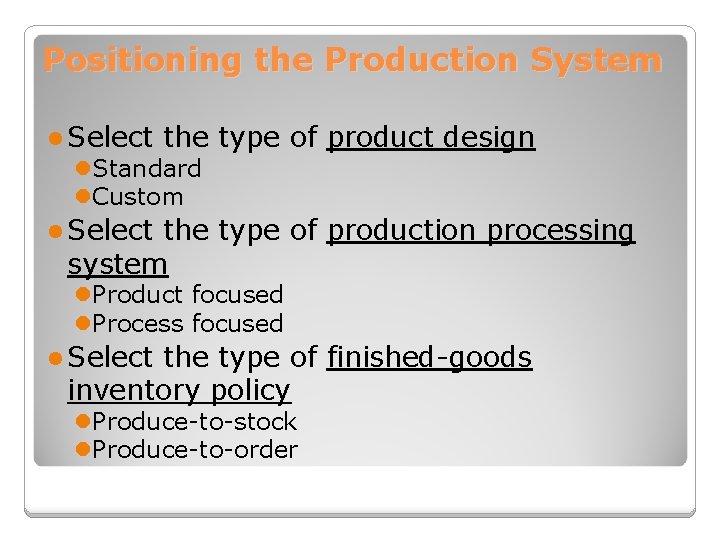
Positioning the Production System l Select the l. Standard l. Custom type of product design l Select the type of production processing system l. Product focused l. Process focused l Select the type of finished-goods inventory policy l. Produce-to-stock l. Produce-to-order
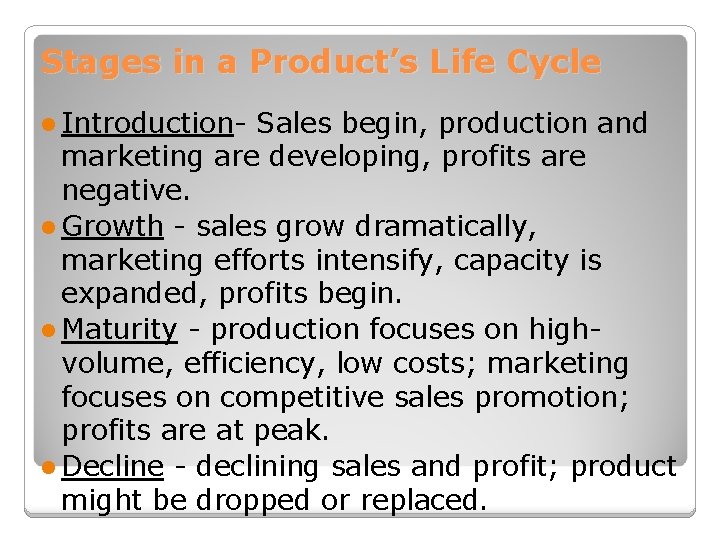
Stages in a Product’s Life Cycle l Introduction- Sales begin, production and marketing are developing, profits are negative. l Growth - sales grow dramatically, marketing efforts intensify, capacity is expanded, profits begin. l Maturity - production focuses on highvolume, efficiency, low costs; marketing focuses on competitive sales promotion; profits are at peak. l Decline - declining sales and profit; product might be dropped or replaced.
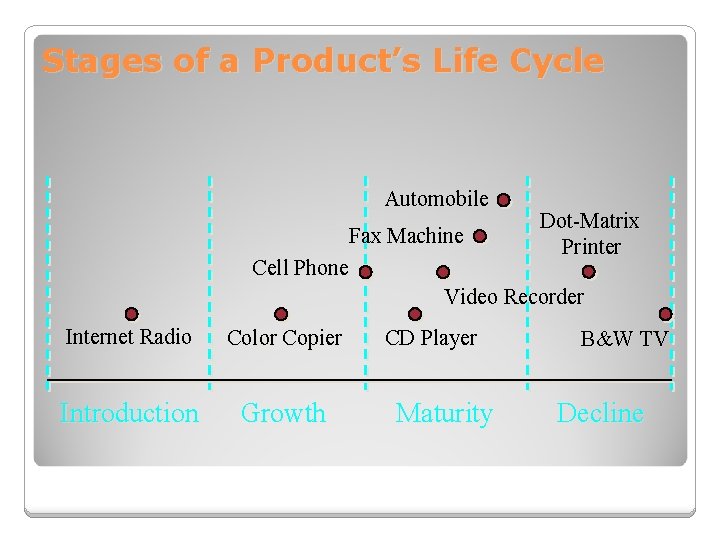
Stages of a Product’s Life Cycle Automobile Dot-Matrix Fax Machine Printer Cell Phone Video Recorder Internet Radio Color Copier Introduction Growth CD Player Maturity B&W TV Decline
Outsourcing refers to hiring out or subcontracting some of the work that a company needs to do. l This strategy is being used more and more as companies strive to operate more efficiently. l Outsourcing has many advantages and disadvantages. l Companies try to determine the best level of outsourcing to achieve their operations & business goals. l More outsourcing requires a company to have less equipment, fewer employees, and a smaller facility. l
Outsourcing Plans l. A company might outsource any of the following manufacturing related functions: l. Designing the product l. Purchasing the basic raw materials l. Processing the subcomponents, subassemblies, major assemblies, and finished product l. Distributing the product
Outsourcing Plans l Many companies even outsource some service functions such as: l. Payroll l. Billing l. Order processing l. Developing/maintaining a website l. Employee recruitment l. Facility maintenance
Process and Technology Plans l An essential part of operations strategy is the determination of how products/services will be produced. l The range of technologies available to produce products/services is great and is continually changing.
Strategic Allocation of Resources l For most companies, the vast majority of the firm’s resources are used in production/operations. l Some or all of these resources are limited. l The resources must be allocated to products, services, projects, or profit opportunities in ways that maximize the achievement of the operations objectives.
Facility Plans l How to provide the long-range capacity to produce the firm’s products/services is a critical strategic decision. l The location of a new facility may need to be decided. l The internal arrangement (layout) of workers, equipment, and functional areas within a facility affects the ability to provide the desired volume, quality, and cost of products/services.
Competitive Priorities for Services l The competitive priorities listed earlier for manufacturers apply to service firms as well l. Low production costs l. Fast and on-time delivery l. High-quality products/services l. Customer service and flexibility l Providing all the priorities simultaneously to customers is seldom possible.
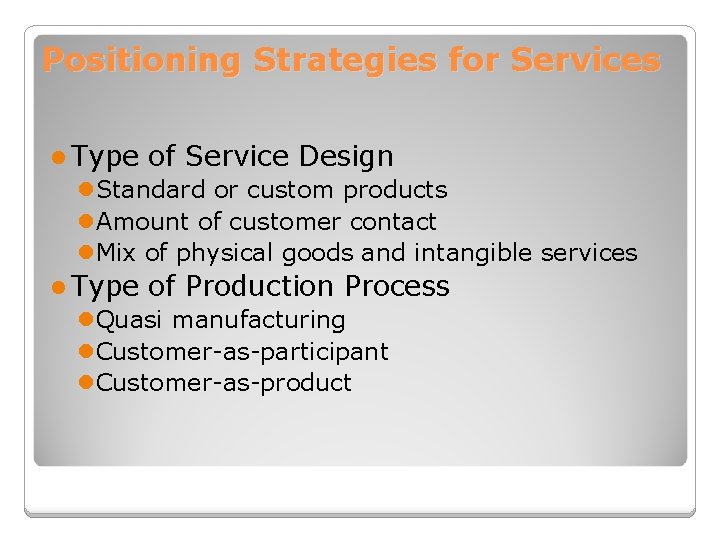
Positioning Strategies for Services l Type of Service Design l. Standard or custom products l. Amount of customer contact l. Mix of physical goods and intangible services l Type of Production Process l. Quasi manufacturing l. Customer-as-participant l. Customer-as-product
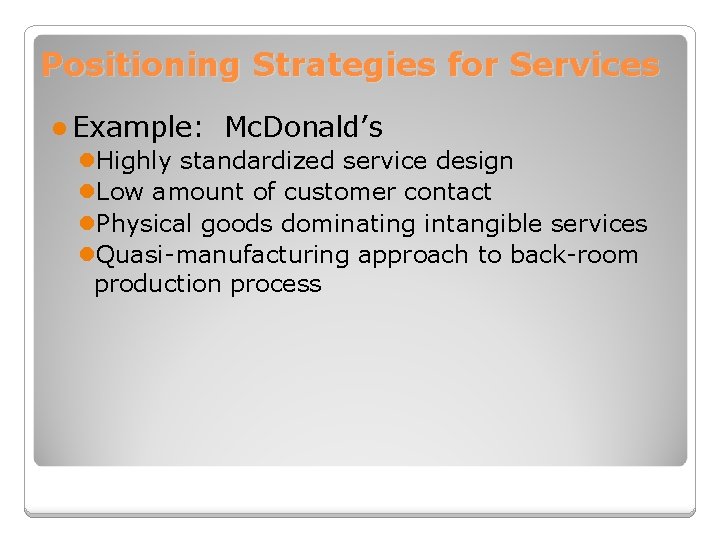
Positioning Strategies for Services l Example: Mc. Donald’s l. Highly standardized service design l. Low amount of customer contact l. Physical goods dominating intangible services l. Quasi-manufacturing approach to back-room production process
Forming Operations Strategies l Support the product plans and competitive priorities defined in the business strategy. l Adjust to the evolving positioning strategies. l Link to the marketing strategies. l Look at alternative operations strategies.
Evolution of Positioning Strategies l The characteristics of production systems tend to evolve as products move through their product life cycles. l Operations strategies must include plan for modifying production systems to a changing set of competitive priorities as products mature. l The capital and production technology required to support these changes must be provided.
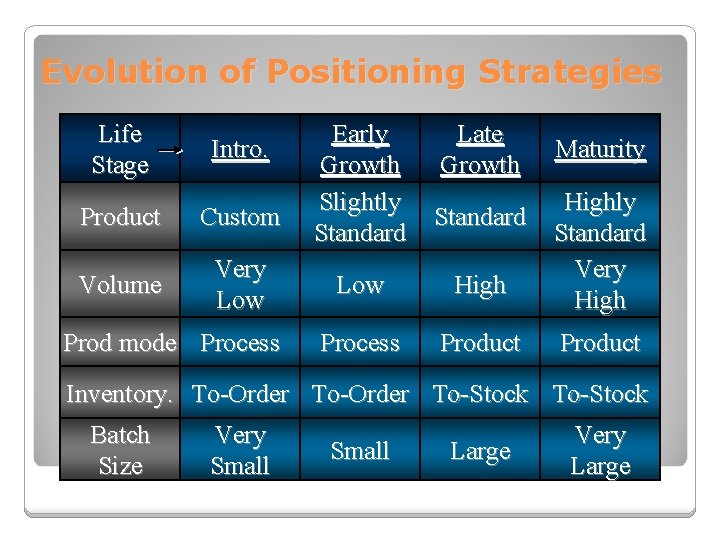
Evolution of Positioning Strategies Life Stage Intro. Product Custom Volume Very Low Prod mode Process Early Growth Slightly Standard Late Growth Standard Low High Process Product Maturity Highly Standard Very High Product Inventory. To-Order To-Stock Batch Size Very Small Large Very Large
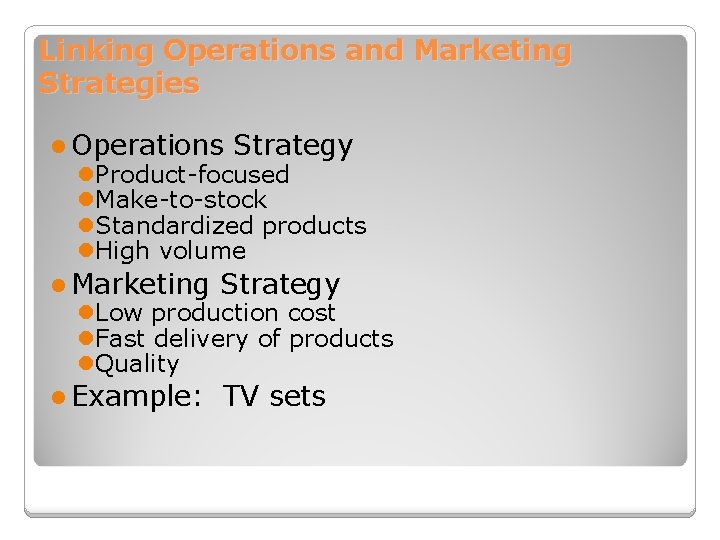
Linking Operations and Marketing Strategies l Operations Strategy l. Product-focused l. Make-to-stock l. Standardized products l. High volume l Marketing Strategy l. Low production cost l. Fast delivery of products l. Quality l Example: TV sets
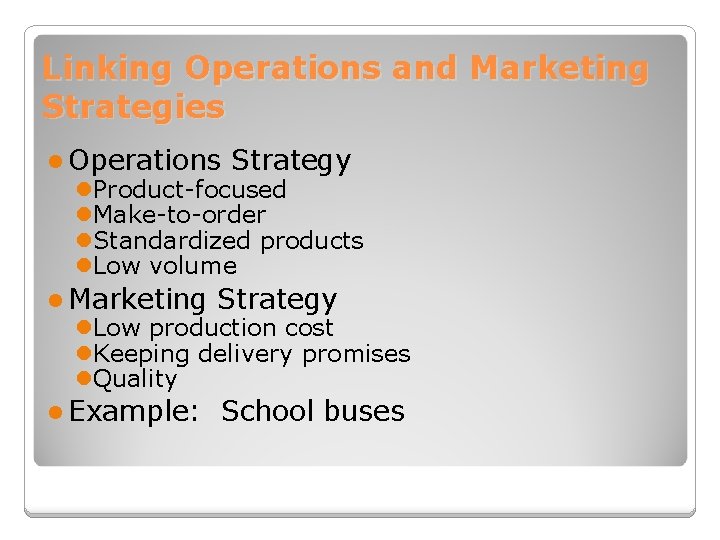
Linking Operations and Marketing Strategies l Operations Strategy l. Product-focused l. Make-to-order l. Standardized products l. Low volume l Marketing Strategy l. Low production cost l. Keeping delivery promises l. Quality l Example: School buses
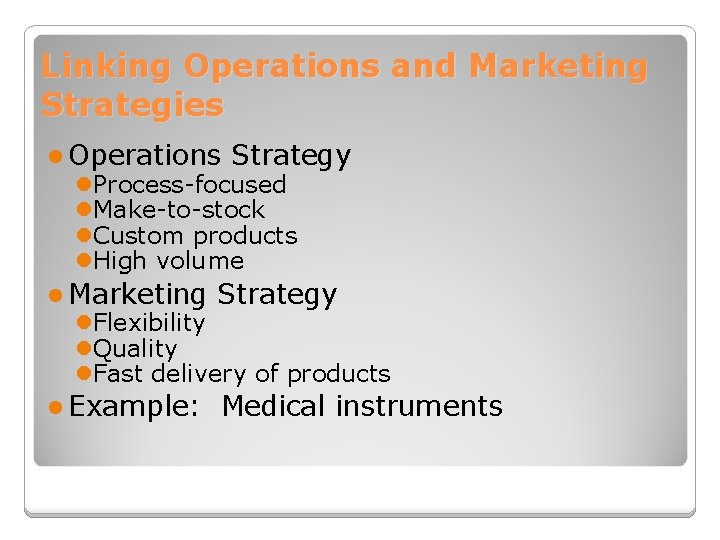
Linking Operations and Marketing Strategies l Operations Strategy l. Process-focused l. Make-to-stock l. Custom products l. High volume l Marketing Strategy l. Flexibility l. Quality l. Fast delivery of products l Example: Medical instruments
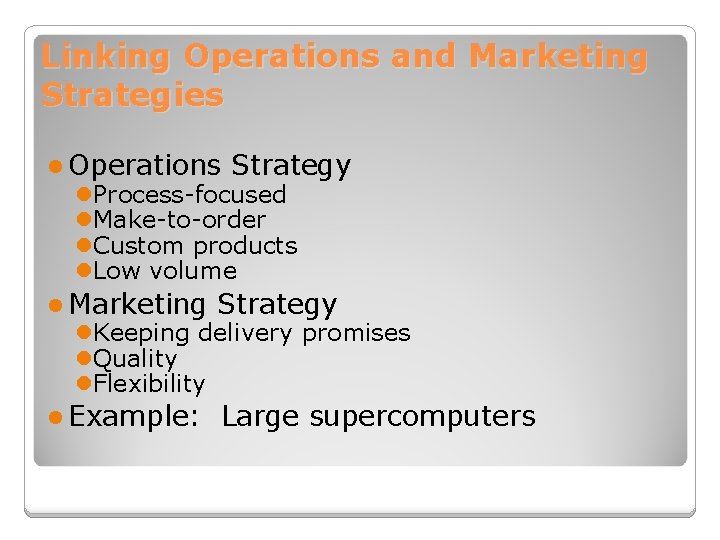
Linking Operations and Marketing Strategies l Operations Strategy l. Process-focused l. Make-to-order l. Custom products l. Low volume l Marketing Strategy l. Keeping delivery promises l. Quality l. Flexibility l Example: Large supercomputers
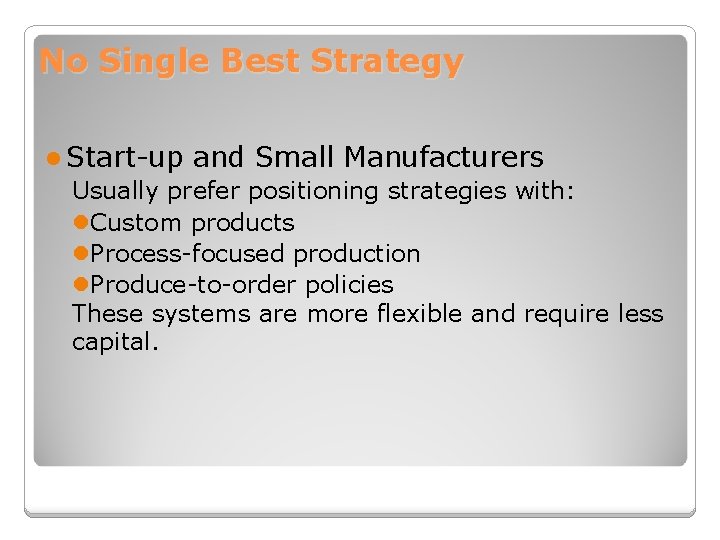
No Single Best Strategy l Start-up and Small Manufacturers Usually prefer positioning strategies with: l. Custom products l. Process-focused production l. Produce-to-order policies These systems are more flexible and require less capital.
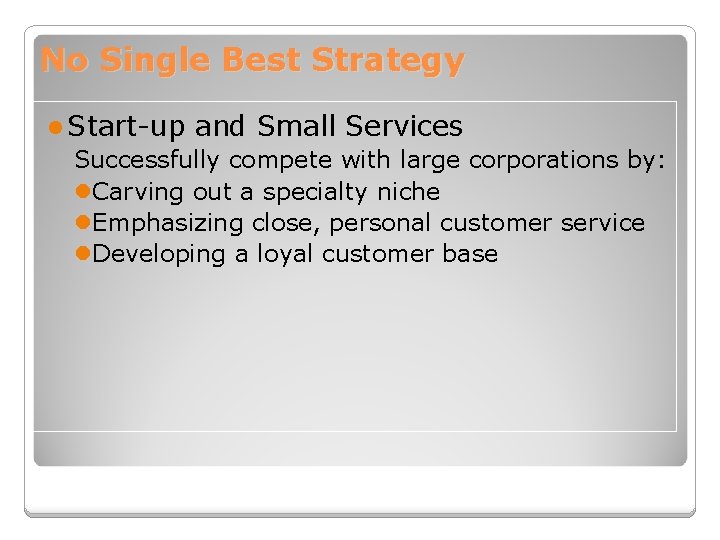
No Single Best Strategy l Start-up and Small Services Successfully compete with large corporations by: l. Carving out a specialty niche l. Emphasizing close, personal customer service l. Developing a loyal customer base
No Single Best Strategy l Technology-Intensive Business l. Production systems must be capable of producing new products and services in high volume soon after introduction l. Such companies must have two key strengths: l. Highly capable technical people l. Sufficient capital
Wrap-Up: World-Class Practice l Innovation l Customers first l New products/services to market first l High quality l High labor productivity & low production costs l Little excess inventory l. . . more
Wrap-Up: World-Class Practice l Global purchasing and selling l Quick technology development & adoption l Lean & flexible organization l Strategic alliances/joint ventures l Sensitive to social/political issues when setting strategies
Enterprise Operations & Strategic Planning Overview SAP Implementation EGN 5622 Enterprise Systems Integration
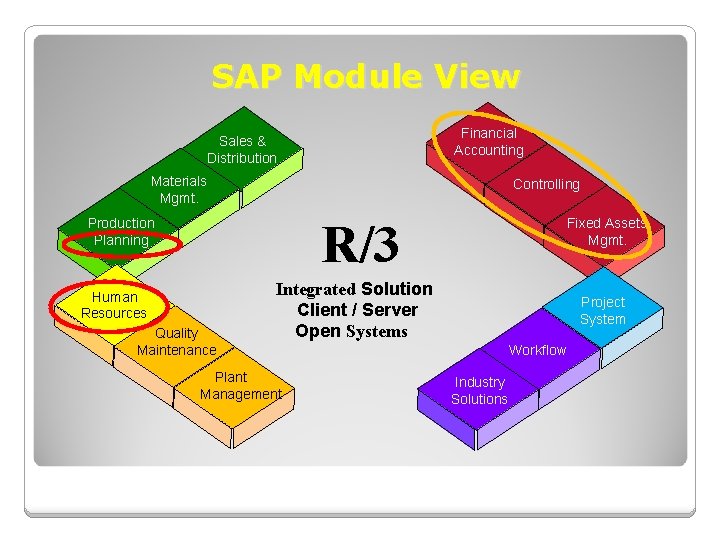
SAP Module View Financial Accounting Sales & Distribution Materials Mgmt. Controlling R/3 Production Planning Human Resources Quality Maintenance Fixed Assets Mgmt. Integrated Solution Client / Server Open Systems Plant Management Project System Workflow Industry Solutions
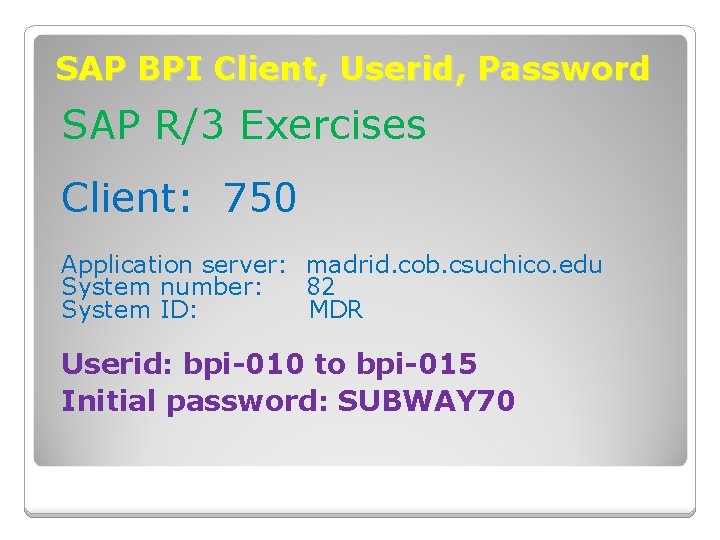
SAP BPI Client, Userid, Password SAP R/3 Exercises Client: 750 Application server: madrid. cob. csuchico. edu System number: 82 System ID: MDR Userid: bpi-010 to bpi-015 Initial password: SUBWAY 70
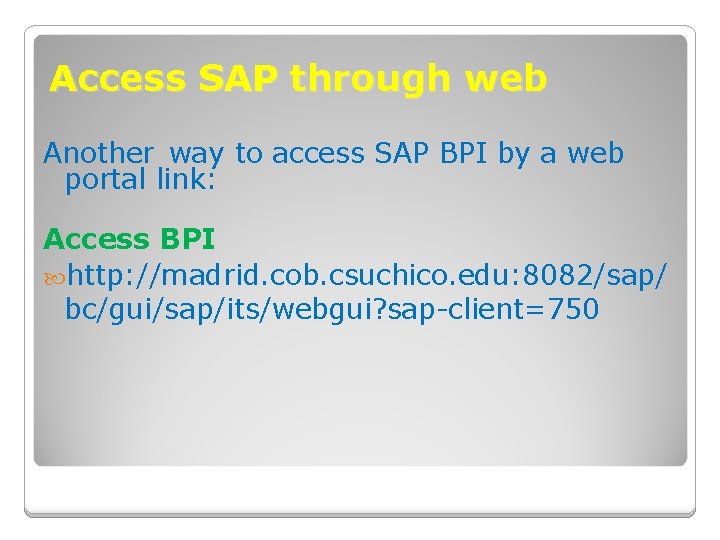
Access SAP through web Another way to access SAP BPI by a web portal link: Access BPI http: //madrid. cob. csuchico. edu: 8082/sap/ bc/gui/sap/its/webgui? sap-client=750
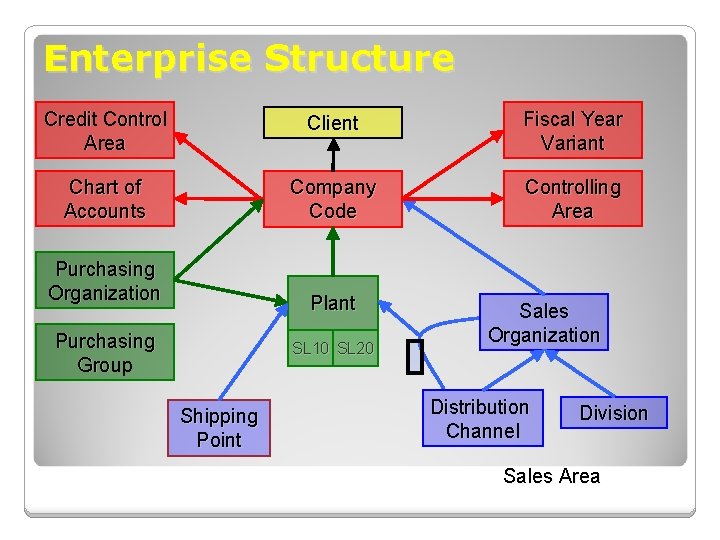
Enterprise Structure Credit Control Area Client Fiscal Year Variant Chart of Accounts Company Code Controlling Area Purchasing Organization Plant Purchasing Group SL 10 SL 20 Shipping Point Sales Organization Distribution Channel Division Sales Area
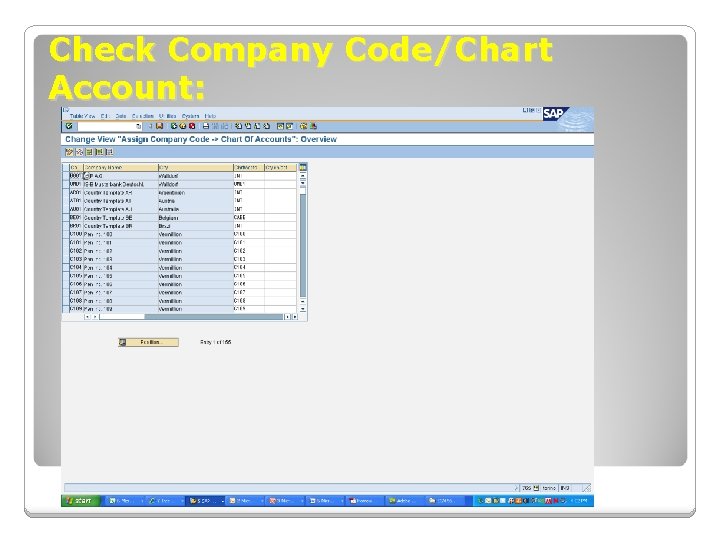
Check Company Code/Chart Account:
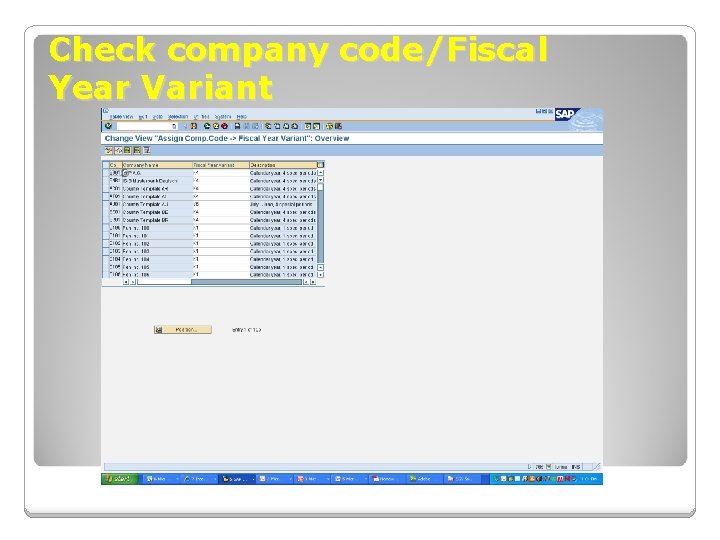
Check company code/Fiscal Year Variant
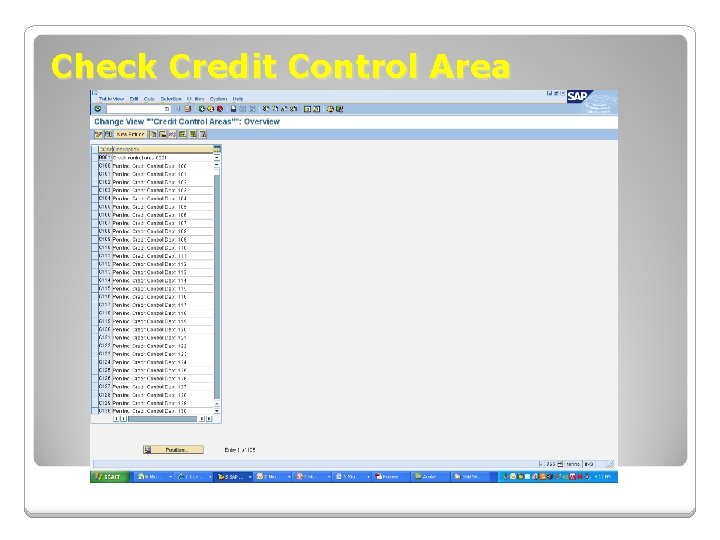
Check Credit Control Area
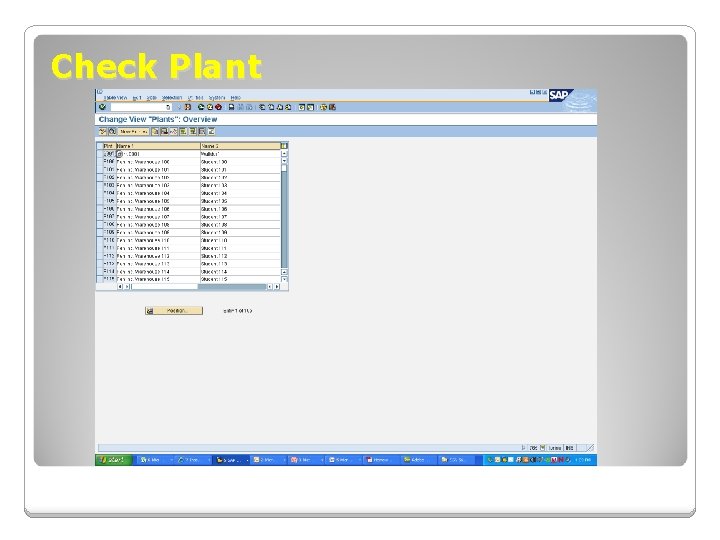
Check Plant
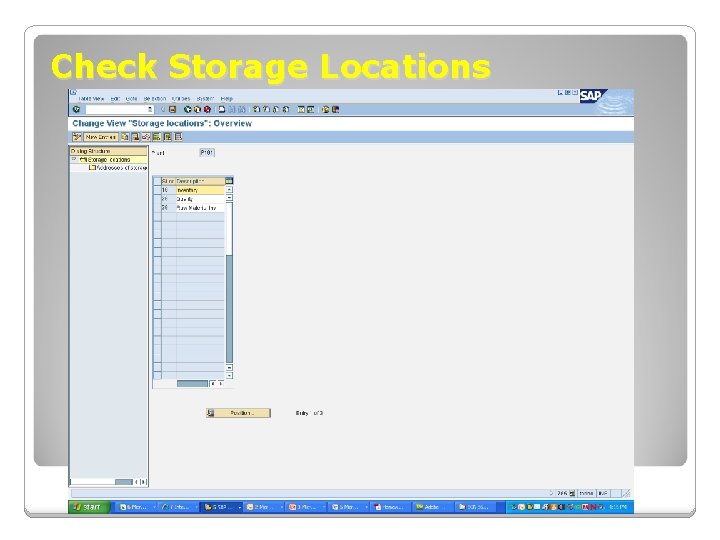
Check Storage Locations
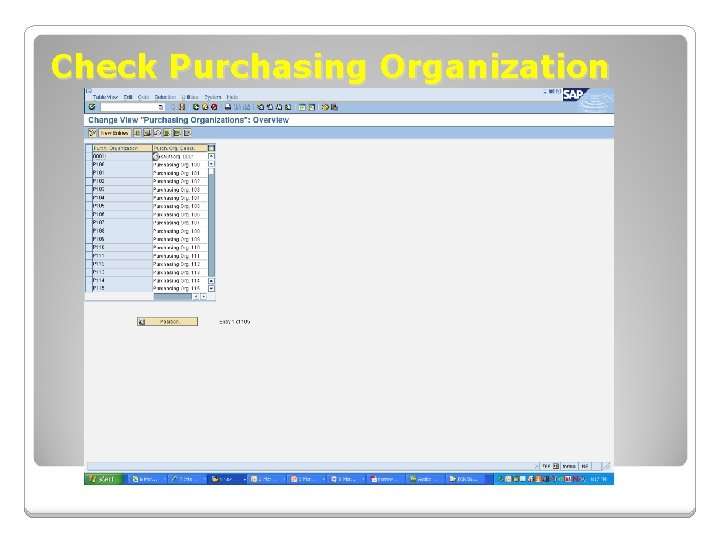
Check Purchasing Organization
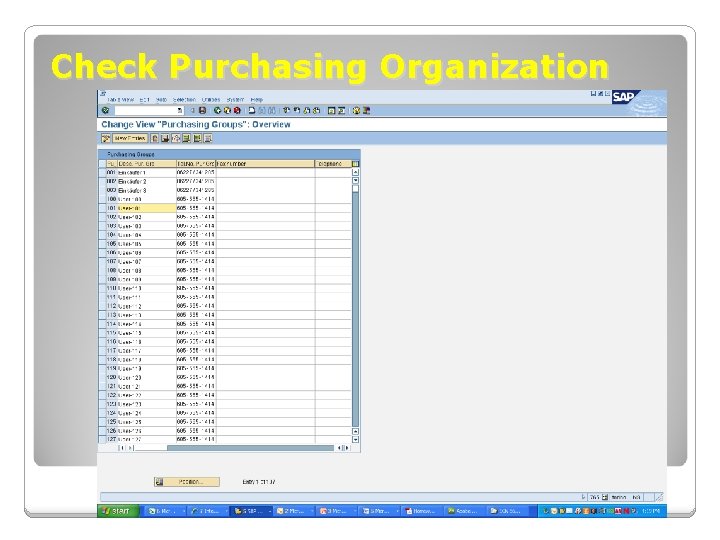
Check Purchasing Organization
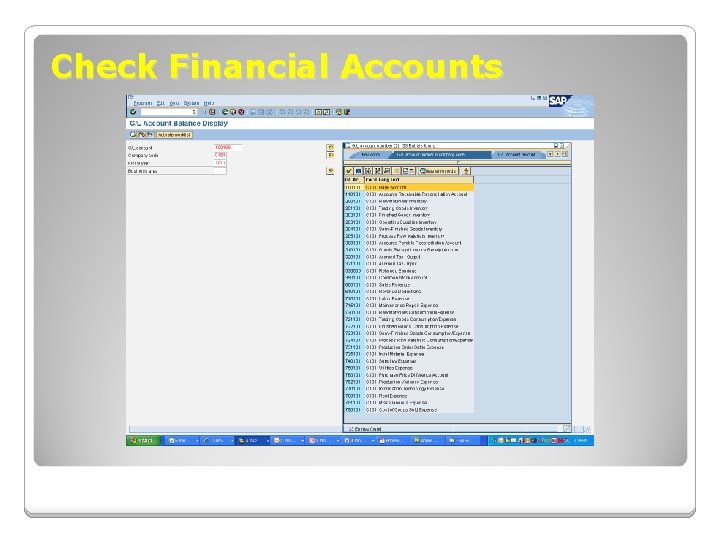
Check Financial Accounts
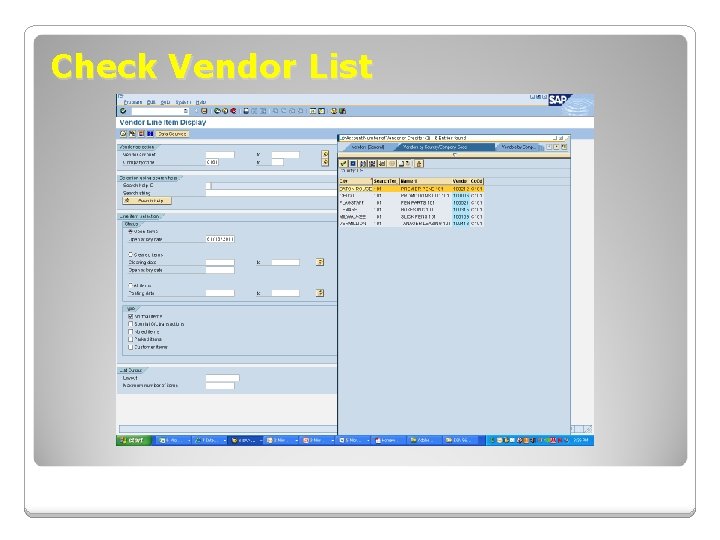
Check Vendor List
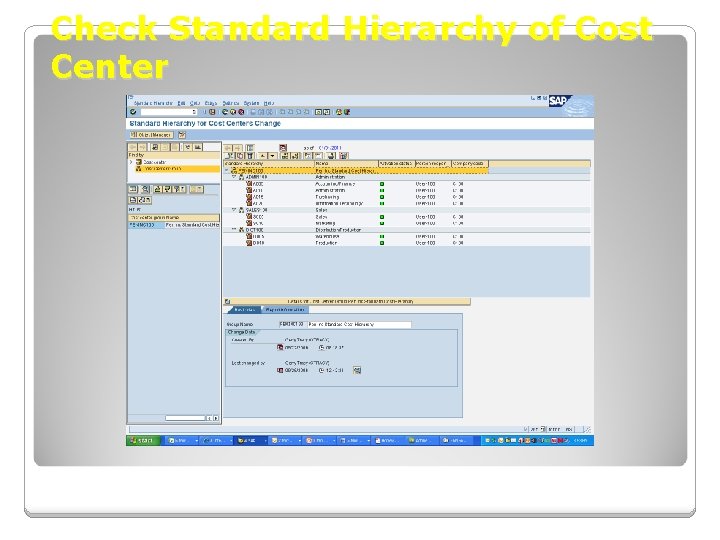
Check Standard Hierarchy of Cost Center
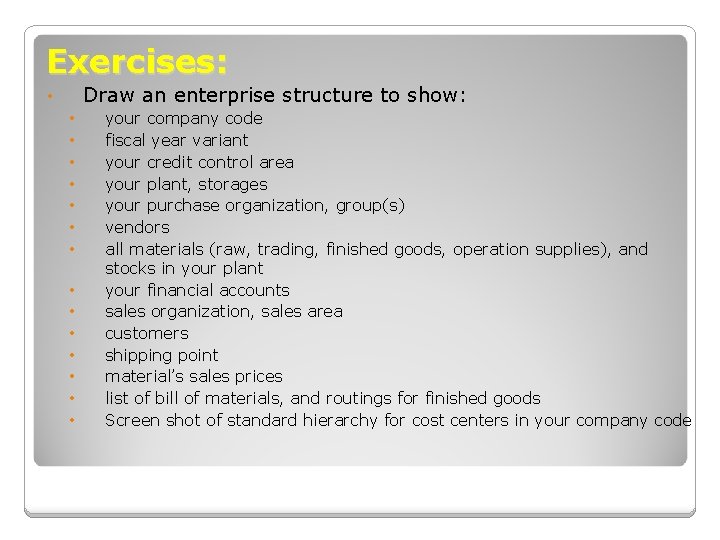
Exercises: Draw an enterprise structure to show: • • • • your company code fiscal year variant your credit control area your plant, storages your purchase organization, group(s) vendors all materials (raw, trading, finished goods, operation supplies), and stocks in your plant your financial accounts sales organization, sales area customers shipping point material’s sales prices list of bill of materials, and routings for finished goods Screen shot of standard hierarchy for cost centers in your company code