
Enterprise IT Lecture 1 2 and 3 Enterprise
![Enterprise IT [Πληροφοριακές Τεχνολογίες της Επιχείρησης] Lecture 1, 2 and 3: Enterprise Systems Architecture](https://slidetodoc.com/presentation_image_h/02caea67ee308063558fca6fadda695c/image-1.jpg "Enterprise IT [Πληροφοριακές Τεχνολογίες της Επιχείρησης] Lecture 1, 2 and 3: Enterprise Systems Architecture")
![My expectations [I copy a colleague I respect a lot…] n n Enterprise IT](https://slidetodoc.com/presentation_image_h/02caea67ee308063558fca6fadda695c/image-6.jpg "My expectations [I copy a colleague I respect a lot…] n n Enterprise IT")

![[Data Integration] from S. Madnick Course at MIT <pkavassalis@atlantis-group. gr> 17](https://slidetodoc.com/presentation_image_h/02caea67ee308063558fca6fadda695c/image-17.jpg "[Data Integration] from S. Madnick Course at MIT <pkavassalis@atlantis-group. gr> 17")
![[Process Integration] from S. Madnick Course at MIT <pkavassalis@atlantis-group. gr> 18](https://slidetodoc.com/presentation_image_h/02caea67ee308063558fca6fadda695c/image-18.jpg "[Process Integration] from S. Madnick Course at MIT <pkavassalis@atlantis-group. gr> 18")
![[parenthesis: Messaging] n n n Distributed systems and applications communicate by exchanging messages Messaging](https://slidetodoc.com/presentation_image_h/02caea67ee308063558fca6fadda695c/image-21.jpg "[parenthesis: Messaging] n n n Distributed systems and applications communicate by exchanging messages Messaging")
- Slides: 32
Enterprise IT [Πληροφοριακές Τεχνολογίες της Επιχείρησης] Lecture 1, 2 and 3: Enterprise Systems Architecture Univ. of the Aegean Financial and Management Engineering Dpt Petros KAVASSALIS <pkavassalis@atlantis-group. gr> 1
What you will learn in this course n A set of fundamental concepts for understanding basic Enterprise Information Technologies > > n Strategies for integrating applications using standard technologies > > n Enterprise Software Applications Enterprise Architecture Integration (EAI) XML Web Services Familiarization with concepts such as: > > Interoperability e-business e-government 2. 0 Best practices and techniques for building and migrating enterprise IT infrastructure to a Service-oriented Architecture <pkavassalis@atlantis-group. gr> 2
Who am I? n Ph. D in Economics and Management (Univ. Paris Dauphine & Ecole polytechnique) n Research experience > > n Ecole polytechnique, Paris MIT Center of Technology Policy and Industrial Development, MIT CTPID (MIT Internet Telecommunications Convergence Consortium) Current positions > > Univ. of the Aegean (FME): Assoc. Professor RACTI: Director of ATLANTIS Group <pkavassalis@atlantis-group. gr> 3
Communication tools n n e-mail: pkavassalis@atlantis-group. gr Course web site: see FME web site <pkavassalis@atlantis-group. gr> 4
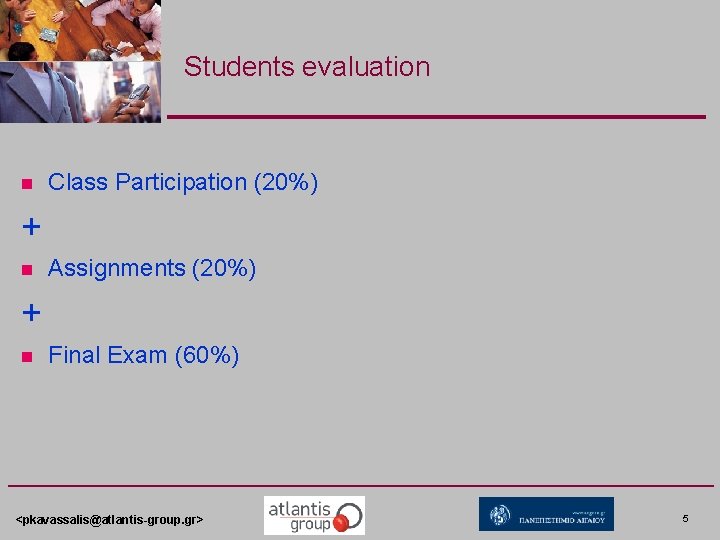
Students evaluation n Class Participation (20%) + n Assignments (20%) + n Final Exam (60%) <pkavassalis@atlantis-group. gr> 5
My expectations [I copy a colleague I respect a lot…] n n Enterprise IT course requires consistent effort and active participation (I want from my students to avoid missing lectures) Important suggestion: Please take extensive notes in the class I'm not a formal person and will be as accessible as I can to all of you through e-mail and physically – my official office hours are proposed as Friday, 12: 00 – 15: 00 h But my informality doesn't mean I'm casual about what goes on in my class… <pkavassalis@atlantis-group. gr> 6
Enterprise Information Systems (1) n n Information technology is the hardware and software a business uses to achieve its objectives Enterprise. IS (according to Wikipedia) > > > An Enterprise Information System is generally any kind of computing system that is of "enterprise class". This means typically offering high quality of service, dealing with large volumes of data and capable of supporting some large organization ("an enterprise"). Enterprise Information Systems provide a technology platform that enables organizations to integrate and coordinate their business processes. They provide a single system that is central to the organization and ensure that information can be shared across all functional levels and management hierarchies. Enterprise systems are invaluable in eliminating the problem of information fragmentation caused by multiple information systems in an organization, by creating a standard data structure. A typical Enterprise Information System would be housed in one or more Data centers , run Enterprise software, and could include applications that typically cross organizational borders such as Content management systems. <pkavassalis@atlantis-group. gr> 7
Enterprise Information Systems (2) n n Enterprise information systems (EIS) has become increasingly popular over the last 20 years because they integrates and extend business processes across the boundaries of business functions and corporate walls, as well as country border lines. EIS have to deal with three basic realities: > > > Data: streams of raw facts representing events and occurrences Information: data shaped into a meaningful and useful form Knowledge: application of data and information (examples: modeling, simulations etc) to answer "how" questions o “Knowledge is only relevant in the context of changing conditions when someone who needs to make a decision can synthesize ‘information’ INTO ‘knowledge’ given the current change situation” (http: //www. wikithat. com) <pkavassalis@atlantis-group. gr> 8
Enterprise Systems Architectures n Enterprise System Architectures (ESA) are composed of IS > Different from software systems in the area of “embedded computing” n Enterprise System Architectures integrate business architecture and IS architecture (convergence of business and technology) n ESA makes possible > > n n The re-usability of business and technology infrastructure The leverage of a knowledge base of market and enterprise data, content and documents, operations methods and their status information etc. … to provide agility and therefore competitive advantage [more: see M. Weske: Business Process Management: Concepts, Languages, Architectures, Springer, 2007, chapter 2] <pkavassalis@atlantis-group. gr> 9
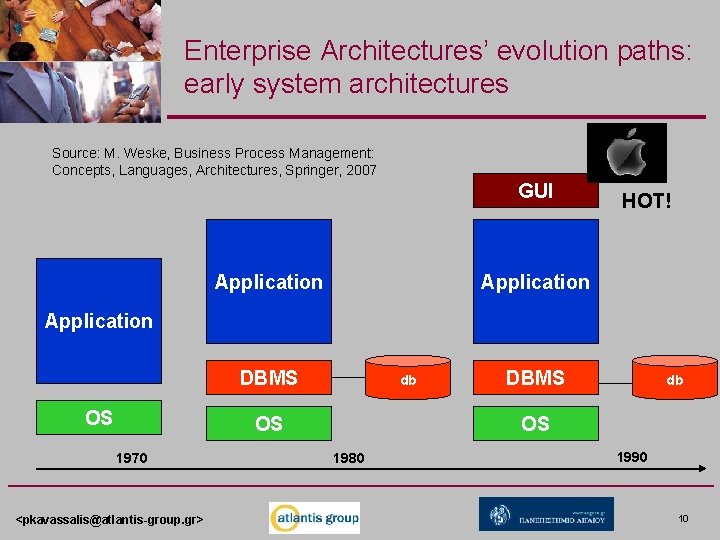
Enterprise Architectures’ evolution paths: early system architectures Source: M. Weske, Business Process Management: Concepts, Languages, Architectures, Springer, 2007 GUI Application HOT! Application DBMS OS db OS 1970 <pkavassalis@atlantis-group. gr> DBMS db OS 1980 1990 10
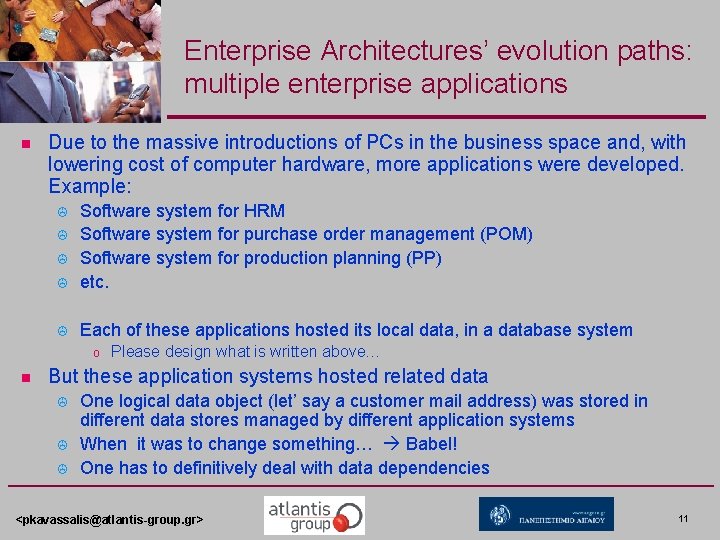
Enterprise Architectures’ evolution paths: multiple enterprise applications n Due to the massive introductions of PCs in the business space and, with lowering cost of computer hardware, more applications were developed. Example: > Software system for HRM Software system for purchase order management (POM) Software system for production planning (PP) etc. > Each of these applications hosted its local data, in a database system > > > o n Please design what is written above… But these application systems hosted related data > > > One logical data object (let’ say a customer mail address) was stored in different data stores managed by different application systems When it was to change something… Babel! One has to definitively deal with data dependencies <pkavassalis@atlantis-group. gr> 11
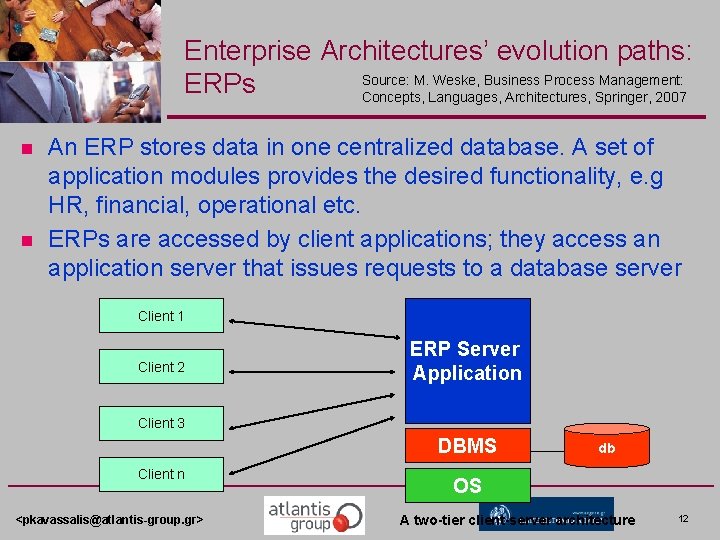
Enterprise Architectures’ evolution paths: Source: M. Weske, Business Process Management: ERPs Concepts, Languages, Architectures, Springer, 2007 n n An ERP stores data in one centralized database. A set of application modules provides the desired functionality, e. g HR, financial, operational etc. ERPs are accessed by client applications; they access an application server that issues requests to a database server Client 1 Client 2 ERP Server Application Client 3 DBMS Client n <pkavassalis@atlantis-group. gr> db OS A two-tier client-server architecture 12
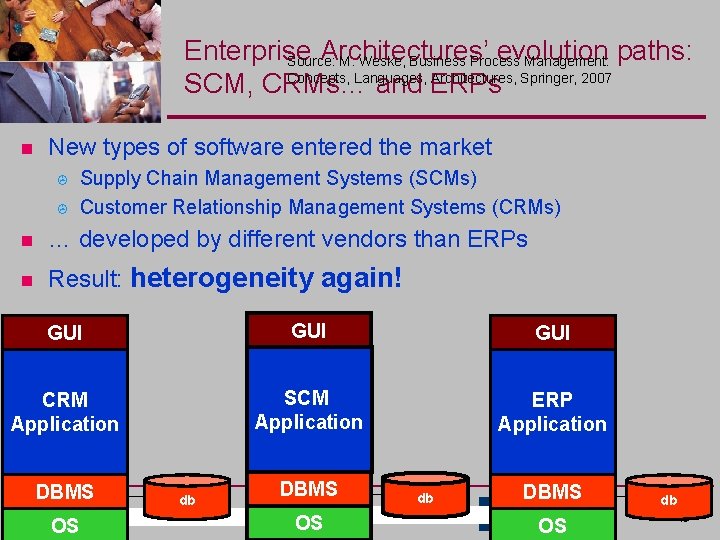
Enterprise Architectures’ evolution Source: M. Weske, Business Process Management: paths: Concepts, Languages, Architectures, Springer, 2007 SCM, CRMs… and ERPs n New types of software entered the market > > Supply Chain Management Systems (SCMs) Customer Relationship Management Systems (CRMs) n … developed by different vendors than ERPs n Result: heterogeneity again! GUI GUI CRM Application SCM Application ERP Application DBMS db <pkavassalis@atlantis-group. gr> OS DBMS OS db 13
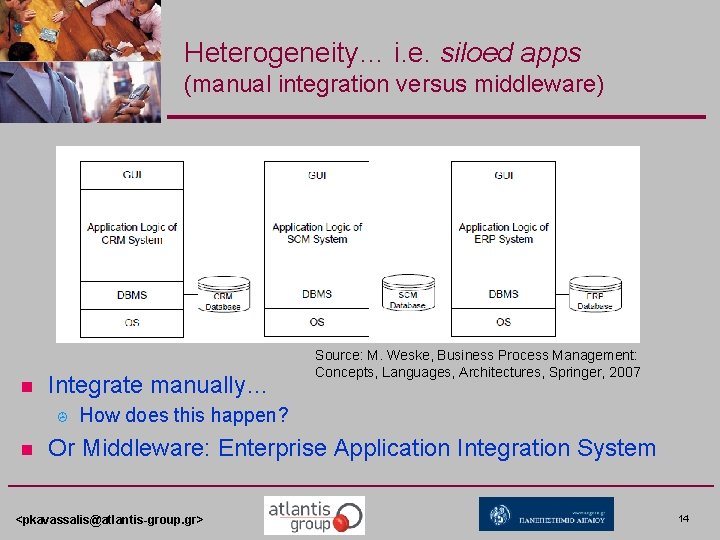
Heterogeneity… i. e. siloed apps (manual integration versus middleware) n Integrate manually… > n Source: M. Weske, Business Process Management: Concepts, Languages, Architectures, Springer, 2007 How does this happen? Or Middleware: Enterprise Application Integration System <pkavassalis@atlantis-group. gr> 14
What is Enterprise Application Integration? n Enterprise Application Integration (EAI) is defined > > n As the use of software and computer systems architectural principles to integrate a set of enterprise computer applications (Wikipedia) As the unrestricted sharing of data and business processes among any connected applications and data sources in the enterprise (Gartner) Different layers of integration > Data Integration > Process Integration <pkavassalis@atlantis-group. gr> 15
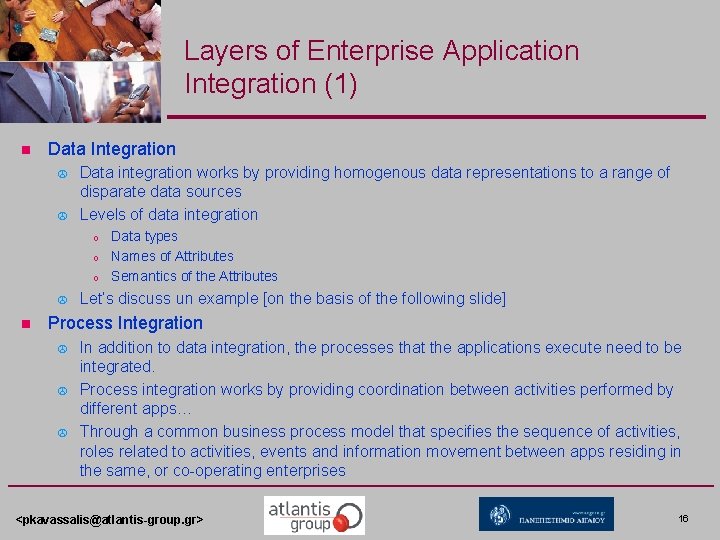
Layers of Enterprise Application Integration (1) n Data Integration > > Data integration works by providing homogenous data representations to a range of disparate data sources Levels of data integration o o o > n Data types Names of Attributes Semantics of the Attributes Let’s discuss un example [on the basis of the following slide] Process Integration > > > In addition to data integration, the processes that the applications execute need to be integrated. Process integration works by providing coordination between activities performed by different apps… Through a common business process model that specifies the sequence of activities, roles related to activities, events and information movement between apps residing in the same, or co-operating enterprises <pkavassalis@atlantis-group. gr> 16
[Data Integration] from S. Madnick Course at MIT <pkavassalis@atlantis-group. gr> 17
[Process Integration] from S. Madnick Course at MIT <pkavassalis@atlantis-group. gr> 18
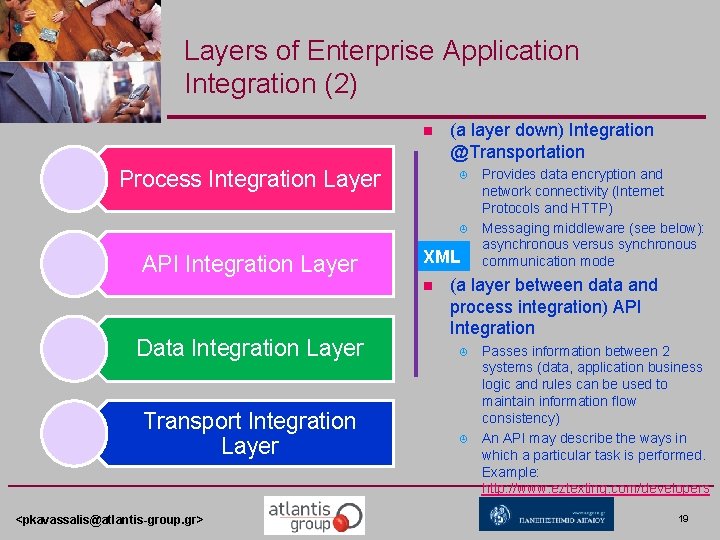
Layers of Enterprise Application Integration (2) n Process Integration Layer (a layer down) Integration @Transportation > > API Integration Layer XML n Data Integration Layer Transport Integration Layer <pkavassalis@atlantis-group. gr> Provides data encryption and network connectivity (Internet Protocols and HTTP) Messaging middleware (see below): asynchronous versus synchronous communication mode (a layer between data and process integration) API Integration > > Passes information between 2 systems (data, application business logic and rules can be used to maintain information flow consistency) An API may describe the ways in which a particular task is performed. Example: http: //www. eztexting. com/developers 19
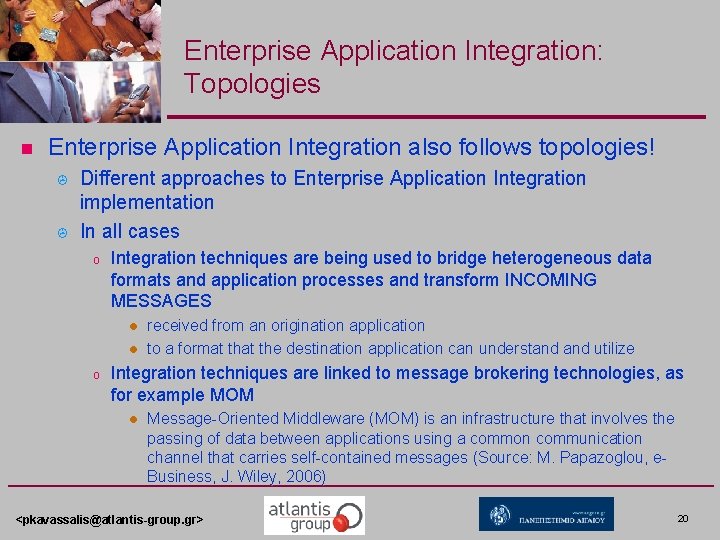
Enterprise Application Integration: Topologies n Enterprise Application Integration also follows topologies! > > Different approaches to Enterprise Application Integration implementation In all cases o Integration techniques are being used to bridge heterogeneous data formats and application processes and transform INCOMING MESSAGES l l o received from an origination application to a format the destination application can understand utilize Integration techniques are linked to message brokering technologies, as for example MOM l Message-Oriented Middleware (MOM) is an infrastructure that involves the passing of data between applications using a common communication channel that carries self-contained messages (Source: M. Papazoglou, e. Business, J. Wiley, 2006) <pkavassalis@atlantis-group. gr> 20
[parenthesis: Messaging] n n n Distributed systems and applications communicate by exchanging messages Messaging enables highspeed, program-to-program communication with reliable delivery Message passing between a pair of processes is supported by two message communication operations: send and receive, defined in terms of destinations and messages <pkavassalis@atlantis-group. gr> Source: M. Papazoglou, e-Business, 2006 21
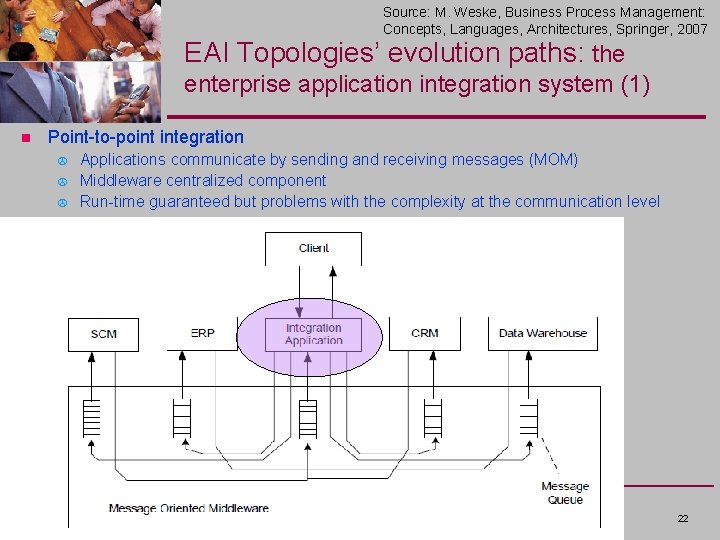
Source: M. Weske, Business Process Management: Concepts, Languages, Architectures, Springer, 2007 EAI Topologies’ evolution paths: the enterprise application integration system (1) n Point-to-point integration > > > Applications communicate by sending and receiving messages (MOM) Middleware centralized component Run-time guaranteed but problems with the complexity at the communication level <pkavassalis@atlantis-group. gr> 22
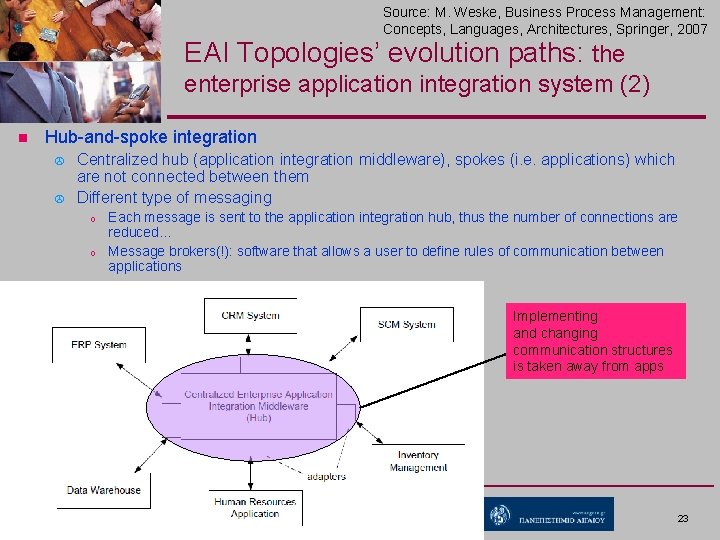
Source: M. Weske, Business Process Management: Concepts, Languages, Architectures, Springer, 2007 EAI Topologies’ evolution paths: the enterprise application integration system (2) n Hub-and-spoke integration > > Centralized hub (application integration middleware), spokes (i. e. applications) which are not connected between them Different type of messaging o o Each message is sent to the application integration hub, thus the number of connections are reduced… Message brokers(!): software that allows a user to define rules of communication between applications Implementing and changing communication structures is taken away from apps <pkavassalis@atlantis-group. gr> 23
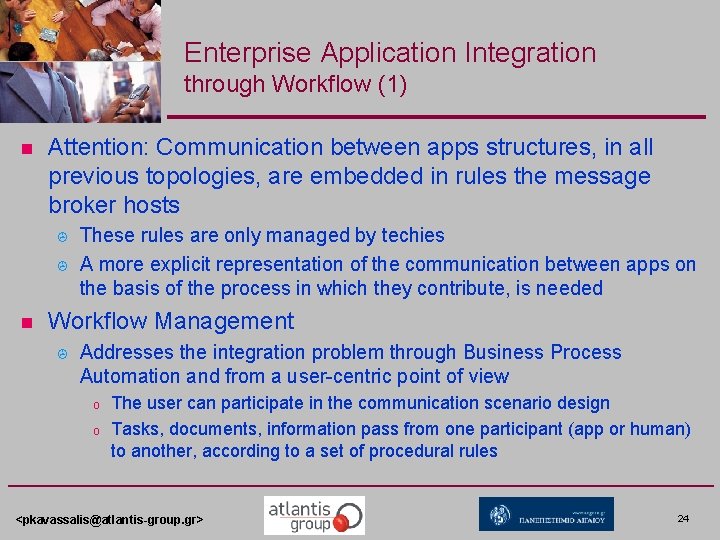
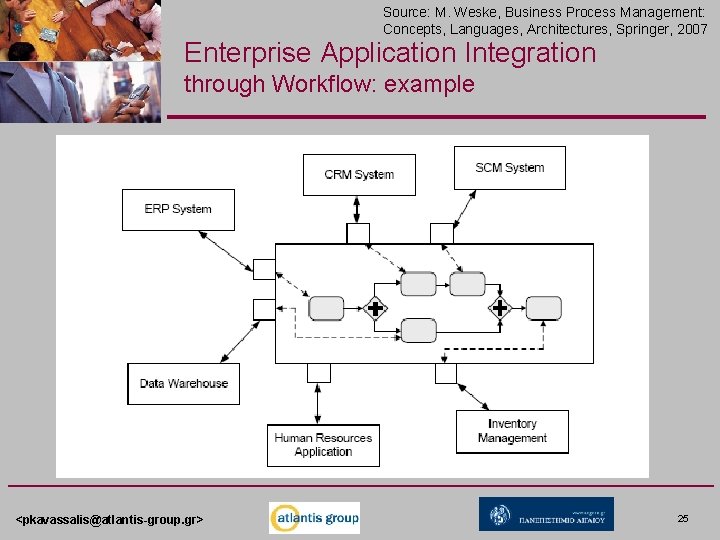
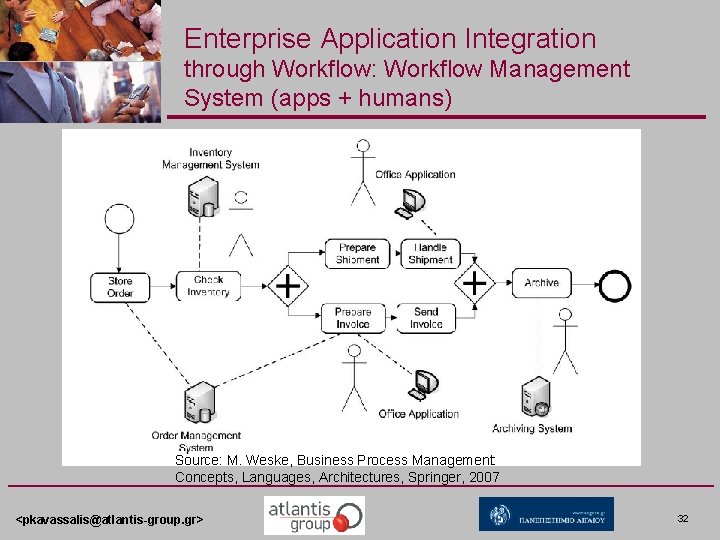
Enterprise Application Integration through Workflow (1) n Attention: Communication between apps structures, in all previous topologies, are embedded in rules the message broker hosts > > n These rules are only managed by techies A more explicit representation of the communication between apps on the basis of the process in which they contribute, is needed Workflow Management > Addresses the integration problem through Business Process Automation and from a user-centric point of view o o The user can participate in the communication scenario design Tasks, documents, information pass from one participant (app or human) to another, according to a set of procedural rules <pkavassalis@atlantis-group. gr> 24
Source: M. Weske, Business Process Management: Concepts, Languages, Architectures, Springer, 2007 Enterprise Application Integration through Workflow: example <pkavassalis@atlantis-group. gr> 25
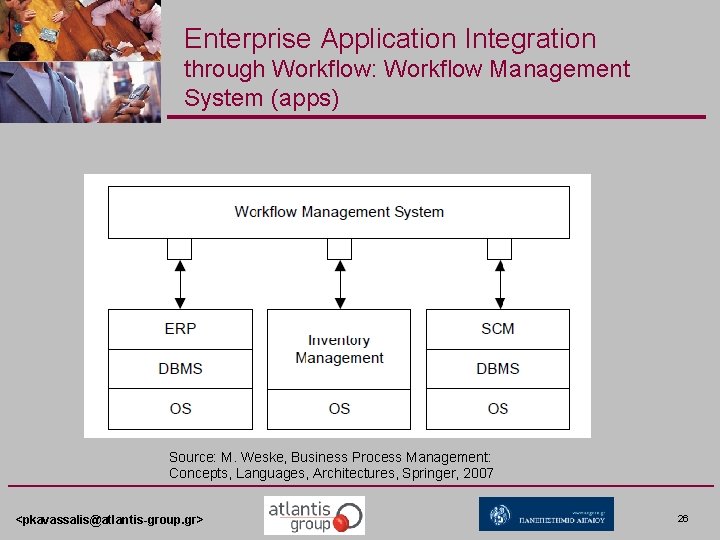
Enterprise Application Integration through Workflow: Workflow Management System (apps) Source: M. Weske, Business Process Management: Concepts, Languages, Architectures, Springer, 2007 <pkavassalis@atlantis-group. gr> 26
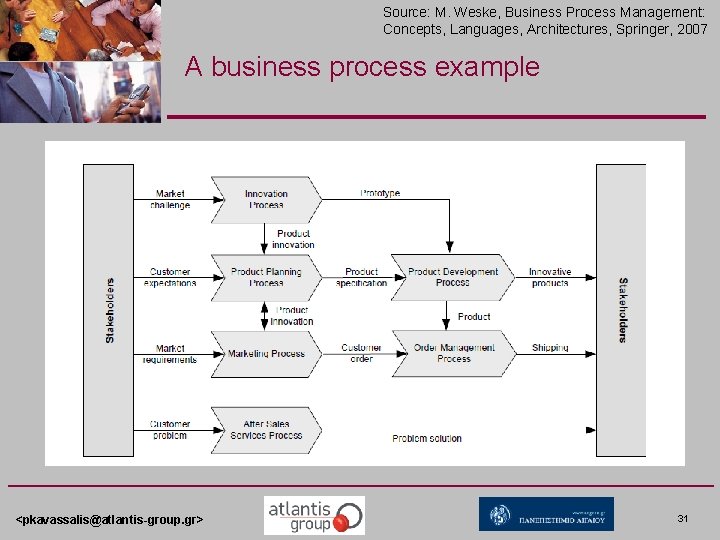
Workflow Management Systems orchestrate apps and humans in the context of a process n n Work within the firm combines multiple units of work of small granularity into work units of larger granularity From this perspective, the operations of a firm look like a process which > > > includes a set of activities (i. e. tasks) performed in coordination in an organizational and technical environment… to realize a concrete business goal <pkavassalis@atlantis-group. gr> 27
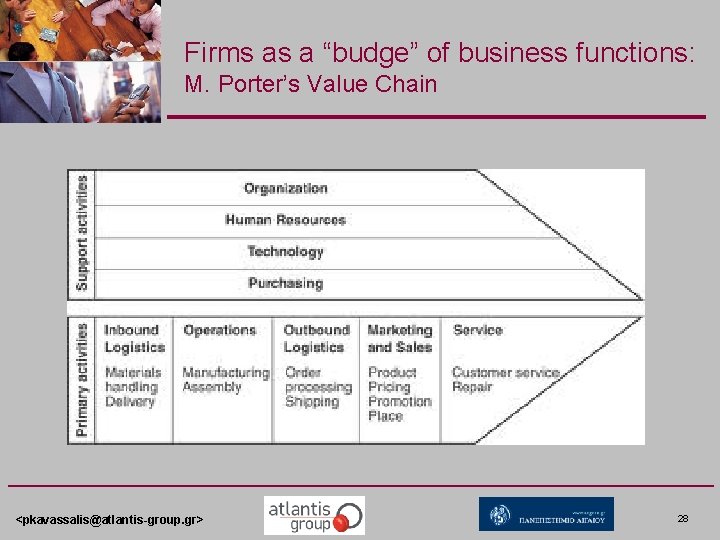
Firms as a “budge” of business functions: M. Porter’s Value Chain <pkavassalis@atlantis-group. gr> 28
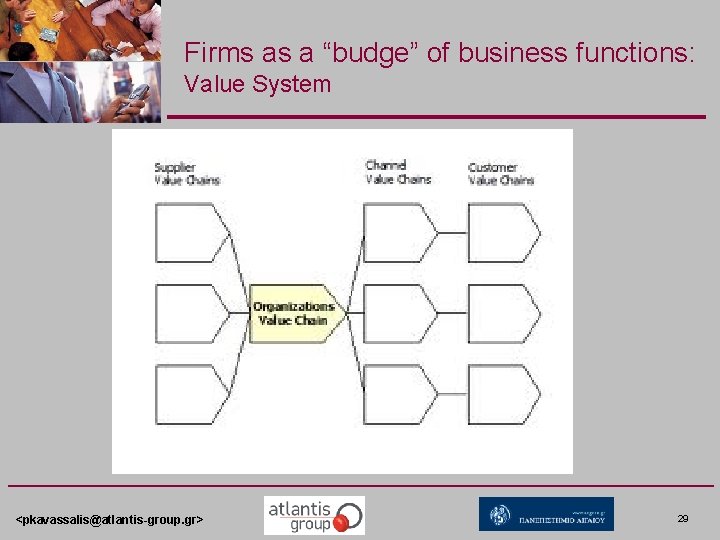
Firms as a “budge” of business functions: Value System <pkavassalis@atlantis-group. gr> 29
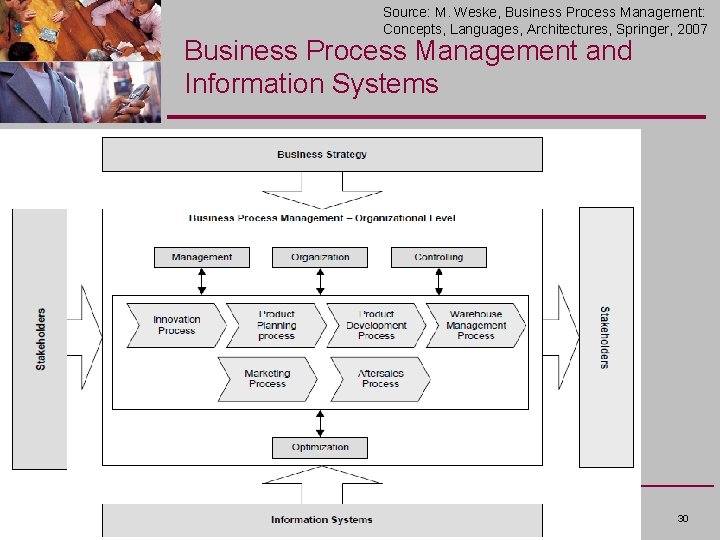
Source: M. Weske, Business Process Management: Concepts, Languages, Architectures, Springer, 2007 Business Process Management and Information Systems <pkavassalis@atlantis-group. gr> 30
Source: M. Weske, Business Process Management: Concepts, Languages, Architectures, Springer, 2007 A business process example <pkavassalis@atlantis-group. gr> 31
Enterprise Application Integration through Workflow: Workflow Management System (apps + humans) Source: M. Weske, Business Process Management: Concepts, Languages, Architectures, Springer, 2007 <pkavassalis@atlantis-group. gr> 32