
Enterprise Information Technology Architecture An Overview Creative Commons
- Slides: 34
Enterprise Information Technology Architecture An Overview Creative Commons License – Curt Hill.
In The Beginning … • US Census bureau is first to buy a commercial computer – UNIVAC I in 1951 (delivered 1952) • GE is the first business in 1954 – UNIVAC I – Also, Metropolitan Life in same year • Computers in the 1950 s had very simple programs – Read input on cards – Process with assembly language – Produce output on printer Creative Commons License – Curt Hill.
Commercial Data Processing • Not much changes in the 1960 s • Computers are faster but the programs are still simple: – Input – processing – output – COBOL replaces Assembly – More peripherals – tapes and disks – Still batch – no interaction with the computer • Time sharing is introduced in 1960 s – Programs retain simple processing Creative Commons License – Curt Hill.
1970 s • Minicomputers and superminis – Smaller size – More bang for the buck – These give new options • Distribution of data and logic – The mainframe still retains the original and the most up to date data – The mini receives an extraction from the mainframe – There is now a problem with redundant and out-of-date data Creative Commons License – Curt Hill.
Silos • Many different systems – Perhaps at different sites • Data may be filtered, but is duplicated • Business logic also duplicated – Duplicating, then tweaking processing logic for different goals – including online access • Redundant data and processing becomes the norm • Multiple silos (or stovepipes) of similar processing and duplicated data Creative Commons License – Curt Hill.
Late 1970 s and 1980 s • Personal computers – Compared to minis and mainframes these are free, yet powerful enough to be very useful • Networking – Make distribution of data and software easy • These two compound the redundant and out of date data problems – The mainframe still contains the originals Creative Commons License – Curt Hill.
Better Networking • Client – server computing becomes common – Solves some of the redundant data problem – The logic is still around in multiple different form – Every important change to original programs should be propagated to the derived ones Creative Commons License – Curt Hill.
Internet • Government seed money establishes • The basic philosophy of input, processing, output is slowly changing – Our silos are better but still somewhat disjoint • Security issues start to increase dramatically Creative Commons License – Curt Hill.
WWW • Its introduction changes how things are viewed • The browser becomes the primary communication for people • Fiber optics does for networks what previously was done for computers – Reduce price and increase capability • Wireless allows a new mobility Creative Commons License – Curt Hill.
Programs • The early programs were simple but potentially large monoliths – COBOL programs typically have a simple structure • The structured languages use more procedures and functions • The object-oriented languages add classes and objects • The monolith is dead, programs are now composed of many small units – Procedures, functions, classes Creative Commons License – Curt Hill.
Architecture • The expression is now applied to a program to describe how the units interact – Some of the units are reusable • Requirements get more complicated – We no longer think of stand-alone programs – Instead, systems of interacting programs and the files they use – Architecture can now be applied to how the programs and files interact Creative Commons License – Curt Hill.
Next Step • It is not much of a step to the next level • How do our systems of programs interact with one another? • Several results from this next step – ERPs – Enterprise IT Architecture • How do we design the architecture of all enterprise IT? – SAP wants it to be with its ERP – As do other ERP vendors Creative Commons License – Curt Hill.
One More Step • Zachman comes to the realization that Enterprise IT Architecture must change the shape of the Enterprise itself – Also, the shape of the Enterprise must profoundly impact IT architecture • Enterprise Architecture is born • It must include Enterprise IT Architecture (EIA) – Neither can be considered by itself • Thus, this class is needed Creative Commons License – Curt Hill.
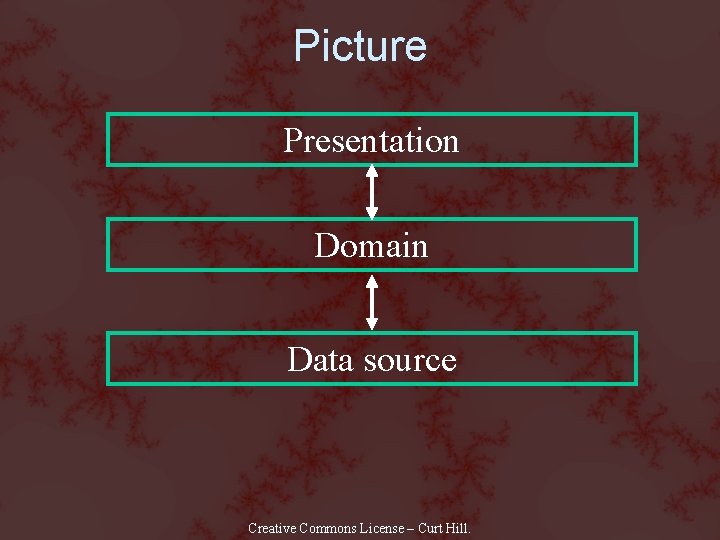
Back to IT • New possibilities are now available • The structure of a program or system of programs can be considered as three layers: • Presentation – The user interface • Domain – Business logic occurs here • Data source – File access – Other service access Creative Commons License – Curt Hill.
Picture Presentation Domain Data source Creative Commons License – Curt Hill.
Comparison • In the olden days – This was a single program – Monoliths made little distinction between the levels – Structured programs often did • Systems – Each layer was handled by one or more of the enclosed programs usually on the same machine – These communicated through files Creative Commons License – Curt Hill.
Service Oriented Architecture • Now the three layers may be on multiple machines – Even more than three • The presentation layer – Often a web browser • The other two layers may be any number of web services – Communicating over web Creative Commons License – Curt Hill.
Full Circle • In the beginning it was one system – One program – One computer • It is back to one system – Many separate programs – Dispersed over many computers – It communicates so well as to appear to be one system Creative Commons License – Curt Hill.
The Changes are Not Over • Not even close, a new upheaval is ongoing • Networking has allowed new options that we have seen • There are more that we have not • Our ability to gather information from the Internet or other sources has created a new field: Big Data Creative Commons License – Curt Hill.
The Future • Predictions of the future always tenuous • However, when the pieces are present and things are starting to come together, there can be more confidence • IBM, among others, has proposed the three stages of IT that need to be reckoned with Creative Commons License – Curt Hill.
Three Stages • Consider these three stages • Historical reporting – This is where many enterprises are • Sense and respond – Measure performance and risks and respond quickly • Anticipate and shape – Use the flood of information to predict what is happening and shape strategy to gain competitive advantage Creative Commons License – Curt Hill.
Characteristics • How are these different? • Let’s consider some objective differences in how these enterprises would operate Creative Commons License – Curt Hill.
Information Sources • Where does the organization get its data? • Historical Reporting – Internally: Transactional databases • Sense and Respond – The above integrated with event based data from CRM and external sources • Anticipate and Shape – The above and much more is in the knowledge warehouse – Analysis occurs in near real time Creative Commons License – Curt Hill.
Processing • Historical Reporting – Databases are processed in batch to give a snapshot of the past • Sense and Respond – Large quantities of obtained data are processed quickly • Anticipate and Shape – Both structured and unstructured data are processed in real time Creative Commons License – Curt Hill.
Business Insight • Historical Reporting – Personal experience and informed guess work leads to decisions • Sense and Respond – Decisions are supported by data-driven facts • Anticipate and Shape – Analytical tools are user friendly – Delivered any time, any where, in a channel of the user’s choice – Important decisions made in the field Creative Commons License – Curt Hill.
History and Future • Historical Reporting – Historical data may tell us what happened • Sense and Respond – Smart decisions are enabled by up to the minute tracking of data and events • Anticipate and Shape – Modeling and simulations allow more accurate predictions in the short and long term Creative Commons License – Curt Hill.
The Importance of Data • What does this mean for the enterprise of the future? • All the things we have now will continue: – Transactional databases – ERPs and CRMs • The knowledge warehouses and data marts will become far more responsive and far more pervasive – As a technology it will become as important in the future as the transactional database was in the past Creative Commons License – Curt Hill.
Data Handling Goals • Reduce time to access • Reduce the complexity of the data • Optimizing the infrastructure to access the data • Using big data analysis to obtain insight • Leveraging the insight to transform the enterprise • Gaining and maintaining control over the data • Managing risk and compliance with data Creative Commons License – Curt Hill.
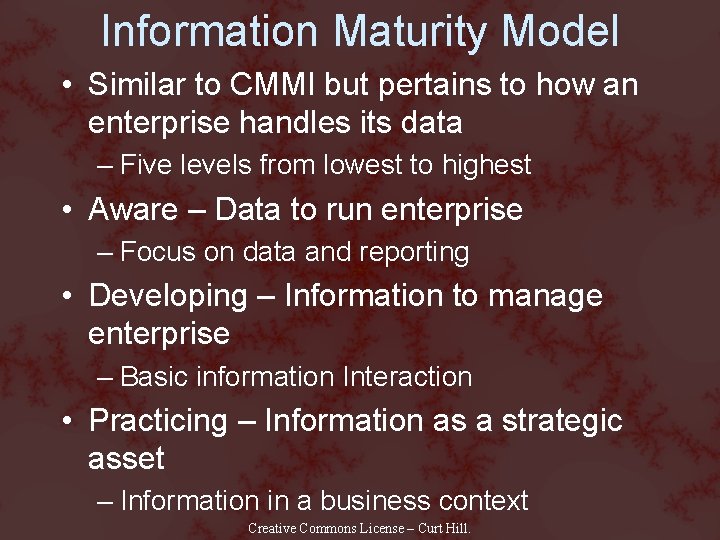
Information Maturity Model • Similar to CMMI but pertains to how an enterprise handles its data – Five levels from lowest to highest • Aware – Data to run enterprise – Focus on data and reporting • Developing – Information to manage enterprise – Basic information Interaction • Practicing – Information as a strategic asset – Information in a business context Creative Commons License – Curt Hill.
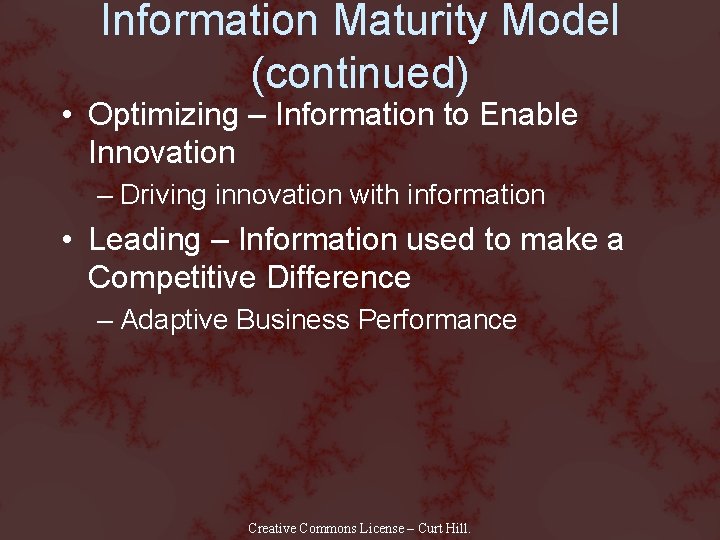
Information Maturity Model (continued) • Optimizing – Information to Enable Innovation – Driving innovation with information • Leading – Information used to make a Competitive Difference – Adaptive Business Performance Creative Commons License – Curt Hill.
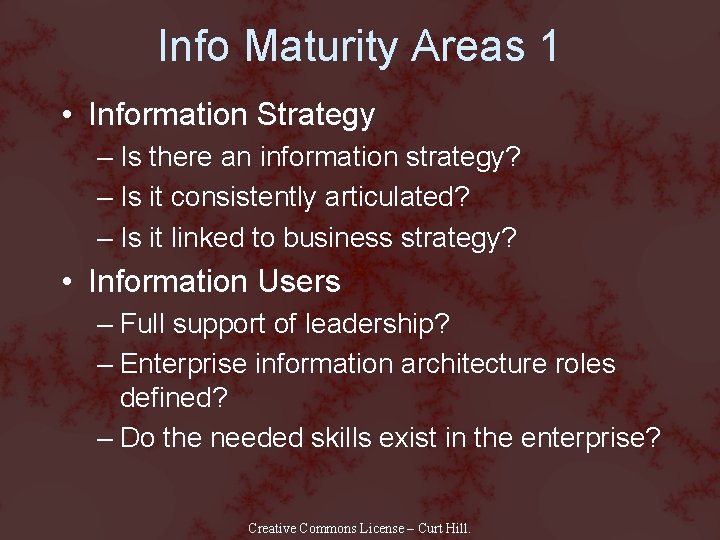
Info Maturity Areas 1 • Information Strategy – Is there an information strategy? – Is it consistently articulated? – Is it linked to business strategy? • Information Users – Full support of leadership? – Enterprise information architecture roles defined? – Do the needed skills exist in the enterprise? Creative Commons License – Curt Hill.
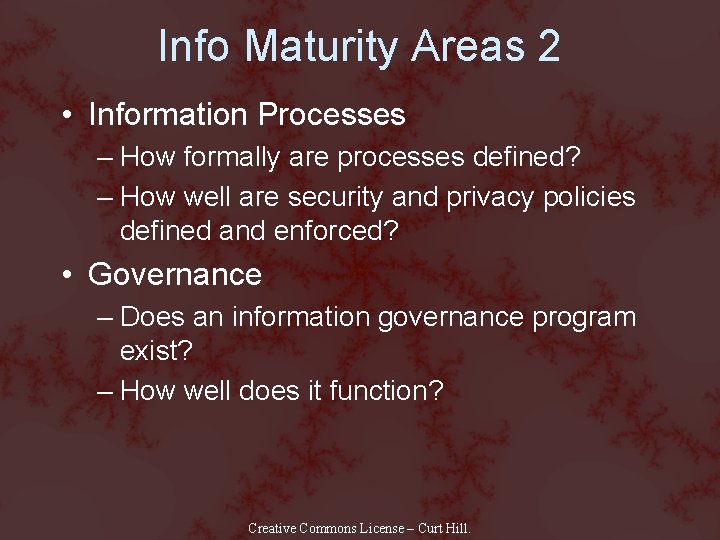
Info Maturity Areas 2 • Information Processes – How formally are processes defined? – How well are security and privacy policies defined and enforced? • Governance – Does an information governance program exist? – How well does it function? Creative Commons License – Curt Hill.
Info Maturity Areas 3 • Data – Are information architectures and standards in place? – What are the processes around information integration and data quality? – What metadata strategy exists? • Information technology – Are quality and security controls present? Creative Commons License – Curt Hill.
Finally • Enterprises are always in transition – Most have some legacy systems that are important – These are siloed – They are trying to convert to a more service -oriented model – They cannot afford to convert everything all at one time • The computational power they will have in the future will make what they currently have look like a toy Creative Commons License – Curt Hill.