
Enterprise Ground Transformation at NESDIS Steve Petersen Director
- Slides: 25
Enterprise Ground Transformation at NESDIS Steve Petersen Director, Office of Satellite Ground Services National Environmental Satellite Data & Information Service National Oceanic and Atmospheric Administration April 12, 2016 Sustain • Enable • Create – OSGS
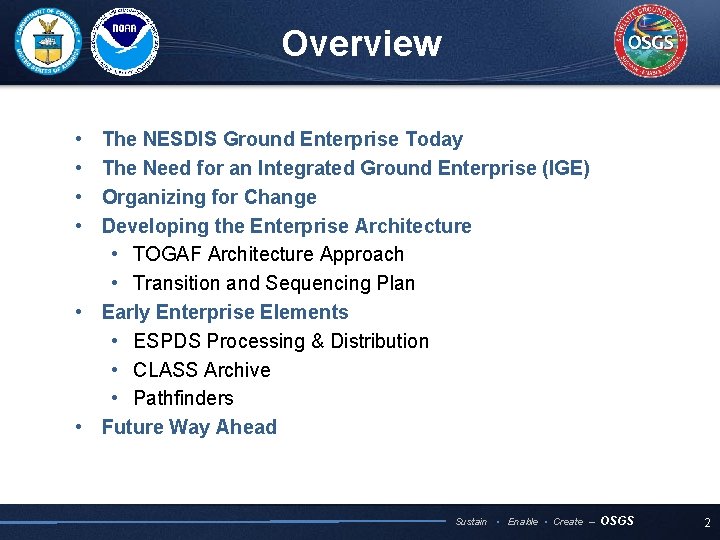
Overview • • The NESDIS Ground Enterprise Today The Need for an Integrated Ground Enterprise (IGE) Organizing for Change Developing the Enterprise Architecture • TOGAF Architecture Approach • Transition and Sequencing Plan • Early Enterprise Elements • ESPDS Processing & Distribution • CLASS Archive • Pathfinders • Future Way Ahead Sustain • Enable • Create – OSGS 2
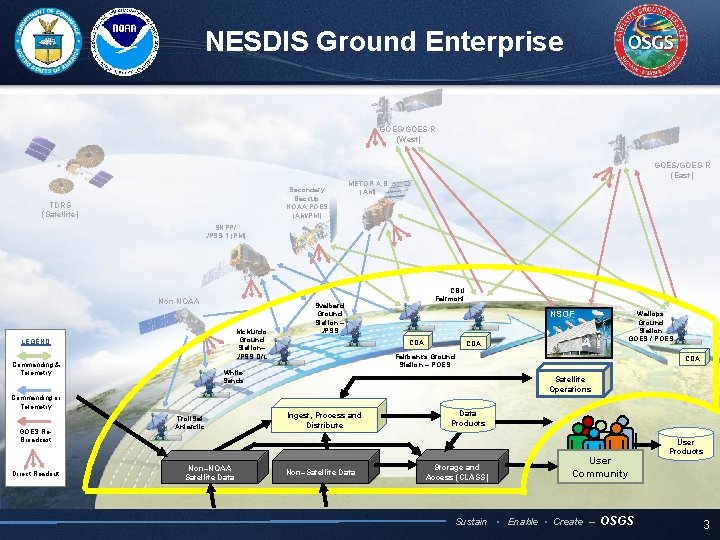
NESDIS Ground Enterprise GOES/GOES-R (West) GOES/GOES-R (East) Secondary Backup NOAA POES (AM/PM) TDRS (Satellite) METOP-A, B (AM) SNPP/ JPSS-1 (PM) Non-NOAA Mc. Murdo Ground Station– JPSS D/L LEGEND Commanding & Telemetry Direct Readout NSOF CDA White Sands Troll. Sat Antarctic Non–NOAA Satellite Data Wallops Ground Station GOES / POES Fairbanks Ground Station – POES CDA Satellite Operations Commanding or Telemetry GOES Re. Broadcast CBU Fairmont Svalbard Ground Station – JPSS Ingest, Process and Distribute Non–Satellite Data Products Storage and Access (CLASS) User Community Sustain • Enable • Create – OSGS User Products 3
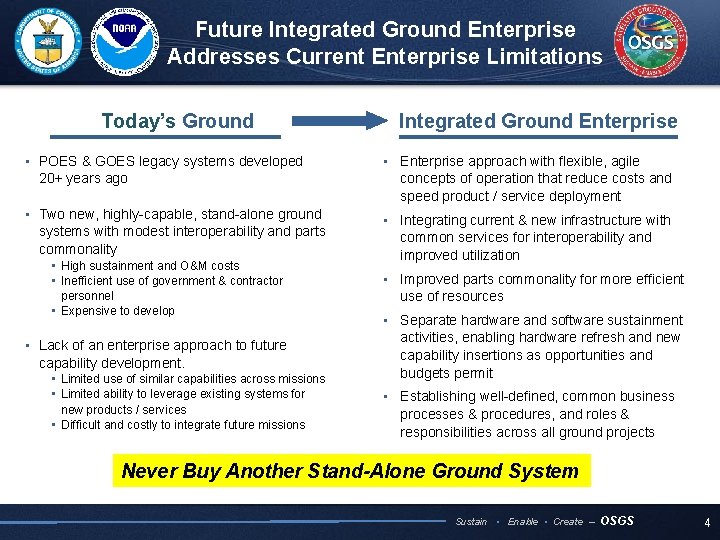
Future Integrated Ground Enterprise Addresses Current Enterprise Limitations Today’s Ground • POES & GOES legacy systems developed 20+ years ago • Two new, highly-capable, stand-alone ground systems with modest interoperability and parts commonality • High sustainment and O&M costs • Inefficient use of government & contractor personnel • Expensive to develop • Lack of an enterprise approach to future capability development. • Limited use of similar capabilities across missions • Limited ability to leverage existing systems for new products / services • Difficult and costly to integrate future missions Integrated Ground Enterprise • Enterprise approach with flexible, agile concepts of operation that reduce costs and speed product / service deployment • Integrating current & new infrastructure with common services for interoperability and improved utilization • Improved parts commonality for more efficient use of resources • Separate hardware and software sustainment activities, enabling hardware refresh and new capability insertions as opportunities and budgets permit • Establishing well-defined, common business processes & procedures, and roles & responsibilities across all ground projects Never Buy Another Stand-Alone Ground System Sustain • Enable • Create – OSGS 4
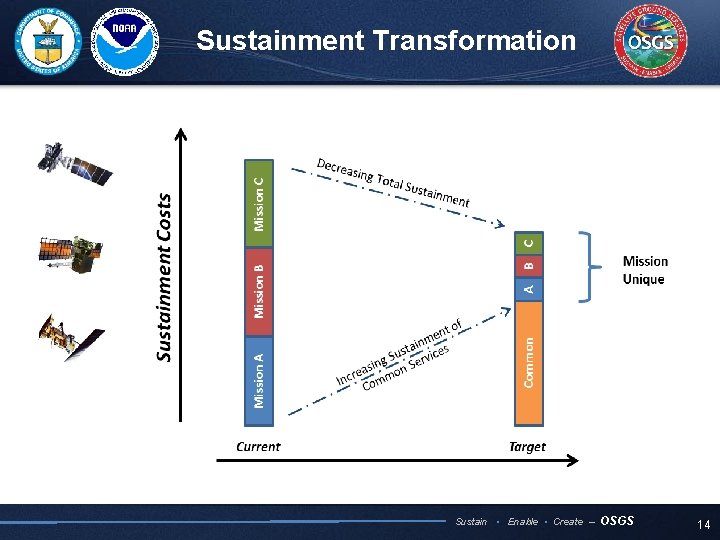
NESDIS Perspective on Transformation • Move to Integrated Ground Enterprise must be achieved while executing on existing missions and acquisitions / commitments – Simultaneously sustain current capability and transition two new ground segments to sustainment – Then integrate, modify and enhance capabilities § Ground Enterprise Architectures Services (GEARS) Investments – While exploiting early opportunities to achieve progress on key challenges • Challenges exist in processes, procedures, and workforce / culture – Existing workforce acquires and sustains with legacy system approaches § Many small contracts, stand-alone acquisitions, hands-on software maintenance, limited systems limited architecture considerations – New systems (GOES-R, JPSS) need different approaches § Potentially too complex for hands-on government software maintenance § Integrated maintenance and sustainment § Enterprise architecture and systems engineering influences on tech refresh – OSGS emphasis on systems engineering requires additional staff § Realignment of current processes governing sustainment Sustain • Enable • Create – OSGS 5
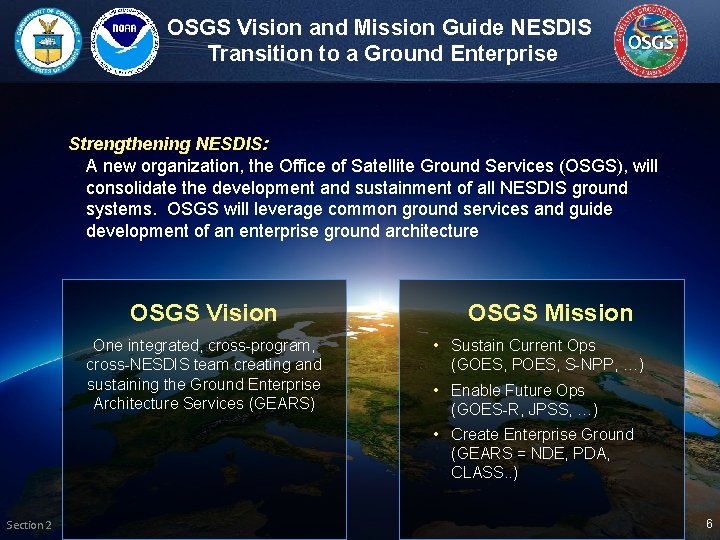
OSGS Vision and Mission Guide NESDIS Transition to a Ground Enterprise Strengthening NESDIS: A new organization, the Office of Satellite Ground Services (OSGS), will consolidate the development and sustainment of all NESDIS ground systems. OSGS will leverage common ground services and guide development of an enterprise ground architecture OSGS Vision One integrated, cross-program, cross-NESDIS team creating and sustaining the Ground Enterprise Architecture Services (GEARS) OSGS Mission • Sustain Current Ops (GOES, POES, S-NPP, …) • Enable Future Ops (GOES-R, JPSS, …) • Create Enterprise Ground (GEARS = NDE, PDA, CLASS. . ) Section 2 Sustain • Enable • Create – OSGS 6
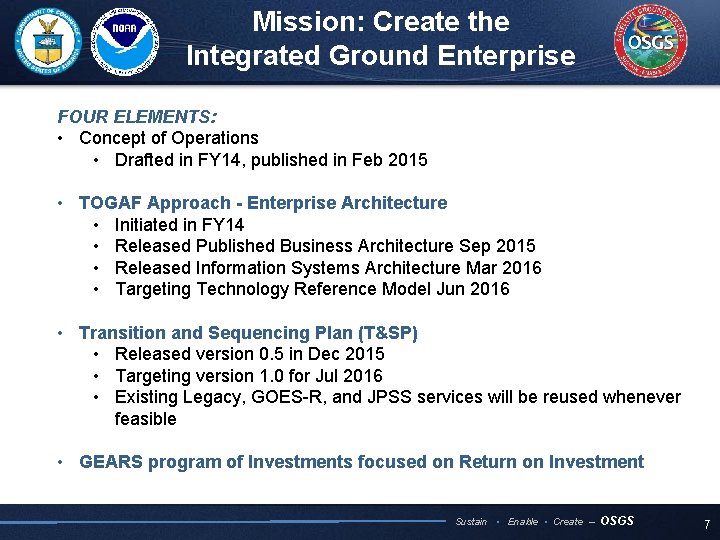
Mission: Create the Integrated Ground Enterprise FOUR ELEMENTS: • Concept of Operations • Drafted in FY 14, published in Feb 2015 • TOGAF Approach - Enterprise Architecture • Initiated in FY 14 • Released Published Business Architecture Sep 2015 • Released Information Systems Architecture Mar 2016 • Targeting Technology Reference Model Jun 2016 • Transition and Sequencing Plan (T&SP) • Released version 0. 5 in Dec 2015 • Targeting version 1. 0 for Jul 2016 • Existing Legacy, GOES-R, and JPSS services will be reused whenever feasible • GEARS program of Investments focused on Return on Investment Sustain • Enable • Create – OSGS 7
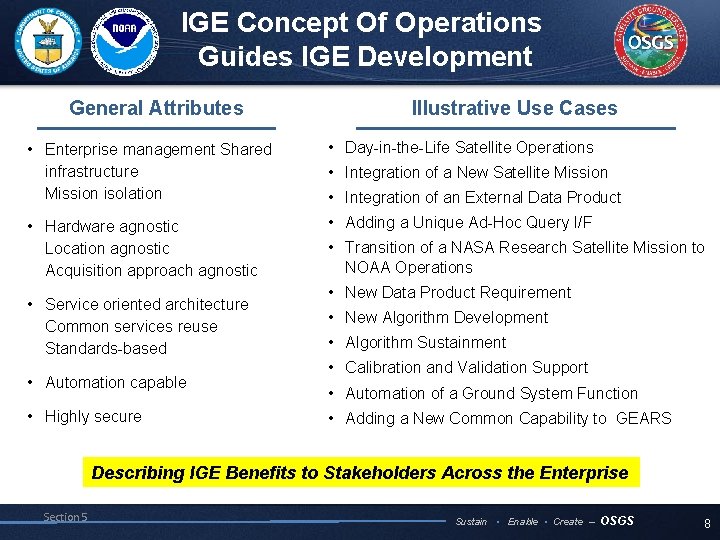
IGE Concept Of Operations Guides IGE Development General Attributes Illustrative Use Cases • Enterprise management Shared infrastructure Mission isolation • Day-in-the-Life Satellite Operations • Hardware agnostic Location agnostic Acquisition approach agnostic • Adding a Unique Ad-Hoc Query I/F • Service oriented architecture Common services reuse Standards-based • Automation capable • Highly secure • Integration of a New Satellite Mission • Integration of an External Data Product • Transition of a NASA Research Satellite Mission to NOAA Operations • New Data Product Requirement • New Algorithm Development • Algorithm Sustainment • Calibration and Validation Support • Automation of a Ground System Function • Adding a New Common Capability to GEARS Describing IGE Benefits to Stakeholders Across the Enterprise Section 5 Sustain • Enable • Create – OSGS 8
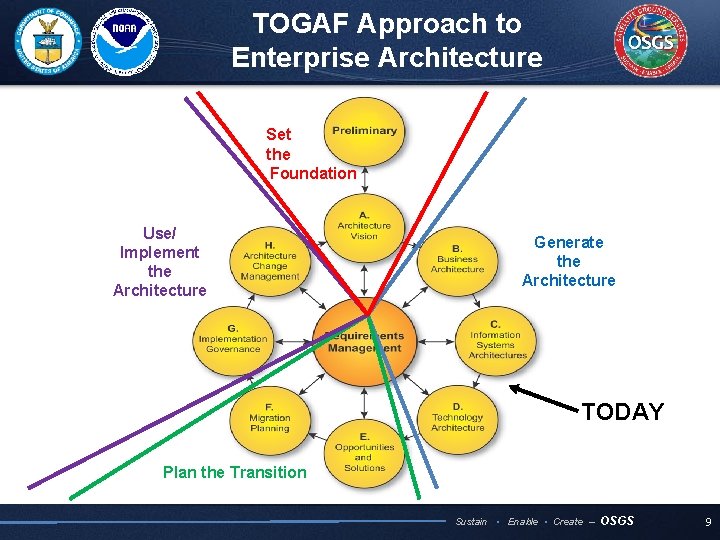
TOGAF Approach to Enterprise Architecture Set the Foundation Use/ Implement the Architecture Generate the Architecture TODAY Plan the Transition Sustain • Enable • Create – OSGS 9
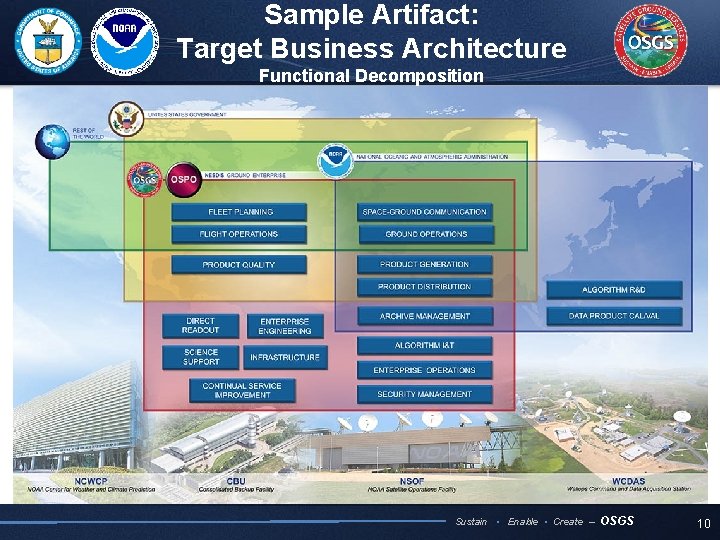
Sample Artifact: Target Business Architecture Functional Decomposition Sustain • Enable • Create – OSGS 10
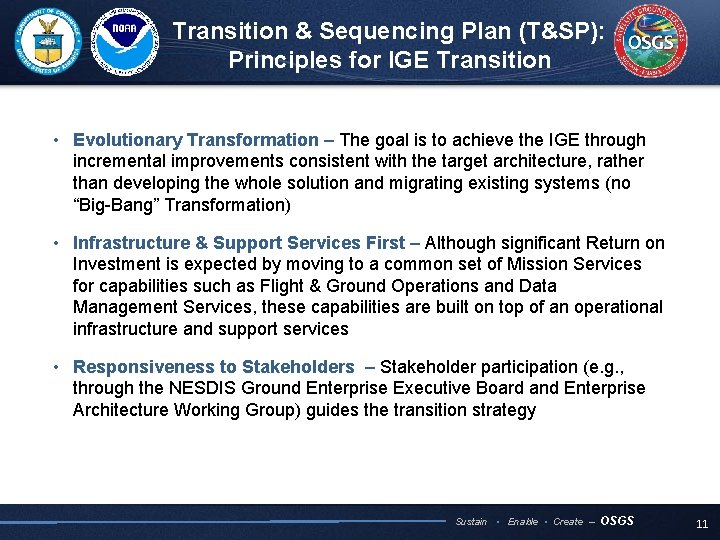
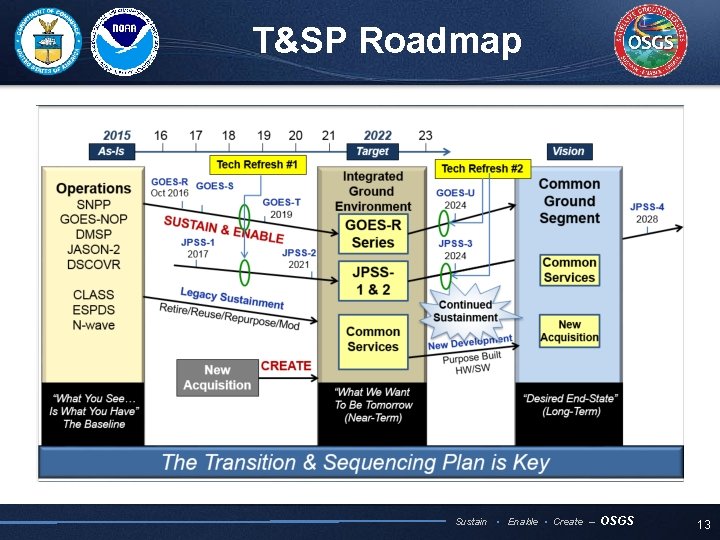
Transition & Sequencing Plan (T&SP): Principles for IGE Transition • Evolutionary Transformation – The goal is to achieve the IGE through incremental improvements consistent with the target architecture, rather than developing the whole solution and migrating existing systems (no “Big-Bang” Transformation) • Infrastructure & Support Services First – Although significant Return on Investment is expected by moving to a common set of Mission Services for capabilities such as Flight & Ground Operations and Data Management Services, these capabilities are built on top of an operational infrastructure and support services • Responsiveness to Stakeholders – Stakeholder participation (e. g. , through the NESDIS Ground Enterprise Executive Board and Enterprise Architecture Working Group) guides the transition strategy Sustain • Enable • Create – OSGS 11
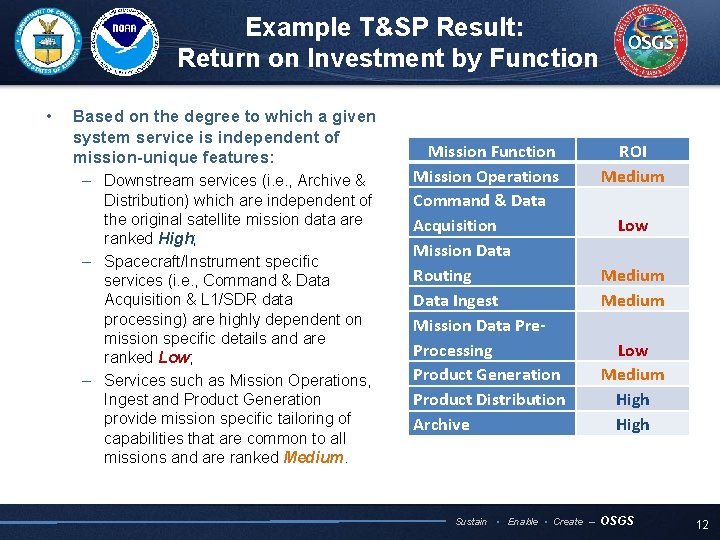
Example T&SP Result: Return on Investment by Function • Based on the degree to which a given system service is independent of mission-unique features: – Downstream services (i. e. , Archive & Distribution) which are independent of the original satellite mission data are ranked High; – Spacecraft/Instrument specific services (i. e. , Command & Data Acquisition & L 1/SDR data processing) are highly dependent on mission specific details and are ranked Low; – Services such as Mission Operations, Ingest and Product Generation provide mission specific tailoring of capabilities that are common to all missions and are ranked Medium. Mission Function Mission Operations Command & Data Acquisition Mission Data Routing Data Ingest Mission Data Pre. Processing Product Generation Product Distribution Archive Sustain • Enable • Create – ROI Medium Low Medium High OSGS 12
T&SP Roadmap Sustain • Enable • Create – OSGS 13
Sustainment Transformation Sustain • Enable • Create – OSGS 14
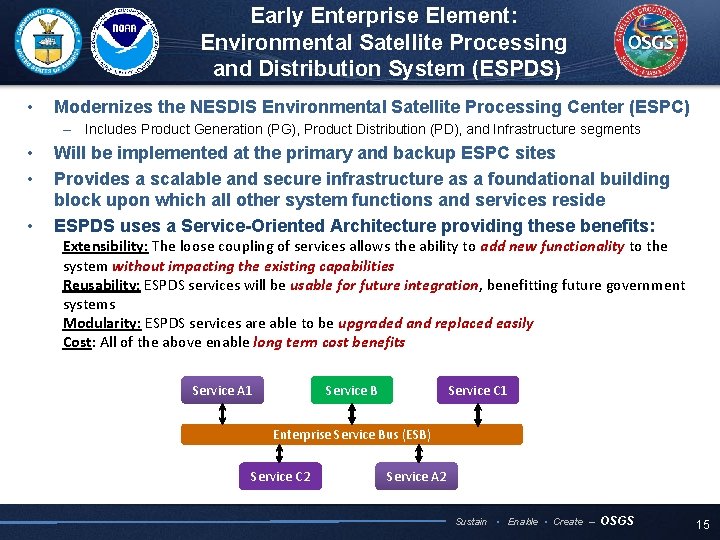
Early Enterprise Element: Environmental Satellite Processing and Distribution System (ESPDS) • Modernizes the NESDIS Environmental Satellite Processing Center (ESPC) – Includes Product Generation (PG), Product Distribution (PD), and Infrastructure segments • • • Will be implemented at the primary and backup ESPC sites Provides a scalable and secure infrastructure as a foundational building block upon which all other system functions and services reside ESPDS uses a Service-Oriented Architecture providing these benefits: Extensibility: The loose coupling of services allows the ability to add new functionality to the system without impacting the existing capabilities Reusability: ESPDS services will be usable for future integration, benefitting future government systems Modularity: ESPDS services are able to be upgraded and replaced easily Cost: All of the above enable long term cost benefits Service A 1 Service B Service C 1 Enterprise Service Bus (ESB) Service C 2 Service A 2 Sustain • Enable • Create – OSGS 15
Early Enterprise Element: Product Access and Distribution (PDA) Operational Concept • PDA provides a paradigm shift in the agency’s approach to managing real-time distribution of environmental satellite data: - Allows approved users to manage their data access details (product customization, selection and transfer method) - Provides the user with greater data discovery (via the online catalog) and OSPO with greater data organizational control - Enables OSPO to manage / monitor the user’s data volume usage and user’s access to product groups • Data access reviewed and granted by the Data Access Review Board (DARB) – product groups and data volume allocations Sustain • Enable • Create – OSGS 16
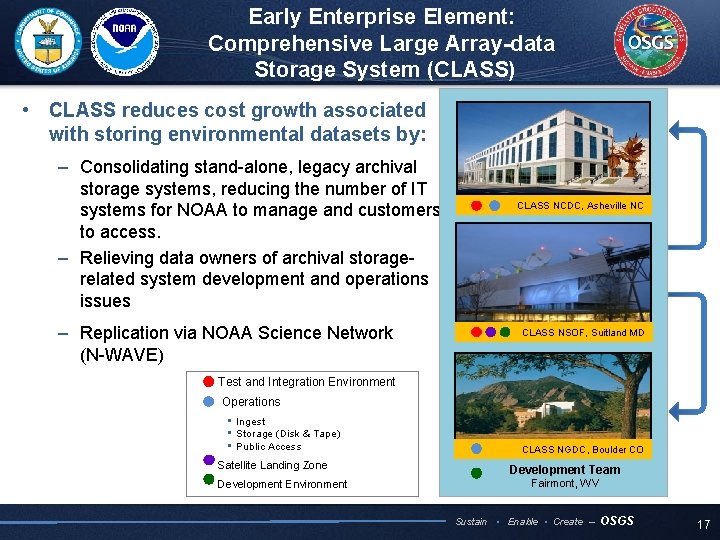
Early Enterprise Element: Comprehensive Large Array-data Storage System (CLASS) • CLASS reduces cost growth associated with storing environmental datasets by: – Consolidating stand-alone, legacy archival storage systems, reducing the number of IT systems for NOAA to manage and customers to access. – Relieving data owners of archival storagerelated system development and operations issues – Replication via NOAA Science Network (N-WAVE) CLASS NCDC, Asheville NC CLASS NSOF, Suitland MD Test and Integration Environment Operations • Ingest • Storage (Disk & Tape) • Public Access Satellite Landing Zone Development Environment CLASS NGDC, Boulder CO Development Team Fairmont, WV Sustain • Enable • Create – OSGS 17
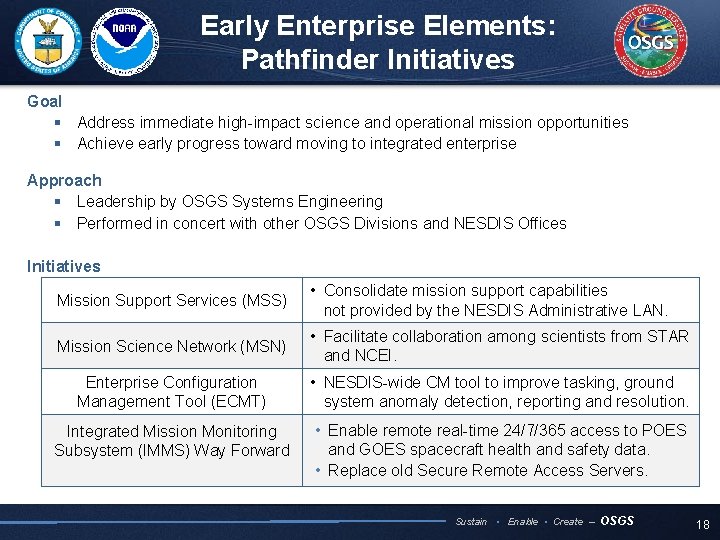
Early Enterprise Elements: Pathfinder Initiatives Goal § Address immediate high-impact science and operational mission opportunities § Achieve early progress toward moving to integrated enterprise Approach § Leadership by OSGS Systems Engineering § Performed in concert with other OSGS Divisions and NESDIS Offices Initiatives Mission Support Services (MSS) • Consolidate mission support capabilities not provided by the NESDIS Administrative LAN. Mission Science Network (MSN) • Facilitate collaboration among scientists from STAR and NCEI. Enterprise Configuration Management Tool (ECMT) • NESDIS-wide CM tool to improve tasking, ground system anomaly detection, reporting and resolution. Integrated Mission Monitoring Subsystem (IMMS) Way Forward • Enable remote real-time 24/7/365 access to POES and GOES spacecraft health and safety data. • Replace old Secure Remote Access Servers. Sustain • Enable • Create – OSGS 18
NESDIS Transformation Summary • Early Enterprise Element product generation, distribution, and archival activities are meeting all milestones, closely integrated with the JPSS, GOES-R, and legacy ground programs • Transformation planning is well underway, addressing key enterprise architecture, concept of operations, and transition objectives in collaboration with JPSS, GOES-R, NWS and NOAA CIO • Cost avoidance is a key objective that influences every aspect of our work Never Buy Another Stand-Alone Ground System Sustain • Enable • Create – OSGS 19
BACK-UP Sustain • Enable • Create – OSGS 20
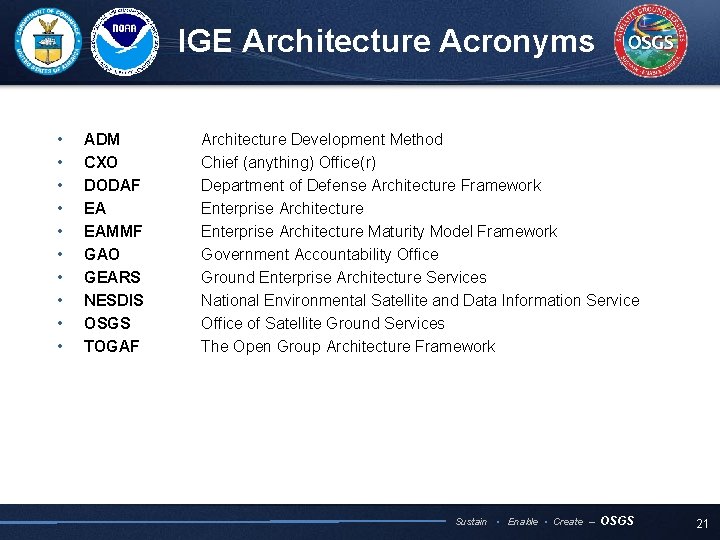
IGE Architecture Acronyms • • • ADM CXO DODAF EA EAMMF GAO GEARS NESDIS OSGS TOGAF Architecture Development Method Chief (anything) Office(r) Department of Defense Architecture Framework Enterprise Architecture Maturity Model Framework Government Accountability Office Ground Enterprise Architecture Services National Environmental Satellite and Data Information Service Office of Satellite Ground Services The Open Group Architecture Framework Sustain • Enable • Create – OSGS 21
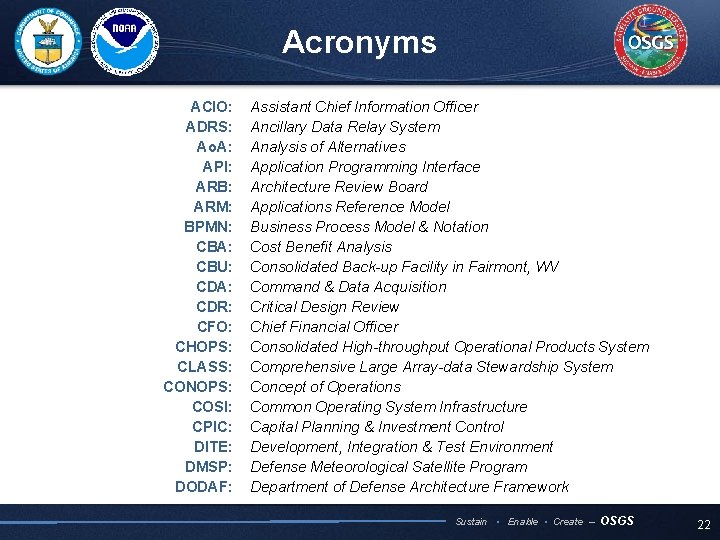
Acronyms ACIO: ADRS: Ao. A: API: ARB: ARM: BPMN: CBA: CBU: CDA: CDR: CFO: CHOPS: CLASS: CONOPS: COSI: CPIC: DITE: DMSP: DODAF: Assistant Chief Information Officer Ancillary Data Relay System Analysis of Alternatives Application Programming Interface Architecture Review Board Applications Reference Model Business Process Model & Notation Cost Benefit Analysis Consolidated Back-up Facility in Fairmont, WV Command & Data Acquisition Critical Design Review Chief Financial Officer Consolidated High-throughput Operational Products System Comprehensive Large Array-data Stewardship System Concept of Operations Common Operating System Infrastructure Capital Planning & Investment Control Development, Integration & Test Environment Defense Meteorological Satellite Program Department of Defense Architecture Framework Sustain • Enable • Create – OSGS 22
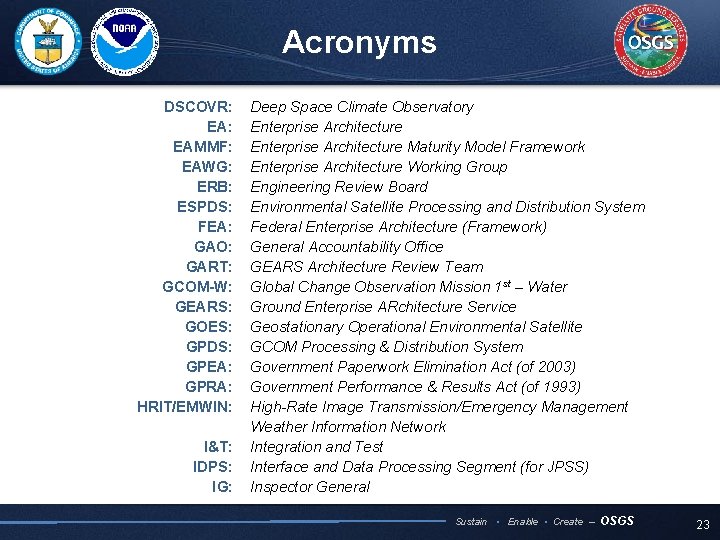
Acronyms DSCOVR: EAMMF: EAWG: ERB: ESPDS: FEA: GAO: GART: GCOM-W: GEARS: GOES: GPDS: GPEA: GPRA: HRIT/EMWIN: I&T: IDPS: IG: Deep Space Climate Observatory Enterprise Architecture Maturity Model Framework Enterprise Architecture Working Group Engineering Review Board Environmental Satellite Processing and Distribution System Federal Enterprise Architecture (Framework) General Accountability Office GEARS Architecture Review Team Global Change Observation Mission 1 st – Water Ground Enterprise ARchitecture Service Geostationary Operational Environmental Satellite GCOM Processing & Distribution System Government Paperwork Elimination Act (of 2003) Government Performance & Results Act (of 1993) High-Rate Image Transmission/Emergency Management Weather Information Network Integration and Test Interface and Data Processing Segment (for JPSS) Inspector General Sustain • Enable • Create – OSGS 23
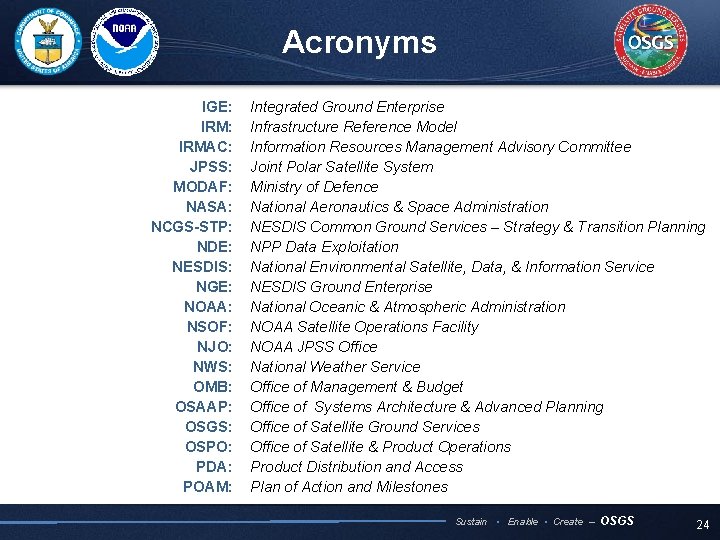
Acronyms IGE: IRMAC: JPSS: MODAF: NASA: NCGS-STP: NDE: NESDIS: NGE: NOAA: NSOF: NJO: NWS: OMB: OSAAP: OSGS: OSPO: PDA: POAM: Integrated Ground Enterprise Infrastructure Reference Model Information Resources Management Advisory Committee Joint Polar Satellite System Ministry of Defence National Aeronautics & Space Administration NESDIS Common Ground Services – Strategy & Transition Planning NPP Data Exploitation National Environmental Satellite, Data, & Information Service NESDIS Ground Enterprise National Oceanic & Atmospheric Administration NOAA Satellite Operations Facility NOAA JPSS Office National Weather Service Office of Management & Budget Office of Systems Architecture & Advanced Planning Office of Satellite Ground Services Office of Satellite & Product Operations Product Distribution and Access Plan of Action and Milestones Sustain • Enable • Create – OSGS 24
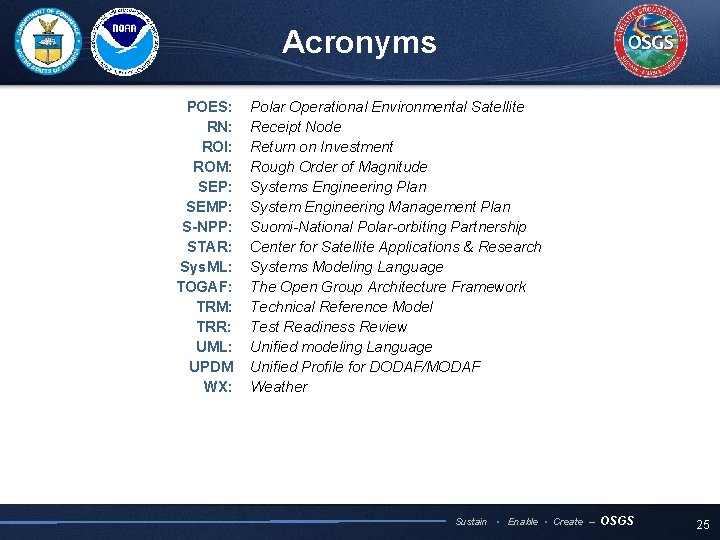
Acronyms POES: RN: ROI: ROM: SEP: SEMP: S-NPP: STAR: Sys. ML: TOGAF: TRM: TRR: UML: UPDM WX: Polar Operational Environmental Satellite Receipt Node Return on Investment Rough Order of Magnitude Systems Engineering Plan System Engineering Management Plan Suomi-National Polar-orbiting Partnership Center for Satellite Applications & Research Systems Modeling Language The Open Group Architecture Framework Technical Reference Model Test Readiness Review Unified modeling Language Unified Profile for DODAF/MODAF Weather Sustain • Enable • Create – OSGS 25