
Enterprise environmental monitoring Elements for guidelines on strengthening






- Slides: 43
Enterprise environmental monitoring Elements for guidelines on strengthening environmental monitoring and reporting by enterprises Aare Enterprise Sirendi environmental monitoring
Purpose and status of the Guidelines The current Guidelines serve to help: Ü Public authorities Ü Industrial operators Ü Environmental inspectors Ü Third parties Enterprise environmental monitoring 2
Definitions Ü Enterprise environmental monitoring Ü Operator Ü Quality assurance Ü Quality control Ü Direct (based on measurements) monitoring Ü Indirect (based on environmental estimates) evaluation Enterprise monitoring 3
Goals of enterprise environmental monitoring Ü Improved control over impacts on the environment Ü Higher environmental awareness Ü Increased management responsibility for regulatory compliance Ü Increased cost-effectiveness Ü Increased public access to information Enterprise environmental monitoring 4
Types of enterprise environmental monitoring Ü Operation (process) monitoring Ü Emissions monitoring Ü Impact monitoring Enterprise environmental monitoring 5
Parameters measured Ü Raw material inputs Ü Operating conditions Ü Use of raw materials and energy Ü Channeled emissions of waste gases Ü Controlled discharges of waste water Ü Controlled disposals of solid waste Enterprise environmental monitoring 6
Parameters measured (continued) Ü Diffuse releases to air, water and land Ü Accidental releases Ü Nuisance level of noise, vibration and odour Ü Process/plant conditions Ü Operation and maintenance of monitoring equipment Ü Impact on receiving environment Enterprise environmental monitoring 7
Overall obligations of the operator Ü Develop a draft enterprise environmental monitoring programme Ü Conduct and document monitoring Ü Follow all procedural requirements Ü Perform quality control and quality assurance Ü Follow safety Enterprise precautions environmental monitoring 8
Overall obligations of the operator (continued) Ü Evaluate the performance of the methods of programme implementation Ü Provide inspectors’ access to facility and data Ü Operators will not carry out the impact monitoring themselves but are covering its costs Enterprise environmental monitoring 9
Role of the public authority Ü Enterprise environmental monitoring is not meant to replace government supervision Ü Public authorities will be responsible for assessing the correct implementation of the enterprise environmental monitoring programmes Ü Public authorities will consider the costs of data production, analysis and reporting Ü The need for impact monitoring will be considered at the stage of enterprise environmental monitoring programme Enterprise environmental monitoring development 10
Main steps involved in programme development Ü Specifying the goals for enterprise environmental monitoring Ü Stating the responsibilities Ü Identification of the scope of enterprise environmental monitoring Ü Considering the general approach and the monitoring methods available Ü Specifying the technical details of particular standard Enterprise environmental monitoring 11
Main steps involved in programme development (continued) Ü Specifying the monitoring timing requirements of sampling and measurements Ü Stating clearly the location where samples and measurements are to be taken Ü Stating the operational conditions Ü Including appropriate quality assurance Enterprise environmental monitoring 12 and control requirements
Main steps involved in programme development (continued) Ü Defining the recording and reporting requirements Ü Arrangements for the assessment and reporting of exceptional releases Ü Establish an internal framework to ensure compliance Ü Provide statement of the compliance control procedures and the response in case of non-compliance Enterprise environmental monitoring 13
The main quality considerations include: Ü Traceability of the measurements’ results Ü Maintenance of the monitoring system Ü The use of recognised Quality Management Systems Ü Periodic checks by an external Accredited laboratory Enterprise environmental monitoring 14
The main quality considerations include (continued): Ü Certification of instruments and personnel under recognised certification schemes Ü Calibration of equipment according to designated techniques Ü Self-certification of monitoring data Ü Participation in laboratory intercalibrations and other evaluations Enterprise environmental monitoring 15
Monitoring approaches complementing or substituting direct measurement of emissions Enterprise environmental monitoring
Surrogate parameters Ü Cost savings thus greater costeffectiveness; Ü Reduced complexity; Ü Wider scope: more discharge points can be monitored for the same or less resource; Ü Sometimes more accurate than direct Enterprise environmental monitoring 17 values;
Surrogate parameters (continued) Ü Give an early warning of possible upset conditions Ü Less disruption to the process operation than direct measurements; Ü Information from several direct measurements may be combined Ü Recovery of corrupted monitoring data. Enterprise environmental monitoring 18
Disadvantages of the use of surrogates may include: Ü The need for calibration against direct measurements; Ü May only be valid for a restricted range of process conditions; Ü May not assure as much public confidence as direct measurements; Ü Sometimes less accurate than direct measurements; Enterprise environmental Ü May not be valid formonitoring legal purposes. 19
Mass balances Ü The emissions are the same order of magnitude as inputs or outputs; Ü The amounts of the substance (input, output, transfer, accumulation) can be readily quantified over a defined period of time. Estimating emissions by a mass balance is based on the following equation: Total mass into process = accumulations +total mass out of process +uncertainties Inputs = products +transfers +accumulations +emissions +uncertainties Enterprise environmental monitoring 20
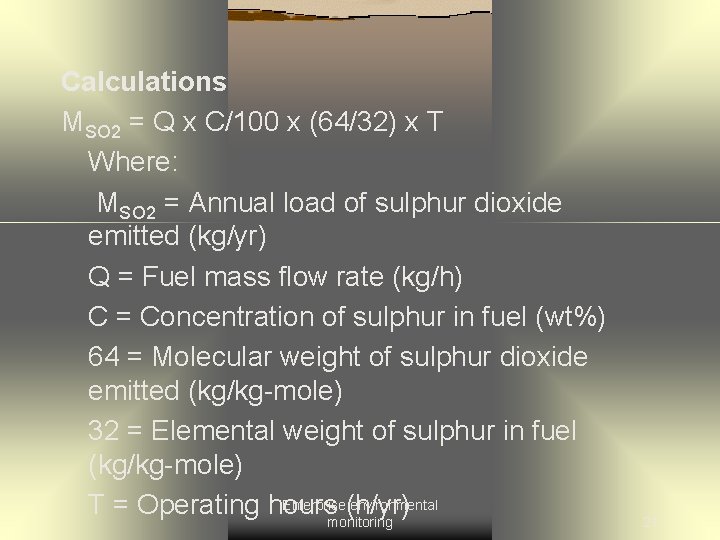
Calculations MSO 2 = Q x C/100 x (64/32) x T Where: MSO 2 = Annual load of sulphur dioxide emitted (kg/yr) Q = Fuel mass flow rate (kg/h) C = Concentration of sulphur in fuel (wt%) 64 = Molecular weight of sulphur dioxide emitted (kg/kg-mole) 32 = Elemental weight of sulphur in fuel (kg/kg-mole) Enterprise(h/yr) environmental T = Operating hours monitoring 21
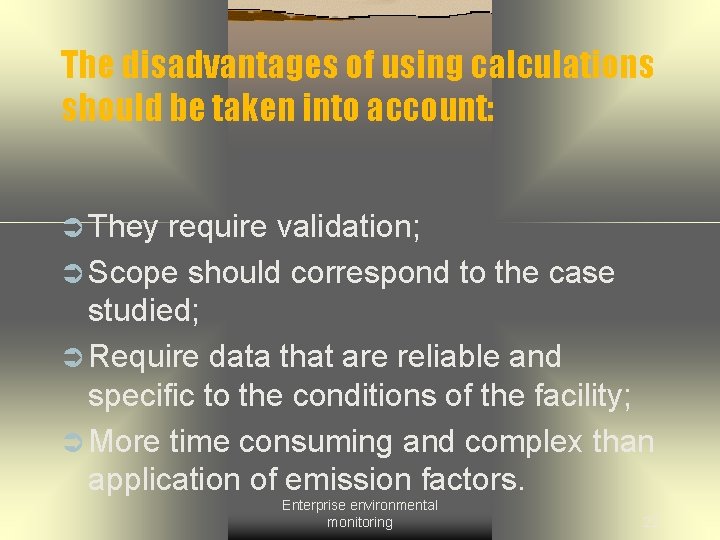
The disadvantages of using calculations should be taken into account: Ü They require validation; Ü Scope should correspond to the case studied; Ü Require data that are reliable and specific to the conditions of the facility; Ü More time consuming and complex than application of emission factors. Enterprise environmental monitoring 22
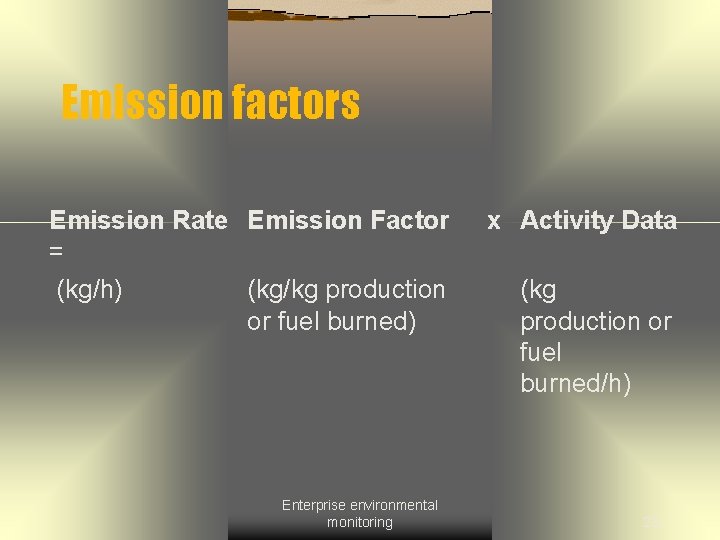
Emission factors Emission Rate Emission Factor = (kg/h) (kg/kg production or fuel burned) Enterprise environmental monitoring x Activity Data (kg production or fuel burned/h) 23
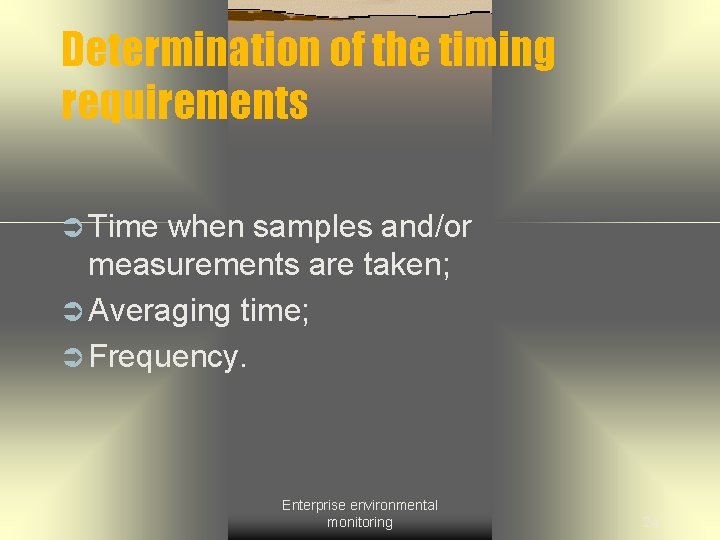
Determination of the timing requirements Ü Time when samples and/or measurements are taken; Ü Averaging time; Ü Frequency. Enterprise environmental monitoring 24
Averaging time and the frequency depends on the type of the process: ÜA very stable process Ü A cyclic or a batch process Ü A relatively stable process Ü A highly variable process Enterprise environmental monitoring 25
Optimising costs of enterprise environmental monitoring Enterprise environmental monitoring
Costs associated with enterprise environmental monitoring Resources to design the system: including staff time, hiring of outside contractors Design and construction of dedicated lines, control loops, wells, sampling ports Laboratory and analytical costs Training of managers Continuous staff training to run the enterprise environmental monitoring programme Enterprise environmental monitoring 27
Costs associated with enterprise environmental monitoring (continues) Ü Sampling Ü Transport of samples Ü Treatment of samples Ü Data processing Ü Distribution of data Ü Hiring of third party contractors to perform parts of the monitoring Ü Modification of the monitoring system Ü Penalties for an inadequate functioning of enterprise environmental monitoring Enterprise environmental monitoring 28
Possible actions to optimise costs Select the appropriate quality performance requirements Optimise the monitoring frequency and match it with the desired accuracy of the results Optimise the number of parameters to be monitored by only considering those that are strictly necessary Consider the use of continuous monitoring only when it provides the requested information at a lower overall monitoring cost than Enterprise environmental monitoring 29
Possible actions to optimise costs (continued) Consider, where possible, replacing expensive parameters with surrogates that are more economical and simpler to monitor Standardize data collection techniques, use to the needs existing procedures and tools of data management and analysis; Consider whether data collection matches the capacity to respond to and capitalize of the information generated Consider complementing routine monitoring by special studies (such as campaign Enterprise environmental monitoring 30 monitoring).
REPORTING AND RECORD KEEPING Enterprise environmental monitoring
Types of data that should be recorded Ü All sampling, analyses, measurements, examinations, calibrations and maintenance carried out in accordance with the permit or the enterprise environmental monitoring programme; Ü All planned changes (alterations or additions) to the permitted installation; Enterprise environmental monitoring 32
Types of data that must be recorded (continued) Ü All incidents which affect the normal operation of the activity and which may create an environmental risk; Ü All non-compliance cases and selfcorrection measures; Ü All complaints of an environmental nature related to the operation of the activity. A record shall also be kept of the response made in the case of each complaint. Enterprise environmental monitoring 33
The analysis and reporting of results: Ü Evaluate results, including through a statistical analysis Ü Assess compliance with regulatory requirements Ü Report and explain results to the authority and the public Enterprise environmental monitoring 34
The operator will submit enterprise environmental monitoring data to the competent authority Ü Periodically, according to a predefined schedule; Ü Immediately, when violations are discovered Ü Upon the request of the competent authority Enterprise environmental monitoring 35
Air emissions and air quality monitoring Conversion to reference standard conditions Normalised data are standardised to a particular temperature and pressure, typically 0 ºC and 1 atm respectively, although sometimes they may be referenced to Enterprise 25 monitoring ºCenvironmental and 1 atm. 36
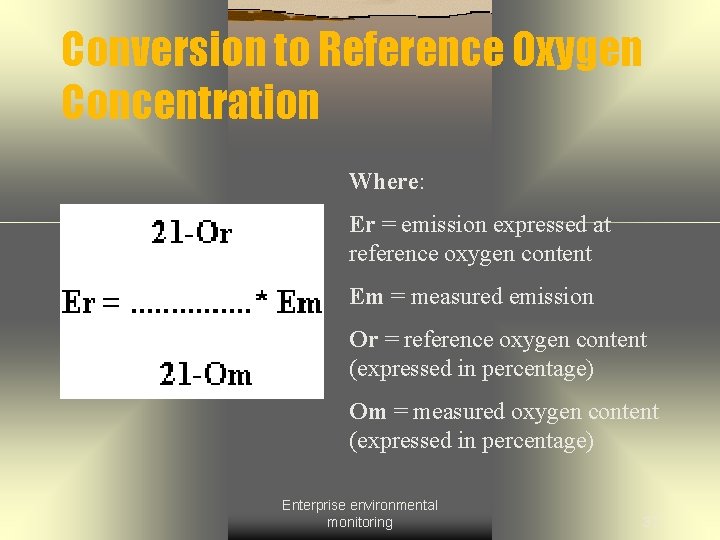
Conversion to Reference Oxygen Concentration Where: Er = emission expressed at reference oxygen content Em = measured emission Or = reference oxygen content (expressed in percentage) Om = measured oxygen content (expressed in percentage) Enterprise environmental monitoring 37
Approaches to assess compliance 1) the measurements, or a summary statistic estimated from the measurements 2) the uncertainty of the measurements 3) the relevant ELV or equivalent parameter Before assessing compliance, all three Enterprise environmental items may need conversion. monitoring 38
The result of this assessment can be assigned to one of three categories: 1. compliant 2. borderline or 3. non-compliant. Enterprise environmental monitoring 39
There are two aspects of compliance to be considered: 1. Evidential compliance. This means compliance with requirements to provide adequate monitoring evidence. 2. Compliance with limit values. This means compliance on the basis of monitoring results with requirements for emissions not to exceed numerical limits in permits, or for ambient impacts not to exceed quality standards in receiving environments. Enterprise environmental monitoring 40
In order to assess compliance with limit values the following items are necessary: Ü The limit value for the relevant operating condition Ü The relevant measured pollutant or parameter value Ü An estimate of the uncertainty in measurements Ü A level of statistical probability or confidence Enterprise environmental monitoring 41
Use of enterprise environmental monitoring data for enforcement and public review Ü Can enterprise environmental monitoring information be used as a basis for non-compliance actions against the facility? Ü Enterprise environmental monitoring programmes should be available for review by the general public Enterprise environmental monitoring 42
The End Enterprise environmental monitoring 43