
Enterprise Content Metamodel Information Type Definitions Specialization Focus

- Slides: 80
Enterprise Content Metamodel: Information Type Definitions Specialization Focus Area Rob Hanna September 22, 2010 DITA for Enterprise Business Documents Subcommittee
Agenda • Introduction • Describe Business Document Environment • Introduce 3 Content Models – DITA Information Model – Information Mapping® – Enterprise Content Metamodel DITA for Enterprise Business Documents Subcommittee
Presentation Objectives • Explore three known information models • Discuss merits of each leading to decisions on: – whether one is best suited to the efforts of the subcommittee; or – if a new model needs to be developed DITA for Enterprise Business Documents Subcommittee
Specialization Focus Area • The goal of the Specialization Focus Area is to make recommendations for structural and domain specializations needed to support enterprise business documents • The first task is to identify potential new information types that would require structural specialization • Once the information types have been determined, the Focus Area will examine specific domain specializations common across all information types in this domain DITA for Enterprise Business Documents Subcommittee
Objectives for the Metamodel • Develop a universal metamodel to describe typical business document content • Identify reusable semantic structures with a compatible granularity to the DITA standard • Describe a framework for adoption of a DITA standard for enterprise business documents DITA for Enterprise Business Documents Subcommittee
Business Documents Typically include controlled items such as: Typically do not include items such as: • Policies and procedures • Product development/maintenanc e documentation • Technical publications • Sales and marketing materials • Memoranda and correspondence • Newsletters and social media • Third-party materials • Database and financial output These items along with business documents represent business records DITA for Enterprise Business Documents Subcommittee
Research • Content Models – Information Mapping® – DITA • Document Models – Military Specifications (S 1000 D, 2361, 2167, 498) – ISO (9000, 15489) • Business Object Models – Rational Unified Process/Unified Modeling Language – Zachman Framework – Information Technology Infrastructure Library (ITIL) DITA for Enterprise Business Documents Subcommittee
Nature of Business Documents • Business documents are – – a conglomeration of different types of information managed using extensive metadata process-driven referenced by content used elsewhere in the process • While there are no widely adopted standards for content models, there are typical document types and recognizable structures in most business documents DITA for Enterprise Business Documents Subcommittee
Accountability • A convergence of factors are driving business towards – – process certification, regulatory requirements, needs for improved efficiency, and measurable quality • These demands require – – – better metadata, finer granularity of information, centralization, process automation, information ownership, and traceability DITA for Enterprise Business Documents Subcommittee
Knowledge Management • Knowledge is rarely captured directly in business documents and is most often compiled indirectly by document authors • Information is gathered from multiple sources and subject matter experts and distilled into documents before it is thrown over the wall – the information is written and forgotten about • Over time, the knowledge loses relevance or is lost • The metamodel breaks content down into manageable chunks that can be controlled by the subject matter experts and compiled into traditional documents DITA for Enterprise Business Documents Subcommittee
Unified Content Strategy • Single-source authoring – has reached a state of maturity within technical publications – enable collaboration on content creation – Improves • content quality, • consistency, and • maintainability – requires a level of sophistication that eludes most business users DITA for Enterprise Business Documents Subcommittee
Granularity • Granularity of reuse within business documents appears to be more complex than in typical technical publications – Size of reusable components varies from a single-statement to collections of nested topics – Application of reusable components may be used across far more diverse audiences • Granularity must be defined as well by the ownership and lifecycle of the component within the metamodel • Information must be captured into a single source and managed according to robust rules for reuse using progressive disclosure to determine the granularity DITA for Enterprise Business Documents Subcommittee
Evolution of the Enterprise Topic • What is a topic? – fundamental building blocks used to capture knowledge about any given subject – a single definitive source of information – designed to be used and reused in their entirety or in part – independent of any containing document or map and can be used in any appropriate context DITA for Enterprise Business Documents Subcommittee
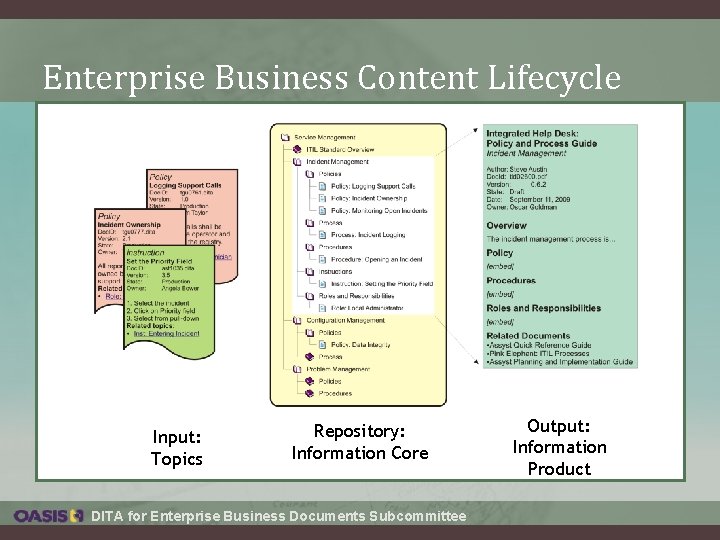
Content Lifecycle • Typical content lifecycle describes documents developed and stored in a repository • Topic-based lifecycle is similar in that documents are planned developed and stored in a repository as topics that can be reused • Enterprise Business Content Lifecycle describes a different process where topics are developed and stored in a repository. Documents are then created as needed using topics in the repository. DITA for Enterprise Business Documents Subcommittee
Enterprise Business Content Lifecycle Input: Topics Repository: Information Core DITA for Enterprise Business Documents Subcommittee Output: Information Product
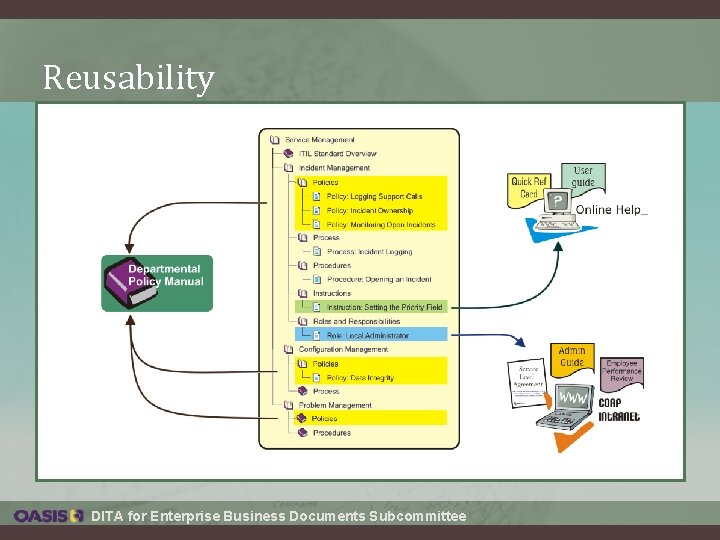
Reusability DITA for Enterprise Business Documents Subcommittee
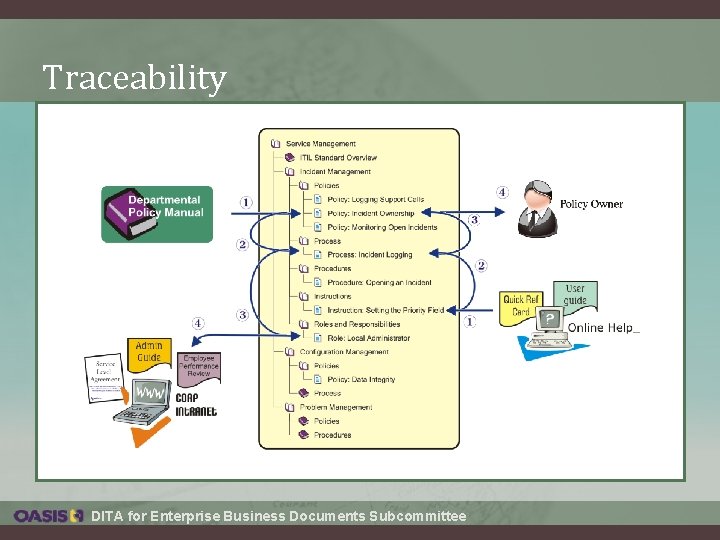
Traceability DITA for Enterprise Business Documents Subcommittee
Traceability • Businesses use many purpose-built applications and databases to manage business information such as: – Requirements management tools – Bug tracking systems – Software testing tools • The metamodel should incorporate traceability for business documents to integrate with these systems DITA for Enterprise Business Documents Subcommittee
Traceability in the Enterprise • Traceability is normally driven subjectively by the author creating cross-references and links to related content he or she is has written or is aware of • Content that flows together goes together in a document as it is created • Where content is topic-based rather than documentbased, traceability to enterprise content is considerably more difficult without business rules for relationships • The metamodel establishes basic rules for traceability based upon the common flow of information in an enterprise with dependencies and ancestry DITA for Enterprise Business Documents Subcommittee
Content Classes • Early on in the discussion on topic specializations, the focus area discovered that content needed to be broken down into classes to describe its properties and behaviours • DITA had first dealt only with one class of content – the topic – which was a standalone chunk of content that existed outside of any single document • New innovations such as the DITA Bookmap introduced classes of content that did not fit with this description • This focus area has categorized content into four classes that describe the different properties of content DITA for Enterprise Business Documents Subcommittee
Content Classes I & II • Class I Content – Represents portable, non-contextual information topics living outside of documents. Class I Content requires specific sub-structures unique to the topic type. • For example: DITA concept, task, and reference • Class II Content – Represents non-portable, contextual information topics that resides only within a given document. Class II Content requires very general, common sub-structures. • For example: Executive summary, chapter summary, document foreword, dedication, etc DITA for Enterprise Business Documents Subcommittee
Content Classes III & IV • Class III Content – Represents boilerplate text that can reside outside of a content repository and may be produced automatically at publishing time. • For example: Legal disclaimer, company information, table of contents, index, advance organizer, cover page, etc • Class IV Content – Represents content needed to aggregate documents from the three previous classes of content including metadata about the document. • For example: DITA map or bookmap DITA for Enterprise Business Documents Subcommittee
Information Models • To identify the necessary information types needed to support business documents, the focus area will study available information models – DITA information model • Breaks information types into Topics – Information Mapping® • Breaks information types into Information Modules – Information Management Model • Breaks information types into Information Objects • This is not necessarily an exhaustive list of models and others may be looked at as they surface DITA for Enterprise Business Documents Subcommittee
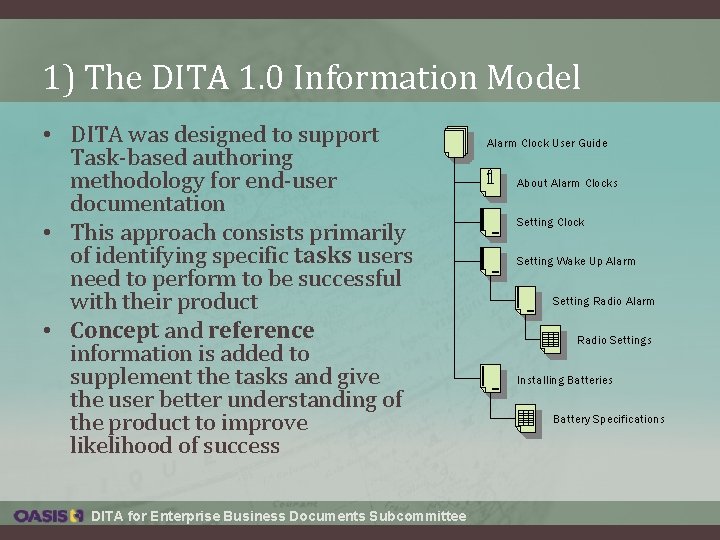
1) The DITA 1. 0 Information Model • DITA was designed to support Task-based authoring methodology for end-user documentation • This approach consists primarily of identifying specific tasks users need to perform to be successful with their product • Concept and reference information is added to supplement the tasks and give the user better understanding of the product to improve likelihood of success DITA for Enterprise Business Documents Subcommittee Alarm Clock User Guide About Alarm Clocks Setting Clock Setting Wake Up Alarm Setting Radio Alarm Radio Settings Installing Batteries Battery Specifications
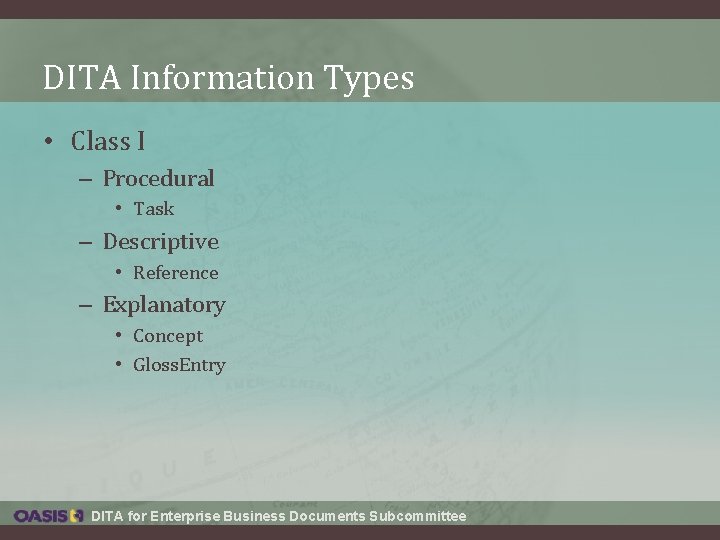
DITA Information Types • Class I – Procedural • Task – Descriptive • Reference – Explanatory • Concept • Gloss. Entry DITA for Enterprise Business Documents Subcommittee
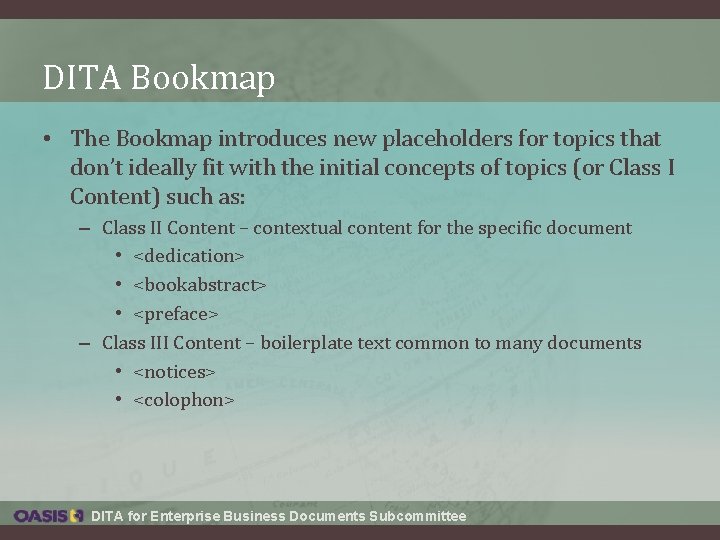
DITA Bookmap • The Bookmap introduces new placeholders for topics that don’t ideally fit with the initial concepts of topics (or Class I Content) such as: – Class II Content – contextual content for the specific document • <dedication> • <bookabstract> • <preface> – Class III Content – boilerplate text common to many documents • <notices> • <colophon> DITA for Enterprise Business Documents Subcommittee
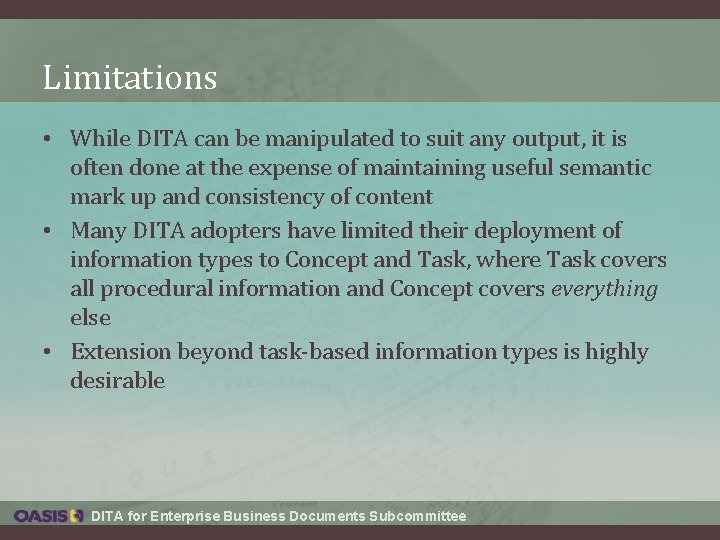
Limitations • While DITA can be manipulated to suit any output, it is often done at the expense of maintaining useful semantic mark up and consistency of content • Many DITA adopters have limited their deployment of information types to Concept and Task, where Task covers all procedural information and Concept covers everything else • Extension beyond task-based information types is highly desirable DITA for Enterprise Business Documents Subcommittee
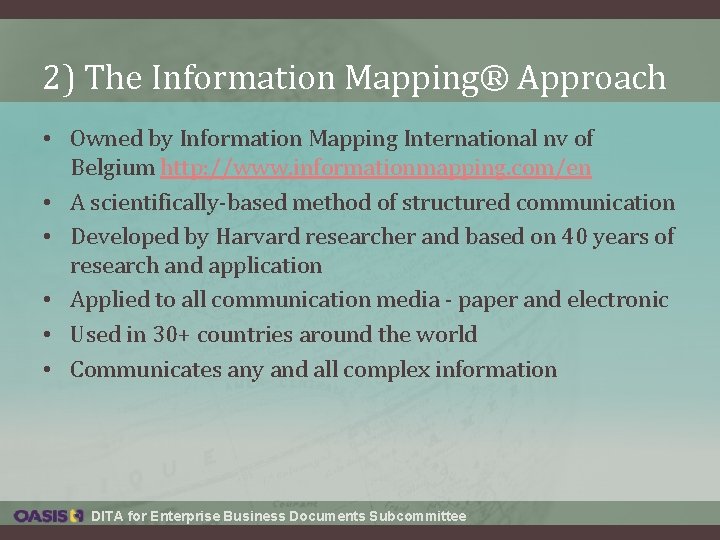
2) The Information Mapping® Approach • Owned by Information Mapping International nv of Belgium http: //www. informationmapping. com/en • A scientifically-based method of structured communication • Developed by Harvard researcher and based on 40 years of research and application • Applied to all communication media - paper and electronic • Used in 30+ countries around the world • Communicates any and all complex information DITA for Enterprise Business Documents Subcommittee
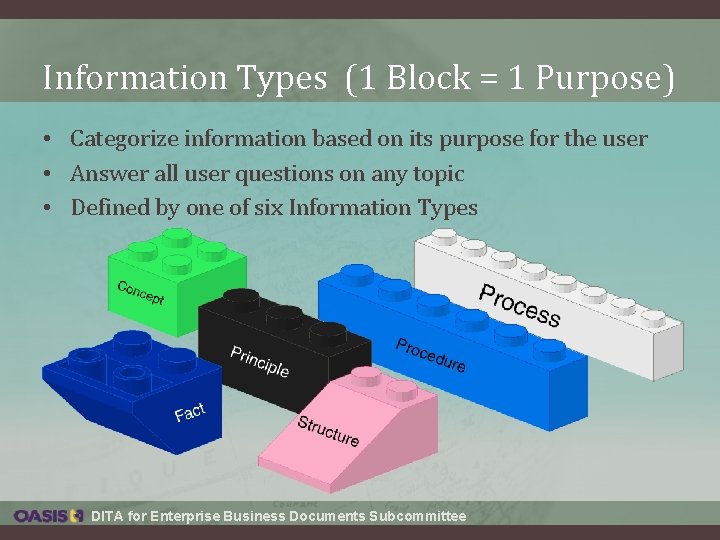
Information Types (1 Block = 1 Purpose) • Categorize information based on its purpose for the user • Answer all user questions on any topic • Defined by one of six Information Types DITA for Enterprise Business Documents Subcommittee
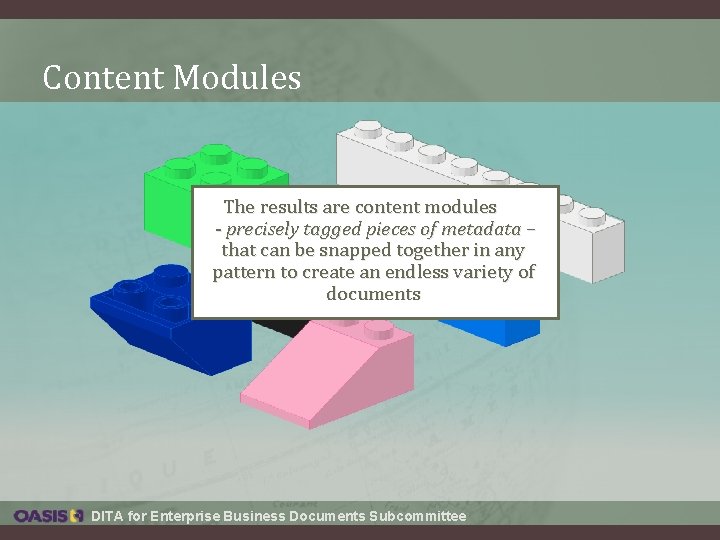
Content Modules The results are content modules - precisely tagged pieces of metadata – that can be snapped together in any pattern to create an endless variety of documents DITA for Enterprise Business Documents Subcommittee
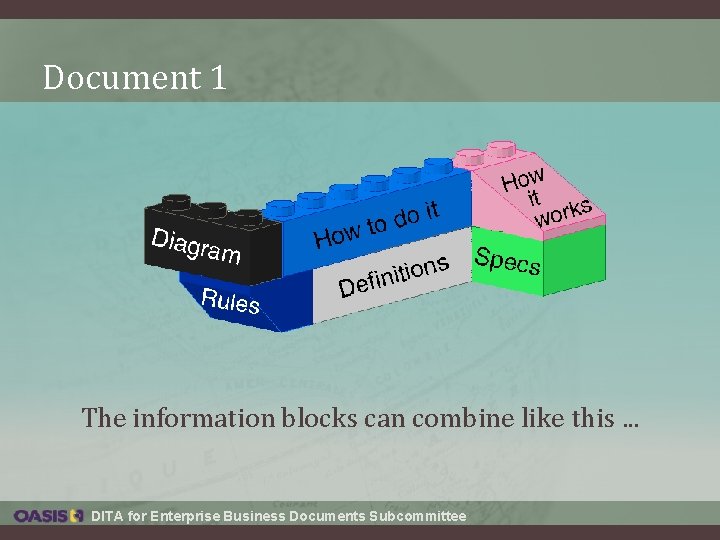
Document 1 The information blocks can combine like this. . . DITA for Enterprise Business Documents Subcommittee
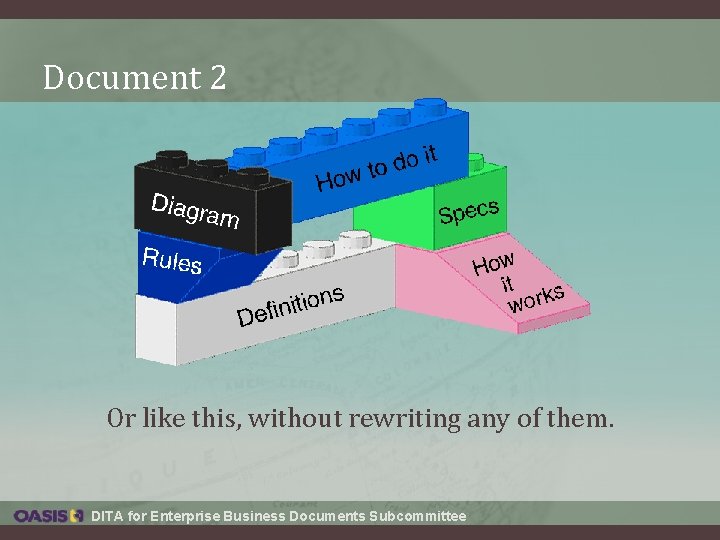
Document 2 Or like this, without rewriting any of them. DITA for Enterprise Business Documents Subcommittee
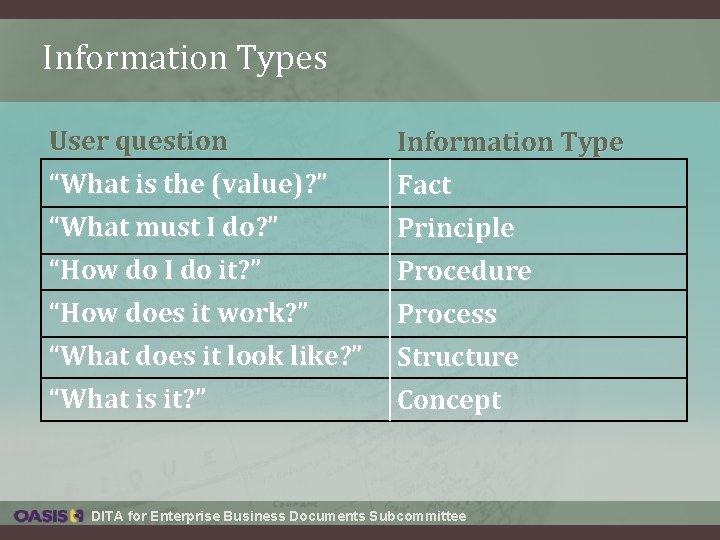
Information Types User question “What is the (value)? ” Information Type Fact “What must I do? ” “How do I do it? ” Principle Procedure “How does it work? ” “What does it look like? ” Process Structure “What is it? ” Concept DITA for Enterprise Business Documents Subcommittee
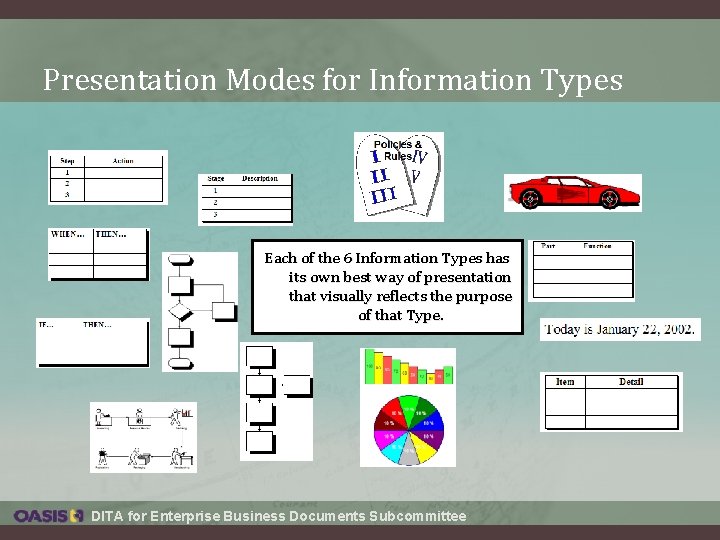
Presentation Modes for Information Types Each of the 6 Information Types has its own best way of presentation that visually reflects the purpose of that Type. DITA for Enterprise Business Documents Subcommittee
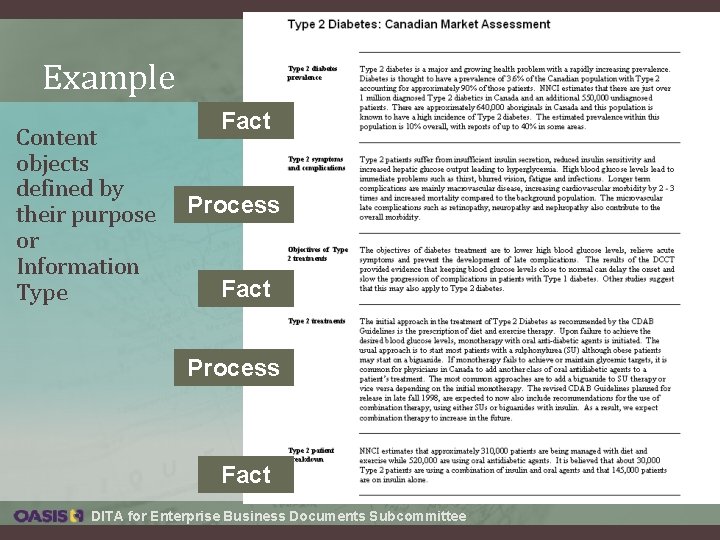
Example Content objects defined by their purpose or Information Type Fact Process Fact DITA for Enterprise Business Documents Subcommittee
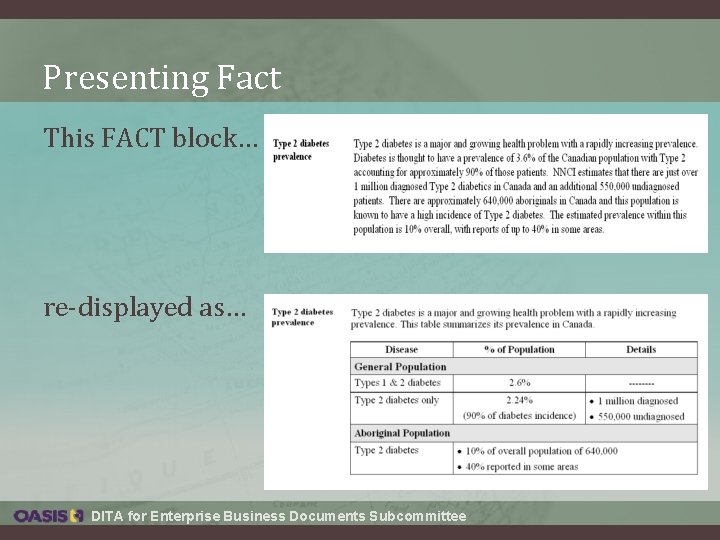
Presenting Fact This FACT block… re-displayed as… DITA for Enterprise Business Documents Subcommittee
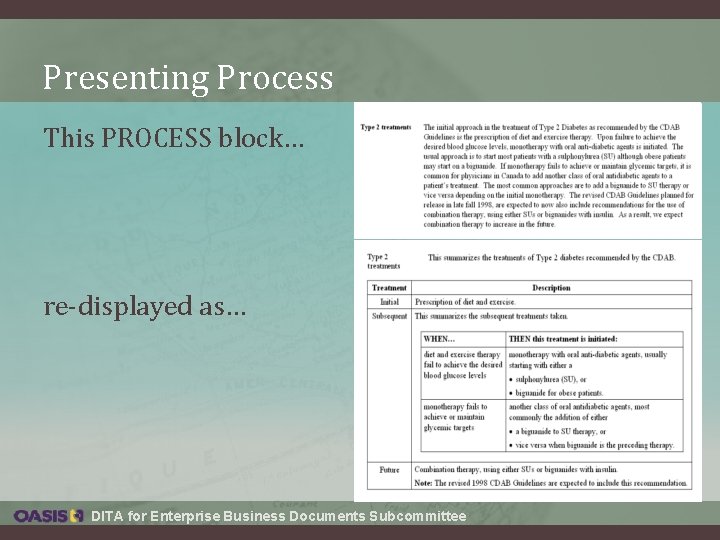
Presenting Process This PROCESS block… re-displayed as… DITA for Enterprise Business Documents Subcommittee
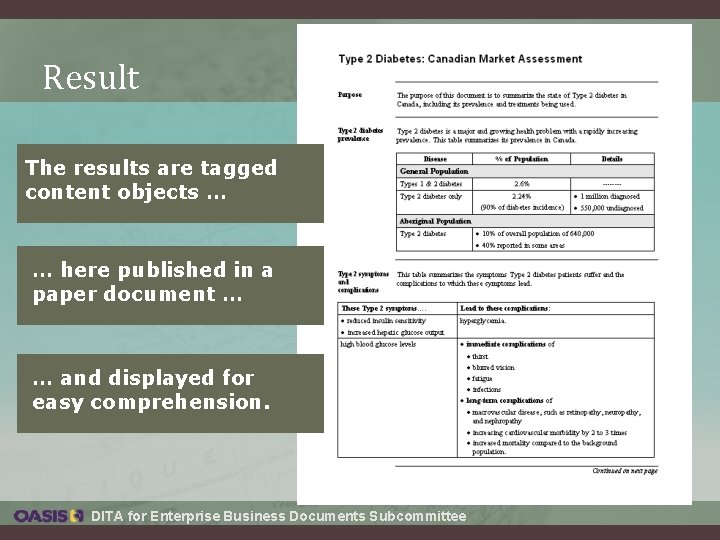
Result The results are tagged content objects … … here published in a paper document … … and displayed for easy comprehension. DITA for Enterprise Business Documents Subcommittee
Challenges • Information Mapping® models content at a different level of granularity to DITA • Information Mapping® focuses on the appearance of the rendered content more than the semantic markup of the source content • Information Mapping® isn’t widely used for structured authoring with XML • The methodologies are proprietary and any use of their approach may be limited DITA for Enterprise Business Documents Subcommittee
3) The Enterprise Content Metamodel • Created in 2002 by Rob Hanna • Published in 2005 STC Conference Proceedings as the Information Management Model http: //www. ascan. ca/stc/whitepaper_imm. pdf DITA for Enterprise Business Documents Subcommittee
Scope • The Enterprise Business Metamodel – is designed specifically for business documents – attempts to integrate with rather than replace existing information systems – is not intended to dispense with vast amounts of dissimilar or unstructured information used within an enterprise DITA for Enterprise Business Documents Subcommittee
Modeling Enterprise Content • The model started as a map of dozens of dissimilar types of content found within an enterprise linked in various ways through traceability • For example – – – RFP elements were linked to proposal elements Proposal elements were linked to requirement elements Requirement elements were linked to design elements Design elements were linked to specification elements Specification elements were linked to procedural elements • As information changed in one element, other elements within the chain were impacted DITA for Enterprise Business Documents Subcommittee
Traceability of Class I Content • The model is based upon the traceability of information as it changes within an environment • Within any business, information changes regularly that impacts other sources of information • The model follows these changes from one information type to another as it may appear in any environment • The model deals strictly with Class I Content types DITA for Enterprise Business Documents Subcommittee
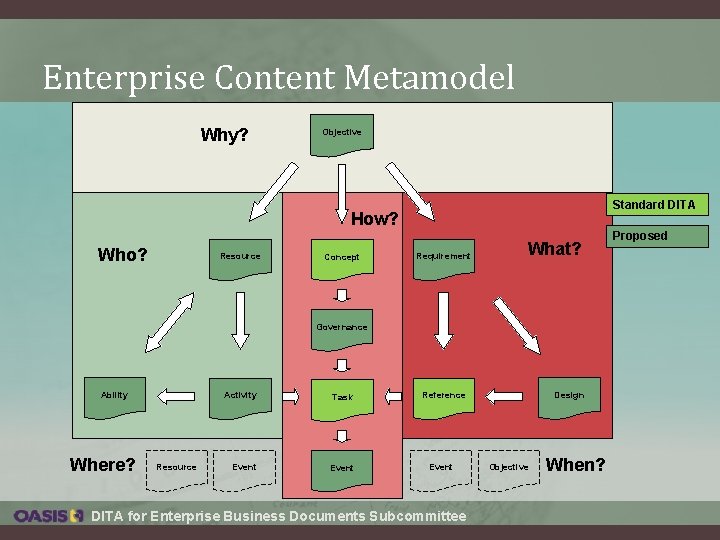
Model Construction • This model breaks down into 11 information types describing enterprise content • Each of the 11 types can be specialized into more specific types as needed • While not modeled after DITA, it shares very similar characteristics and should prove to be entirely compatible • Information types fall into one of four categories answering the “How”, “Who”, “What”, and “Why” DITA for Enterprise Business Documents Subcommittee
Enterprise Content Metamodel Why? Objective Standard DITA How? Who? Resource Concept Requirement What? Governance Ability Where? Resource Activity Task Reference Event DITA for Enterprise Business Documents Subcommittee Design Objective When? Proposed
Info Type Synonyms and Specializations Business Information Types • Objective: Goal, Mission, Plan, Purpose, Aim, Course, Intention, Project, Target Intellectual Information Types • Concept: Term, Definition, Idea, Image, Theory, Principle, Opinion, Generalization • Governance: Policy, Rule, Guidelines, Tip, Warning, Legislation, FAQ, Code • Task: Action, Procedure, Process, Instruction, Method, Mode, Routine • Event: Report, Result, Incident, Issue, Outcome, Case, Scenario, Narrative, Essay, Background DITA for Enterprise Business Documents Subcommittee
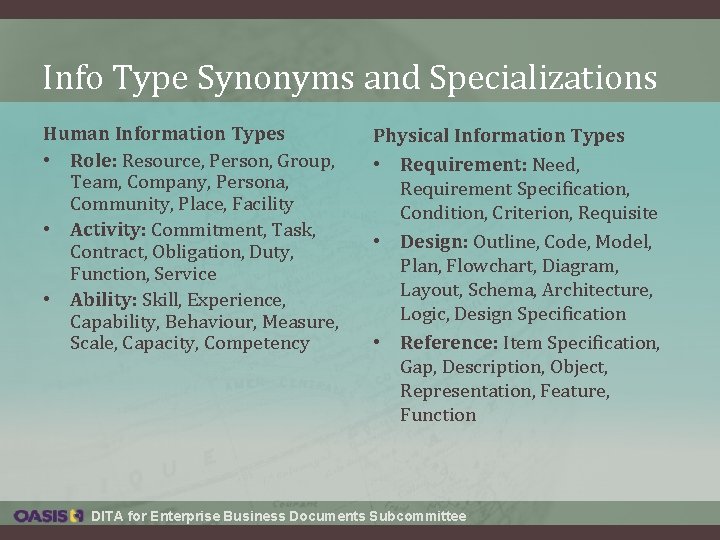
Info Type Synonyms and Specializations Human Information Types • Role: Resource, Person, Group, Team, Company, Persona, Community, Place, Facility • Activity: Commitment, Task, Contract, Obligation, Duty, Function, Service • Ability: Skill, Experience, Capability, Behaviour, Measure, Scale, Capacity, Competency Physical Information Types • Requirement: Need, Requirement Specification, Condition, Criterion, Requisite • Design: Outline, Code, Model, Plan, Flowchart, Diagram, Layout, Schema, Architecture, Logic, Design Specification • Reference: Item Specification, Gap, Description, Object, Representation, Feature, Function DITA for Enterprise Business Documents Subcommittee
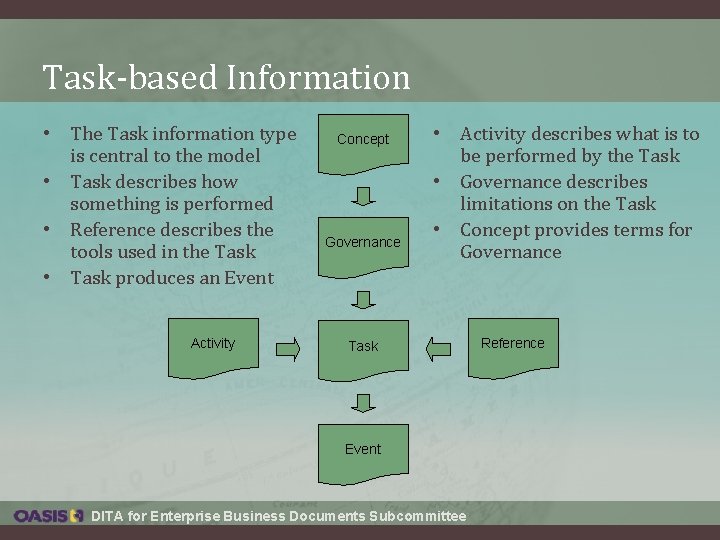
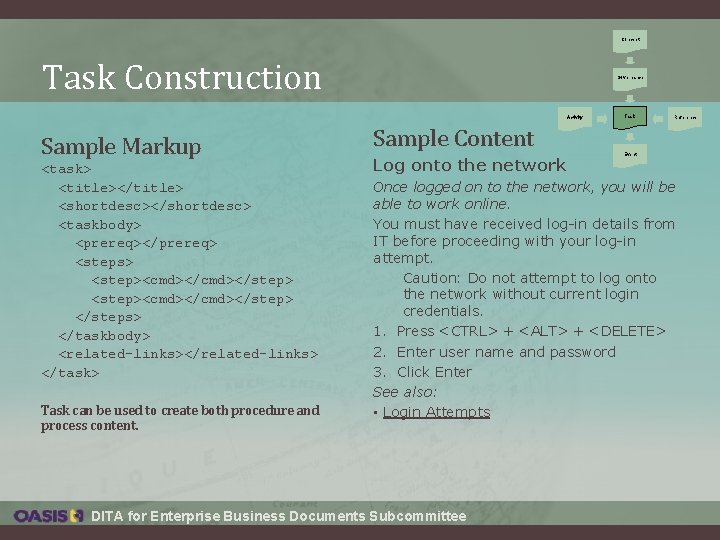
Task-based Information • The Task information type is central to the model • Task describes how something is performed • Reference describes the tools used in the Task • Task produces an Event Activity Concept Governance • Activity describes what is to be performed by the Task • Governance describes limitations on the Task • Concept provides terms for Governance Task Event DITA for Enterprise Business Documents Subcommittee Reference
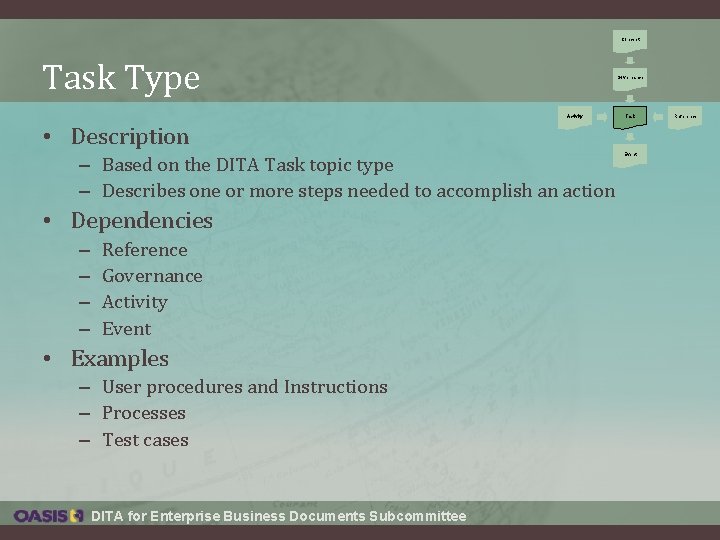
Concept Task Type Governance Activity Task • Description – Based on the DITA Task topic type – Describes one or more steps needed to accomplish an action • Dependencies – – Reference Governance Activity Event • Examples – User procedures and Instructions – Processes – Test cases DITA for Enterprise Business Documents Subcommittee Event Reference
Concept Task Construction Governance Activity Sample Markup <task> <title></title> <shortdesc></shortdesc> <taskbody> <prereq></prereq> <steps> <step><cmd></cmd></step> </steps> </taskbody> <related-links></related-links> </task> Task can be used to create both procedure and process content. Sample Content Log onto the network Task Reference Event Once logged on to the network, you will be able to work online. You must have received log-in details from IT before proceeding with your log-in attempt. Caution: Do not attempt to log onto the network without current login credentials. 1. Press <CTRL> + <ALT> + <DELETE> 2. Enter user name and password 3. Click Enter See also: • Login Attempts DITA for Enterprise Business Documents Subcommittee
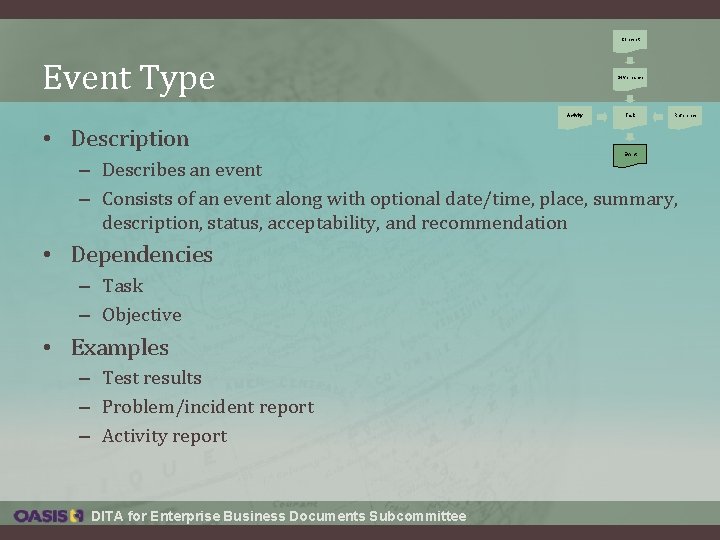
Concept Event Type Governance Activity • Description Task Reference Event – Describes an event – Consists of an event along with optional date/time, place, summary, description, status, acceptability, and recommendation • Dependencies – Task – Objective • Examples – Test results – Problem/incident report – Activity report DITA for Enterprise Business Documents Subcommittee
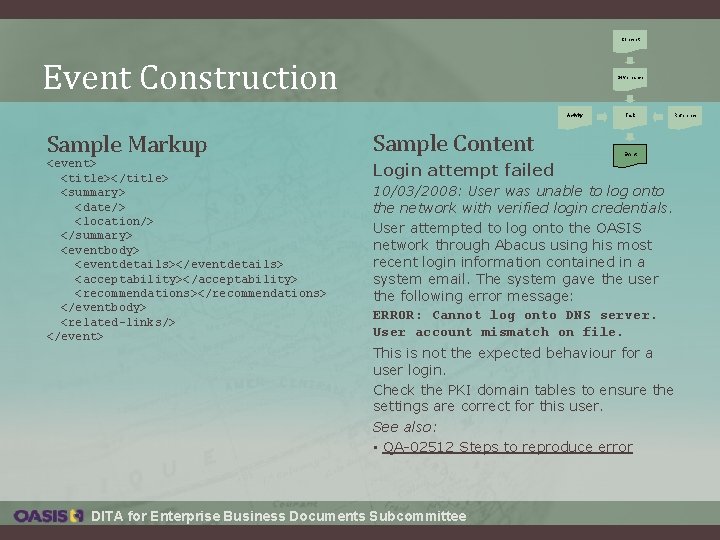
Concept Event Construction Governance Activity Sample Markup Sample Content <event> <title></title> <summary> <date/> <location/> </summary> <eventbody> <eventdetails></eventdetails> <acceptability></acceptability> <recommendations></recommendations> </eventbody> <related-links/> </event> Login attempt failed Task Reference Event 10/03/2008: User was unable to log onto the network with verified login credentials. User attempted to log onto the OASIS network through Abacus using his most recent login information contained in a system email. The system gave the user the following error message: ERROR: Cannot log onto DNS server. User account mismatch on file. This is not the expected behaviour for a user login. Check the PKI domain tables to ensure the settings are correct for this user. See also: • QA-02512 Steps to reproduce error DITA for Enterprise Business Documents Subcommittee
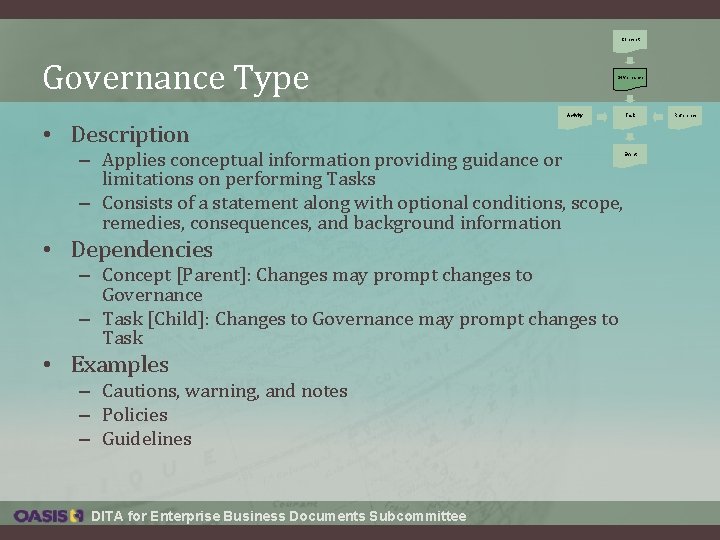
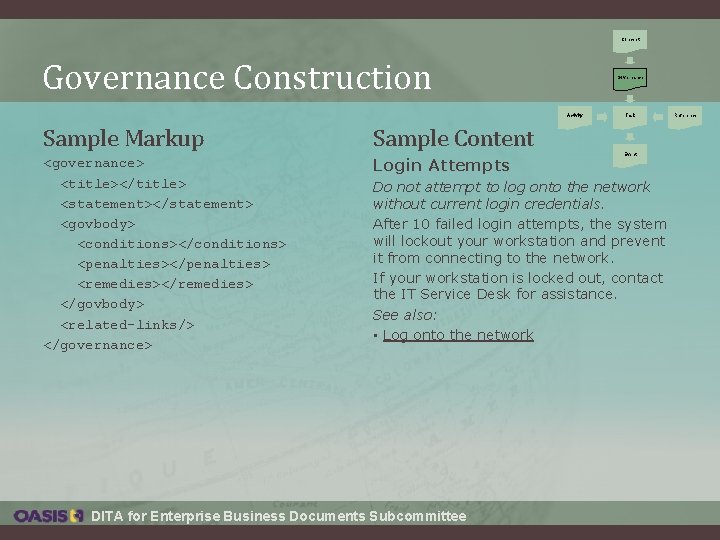
Concept Governance Type Governance Activity Task • Description – Applies conceptual information providing guidance or limitations on performing Tasks – Consists of a statement along with optional conditions, scope, remedies, consequences, and background information Event • Dependencies – Concept [Parent]: Changes may prompt changes to Governance – Task [Child]: Changes to Governance may prompt changes to Task • Examples – Cautions, warning, and notes – Policies – Guidelines DITA for Enterprise Business Documents Subcommittee Reference
Concept Governance Construction Governance Activity Sample Markup Sample Content <governance> <title></title> <statement></statement> <govbody> <conditions></conditions> <penalties></penalties> <remedies></remedies> </govbody> <related-links/> </governance> Login Attempts Task Event Do not attempt to log onto the network without current login credentials. After 10 failed login attempts, the system will lockout your workstation and prevent it from connecting to the network. If your workstation is locked out, contact the IT Service Desk for assistance. See also: • Log onto the network DITA for Enterprise Business Documents Subcommittee Reference
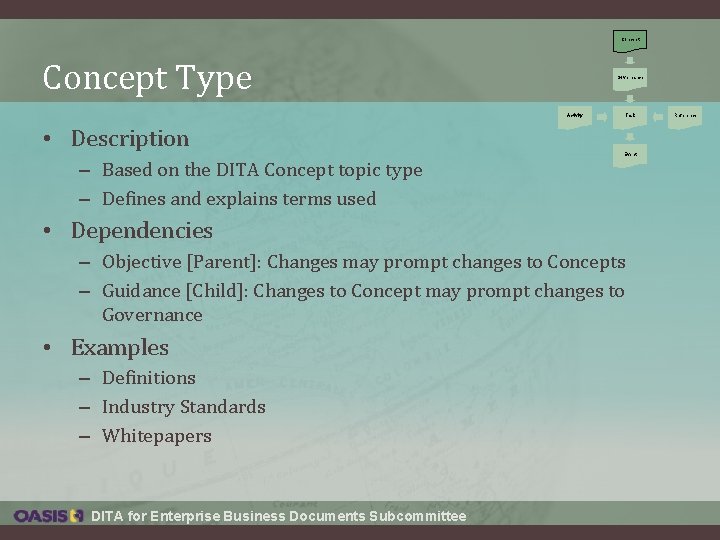
Concept Type Governance Activity • Description Task Event – Based on the DITA Concept topic type – Defines and explains terms used • Dependencies – Objective [Parent]: Changes may prompt changes to Concepts – Guidance [Child]: Changes to Concept may prompt changes to Governance • Examples – Definitions – Industry Standards – Whitepapers DITA for Enterprise Business Documents Subcommittee Reference
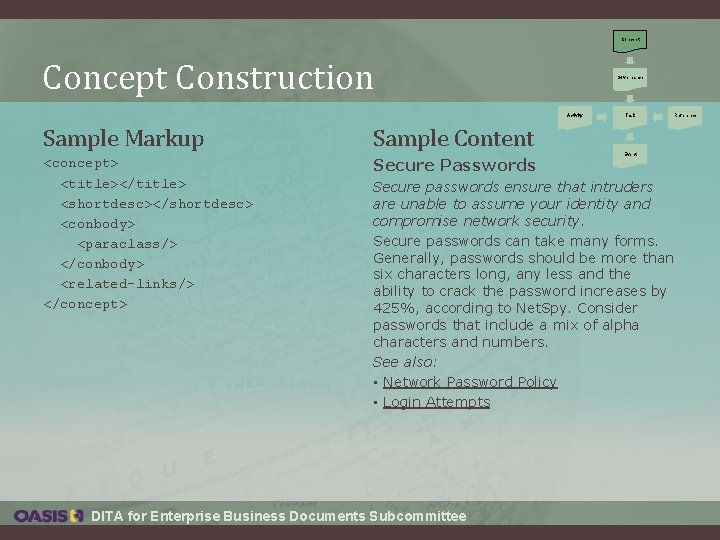
Concept Construction Governance Activity Sample Markup Sample Content <concept> <title></title> <shortdesc></shortdesc> <conbody> <paraclass/> </conbody> <related-links/> </concept> Secure Passwords Task Reference Event Secure passwords ensure that intruders are unable to assume your identity and compromise network security. Secure passwords can take many forms. Generally, passwords should be more than six characters long, any less and the ability to crack the password increases by 425%, according to Net. Spy. Consider passwords that include a mix of alpha characters and numbers. See also: • Network Password Policy • Login Attempts DITA for Enterprise Business Documents Subcommittee
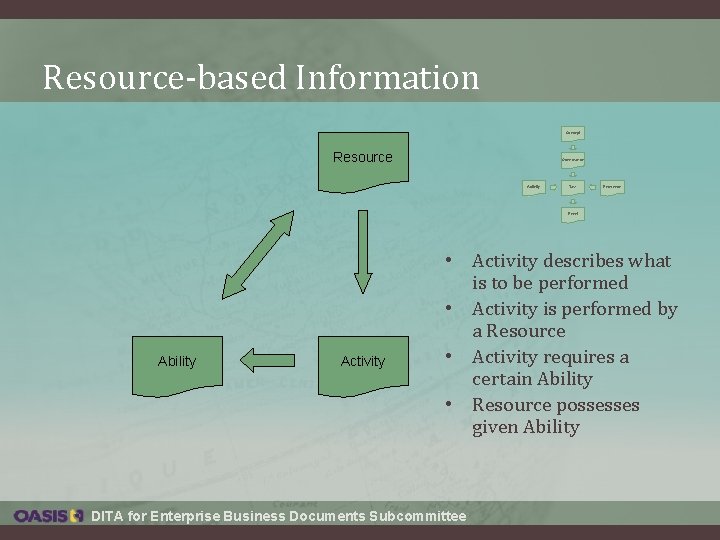
Resource-based Information Concept Resource Governance Activity Task Reference Event Ability Activity • Activity describes what is to be performed • Activity is performed by a Resource • Activity requires a certain Ability • Resource possesses given Ability DITA for Enterprise Business Documents Subcommittee
Resource Activity Type Ability Activity • Description – Describes what needs to be accomplished and criteria for measuring performance – Does not describe “how” it is to be done (see Task) – Consists of an item along with optional summary, description, constraints, and evaluation criteria • Dependencies – Resource [Parent]: Changes to Resource may prompt changes – Ability [Child]: Changes to Activity may require new Abilities – Task [Child]: Changes to Activity may require new Tasks • Examples – Job description – Service Level Agreement – Action items DITA for Enterprise Business Documents Subcommittee
Resource Activity Construction Ability Activity Sample Markup Sample Content <activity> <title></title> <shortdesc></shortdesc> <activitybody> <details></details> <constraints></constraints> <criteria></criteria> </activitybody> <related-links/> </activity> Setting Up Account for New Hires Network accounts are to be set up prior to the first day of work for new-hires. New accounts are created when triggered by the New Hire Process. A problem ticket will arrive and be resolved by the IT Service Desk. New hires that are not subject to the New Hire Process may not have accounts set up during their first week of work. The IT Service Desk requires seven-days notice for new account setup. See also: Service Desk Specialist DITA for Enterprise Business Documents Subcommittee
Resource Type Ability Activity • Description – Identifies a Resource within an organization – May be a named person, job role, department, or other group of related persons – Consists of a name along with optional details and hierarchy • Dependencies – Objective [Parent]: Changes to Objectives may modify Resources – Activity [Child]: Resources are responsible for given Activities – Ability [Child/Parent]: Resources possess and/or require Abilities • Examples – Biographical information – Description of organization – Contact record DITA for Enterprise Business Documents Subcommittee
Resource Construction Ability Sample Markup Sample Content <resource> <name></name> <shortdesc></shortdesc> <resourcebody> <details></details> <characteristics> </resourcebody> <related-links/> </resource> Service Desk Specialist Activity The Service Desk Specialist is a member of the IT Service Desk. This role is typically the first-line of response to customer inquiries and complaints. The Service Desk Specialist reports to the Service Desk Shift Supervisor and may be responsible for supervising Co-Op placements and new-hires. Core competencies: • English/French, Fluent Spoken, • Intermediate ITIL Certification Services include: • Registering Incidents, • Setting Up Accounts See: • Sue Green DITA for Enterprise Business Documents Subcommittee
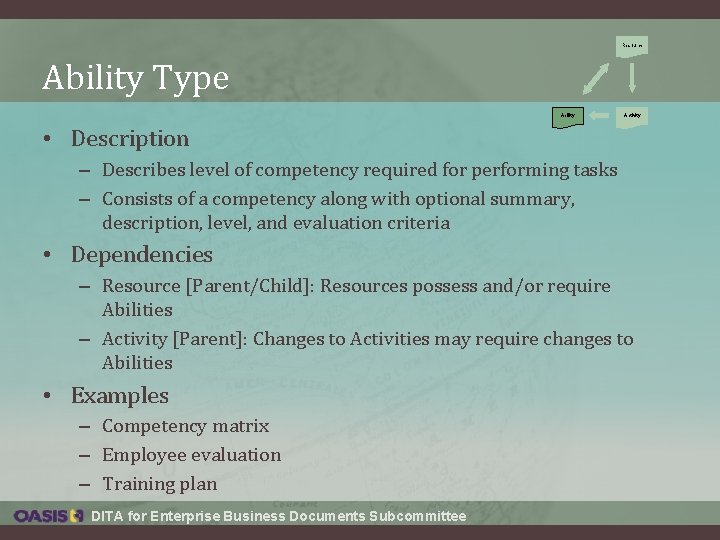
Resource Ability Type Ability Activity • Description – Describes level of competency required for performing tasks – Consists of a competency along with optional summary, description, level, and evaluation criteria • Dependencies – Resource [Parent/Child]: Resources possess and/or require Abilities – Activity [Parent]: Changes to Activities may require changes to Abilities • Examples – Competency matrix – Employee evaluation – Training plan DITA for Enterprise Business Documents Subcommittee
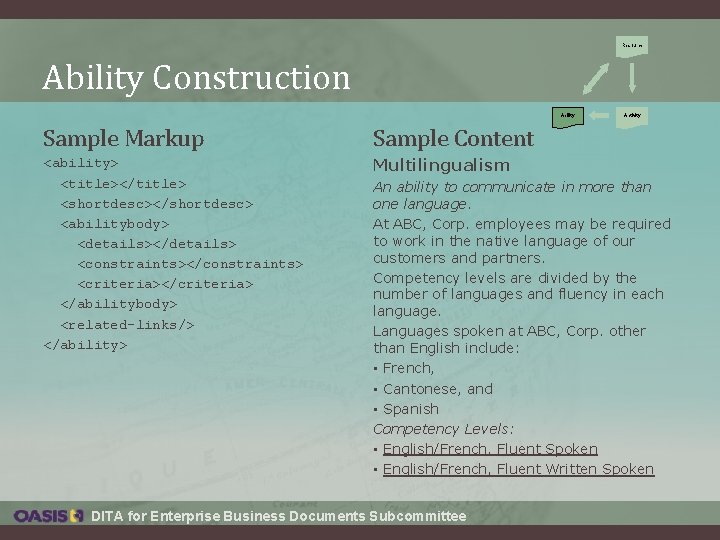
Resource Ability Construction Ability Sample Markup Sample Content <ability> <title></title> <shortdesc></shortdesc> <abilitybody> <details></details> <constraints></constraints> <criteria></criteria> </abilitybody> <related-links/> </ability> Multilingualism Activity An ability to communicate in more than one language. At ABC, Corp. employees may be required to work in the native language of our customers and partners. Competency levels are divided by the number of languages and fluency in each language. Languages spoken at ABC, Corp. other than English include: • French, • Cantonese, and • Spanish Competency Levels: • English/French, Fluent Spoken • English/French, Fluent Written Spoken DITA for Enterprise Business Documents Subcommittee
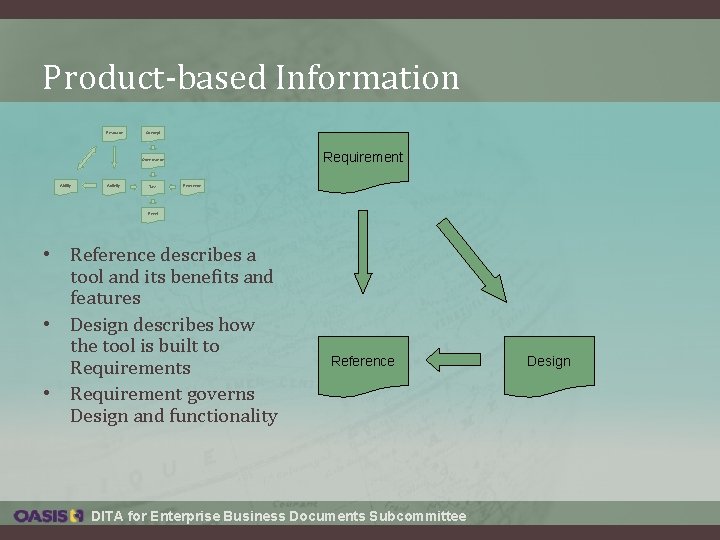
Product-based Information Resource Concept Requirement Governance Ability Activity Task Reference Event • Reference describes a tool and its benefits and features • Design describes how the tool is built to Requirements • Requirement governs Design and functionality Reference DITA for Enterprise Business Documents Subcommittee Design
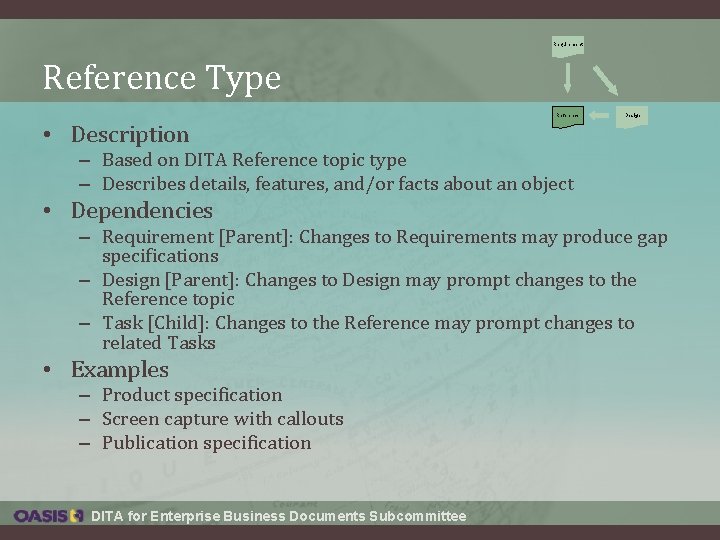
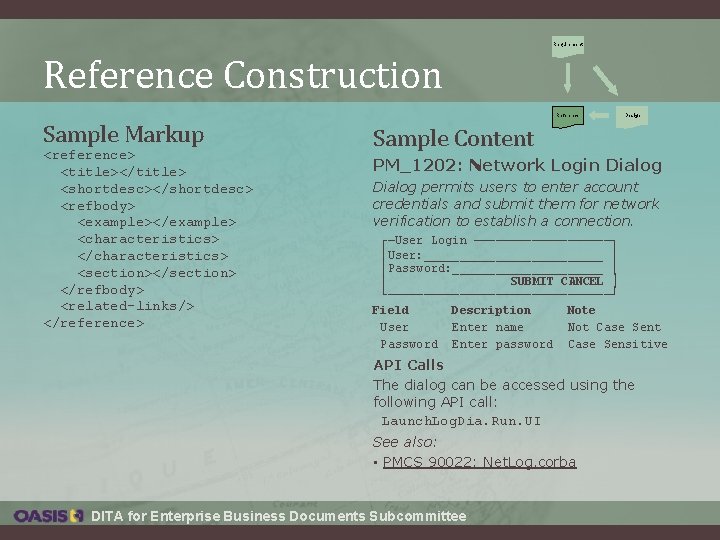
Requirement Reference Type Reference Design • Description – Based on DITA Reference topic type – Describes details, features, and/or facts about an object • Dependencies – Requirement [Parent]: Changes to Requirements may produce gap specifications – Design [Parent]: Changes to Design may prompt changes to the Reference topic – Task [Child]: Changes to the Reference may prompt changes to related Tasks • Examples – Product specification – Screen capture with callouts – Publication specification DITA for Enterprise Business Documents Subcommittee
Requirement Reference Construction Reference Sample Markup <reference> <title></title> <shortdesc></shortdesc> <refbody> <example></example> <characteristics> </characteristics> <section></section> </refbody> <related-links/> </reference> Design Sample Content PM_1202: Network Login Dialog permits users to enter account credentials and submit them for network verification to establish a connection. ┌─User Login ──────────┐ │User: _____________ │ │Password: ___________ │ │ SUBMIT CANCEL │ └────────────────┘ Field Description Note User Enter name Not Case Sent Password Enter password Case Sensitive API Calls The dialog can be accessed using the following API call: Launch. Log. Dia. Run. UI See also: • PMCS 90022: Net. Log. corba DITA for Enterprise Business Documents Subcommittee
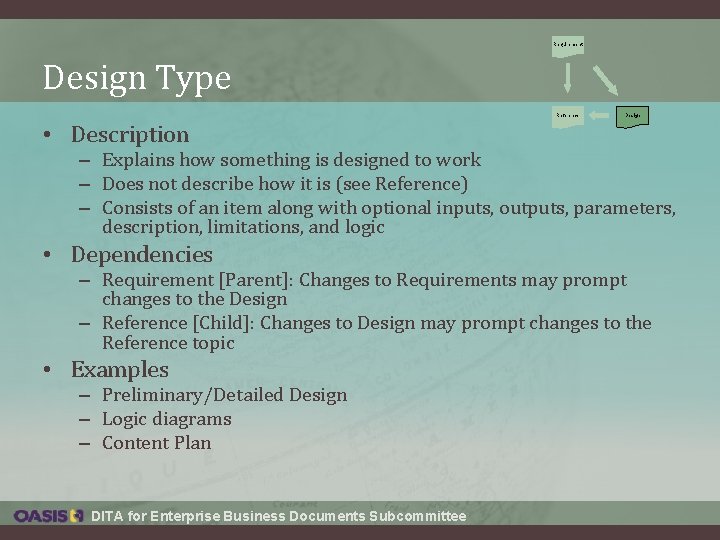
Requirement Design Type Reference Design • Description – Explains how something is designed to work – Does not describe how it is (see Reference) – Consists of an item along with optional inputs, outputs, parameters, description, limitations, and logic • Dependencies – Requirement [Parent]: Changes to Requirements may prompt changes to the Design – Reference [Child]: Changes to Design may prompt changes to the Reference topic • Examples – Preliminary/Detailed Design – Logic diagrams – Content Plan DITA for Enterprise Business Documents Subcommittee
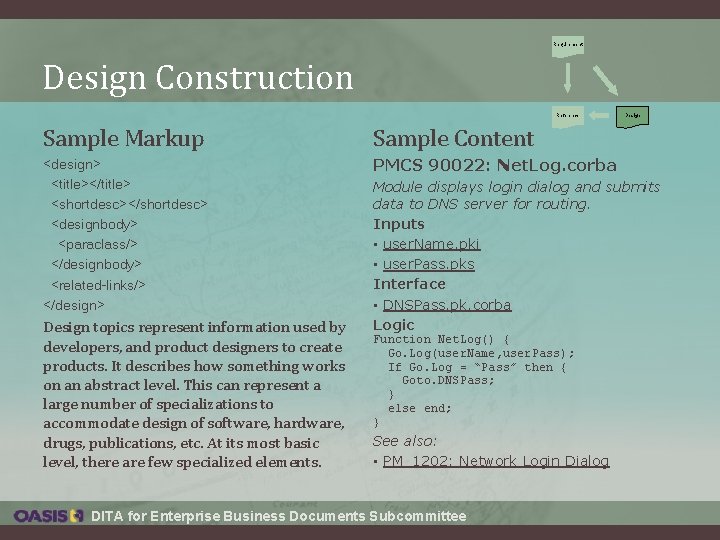
Requirement Design Construction Reference Sample Markup Sample Content <design> <title></title> <shortdesc></shortdesc> <designbody> <paraclass/> </designbody> <related-links/> </design> PMCS 90022: Net. Log. corba Design topics represent information used by developers, and product designers to create products. It describes how something works on an abstract level. This can represent a large number of specializations to accommodate design of software, hardware, drugs, publications, etc. At its most basic level, there are few specialized elements. Design Module displays login dialog and submits data to DNS server for routing. Inputs • user. Name. pki • user. Pass. pks Interface • DNSPass. pk. corba Logic Function Net. Log() { Go. Log(user. Name, user. Pass); If Go. Log = “Pass” then { Goto. DNSPass; } else end; } See also: • PM_1202: Network Login Dialog DITA for Enterprise Business Documents Subcommittee
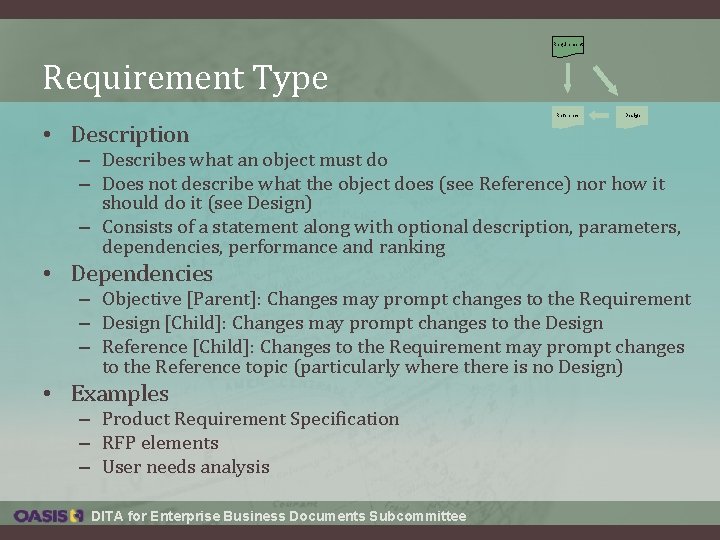
Requirement Type Reference Design • Description – Describes what an object must do – Does not describe what the object does (see Reference) nor how it should do it (see Design) – Consists of a statement along with optional description, parameters, dependencies, performance and ranking • Dependencies – Objective [Parent]: Changes may prompt changes to the Requirement – Design [Child]: Changes may prompt changes to the Design – Reference [Child]: Changes to the Requirement may prompt changes to the Reference topic (particularly where there is no Design) • Examples – Product Requirement Specification – RFP elements – User needs analysis DITA for Enterprise Business Documents Subcommittee
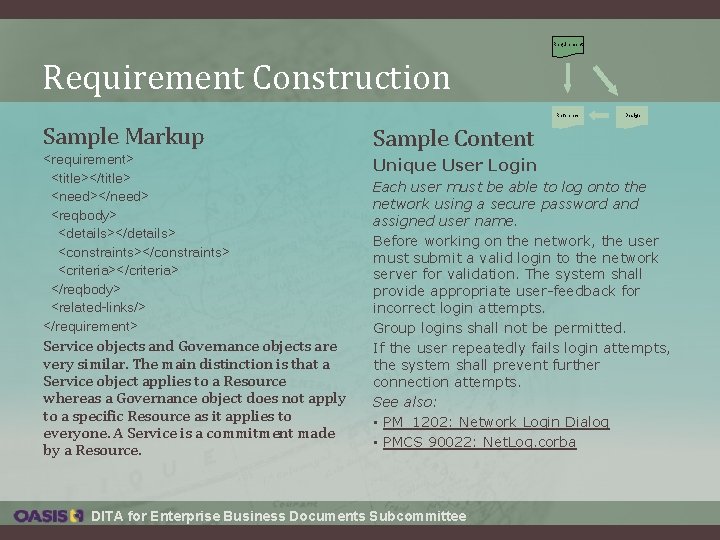
Requirement Construction Reference Sample Markup Sample Content <requirement> <title></title> <need></need> <reqbody> <details></details> <constraints></constraints> <criteria></criteria> </reqbody> <related-links/> </requirement> Unique User Login Service objects and Governance objects are very similar. The main distinction is that a Service object applies to a Resource whereas a Governance object does not apply to a specific Resource as it applies to everyone. A Service is a commitment made by a Resource. Design Each user must be able to log onto the network using a secure password and assigned user name. Before working on the network, the user must submit a valid login to the network server for validation. The system shall provide appropriate user-feedback for incorrect login attempts. Group logins shall not be permitted. If the user repeatedly fails login attempts, the system shall prevent further connection attempts. See also: • PM_1202: Network Login Dialog • PMCS 90022: Net. Log. corba DITA for Enterprise Business Documents Subcommittee
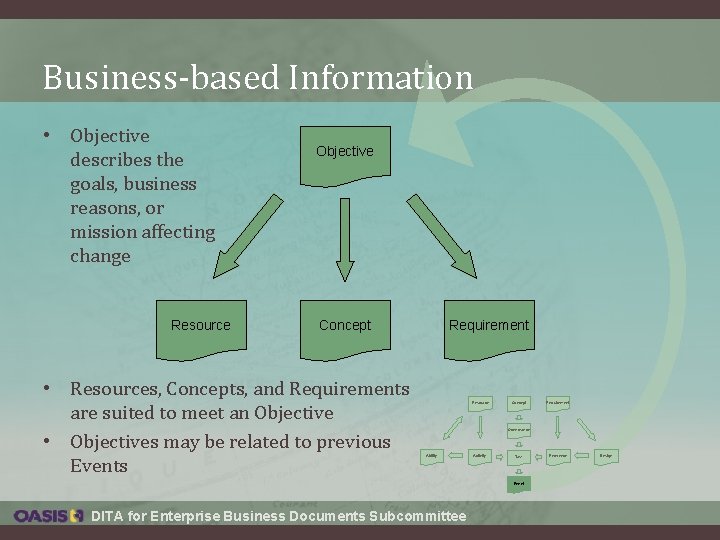
Business-based Information • Objective describes the goals, business reasons, or mission affecting change Resource Objective Concept • Resources, Concepts, and Requirements are suited to meet an Objective • Objectives may be related to previous Events Requirement Resource Concept Requirement Governance Ability Activity Task Event DITA for Enterprise Business Documents Subcommittee Reference Design
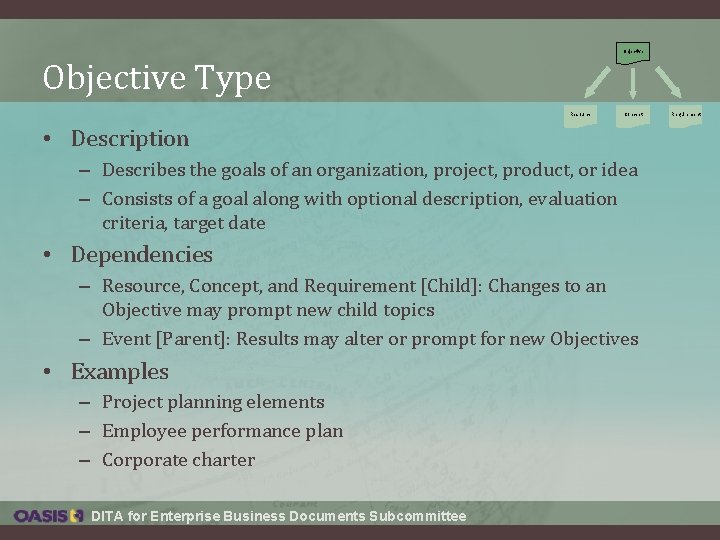
Objective Type Resource Concept • Description – Describes the goals of an organization, project, product, or idea – Consists of a goal along with optional description, evaluation criteria, target date • Dependencies – Resource, Concept, and Requirement [Child]: Changes to an Objective may prompt new child topics – Event [Parent]: Results may alter or prompt for new Objectives • Examples – Project planning elements – Employee performance plan – Corporate charter DITA for Enterprise Business Documents Subcommittee Requirement
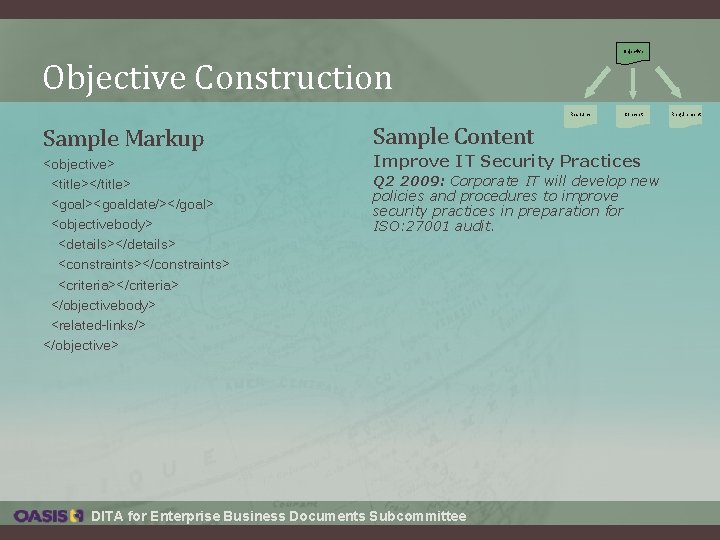
Objective Construction Resource Sample Markup <objective> <title></title> <goal><goaldate/></goal> <objectivebody> <details></details> <constraints></constraints> <criteria></criteria> </objectivebody> <related-links/> </objective> Concept Sample Content Improve IT Security Practices Q 2 2009: Corporate IT will develop new policies and procedures to improve security practices in preparation for ISO: 27001 audit. DITA for Enterprise Business Documents Subcommittee Requirement
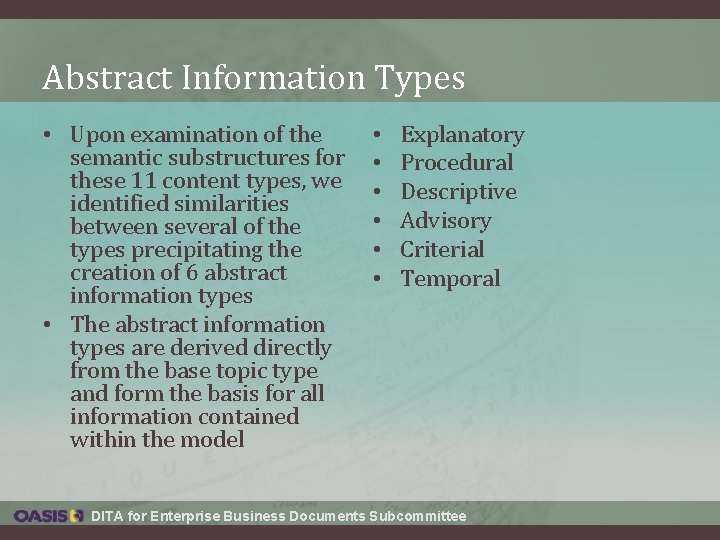
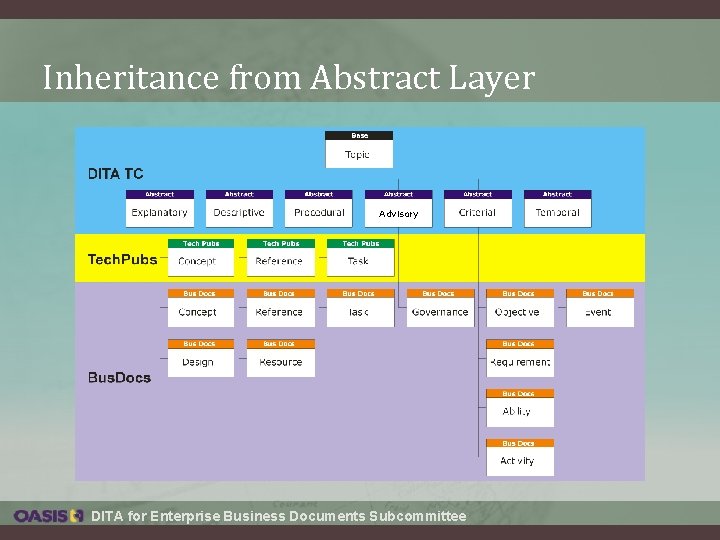
Abstract Information Types • Upon examination of the semantic substructures for these 11 content types, we identified similarities between several of the types precipitating the creation of 6 abstract information types • The abstract information types are derived directly from the base topic type and form the basis for all information contained within the model • • • Explanatory Procedural Descriptive Advisory Criterial Temporal DITA for Enterprise Business Documents Subcommittee
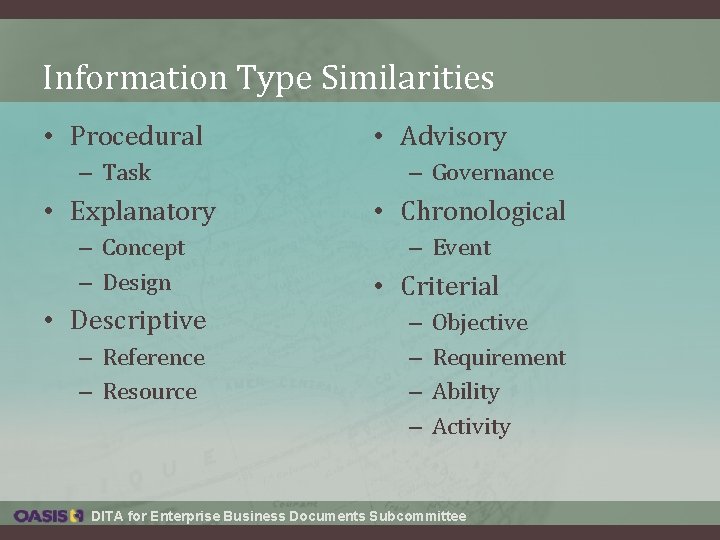
Information Type Similarities • Procedural – Task • Explanatory – Concept – Design • Descriptive – Reference – Resource • Advisory – Governance • Chronological – Event • Criterial – – Objective Requirement Ability Activity DITA for Enterprise Business Documents Subcommittee
Inheritance from Abstract Layer Advisory DITA for Enterprise Business Documents Subcommittee
Business Document Examples • The objects described in the model can be used to create business documents • Business documents will contain a mix of content classes but will primarily consist of Class I content • The traceability and reuse potential for many of the objects is substantial • Presenting three possible examples: – Request for Proposal (RFP) – Software Incident Report – Meeting Minutes DITA for Enterprise Business Documents Subcommittee
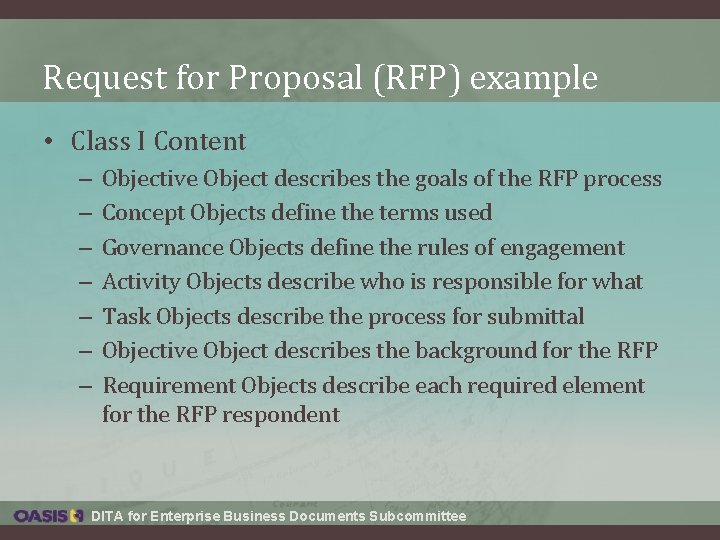
Request for Proposal (RFP) example • Class I Content – – – – Objective Object describes the goals of the RFP process Concept Objects define the terms used Governance Objects define the rules of engagement Activity Objects describe who is responsible for what Task Objects describe the process for submittal Objective Object describes the background for the RFP Requirement Objects describe each required element for the RFP respondent DITA for Enterprise Business Documents Subcommittee
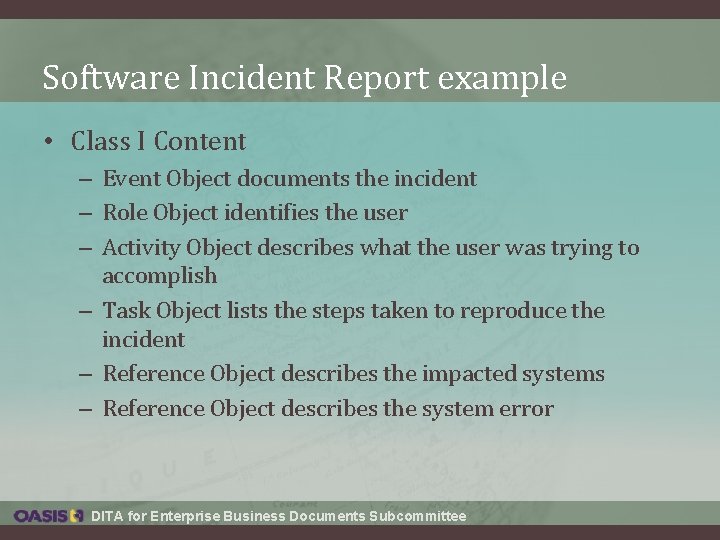
Software Incident Report example • Class I Content – Event Object documents the incident – Role Object identifies the user – Activity Object describes what the user was trying to accomplish – Task Object lists the steps taken to reproduce the incident – Reference Object describes the impacted systems – Reference Object describes the system error DITA for Enterprise Business Documents Subcommittee
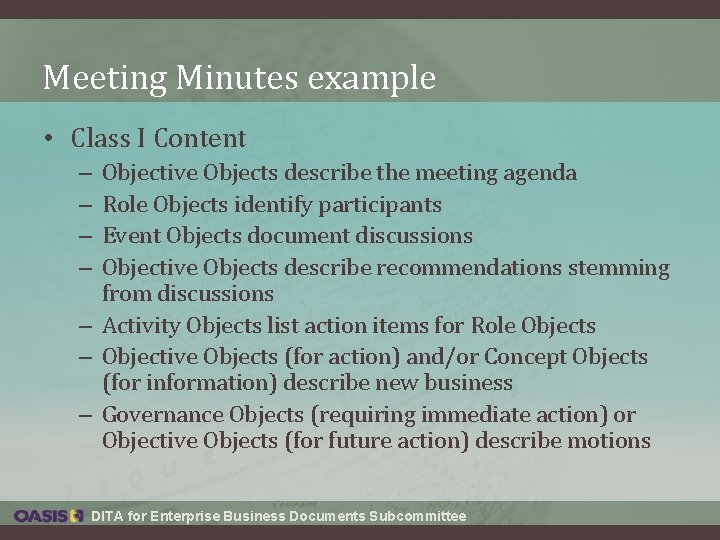
Meeting Minutes example • Class I Content Objective Objects describe the meeting agenda Role Objects identify participants Event Objects document discussions Objective Objects describe recommendations stemming from discussions – Activity Objects list action items for Role Objects – Objective Objects (for action) and/or Concept Objects (for information) describe new business – Governance Objects (requiring immediate action) or Objective Objects (for future action) describe motions – – DITA for Enterprise Business Documents Subcommittee