
Enterprise Architecture Wheres the Business Andrew L Macaulay
Enterprise Architecture Where’s the Business? Andrew L Macaulay Certified Global Architect, Capgemini
Agenda 4 Introduction and Agenda 4 The Quest for Business/IT Alignment 4 What is Business Architecture 4 Organisational Barriers 4 Moving to a Strategic Value Focus 4 Changing the Game 4 Summary Copyright © 2007 Capgemini UK 1
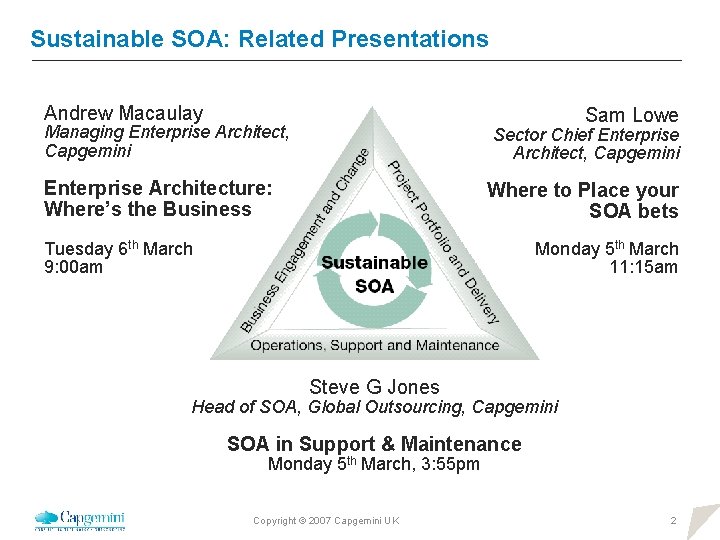
Sustainable SOA: Related Presentations Andrew Macaulay Sam Lowe Managing Enterprise Architect, Capgemini Sector Chief Enterprise Architect, Capgemini Enterprise Architecture: Where’s the Business Where to Place your SOA bets Tuesday 6 th March 9: 00 am Monday 5 th March 11: 15 am Steve G Jones Head of SOA, Global Outsourcing, Capgemini SOA in Support & Maintenance Monday 5 th March, 3: 55 pm Copyright © 2007 Capgemini UK 2
Brief Biography 4 Worked in IT since early 1980’s 4 Joined Capgemini’s Architecture team in the UK in 1993, working across sectors (including government and finance) 4 Remain active Enterprise Architect both developing architecture and architecture capability with clients 4 Active in Capgemini’s Global Architects Community, including being elected Global Head of the Community for 2005/2006 § Major contributor to Capgemini’s Integrated Architecture Framework § Senior trainer (facilitator) in architecture for Capgemini and our clients § Active contributor to the Capgemini Architects Learning Programme 4 Capgemini Certified Global Architect, Open Group Master Certified IT Architect and Microsoft Infrastructure Architect MVP Copyright © 2007 Capgemini UK 3
Connecting IT with the Business 4 Business and IT often remain poorly aligned/connected 4 IT Departments are often still seen as a cost 4 Business and IT find it hard to communicate effectively 4 This lack of alignment often results in: § Costs of IT being significantly larger than necessary § Strategic investments being under-utilised 4 Service Oriented Architecture makes this even more critical Copyright © 2007 Capgemini UK 4
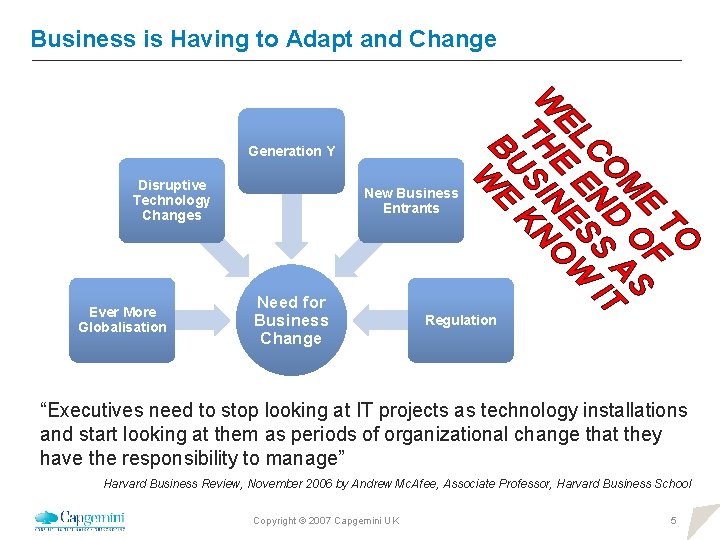
Business is Having to Adapt and Change Disruptive Technology Changes Ever More Globalisation New Business Entrants Need for Business Change TO E F M O S O D A C EN SS IT EL E E W W H IN NO S T K U B E W Generation Y Regulation “Executives need to stop looking at IT projects as technology installations and start looking at them as periods of organizational change that they have the responsibility to manage” Harvard Business Review, November 2006 by Andrew Mc. Afee, Associate Professor, Harvard Business School Copyright © 2007 Capgemini UK 5
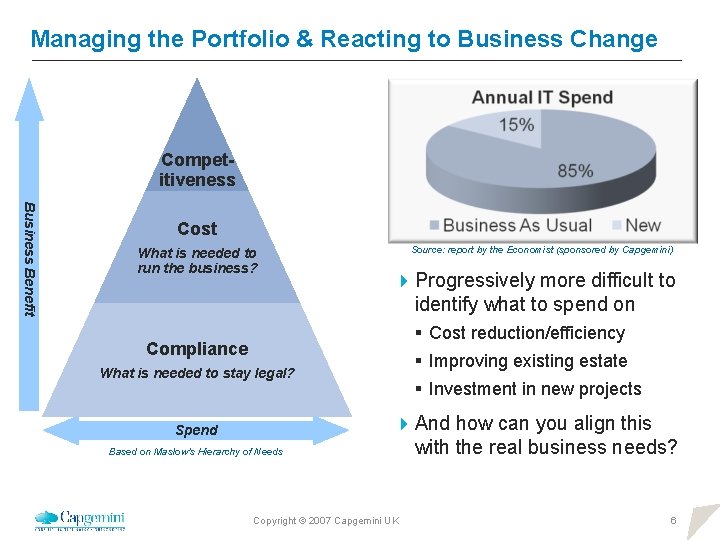
Managing the Portfolio & Reacting to Business Change Competitiveness Business Benefit Cost What is needed to run the business? Source: report by the Economist (sponsored by Capgemini) 4 Progressively more difficult to identify what to spend on § Cost reduction/efficiency Compliance § Improving existing estate What is needed to stay legal? Spend Based on Maslow's Hierarchy of Needs § Investment in new projects 4 And how can you align this with the real business needs? Copyright © 2007 Capgemini UK 6
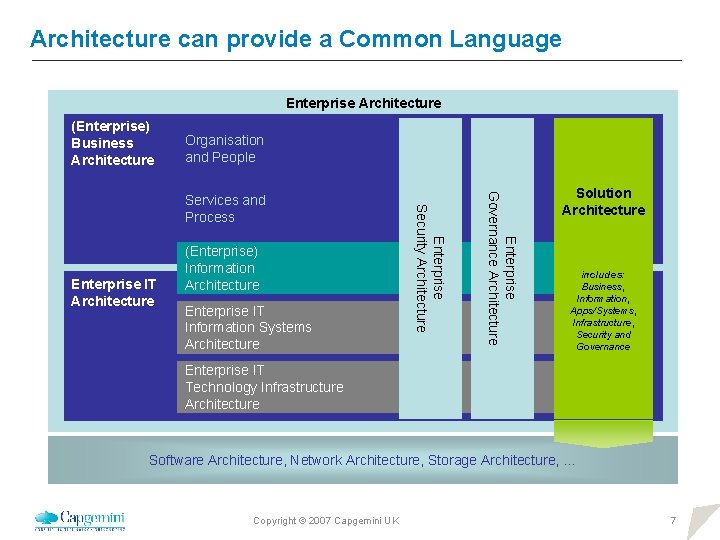
Architecture can provide a Common Language Enterprise Architecture (Enterprise) Business Architecture Organisation and People Enterprise IT Information Systems Architecture Enterprise Governance Architecture Enterprise IT Architecture (Enterprise) Information Architecture Enterprise Security Architecture Services and Process Solution Architecture includes: Business, Information, Apps/Systems, Infrastructure, Security and Governance Enterprise IT Technology Infrastructure Architecture Software Architecture, Network Architecture, Storage Architecture, … Copyright © 2007 Capgemini UK 7
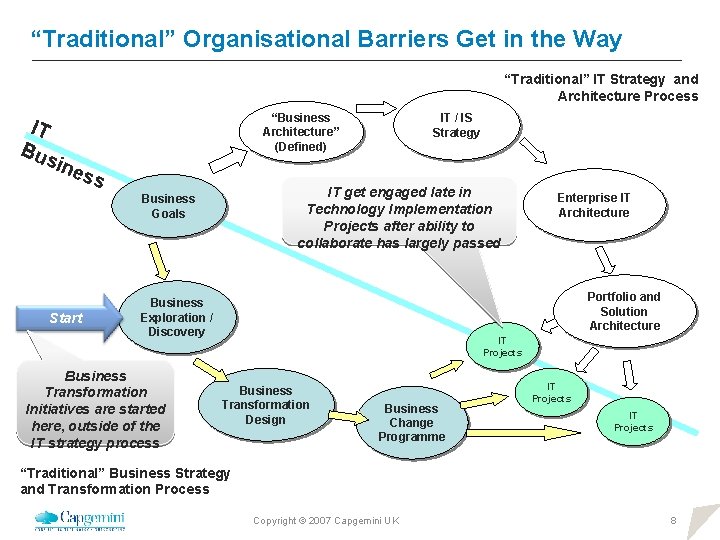
“Traditional” Organisational Barriers Get in the Way “Traditional” IT Strategy and Architecture Process “Business Architecture” (Defined) IT Bu sin es s IT get engaged late in Technology Implementation Projects after ability to collaborate has largely passed Business Goals Start IT / IS Strategy Portfolio and Solution Architecture Business Exploration / Discovery Business Transformation Initiatives are started here, outside of the IT strategy process Enterprise IT Architecture IT Projects Business Transformation Design Business Change Programme IT Projects “Traditional” Business Strategy and Transformation Process Copyright © 2007 Capgemini UK 8
Business/IT Alignment needs a Collaborative Approach 4 A common understanding of business priorities/timescales 4 A coherent view of Enterprise Architecture that supports and informs both business and IT 4 Clear sponsorship from across the Business as well as IT 4 Business and IT working together as one, with IT seen as an integral (and valuable) part of the business But how can you break down the barriers? Copyright © 2007 Capgemini UK 9
Earning the Right 4 To move towards this goal, the IT Function needs to… § Improve each line-of-business’ opinion of the value it can and will get from involving (appropriate) representation from IT § Demonstrate the ability to successfully deliver strategic business value including getting recognition of this success from the business § Offer credible and value-adding business- focused IT advisory expertise to earlyphase business transformation work § Provide transparency of TCO for the full life cycle of the deployment of IT solutions driven from business transformation and improvement initiatives Copyright © 2007 Capgemini UK 10
Architectural Thinking Does Not Need Only Apply to IT 4 The definition of architecture in ANSI/IEEE Std 1471 -2000 is “The fundamental organization of a system, embodied in its components, their relationships to each other and the environment, and the principles governing its design and evolution. ” This can be applied equally well to business as well as IT 4 But, Business Architecture is often little more than a business model developed by/for the architects to document the solution requirements or to identify business impact of an IT solution 4 Business Architecture can be used to Architect the Business and drive business change in a holistic way supported by IT Copyright © 2007 Capgemini UK 11
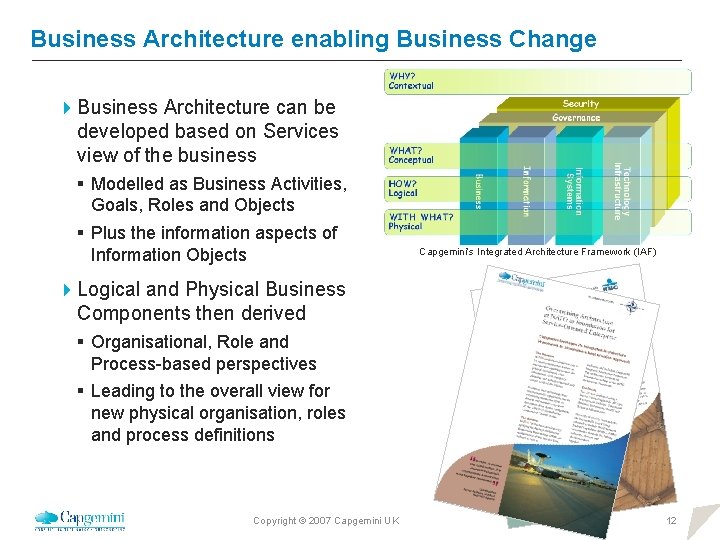
Business Architecture enabling Business Change 4 Business Architecture can be developed based on Services view of the business § Modelled as Business Activities, Goals, Roles and Objects § Plus the information aspects of Information Objects Capgemini’s Integrated Architecture Framework (IAF) 4 Logical and Physical Business Components then derived § Organisational, Role and Process-based perspectives § Leading to the overall view for new physical organisation, roles and process definitions Copyright © 2007 Capgemini UK 12
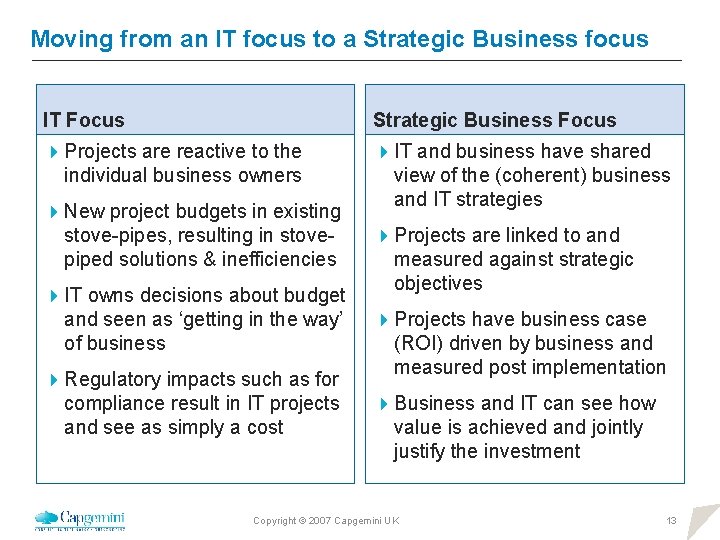
Moving from an IT focus to a Strategic Business focus IT Focus Strategic Business Focus 4 Projects are reactive to the individual business owners 4 IT and business have shared view of the (coherent) business and IT strategies 4 New project budgets in existing stove-pipes, resulting in stovepiped solutions & inefficiencies 4 IT owns decisions about budget and seen as ‘getting in the way’ of business 4 Regulatory impacts such as for compliance result in IT projects and see as simply a cost 4 Projects are linked to and measured against strategic objectives 4 Projects have business case (ROI) driven by business and measured post implementation 4 Business and IT can see how value is achieved and jointly justify the investment Copyright © 2007 Capgemini UK 13
Some Key Activities to Move You Forward 4 Joint-Team Transformation Discovery Initiatives § Consulting ‘discovery’ techniques are well developed, but generally developed for business-only use – use of a Concurrent Business/IT approach greatly improves the value delivered 4 Joint-Team Capability Creation and Development § Identify the organisational and skills required to successfully deliver this joint delivery approach § Most organisations need to evolve their own capabilities and processes needed to be successful with the new approach 4 Combined Business and Technology Roadmap Definition § Identifying the framework to evaluate the candidate technologies might be that support the business and technical functions in order to realise the benefits identified for the business initiatives Copyright © 2007 Capgemini UK 14
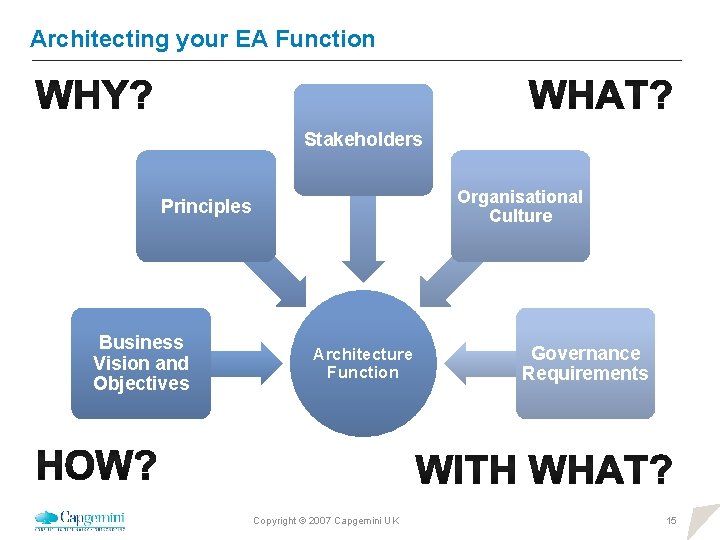
Architecting your EA Function Stakeholders Organisational Culture Principles Business Vision and Objectives Architecture Function Copyright © 2007 Capgemini UK Governance Requirements 15
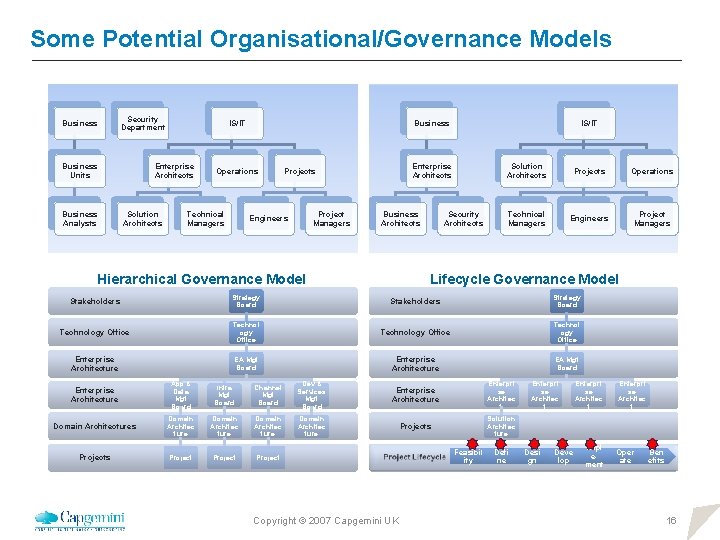
Some Potential Organisational/Governance Models Business Security Department Business Units Business Analysts IS/IT Enterprise Architects Solution Architects Business Operations Technical Managers Enterprise Architects Project Managers Engineers IS/IT Business Architects Hierarchical Governance Model Security Architects Solution Architects Projects Operations Technical Managers Engineers Project Managers Lifecycle Governance Model Stakeholders Strategy Board Technology Office Technol ogy Office Enterprise Architecture EA Mgt Board Enterprise Architecture App & Data Mgt Board Infra Mgt Board Channel Mgt Board Dev & Services Mgt Board Enterprise Architecture Enterpri se Architec t Domain Architectures Domain Architec ture Projects Solution Architec ture Projects Project Copyright © 2007 Capgemini UK Feasibil ity Defi ne Enterpri se Architec t Desi gn Deve lop Enterpri se Architec t Impl ement Enterpri se Architec t Oper ate Ben efits 16
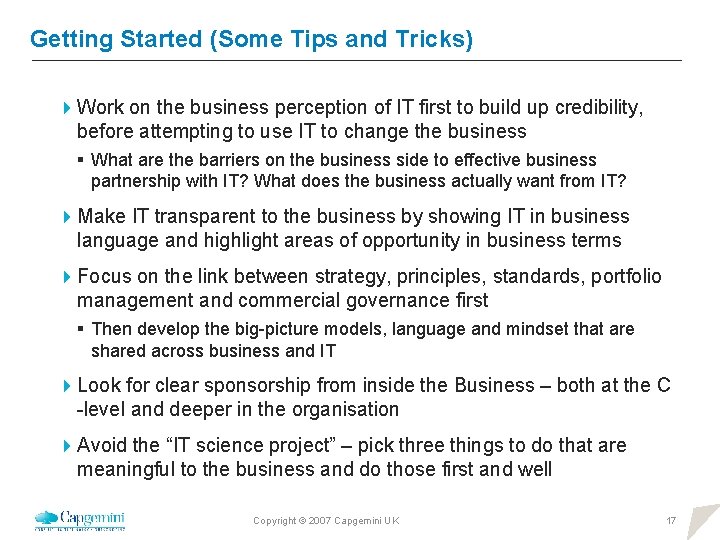
Getting Started (Some Tips and Tricks) 4 Work on the business perception of IT first to build up credibility, before attempting to use IT to change the business § What are the barriers on the business side to effective business partnership with IT? What does the business actually want from IT? 4 Make IT transparent to the business by showing IT in business language and highlight areas of opportunity in business terms 4 Focus on the link between strategy, principles, standards, portfolio management and commercial governance first § Then develop the big-picture models, language and mindset that are shared across business and IT 4 Look for clear sponsorship from inside the Business – both at the C -level and deeper in the organisation 4 Avoid the “IT science project” – pick three things to do that are meaningful to the business and do those first and well Copyright © 2007 Capgemini UK 17
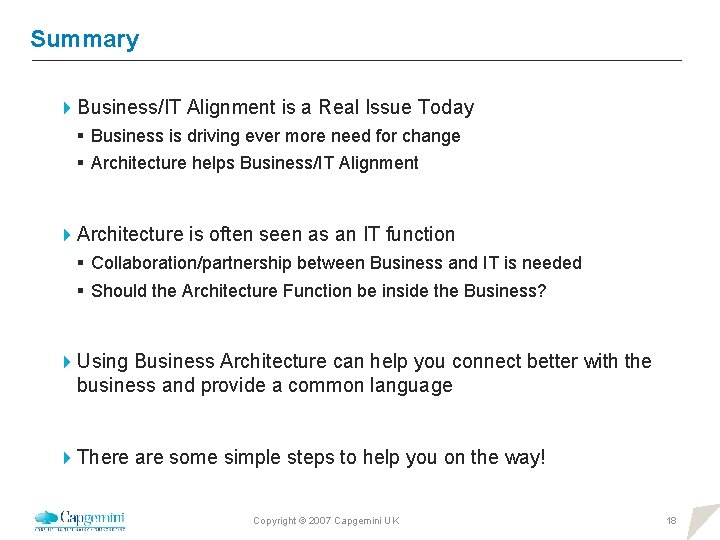
Summary 4 Business/IT Alignment is a Real Issue Today § Business is driving ever more need for change § Architecture helps Business/IT Alignment 4 Architecture is often seen as an IT function § Collaboration/partnership between Business and IT is needed § Should the Architecture Function be inside the Business? 4 Using Business Architecture can help you connect better with the business and provide a common language 4 There are some simple steps to help you on the way! Copyright © 2007 Capgemini UK 18
Additional Reading 4 Capgemini Resources § http: //www. capgemini. com/soa § http: //www. capgemini. com/architecture § http: //www. capgemini. com/iaf § http: //www. capgemini. com/ctoblog 4 Published Case Studies § http: //www. capgemini. com/resources/success-stories/nato/ § http: //www. capgemini. com/resources/success-stories/kbc_group/ 4 Open Group Architecture Resources § http: //www. opengroup. org/togaf § http: //www. opengroup. org/itac Copyright © 2007 Capgemini UK 19

andrew. macaulay@capgemini. com www. capgemini. com
- Slides: 21