
Enterprise Architecture a focus on Communication and Stakeholder






- Slides: 29
Enterprise Architecture: a focus on Communication and Stakeholder Engagement Gail Verley: Assistant Director Enterprise Architecture, FDIC
Goals/Scope of Presentation • How to obtain high level stakeholder involvement in EA governing processes and address major challenges for building stakeholder engagement • Identify vehicles to communicate with EA stakeholders while ensuring the architecture accommodates the style and priorities of the stakeholder community • Provide examples of how stakeholder involvement can lead to consolidation and better management of IT investments
FDIC Organizational Profile • An independent agency of the federal government that was created in 1933 in response to the thousands of bank failures that occurred in the 1920 s and early 1930 s. • Examines and supervises about 5, 300 banks and savings banks. • The FDIC is managed by a five-person Board of Directors, appointed by the President and confirmed by the Senate, with no more than three from the same political party • 2006 proposed corporate operating budget- $1, 050, 075, 522 • 2006 IT Budget-$170, 336, 799 • Currently employs 4, 466 people throughout the US (267 IT employees) • Washington, D. C. Headquarters (209 IT employees) • 6 Regional Offices (58 IT employees)
Architecting the FDIC: A study in information integration and business alignment
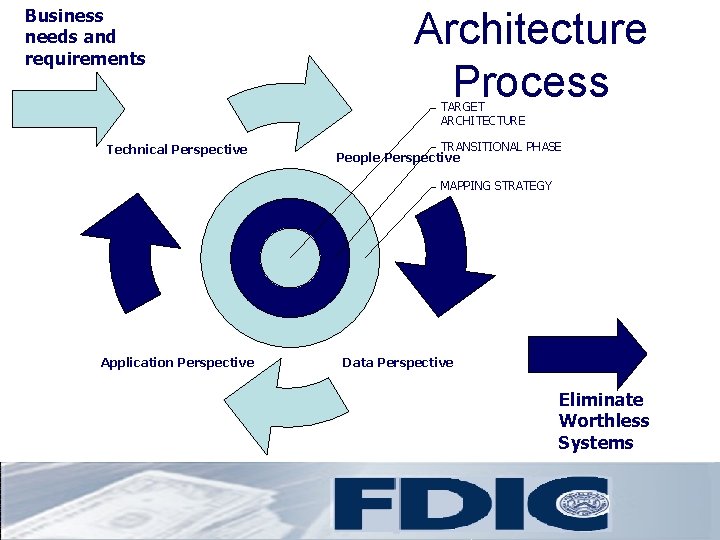
Enterprise Architecture Run-down • Architectural Framework – blueprint of beginning to end progression – integrates agreed upon goals to contrive a target architecture – a continual process
Business needs and requirements Architecture Process TARGET ARCHITECTURE Technical Perspective TRANSITIONAL PHASE People Perspective MAPPING STRATEGY Application Perspective Data Perspective Eliminate Worthless Systems
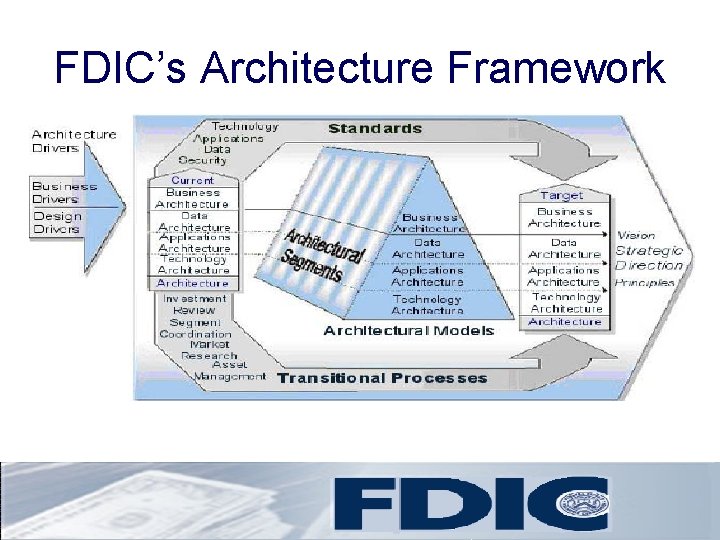
FDIC’s Architecture Framework
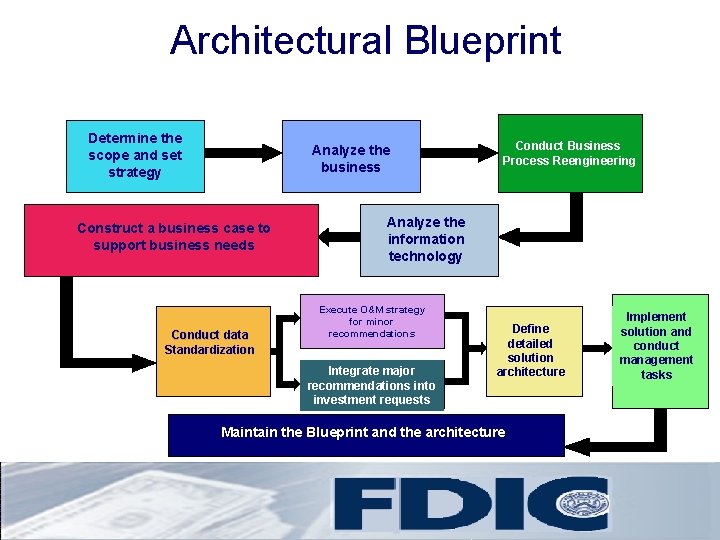
Architectural Blueprint Determine the scope and set strategy Analyze the business Construct a business case to support business needs Conduct Business Process Reengineering Conduct data Standardization Conduct Business Process Reengineering Analyze the information technology Execute O&M strategy for minor recommendations Integrate major recommendations into investment requests Define detailed solution architecture Maintain the Blueprint and the architecture Implement solution and conduct management tasks
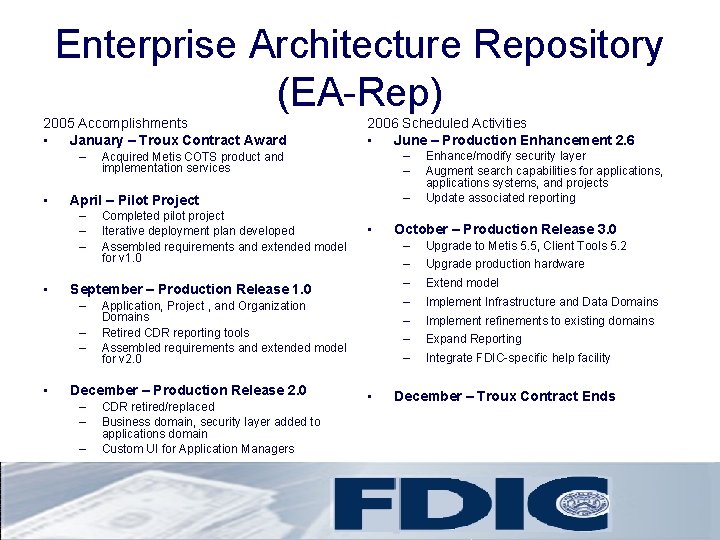
Enterprise Architecture Repository (EA-Rep) 2005 Accomplishments • January – Troux Contract Award – • – Completed pilot project Iterative deployment plan developed Assembled requirements and extended model for v 1. 0 • – – Application, Project , and Organization Domains Retired CDR reporting tools Assembled requirements and extended model for v 2. 0 December – Production Release 2. 0 – – – CDR retired/replaced Business domain, security layer added to applications domain Custom UI for Application Managers • Enhance/modify security layer Augment search capabilities for applications, applications systems, and projects Update associated reporting October – Production Release 3. 0 – – – – September – Production Release 1. 0 – • – – Acquired Metis COTS product and implementation services April – Pilot Project – – – • 2006 Scheduled Activities • June – Production Enhancement 2. 6 Upgrade to Metis 5. 5, Client Tools 5. 2 Upgrade production hardware Extend model Implement Infrastructure and Data Domains Implement refinements to existing domains Expand Reporting Integrate FDIC-specific help facility December – Troux Contract Ends
Engaging the Stakeholder
Who are Stakeholders? • Defined: an individual with a vested interest in the results of IT solutions and implementation. • Include: business owners, data owners, developers and technical infrastructure operational staff
10 Ways to Maximize Stakeholder Engagement 1. Executive Management Buy-in 2. Connect Business Goals with IT 3. Link pay and performance with IT projects 4. Communicate Objectives Frequently 5. Clearly Defined Principles 6. Demonstrate Benefits 7. Govern from Different Perspectives 8. Active Leadership 9. IT gets a seat at the Business table 10. Recognition and Success shared by all
Why is stakeholder engagement is important? • Stakeholder engagement is critical to applying enterprise architecture EA principles and methodologies in order to achieve value from information technology IT investments • Multi-layered perspectives and comprehensive strategies result from high levels of stakeholder engagement in EA, from a project’s inception to completion • Stakeholder experience and subsequent foresight of obstacles in respective program areas can prove invaluable to the smooth process toward target architecture.
Application Rationalization Effort Example • • • PROBLEM Many organizations accumulate large and technically diverse portfolio of systems Unmanaged, this portfolio is too expensive and unresponsive to change. The result, restricting the organization from taking on IT initiatives that are strategically important to its mission • • • FDIC SOLUTION Engaged both the IT Department and Business Stakeholders in a systematic and joint effort to make targeted reductions in the inventory of applications This effort served to raise the awareness of staff and management throughout the FDIC of the life-cycle costs of applications and the increasing need for application integration and consolidation This allowed the FDIC implement several new enterprise-wide integrated applications that not only met the need to improve business operations, but at the same time, replaced older, stovepiped legacy applications.
Corporate Data Sharing • CDS Data Families • FDIC Conceptual Data Model describes the relationships between FDIC's data across the data families and the entire enterprise • The Collaborative Working Groups (CWGs) were established to verify that the data has been defined and categorized correctly in their data family.
Bank Call Reports Use XBRL • FDIC is one of the biggest proponents of XBRL • 8, 200 U. S. banks use XBRL to submit balance sheets and income statement reports. • XBRL has proven its value: All XBRL-tagged data received from banks was 95% accurate, compared with 70% accuracy before implementation • An analyst who could handle 450 to 500 banks before implementation can now handle 550 to 600 of them.
Maximizing the Impact of the Stakeholder • Ultimately stakeholder compliance with EA must be governed through a comprehensive system that divides responsibilities to take full advantage of individual strengths as well as increase the efficiency of the corporate structure • There exist a few mechanisms to reach this end. Two of the most important and effective are Established Governance Systems and Business Metrics
Governance Structures
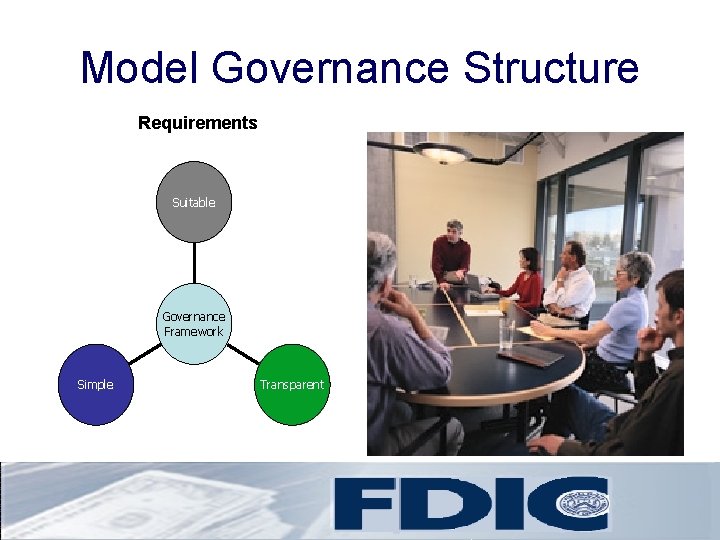
Governance Mapping • A key step in the EA process is to establish a system of governance. One in which rules and order of operation are hashed out between relevant actors to meet the target architecture. • Every Corporation is different, but the basic requirements for a healthy Governance body are similar to all
Model Governance Structure Requirements Suitable Governance Framework Simple Transparent
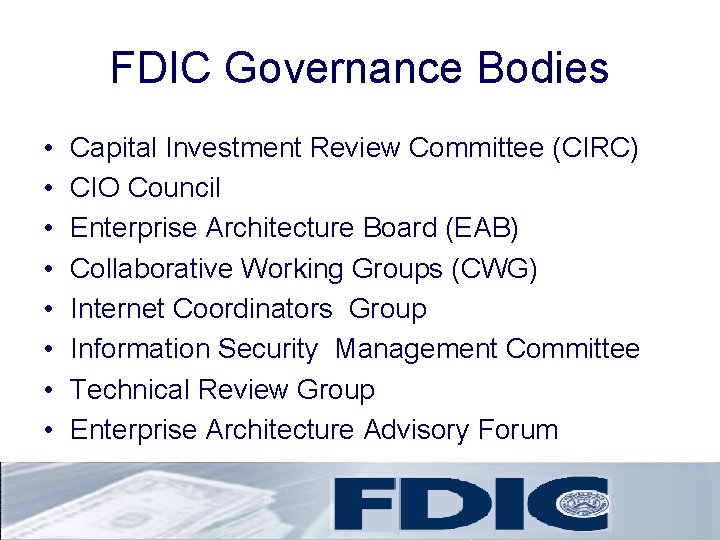
The Capital Investment Review Committee (CIRC) • Comprised of Senior Level Division Directors • Evaluate the impact of IT investment decisions on the Corporations capital investment portfolio • Reviews proposed major investments and makes the final funding recommendations to the FDIC’s Board of Directors • Indicates Success in integration of EA and the capital investment management process.
FDIC Governance Bodies • • Capital Investment Review Committee (CIRC) CIO Council Enterprise Architecture Board (EAB) Collaborative Working Groups (CWG) Internet Coordinators Group Information Security Management Committee Technical Review Group Enterprise Architecture Advisory Forum
Metrics
Utilize Metrics • Metrics guide architecture • IT desirables are reflected in the IT metrics • Measure accountabilities
Metrics’ Importance • Identify specific EA and Business related metrics early to guide decisions • Enable the tracking and recording of data required to report results and evaluate the impact of EA related strategies
Linking Business and IT via Metrics • You need at least three kinds of metrics to begin establishing a linkage from the business needs and the implementation of them as guided by EA. Chris Curran March 21, 2005, Enterprise Architect 1. Business Alignment 2. EA Compliance 3. EA Governance
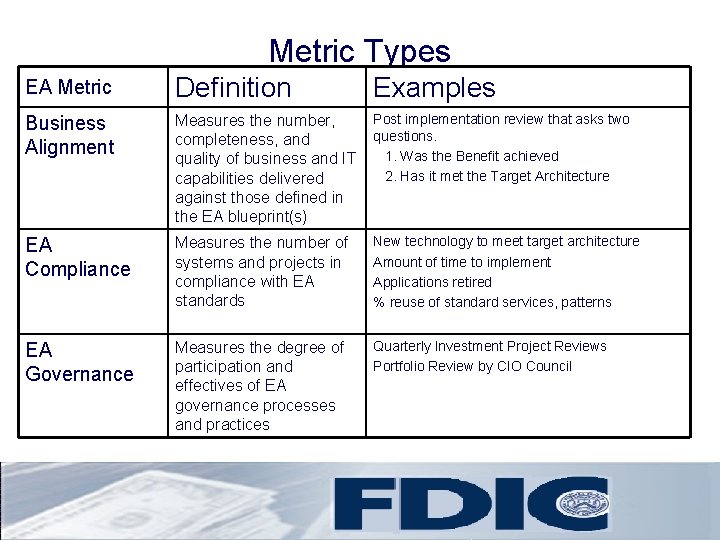
Metric Types EA Metric Definition Examples Business Alignment Measures the number, completeness, and quality of business and IT capabilities delivered against those defined in the EA blueprint(s) Post implementation review that asks two questions. 1. Was the Benefit achieved 2. Has it met the Target Architecture EA Compliance Measures the number of systems and projects in compliance with EA standards New technology to meet target architecture Amount of time to implement Applications retired % reuse of standard services, patterns EA Governance Measures the degree of participation and effectives of EA governance processes and practices Quarterly Investment Project Reviews Portfolio Review by CIO Council
Lessons Learned by FDIC EA • Work with and enable the business first- critical first step of any EA organization is to identify the problem/business need first and work cooperatively with Business Professionals to show the value of IT and EA setup to the Corporation. • Optimize EA to enable organizational transformationcontinuing on theme of a complete and stated goal with a strategy to achieve that goal, EA allows, via open communication and cooperation between IT and EA, for a comprehensive evaluation of all business processes and IT involvement to maximize EA goals while serving IT purposes and business needs.