
Enterprise and Industry ICSMS Information and Communication System


- Slides: 19
Enterprise and Industry ICSMS (Information and Communication System for Market Surveillance) Zacharias Bilalis Unit ENTR/C 1: Internal Market and its International Dimension
Market Surveillance under New Legislative Framework (1) Reg 765/2008 requirements include: • Art 19. 2 – Obligation of market surveillance authorities to alert users • Art 22 – Community rapid information system about products presenting a serious risk (RAPEX) • Art 23 - Exchange across EU of information not referred to under Art 22 • Art 24 – Cooperation of market surveillance authorities • Art 26 Co-operation with the competent authorities of third countries • Art 27 - Effective market surveillance infrastructure and effective controls at the EU borders
Market Surveillance under New Legislative Framework (2) Reg 765/2008 Art 23 stipulates that: • The Commission shall develop and maintain a general archiving and exchange of information system, using electronic means, on issues relating to market surveillance activities, programmes and related information on non-compliance with Community harmonisation legislation. The system shall appropriately reflect notifications and information provided under Article 22. • For this purposes, Member States shall provide the Commission with information at their disposal and not already provided under Article 22 on products presenting a risk regarding, in particular, identification of risks, results of testing carried out, provisional restrictive measures taken, contacts with the economic operators concerned and justification for action or inaction.
Role of ICSMS (1) ICSMS fulfills Reg 765/2008 Art 23 requirements by providing for: • Quick and in-time exchange of information on market surveillance measures conducted by other enforcement authorities. Enables national market surveillance authorities to coordinate their market surveillance activities more effectively, especially risk-based and targeted market inspections. • A cross EU data base covering non-conforming products in circulation in Europe including up-to-date information on products being tested (even beyond Reg 765/2008). The system allows test results, product identification data, photographs, economic operator information, risk assessments including hazard data, accident information, and measures taken by surveillance authorities to be quickly and efficiently shared between its users.
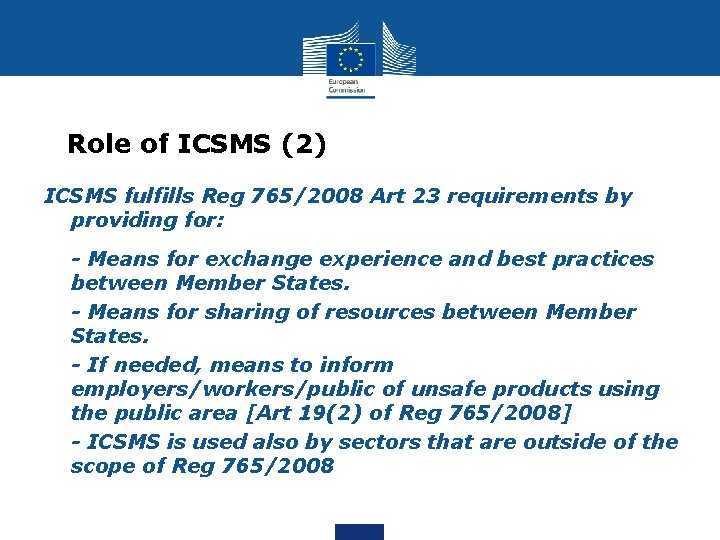
Role of ICSMS (2) ICSMS fulfills Reg 765/2008 Art 23 requirements by providing for: • - Means for exchange experience and best practices between Member States. • - Means for sharing of resources between Member States. • - If needed, means to inform employers/workers/public of unsafe products using the public area [Art 19(2) of Reg 765/2008] • - ICSMS is used also by sectors that are outside of the scope of Reg 765/2008
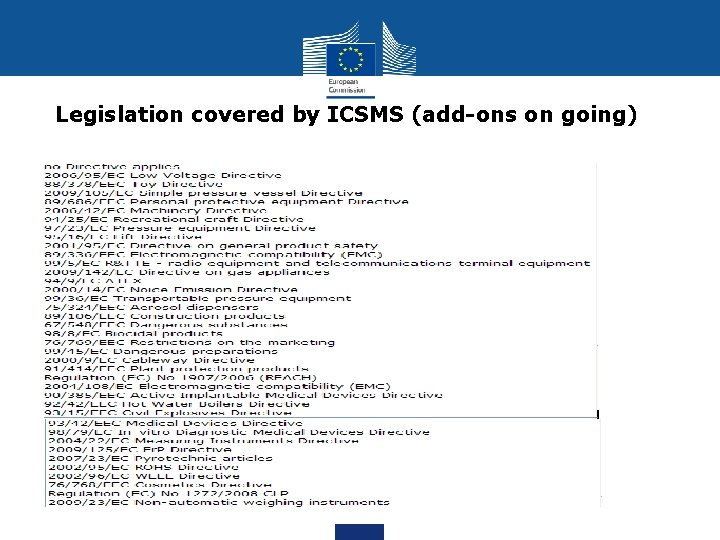
Legislation covered by ICSMS (add-ons on going) • text
ICSMS Governance • ICSMS is owned by the European Commission • Languages: DE, EN, ES, FR, NL, PT, SL, IT • System administrator / State administrator / Authority administrator / User
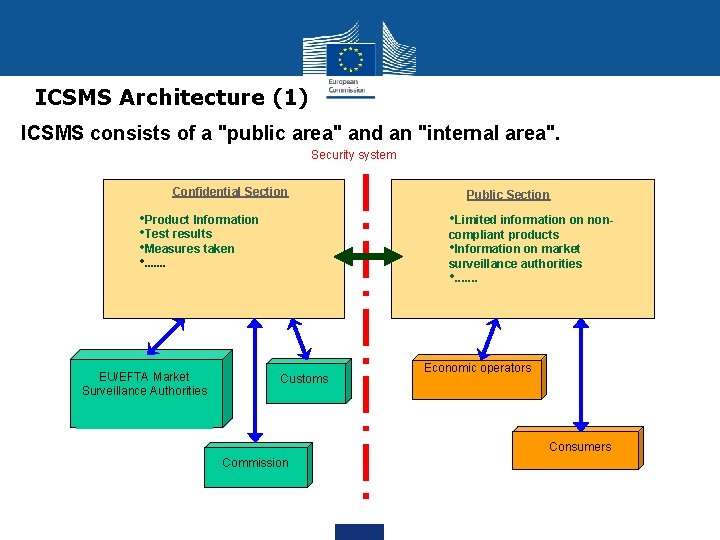
ICSMS Architecture (1) ICSMS consists of a "public area" and an "internal area". Security system Confidential Section • Product Information • Test results • Measures taken • . . . . EU/EFTA Market Surveillance Authorities Public Section • Limited information on noncompliant products • Information on market surveillance authorities • . . . . Customs Economic operators Consumers Commission
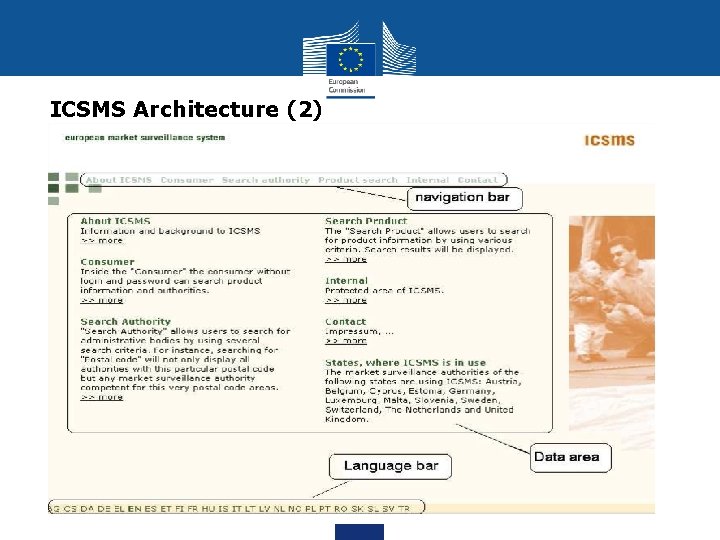
ICSMS Architecture (2)
ICSMS Architecture – The public area • It is accessible for every internet user. • It informs about the objectives of the ICSMS, its background and its importance for the European market. • Product information • It contains official information about non-conform products published by the responsible market surveillance authorities. • • In the public area only selected product information can be searched for. The selection criteria is the status of “visibility of information for” needs to be “public”. The product information which is visible to the public provides only the data, which references the product and its non-compliance and not any internal documents (i. e. between authority and importer etc. ). •
ICSMS Architecture – The public area (2) • Product search • The product search provides the ability to use keywords as selection criteria for specific products via a search engine. • Authority search • The database contains a list with all authorities, which are working in the area of market surveillance and each of them is provided with a scope consisting of the Directives and Regulations, where they have a designated responsibility. • Every internet user can contact the authorities listed in ICSMS via the system.
ICSMS Architecture – The internal area (1) • Accessible only to market surveillance authorities, customs and the EU Commission, it contains product information, test results and official measures taken against non-compliant products. • Authorised users can among other things: • Read, enter, share information about products • Interrogate data in form of graphs • Coordinate measures with other authorities • Look for authorities and addresses • Subscribe to information on selected subjects • Review and update the information the system holds on them (user's/authority's name, address, phone and fax number, etc. ).
ICSMS Architecture – The internal area (2) • Product information • Product search by using of keywords as selection criteria for specific products via a search engine. • Input of new product information • Each market surveillance authority can input data about investigated products, which are not already in the database. • Adding of comments to an already existing product information file, i. e. feedback about the activities of market surveillance authorities with regard to European notifications.
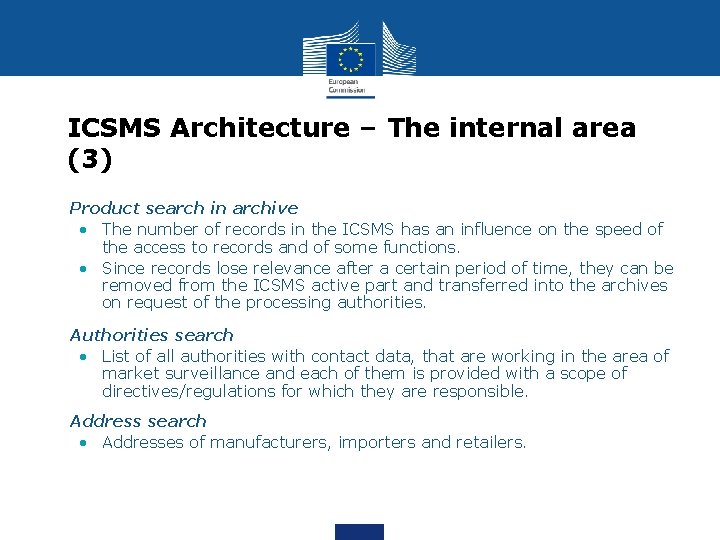
ICSMS Architecture – The internal area (3) • Product search in archive • The number of records in the ICSMS has an influence on the speed of the access to records and of some functions. • Since records lose relevance after a certain period of time, they can be removed from the ICSMS active part and transferred into the archives on request of the processing authorities. • Authorities search • List of all authorities with contact data, that are working in the area of market surveillance and each of them is provided with a scope of directives/regulations for which they are responsible. • Address search • Addresses of manufacturers, importers and retailers.
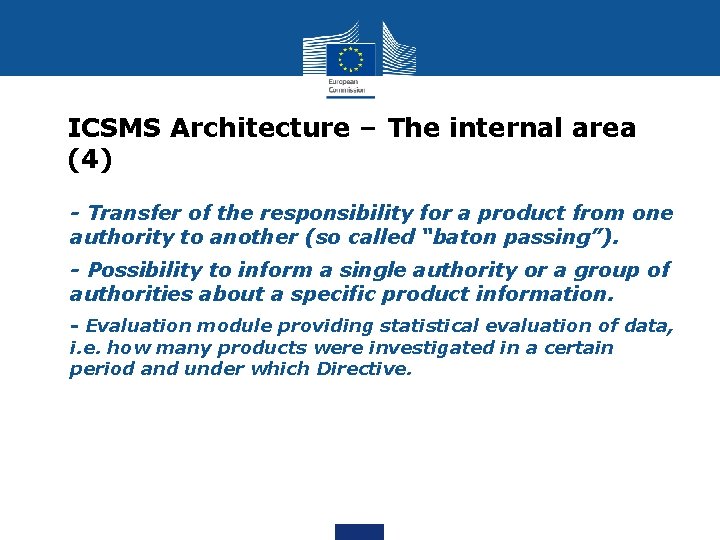
ICSMS Architecture – The internal area (4) • - Transfer of the responsibility for a product from one authority to another (so called “baton passing”). • - Possibility to inform a single authority or a group of authorities about a specific product information. • - Evaluation module providing statistical evaluation of data, i. e. how many products were investigated in a certain period and under which Directive.
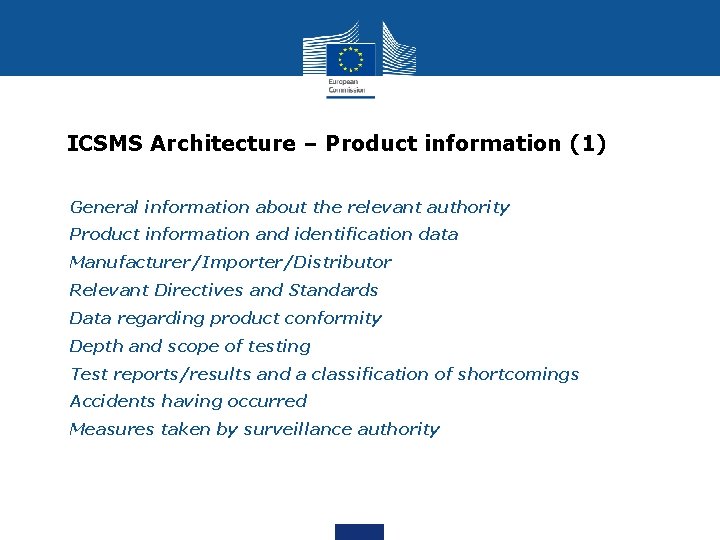
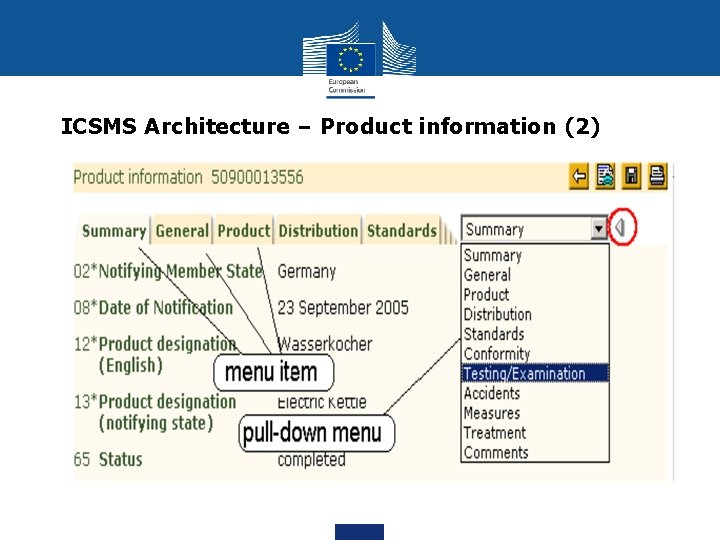
ICSMS Architecture – Product information (1) • General information about the relevant authority • Product information and identification data • Manufacturer/Importer/Distributor • Relevant Directives and Standards • Data regarding product conformity • Depth and scope of testing • Test reports/results and a classification of shortcomings • Accidents having occurred • Measures taken by surveillance authority
ICSMS Architecture – Product information (2)
Web site addresses • http: //www. icsms. org • New Legislative Framework: http: //ec. europa. eu/enterprise/policies/singl e-market-goods/regulatory-policiescommon-rules-for-products/index_en. htm
Questions? ENTR-REG-APPROACH-FOR-FREEMOVEMENT@ec. europa. eu