
Enterohemorrhagic Escherichia coli Infections Verocytotoxin producing E coli





- Slides: 37
Enterohemorrhagic Escherichia coli Infections Verocytotoxin producing E. coli (VTEC) Shiga toxin producing E. coli (STEC) E. coli O 157: H 7
Overview • Organism • History • Epidemiology • Transmission • Disease in Humans • Disease in Animals • Prevention and Control • Actions to Take Center for Food Security and Public Health, Iowa State University, 2012
THE ORGANISM
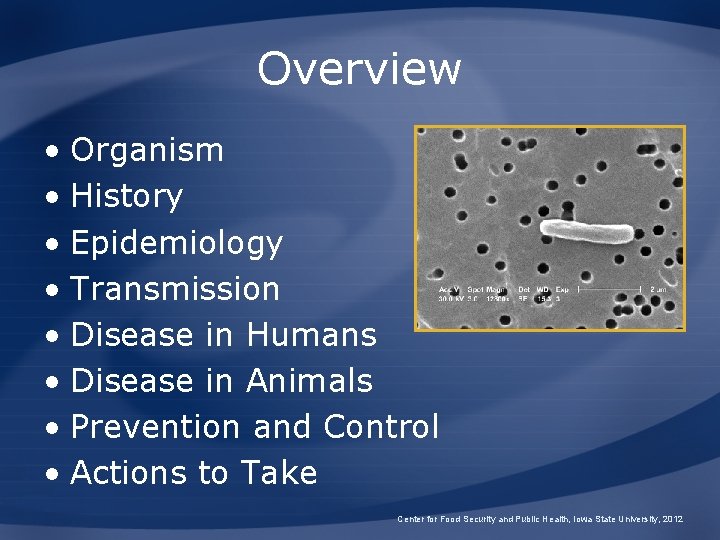
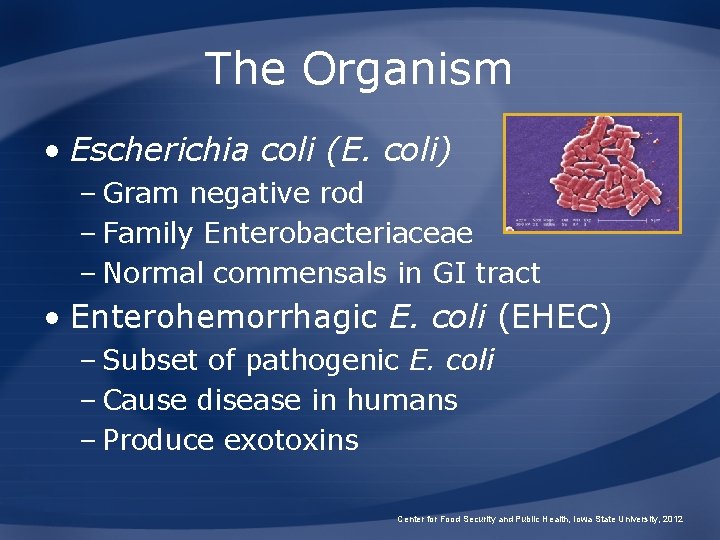
The Organism • Escherichia coli (E. coli) – Gram negative rod – Family Enterobacteriaceae – Normal commensals in GI tract • Enterohemorrhagic E. coli (EHEC) – Subset of pathogenic E. coli – Cause disease in humans – Produce exotoxins Center for Food Security and Public Health, Iowa State University, 2012
Virulence Factors • Verocytotoxigenic E. coli (VTEC) – Toxins: Vt 1, Vt 2 – Also known as shiga toxin-producing E. coli (STEC) • EHEC are VTEC that have additional virulence factors – Example: genes that produce attaching and effacing lesions in human GI tract Center for Food Security and Public Health, Iowa State University, 2012
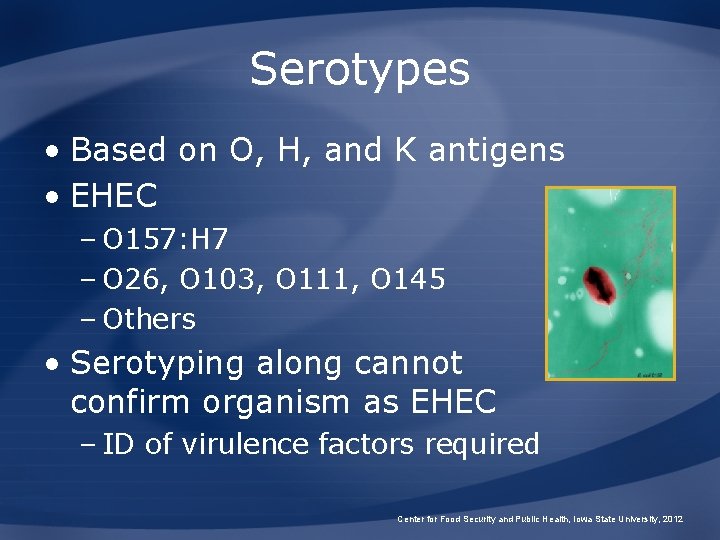
Serotypes • Based on O, H, and K antigens • EHEC – O 157: H 7 – O 26, O 103, O 111, O 145 – Others • Serotyping along cannot confirm organism as EHEC – ID of virulence factors required Center for Food Security and Public Health, Iowa State University, 2012
HISTORY
History • First description of E. coli O 157: H 7 – 1982 – Four patients with bloody diarrhea – Linked to undercooked hamburgers at a fast food chain • Other sources identified over time • Now a major problem – Physicians, public health, food industry Center for Food Security and Public Health, Iowa State University, 2012
EPIDEMIOLOGY Center for Food Security and Public Health, Iowa State University, 2012
Geographic Distribution • E. coli O 157: H 7 – Found worldwide – Exception: Antarctica • Other EHEC – Wide distribution • Prominent serotypes may vary by geographic area Center for Food Security and Public Health, Iowa State University, 2012
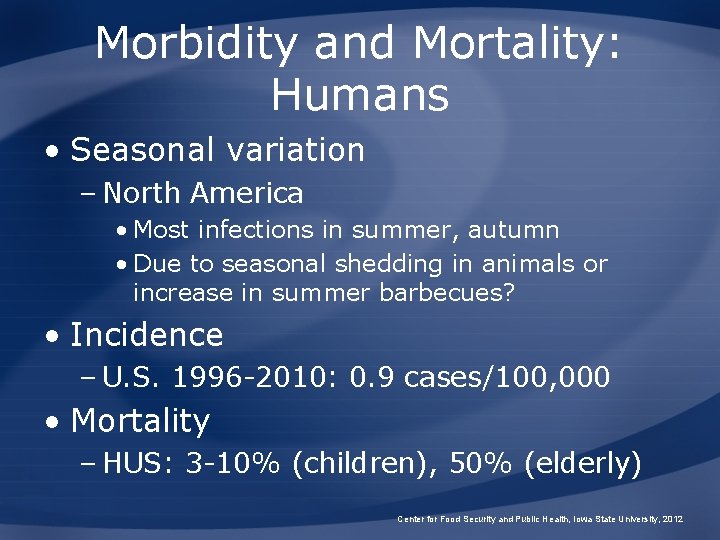
Morbidity and Mortality: Humans • Seasonal variation – North America • Most infections in summer, autumn • Due to seasonal shedding in animals or increase in summer barbecues? • Incidence – U. S. 1996 -2010: 0. 9 cases/100, 000 • Mortality – HUS: 3 -10% (children), 50% (elderly) Center for Food Security and Public Health, Iowa State University, 2012
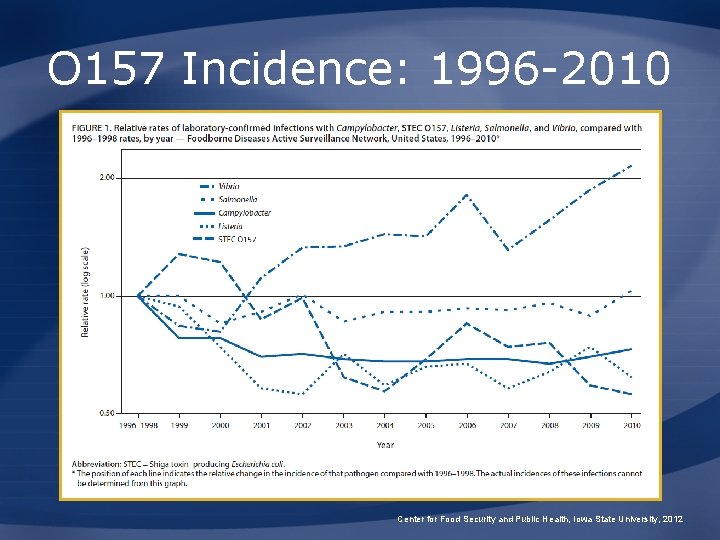
O 157 Incidence: 1996 -2010 Center for Food Security and Public Health, Iowa State University, 2012
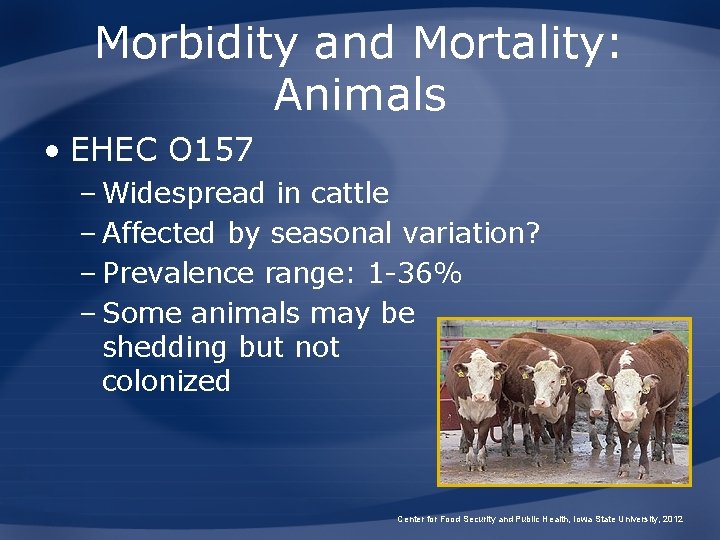
Morbidity and Mortality: Animals • EHEC O 157 – Widespread in cattle – Affected by seasonal variation? – Prevalence range: 1 -36% – Some animals may be shedding but not colonized Center for Food Security and Public Health, Iowa State University, 2012
TRANSMISSION
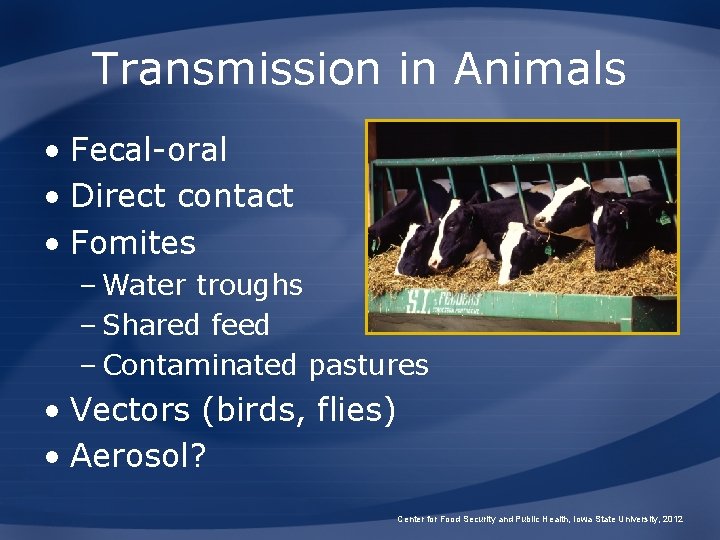
Transmission in Animals • Fecal-oral • Direct contact • Fomites – Water troughs – Shared feed – Contaminated pastures • Vectors (birds, flies) • Aerosol? Center for Food Security and Public Health, Iowa State University, 2012
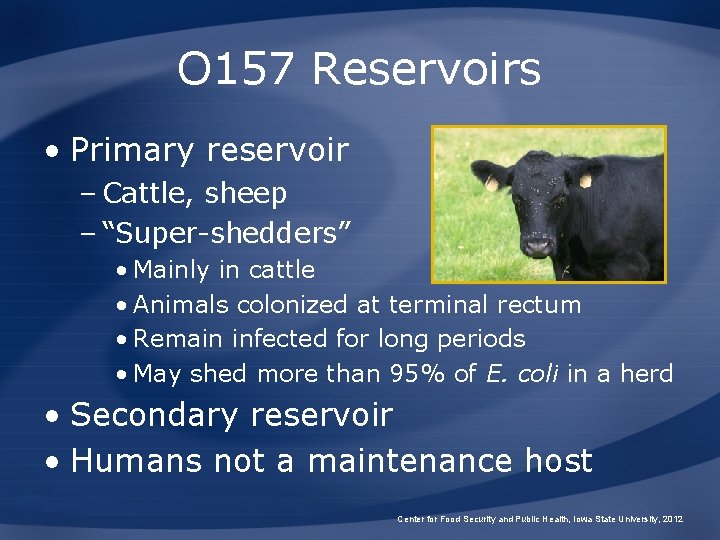
O 157 Reservoirs • Primary reservoir – Cattle, sheep – “Super-shedders” • Mainly in cattle • Animals colonized at terminal rectum • Remain infected for long periods • May shed more than 95% of E. coli in a herd • Secondary reservoir • Humans not a maintenance host Center for Food Security and Public Health, Iowa State University, 2012
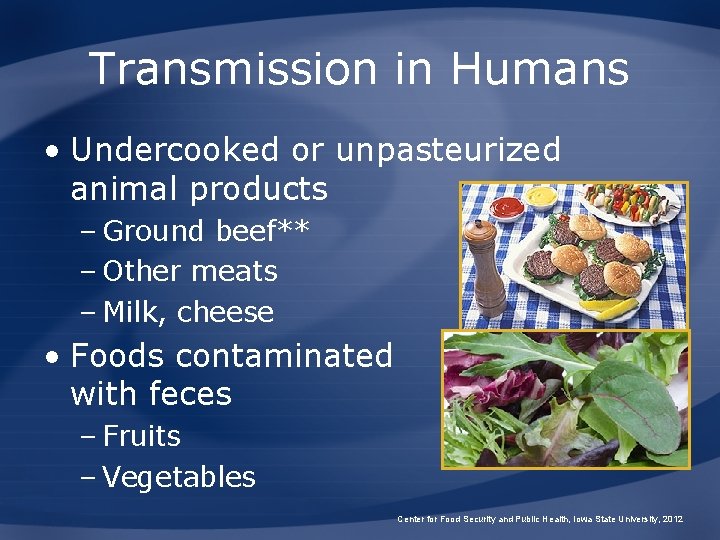
Transmission in Humans • Undercooked or unpasteurized animal products – Ground beef** – Other meats – Milk, cheese • Foods contaminated with feces – Fruits – Vegetables Center for Food Security and Public Health, Iowa State University, 2012
Foodborne Outbreaks: CDC Investigation Examples • 2012: – Clover sprouts • 2011 – Lettuce, bologna, in-shell hazelnuts • 2010 – Cheese, romaine lettuce, steak • 2009 – Ground beef, cookie dough Center for Food Security and Public Health, Iowa State University, 2012
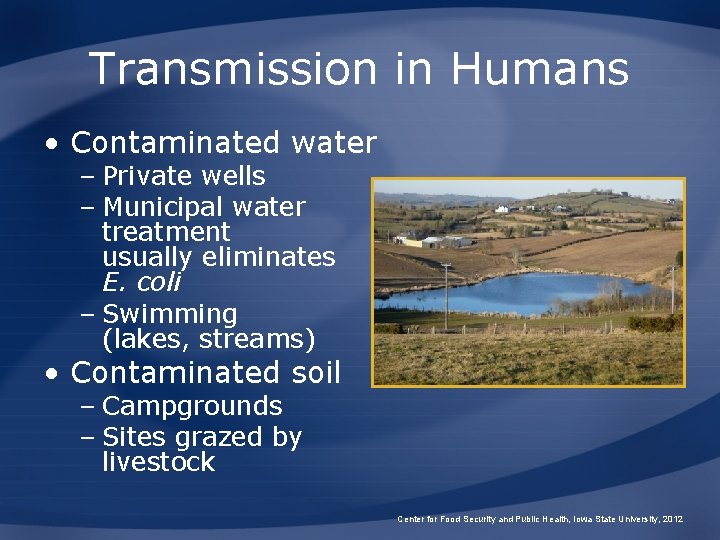
Transmission in Humans • Contaminated water – Private wells – Municipal water treatment usually eliminates E. coli – Swimming (lakes, streams) • Contaminated soil – Campgrounds – Sites grazed by livestock Center for Food Security and Public Health, Iowa State University, 2012
DISEASE IN HUMANS
Disease in Humans • Incubation – 1 to 16 days • Shedding – 7 to 9 days – May continue for months – Longest shedding period in children Center for Food Security and Public Health, Iowa State University, 2012
Disease in Humans • Hemorrhagic colitis – Bloody diarrhea – Severe abdominal cramps – +/- fever, nausea/vomiting • Many cases self-limiting – Resolve in about 1 week Center for Food Security and Public Health, Iowa State University, 2012
Disease in Humans • Hemolytic uremic syndrome (HUS) – Children, elderly, immunocompromised – Usually develops post-diarrhea • Clinical signs – Kidney failure, hemolytic anemia, thrombocytopenia • Thrombotic thrombocytopenic purpura (TTP) Center for Food Security and Public Health, Iowa State University, 2012
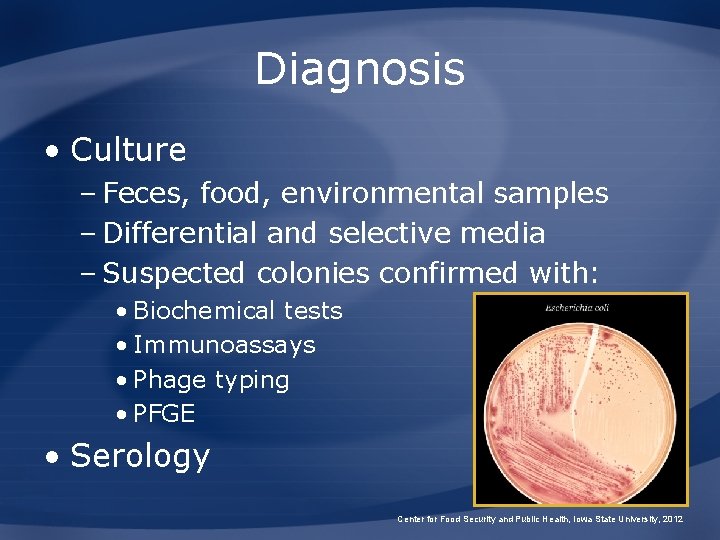
Diagnosis • Culture – Feces, food, environmental samples – Differential and selective media – Suspected colonies confirmed with: • Biochemical tests • Immunoassays • Phage typing • PFGE • Serology Center for Food Security and Public Health, Iowa State University, 2012
Treatment • Mainly supportive • Antibiotics – Usually avoided – Do not reduce symptoms, prevent complications, or reduce shedding – May increase risk of HUS • Antimotility drugs – May increase risk of HUS Center for Food Security and Public Health, Iowa State University, 2012
DISEASE IN ANIMALS
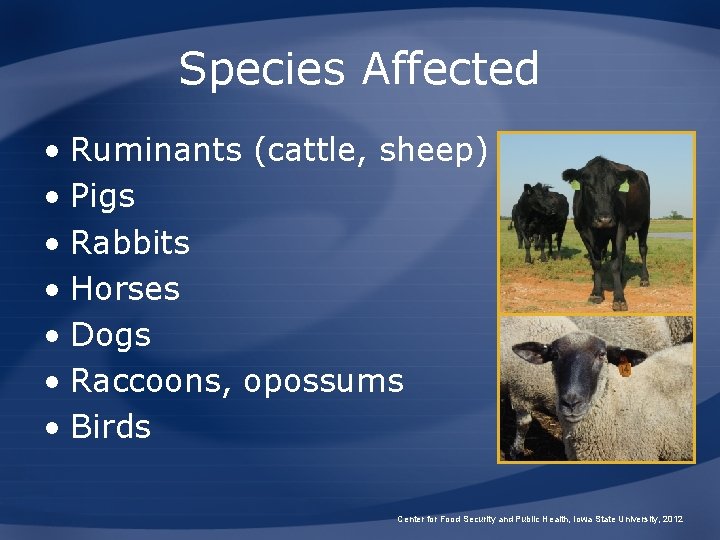
Species Affected • Ruminants (cattle, sheep) • Pigs • Rabbits • Horses • Dogs • Raccoons, opossums • Birds Center for Food Security and Public Health, Iowa State University, 2012
Disease in Animals • O 157: H 7 EHEC – Natural infections • No illness detected – Experimental infections • Disease in very young animals • Non-O 157 EHEC – Diarrhea, GI signs in young animals • Shedding – Subclinically infected, young animals Center for Food Security and Public Health, Iowa State University, 2012
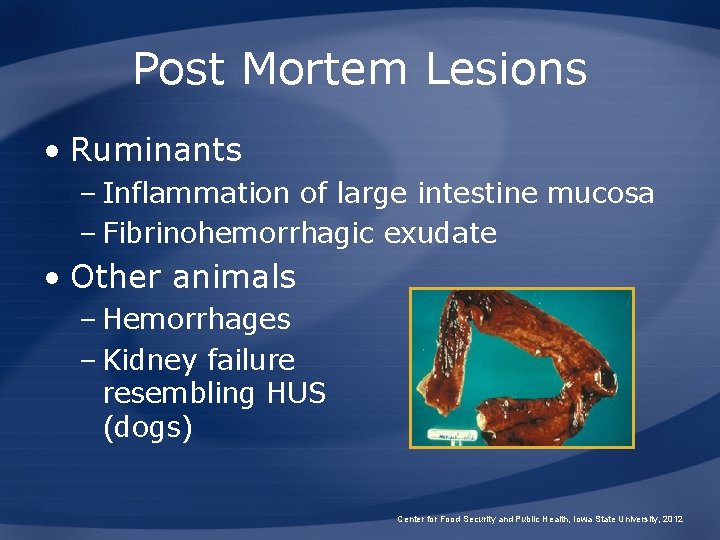
Post Mortem Lesions • Ruminants – Inflammation of large intestine mucosa – Fibrinohemorrhagic exudate • Other animals – Hemorrhages – Kidney failure resembling HUS (dogs) Center for Food Security and Public Health, Iowa State University, 2012
Diagnosis • Culture – Fecal samples, rectoanal swabs – Differential and selective media • Detection of antigens, toxins, genes – Immunological tests – Nucleic-acid based tests • Serology not routinely used in animals Center for Food Security and Public Health, Iowa State University, 2012
PREVENTION AND CONTROL
Recommended Actions • O 157: H 7 nationally notifiable in humans – Contact your physician for guidance • Animal cases may be reportable in some states – State veterinarian http: //www. usaha. org/stateanimalhealthofficials. aspx Center for Food Security and Public Health, Iowa State University, 2012
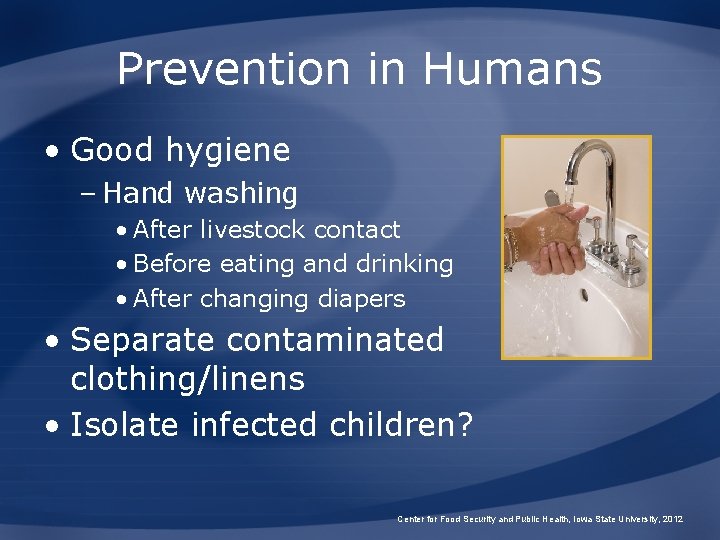
Prevention in Humans • Good hygiene – Hand washing • After livestock contact • Before eating and drinking • After changing diapers • Separate contaminated clothing/linens • Isolate infected children? Center for Food Security and Public Health, Iowa State University, 2012
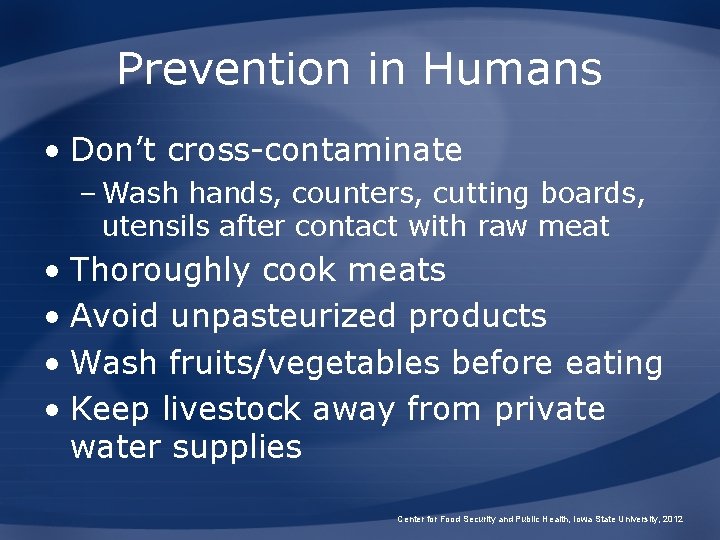
Prevention in Humans • Don’t cross-contaminate – Wash hands, counters, cutting boards, utensils after contact with raw meat • Thoroughly cook meats • Avoid unpasteurized products • Wash fruits/vegetables before eating • Keep livestock away from private water supplies Center for Food Security and Public Health, Iowa State University, 2012
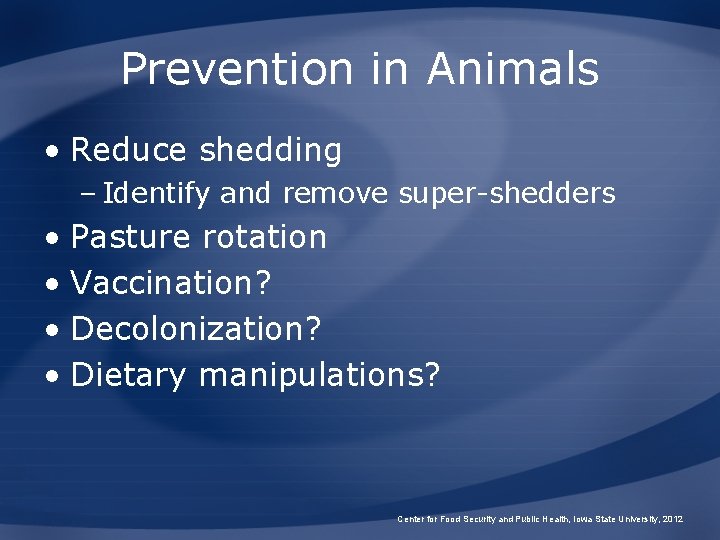
Prevention in Animals • Reduce shedding – Identify and remove super-shedders • Pasture rotation • Vaccination? • Decolonization? • Dietary manipulations? Center for Food Security and Public Health, Iowa State University, 2012
Additional Resources • USDA Food Safety and Inspection Service – www. fsis. usda. gov/wps/portal/fsis/topics/foodsafety-education/get-answers/food-safety-factsheets/foodborne-illness-anddisease/escherichia-coli-o 157 h 7/ct_index Center for Food Security and Public Health – www. cfsph. iastate. edu CDC E. coli – www. cdc. gov/ecoli/ Center for Food Security and Public Health, Iowa State University, 2012
Acknowledgments Development of this presentation was made possible through grants provided to the Center for Food Security and Public Health at Iowa State University, College of Veterinary Medicine from the Centers for Disease Control and Prevention, the U. S. Department of Agriculture, the Iowa Homeland Security and Emergency Management Division, and the Multi-State Partnership for Security in Agriculture. Authors: Kerry Leedom Larson, DVM, MPH, Ph. D, DACVPM; Ariel Pleva, MPH; Anna Rovid Spickler, DVM, Ph. D Reviewer: Glenda Dvorak, DVM, MPH, DACVPM Center for Food Security and Public Health, Iowa State University, 2012