
Enterobacteriaceae Introduction p The family Enterobacteriaceae is the

Enterobacteriaceae
Introduction p The family Enterobacteriaceae is the largest, most heterogeneous collection of medically important gram –negative bacilli. p Their natural habitat is the intestinal tract of humans and animals (Enteric gram negative rods). p The Enterobacteriaceae are the most common group of gram negative bacilli isolated in the lab.
p At present, at least 27 genera and 102 species as well as eight enteric groups ( isolates with undefined genus affiliation) have been described. p These genera have been classified on the basis of DNA homology, biochemical properties, serologic reactions, susceptibility to genus – specific and species – specific bacteriophages and antibiotic susceptibility patterns. p Despite the complexity of this family, more than 95% of medically important isolates belong to fewer than 25 species.
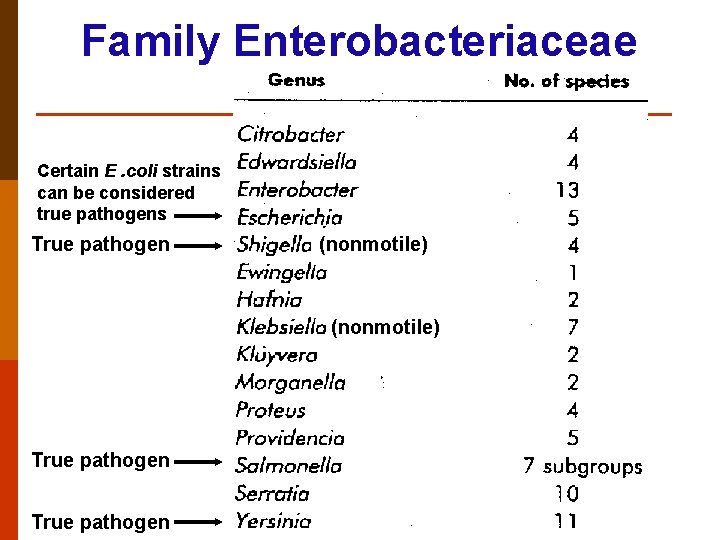
Family Enterobacteriaceae Certain E. coli strains can be considered true pathogens True pathogen (nonmotile) True pathogen
p Enterobacteriaceae are ubiquitous organisms that are found worldwide in soil, water, vegetation and are part of the normal flora of the intestines of most animals including humans. p Some members of the family (Shigella, Salmonella) are always associated with disease when isolated from humans whereas others are members of the normal flora that can cause opportunistic infections.
p Infections can originate from an animal reservoir (Salmonella), from human carriers (Shigella, Salmonella), or by endogenous spread of organisms in a susceptible patient (E. coli) involving virtually all body sites. p The Enterobacteriaceae are responsible for 30% to 35 % of all septicemias, more than 70% of urinary tract infections and many intestinal infections.
Physiology and Structure p The Enterobacteriaceae are gram negative bacilli, usually motile, aerobes or facultative anaerobes and non spore- forming. p The Enterobacteriaceae have simple nutritional requirements; ferment glucose, reduce nitrate and are oxidase negative and catalase positive.
p Morphological characteristics on differential and selective media have been used to identify members of the family (lactose fermentation, resistance to bile salts). p Some members are encapsulated (Klebsiella and Enterobacter). p The serologic classification is based on three major group antigens; somatic(O antigen), Capsular(K antigen) and flagellar (H antigen).
Pathogenesis p Consistent with the large and diverse composition of the family is the observation of many virulence factors in the pathogenic strains. n Endotoxin (more than 150 somatic O antigens). n Capsule (more than 100 K (Vi) antigens). n Antigenic phase variation (protection from antibody –mediated cell death)
n - Exotoxin production Numerous, including heat stable and heat labile enterotoxins, shiga and shiga – like toxins, and hemolysins. - The heat –labile enterotoxins as well as shiga and shiga-like toxins are produced primarily by E. Coli and occasional isolates of Klebsiella and Salmonella. - The heat stable toxin is produced by E. coli and occasionally Citrobacter freundii. - Shigella dysenteriae produces shiga toxin (neurotoxic, enterotoxic and cytotoxic) which inhibits protein synthesis by inactivation of 60'S ribosomes.
n Expression of Adhesion Factors: Fimbriae with phase variation. n Intracellular Survival and Multiplication: can replicate intracellularly but do not require intracellular host factors for survival. n Sequestration of growth factors: (siderophores like enterobactin). n Resistance to Serum Killing. n Antimicrobial Resistance.
OPPORTUNISTIC INFECTIONS OF ENTEROBACTERIACEAE ØGRAM NEGATIVE SEPSIS ØURINARY TRACT INFECTIONS ØPNEUMONIA ØABDOMINAL SEPSIS ØMENINGITIS ØSPONTANEOUS BACTERIAL PERITONITIS ØENDOCARDITIS
Endotoxin-Mediated Toxicity Ø Fever Ø Leukopenia (reduced # of WBCs) (<5000/mm 3) followed by leukocytosis (increased # of WBCs)(>10 -12, 000/mm 3) Ø Activation of complement Ø Thrombocytopenia (reduced # of platelets) Ø DIC (Disseminated intravascular coagulation) Ø Decreased peripheral circulation and perfusion (blood flow) to major organs Ø Shock Ø Death
Nonspecific Disease Entities E. Coli and Others p p p - Urinary tract infection (UTI) E. coli is the most common cause. Infecting strains usually originate from the GIT. Signs and symptoms. Diagnosis. Pneumonia (Esp. Klebsiella pneumonia) Septicemia When normal host defenses are inadequate. Newborns may be highly susceptible to E. coli, Klebsiella, and Enterobacter. The focus of infection from which spread takes place is the UT or GIT.
p Neonatal meningitis. p E. coli Associated Diarrheal Diseases • Enterotoxigenic E. coli (ETEC) § A common cause of traveler’s diarrhea and a very important cause of diarrhea in infants in the developing countries. § Secretes a heat labile exotoxin that acts on the small intestines causing activation of adenylate cyclase and increase of c. AMP leading to hypersecretion of water. § Some strains produce a heat stable toxin and a colonization factor
• Enteropathogenic E. coli (EPEC) § Damage the epithelium of the small intestine. § An important cause of diarrhea in infants especially in the developing countries. § Self limited watery diarrhea but can be chronic. § May cause outbreaks of diarrhea in nurseries.
• Enterohemorrhagic E. coli (EHEC) § Produces verotoxin which has 2 antigenic types. § Has been associated with hemorrhagic colitis, a severe form of diarrhea with hemolytic uremic syndrome, a disease resulting in acute renal failure, microangiopathic hemolytic anemia and thrombocytopenia. § E. coli O 157: H 7 is the most common. § Can be prevented by thorough cooking of ground beef.
• Enteroeinvasive E. coli (EIEC) § Invades the intestinal mucosal epithelial cells. § Disease is similar to shigellosis § Affects children in the developing countries and travelers to them.
• Enteroaggregative E. coli (EAEC) § Causes acute and chronic diarrhea( >14 days) in the developing countries. § Causes a food-borne illness in the developed countries. § Characteristic pattern of adherence to human cells. § Elaborates an enterotoxin and cytotoxin.
The Salmonella: Classification and Taxonomy ØOld: Serotyping & biochemical assays used to name individual species within genus (e. g. , Salmonella enteritidis, S. choleraesuis, S. typhi) · Over 2400 O-serotypes (referred to as species) (Kauffman-White antigenic schema) · Bioserotyping (e. g. , S. typhimurium) ØNew: DNA homology shows only two species Salmonella enterica (six subspecies) and S. bongori · Most pathogens in S. enterica ssp. enterica
The Salmonella p Serotypes Typhi, paratyphi A and B, and choleraesuis are primarily human pathogens. p The vast majority of salmonellae are chiefly animal pathogens (poultry, pigs, rodents, cattle, pets and others). p Infecting dose is variable depending on serotype.
Clinical Syndromes of Salmonella Clinical Syndromes Ø Enteritis (acute enterocolitis) Ø Enteric fever (prototype is typhoid fever and less severe paratyphoid fever) Ø Septicemia (particularly S. choleraesuis, S. typhi, and S. paratyphi) Ø Asymptomatic carriage (gall bladder is the reservoir for Salmonella typhi)
Epidemiology and Clinical Syndromes of Salmonella Enteritis Ø Most common form of salmonellosis with major foodborne outbreaks and sporadic disease Ø High infectious dose (108 CFU) Ø Poultry, eggs, etc. are sources of infection Ø 6 -48 h incubation period Ø Nausea, vomiting, nonbloody diarrhea, fever, cramps, myalgia and headache are common Ø S. enteritidis bioserotypes (e. g. , S. typhimurium)
Pathogenesis of Salmonella Enteritis (cont. ) Virulence attributable to: Ø Invasiveness Ø Intracellular survival & multiplication Ø Endotoxin Ø Exotoxins: Effects in host have not been identified · Several Salmonella serotypes produce enterotoxins similar to both the heat-labile (LT) and heat-stable enterotoxins (ST), but their effect has not been identified · A distinct cytotoxin is also produced and may be involved in invasion and cell destruction
Pathogenesis of Salmonella (cont. ) Invasiveness in Enteritis (cont. ) Ø Penetrate mucus, adhere to and invade into epithelial layer (enterocytes) of terminal small intestine and further into subepithelial tissue Ø Bacterial cells are internalized in endocytic vacuoles (intracellular) and the organisms multiply Ø PMN’s confine infection to gastrointestinal (GI) tract, but organisms may spread hematogenously (through blood, i. e. , septicemia) to other body sites Ø Inflammatory response mediates release of prostaglandins, stimulating c. AMP and active fluid secretion with loose diarrheal stools; epithelial destruction occurs during late stage of disease
Epidemiology & Clinical Syndromes (cont. ) Enteric Fevers Ø S. typhi causes typhoid fever S. paratyphi A, B (S. schottmuelleri) and C (S. hirschfeldii) cause milder form of enteric fever Ø Infectious dose = 106 CFU Ø Fecal-oral route of transmission · Person-to-person spread by chronic carrier · Fecally -contaminated food or water Ø 10 -14 day incubation period Ø Initially signs of sepsis/bacteremia with sustained fever (delirium) for > one week before abdominal pain and gastrointestinal symptoms
Enteric Fevers (cont. ) Virulence attributable to Invasiveness · Pass through intestinal epithelial cells in ileocecal region, infect the regional lymphatic system, invade the bloodstream, and infect other parts of the reticuloendothelial system · Organisms are phagocytosed by macrophages and monocytes, but survive, multiply and are transported to the liver, spleen, and bone marrow where they continue to replicate · Second week: organisms reenter bloodstream and cause prolonged bacteremia; biliary tree and other organs are infected; gradually increasing sustained fever likely from endotoxemia · Second to third week: bacteria colonize gallbladder, reinfect intestinal tract with diarrheal symptoms and possible necrosis of the Peyer’s patches
Epidemiology & Clinical Syndromes (cont. ) Septicemia Ø Can be caused by all species, but more commonly associated with S. choleraesuis, S. paratyphi, S. typhi, and S. dublin Ø Old, young and immunocompromised (e. g. , AIDS patients) at increased risk
Epidemiology & Clinical Syndromes (cont. ) Asymptomatic Carriage Ø Chronic carriage in 1 -5% of cases following S. typhi or S. paratyphi infection Ø Gall bladder usually the reservoir Ø Chronic carriage with other Salmonella spp. occurs in <<1% of cases and does not play a role in human disease transmission
Treatment, Prevention and Control Enteritis: Ø Antibiotics not recommended for enteritis because they prolong duration of illness Ø Control by proper preparation of poultry & eggs Enteric fever: Ø Antibiotics to avoid carrier state Ø Identify & treat carriers of S. typhi & S. paratyphi Ø Vaccination can reduce risk of disease for travellers in endemic areas
The Shigellae: Epidemiology and Clinical Syndromes Ø Four species: S. sonnei, S. flexneri, S. boydii, and S. dysenteriae Low infectious dose (102 -104 CFU) Humans are the only reservoir Transmission by fecal-oral route Incubation period = 1 -3 days Watery diarrhea with fever; changing to dysentery Ø Ø Ø Major cause of bacillary dysentery (severe 2 nd stage) in pediatric age group (1 -10 yrs) via fecal-oral route Ø Outbreaks in daycare centers, nurseries, institutions Ø Leading cause of infant diarrhea and mortality (death) in developing countries
Pathogenesis of Shigellosis Two-stage disease: Ø Early stage: · Watery diarrhea attributed to the enterotoxic activity of Shiga toxin following ingestion and noninvasive colonization, multiplication, and production of enterotoxin in the small intestine · Fever attributed to neurotoxic activity of toxin Ø Second stage: · Adherence to and tissue invasion of large intestine with typical symptoms of dysentery · Cytotoxic activity of Shiga toxin increases severity
Pathogenesis and Virulence Factors (cont. ) Virulence attributable to: Ø Invasiveness · Attachment (adherence) and internalization with complex genetic control · Large multi-gene virulence plasmid regulated by multiple chromosomal genes Ø Exotoxin (Shiga toxin) Ø Intracellular survival & multiplication
Pathogenesis and Virulence Factors (cont. ) Invasiveness in Shigella -Associated Dysentery Ø Penetrate through mucosal surface of colon (colonic mucosa) and invade and multiply in the colonic epithelium but do not typically invade beyond the epithelium into the lamina propria (thin layer of fibrous connective tissue immediately beneath the surface epithelium of mucous membranes) Ø Preferentially attach to and invade into M cells in Peyer’s patches (lymphoid tissue, i. e. , lymphatic system) of small intestine
Pathogenesis and Virulence Factors (cont. ) Characteristics of Shiga Toxin Ø Enterotoxic, neurotoxic and cytotoxic Ø Encoded by chromosomal genes Ø Two domain (A-5 B) structure Ø Similar to the Shiga-like toxin of enterohemorrhagic E. coli (EHEC) · NOTE: except that Shiga-like toxin is encoded by lysogenic bacteriophage
Pathogenesis and Virulence Factors (cont. ) Shiga Toxin Effects in Shigellosis Enterotoxic Effect: Ø Adheres to small intestine receptors Ø Blocks absorption (uptake) of electrolytes, glucose, and amino acids from the intestinal lumen
Pathogenesis and Virulence Factors (cont. ) Shiga Toxin Effects in Shigellosis (cont. ) Cytotoxic Effect: Ø B subunit of Shiga toxin binds host cell glycolipid Ø A domain is internalized via receptor-mediated endocytosis (coated pits) Ø Causes irreversible inactivation of the 60 S ribosomal subunit, thereby causing: · Inhibition of protein synthesis · Cell death · Microvasculature damage to the intestine · Hemorrhage (blood & fecal leukocytes in stool) Neurotoxic Effect: Fever, abdominal cramping are considered signs of neurotoxicity
Yersenia p Most important species is Yersenia pestis, the causative agent of the most devastating disease in history; plague (black death). p Two epidemiologic forms, urban and sylvatic plague. p Urban plague is maintained in rat populations and spread among rats by infected fleas (humans are accidentally infected). It has been controlled
p Sylvatic plague is impossible to eliminate because the mammalian reservoirs ( prairie dogs, mice, rabbits, rats) and flea vectors are wide spread. p Infection can be acquired by ingestion of contaminated animals or handling contaminated animal tissues. p Person to person transmission in pneumonic plague.
Epidemiology and History of Plague Ø Zoonotic infection; Humans are accidental hosts Ø Outbreaks are cyclical corresponding to rodent reservoir and arthropod vector populations Ø Plague was recorded more than 2000 years ago Ø Three pandemics · 1 st 542 AD; 100 million dead in 60 years; from N. Africa · 2 nd 14 th century; Black Death; 25 million dead in Europe alone (>1/4 of entire population); from central Asia; disease became endemic in urban rat population and smaller epidemics occurred through 17 th century · 3 rd ended in 1990 s; Burma to China (1894) & Hong Kong to other continents including N. America via ratinfected ships; 20 million dead in India alone; foci of infection firmly established in wild rodents in rural areas
Arthropod-Borne Transmission of Plague Ø Fleas required for perpetuation of plague vary greatly in vector efficiency and host range Ø Organisms ingested during blood meal from bacteremic host Ø Coagulase of flea may cause fibrin clot of organism in stomach which fixes to spines of proventriculus (throat parts of flea) Ø Organisms multiply causing blockage Ø Flea regurgitates infectious material into new host during subsequent attempts at blood meal Ø Flea remains hungry & feeds more aggressively Ø Sudden eradication of rats could lead to outbreak
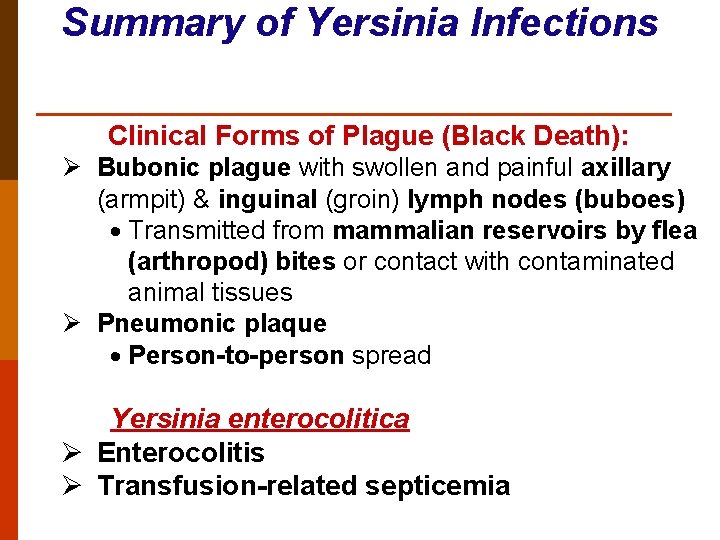
Summary of Yersinia Infections Clinical Forms of Plague (Black Death): Ø Bubonic plague with swollen and painful axillary (armpit) & inguinal (groin) lymph nodes (buboes) · Transmitted from mammalian reservoirs by flea (arthropod) bites or contact with contaminated animal tissues Ø Pneumonic plaque · Person-to-person spread Yersinia enterocolitica Ø Enterocolitis Ø Transfusion-related septicemia
- Slides: 42