
Enterobacteriaceae Biochemical Reactions IMVi C Test Indole Methyl
Enterobacteriaceae Biochemical Reactions
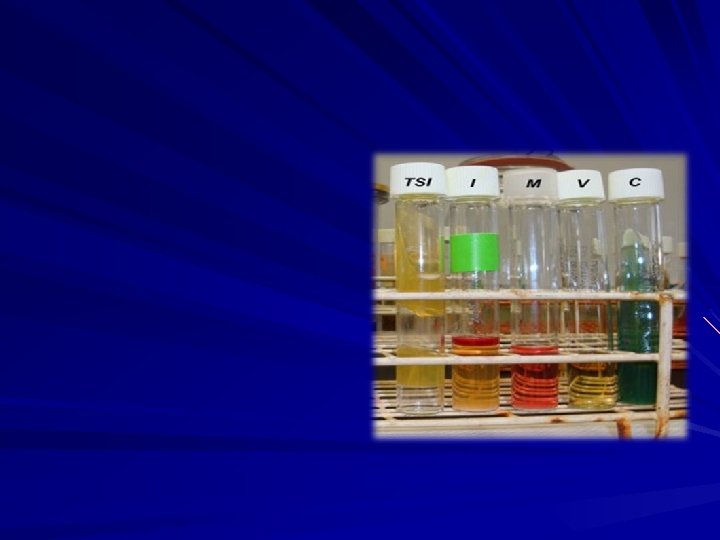
IMVi. C Test Indole, Methyl Red, Voges-Prosakaur, Citrate (IMVi. C) Tests: – The following four tests comprise a series of important determinations that are collectively called the IMVi. C series of reactions – The IMVi. C series of reactions allows for the differentiation of the various members of Enterobacteriaceae.
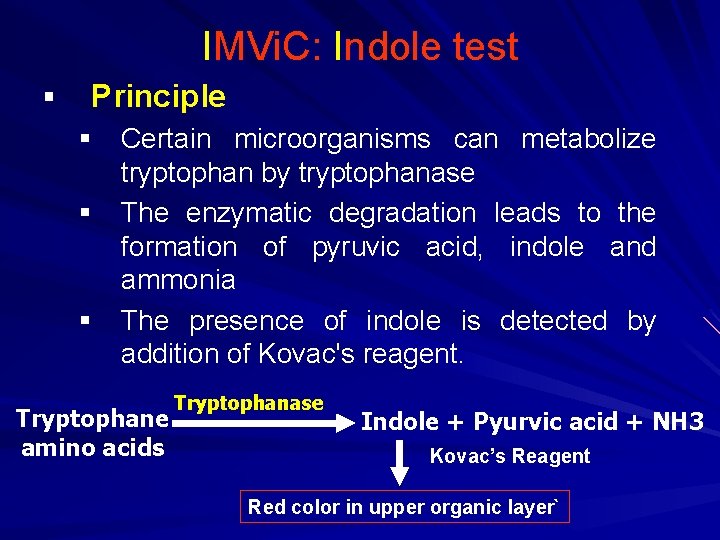
IMVi. C: Indole test § Principle § Certain microorganisms can metabolize tryptophan by tryptophanase § The enzymatic degradation leads to the formation of pyruvic acid, indole and ammonia § The presence of indole is detected by addition of Kovac's reagent. Tryptophane amino acids Tryptophanase Indole + Pyurvic acid + NH 3 Kovac’s Reagent Red color in upper organic layer`
IMVi. C: Indole test v Method: Ø Inoculate tryptone water with the tested microorganism Ø Incubate at 37°C for 24 hours Ø After incubation interval, add 1 ml Kovacs reagent, shake the tube gently and read immediately
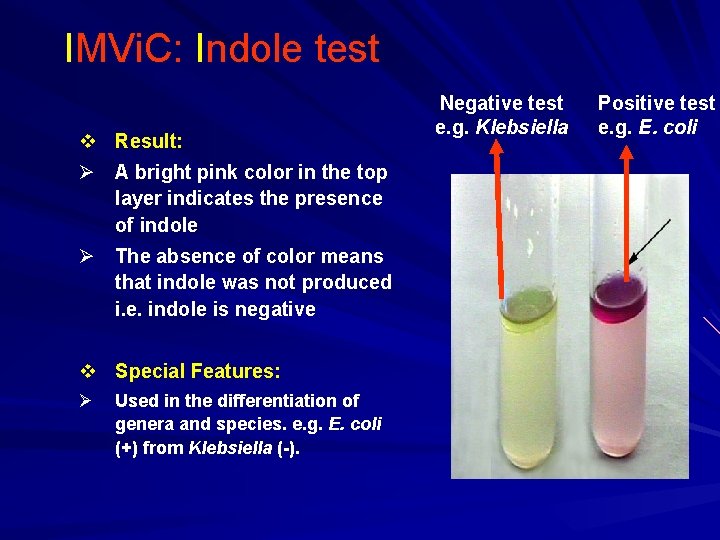
IMVi. C: Indole test v Result: Ø A bright pink color in the top layer indicates the presence of indole Ø The absence of color means that indole was not produced i. e. indole is negative v Special Features: Ø Used in the differentiation of genera and species. e. g. E. coli (+) from Klebsiella (-). Negative test e. g. Klebsiella Positive test e. g. E. coli
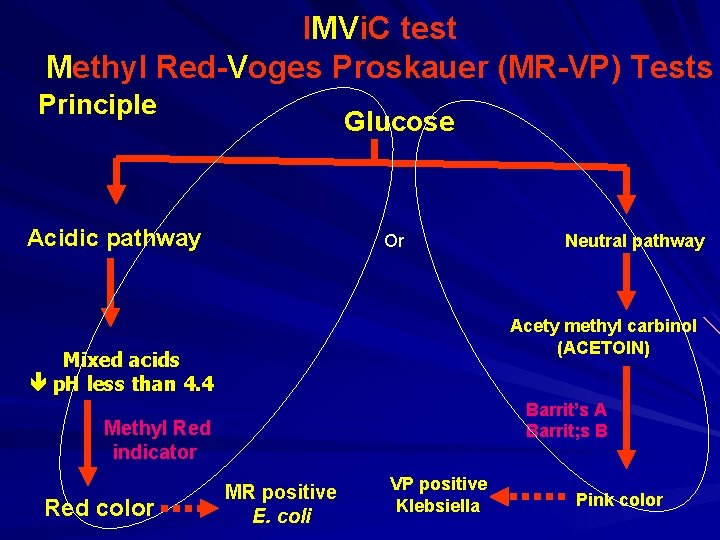
IMVi. C test Methyl Red-Voges Proskauer (MR-VP) Tests Principle Glucose Acidic pathway Or Acety methyl carbinol (ACETOIN) Mixed acids p. H less than 4. 4 Barrit’s A Barrit; s B Methyl Red indicator Red color Neutral pathway MR positive E. coli VP positive Klebsiella Pink color
IMVi. C test: MRVP test v. Method Ø Inoculate the tested organism into One tube of MRVP broth Ø Incubate the tubes at 37°C for 24 hours Ø AFTER INCUBATION: Pour 1/3 of the suspension into a clean nonsterile tube: Ø Run the MR test in the tube with 2/3, and the VP test in the open tube with 1/3. – For methyl red: Add 6 -8 drops of methyl red reagent. – For Voges-Proskauer: Add 12 drops of Barritt's A ( naphthol), mix, 4 drops of Barritt's B (40% KOH), mix – Let sit, undisturbed, for at least 1 hour
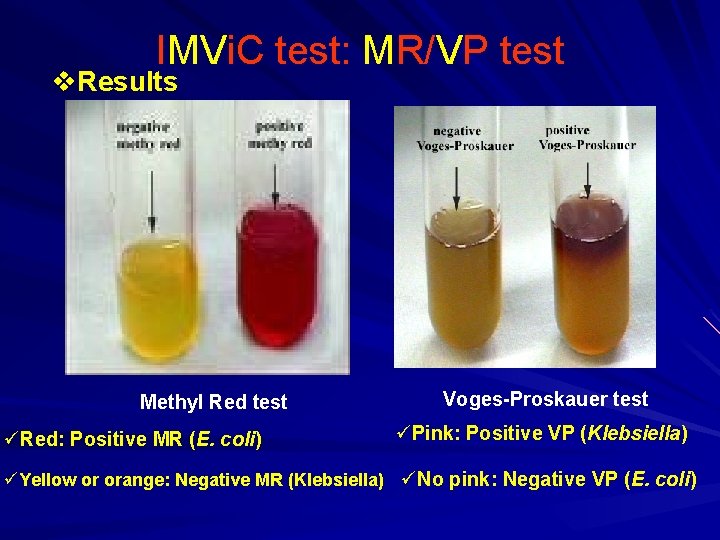
IMVi. C test: MR/VP test v. Results Methyl Red test üRed: Positive MR (E. coli) Voges-Proskauer test üPink: Positive VP (Klebsiella) üYellow or orange: Negative MR (Klebsiella) üNo pink: Negative VP (E. coli)
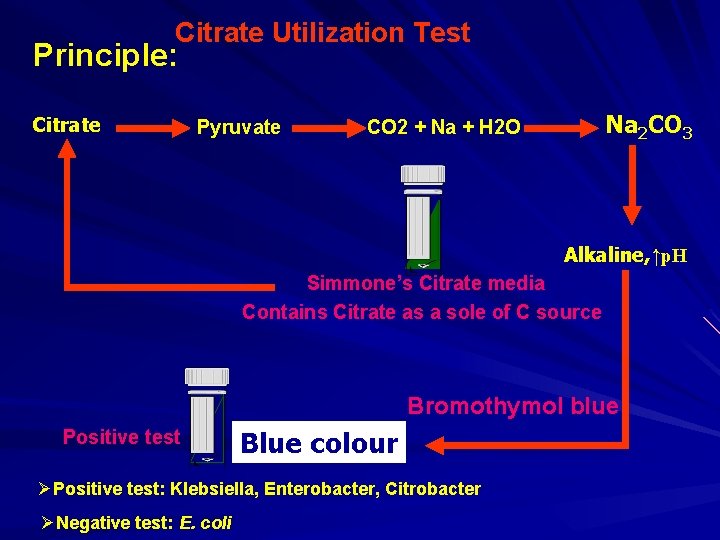
Citrate Utilization Test Principle: Citrate Pyruvate Na 2 CO 3 CO 2 + Na + H 2 O Alkaline, ↑p. H Simmone’s Citrate media Contains Citrate as a sole of C source Bromothymol blue Positive test Blue colour ØPositive test: Klebsiella, Enterobacter, Citrobacter ØNegative test: E. coli
Citrate Utilization Test v. Method Ø Streak a Simmon's Citrate agar slant with the organism Ø Incubate at 37°C for 24 hours.
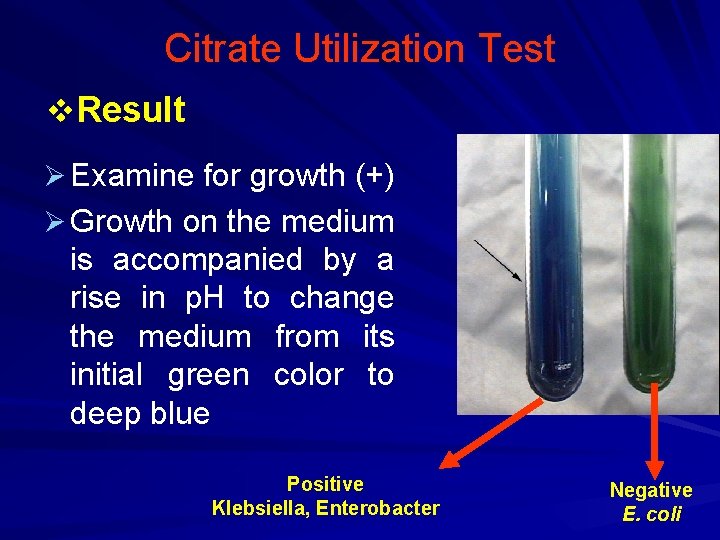
Citrate Utilization Test v. Result Ø Examine for growth (+) Ø Growth on the medium is accompanied by a rise in p. H to change the medium from its initial green color to deep blue Positive Klebsiella, Enterobacter Negative E. coli
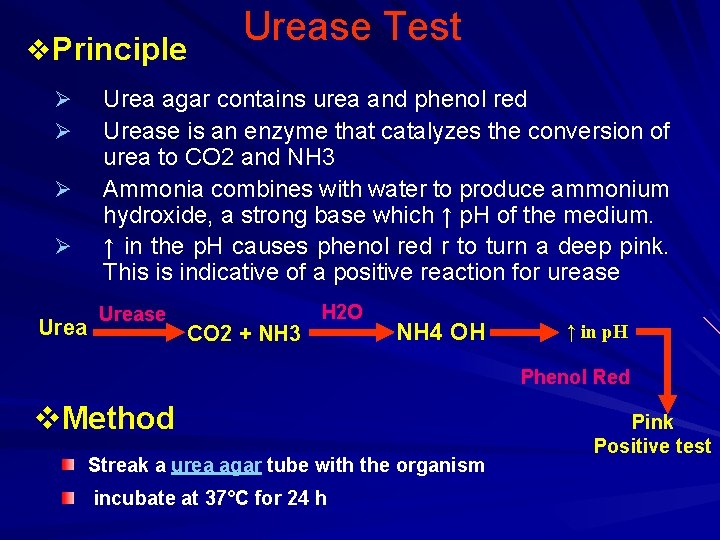
v. Principle Ø Ø Urease Test Urea agar contains urea and phenol red Urease is an enzyme that catalyzes the conversion of urea to CO 2 and NH 3 Ammonia combines with water to produce ammonium hydroxide, a strong base which ↑ p. H of the medium. ↑ in the p. H causes phenol red r to turn a deep pink. This is indicative of a positive reaction for urease Urease CO 2 + NH 3 H 2 O NH 4 OH ↑ in p. H Phenol Red v. Method Streak a urea agar tube with the organism incubate at 37°C for 24 h Pink Positive test
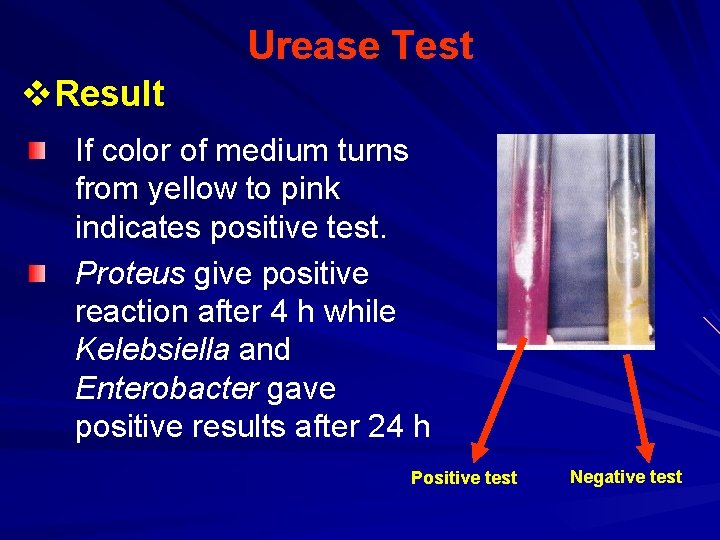
Urease Test v. Result If color of medium turns from yellow to pink indicates positive test. Proteus give positive reaction after 4 h while Kelebsiella and Enterobacter gave positive results after 24 h Positive test Negative test
Reaction on Triple Sugar Iron (TSI) Agar TSI contains – Three different types of sugars Glucose (1 part) Lactose (10 part) Sucrose (10 part) – Phenol red (acidic: Yellow) TSI dispensed in tubes with equal butt & slant Principle – To determine the ability of an organism to attack a specific carbohydrate incorporated into a basal growth medium, with or without the production of gas, along with the determination of possible hydrogen sulphide production.
Reaction on TSI Method: – Inoculate TSI medium with an organism by inoculating needle by stabbing the butt and streaking the slant – Incubate at 37°C for 24 hours
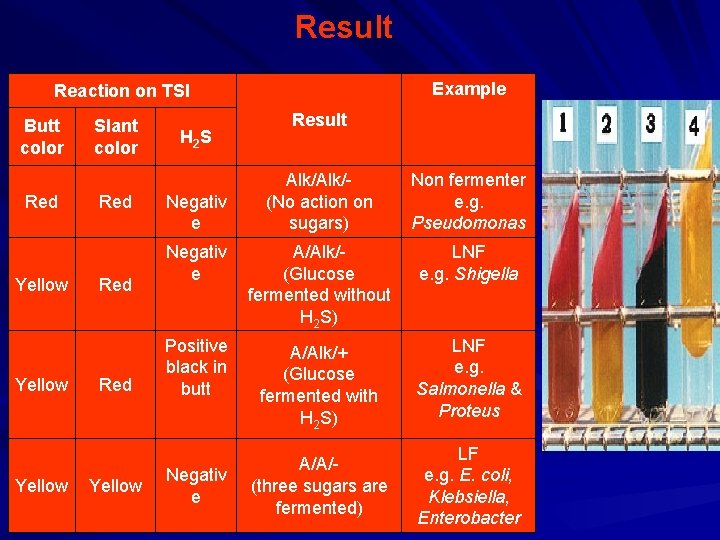
Result Example Reaction on TSI Butt color Red Yellow Slant color Red Red Yellow H 2 S Result Alk/- (No action on sugars) Non fermenter e. g. Pseudomonas Negativ e A/Alk/- (Glucose fermented without H 2 S) LNF e. g. Shigella Positive black in butt A/Alk/+ (Glucose fermented with H 2 S) LNF e. g. Salmonella & Proteus Negativ e A/A/- (three sugars are fermented) LF e. g. E. coli, Klebsiella, Enterobacter
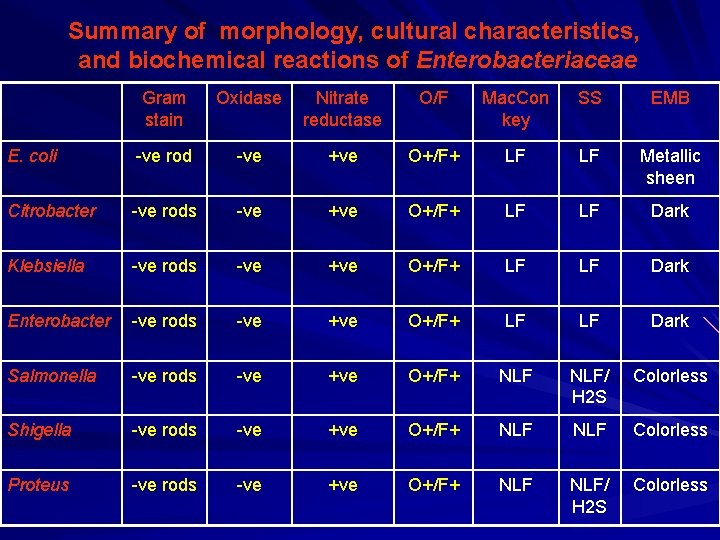
Summary of morphology, cultural characteristics, and biochemical reactions of Enterobacteriaceae Gram stain Oxidase Nitrate reductase O/F Mac. Con key SS EMB E. coli -ve rod -ve +ve O+/F+ LF LF Metallic sheen Citrobacter -ve rods -ve +ve O+/F+ LF LF Dark Klebsiella -ve rods -ve +ve O+/F+ LF LF Dark Enterobacter -ve rods -ve +ve O+/F+ LF LF Dark Salmonella -ve rods -ve +ve O+/F+ NLF/ H 2 S Colorless Shigella -ve rods -ve +ve O+/F+ NLF Colorless Proteus -ve rods -ve +ve O+/F+ NLF/ H 2 S Colorless
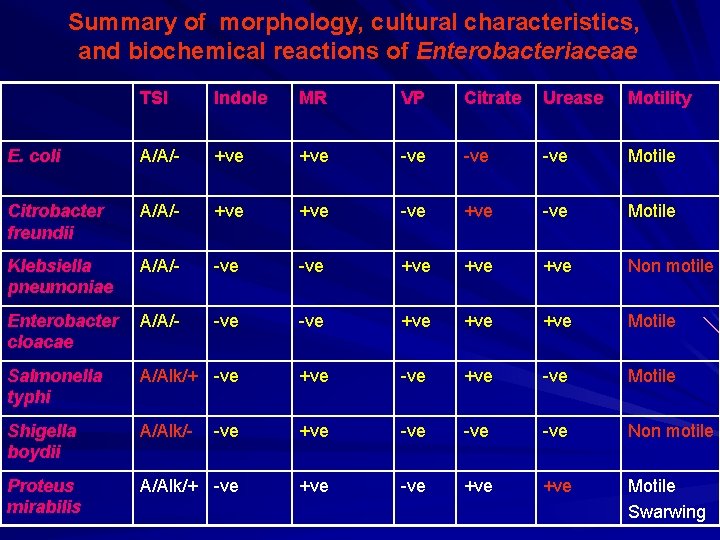
Summary of morphology, cultural characteristics, and biochemical reactions of Enterobacteriaceae TSI Indole MR VP Citrate Urease Motility E. coli A/A/- +ve -ve -ve Motile Citrobacter freundii A/A/- +ve -ve Motile Klebsiella pneumoniae A/A/- -ve +ve +ve Non motile Enterobacter cloacae A/A/- -ve +ve +ve Motile Salmonella typhi A/Alk/+ -ve +ve -ve Motile Shigella boydii A/Alk/- -ve +ve -ve -ve Non motile Proteus mirabilis A/Alk/+ -ve +ve +ve Motile Swarwing
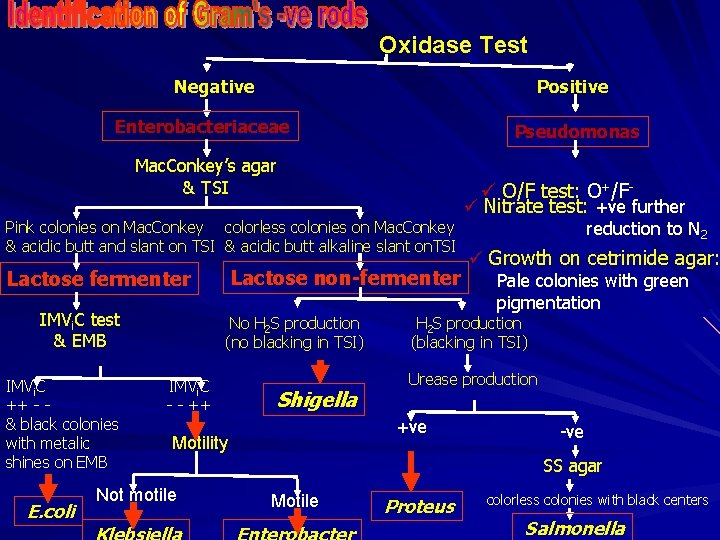
Oxidase Test Negative Positive Enterobacteriaceae Pseudomonas Mac. Conkey’s agar & TSI ü O/F test: O+/Fü Nitrate test: +ve further reduction to N 2 Pink colonies on Mac. Conkey colorless colonies on Mac. Conkey & acidic butt and slant on TSI & acidic butt alkaline slant on. TSI ü Growth on cetrimide agar: Lactose non-fermenter Pale colonies with green pigmentation Lactose fermenter IMVi. C test & EMB IMVi. C ++ - & black colonies with metalic shines on EMB E. coli No H 2 S production (no blacking in TSI) IMVi. C - - ++ Shigella Urease production +ve Motility Not motile H 2 S production (blacking in TSI) -ve SS agar Motile Proteus colorless colonies with black centers Salmonella
Practical Work Reaction on TSI Indole Test MR test VP test Citrate Utilization test Urease test
- Slides: 21