
Entering the KilometerSquare Era of High Energy Neutrino



- Slides: 49
Entering the Kilometer-Square Era of High Energy Neutrino Detection Azriel Goldschmidt INPA Journal Club, LBNL, Berkeley, Nov. 2004
Outline • Physics of a km 2 neutrino detector – Driving forces – Neutrino sources • The Ice. Cube detector: – Point sources searches • The Ice. Cube DAQ: – Timing of PMT pulses – System performance • Outlook
Main Goal of a km 2 Neutrino Detector § Observation of high-energy n point sources § from our galaxy and… § up to cosmological distances § Observed so far, nuclear energy ~Me. V sources: § Sun, steady source: Solar physics, neutrino mixing… § SN 1987 A, transient source: Supernova physics, neutrino mass…
Driving Force: Data from Related Fields Cosmic Rays physics: ions with 109 -1020 e. V tells us there is SOMETHING to look for! High Energy Photon astronomy: 103 -1013 e. V tells us WHERE to look CGRO Whipple Observatory CR detection
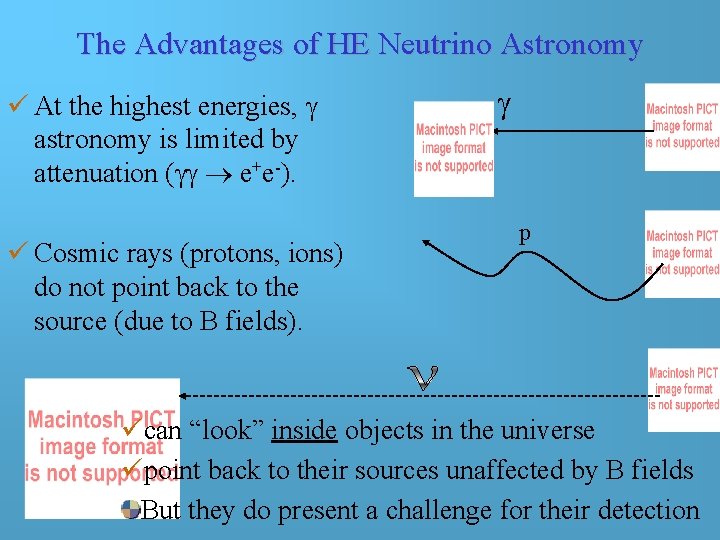
The Advantages of HE Neutrino Astronomy ü At the highest energies, g astronomy is limited by attenuation (gg e+e-). ü Cosmic rays (protons, ions) do not point back to the source (due to B fields). g p ücan “look” inside objects in the universe üpoint back to their sources unaffected by B fields But they do present a challenge for their detection
? What we hope to learn from the observation of HE n point sources o Origin of Cosmic Rays: “smoking gun” of the Supernova Remnant (SNR) hypothesis o Origin of the Ultra High Energy Cosmic Rays (UHECR, ECR> 1018 e. V) which present an “acceleration challenge” o Inner workings of the most powerful objects in the Universe such as AGN/Blazars, GRB, SNR, Microquasars…
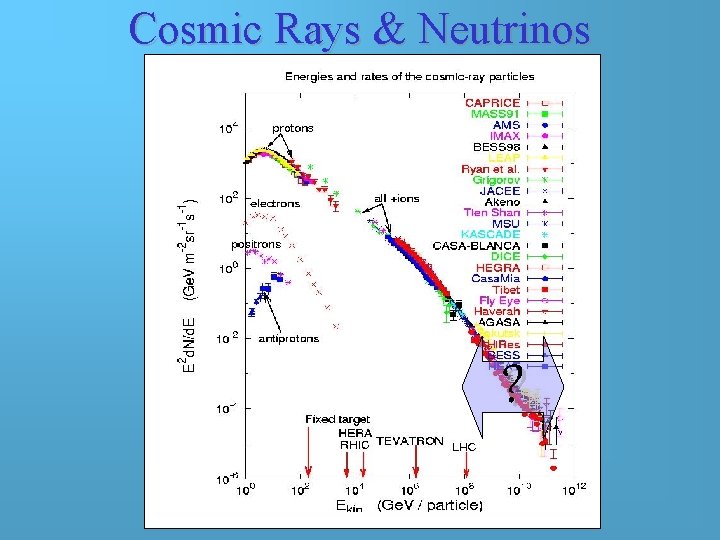
Cosmic Rays & Neutrinos ? p p Galactic SNR ? p n n
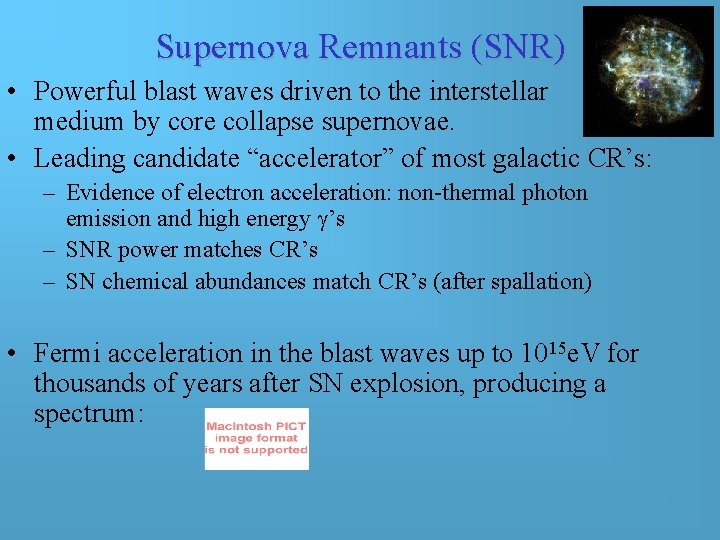
Supernova Remnants (SNR) • Powerful blast waves driven to the interstellar medium by core collapse supernovae. • Leading candidate “accelerator” of most galactic CR’s: – Evidence of electron acceleration: non-thermal photon emission and high energy g’s – SNR power matches CR’s – SN chemical abundances match CR’s (after spallation) • Fermi acceleration in the blast waves up to 1015 e. V for thousands of years after SN explosion, producing a spectrum:
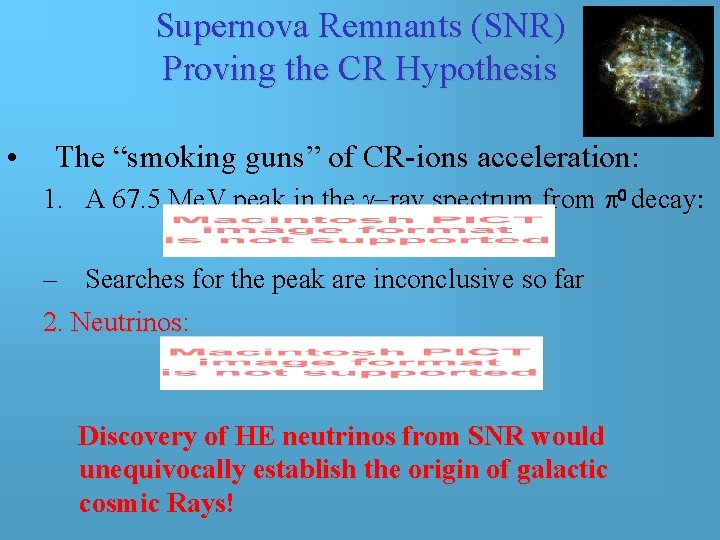
Supernova Remnants (SNR) Proving the CR Hypothesis • The “smoking guns” of CR-ions acceleration: 1. A 67. 5 Me. V peak in the g-ray spectrum from p 0 decay: – Searches for the peak are inconclusive so far 2. Neutrinos: Discovery of HE neutrinos from SNR would unequivocally establish the origin of galactic cosmic Rays!
Cosmic Rays & Neutrinos ?
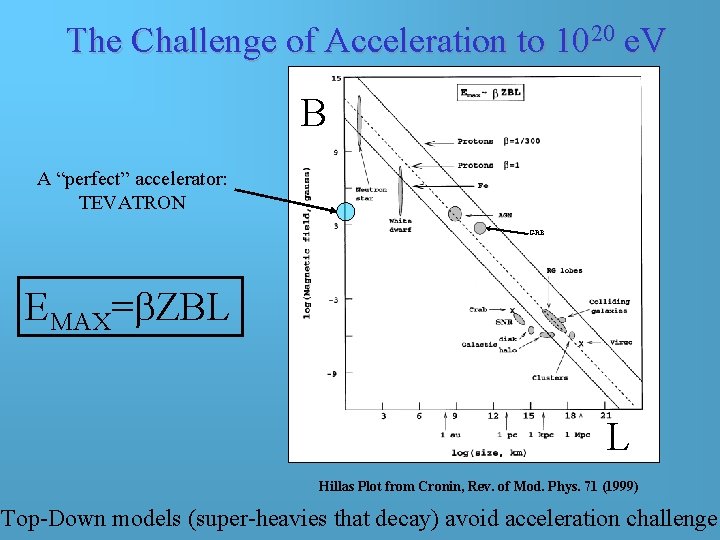
The Challenge of Acceleration to 1020 e. V B A “perfect” accelerator: TEVATRON GRB EMAX=b. ZBL L Hillas Plot from Cronin, Rev. of Mod. Phys. 71 (1999) Top-Down models (super-heavies that decay) avoid acceleration challenge
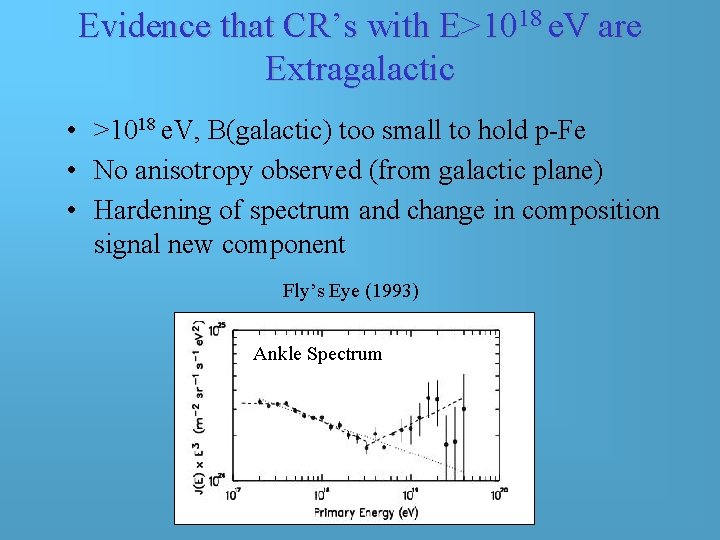
Evidence that CR’s with E>1018 e. V are Extragalactic • >1018 e. V, B(galactic) too small to hold p-Fe • No anisotropy observed (from galactic plane) • Hardening of spectrum and change in composition signal new component Fly’s Eye (1993) Ankle Spectrum
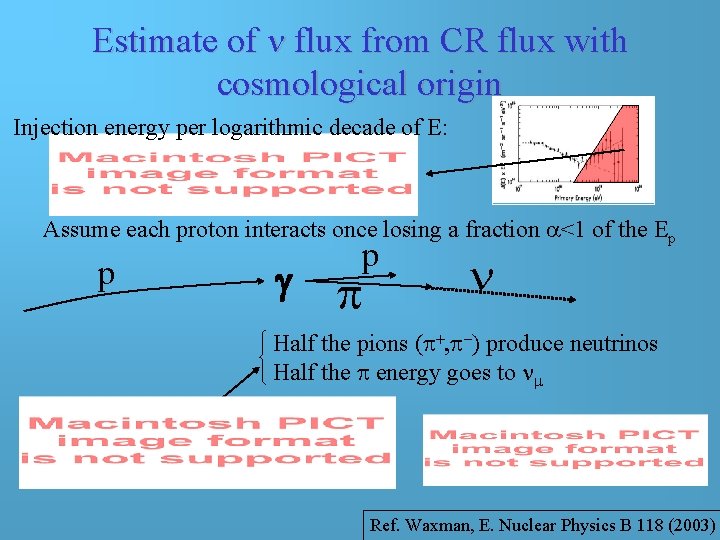
Estimate of n flux from CR flux with cosmological origin Injection energy per logarithmic decade of E: Assume each proton interacts once losing a fraction a<1 of the Ep p g p p n Half the pions (p+, p-) produce neutrinos Half the p energy goes to n Ref. Waxman, E. Nuclear Physics B 118 (2003)
Estimate of Event Rates from CR flux with cosmological origin For instance, the flux between 100 Te. V and 100 Pe. V: But life isn’t that easy for the neutrino physicist… Probability of observing a muon (per neutrino) Given by the ratio: muon range / neutrino range
Candidate Sources of post-ankle CR’s and neutrinos • AGN = Active Galactic Nuclei • GRB = Gamma Ray Bursts • Top-Down super-heavies
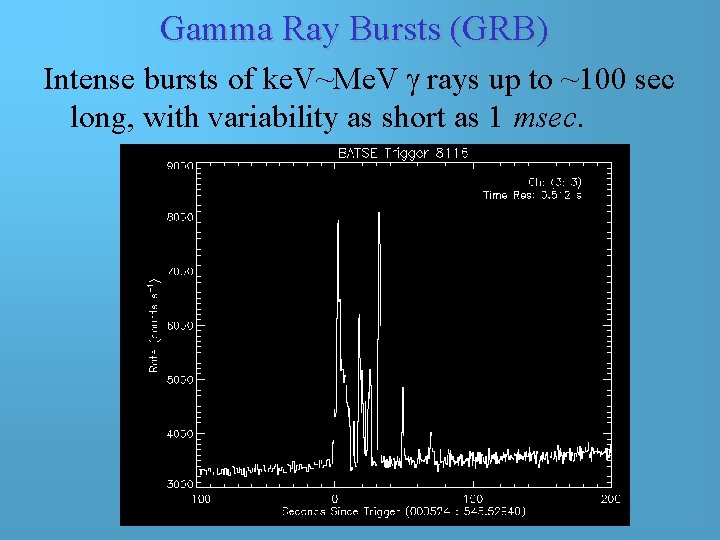
Gamma Ray Bursts (GRB) Intense bursts of ke. V~Me. V g rays up to ~100 sec long, with variability as short as 1 msec.
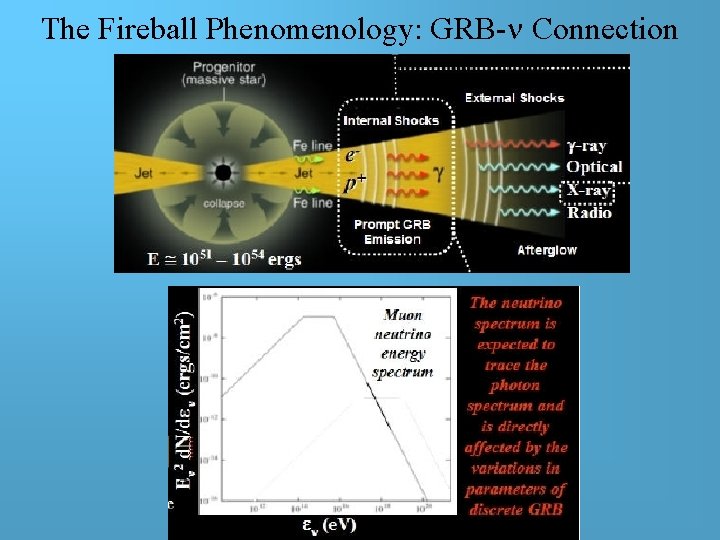
The Fireball Phenomenology: GRB-n Connection
GRB’s (continued) • Maximum proton energies of 1020 e. V attainable: possible source of post-ankle CR’s. • Energy injection similar to the post-ankle CR’s. • Detection in coincidence (time and direction) of neutrinos and g rays (from satellite measurements) reduces background dramatically. • And an “extra bonus”: Tests of Relativity…
Arrival Times of n & g from GRBs: • Concept: Measure Dtng=tn-tg with ~1 sec precision • Test of Lorentz Invariance: Is vn= vg (=c) ? e. g. Dsource ~100 Mpc and Dtng < 1 sec vn/vg-1 < 10 -16 • (Mass effect negligible: Dsource ~100 Mpc, mn~1 e. V, En~Te. V Dtng~nsec) • Weak equivalence Principle: “space-time is endowed with a metric and the world lines of uncharged test bodies are geodesics of that metric”. • Test that photons and neutrinos are affected equally by the galaxy gravitational potential: 10 -6 level test possible for Dtng <~1 sec
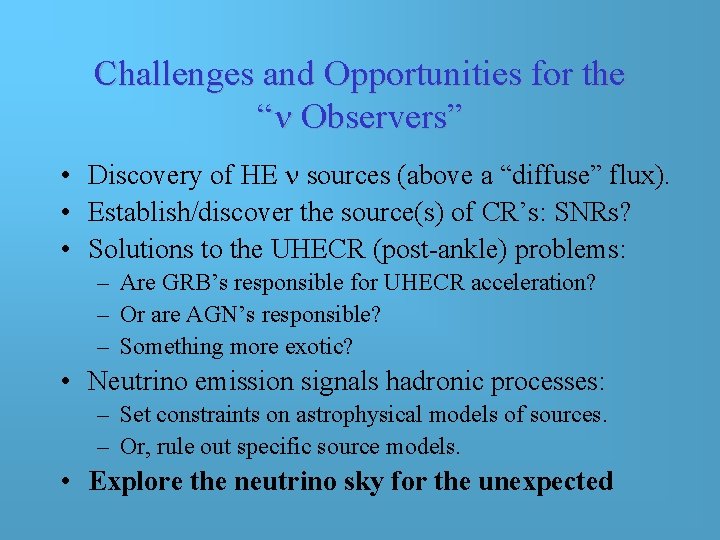
Challenges and Opportunities for the “n Observers” • Discovery of HE n sources (above a “diffuse” flux). • Establish/discover the source(s) of CR’s: SNRs? • Solutions to the UHECR (post-ankle) problems: – Are GRB’s responsible for UHECR acceleration? – Or are AGN’s responsible? – Something more exotic? • Neutrino emission signals hadronic processes: – Set constraints on astrophysical models of sources. – Or, rule out specific source models. • Explore the neutrino sky for the unexpected
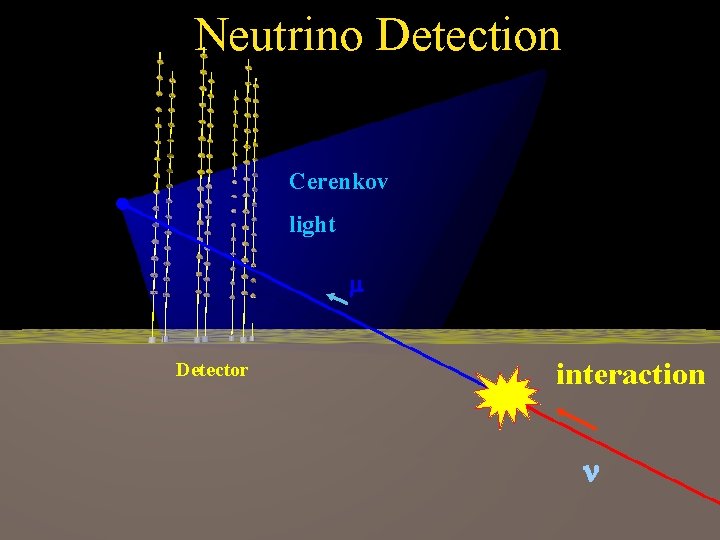
Neutrino Detection Cerenkov light m Detector interaction n
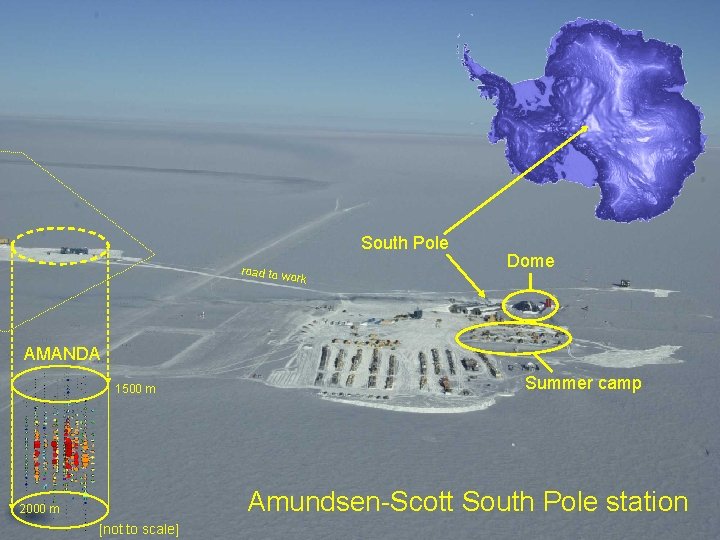
South Pole road to w ork Dome AMANDA 1500 m Summer camp Amundsen-Scott South Pole station 2000 m [not to scale]
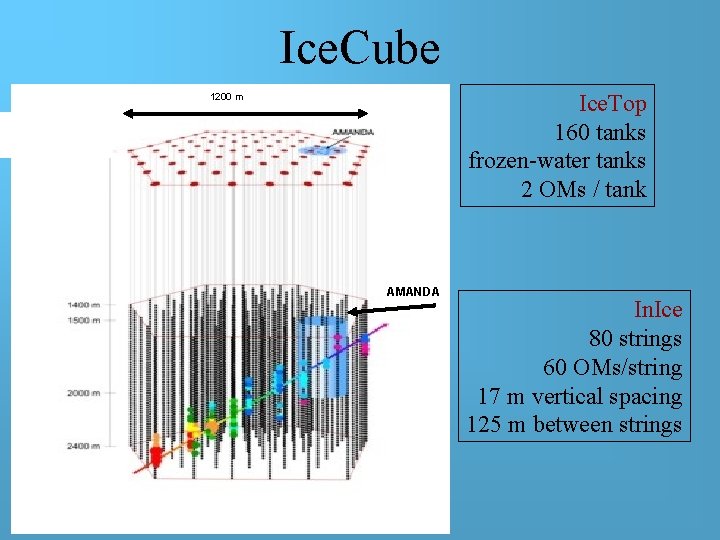
Ice. Cube Ice. Top 160 tanks frozen-water tanks 2 OMs / tank 1200 m Ice. Top AMANDA In. Ice 80 strings 60 OMs/string 17 m vertical spacing 125 m between strings
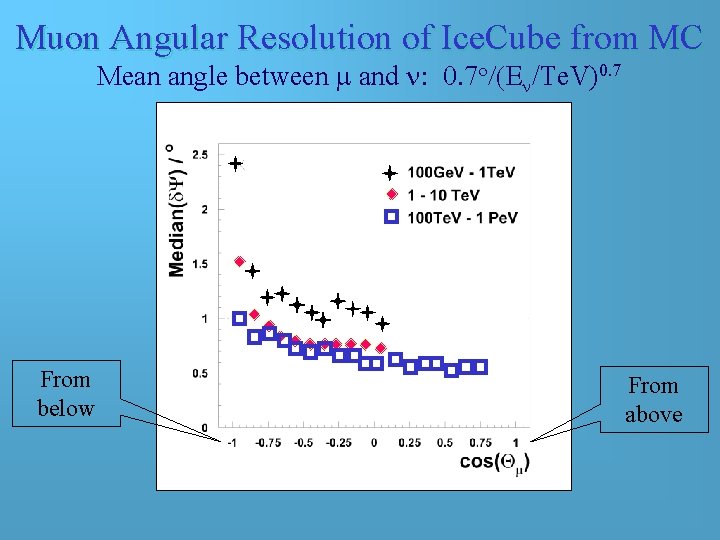
Muon Angular Resolution of Ice. Cube from MC Mean angle between and n: 0. 7 o/(En/Te. V)0. 7 From below From above
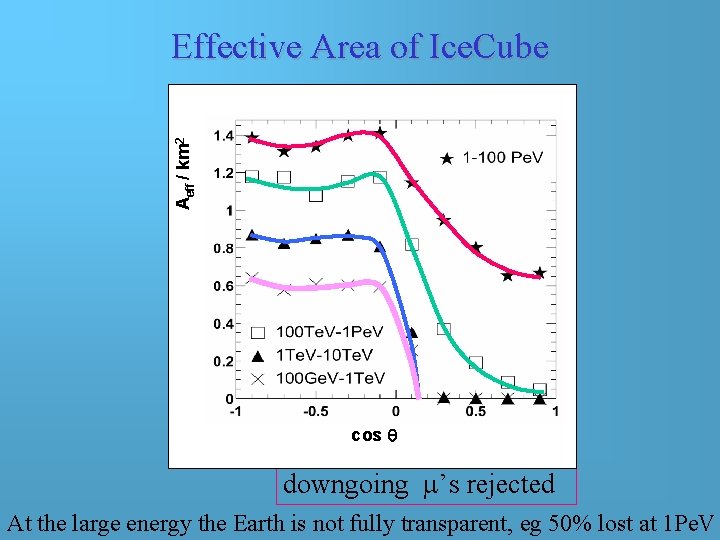
Aeff / km 2 Effective Area of Ice. Cube cos downgoing ’s rejected At the large energy the Earth is not fully transparent, eg 50% lost at 1 Pe. V
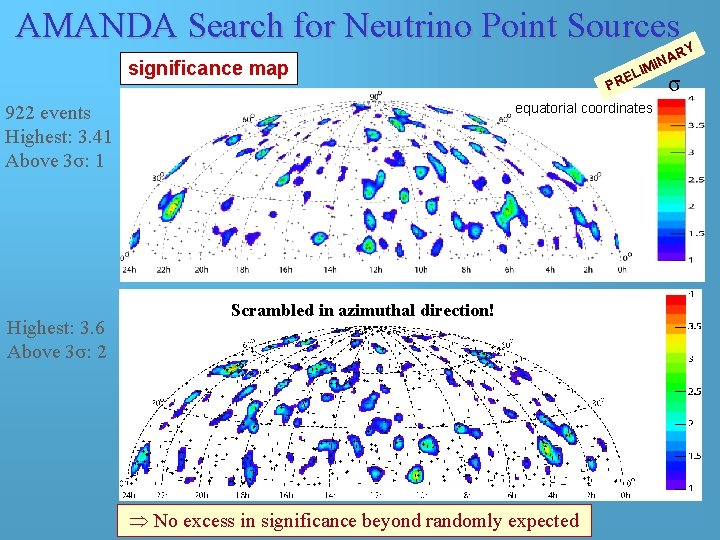
AMANDA Search for Neutrino Point Sources significance map LI E PR equatorial coordinates 922 events Highest: 3. 41 Above 3σ: 1 Highest: 3. 6 Above 3σ: 2 RY A N MI Scrambled in azimuthal direction! No excess in significance beyond randomly expected σ
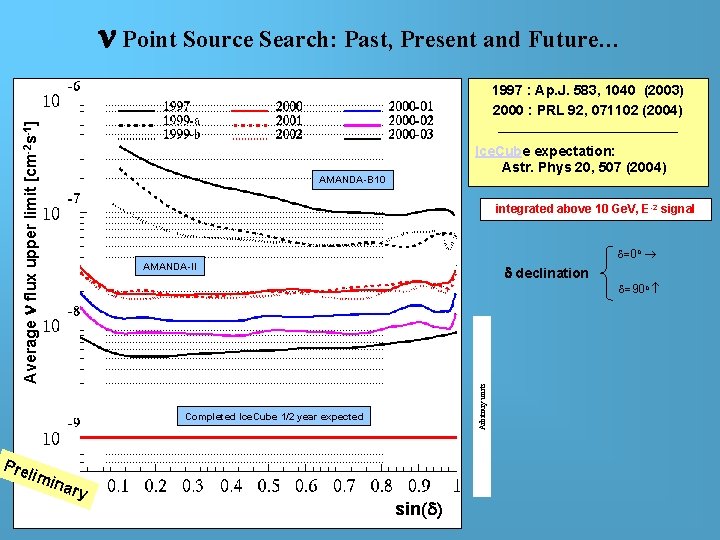
n Point Source Search: Past, Present and Future… Average n flux upper limit [cm-2 s-1] 1997 : Ap. J. 583, 1040 (2003) 2000 : PRL 92, 071102 (2004) Ice. Cube expectation: Astr. Phys 20, 507 (2004) AMANDA-B 10 integrated above 10 Ge. V, E-2 signal =0 o AMANDA-II d declination Arbitrary units =90 o Completed Ice. Cube 1/2 year expected Pre limi nar y sin(d)
The High-Energy n Sky Today (En > 1 Ge. V) No observation yet of HE neutrino sources Null results in searches for GRB neutrinos (in coincidence)
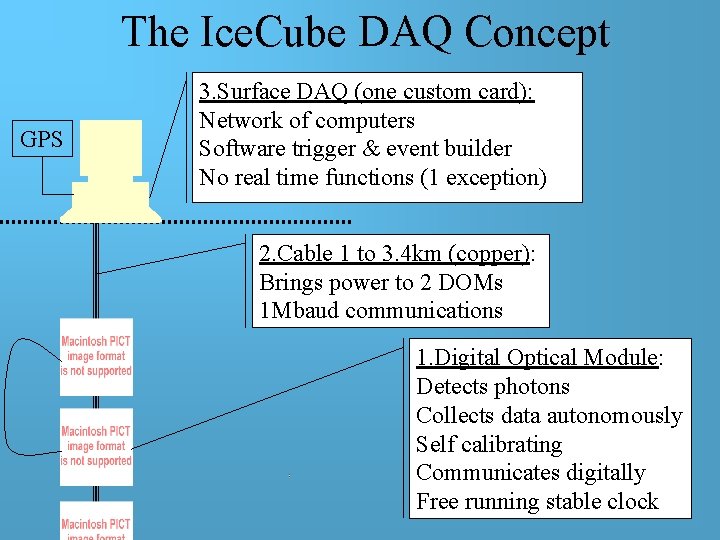
The Ice. Cube DAQ Concept GPS 3. Surface DAQ (one custom card): Network of computers Software trigger & event builder No real time functions (1 exception) 2. Cable 1 to 3. 4 km (copper): Brings power to 2 DOMs 1 Mbaud communications 1. Digital Optical Module: Detects photons Collects data autonomously Self calibrating Communicates digitally Free running stable clock
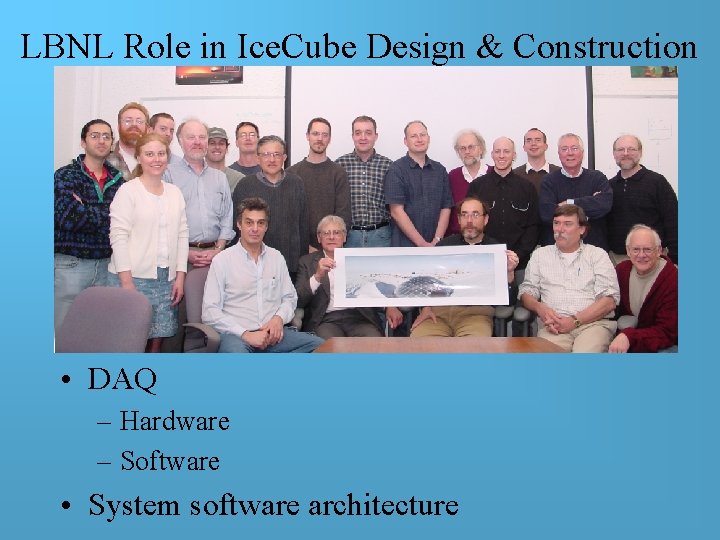
LBNL Role in Ice. Cube Design & Construction • DAQ – Hardware – Software • System software architecture
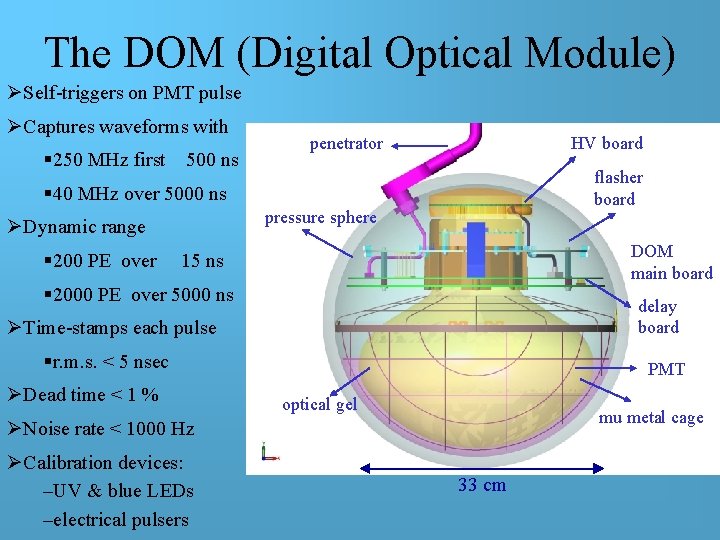
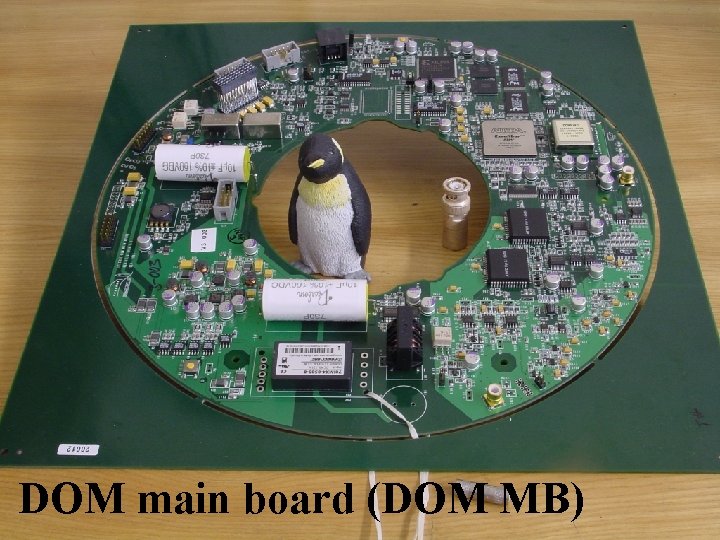
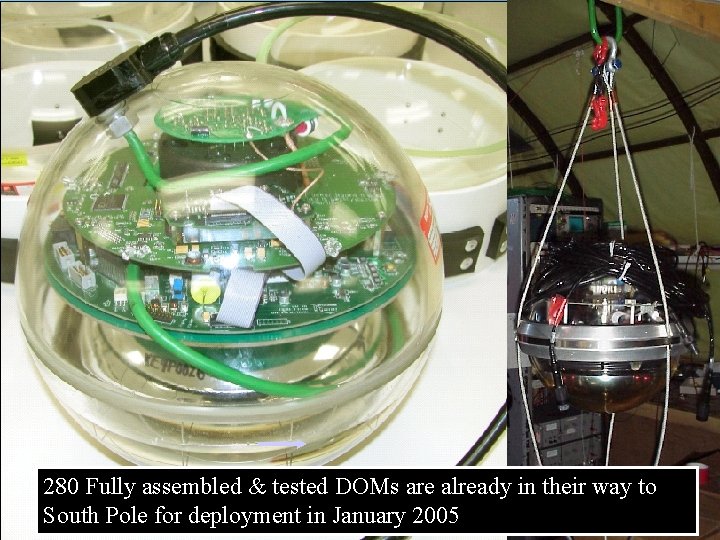
The DOM (Digital Optical Module) ØSelf-triggers on PMT pulse ØCaptures waveforms with § 250 MHz first 500 ns penetrator HV board flasher board § 40 MHz over 5000 ns pressure sphere ØDynamic range § 200 PE over DOM main board 15 ns § 2000 PE over 5000 ns delay board ØTime-stamps each pulse §r. m. s. < 5 nsec ØDead time < 1 % PMT optical gel mu metal cage ØNoise rate < 1000 Hz ØCalibration devices: –UV & blue LEDs –electrical pulsers 33 cm
DOM main board (DOM MB)
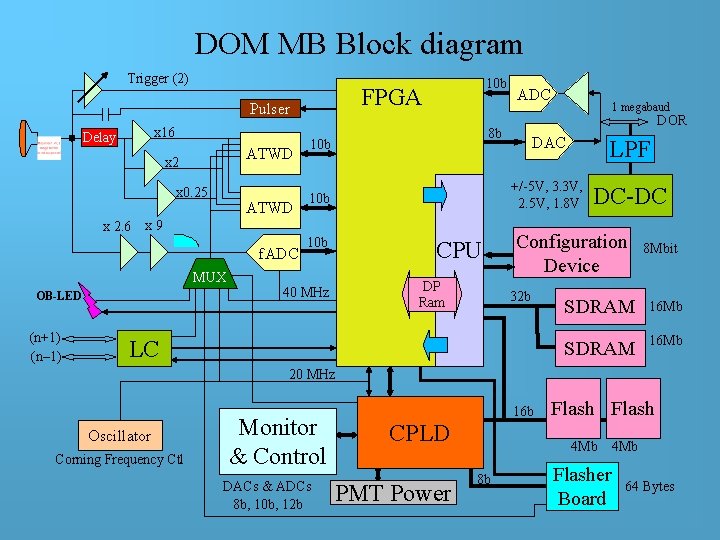
DOM MB Block diagram Trigger (2) FPGA Pulser x 16 Delay ATWD x 2 x 0. 25 x 2. 6 ATWD MUX OB-LED ADC 10 b 10 b CPU DP Ram 40 MHz 1 megabaud DOR 8 b x 9 f. ADC (n+1) (n– 1) 10 b DAC LPF +/-5 V, 3. 3 V, 2. 5 V, 1. 8 V DC-DC Configuration Device 32 b LC 8 Mbit SDRAM 16 Mb 20 MHz Oscillator Corning Frequency Ctl Monitor & Control DACs & ADCs 8 b, 10 b, 12 b 16 b CPLD PMT Power Flash 4 Mb 8 b Flasher Board 4 Mb 64 Bytes
DOM MB Reliability • The challenge: – No possibility of repair after deployment – 15 yr detector lifetime required • Our approach: – Parts selection with reliability as a first priority – Selection of manufacturers (board+assembly) – Extensive testing including accelerated stress
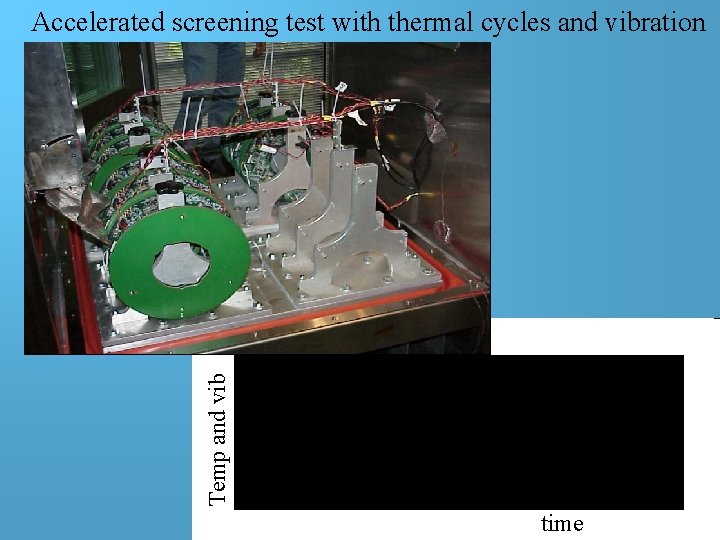
Temp and vib Accelerated screening test with thermal cycles and vibration time
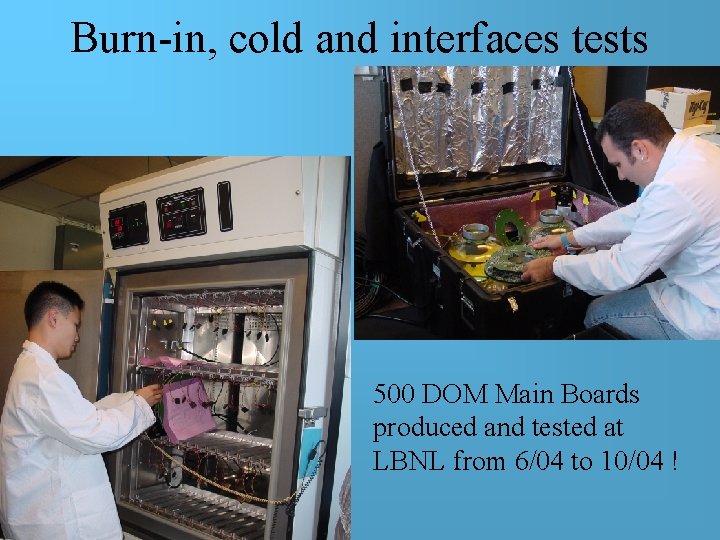
Burn-in, cold and interfaces tests 500 DOM Main Boards produced and tested at LBNL from 6/04 to 10/04 !
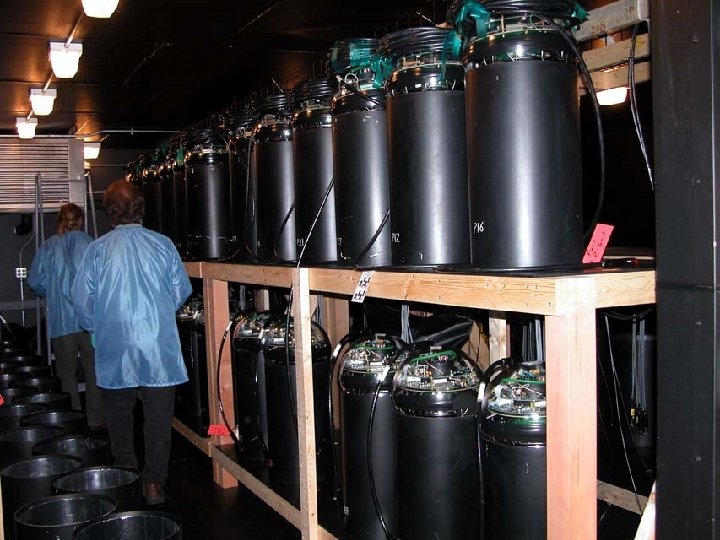
10” PMT Hamatsu 70 280 Fully assembled & tested DOMs are already in their way to South Pole for deployment in January 2005
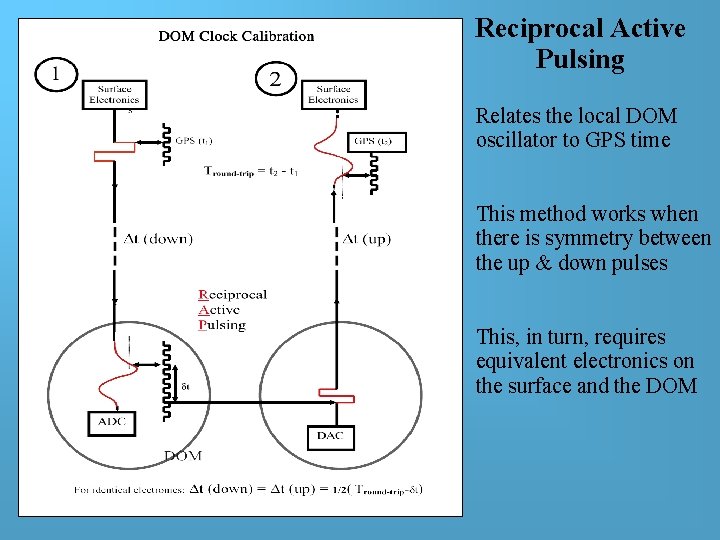
Calibrating Clocks with nsec Timing over 3. 4 km long “phone wires” • ~5, 000 “phones” with – Varying cable lengths (depth & position) – Transit time for 3. 4 km twisted pair: ~17 s – Rise-time after propagation ~ 2 s (~1/t) • The solution: – High-stability local clock: f/f ~ 6 x 10 -11/s ! – Frequent (1 every 10 sec) calibrations – Cable delay measurement in situ
Reciprocal Active Pulsing Relates the local DOM oscillator to GPS time This method works when there is symmetry between the up & down pulses This, in turn, requires equivalent electronics on the surface and the DOM
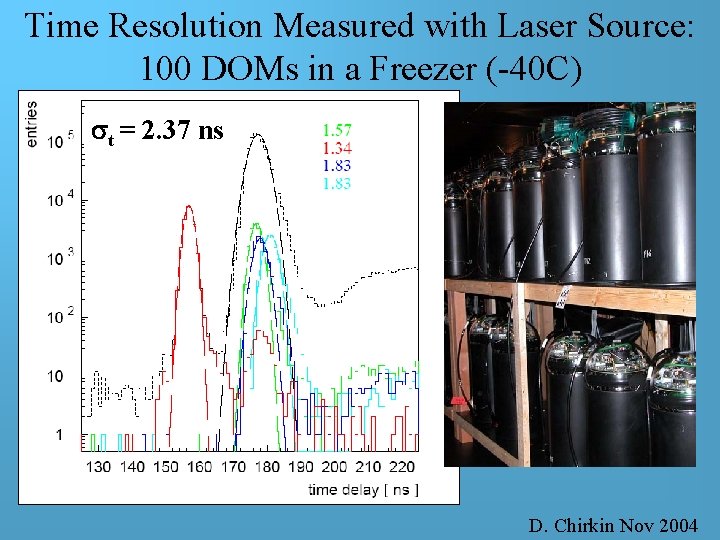
Time Resolution Measured with Laser Source: 100 DOMs in a Freezer (-40 C) st = 2. 37 ns D. Chirkin Nov 2004
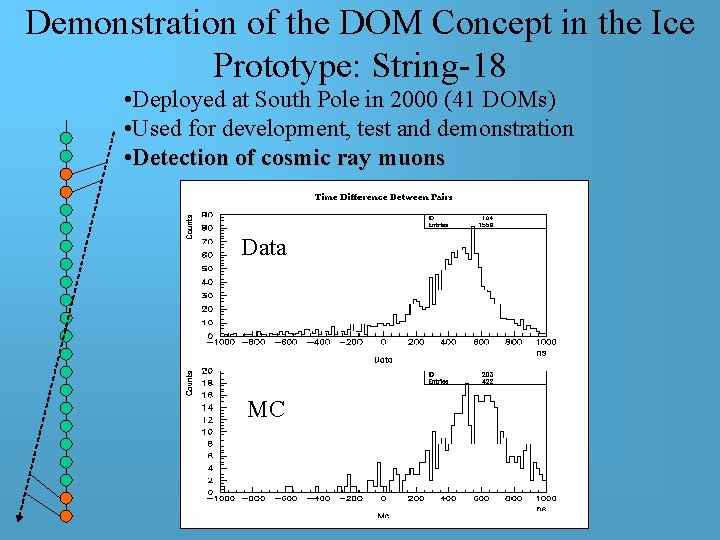
Demonstration of the DOM Concept in the Ice Prototype: String-18 • Deployed at South Pole in 2000 (41 DOMs) • Used for development, test and demonstration • Detection of cosmic ray muons Data MC
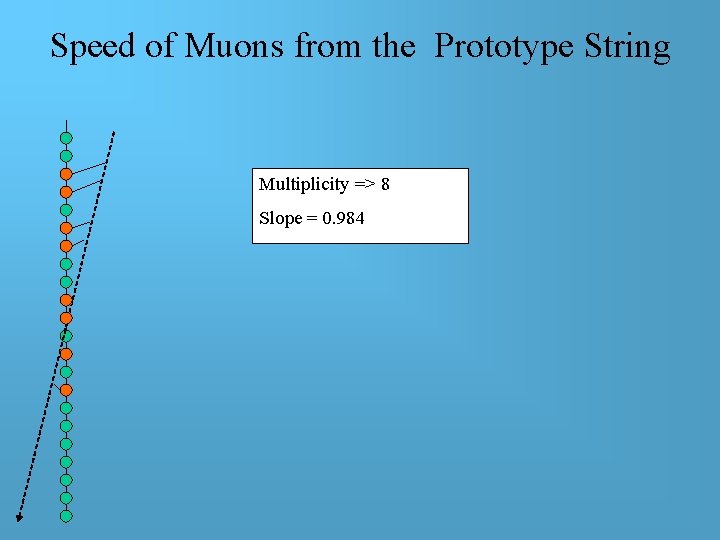
Speed of Muons from the Prototype String Multiplicity => 8 Slope = 0. 984
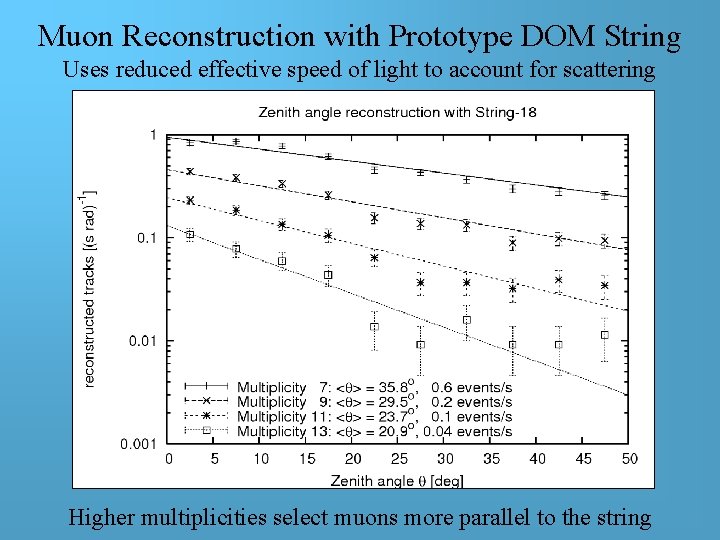
Muon Reconstruction with Prototype DOM String Uses reduced effective speed of light to account for scattering Higher multiplicities select muons more parallel to the string
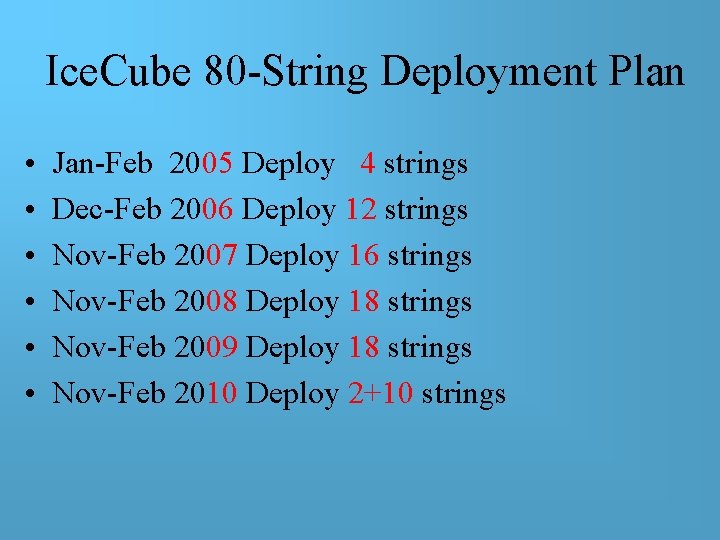
Ice. Cube 80 -String Deployment Plan • • • Jan-Feb 2005 Deploy 4 strings Dec-Feb 2006 Deploy 12 strings Nov-Feb 2007 Deploy 16 strings Nov-Feb 2008 Deploy 18 strings Nov-Feb 2009 Deploy 18 strings Nov-Feb 2010 Deploy 2+10 strings
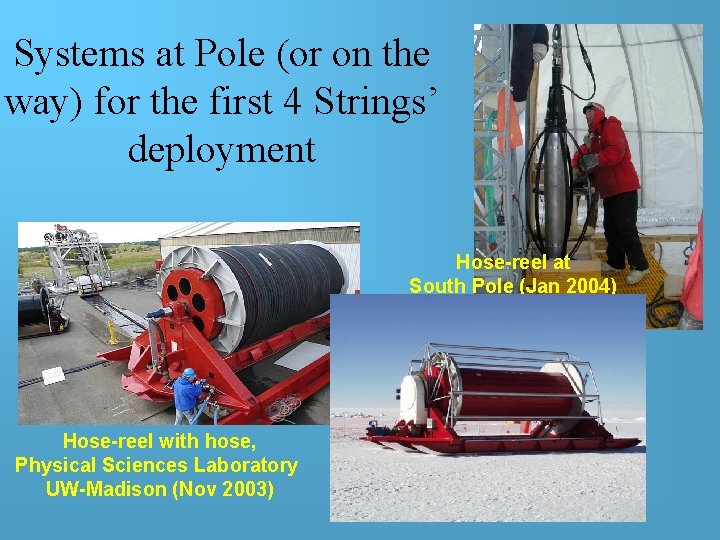
Systems at Pole (or on the way) for the first 4 Strings’ deployment Hose-reel at South Pole (Jan 2004) Hose-reel with hose, Physical Sciences Laboratory UW-Madison (Nov 2003)
News Flashes 11/11/04 –yesterday. P. O. H: “The first part of the summer season has been very cold -44 to -57 C…it is not possible to unload the planes in a normal way from the back with tractors because you get lots of small ice particles from condensation behind the engines. You are not able to see anything back of the plane… to unload the cargo one has a combat procedure: stop the plane, open up the back, release the pallets with cargo, accelerate the plane so the pallets with the cargo move out of the plane onto the snow. It is a very fast but sensitive equipment should not be unloaded this way. “ “Last week about 130 (out of 220) people went to the doctor due to the flu or a very heavy cold. ” (our guys are OK already)
In Summary… • The neutrino sky holds the potential for important discoveries from CR’s origin to the physics of GRBs and AGNs • Ice. Cube experiment is on track: – Funded km 3 detector at the South Pole – Working prototype – Drilling and deployment starts in January • Major LBNL Role • …the next 5 -10 years…
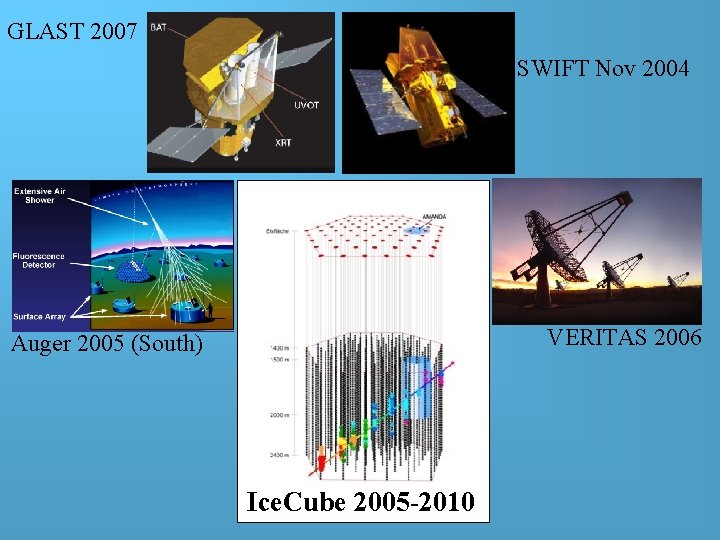
GLAST 2007 SWIFT Nov 2004 VERITAS 2006 Auger 2005 (South) Ice. Cube 2005 -2010