
ENTC 3320 Op Amp Review Operational amplifiers opamps
- Slides: 20
ENTC 3320 Op Amp Review
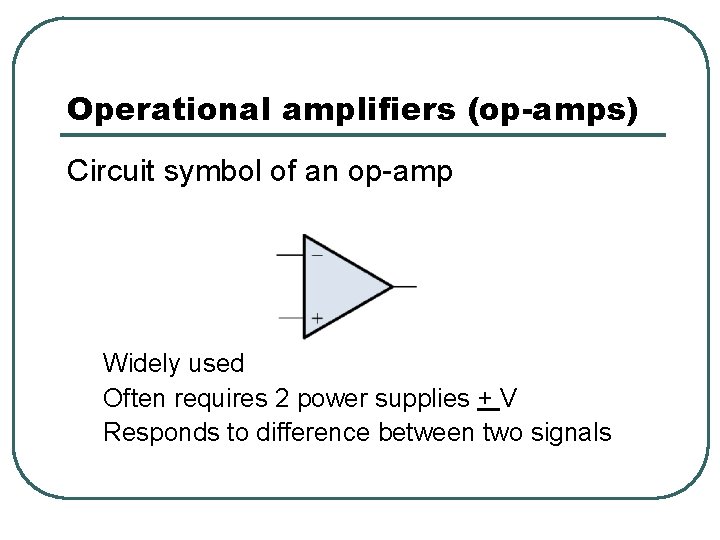
Operational amplifiers (op-amps) Circuit symbol of an op-amp Widely used Often requires 2 power supplies + V Responds to difference between two signals
Ideal op-amp Characteristics of an ideal op-amp Rin = infinity Rout = 0 Avo = infinity (Avo is the open-loop gain, sometimes A or Av of the op-amp) Bandwidth = infinity (amplifies all frequencies equally)
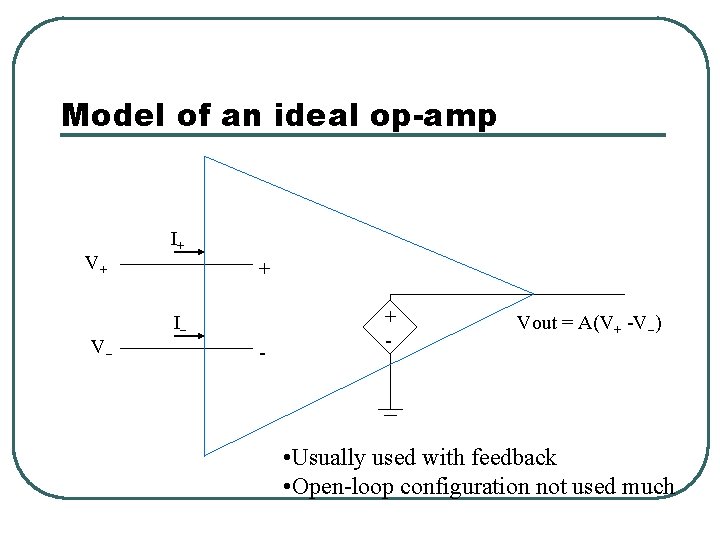
Model of an ideal op-amp V+ V I+ + I - + - Vout = A(V+ -V ) • Usually used with feedback • Open-loop configuration not used much
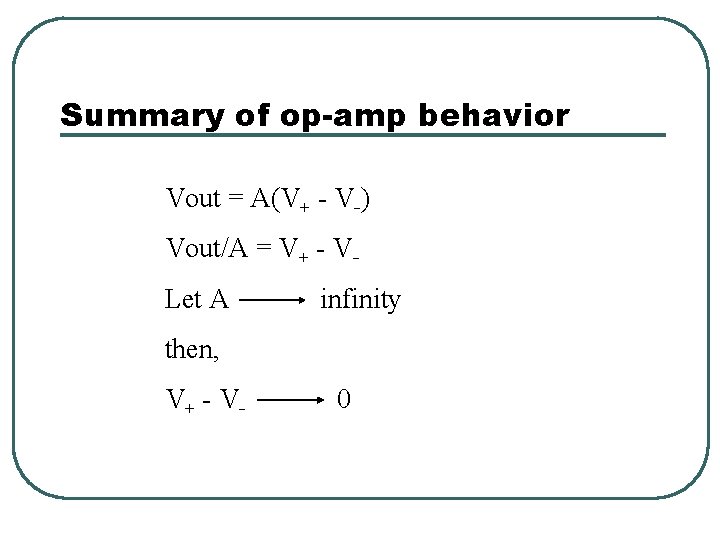
Summary of op-amp behavior Vout = A(V+ - V ) Vout/A = V+ - V Let A infinity then, V+ - V 0
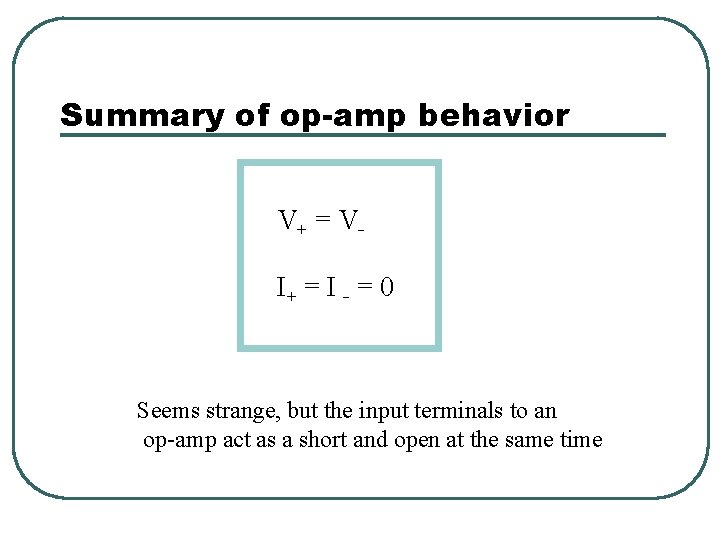
Summary of op-amp behavior V+ = V I+ = I = 0 Seems strange, but the input terminals to an op-amp act as a short and open at the same time
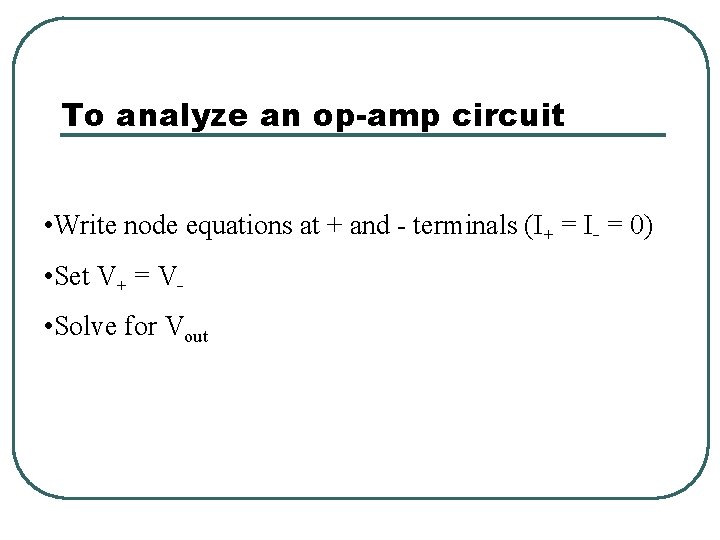
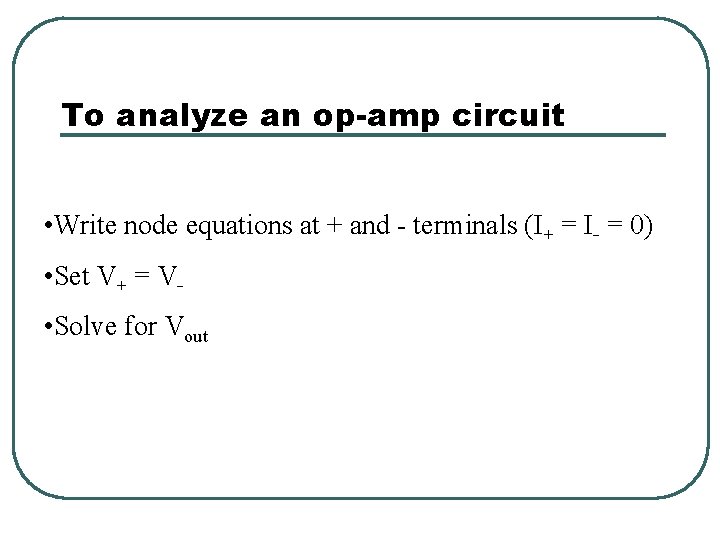
To analyze an op-amp circuit • Write node equations at + and - terminals (I+ = I = 0) • Set V+ = V • Solve for Vout
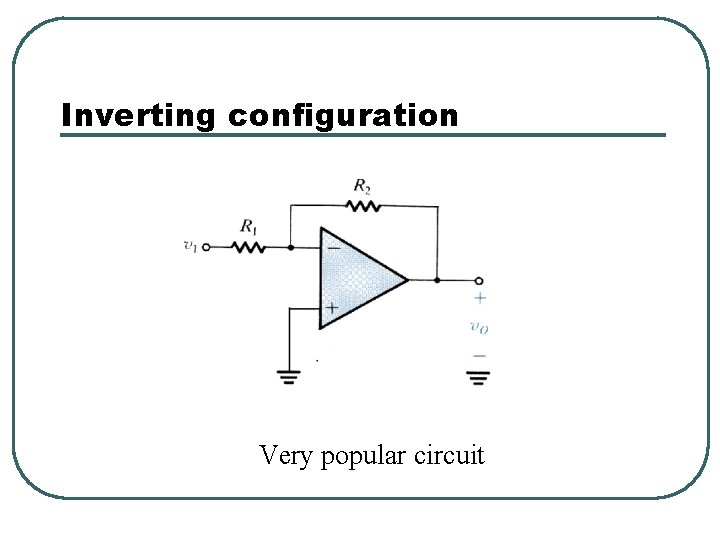
Inverting configuration Very popular circuit
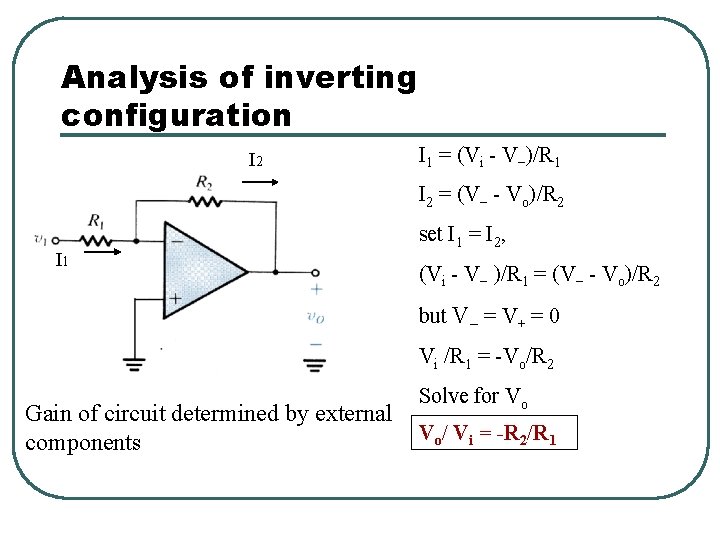
Analysis of inverting configuration I 2 I 1 = (Vi - V )/R 1 I 2 = (V - Vo)/R 2 I 1 set I 1 = I 2, (Vi - V )/R 1 = (V - Vo)/R 2 but V = V+ = 0 Vi /R 1 = -Vo/R 2 Gain of circuit determined by external components Solve for Vo Vo/ Vi = -R 2/R 1
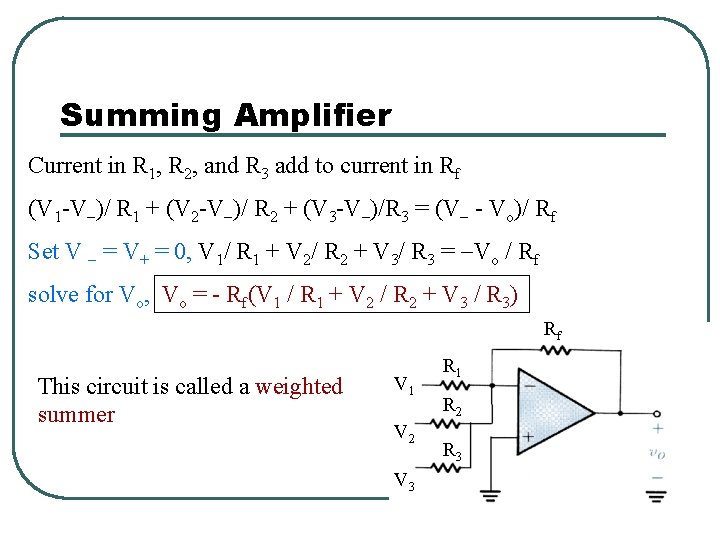
Summing Amplifier Current in R 1, R 2, and R 3 add to current in Rf (V 1 -V )/ R 1 + (V 2 -V )/ R 2 + (V 3 -V )/R 3 = (V - Vo)/ Rf Set V = V+ = 0, V 1/ R 1 + V 2/ R 2 + V 3/ R 3 = Vo / Rf solve for Vo, Vo = - Rf(V 1 / R 1 + V 2 / R 2 + V 3 / R 3) Rf This circuit is called a weighted summer V 1 V 2 V 3 R 1 R 2 R 3
To analyze an op-amp circuit • Write node equations at + and - terminals (I+ = I = 0) • Set V+ = V • Solve for Vout
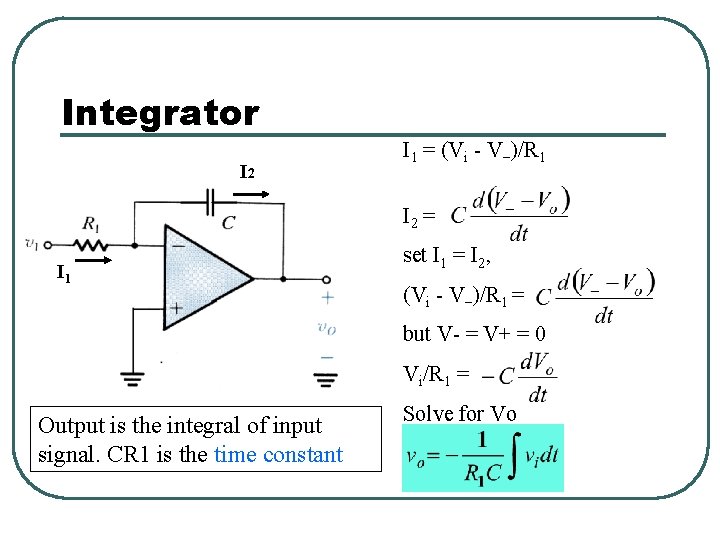
Integrator I 2 I 1 = (Vi - V )/R 1 I 2 = I 1 set I 1 = I 2, (Vi - V )/R 1 = but V- = V+ = 0 Vi/R 1 = Output is the integral of input signal. CR 1 is the time constant Solve for Vo
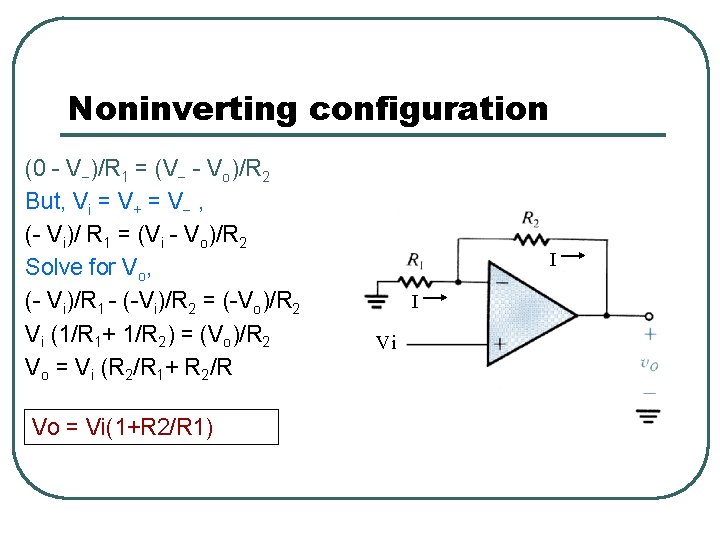
Noninverting configuration (0 - V )/R 1 = (V - Vo)/R 2 But, Vi = V+ = V , (- Vi)/ R 1 = (Vi - Vo)/R 2 Solve for Vo, (- Vi)/R 1 - (-Vi)/R 2 = (-Vo)/R 2 Vi (1/R 1+ 1/R 2) = (Vo)/R 2 Vo = Vi (R 2/R 1+ R 2/R Vo = Vi(1+R 2/R 1) I I Vi
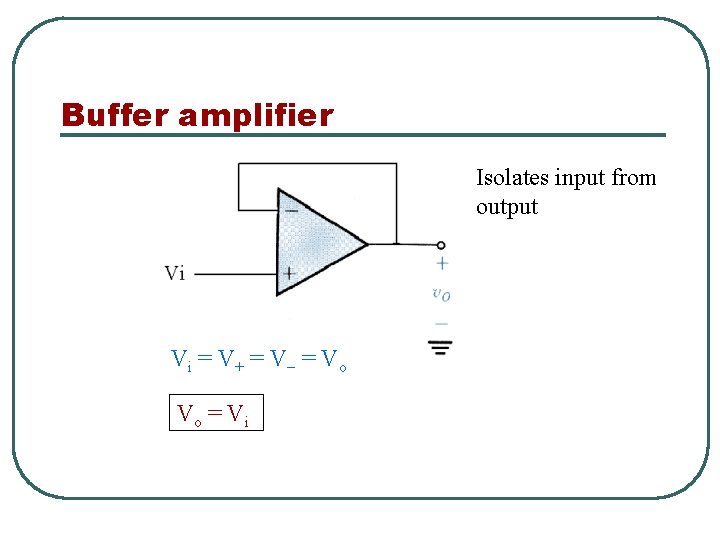
Buffer amplifier Isolates input from output Vi = V + = V o Vo = V i
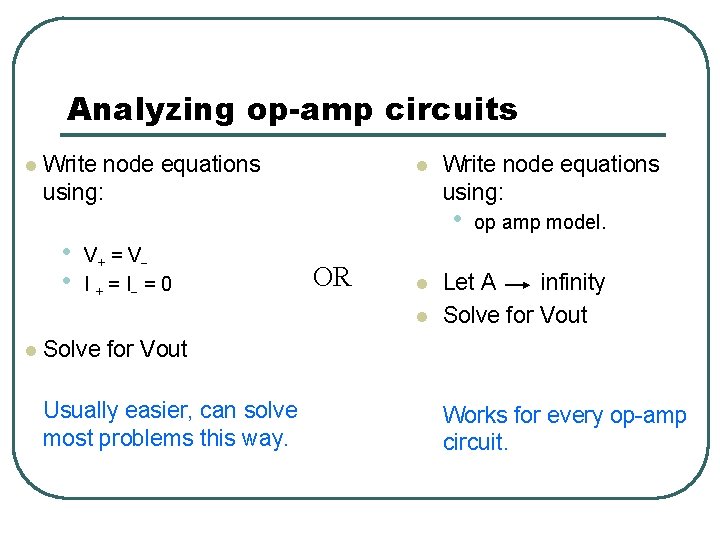
Analyzing op-amp circuits l Write node equations using: • • V+ = V I + = I = 0 l • OR l l l Write node equations using: op amp model. Let A infinity Solve for Vout Usually easier, can solve most problems this way. Works for every op-amp circuit.
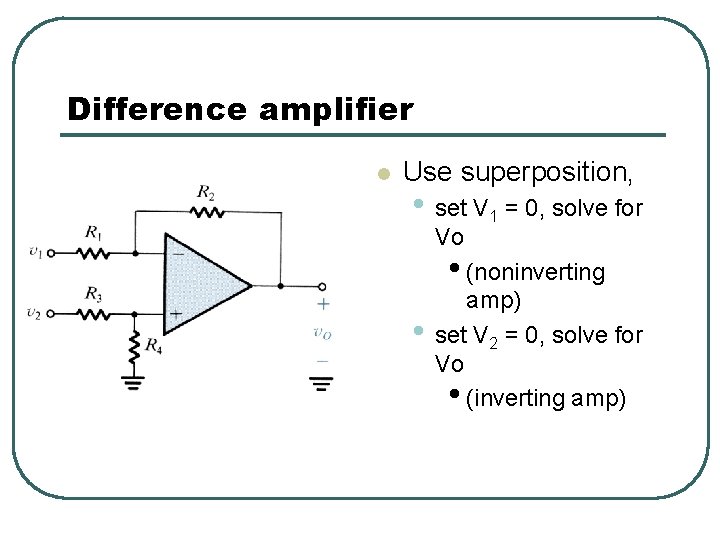
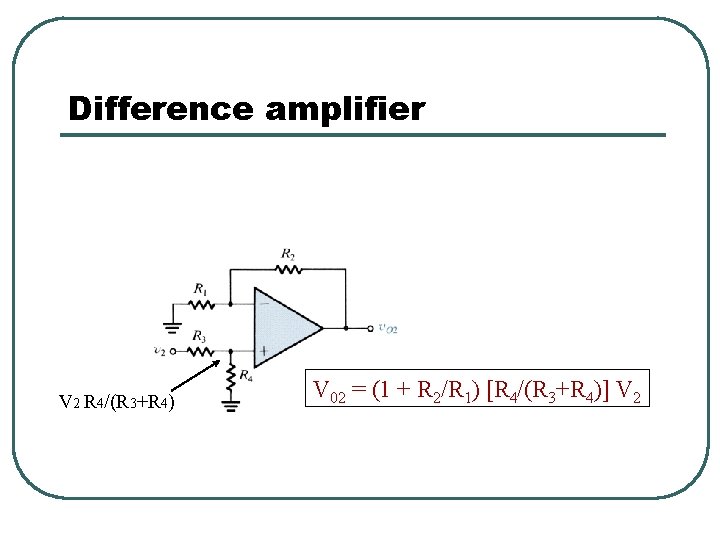
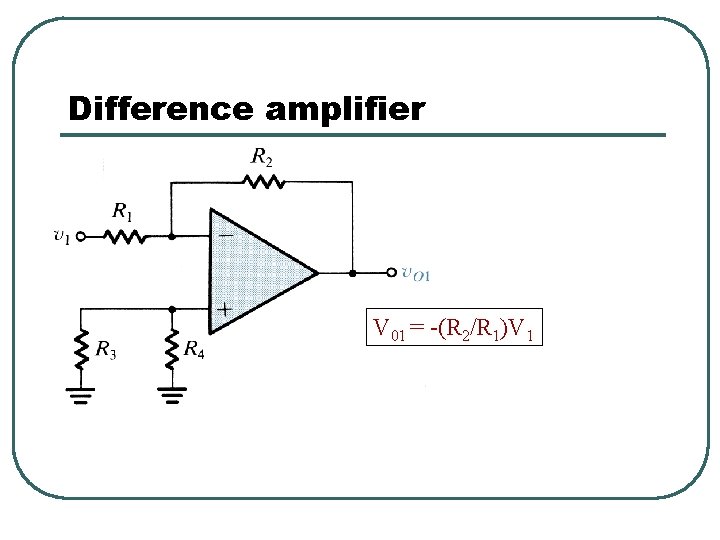
Difference amplifier l Use superposition, • set V 1 = 0, solve for Vo • (noninverting • amp) set V 2 = 0, solve for Vo • (inverting amp)
Difference amplifier V 2 R 4/(R 3+R 4) V 02 = (1 + R 2/R 1) [R 4/(R 3+R 4)] V 2
Difference amplifier V 01 = -(R 2/R 1)V 1
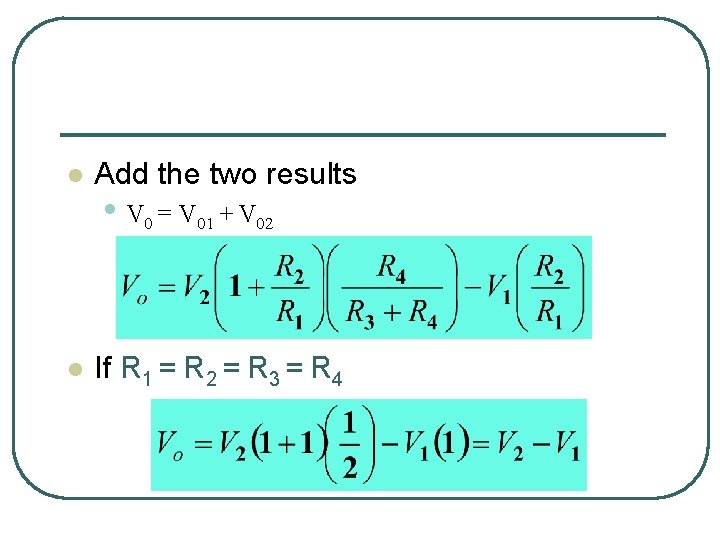
l Add the two results l If R 1 = R 2 = R 3 = R 4 • V 0 = V 01 + V 02
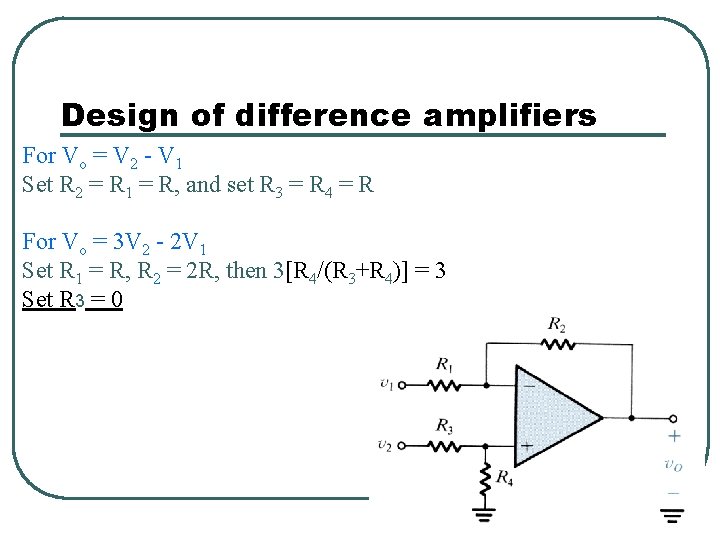
Design of difference amplifiers For Vo = V 2 - V 1 Set R 2 = R 1 = R, and set R 3 = R 4 = R For Vo = 3 V 2 - 2 V 1 Set R 1 = R, R 2 = 2 R, then 3[R 4/(R 3+R 4)] = 3 Set R 3 = 0