
Entamoeba Dr AJIT KUMAR Ho D Department of
Entamoeba Dr. AJIT KUMAR Ho. D Department of Parasitology Bihar Veterinary College Bihar Animal Sciences University Patna-800014 Image source: Google image
Sub-Phylum: Sarcodina Family: Endamoebidae Family members are called parasitic amoebae which occur in the digestive tract of vertebrates and invertebrates. Movement by Pseudopodia. Holozoic type of nutrition. Binary fission type of asexual reproduction. Encystment is common feature.
Family: Endamoebidae Genus : Entamoeba Location: Digestive tract. Usually form cyst. Cysts have 1 -8 nuclei depending upon the species.
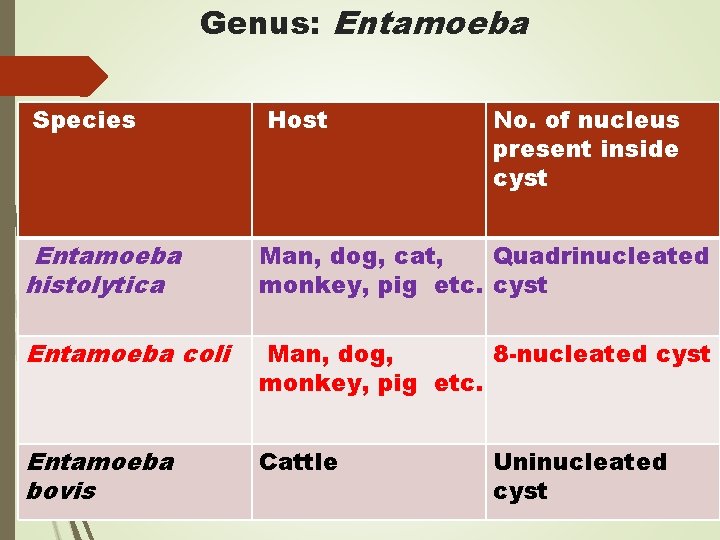
Genus: Entamoeba Species Host No. of nucleus present inside cyst Entamoeba histolytica Man, dog, cat, Quadrinucleated monkey, pig etc. cyst Entamoeba coli Man, dog, 8 -nucleated cyst monkey, pig etc. Entamoeba bovis Cattle Uninucleated cyst

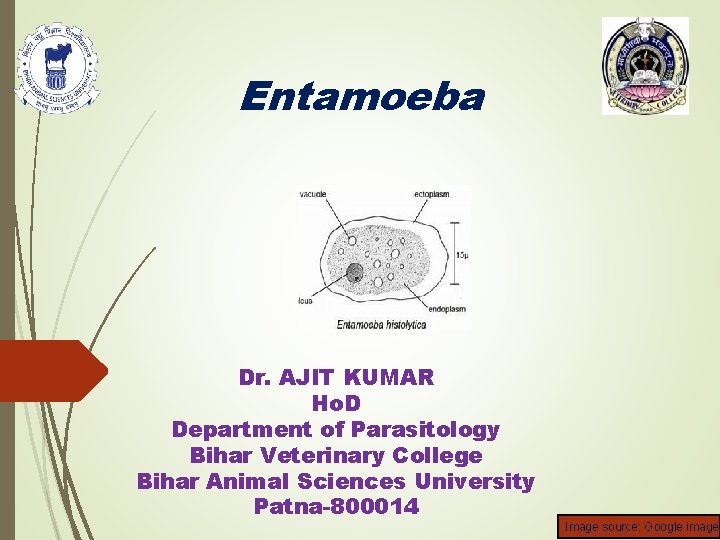
Entamoeba histolytica It is a zoonotic protozoan parasite. Mainly two developmental stages are found : Trophozoite and Cyst. Trophozoite : - ü Size about 10 -60 µm. ü It has clear ectoplasm and granular endoplasm. Image source: Google image
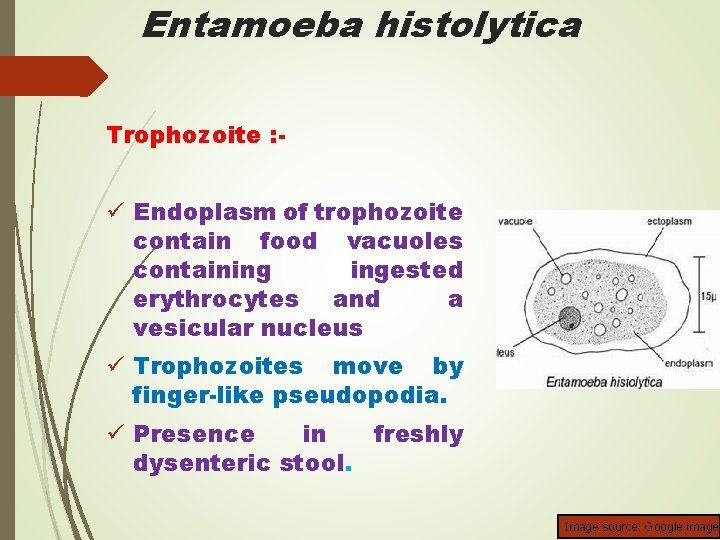
Entamoeba histolytica Trophozoite : - ü Endoplasm of trophozoite contain food vacuoles containing ingested erythrocytes and a vesicular nucleus ü Trophozoites move by finger-like pseudopodia. ü Presence in freshly dysenteric stool. Image source: Google image
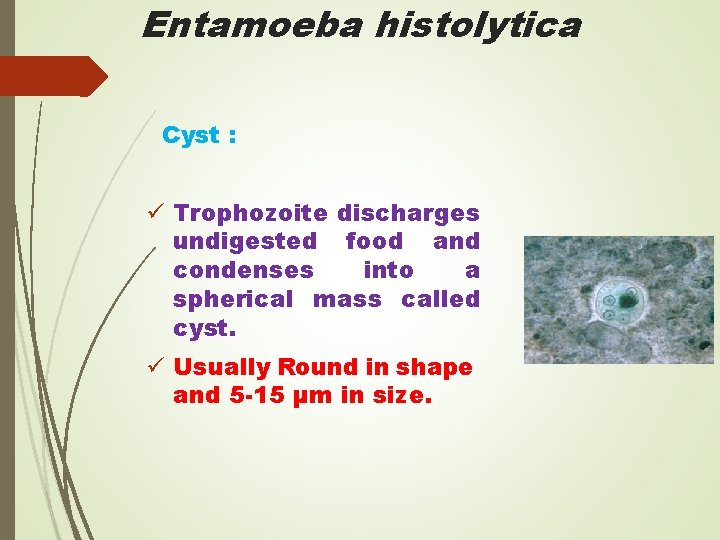
Entamoeba histolytica Cyst : ü Trophozoite discharges undigested food and condenses into a spherical mass called cyst. ü Usually Round in shape and 5 -15 µm in size.
Entamoeba histolytica Cyst : ü Young cyst contains 1 -4 chromatoid bars, glycogen vacuoles and single nucleus whereas Mature cyst contains four nuclei without chromatoid bars and glycogen vacuoles. ü Resistant condition. to averse ü Sensitive to desiccation, putrefaction and temperature above 400 C and below -500 C
Entamoeba histolytica Transmission: v through cysts contaminated food or water , as trophozoites do not survive more than 30 minutes after passing with stools. v Eating of raw and uncleaned vegetable usually in the form of salad. v Eating of food contaminated by flies, use of night soil polluted water etc.
Entamoeba histolytica Life- cycle: - o Hosts get infection by the ingestion of cysts. o Excystment occurs in the intestine in the presence of trypsin enzyme and released metacystic form. o Meatcystic form undergo nuclear and cytoplasmic division and form eight nucleated daughter trophozoites which migrate to the large intestine and grow into full size and invade the bowel mucosa.
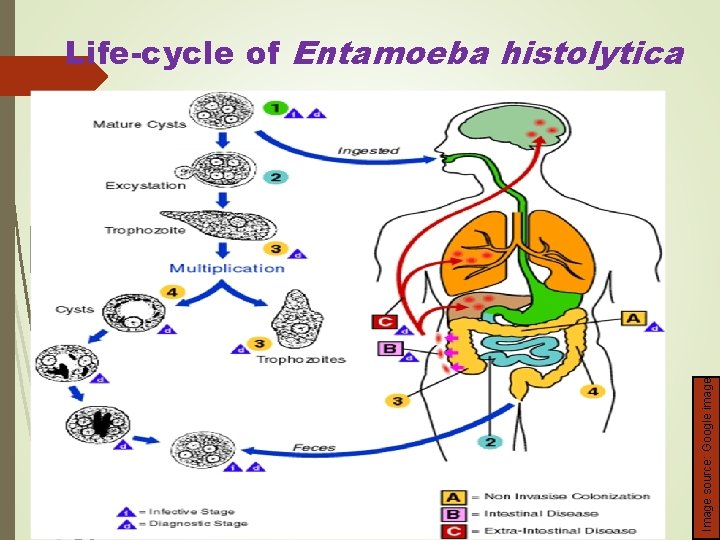
Image source: Google image Life-cycle of Entamoeba histolytica
Entamoeba histolytica Pathogenesis: o Pathogenesis depends on various factors like strain variation, presence of Escherichia coli or Aerobactor aerogenes , nutritional status of hosts, concurrent disease, immunity etc. o Parasites penetrates the intestinal wall by the lysis of the epithelium by the action of phosphohydrloae release by liposomes.
Entamoeba histolytica Pathogenesis: o Amoebae multiply and invade mucosa to produce inverted flask shaped ulcers. o Amoebae may reach other body parts like liver where it may produce abscesses. inflammation and
Entamoeba histolytica Symptoms: o Acute amoebic dysentery- faces consists of almost entirely blood and mucus with amoebae, abdominal pain, with straining. o Chronic dysentery – recurrent dysentery, occasional abdominal pain, nausea, irregular bowels, headache, flatulence etc.
Entamoeba histolytica Diagnosis : - Ø On the basis of symptoms like faeces with blood and mucus, abdominal pain etc. Microscopic examination of faeces reveals for the presence trophozoites (in diarrhoeic faeces) or quadrinucleated cysts (Entamoeba histolytica) or eight nucleated cysts (Entamoeba coli). Ø 2 % iodine is also used for clearly detection of cysts. Image source: Google image Four nucleated cyst
Entamoeba histolytica Treatment : Metronidazole , Tinidazole etc. Control : o Adoption of proper sanitation, personal hygiene, proper disposal of sewage and night soil, avoidance of faecal contamination of food and water, supply of clean drinking water etc.

THANK YOU
- Slides: 17