
ENT 281 Signal and Systems Lecture 2 Signal

- Slides: 59
ENT 281 Signal and Systems Lecture 2 Signal and Systems Modeling Concepts (Part 1) Dr. Abdul Halim Ismail 1 Semester 1, 2017/2018 Session
Contents 1 Introduction 2 Classification of a Signals. 2. 1 Continuous-Time and Discrete-Time Signals 2. 2 Even and Odd Signals. 2. 3 Periodic and Non-periodic Signals. 2. 4 Deterministic and Random Signals. 2. 5 Energy and Power Signals. 3 Basic Operation of the Signal. 3. 1 Amplitude Scaling 3. 2 Signal Addition & Multiplication 3. 3 Differentiation & Integration 3. 4 Time Scaling 3. 5 Time Reversal and Reflection 3. 6 Time Shifting 3. 7 Precedence Rules School of Mechatronic Engineering Universiti Malaysia Perlis (Uni. MAP) 2
Contents 1 Introduction 2 Classification of a Signals. 2. 1 Continuous-Time and Discrete-Time Signals 2. 2 Even and Odd Signals. 2. 3 Periodic and Non-periodic Signals. 2. 4 Deterministic and Random Signals. 2. 5 Energy and Power Signals. 3 Basic Operation of the Signal. 3. 1 Amplitude Scaling 3. 2 Signal Addition & Multiplication 3. 3 Differentiation & Integration 3. 4 Time Scaling 3. 5 Time Reversal and Reflection 3. 6 Time Shifting 3. 7 Precedence Rules School of Mechatronic Engineering Universiti Malaysia Perlis (Uni. MAP) 3
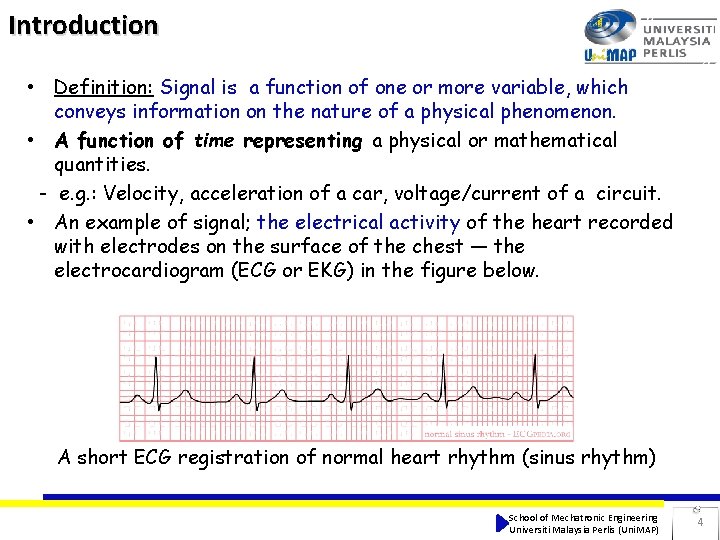
Introduction • Definition: Signal is a function of one or more variable, which conveys information on the nature of a physical phenomenon. • A function of time representing a physical or mathematical quantities. - e. g. : Velocity, acceleration of a car, voltage/current of a circuit. • An example of signal; the electrical activity of the heart recorded with electrodes on the surface of the chest — the electrocardiogram (ECG or EKG) in the figure below. A short ECG registration of normal heart rhythm (sinus rhythm) School of Mechatronic Engineering Universiti Malaysia Perlis (Uni. MAP) 4
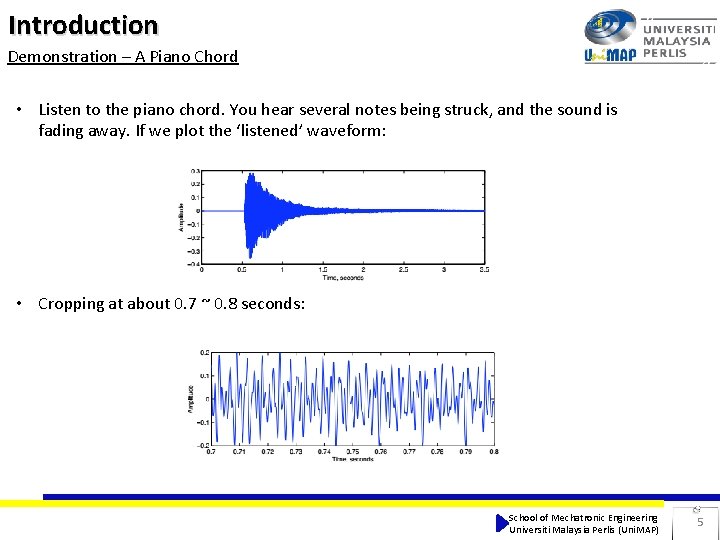
Introduction Demonstration – A Piano Chord • Listen to the piano chord. You hear several notes being struck, and the sound is fading away. If we plot the ‘listened’ waveform: • Cropping at about 0. 7 ~ 0. 8 seconds: School of Mechatronic Engineering Universiti Malaysia Perlis (Uni. MAP) 5
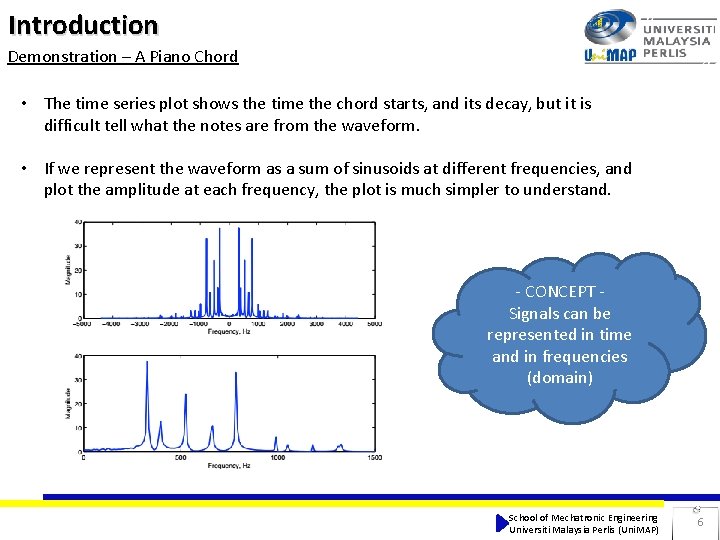
Introduction Demonstration – A Piano Chord • The time series plot shows the time the chord starts, and its decay, but it is difficult tell what the notes are from the waveform. • If we represent the waveform as a sum of sinusoids at different frequencies, and plot the amplitude at each frequency, the plot is much simpler to understand. - CONCEPT Signals can be represented in time and in frequencies (domain) School of Mechatronic Engineering Universiti Malaysia Perlis (Uni. MAP) 6
Introduction What is Signal? Real-life example of signals; i. Doctor listening to the heartbeat, blood pressure and temperature of the patient. These indicate the state of health of the patient. ii. Daily fluctuations in the price of stock market will convey an information on the how the share for a company is doing. iii. Weather forecast over the radio provides information on the variation temperature, humidity, and the speed and direction of the prevailing wind. Signals and Systems in many fields/application; 1) Communication 2) Aeronautics & astronautics 3) Circuit Design 4) Acoustics 5) Seismology 6) Biomedical engineering 7) Energy generation & distribution 8) Chemical process control 9) Speech processing 10) Image processing 11) Economic & Financial Forecasting 12) Weather forecasting & etc…. . School of Mechatronic Engineering Universiti Malaysia Perlis (Uni. MAP) 7
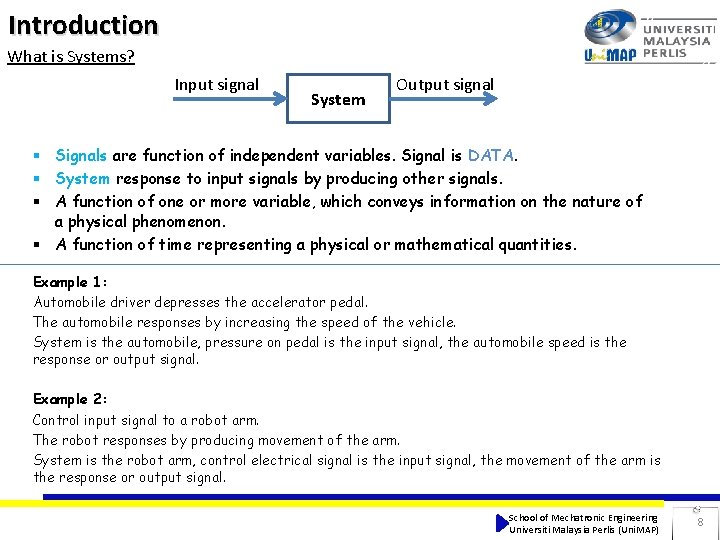
Introduction What is Systems? Input signal System Output signal § Signals are function of independent variables. Signal is DATA. § System response to input signals by producing other signals. § A function of one or more variable, which conveys information on the nature of a physical phenomenon. § A function of time representing a physical or mathematical quantities. Example 1: Automobile driver depresses the accelerator pedal. The automobile responses by increasing the speed of the vehicle. System is the automobile, pressure on pedal is the input signal, the automobile speed is the response or output signal. Example 2: Control input signal to a robot arm. The robot responses by producing movement of the arm. System is the robot arm, control electrical signal is the input signal, the movement of the arm is the response or output signal. School of Mechatronic Engineering Universiti Malaysia Perlis (Uni. MAP) 8
Contents 1 Introduction 2 Classification of a Signals. 2. 1 Continuous-Time and Discrete-Time Signals 2. 2 Even and Odd Signals. 2. 3 Periodic and Non-periodic Signals. 2. 4 Deterministic and Random Signals. 2. 5 Energy and Power Signals. 3 Basic Operation of the Signal. 3. 1 Amplitude Scaling 3. 2 Signal Addition & Multiplication 3. 3 Differentiation & Integration 3. 4 Time Scaling 3. 5 Time Reversal and Reflection 3. 6 Time Shifting 3. 7 Precedence Rules School of Mechatronic Engineering Universiti Malaysia Perlis (Uni. MAP) 9
Classification of a Signals 5 methods of classifying signals, based on different features, are common; • Continuous-Time and Discrete-Time Signals • Even and Odd Signals. • Periodic and Non-periodic Signals. • Deterministic and Random Signals. • Energy and Power Signals. School of Mechatronic Engineering Universiti Malaysia Perlis (Uni. MAP) 10
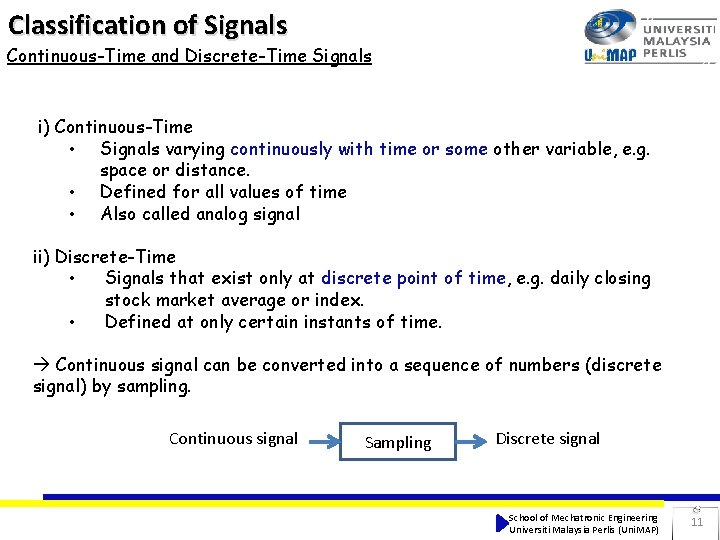
Classification of Signals Continuous-Time and Discrete-Time Signals i) Continuous-Time • Signals varying continuously with time or some other variable, e. g. space or distance. • Defined for all values of time • Also called analog signal ii) Discrete-Time • Signals that exist only at discrete point of time, e. g. daily closing stock market average or index. • Defined at only certain instants of time. Continuous signal can be converted into a sequence of numbers (discrete signal) by sampling. Continuous signal Sampling Discrete signal School of Mechatronic Engineering Universiti Malaysia Perlis (Uni. MAP) 11
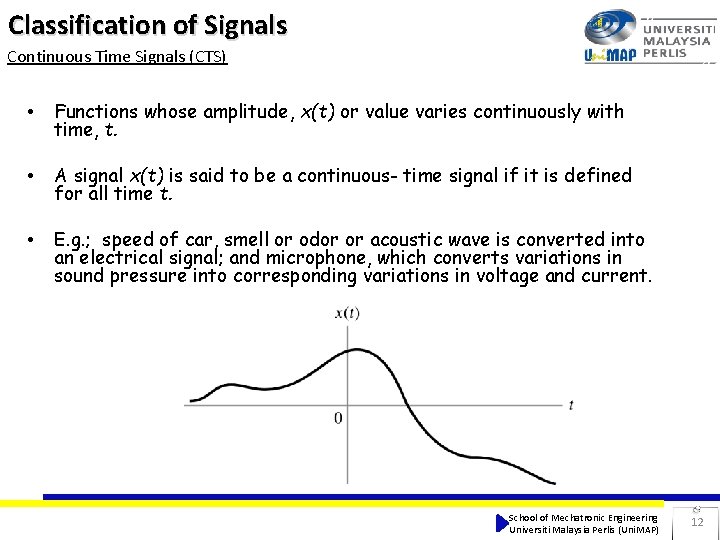
Classification of Signals Continuous Time Signals (CTS) • Functions whose amplitude, x(t) or value varies continuously with time, t. • A signal x(t) is said to be a continuous- time signal if it is defined for all time t. • E. g. ; speed of car, smell or odor or acoustic wave is converted into an electrical signal; and microphone, which converts variations in sound pressure into corresponding variations in voltage and current. School of Mechatronic Engineering Universiti Malaysia Perlis (Uni. MAP) 12
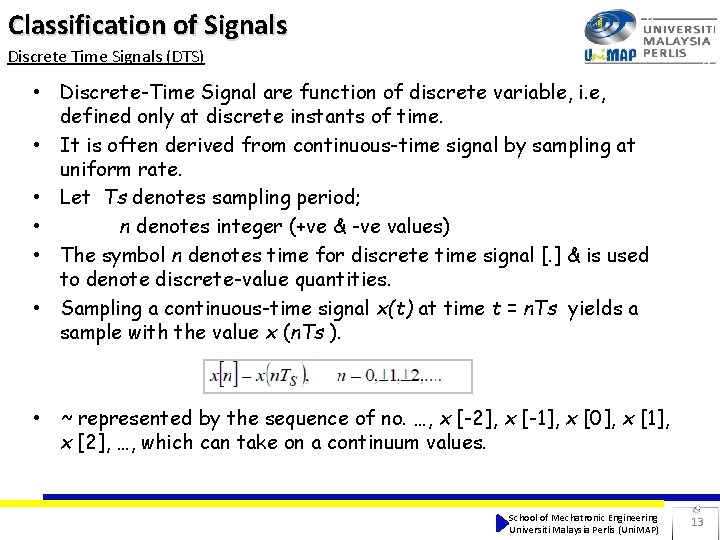
Classification of Signals Discrete Time Signals (DTS) • Discrete-Time Signal are function of discrete variable, i. e, defined only at discrete instants of time. • It is often derived from continuous-time signal by sampling at uniform rate. • Let Ts denotes sampling period; • n denotes integer (+ve & -ve values) • The symbol n denotes time for discrete time signal [. ] & is used to denote discrete-value quantities. • Sampling a continuous-time signal x(t) at time t = n. Ts yields a sample with the value x (n. Ts ). • ~ represented by the sequence of no. …, x [-2], x [-1], x [0], x [1], x [2], …, which can take on a continuum values. School of Mechatronic Engineering Universiti Malaysia Perlis (Uni. MAP) 13
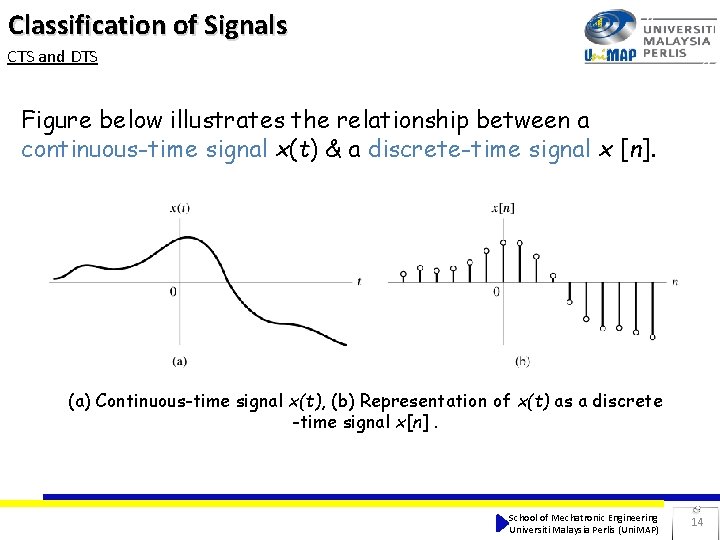
Classification of Signals CTS and DTS Figure below illustrates the relationship between a continuous-time signal x(t) & a discrete-time signal x [n]. (a) Continuous-time signal x(t), (b) Representation of x(t) as a discrete -time signal x[n]. School of Mechatronic Engineering Universiti Malaysia Perlis (Uni. MAP) 14
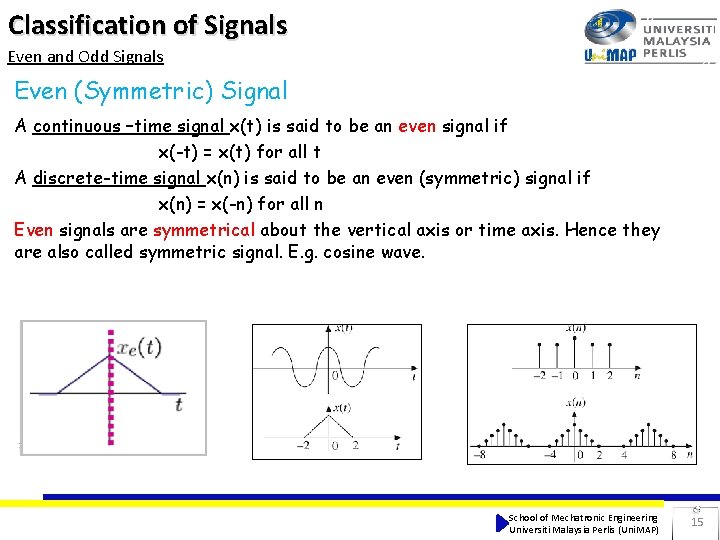
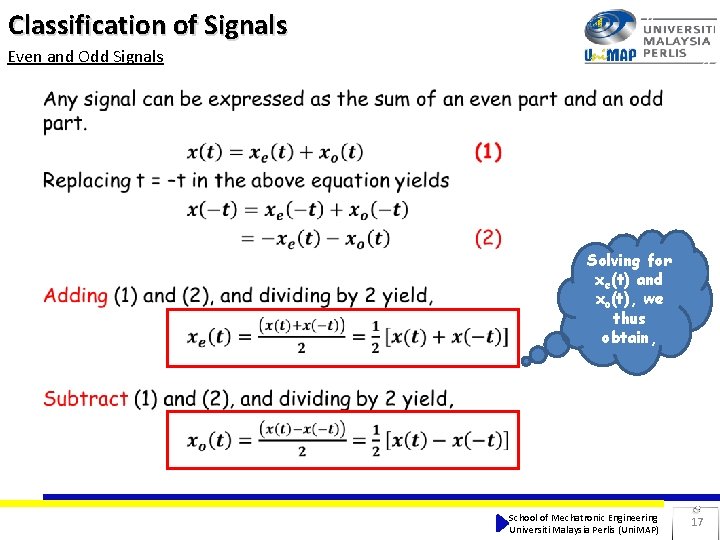
Classification of Signals Even and Odd Signals Even (Symmetric) Signal A continuous –time signal x(t) is said to be an even signal if x(-t) = x(t) for all t A discrete-time signal x(n) is said to be an even (symmetric) signal if x(n) = x(-n) for all n Even signals are symmetrical about the vertical axis or time axis. Hence they are also called symmetric signal. E. g. cosine wave. School of Mechatronic Engineering Universiti Malaysia Perlis (Uni. MAP) 15
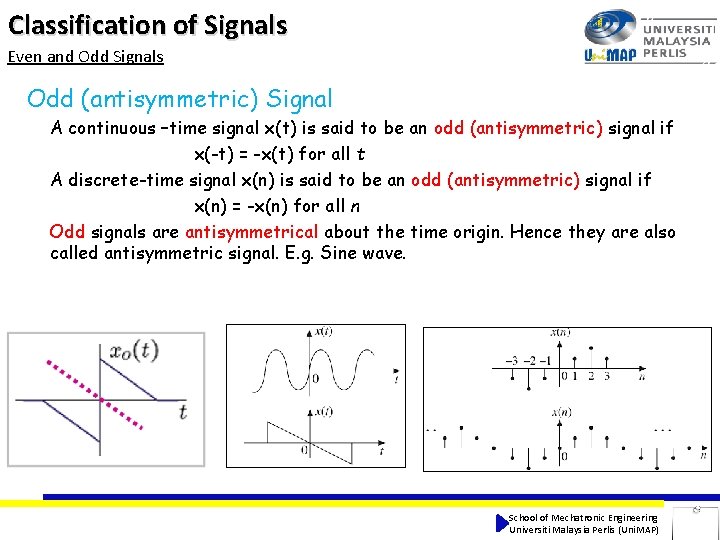
Classification of Signals Even and Odd Signals Odd (antisymmetric) Signal A continuous –time signal x(t) is said to be an odd (antisymmetric) signal if x(-t) = -x(t) for all t A discrete-time signal x(n) is said to be an odd (antisymmetric) signal if x(n) = -x(n) for all n Odd signals are antisymmetrical about the time origin. Hence they are also called antisymmetric signal. E. g. Sine wave. School of Mechatronic Engineering Universiti Malaysia Perlis (Uni. MAP)
Classification of Signals Even and Odd Signals Solving for xe(t) and xo(t), we thus obtain, School of Mechatronic Engineering Universiti Malaysia Perlis (Uni. MAP) 17
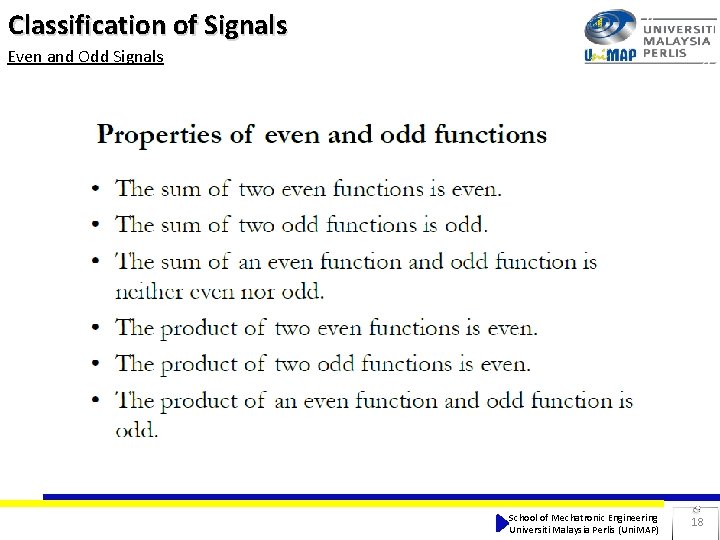
Classification of Signals Even and Odd Signals School of Mechatronic Engineering Universiti Malaysia Perlis (Uni. MAP) 18
Classification of Signals Even and Odd Signals The product of two even or odd signals is an even signal, The product of even signal and odd signal is an odd signal. Prove: If x 1(t) and x 2(t) are both EVEN, i. e School of Mechatronic Engineering Universiti Malaysia Perlis (Uni. MAP) 19
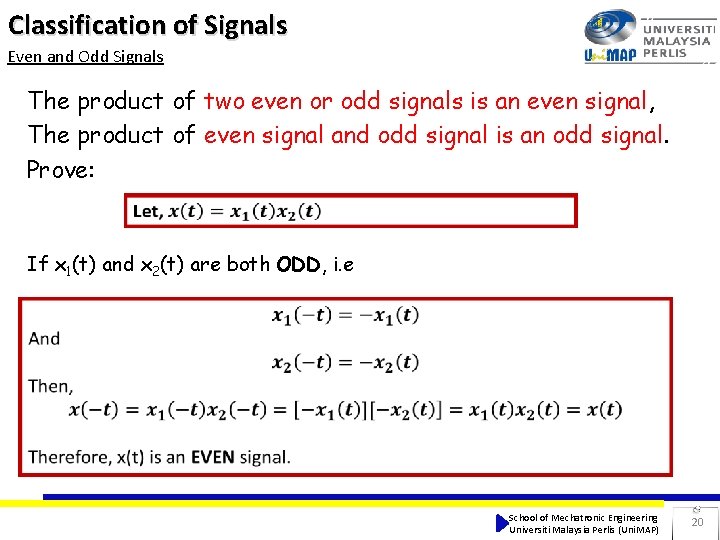
Classification of Signals Even and Odd Signals The product of two even or odd signals is an even signal, The product of even signal and odd signal is an odd signal. Prove: If x 1(t) and x 2(t) are both ODD, i. e School of Mechatronic Engineering Universiti Malaysia Perlis (Uni. MAP) 20
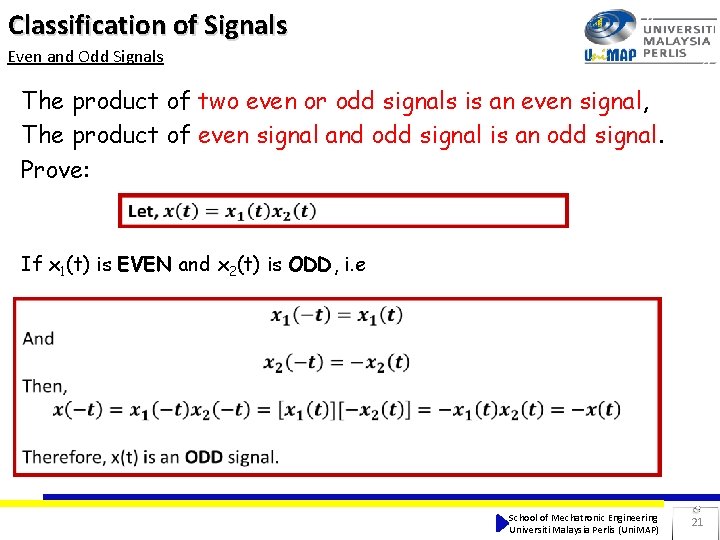
Classification of Signals Even and Odd Signals The product of two even or odd signals is an even signal, The product of even signal and odd signal is an odd signal. Prove: If x 1(t) is EVEN and x 2(t) is ODD, i. e School of Mechatronic Engineering Universiti Malaysia Perlis (Uni. MAP) 21
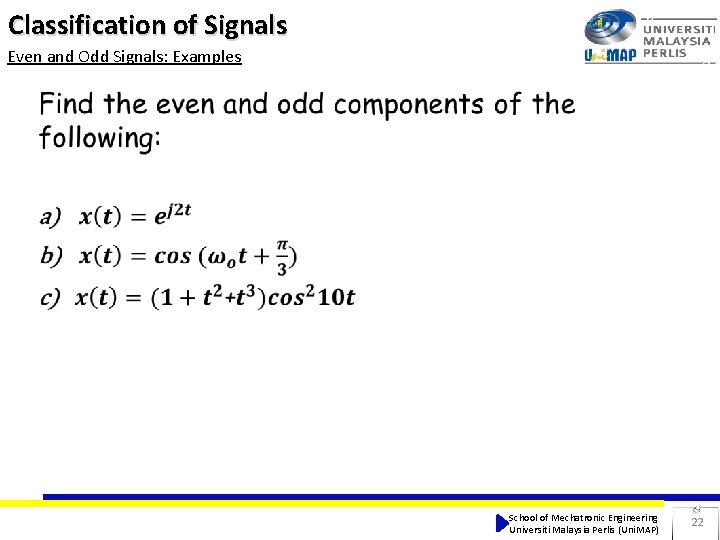
Classification of Signals Even and Odd Signals: Examples School of Mechatronic Engineering Universiti Malaysia Perlis (Uni. MAP) 22
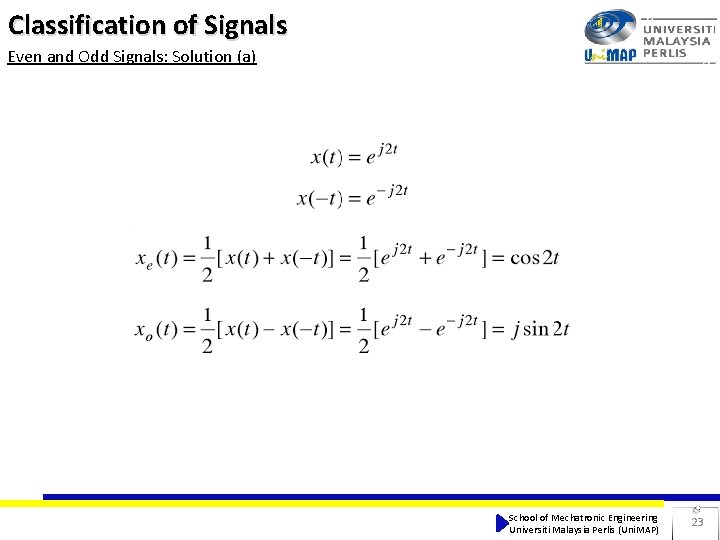
Classification of Signals Even and Odd Signals: Solution (a) School of Mechatronic Engineering Universiti Malaysia Perlis (Uni. MAP) 23
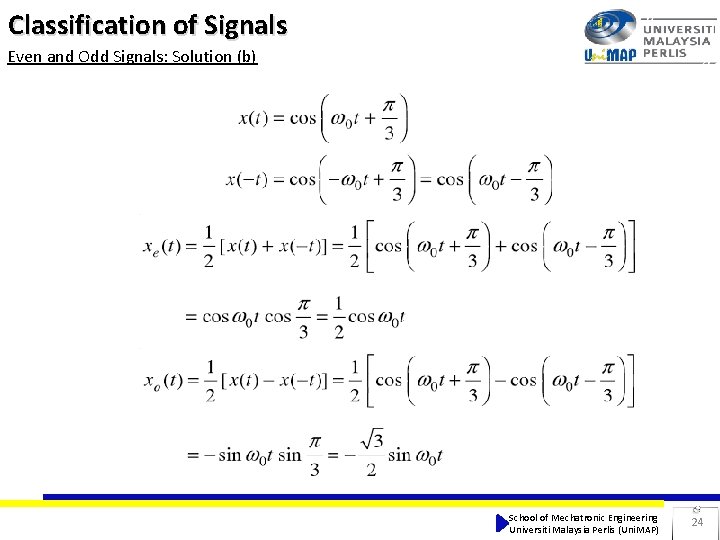
Classification of Signals Even and Odd Signals: Solution (b) School of Mechatronic Engineering Universiti Malaysia Perlis (Uni. MAP) 24
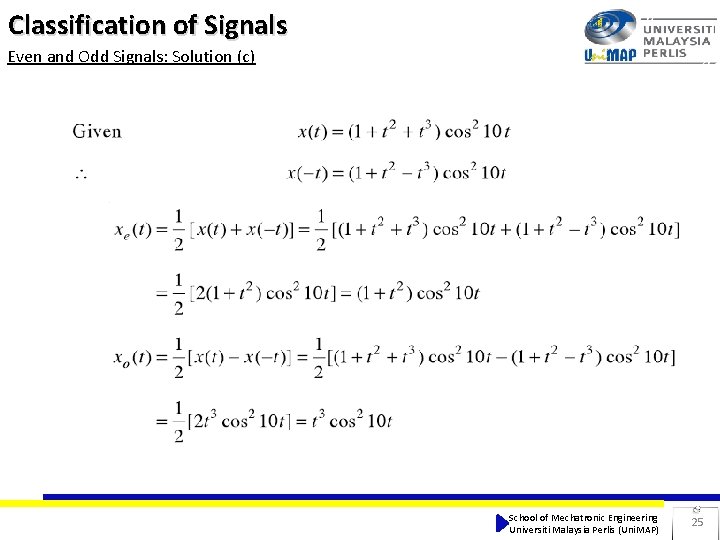
Classification of Signals Even and Odd Signals: Solution (c) School of Mechatronic Engineering Universiti Malaysia Perlis (Uni. MAP) 25
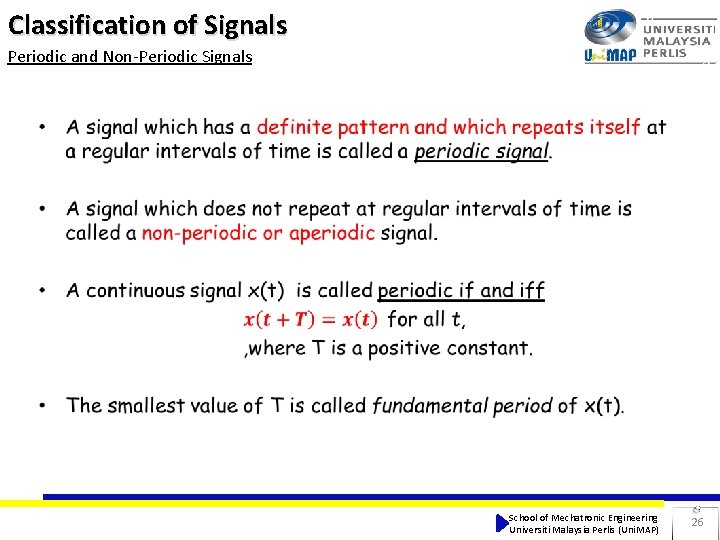
Classification of Signals Periodic and Non-Periodic Signals School of Mechatronic Engineering Universiti Malaysia Perlis (Uni. MAP) 26
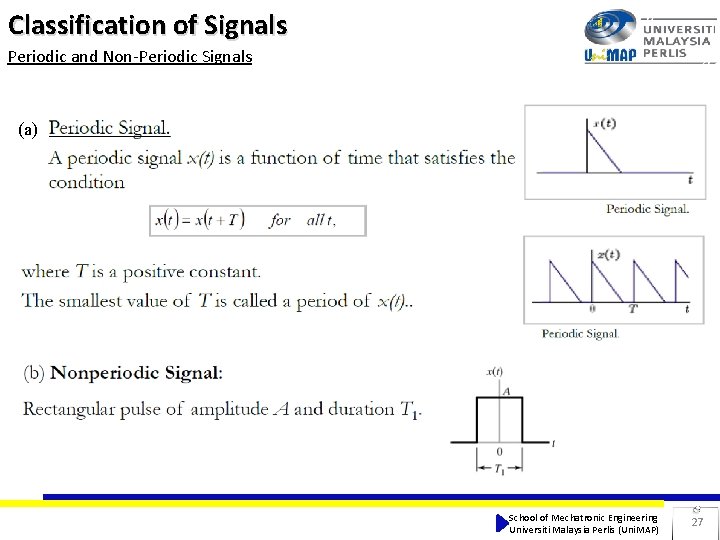
Classification of Signals Periodic and Non-Periodic Signals (a) School of Mechatronic Engineering Universiti Malaysia Perlis (Uni. MAP) 27
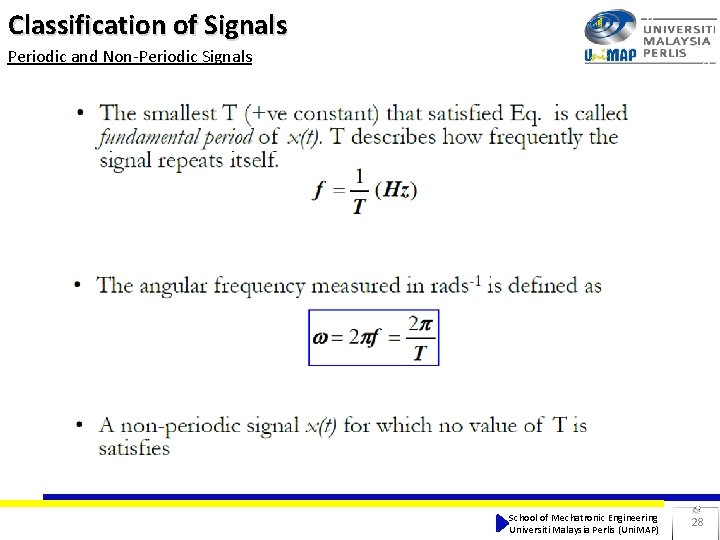
Classification of Signals Periodic and Non-Periodic Signals School of Mechatronic Engineering Universiti Malaysia Perlis (Uni. MAP) 28
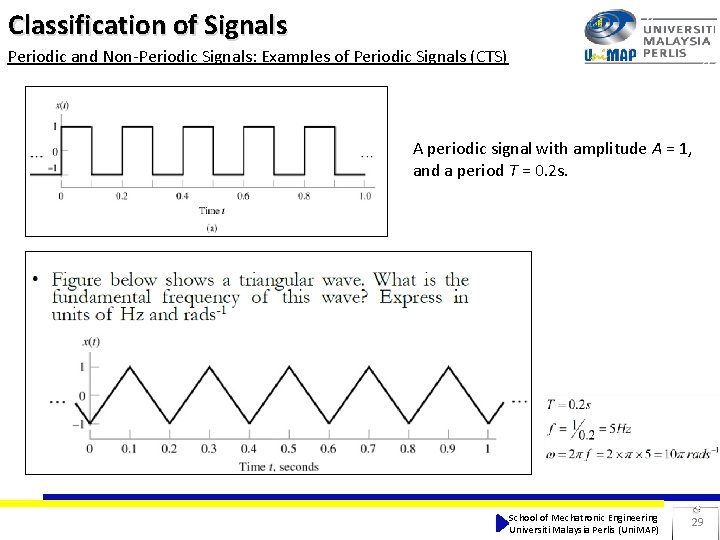
Classification of Signals Periodic and Non-Periodic Signals: Examples of Periodic Signals (CTS) A periodic signal with amplitude A = 1, and a period T = 0. 2 s. School of Mechatronic Engineering Universiti Malaysia Perlis (Uni. MAP) 29
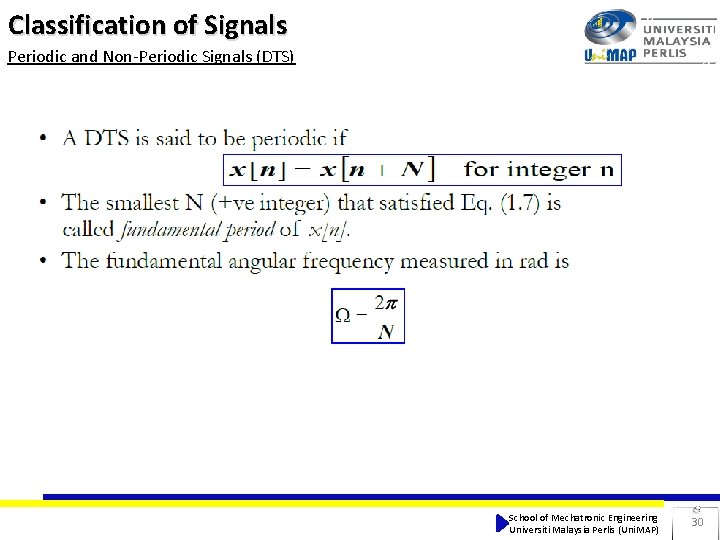
Classification of Signals Periodic and Non-Periodic Signals (DTS) School of Mechatronic Engineering Universiti Malaysia Perlis (Uni. MAP) 30
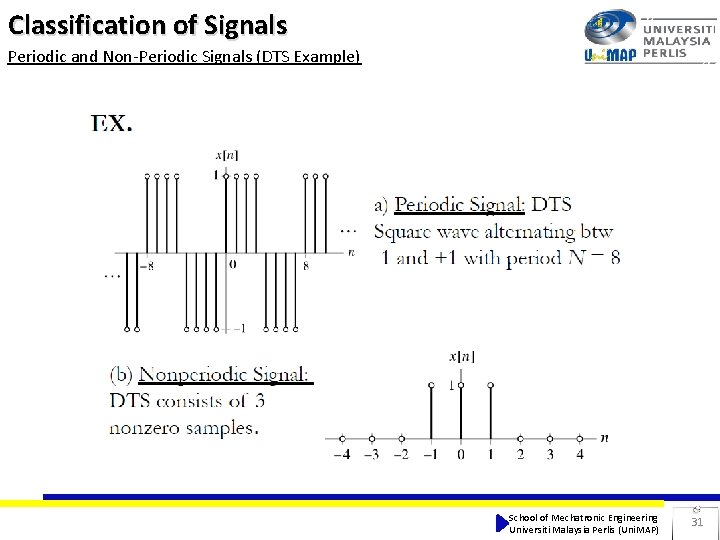
Classification of Signals Periodic and Non-Periodic Signals (DTS Example) School of Mechatronic Engineering Universiti Malaysia Perlis (Uni. MAP) 31
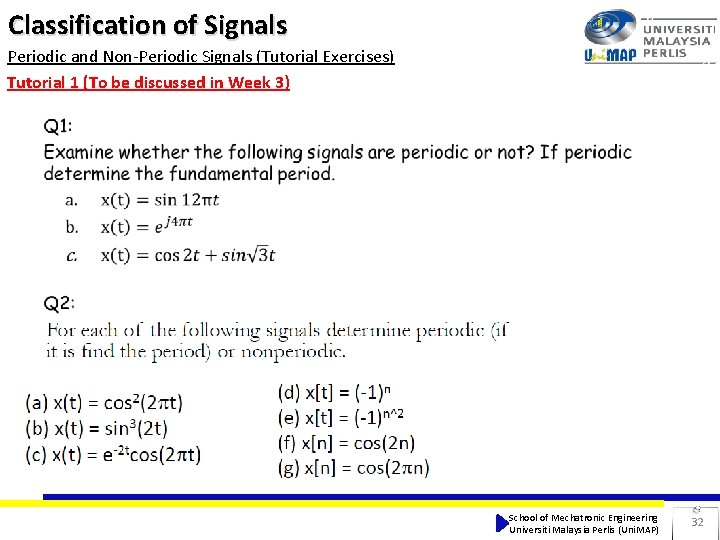
Classification of Signals Periodic and Non-Periodic Signals (Tutorial Exercises) Tutorial 1 (To be discussed in Week 3) School of Mechatronic Engineering Universiti Malaysia Perlis (Uni. MAP) 32
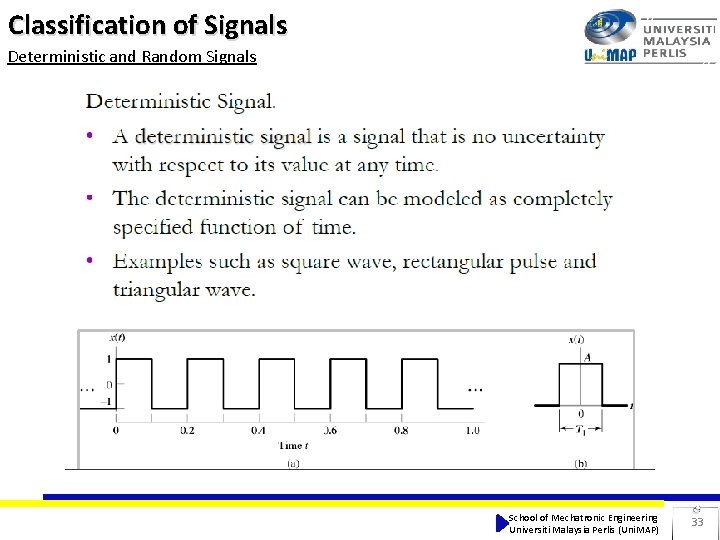
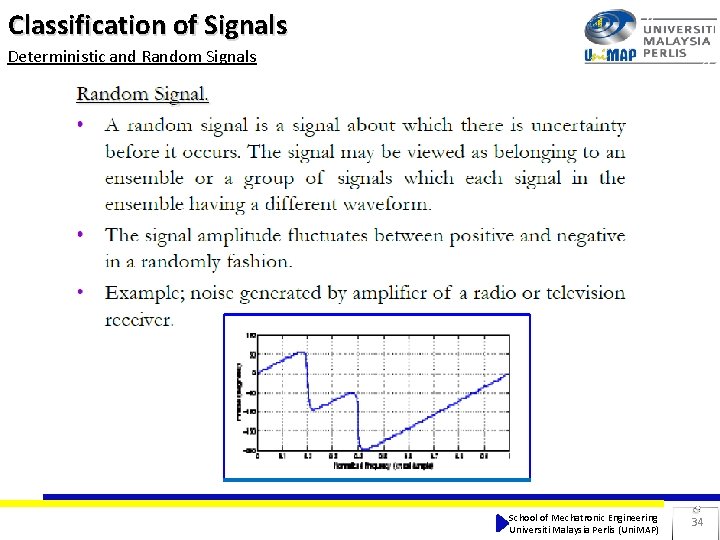
Classification of Signals Deterministic and Random Signals School of Mechatronic Engineering Universiti Malaysia Perlis (Uni. MAP) 33
Classification of Signals Deterministic and Random Signals School of Mechatronic Engineering Universiti Malaysia Perlis (Uni. MAP) 34
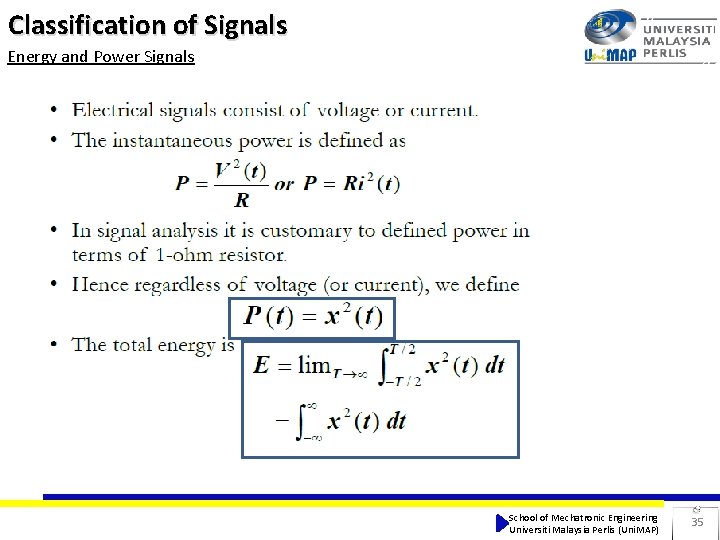
Classification of Signals Energy and Power Signals School of Mechatronic Engineering Universiti Malaysia Perlis (Uni. MAP) 35
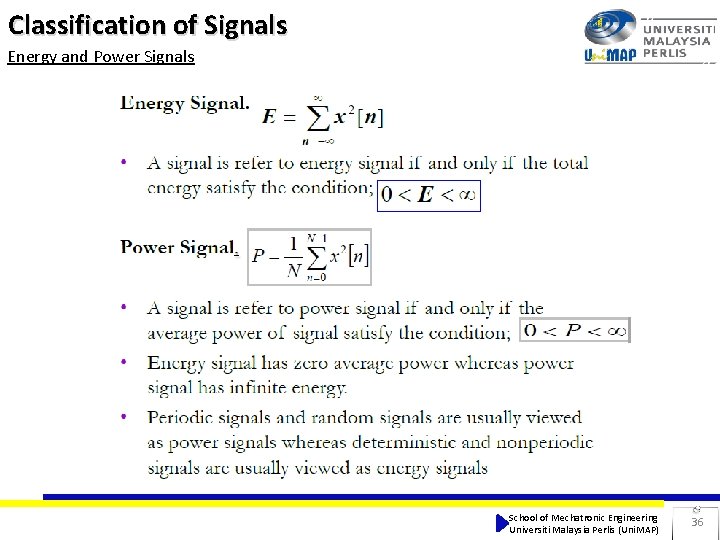
Classification of Signals Energy and Power Signals School of Mechatronic Engineering Universiti Malaysia Perlis (Uni. MAP) 36
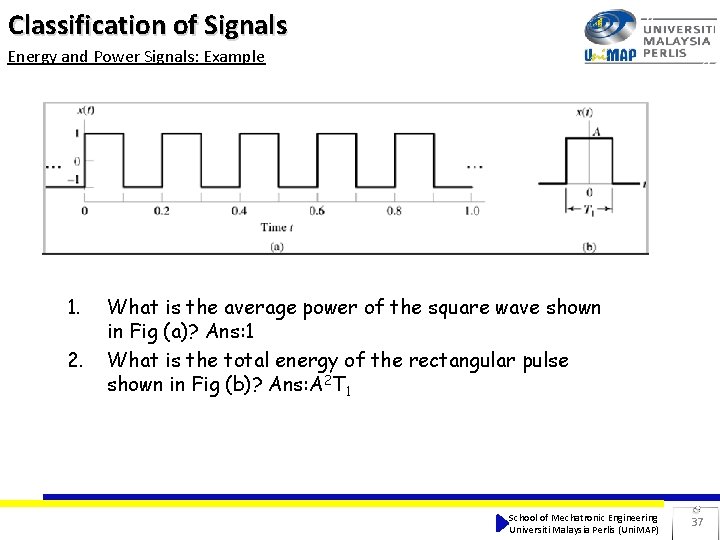
Classification of Signals Energy and Power Signals: Example 1. 2. What is the average power of the square wave shown in Fig (a)? Ans: 1 What is the total energy of the rectangular pulse shown in Fig (b)? Ans: A 2 T 1 School of Mechatronic Engineering Universiti Malaysia Perlis (Uni. MAP) 37
Contents 1 Introduction 2 Classification of a Signals. 2. 1 Continuous-Time and Discrete-Time Signals 2. 2 Even and Odd Signals. 2. 3 Periodic and Non-periodic Signals. 2. 4 Deterministic and Random Signals. 2. 5 Energy and Power Signals. 3 Basic Operation of the Signal. 3. 1 Amplitude Scaling 3. 2 Signal Addition & Multiplication 3. 3 Differentiation & Integration 3. 4 Time Scaling 3. 5 Time Reversal and Reflection 3. 6 Time Shifting 3. 7 Precedence Rules School of Mechatronic Engineering Universiti Malaysia Perlis (Uni. MAP) 38
Basic Operation of the Signal. Systems are used to process or manipulate signals which could involve a combination of some basic operations. • Operations performed on dependents variables – Amplitude Scaling – Addition & Multiplication – Differentiation & Integration • Operations performed on independent variables – Time Scaling – Time Reversal / Reflection – Time Shifting • Precedence Rule for Time Shifting and Time Scaling School of Mechatronic Engineering Universiti Malaysia Perlis (Uni. MAP) 39
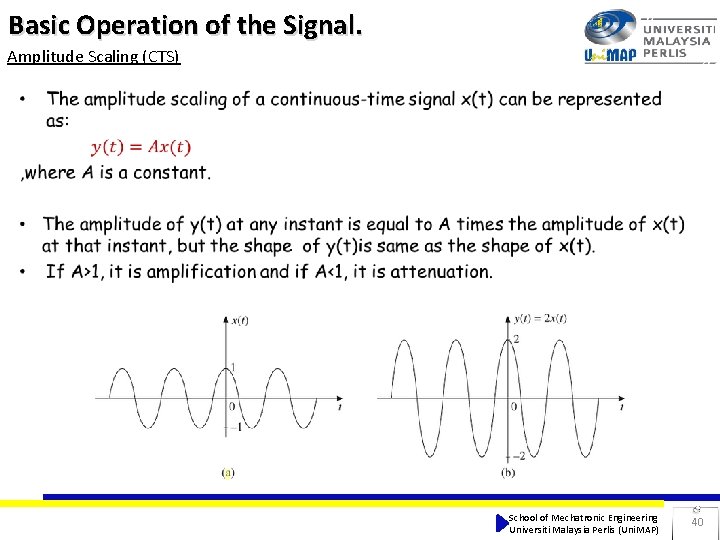
Basic Operation of the Signal. Amplitude Scaling (CTS) School of Mechatronic Engineering Universiti Malaysia Perlis (Uni. MAP) 40
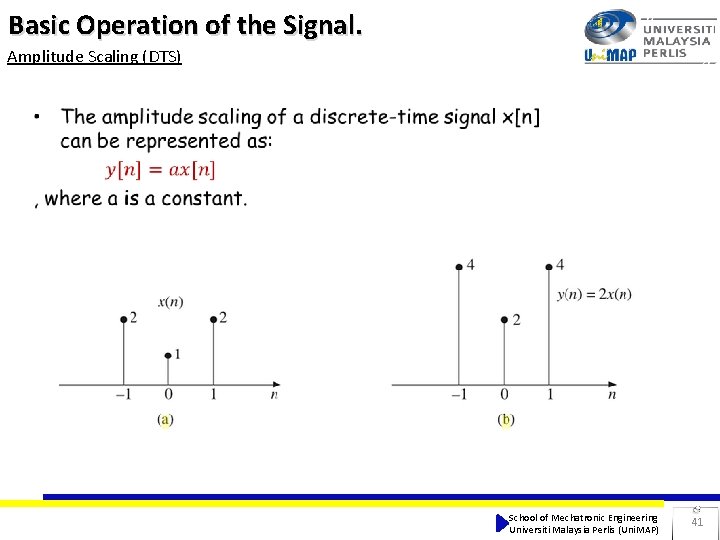
Basic Operation of the Signal. Amplitude Scaling (DTS) School of Mechatronic Engineering Universiti Malaysia Perlis (Uni. MAP) 41
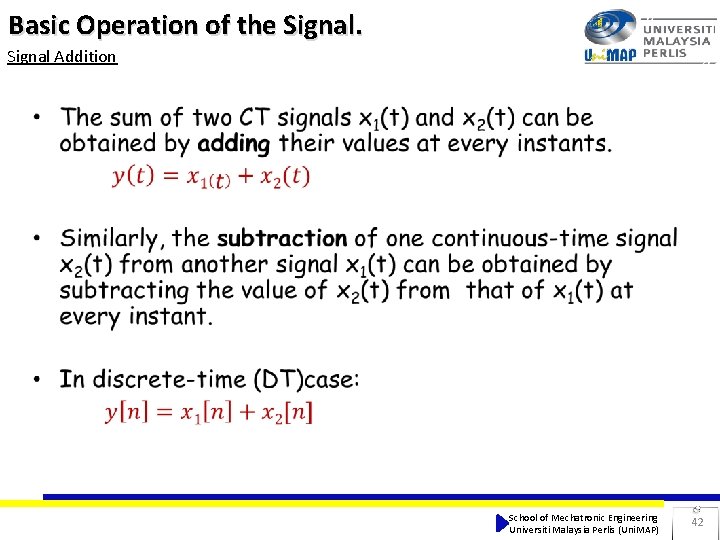
Basic Operation of the Signal Addition School of Mechatronic Engineering Universiti Malaysia Perlis (Uni. MAP) 42
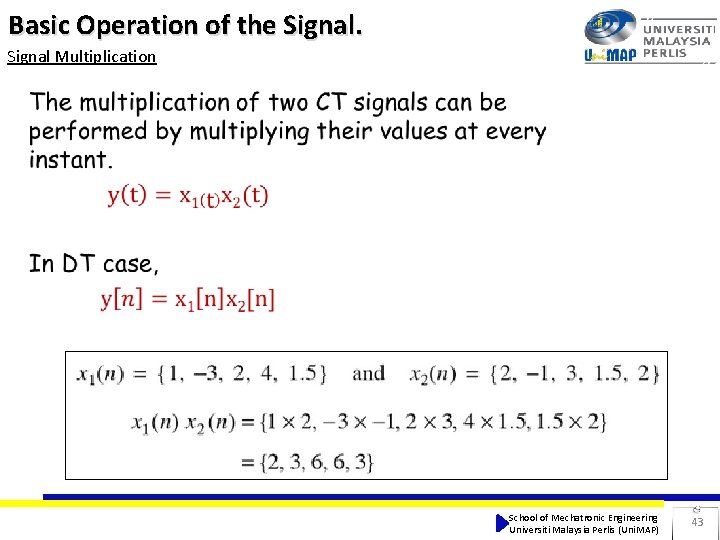
Basic Operation of the Signal Multiplication School of Mechatronic Engineering Universiti Malaysia Perlis (Uni. MAP) 43
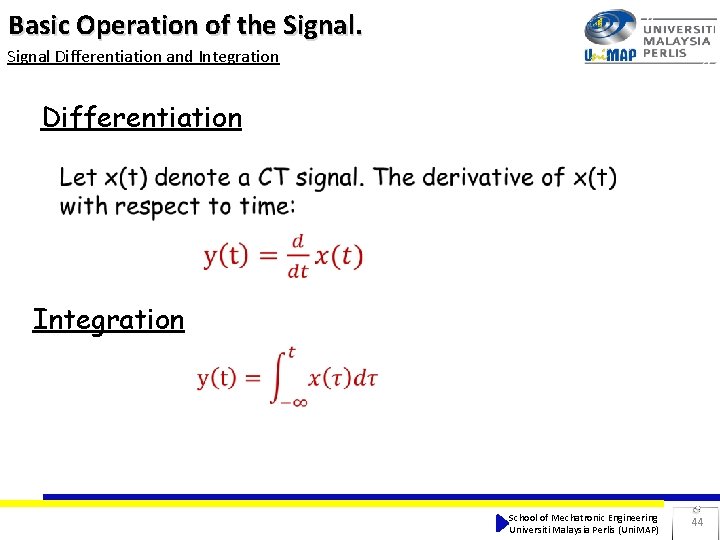
Basic Operation of the Signal Differentiation and Integration Differentiation Integration School of Mechatronic Engineering Universiti Malaysia Perlis (Uni. MAP) 44
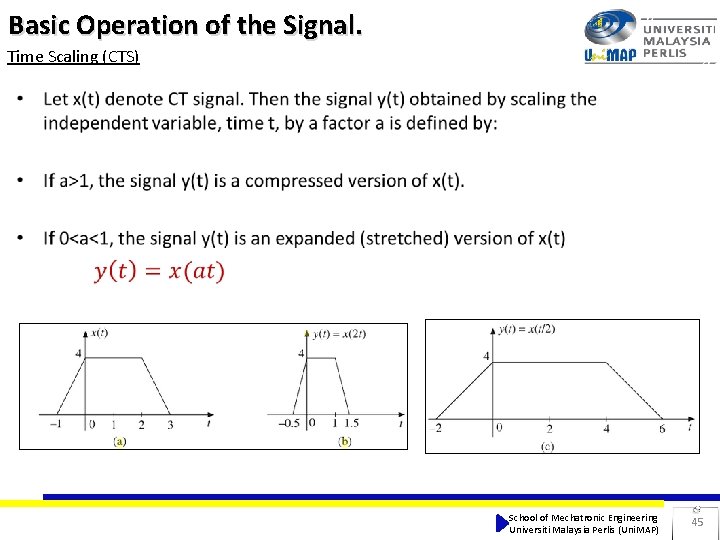
Basic Operation of the Signal. Time Scaling (CTS) School of Mechatronic Engineering Universiti Malaysia Perlis (Uni. MAP) 45
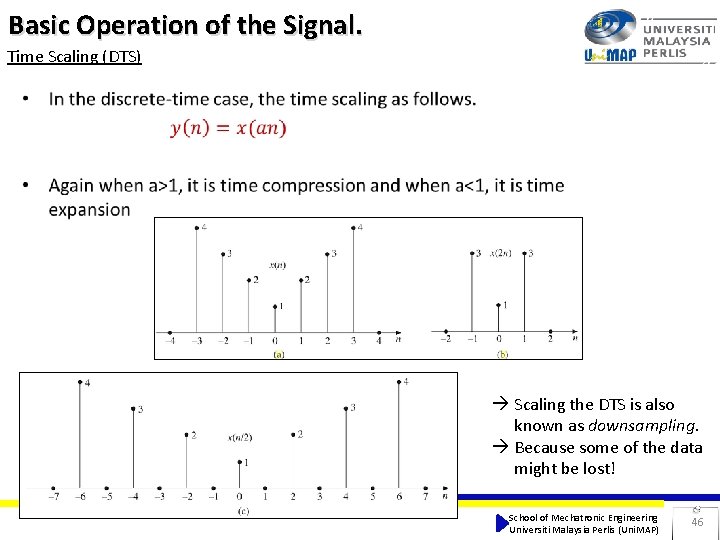
Basic Operation of the Signal. Time Scaling (DTS) Scaling the DTS is also known as downsampling. Because some of the data might be lost! School of Mechatronic Engineering Universiti Malaysia Perlis (Uni. MAP) 46
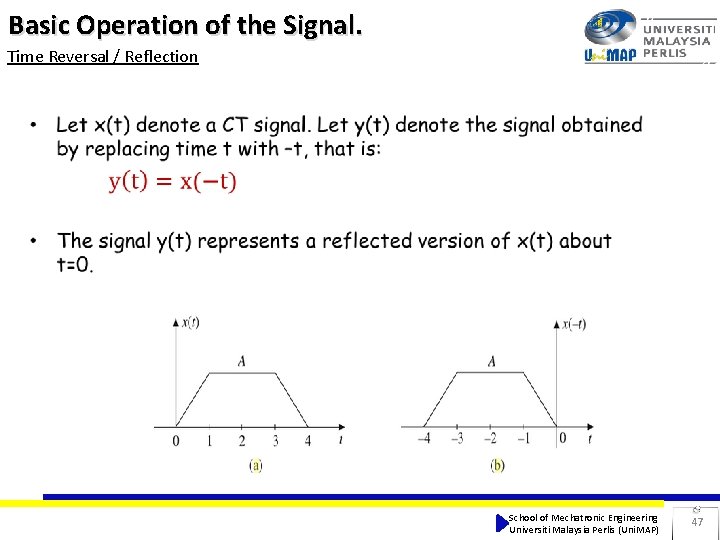
Basic Operation of the Signal. Time Reversal / Reflection School of Mechatronic Engineering Universiti Malaysia Perlis (Uni. MAP) 47
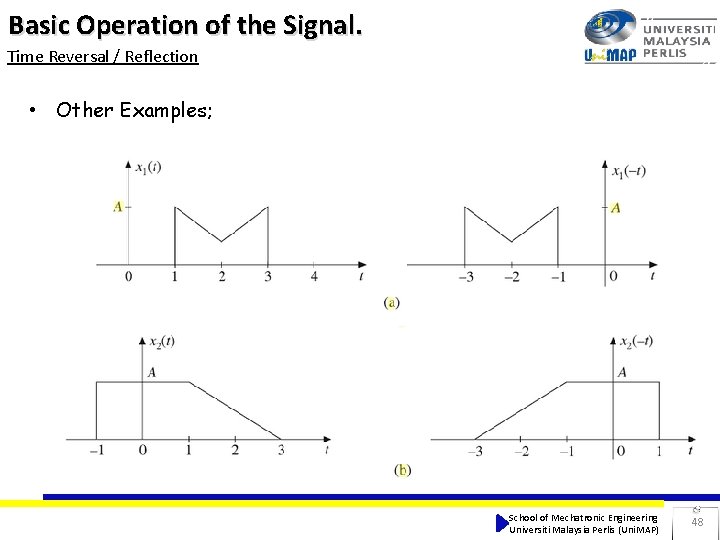
Basic Operation of the Signal. Time Reversal / Reflection • Other Examples; School of Mechatronic Engineering Universiti Malaysia Perlis (Uni. MAP) 48
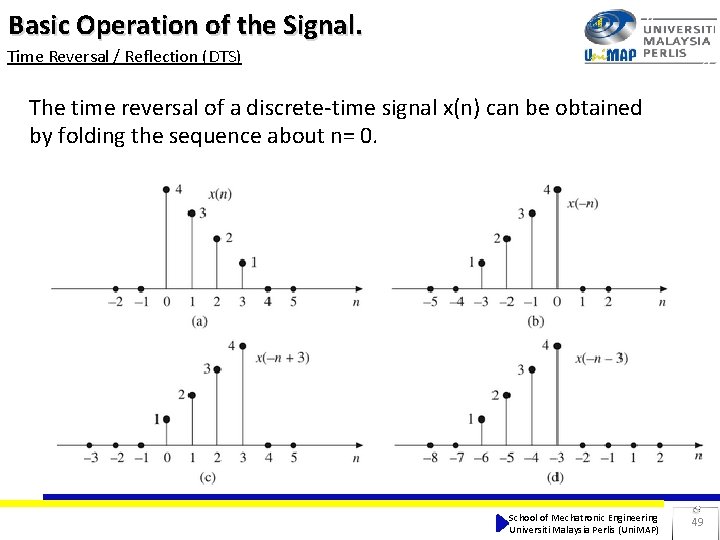
Basic Operation of the Signal. Time Reversal / Reflection (DTS) The time reversal of a discrete-time signal x(n) can be obtained by folding the sequence about n= 0. School of Mechatronic Engineering Universiti Malaysia Perlis (Uni. MAP) 49
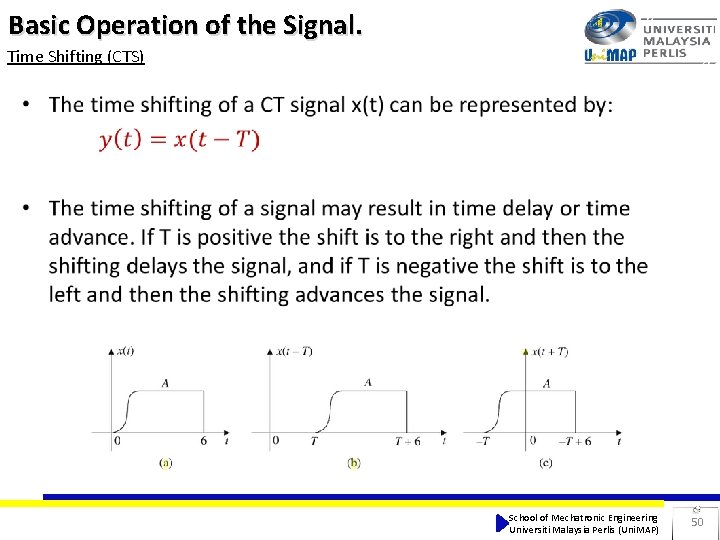
Basic Operation of the Signal. Time Shifting (CTS) School of Mechatronic Engineering Universiti Malaysia Perlis (Uni. MAP) 50
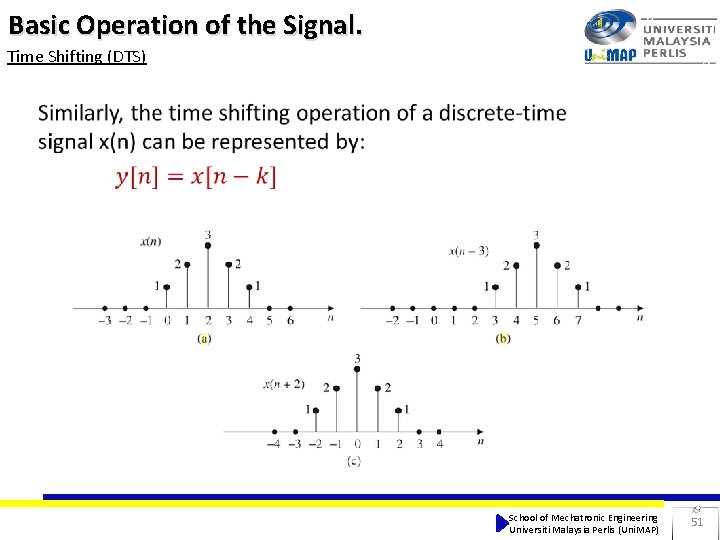
Basic Operation of the Signal. Time Shifting (DTS) School of Mechatronic Engineering Universiti Malaysia Perlis (Uni. MAP) 51
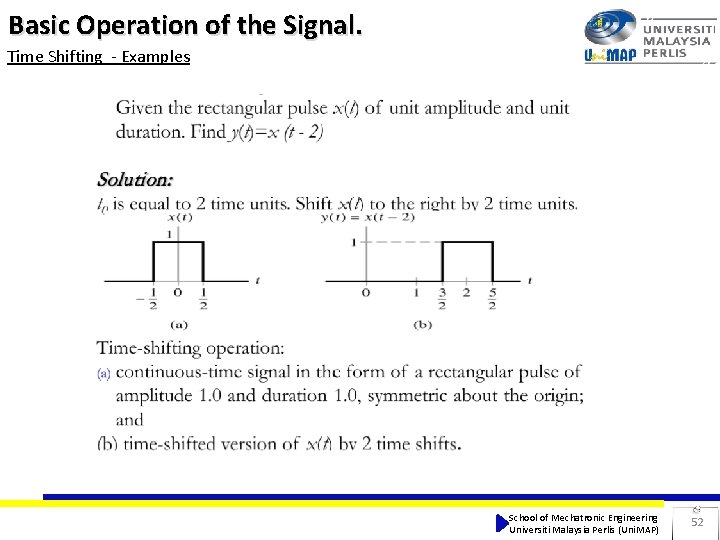
Basic Operation of the Signal. Time Shifting - Examples School of Mechatronic Engineering Universiti Malaysia Perlis (Uni. MAP) 52
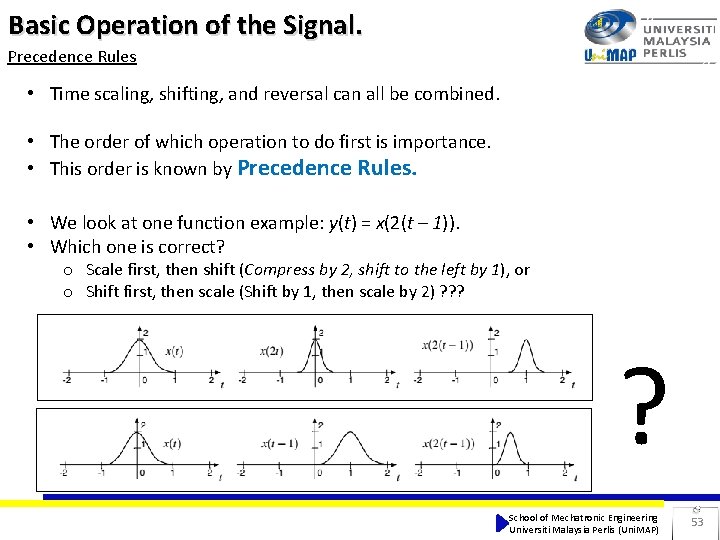
Basic Operation of the Signal. Precedence Rules • Time scaling, shifting, and reversal can all be combined. • The order of which operation to do first is importance. • This order is known by Precedence Rules. • We look at one function example: y(t) = x(2(t – 1)). • Which one is correct? o Scale first, then shift (Compress by 2, shift to the left by 1), or o Shift first, then scale (Shift by 1, then scale by 2) ? ? ? ? School of Mechatronic Engineering Universiti Malaysia Perlis (Uni. MAP) 53
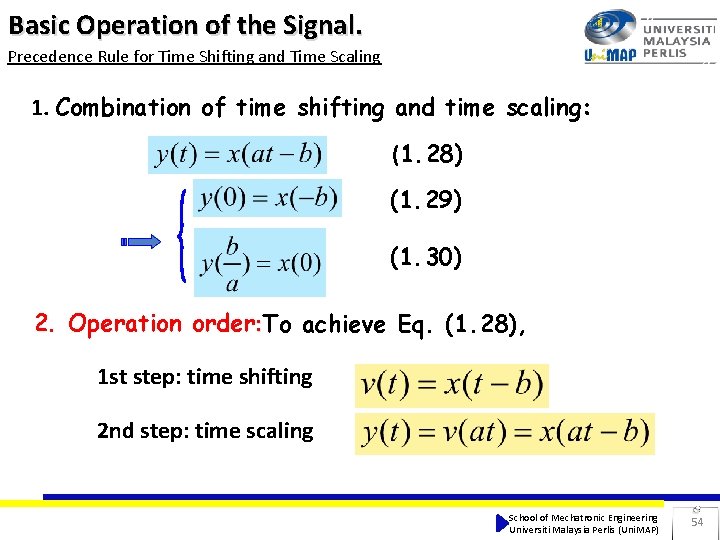
Basic Operation of the Signal. Precedence Rule for Time Shifting and Time Scaling 1. Combination of time shifting and time scaling: (1. 28) (1. 29) (1. 30) 2. Operation order: To achieve Eq. (1. 28), 1 st step: time shifting 2 nd step: time scaling School of Mechatronic Engineering Universiti Malaysia Perlis (Uni. MAP) 54
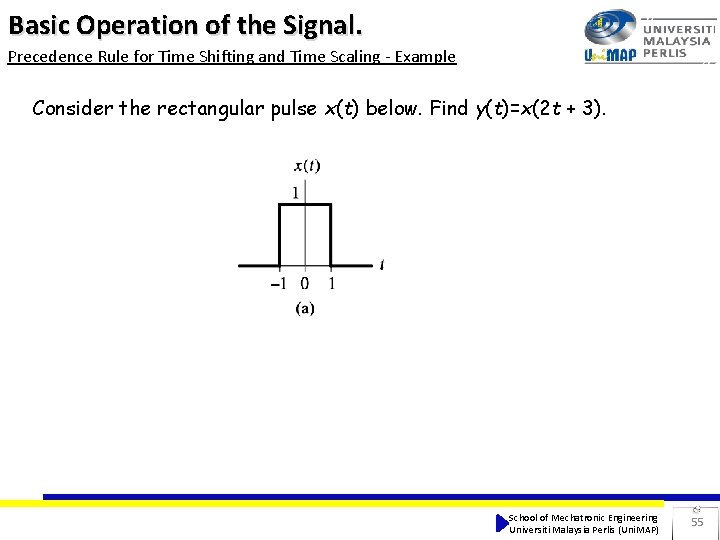
Basic Operation of the Signal. Precedence Rule for Time Shifting and Time Scaling - Example Consider the rectangular pulse x(t) below. Find y(t)=x(2 t + 3). School of Mechatronic Engineering Universiti Malaysia Perlis (Uni. MAP) 55
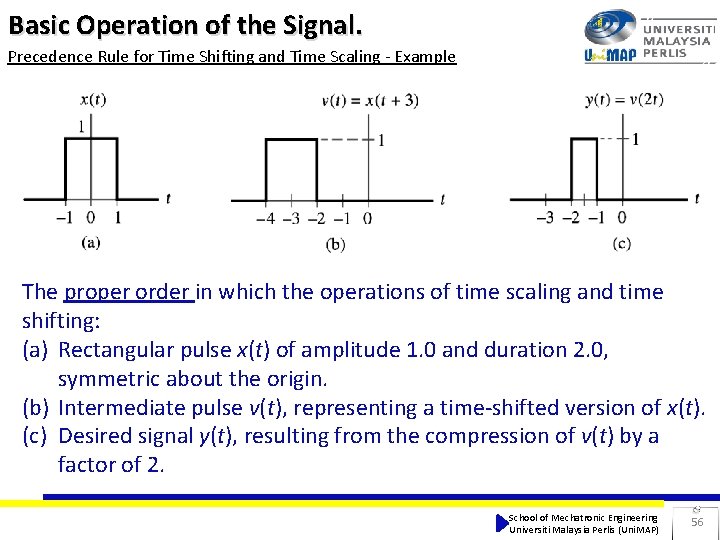
Basic Operation of the Signal. Precedence Rule for Time Shifting and Time Scaling - Example The proper order in which the operations of time scaling and time shifting: (a) Rectangular pulse x(t) of amplitude 1. 0 and duration 2. 0, symmetric about the origin. (b) Intermediate pulse v(t), representing a time-shifted version of x(t). (c) Desired signal y(t), resulting from the compression of v(t) by a factor of 2. School of Mechatronic Engineering Universiti Malaysia Perlis (Uni. MAP) 56
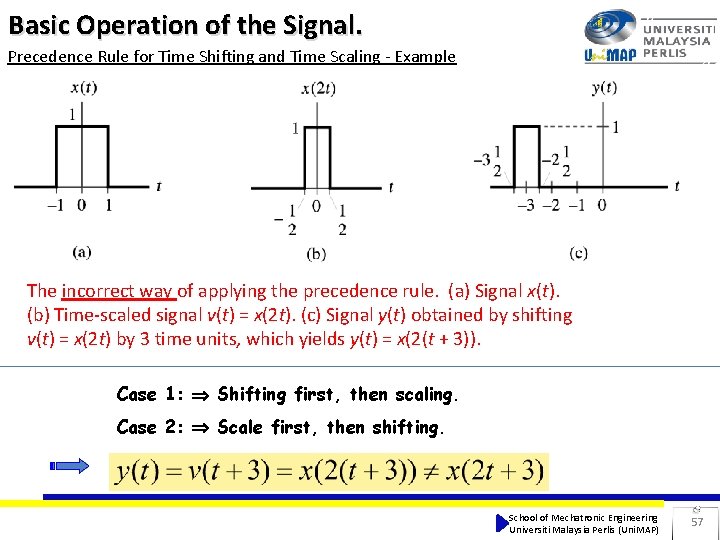
Basic Operation of the Signal. Precedence Rule for Time Shifting and Time Scaling - Example The incorrect way of applying the precedence rule. (a) Signal x(t). (b) Time-scaled signal v(t) = x(2 t). (c) Signal y(t) obtained by shifting v(t) = x(2 t) by 3 time units, which yields y(t) = x(2(t + 3)). Case 1: Shifting first, then scaling. Case 2: Scale first, then shifting. School of Mechatronic Engineering Universiti Malaysia Perlis (Uni. MAP) 57
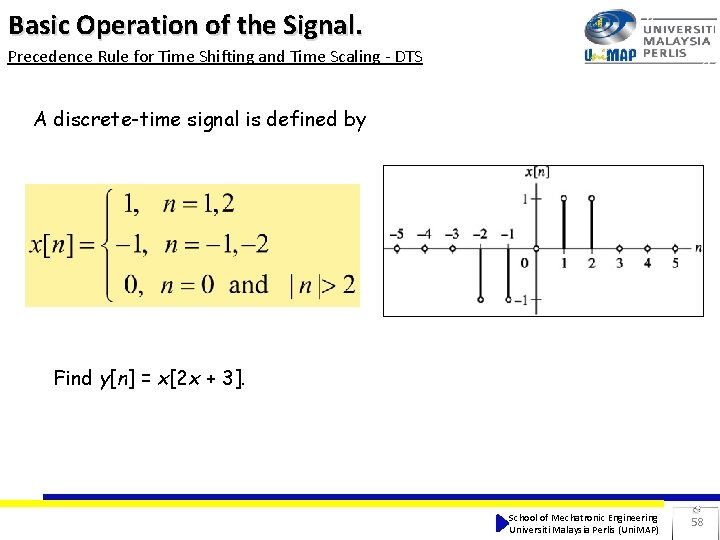
Basic Operation of the Signal. Precedence Rule for Time Shifting and Time Scaling - DTS A discrete-time signal is defined by Find y[n] = x[2 x + 3]. School of Mechatronic Engineering Universiti Malaysia Perlis (Uni. MAP) 58
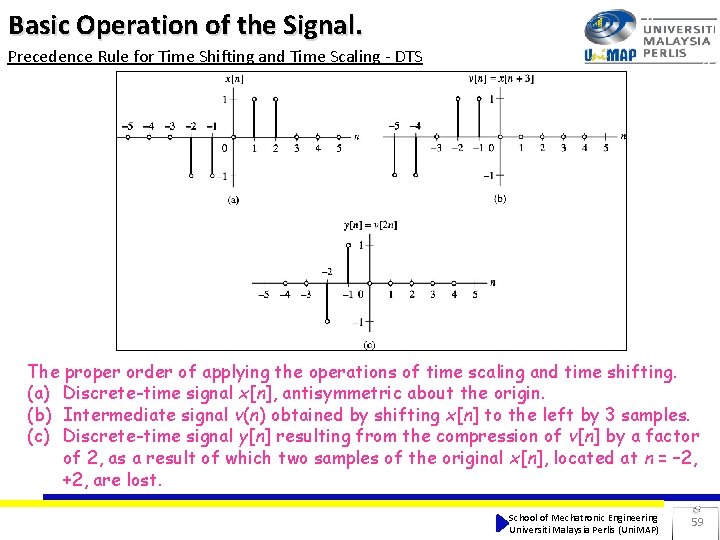
Basic Operation of the Signal. Precedence Rule for Time Shifting and Time Scaling - DTS The proper order of applying the operations of time scaling and time shifting. (a) Discrete-time signal x[n], antisymmetric about the origin. (b) Intermediate signal v(n) obtained by shifting x[n] to the left by 3 samples. (c) Discrete-time signal y[n] resulting from the compression of v[n] by a factor of 2, as a result of which two samples of the original x[n], located at n = – 2, +2, are lost. School of Mechatronic Engineering Universiti Malaysia Perlis (Uni. MAP) 59