
ENT 266 PRINCIPLES OF ENGINEERING MATERIALS SEMESTER 1



- Slides: 31
ENT 266 PRINCIPLES OF ENGINEERING MATERIALS SEMESTER 1 ACADEMIC SESSION 2017/2018 Chapter 08: Photonic Materials DR HASIMAH ALI School of Mechatronic Engineering hasimahali@unimap. edu. my
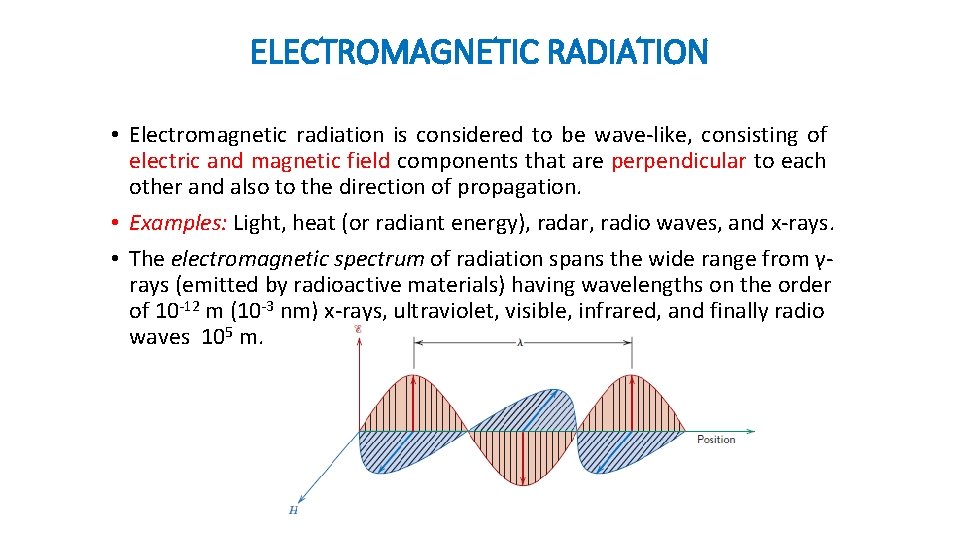
ELECTROMAGNETIC RADIATION • Electromagnetic radiation is considered to be wave-like, consisting of electric and magnetic field components that are perpendicular to each other and also to the direction of propagation. • Examples: Light, heat (or radiant energy), radar, radio waves, and x-rays. • The electromagnetic spectrum of radiation spans the wide range from γrays (emitted by radioactive materials) having wavelengths on the order of 10 -12 m (10 -3 nm) x-rays, ultraviolet, visible, infrared, and finally radio waves 105 m.
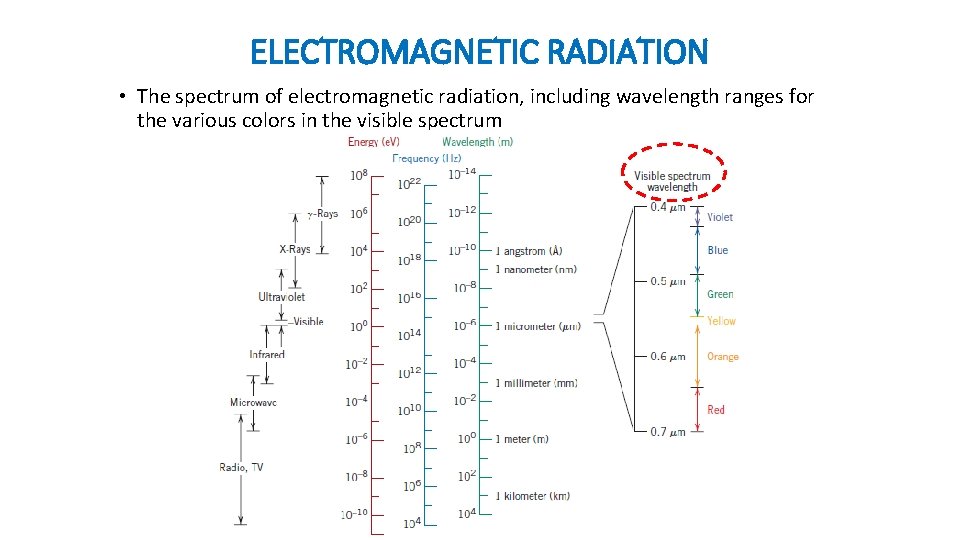
ELECTROMAGNETIC RADIATION • The spectrum of electromagnetic radiation, including wavelength ranges for the various colors in the visible spectrum
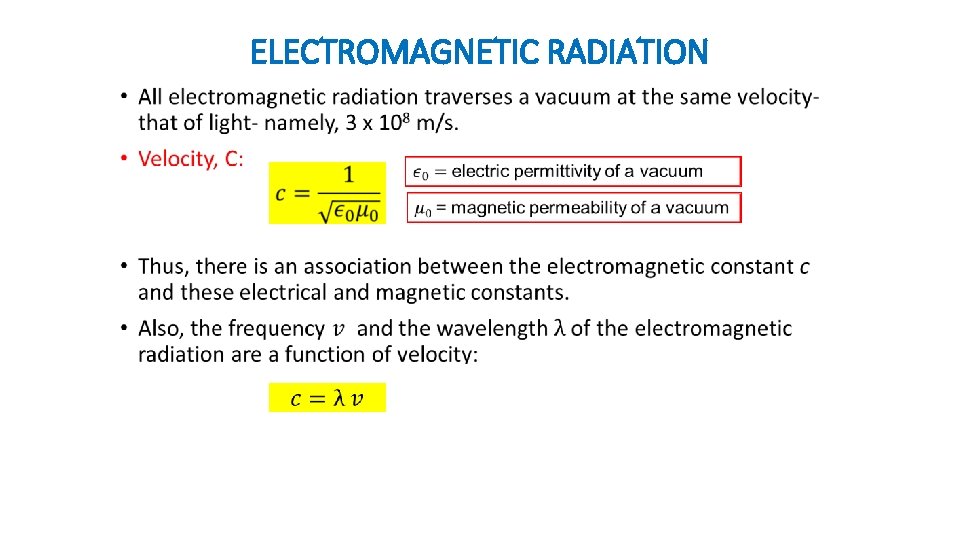
ELECTROMAGNETIC RADIATION •
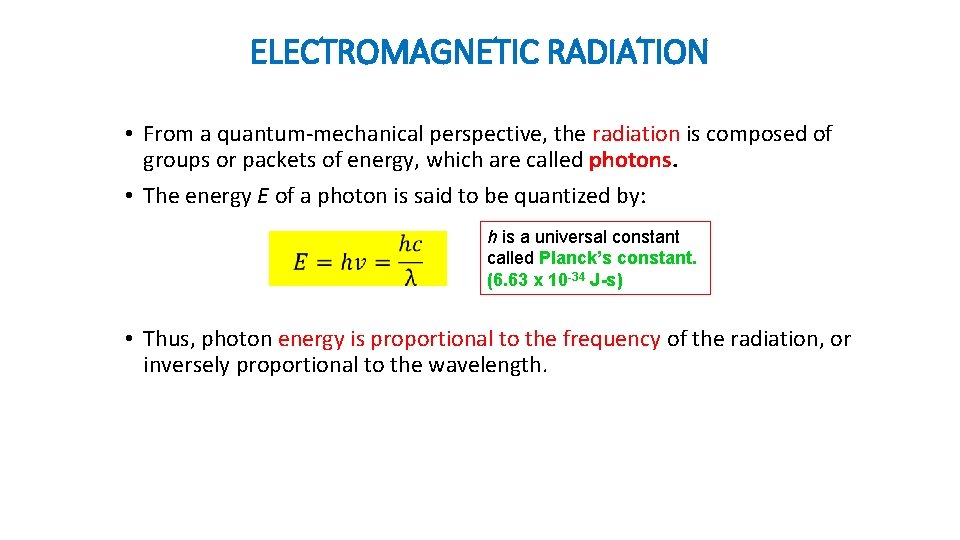
ELECTROMAGNETIC RADIATION • From a quantum-mechanical perspective, the radiation is composed of groups or packets of energy, which are called photons. • The energy E of a photon is said to be quantized by: h is a universal constant called Planck’s constant. (6. 63 x 10 -34 J-s) • Thus, photon energy is proportional to the frequency of the radiation, or inversely proportional to the wavelength.
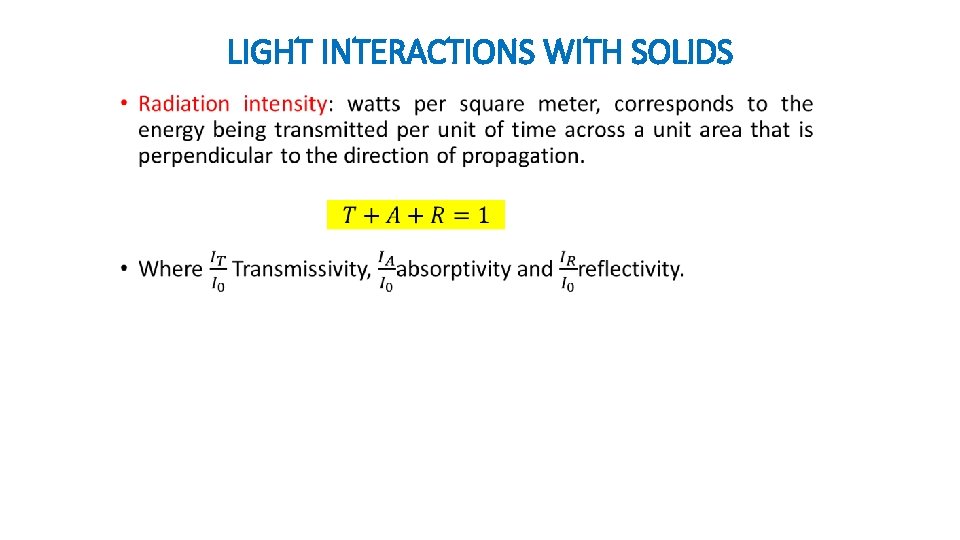
LIGHT INTERACTIONS WITH SOLIDS •
LIGHT INTERACTIONS WITH SOLIDS •
LIGHT INTERACTIONS WITH SOLIDS • Materials that are capable of transmitting light with relatively little absorption and reflection are transparent—one can see through them. (Object that allow light to pass through them) • Translucent materials are those through which light is transmitted diffusely; that is, light is scattered within the interior, to the degree that objects are not clearly distinguishable when viewed through a specimen of the material. (Objects that are partially transparent and partially opaque are called translucent objects. They allow light to pass through them in a scattered or diffused manner. ) • Materials that are impervious to the transmission of visible light are termed opaque. (Objects that do not allow any light to pass through them are called opaque object)
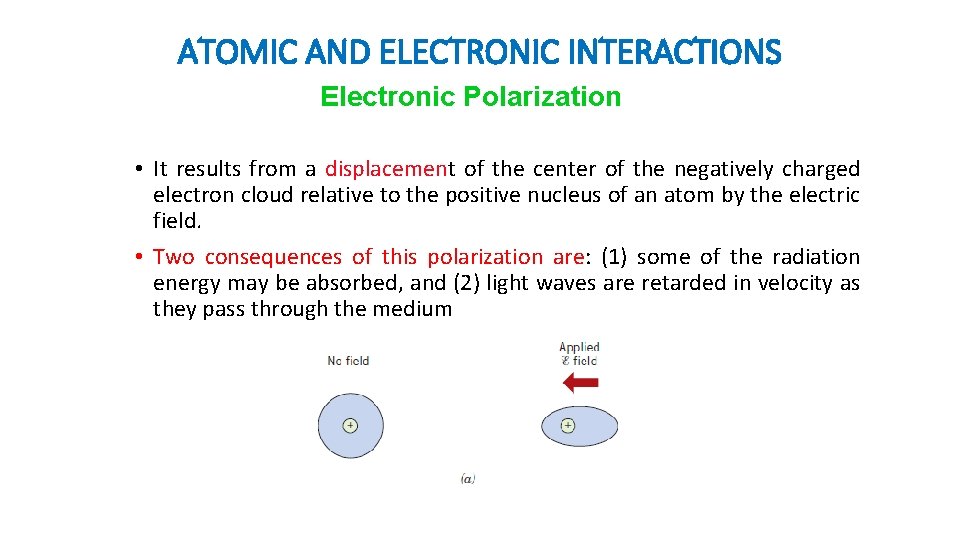
ATOMIC AND ELECTRONIC INTERACTIONS Electronic Polarization • The optical phenomena that occur within solid materials involve interactions between the electromagnetic radiation and atoms, ions, and/or electrons. • Two of the most important of these interactions are electronic polarization and electron energy transitions. • Polarization is the alignment of permanent or induced atomic or molecular dipole moments with an externally applied electric field. • For the visible range of frequencies, this electric field interacts with the electron cloud surrounding each atom within its path in such a way as to induce electronic polarization, or to shift the electron cloud relative to the nucleus of the atom with each change in direction of electric field component
ATOMIC AND ELECTRONIC INTERACTIONS Electronic Polarization • It results from a displacement of the center of the negatively charged electron cloud relative to the positive nucleus of an atom by the electric field. • Two consequences of this polarization are: (1) some of the radiation energy may be absorbed, and (2) light waves are retarded in velocity as they pass through the medium
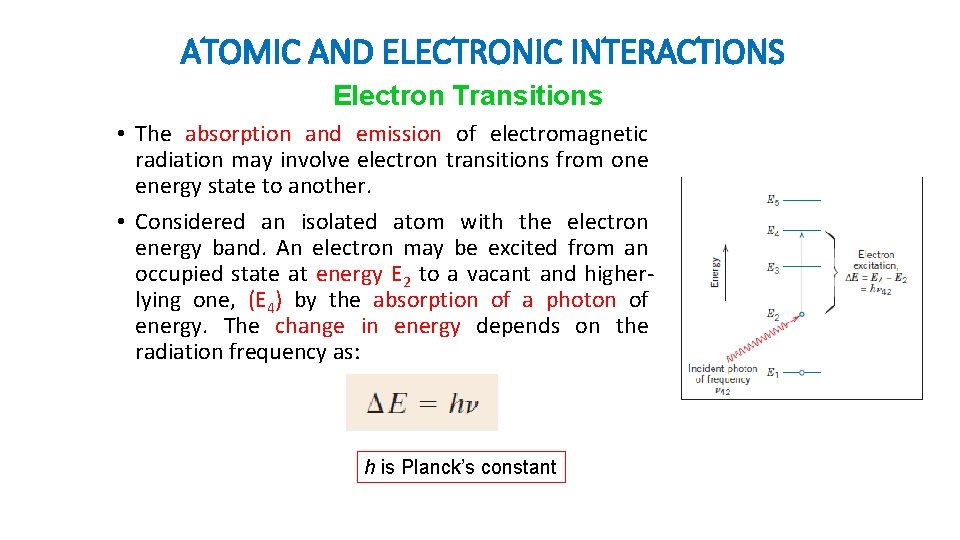
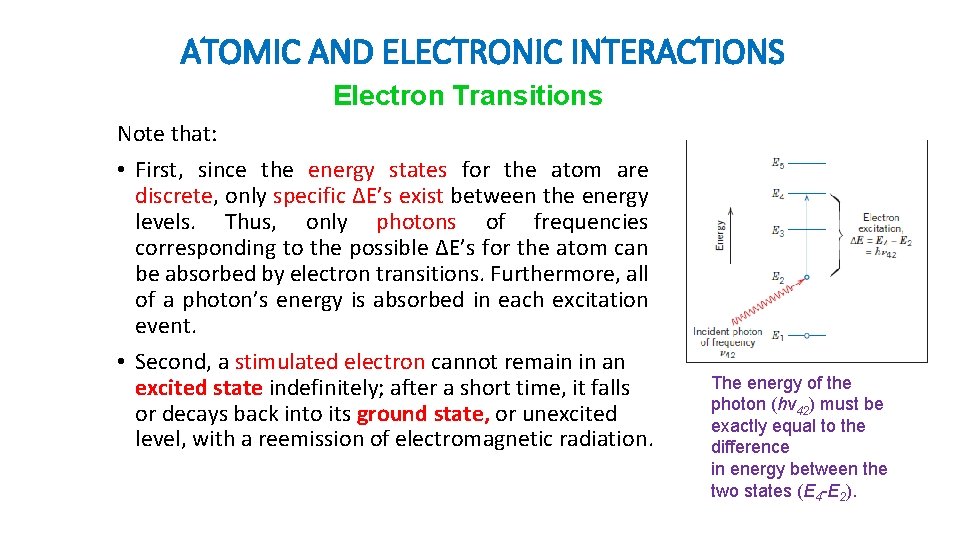
ATOMIC AND ELECTRONIC INTERACTIONS Electron Transitions • The absorption and emission of electromagnetic radiation may involve electron transitions from one energy state to another. • Considered an isolated atom with the electron energy band. An electron may be excited from an occupied state at energy E 2 to a vacant and higherlying one, (E 4) by the absorption of a photon of energy. The change in energy depends on the radiation frequency as: h is Planck’s constant
ATOMIC AND ELECTRONIC INTERACTIONS Electron Transitions Note that: • First, since the energy states for the atom are discrete, only specific ∆E’s exist between the energy levels. Thus, only photons of frequencies corresponding to the possible ∆E’s for the atom can be absorbed by electron transitions. Furthermore, all of a photon’s energy is absorbed in each excitation event. • Second, a stimulated electron cannot remain in an excited state indefinitely; after a short time, it falls or decays back into its ground state, or unexcited level, with a reemission of electromagnetic radiation. The energy of the photon (hv 42) must be exactly equal to the difference in energy between the two states (E 4 -E 2).
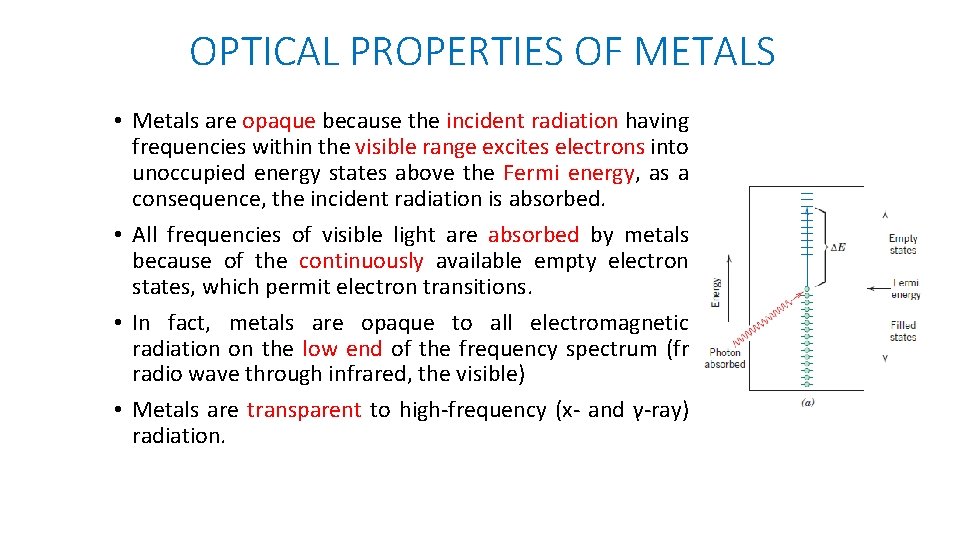
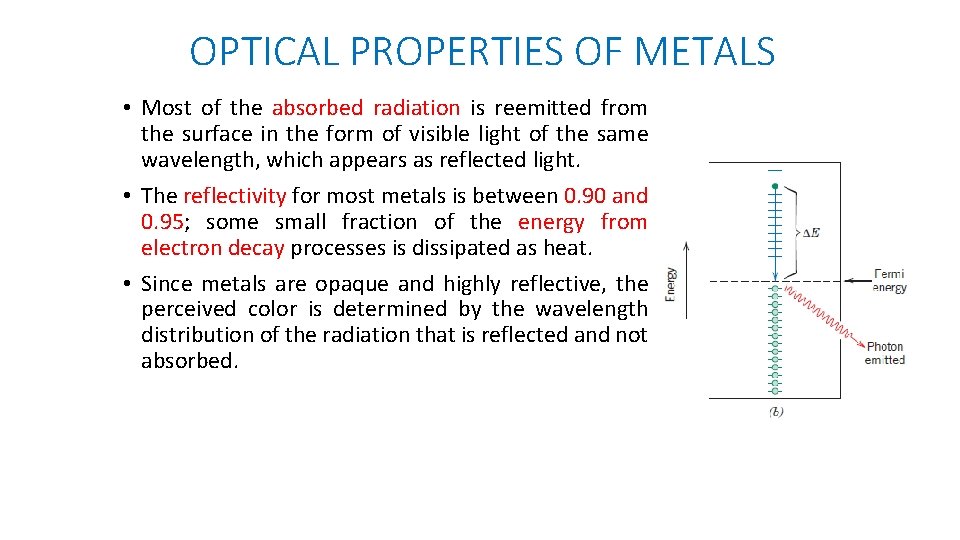
OPTICAL PROPERTIES OF METALS • Metals are opaque because the incident radiation having frequencies within the visible range excites electrons into unoccupied energy states above the Fermi energy, as a consequence, the incident radiation is absorbed. • All frequencies of visible light are absorbed by metals because of the continuously available empty electron states, which permit electron transitions. • In fact, metals are opaque to all electromagnetic radiation on the low end of the frequency spectrum (fr radio wave through infrared, the visible) • Metals are transparent to high-frequency (x- and γ-ray) radiation.
OPTICAL PROPERTIES OF METALS • Most of the absorbed radiation is reemitted from the surface in the form of visible light of the same wavelength, which appears as reflected light. • The reflectivity for most metals is between 0. 90 and 0. 95; some small fraction of the energy from electron decay processes is dissipated as heat. • Since metals are opaque and highly reflective, the perceived color is determined by the wavelength distribution of the radiation that is reflected and not absorbed.
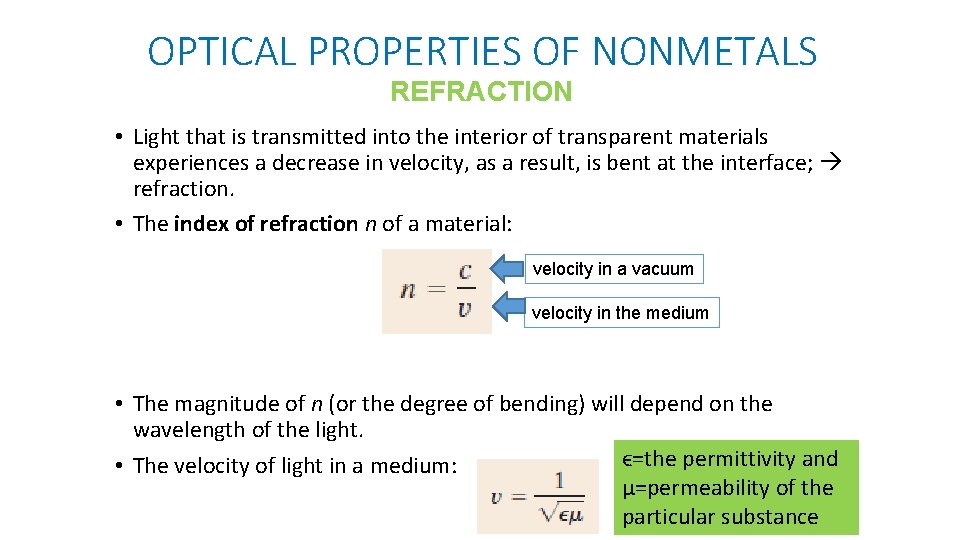
OPTICAL PROPERTIES OF NONMETALS REFRACTION • Light that is transmitted into the interior of transparent materials experiences a decrease in velocity, as a result, is bent at the interface; refraction. • The index of refraction n of a material: velocity in a vacuum velocity in the medium • The magnitude of n (or the degree of bending) will depend on the wavelength of the light. ϵ=the permittivity and • The velocity of light in a medium: μ=permeability of the particular substance
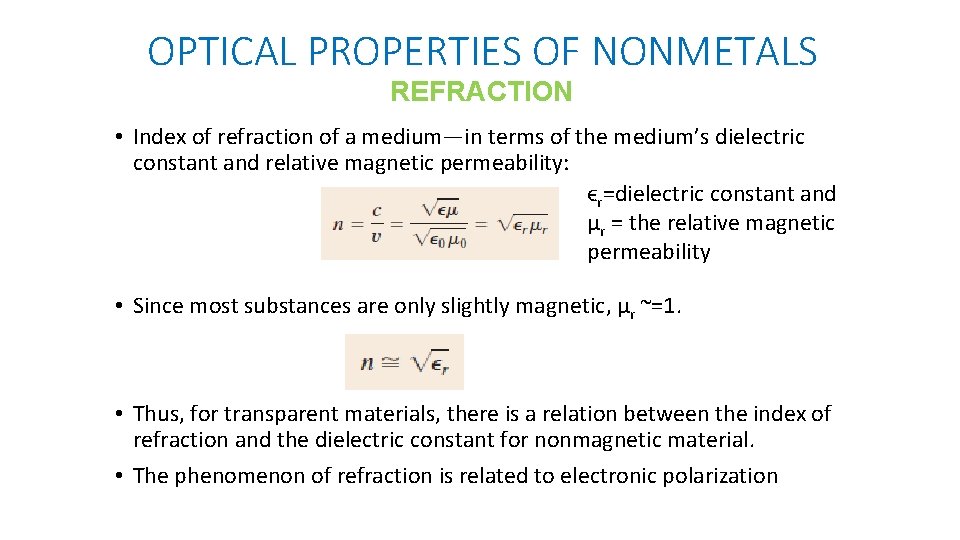
OPTICAL PROPERTIES OF NONMETALS REFRACTION • Index of refraction of a medium—in terms of the medium’s dielectric constant and relative magnetic permeability: ϵr=dielectric constant and μr = the relative magnetic permeability • Since most substances are only slightly magnetic, μr ~=1. • Thus, for transparent materials, there is a relation between the index of refraction and the dielectric constant for nonmagnetic material. • The phenomenon of refraction is related to electronic polarization
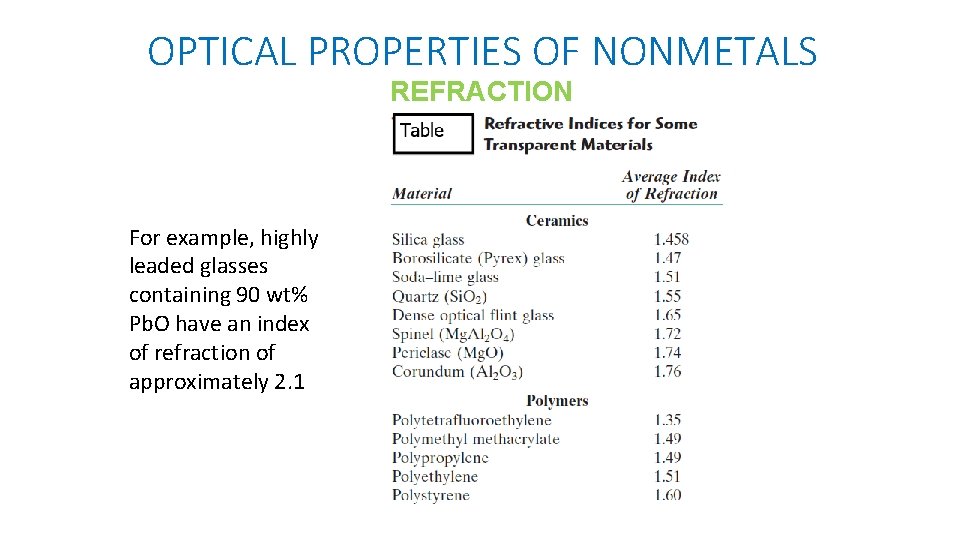
OPTICAL PROPERTIES OF NONMETALS REFRACTION For example, highly leaded glasses containing 90 wt% Pb. O have an index of refraction of approximately 2. 1
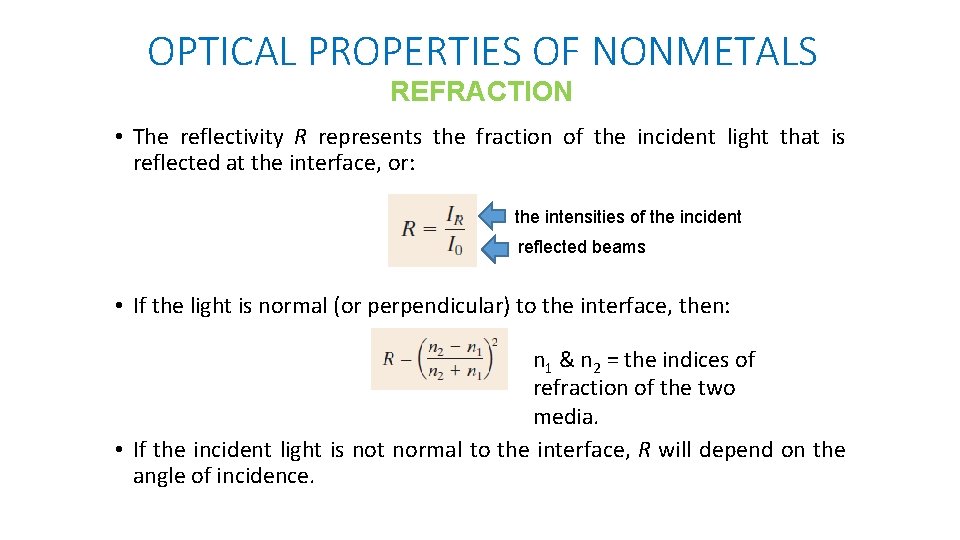
OPTICAL PROPERTIES OF NONMETALS REFRACTION • The reflectivity R represents the fraction of the incident light that is reflected at the interface, or: the intensities of the incident reflected beams • If the light is normal (or perpendicular) to the interface, then: n 1 & n 2 = the indices of refraction of the two media. • If the incident light is not normal to the interface, R will depend on the angle of incidence.
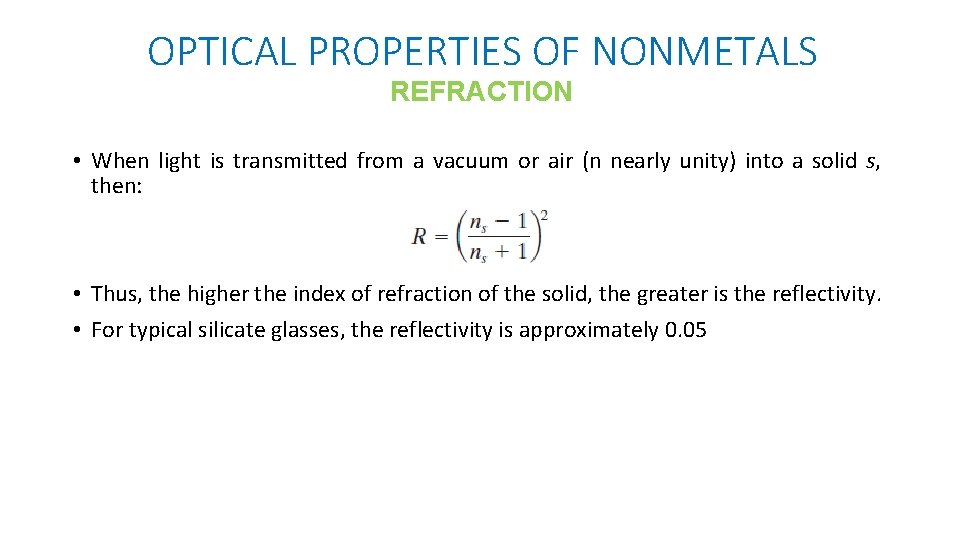
OPTICAL PROPERTIES OF NONMETALS REFRACTION • When light is transmitted from a vacuum or air (n nearly unity) into a solid s, then: • Thus, the higher the index of refraction of the solid, the greater is the reflectivity. • For typical silicate glasses, the reflectivity is approximately 0. 05
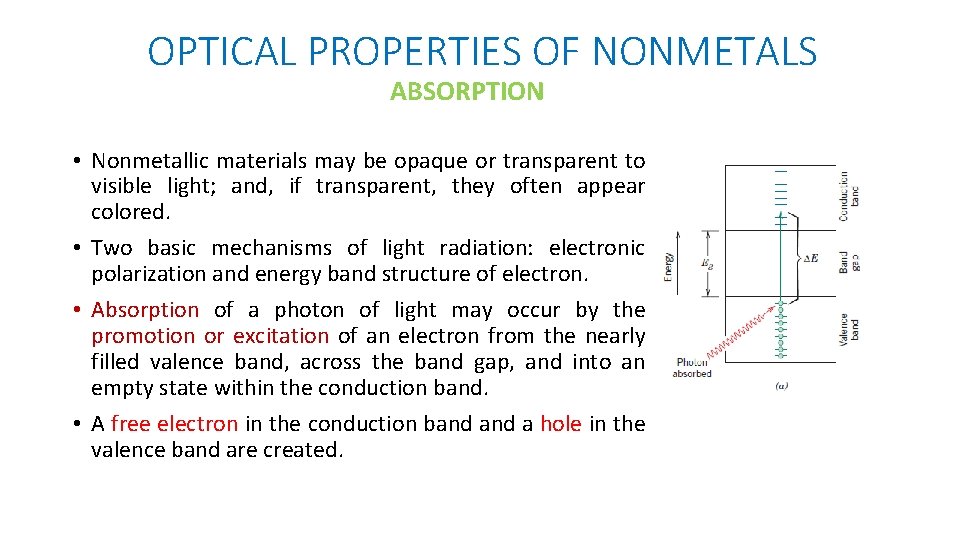
OPTICAL PROPERTIES OF NONMETALS ABSORPTION • Nonmetallic materials may be opaque or transparent to visible light; and, if transparent, they often appear colored. • Two basic mechanisms of light radiation: electronic polarization and energy band structure of electron. • Absorption of a photon of light may occur by the promotion or excitation of an electron from the nearly filled valence band, across the band gap, and into an empty state within the conduction band. • A free electron in the conduction band a hole in the valence band are created.
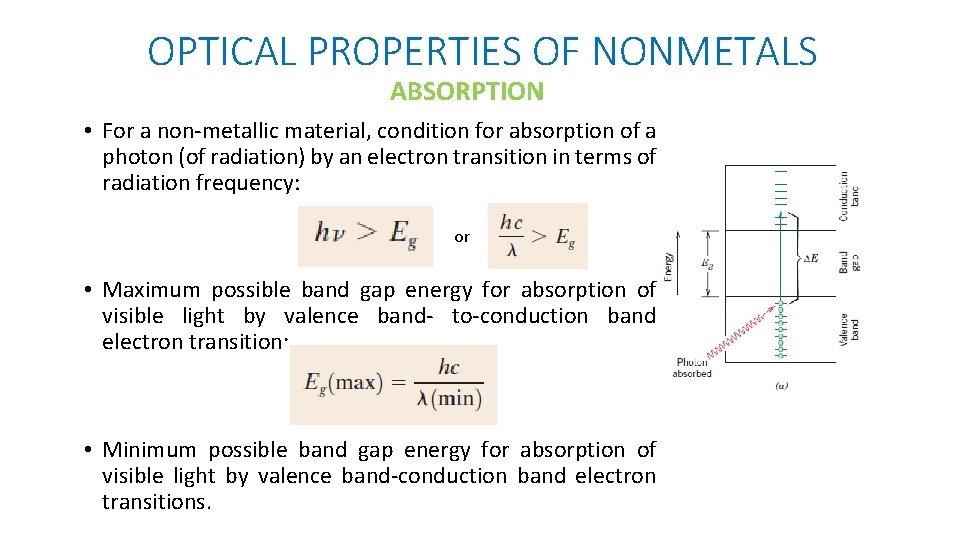
OPTICAL PROPERTIES OF NONMETALS ABSORPTION • For a non-metallic material, condition for absorption of a photon (of radiation) by an electron transition in terms of radiation frequency: or • Maximum possible band gap energy for absorption of visible light by valence band- to-conduction band electron transition: • Minimum possible band gap energy for absorption of visible light by valence band-conduction band electron transitions.
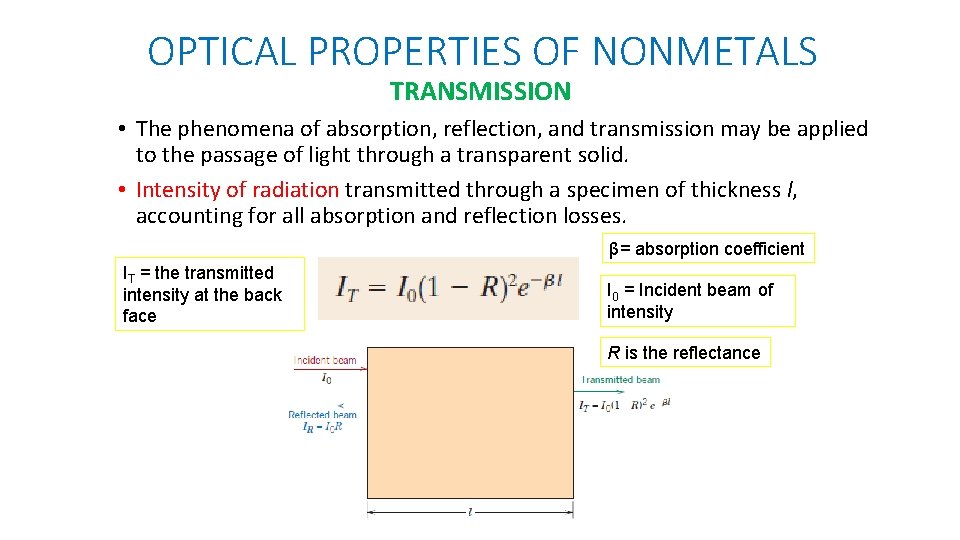
OPTICAL PROPERTIES OF NONMETALS TRANSMISSION • The phenomena of absorption, reflection, and transmission may be applied to the passage of light through a transparent solid. • Intensity of radiation transmitted through a specimen of thickness l, accounting for all absorption and reflection losses. β= absorption coefficient IT = the transmitted intensity at the back face I 0 = Incident beam of intensity R is the reflectance
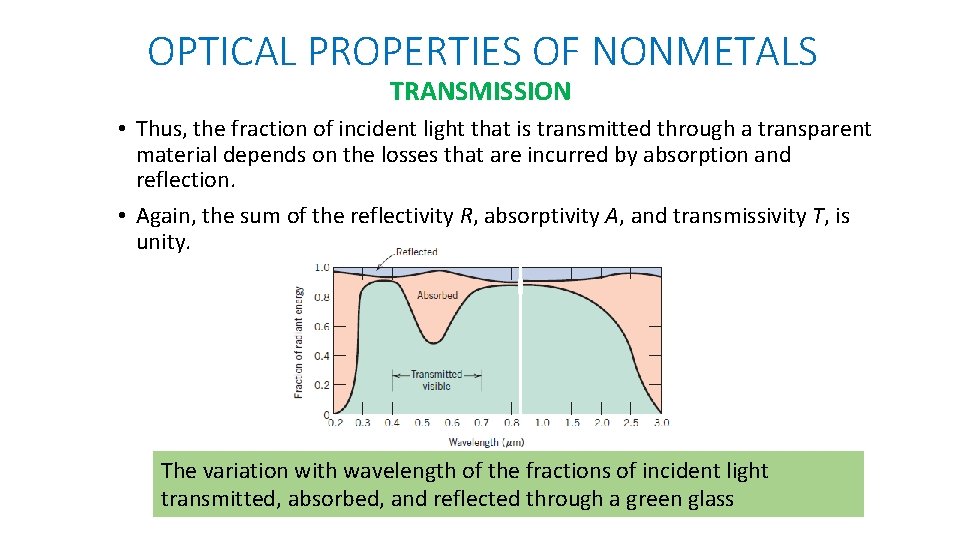
OPTICAL PROPERTIES OF NONMETALS TRANSMISSION • Thus, the fraction of incident light that is transmitted through a transparent material depends on the losses that are incurred by absorption and reflection. • Again, the sum of the reflectivity R, absorptivity A, and transmissivity T, is unity. The variation with wavelength of the fractions of incident light transmitted, absorbed, and reflected through a green glass
Applications of Optical Phenomena OPTICAL FIBERS IN COMMUNICATIONS • At present, virtually all telecommunications are transmitted via this medium rather than through copper wires. • Signal transmission through a metallic wire conductor is electronic (i. e. , by electrons), whereas using optically transparent fibers, signal transmission is photonic, meaning that it uses photons of electromagnetic or light radiation. • Use of fiber-optic systems has improved speed of transmission, information density, and transmission distance, with a reduction in error rate; furthermore, there is no electromagnetic interference with fiber optics. • Regards to speeds, two small optical fibers can transmit the equivalent of 24, 000 telephone calls simultaneously
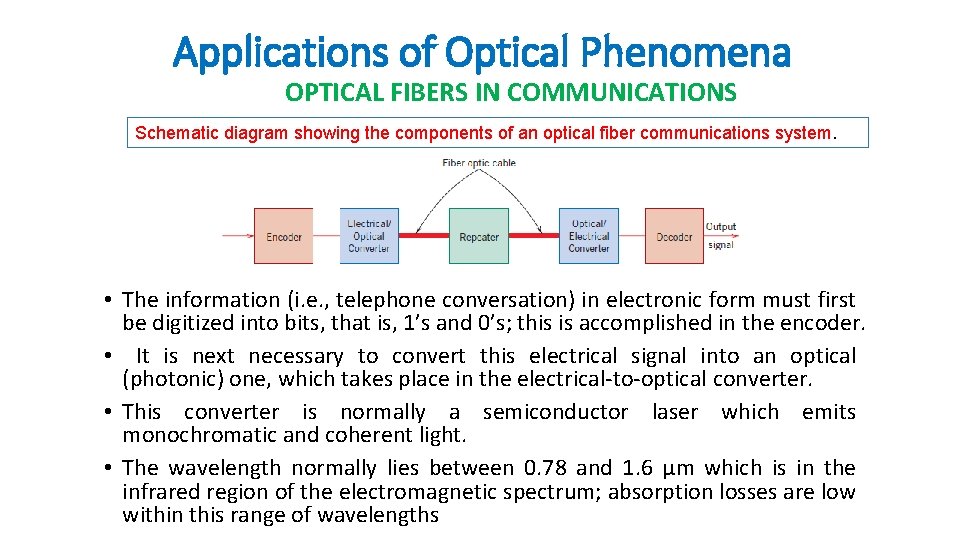
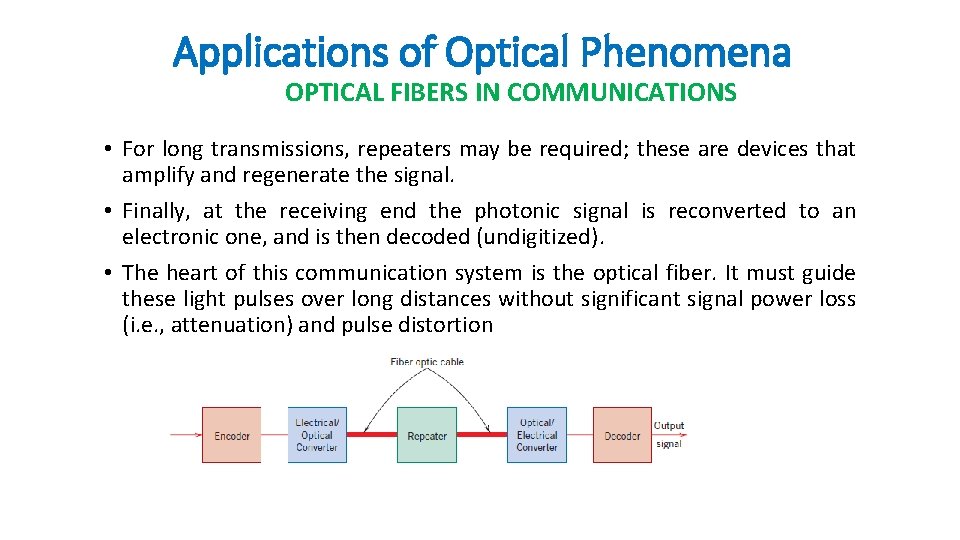
Applications of Optical Phenomena OPTICAL FIBERS IN COMMUNICATIONS Schematic diagram showing the components of an optical fiber communications system. • The information (i. e. , telephone conversation) in electronic form must first be digitized into bits, that is, 1’s and 0’s; this is accomplished in the encoder. • It is next necessary to convert this electrical signal into an optical (photonic) one, which takes place in the electrical-to-optical converter. • This converter is normally a semiconductor laser which emits monochromatic and coherent light. • The wavelength normally lies between 0. 78 and 1. 6 μm which is in the infrared region of the electromagnetic spectrum; absorption losses are low within this range of wavelengths
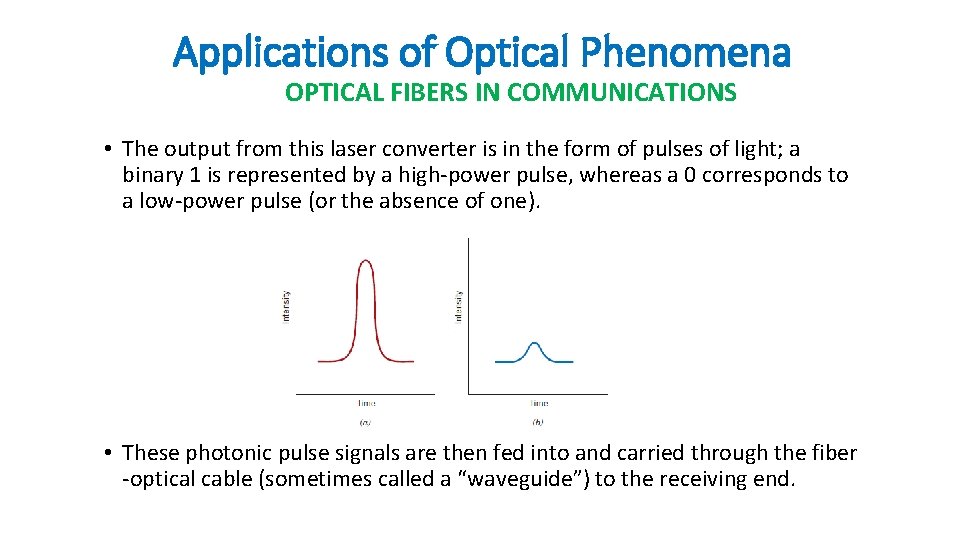
Applications of Optical Phenomena OPTICAL FIBERS IN COMMUNICATIONS • The output from this laser converter is in the form of pulses of light; a binary 1 is represented by a high-power pulse, whereas a 0 corresponds to a low-power pulse (or the absence of one). • These photonic pulse signals are then fed into and carried through the fiber -optical cable (sometimes called a “waveguide”) to the receiving end.
Applications of Optical Phenomena OPTICAL FIBERS IN COMMUNICATIONS • For long transmissions, repeaters may be required; these are devices that amplify and regenerate the signal. • Finally, at the receiving end the photonic signal is reconverted to an electronic one, and is then decoded (undigitized). • The heart of this communication system is the optical fiber. It must guide these light pulses over long distances without significant signal power loss (i. e. , attenuation) and pulse distortion
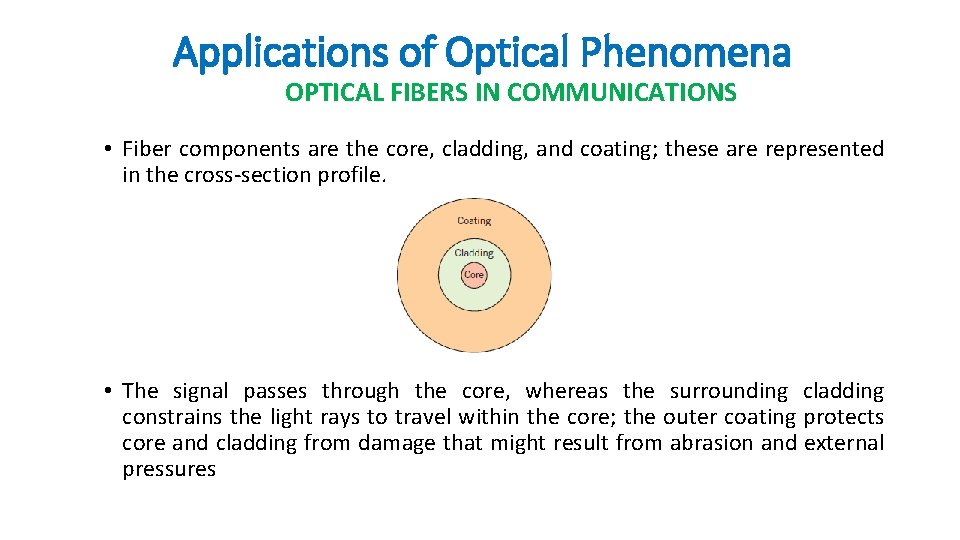
Applications of Optical Phenomena OPTICAL FIBERS IN COMMUNICATIONS • Fiber components are the core, cladding, and coating; these are represented in the cross-section profile. • The signal passes through the core, whereas the surrounding cladding constrains the light rays to travel within the core; the outer coating protects core and cladding from damage that might result from abrasion and external pressures
Applications of Optical Phenomena OPTICAL FIBERS IN COMMUNICATIONS • High-purity silica glass is used as the fiber material; fiber diameters normally range between about 5 and 100 μm. The fibers are relatively flaw free and, thus, remarkably strong; during production the continuous fibers are tested to ensure that they meet minimum strength standards. • Containment of the light to within the fiber core is made possible by total internal reflection; that is, any light rays traveling at oblique angles to the fiber axis are reflected back into the core. • Internal reflection is accomplished by varying the index of refraction of the core and cladding glass materials
Applications of Optical Phenomena OPTICAL FIBERS IN COMMUNICATIONS Step-index optical fiber design Fiber cross section Fiber radial index of refraction profile Input light pulse Internal reflection of light rays Output light pulse • The output pulse will be broader than the input one. Pulse broadening results because various light rays, although being injected at approximately the same instant, arrive at the output at different times; they traverse different trajectories and, thus, have a variety of path lengths
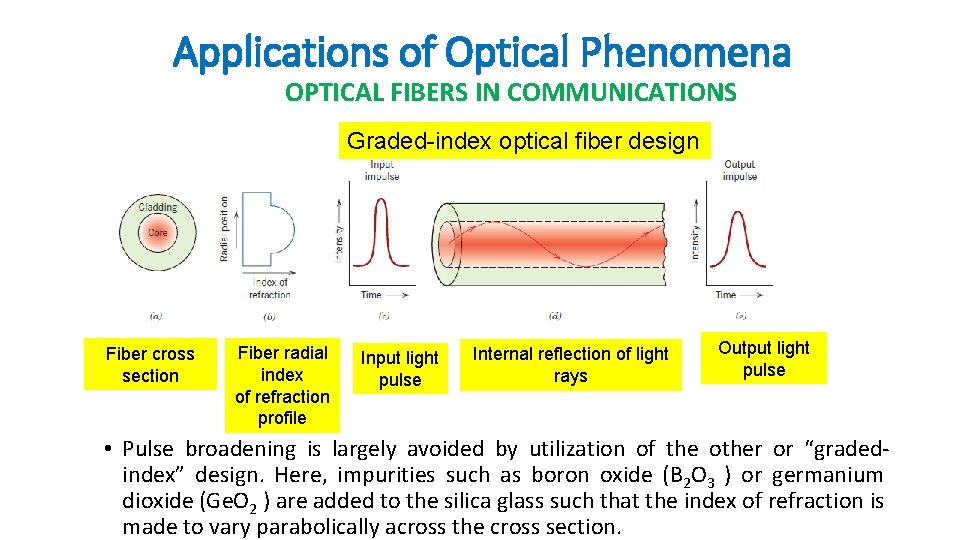
Applications of Optical Phenomena OPTICAL FIBERS IN COMMUNICATIONS Graded-index optical fiber design Fiber cross section Fiber radial index of refraction profile Input light pulse Internal reflection of light rays Output light pulse • Pulse broadening is largely avoided by utilization of the other or “gradedindex” design. Here, impurities such as boron oxide (B 2 O 3 ) or germanium dioxide (Ge. O 2 ) are added to the silica glass such that the index of refraction is made to vary parabolically across the cross section.