
ENT 253 MECHANICAL DESIGN Lecture 13 4042011 Flexible
ENT 253 MECHANICAL DESIGN Lecture 13 4/04/2011 Flexible Mechanical Elements Dr. HAFTIRMAN MECHANICAL ENGINEERING PROGRAM SCHOOL OF MECHATRONIC ENGINEERING Uni. MAP DR. HAFTIRMAN School of Mechatronic ENT 253 MECHANICAL DESIGN I SEM 2 -2010/2011 1
CO 3: Ability to design and analyze mechanical components such as gears, clutches, shaft, bearing, screw, and spring. DR. HAFTIRMAN School of Mechatronic ENT 253 MECHANICAL DESIGN I SEM 2 -2010/2011 2
INTRODUCTION • Belts, ropes, chains, and other similar elastic or flexible machine elements are used in conveying systems and in the transmission of power over comparatively long distances. • In often happens that these elements can be used as a replacement for gears, shafts, bearings, and other relatively rigid power transmission devices. DR. HAFTIRMAN School of Mechatronic ENT 253 MECHANICAL DESIGN I SEM 2 -2010/2011 3
Flexible mechanical elements Chapter outline 1. Belts 2. Flat and belt drives 3. Flat metal belts 4. V belts 5. Timing belts DR. HAFTIRMAN School of Mechatronic ENT 253 MECHANICAL DESIGN I SEM 2 -2010/2011 4
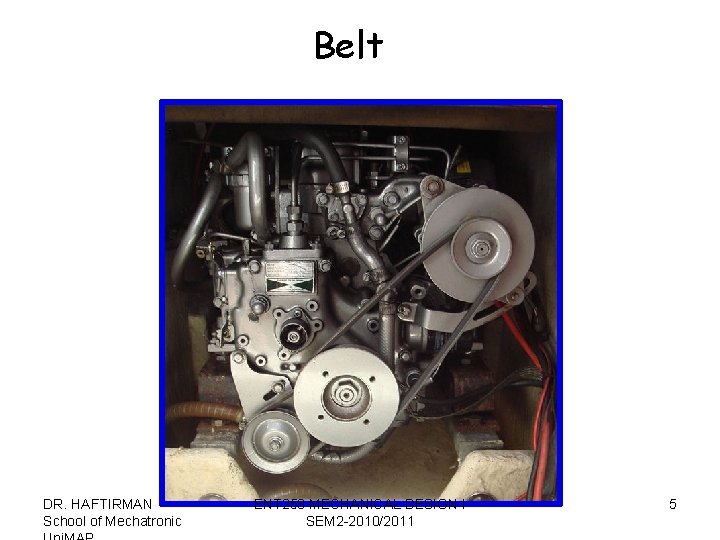
Belt DR. HAFTIRMAN School of Mechatronic ENT 253 MECHANICAL DESIGN I SEM 2 -2010/2011 5
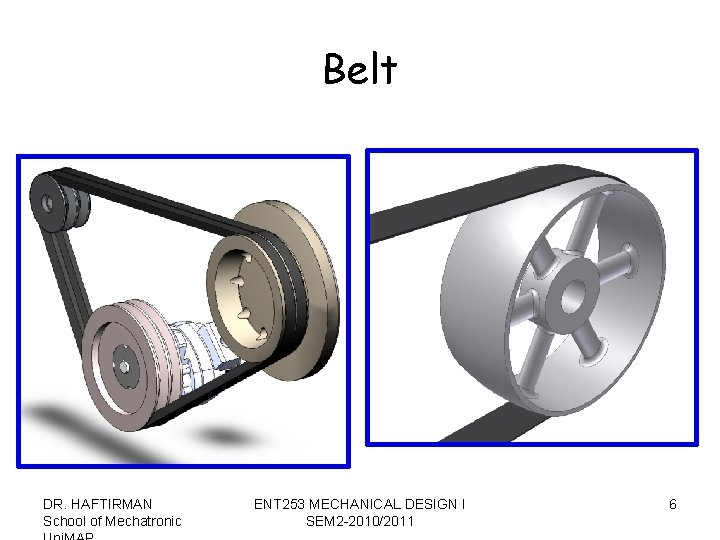
Belt DR. HAFTIRMAN School of Mechatronic ENT 253 MECHANICAL DESIGN I SEM 2 -2010/2011 6
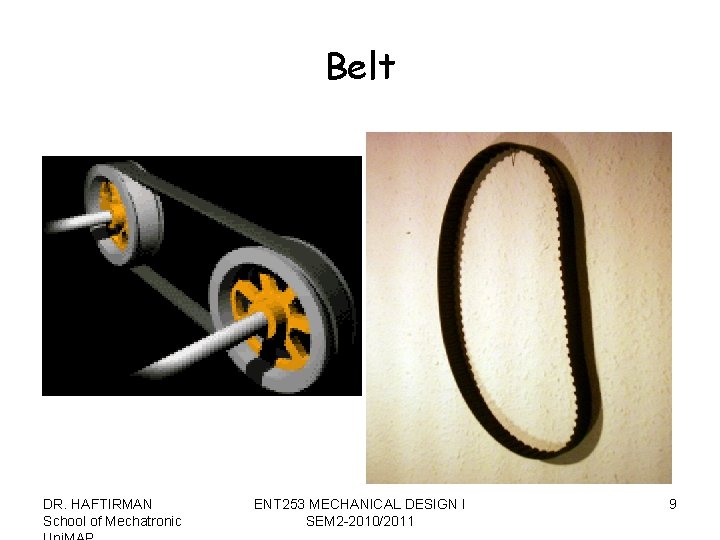
Belt • Belts are the cheapest utility for power transmission between shafts that may not be parallel. • Power transmission is achieved by specially designed belts and pulleys. • They run smoothly and with little noise, and cushion motor and bearings against load changes, albeit with less strength than gears or chains. However, improvements in belt engineering allow use of belts in systems that only formerly allowed chains or gears. DR. HAFTIRMAN School of Mechatronic ENT 253 MECHANICAL DESIGN I SEM 2 -2010/2011 7
Belt • Belt drive, moreover, is simple, inexpensive, and does not require parallel shafts. It helps protect the car from overload and jam, and damping it from noise and vibration. • Load fluctuations are shock-absorbed (cushioned). They need no lubrication and minimal maintenance. They have high efficiency (90 -98%, usually 95%), high tolerance for misalignment, and are inexpensive if the shafts are far apart. • Clutch action is activated by releasing belt tension. DR. HAFTIRMAN School of Mechatronic ENT 253 MECHANICAL DESIGN I SEM 2 -2010/2011 8
Belt DR. HAFTIRMAN School of Mechatronic ENT 253 MECHANICAL DESIGN I SEM 2 -2010/2011 9
DR. HAFTIRMAN School of Mechatronic ENT 253 MECHANICAL DESIGN I SEM 2 -2010/2011 10
DR. HAFTIRMAN School of Mechatronic ENT 253 MECHANICAL DESIGN I SEM 2 -2010/2011 11
DR. HAFTIRMAN School of Mechatronic ENT 253 MECHANICAL DESIGN I SEM 2 -2010/2011 12
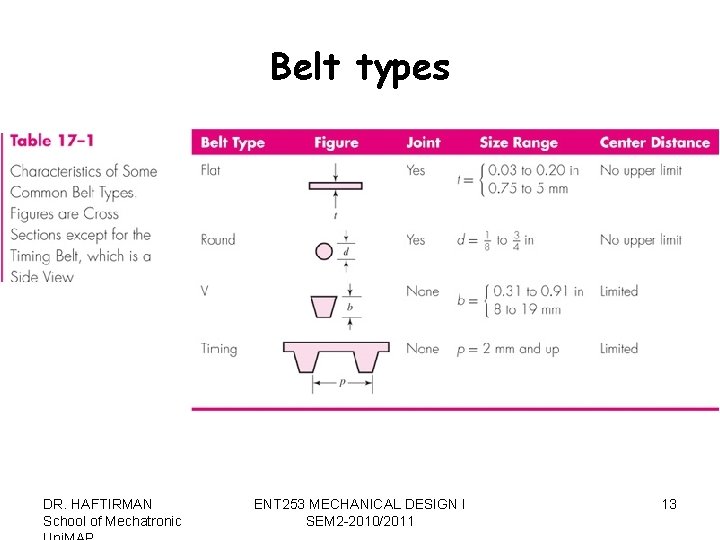
Belt types DR. HAFTIRMAN School of Mechatronic ENT 253 MECHANICAL DESIGN I SEM 2 -2010/2011 13
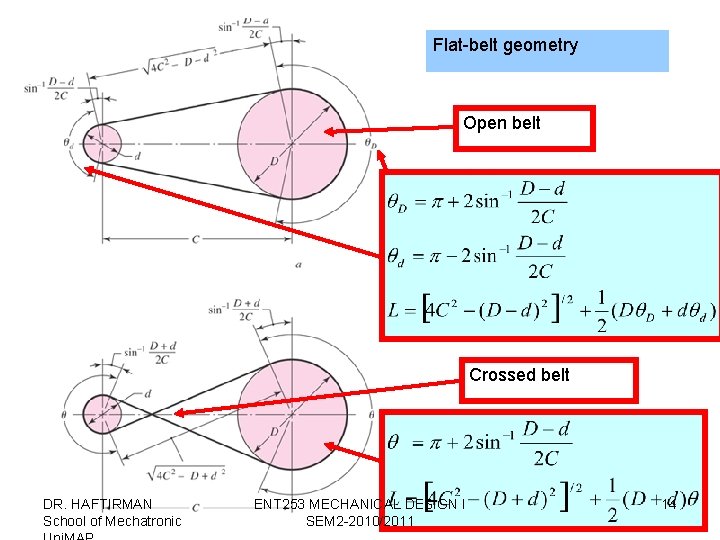
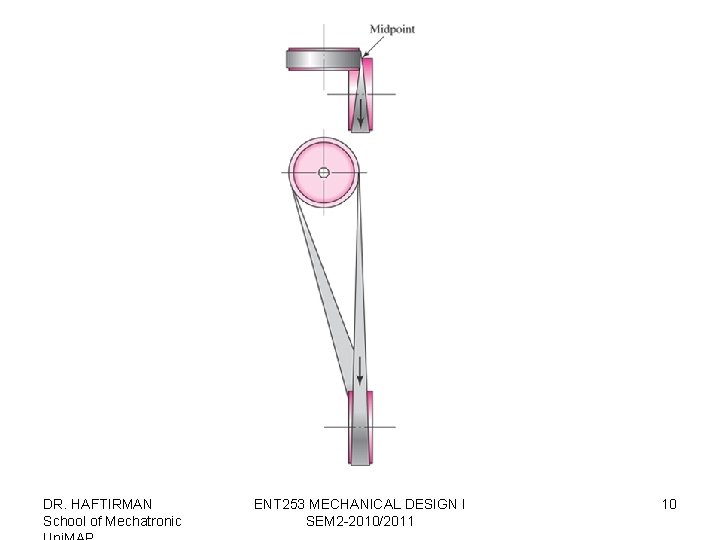
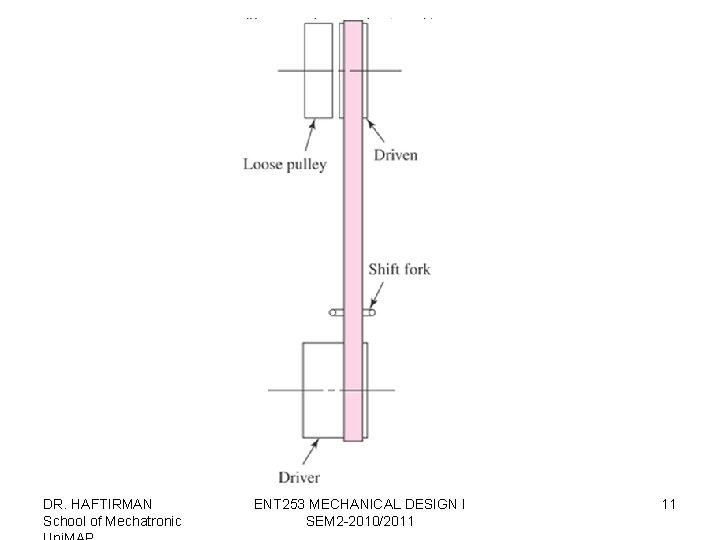
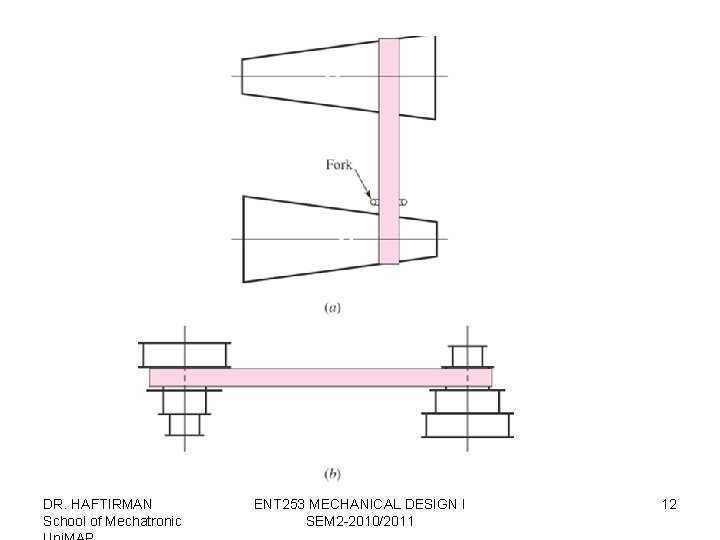
Flat-belt geometry Open belt Crossed belt DR. HAFTIRMAN School of Mechatronic ENT 253 MECHANICAL DESIGN I SEM 2 -2010/2011 14
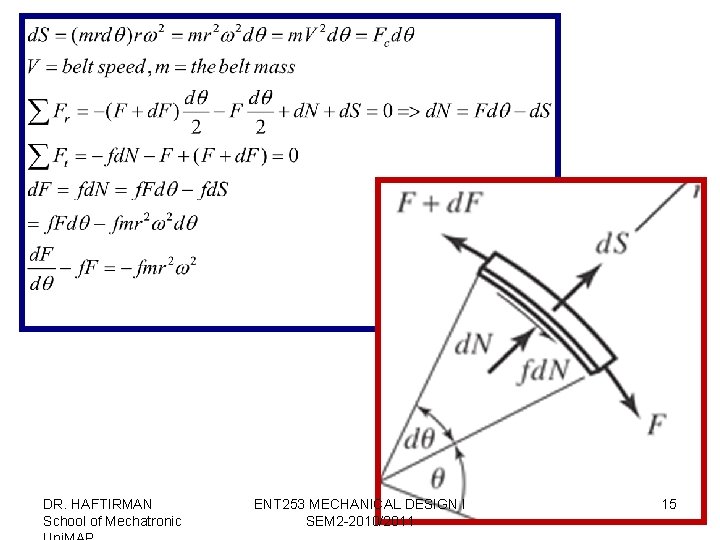
DR. HAFTIRMAN School of Mechatronic ENT 253 MECHANICAL DESIGN I SEM 2 -2010/2011 15
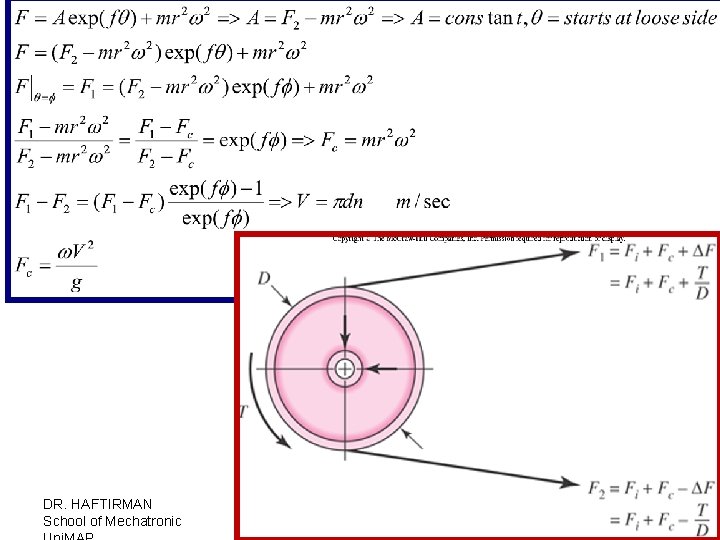
DR. HAFTIRMAN School of Mechatronic ENT 253 MECHANICAL DESIGN I SEM 2 -2010/2011 16
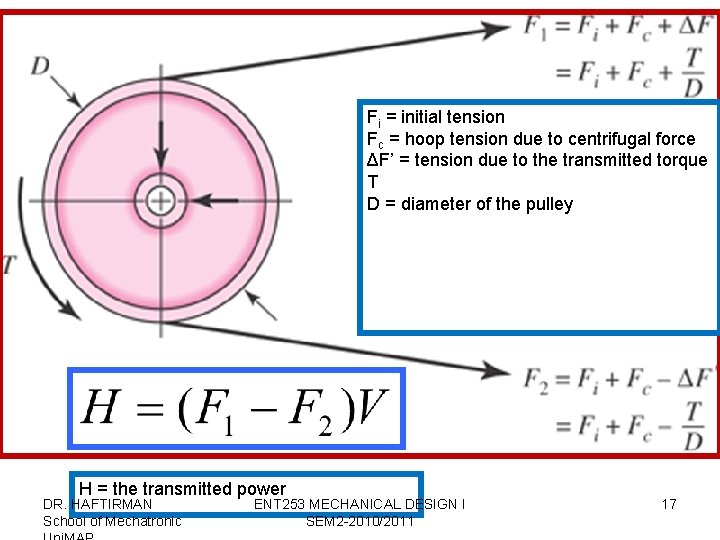
Fi = initial tension Fc = hoop tension due to centrifugal force ΔF’ = tension due to the transmitted torque T D = diameter of the pulley H = the transmitted power DR. HAFTIRMAN School of Mechatronic ENT 253 MECHANICAL DESIGN I SEM 2 -2010/2011 17
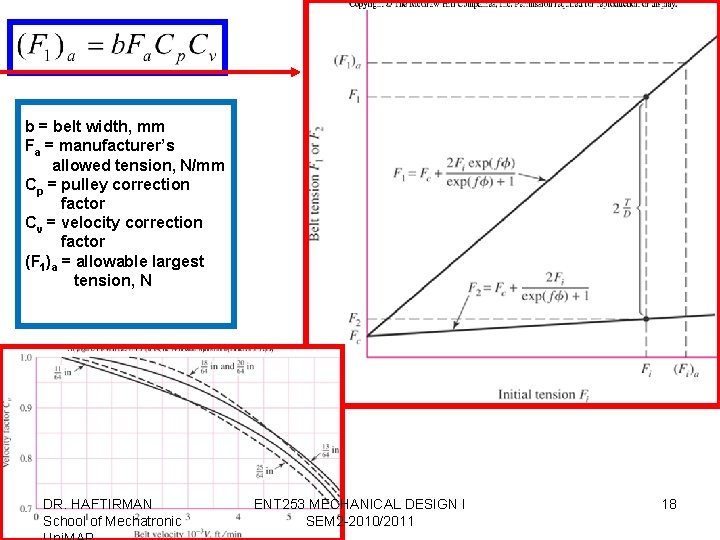
b = belt width, mm Fa = manufacturer’s allowed tension, N/mm Cp = pulley correction factor Cv = velocity correction factor (F 1)a = allowable largest tension, N DR. HAFTIRMAN School of Mechatronic ENT 253 MECHANICAL DESIGN I SEM 2 -2010/2011 18
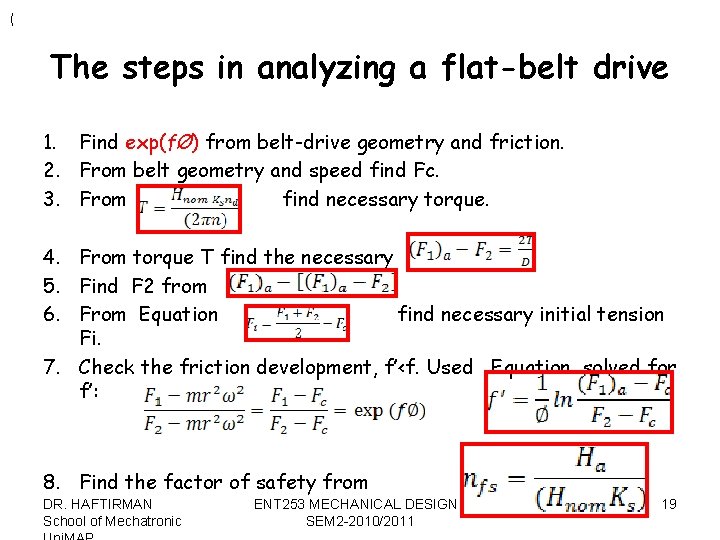
( The steps in analyzing a flat-belt drive 1. Find exp(fØ) from belt-drive geometry and friction. 2. From belt geometry and speed find Fc. 3. From find necessary torque. 4. From torque T find the necessary 5. Find F 2 from 6. From Equation find necessary initial tension Fi. 7. Check the friction development, f’<f. Used Equation solved for f’: 8. Find the factor of safety from DR. HAFTIRMAN School of Mechatronic ENT 253 MECHANICAL DESIGN I SEM 2 -2010/2011 19
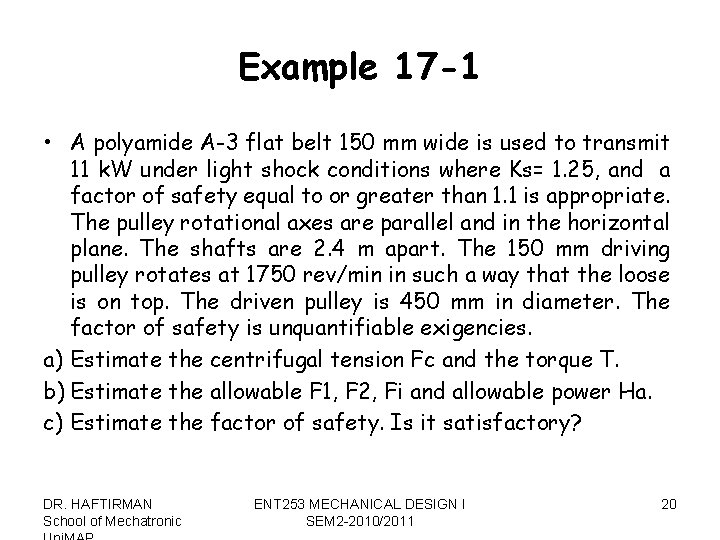
Example 17 -1 • A polyamide A-3 flat belt 150 mm wide is used to transmit 11 k. W under light shock conditions where Ks= 1. 25, and a factor of safety equal to or greater than 1. 1 is appropriate. The pulley rotational axes are parallel and in the horizontal plane. The shafts are 2. 4 m apart. The 150 mm driving pulley rotates at 1750 rev/min in such a way that the loose is on top. The driven pulley is 450 mm in diameter. The factor of safety is unquantifiable exigencies. a) Estimate the centrifugal tension Fc and the torque T. b) Estimate the allowable F 1, F 2, Fi and allowable power Ha. c) Estimate the factor of safety. Is it satisfactory? DR. HAFTIRMAN School of Mechatronic ENT 253 MECHANICAL DESIGN I SEM 2 -2010/2011 20
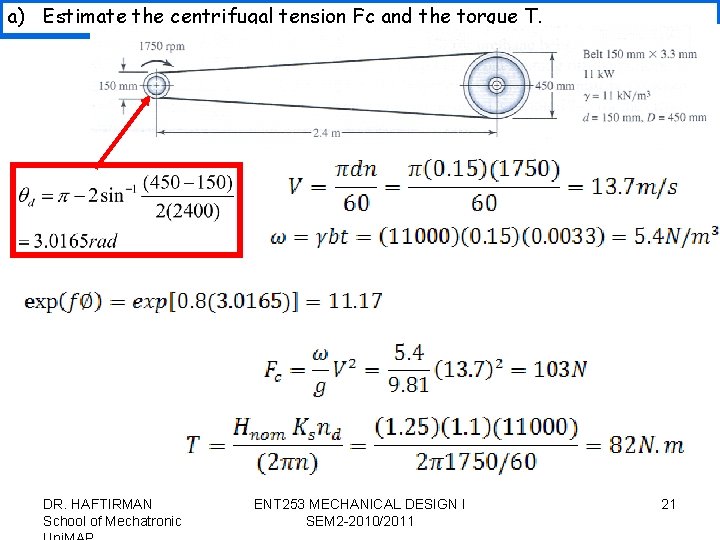
a) Estimate the centrifugal tension Fc and the torque T. DR. HAFTIRMAN School of Mechatronic ENT 253 MECHANICAL DESIGN I SEM 2 -2010/2011 21
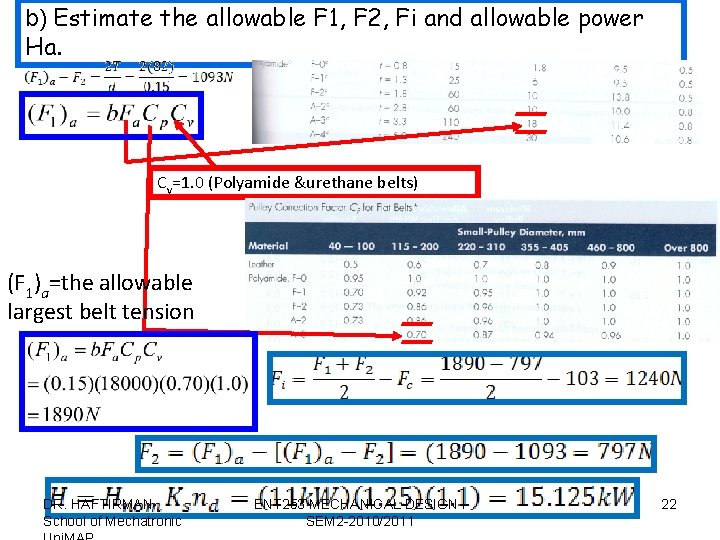
b) Estimate the allowable F 1, F 2, Fi and allowable power Ha. Cv=1. 0 (Polyamide &urethane belts) (F 1)a=the allowable largest belt tension DR. HAFTIRMAN School of Mechatronic ENT 253 MECHANICAL DESIGN I SEM 2 -2010/2011 22
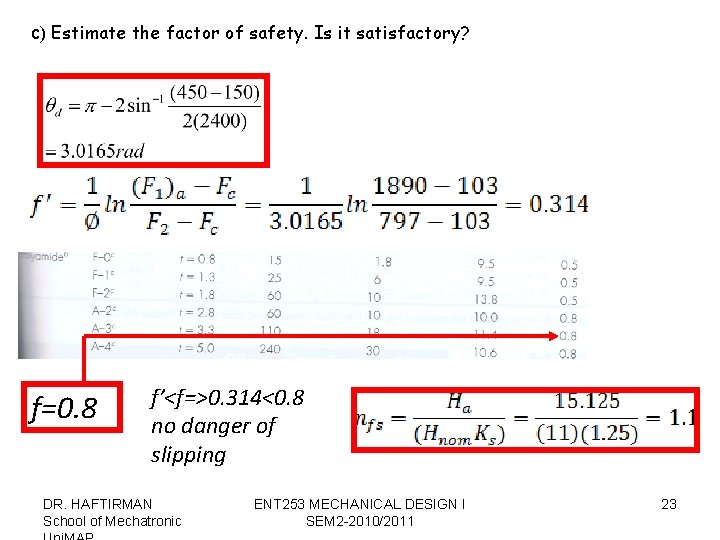
c) Estimate the factor of safety. Is it satisfactory? f=0. 8 f’<f=>0. 314<0. 8 no danger of slipping DR. HAFTIRMAN School of Mechatronic ENT 253 MECHANICAL DESIGN I SEM 2 -2010/2011 23
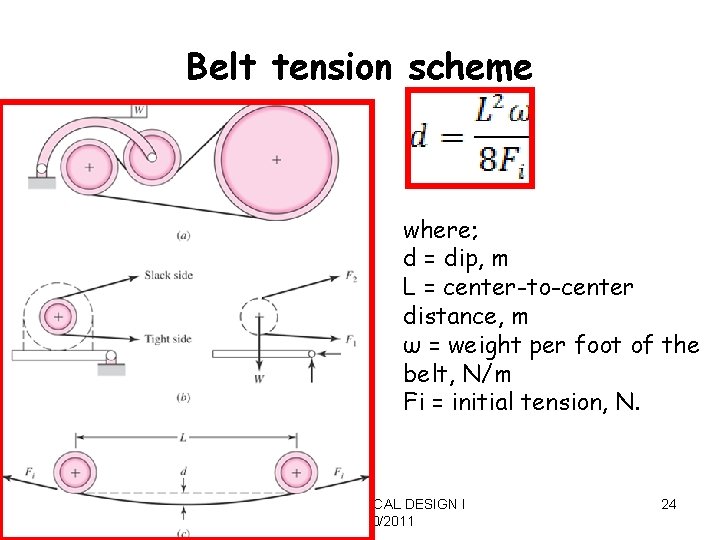
Belt tension scheme where; d = dip, m L = center-to-center distance, m ω = weight per foot of the belt, N/m Fi = initial tension, N. DR. HAFTIRMAN School of Mechatronic ENT 253 MECHANICAL DESIGN I SEM 2 -2010/2011 24
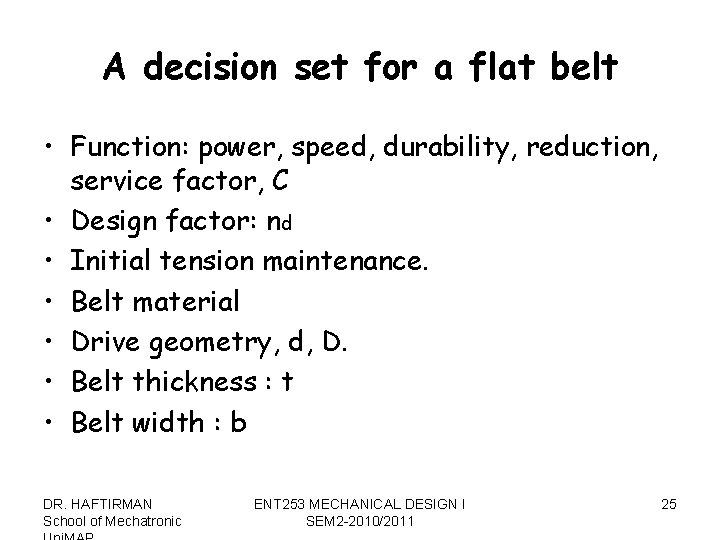
A decision set for a flat belt • Function: power, speed, durability, reduction, service factor, C • Design factor: nd • Initial tension maintenance. • Belt material • Drive geometry, d, D. • Belt thickness : t • Belt width : b DR. HAFTIRMAN School of Mechatronic ENT 253 MECHANICAL DESIGN I SEM 2 -2010/2011 25
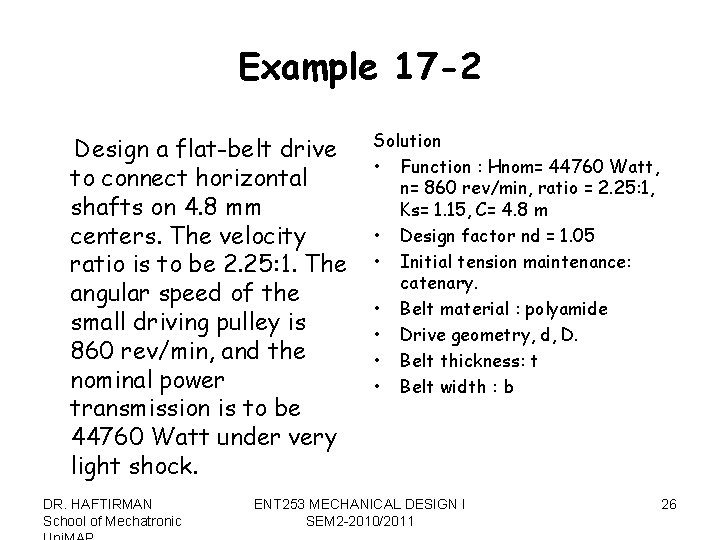
Example 17 -2 Design a flat-belt drive to connect horizontal shafts on 4. 8 mm centers. The velocity ratio is to be 2. 25: 1. The angular speed of the small driving pulley is 860 rev/min, and the nominal power transmission is to be 44760 Watt under very light shock. DR. HAFTIRMAN School of Mechatronic Solution • Function : Hnom= 44760 Watt, n= 860 rev/min, ratio = 2. 25: 1, Ks= 1. 15, C= 4. 8 m • Design factor nd = 1. 05 • Initial tension maintenance: catenary. • Belt material : polyamide • Drive geometry, d, D. • Belt thickness: t • Belt width : b ENT 253 MECHANICAL DESIGN I SEM 2 -2010/2011 26
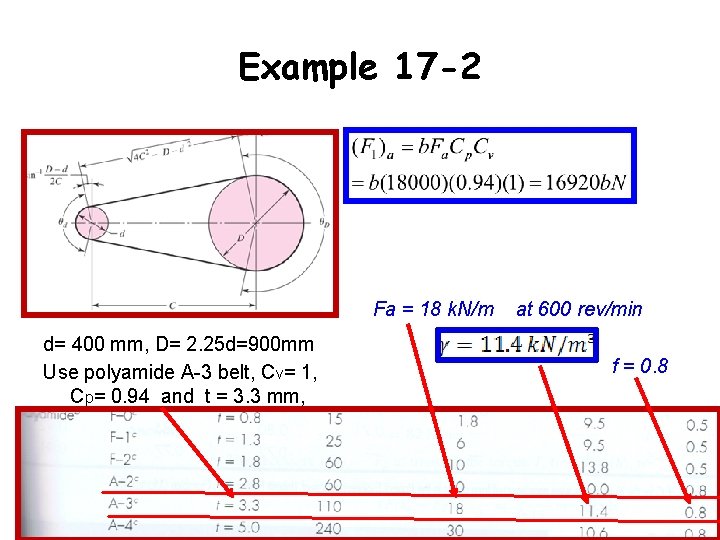
Example 17 -2 Fa = 18 k. N/m d= 400 mm, D= 2. 25 d=900 mm Use polyamide A-3 belt, Cv= 1, Cp= 0. 94 and t = 3. 3 mm, DR. HAFTIRMAN School of Mechatronic ENT 253 MECHANICAL DESIGN I SEM 2 -2010/2011 at 600 rev/min f = 0. 8 27
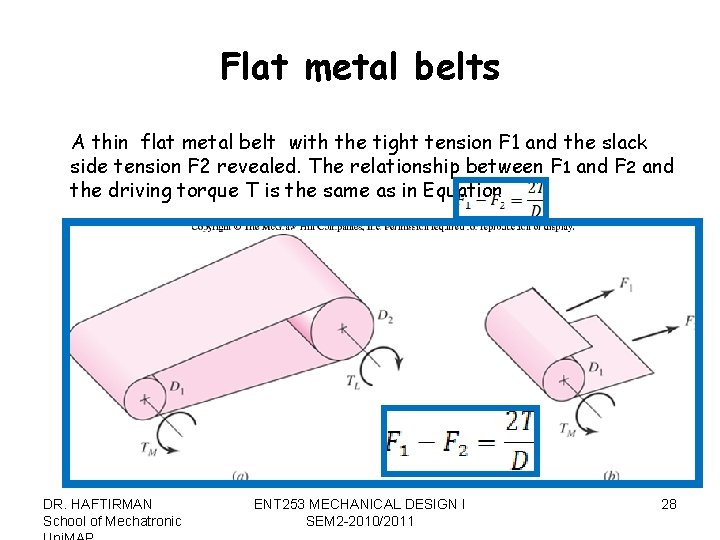
Flat metal belts A thin flat metal belt with the tight tension F 1 and the slack side tension F 2 revealed. The relationship between F 1 and F 2 and the driving torque T is the same as in Equation DR. HAFTIRMAN School of Mechatronic ENT 253 MECHANICAL DESIGN I SEM 2 -2010/2011 28
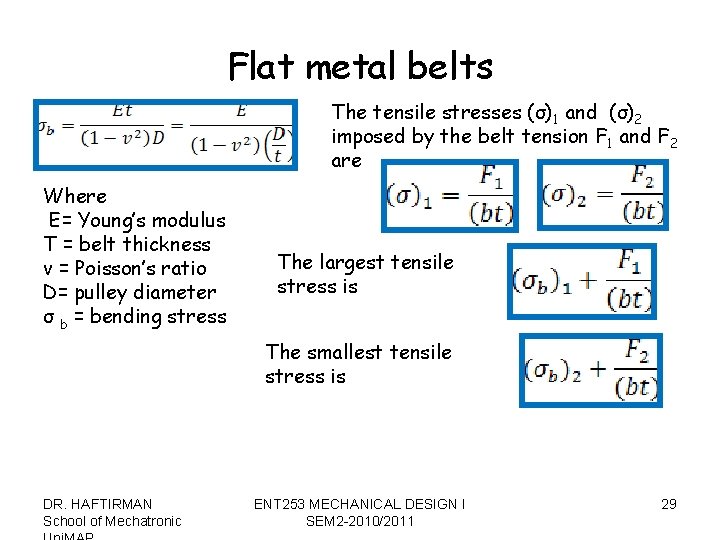
Flat metal belts The tensile stresses (σ)1 and (σ)2 imposed by the belt tension F 1 and F 2 are Where E= Young’s modulus T = belt thickness v = Poisson’s ratio D= pulley diameter σ b = bending stress The largest tensile stress is The smallest tensile stress is DR. HAFTIRMAN School of Mechatronic ENT 253 MECHANICAL DESIGN I SEM 2 -2010/2011 29
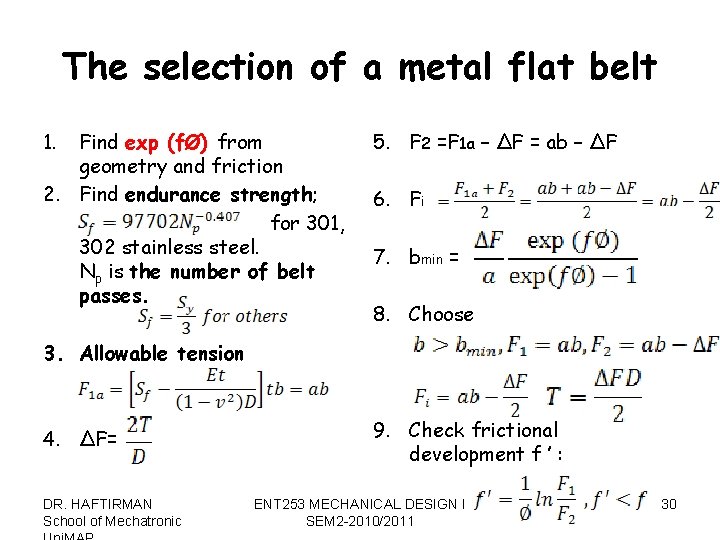
The selection of a metal flat belt 1. Find exp (fØ) from geometry and friction 2. Find endurance strength; for 301, 302 stainless steel. Np is the number of belt passes. 5. F 2 =F 1 a – ΔF = ab – ΔF 6. Fi 7. bmin = 8. Choose 3. Allowable tension 4. ΔF= DR. HAFTIRMAN School of Mechatronic 9. Check frictional development f ’ : ENT 253 MECHANICAL DESIGN I SEM 2 -2010/2011 30
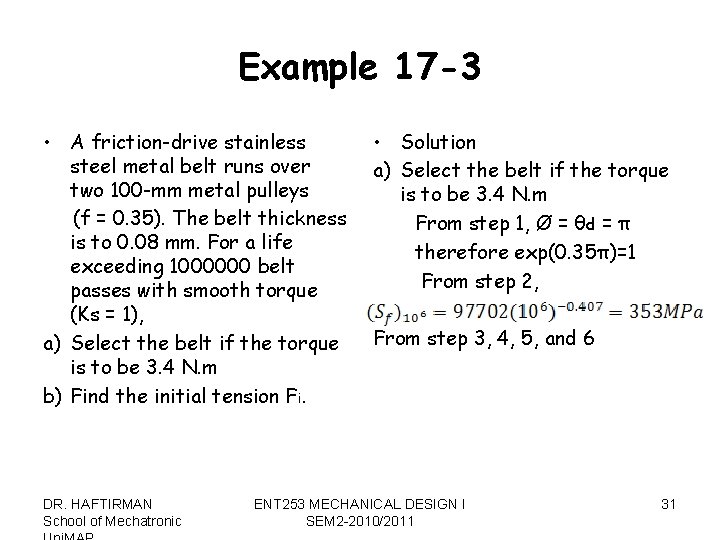
Example 17 -3 • A friction-drive stainless steel metal belt runs over two 100 -mm metal pulleys (f = 0. 35). The belt thickness is to 0. 08 mm. For a life exceeding 1000000 belt passes with smooth torque (Ks = 1), a) Select the belt if the torque is to be 3. 4 N. m b) Find the initial tension Fi. DR. HAFTIRMAN School of Mechatronic • Solution a) Select the belt if the torque is to be 3. 4 N. m From step 1, Ø = θd = π therefore exp(0. 35π)=1 From step 2, From step 3, 4, 5, and 6 ENT 253 MECHANICAL DESIGN I SEM 2 -2010/2011 31
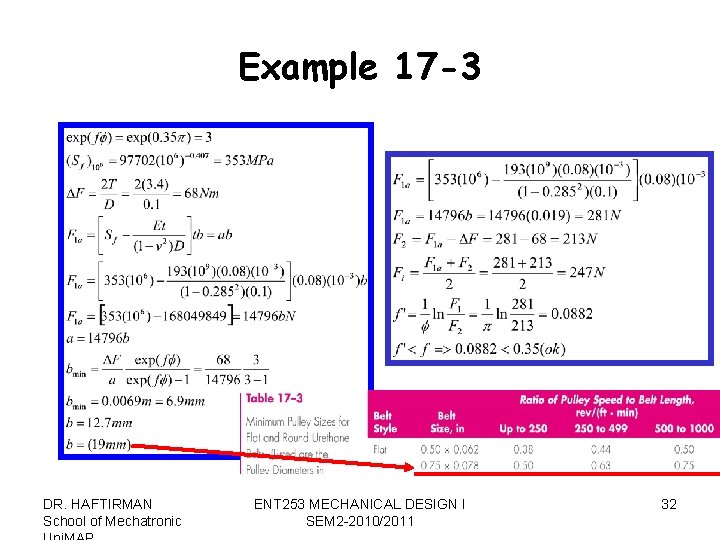
Example 17 -3 DR. HAFTIRMAN School of Mechatronic ENT 253 MECHANICAL DESIGN I SEM 2 -2010/2011 32
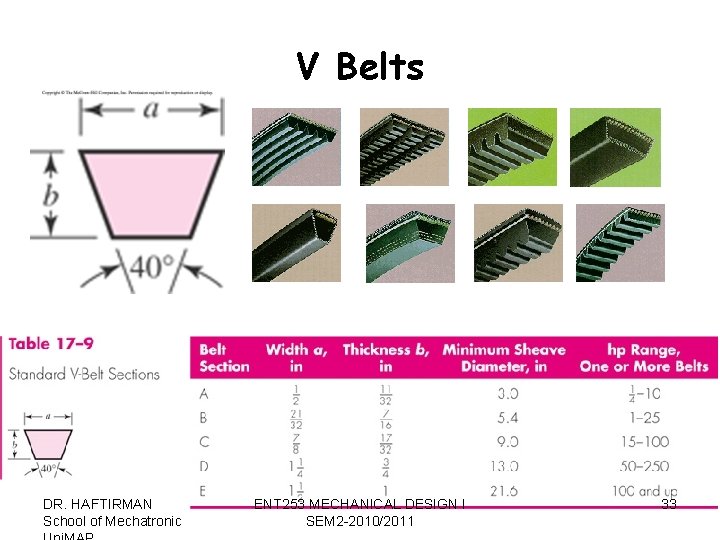
V Belts DR. HAFTIRMAN School of Mechatronic ENT 253 MECHANICAL DESIGN I SEM 2 -2010/2011 33
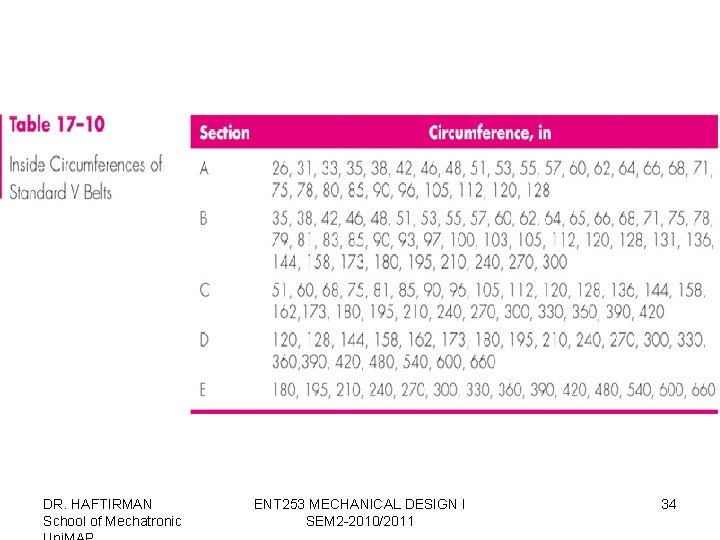
DR. HAFTIRMAN School of Mechatronic ENT 253 MECHANICAL DESIGN I SEM 2 -2010/2011 34
PROPERTIES V-BELTS are oil and heat resistant and manufactured from material to prevent formation of static electricity. 1) OIL RESISTANT V-BELTS are resistant to damage from influence of mineral oil, splash and fatty components. This property provides longer belt life. 2) HEAT RESISTANT To prevent aging and decomposition of the belts in high temperature, V-BELTS have obtained heat resistant properties. 3) ANTI STATIC V-BELTS are of electrical conductivity which prevents the builtup o static electricity. This property is of greatest importance when working with inflammable materials. DR. HAFTIRMAN School of Mechatronic ENT 253 MECHANICAL DESIGN I SEM 2 -2010/2011 35
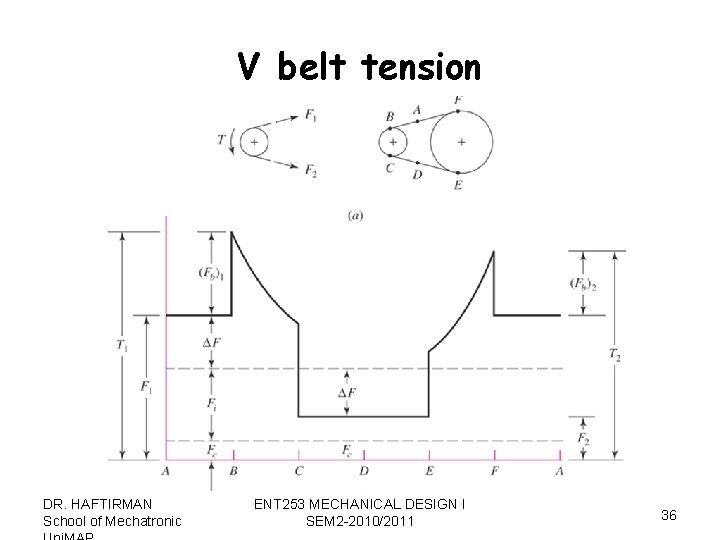
V belt tension DR. HAFTIRMAN School of Mechatronic ENT 253 MECHANICAL DESIGN I SEM 2 -2010/2011 36
DR. HAFTIRMAN School of Mechatronic ENT 253 MECHANICAL DESIGN I SEM 2 -2010/2011 37
DR. HAFTIRMAN School of Mechatronic ENT 253 MECHANICAL DESIGN I SEM 2 -2010/2011 38
DR. HAFTIRMAN School of Mechatronic ENT 253 MECHANICAL DESIGN I SEM 2 -2010/2011 39
DR. HAFTIRMAN School of Mechatronic ENT 253 MECHANICAL DESIGN I SEM 2 -2010/2011 40
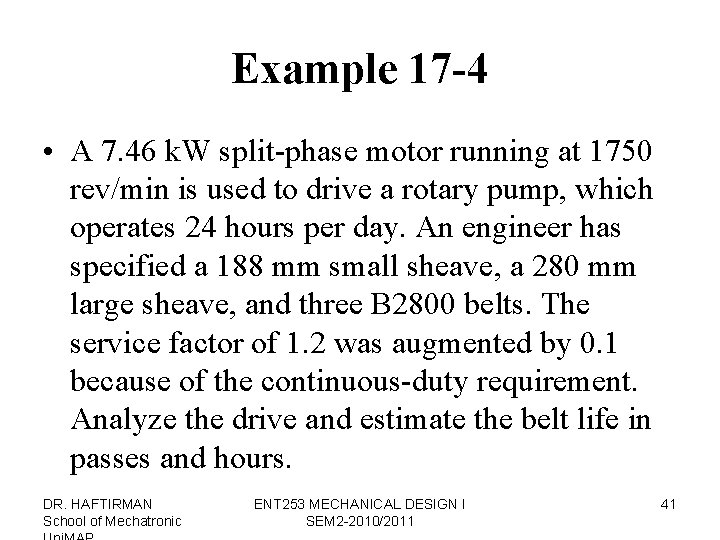
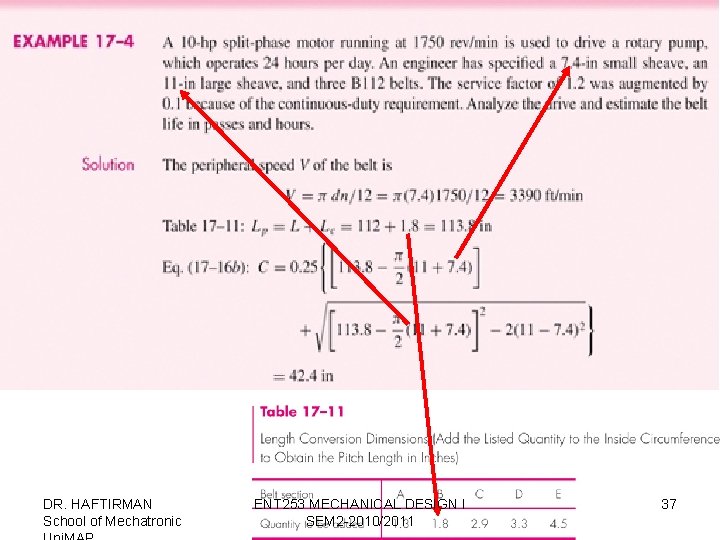
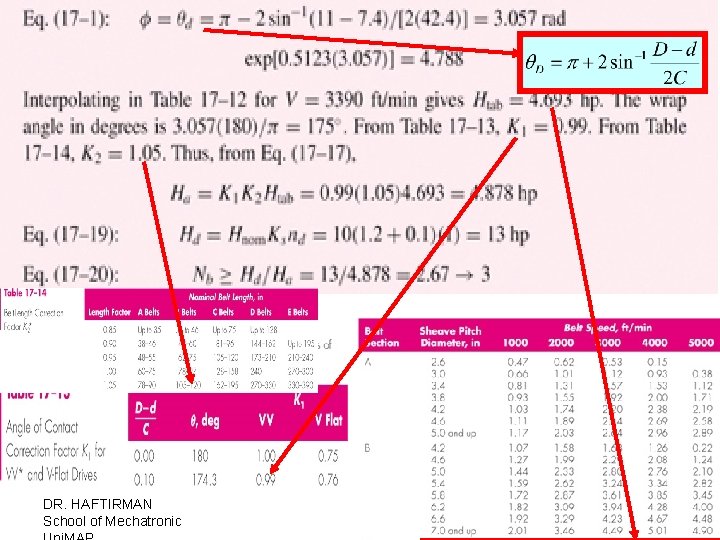
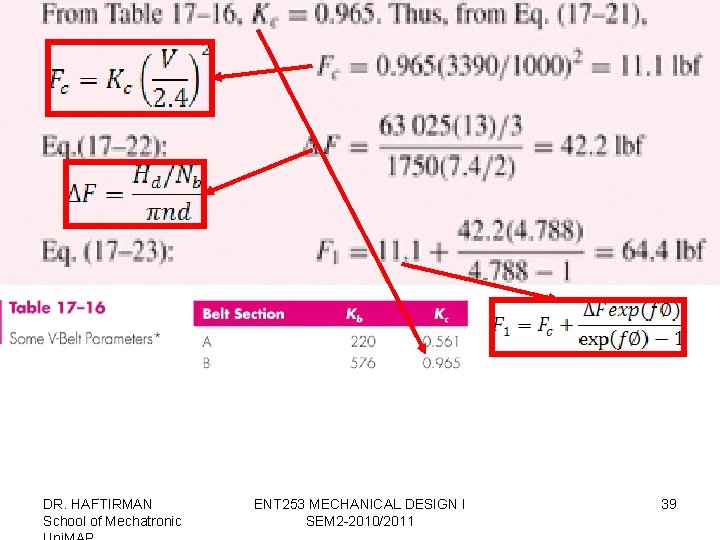
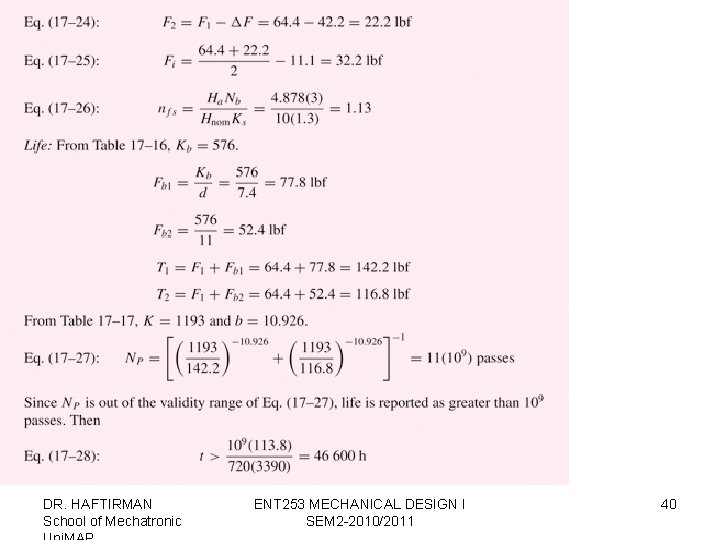
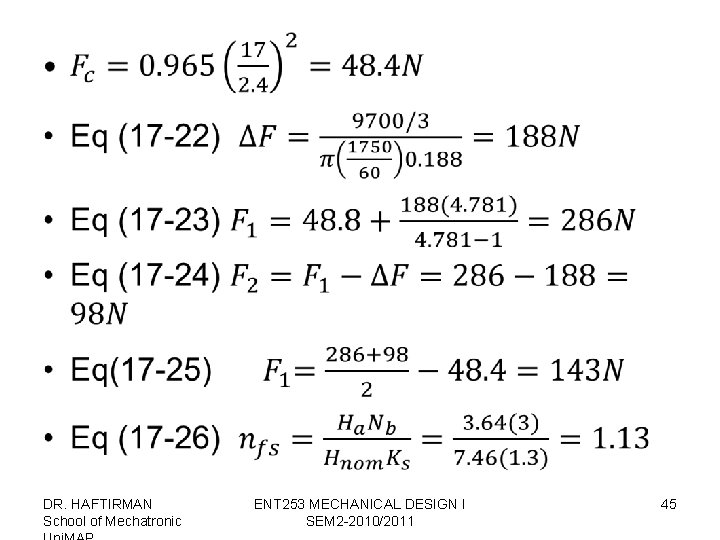
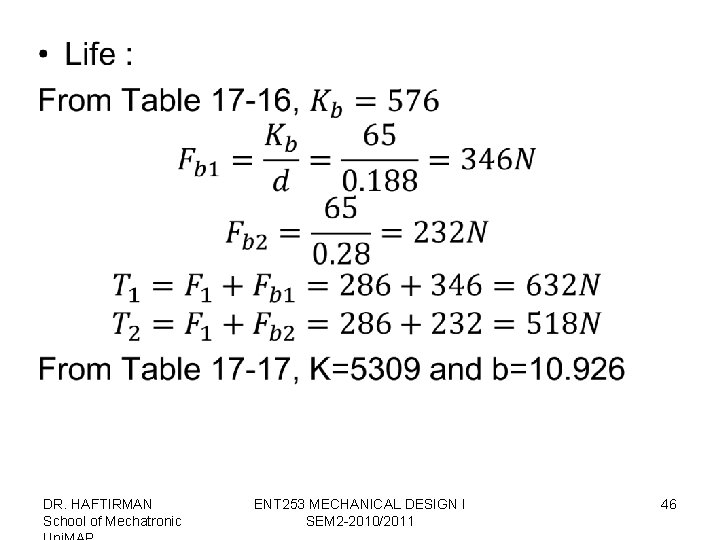
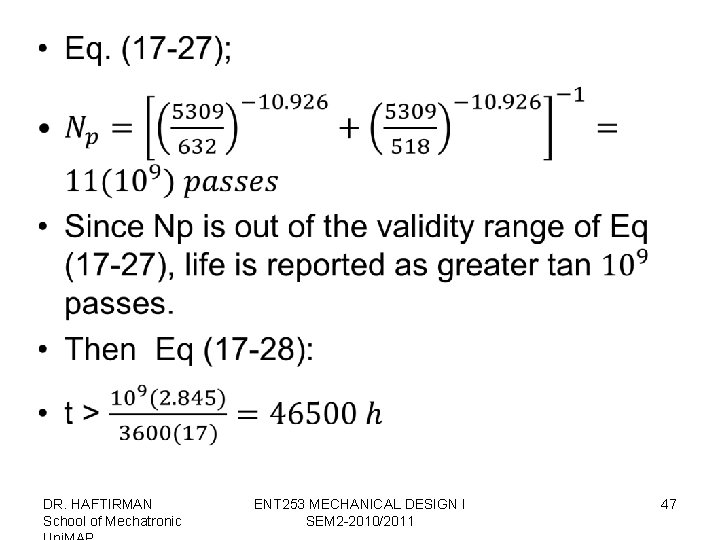
Example 17 -4 • A 7. 46 k. W split-phase motor running at 1750 rev/min is used to drive a rotary pump, which operates 24 hours per day. An engineer has specified a 188 mm small sheave, a 280 mm large sheave, and three B 2800 belts. The service factor of 1. 2 was augmented by 0. 1 because of the continuous-duty requirement. Analyze the drive and estimate the belt life in passes and hours. DR. HAFTIRMAN School of Mechatronic ENT 253 MECHANICAL DESIGN I SEM 2 -2010/2011 41
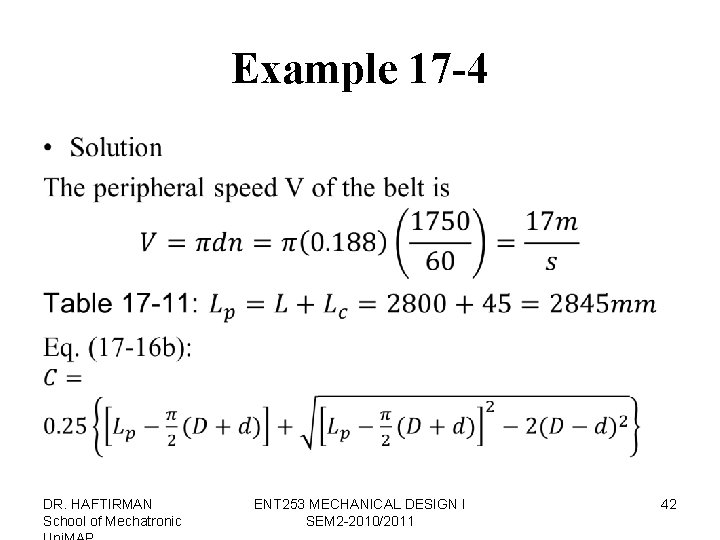
Example 17 -4 • DR. HAFTIRMAN School of Mechatronic ENT 253 MECHANICAL DESIGN I SEM 2 -2010/2011 42
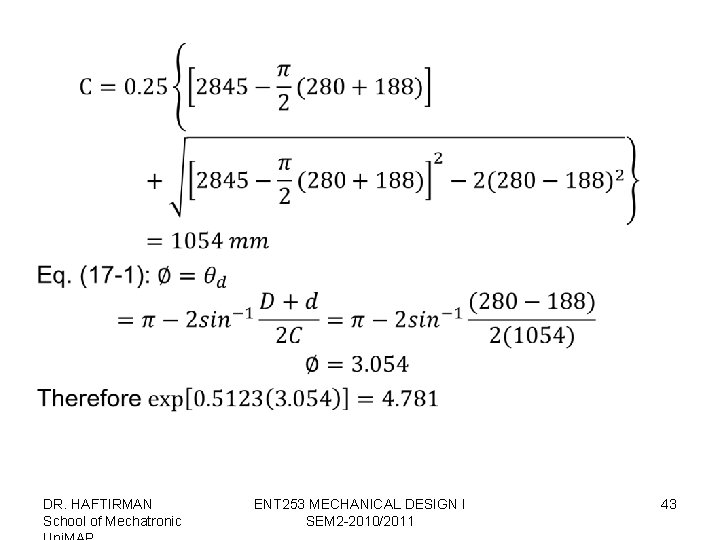
• DR. HAFTIRMAN School of Mechatronic ENT 253 MECHANICAL DESIGN I SEM 2 -2010/2011 43
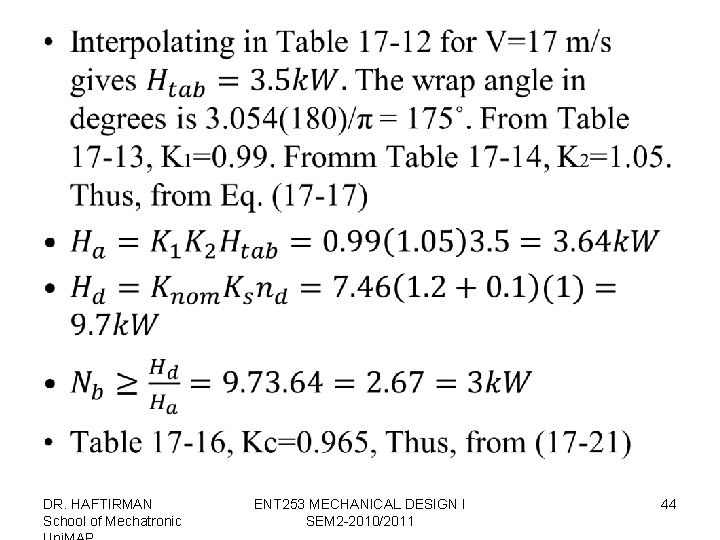
• DR. HAFTIRMAN School of Mechatronic ENT 253 MECHANICAL DESIGN I SEM 2 -2010/2011 44
• DR. HAFTIRMAN School of Mechatronic ENT 253 MECHANICAL DESIGN I SEM 2 -2010/2011 45
• DR. HAFTIRMAN School of Mechatronic ENT 253 MECHANICAL DESIGN I SEM 2 -2010/2011 46
• DR. HAFTIRMAN School of Mechatronic ENT 253 MECHANICAL DESIGN I SEM 2 -2010/2011 47
Timing belts DR. HAFTIRMAN School of Mechatronic ENT 253 MECHANICAL DESIGN I SEM 2 -2010/2011 48
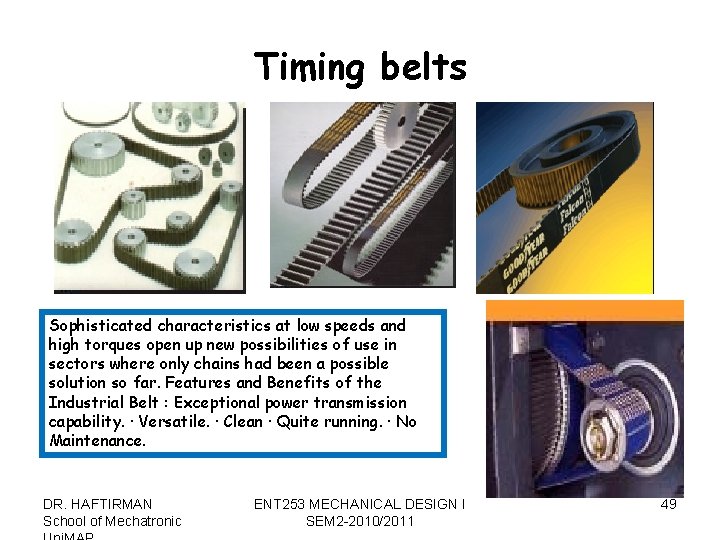
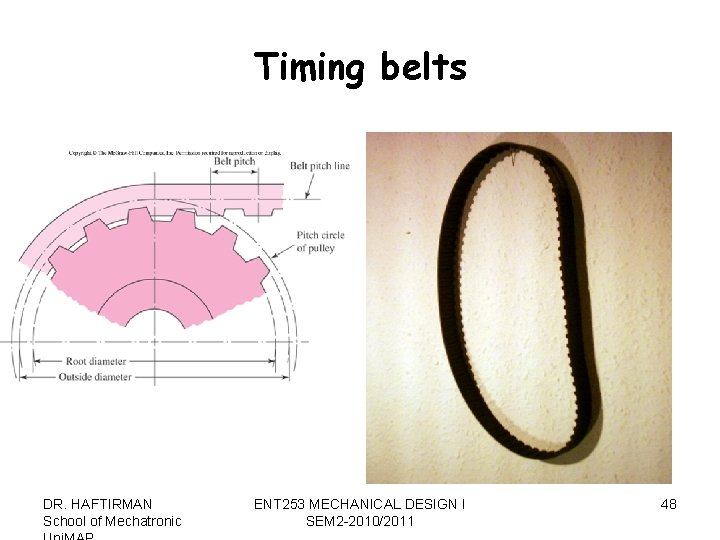
Timing belts Sophisticated characteristics at low speeds and high torques open up new possibilities of use in sectors where only chains had been a possible solution so far. Features and Benefits of the Industrial Belt : Exceptional power transmission capability. · Versatile. · Clean · Quite running. · No Maintenance. DR. HAFTIRMAN School of Mechatronic ENT 253 MECHANICAL DESIGN I SEM 2 -2010/2011 49
ROLLER CHAIN • Basic features of chain drives include a constant ratio. • Since no slippage or creep is involved, long life, and ability to drive a number of shafts from a single source of power. • The standard of roller chain is ANSI DR. HAFTIRMAN School of Mechatronic ENT 253 MECHANICAL DESIGN I SEM 2 -2009/2010 50
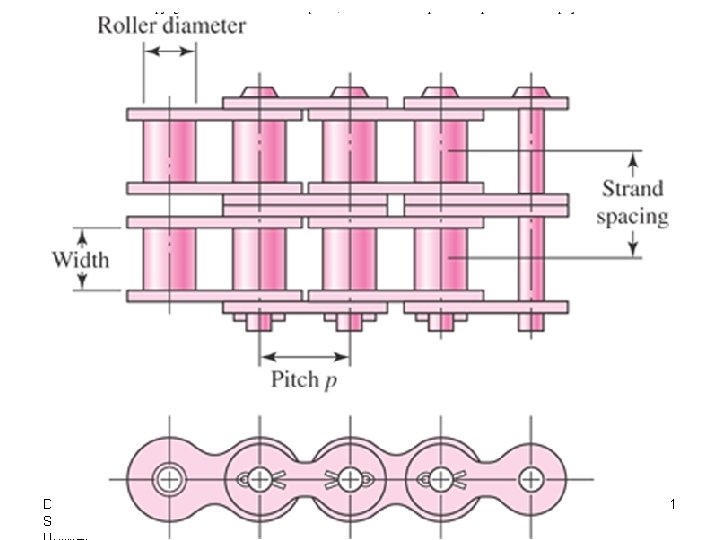
DR. HAFTIRMAN School of Mechatronic ENT 253 MECHANICAL DESIGN I SEM 2 -2009/2010 51
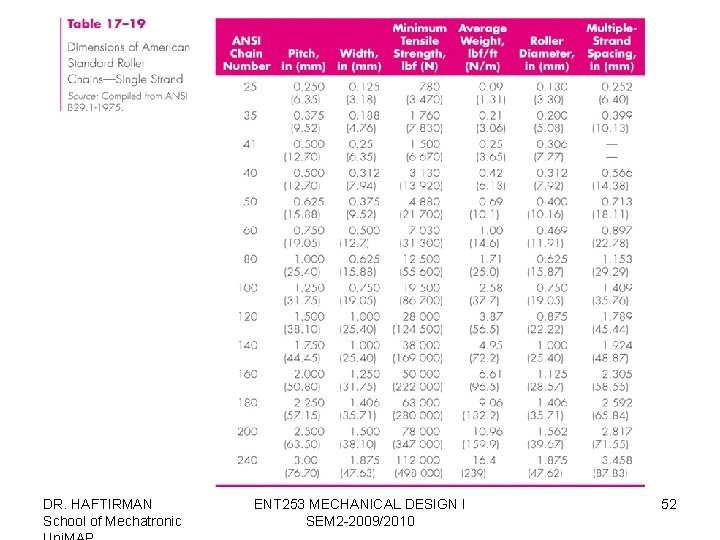
DR. HAFTIRMAN School of Mechatronic ENT 253 MECHANICAL DESIGN I SEM 2 -2009/2010 52
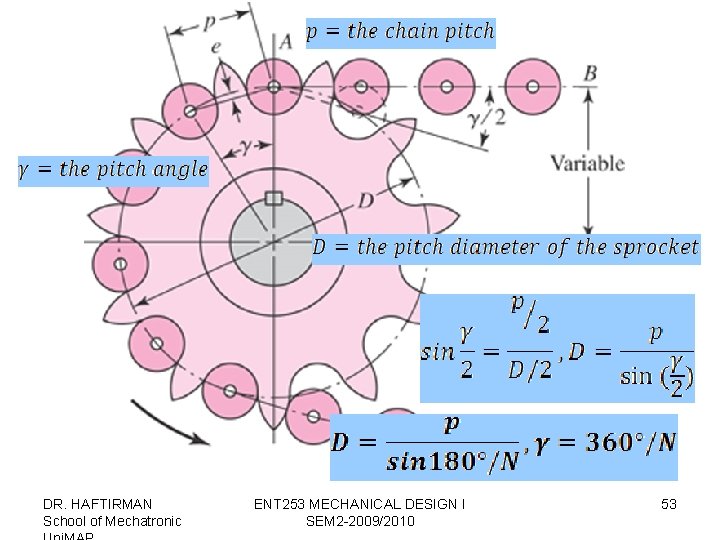
DR. HAFTIRMAN School of Mechatronic ENT 253 MECHANICAL DESIGN I SEM 2 -2009/2010 53
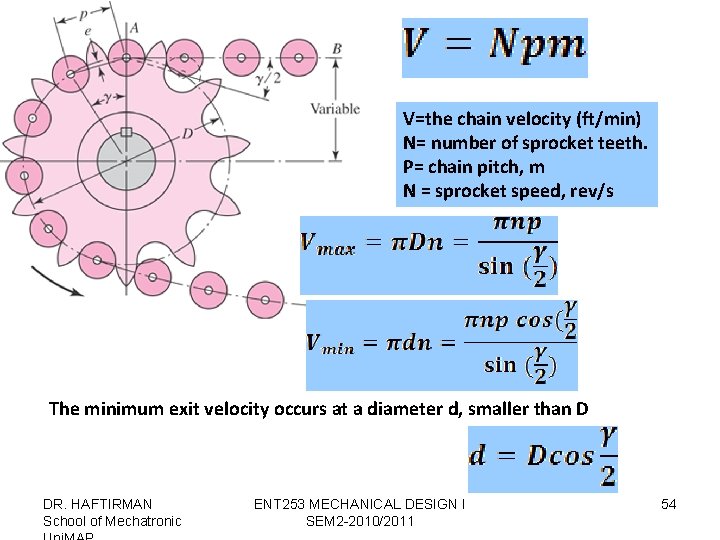
V=the chain velocity (ft/min) N= number of sprocket teeth. P= chain pitch, m N = sprocket speed, rev/s The minimum exit velocity occurs at a diameter d, smaller than D DR. HAFTIRMAN School of Mechatronic ENT 253 MECHANICAL DESIGN I SEM 2 -2010/2011 54
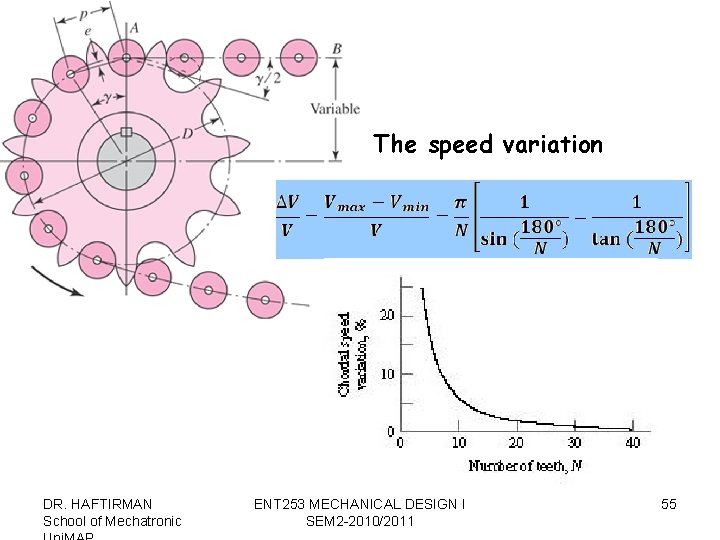
The speed variation DR. HAFTIRMAN School of Mechatronic ENT 253 MECHANICAL DESIGN I SEM 2 -2010/2011 55
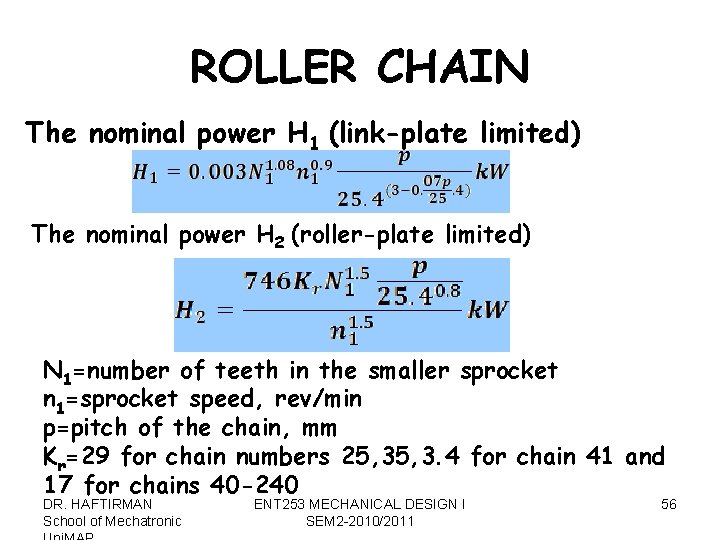
ROLLER CHAIN The nominal power H 1 (link-plate limited) The nominal power H 2 (roller-plate limited) N 1=number of teeth in the smaller sprocket n 1=sprocket speed, rev/min p=pitch of the chain, mm Kr=29 for chain numbers 25, 3. 4 for chain 41 and 17 for chains 40 -240 DR. HAFTIRMAN School of Mechatronic ENT 253 MECHANICAL DESIGN I SEM 2 -2010/2011 56
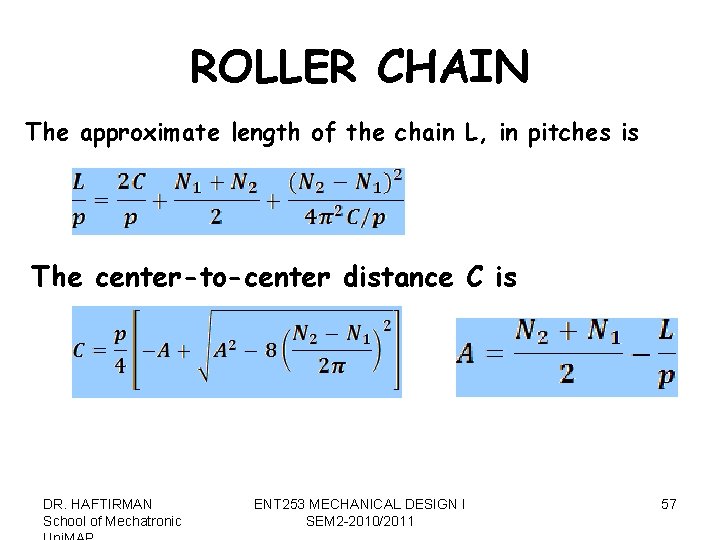
ROLLER CHAIN The approximate length of the chain L, in pitches is The center-to-center distance C is DR. HAFTIRMAN School of Mechatronic ENT 253 MECHANICAL DESIGN I SEM 2 -2010/2011 57
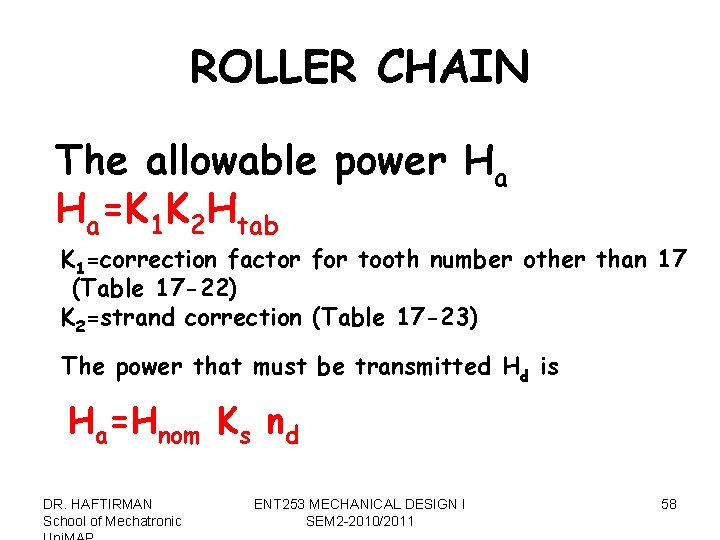
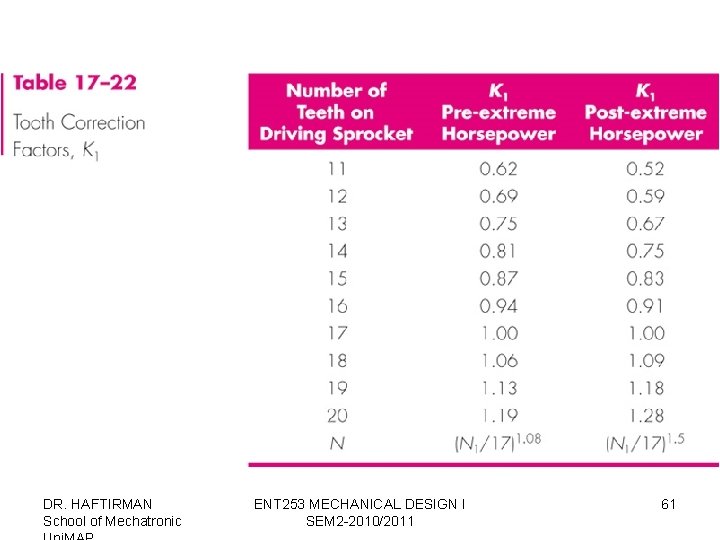
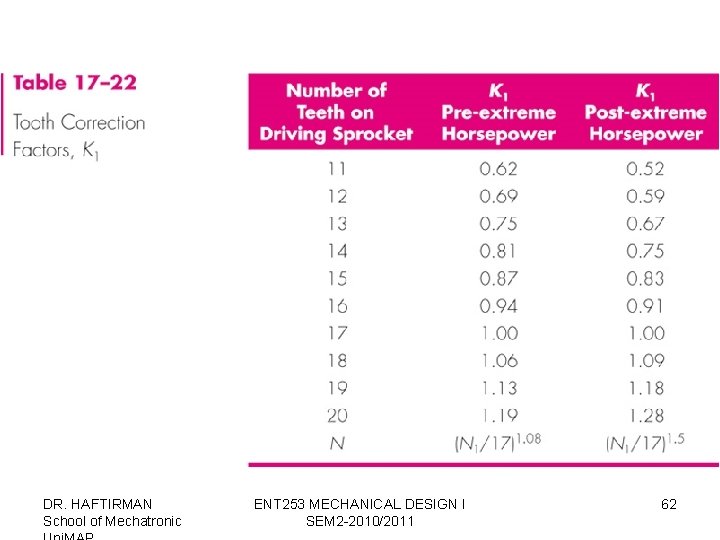
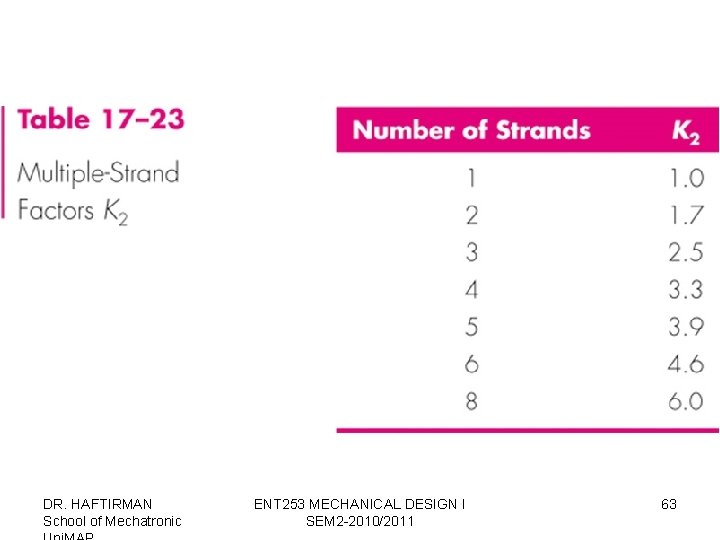
ROLLER CHAIN The allowable power Ha Ha=K 1 K 2 Htab K 1=correction factor for tooth number other than 17 (Table 17 -22) K 2=strand correction (Table 17 -23) The power that must be transmitted Hd is Ha=Hnom Ks nd DR. HAFTIRMAN School of Mechatronic ENT 253 MECHANICAL DESIGN I SEM 2 -2010/2011 58
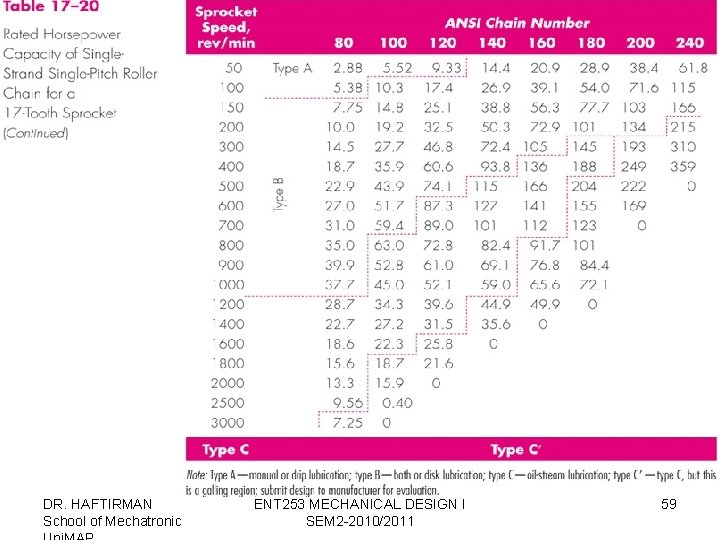
ROLLER CHAIN DR. HAFTIRMAN School of Mechatronic ENT 253 MECHANICAL DESIGN I SEM 2 -2010/2011 59
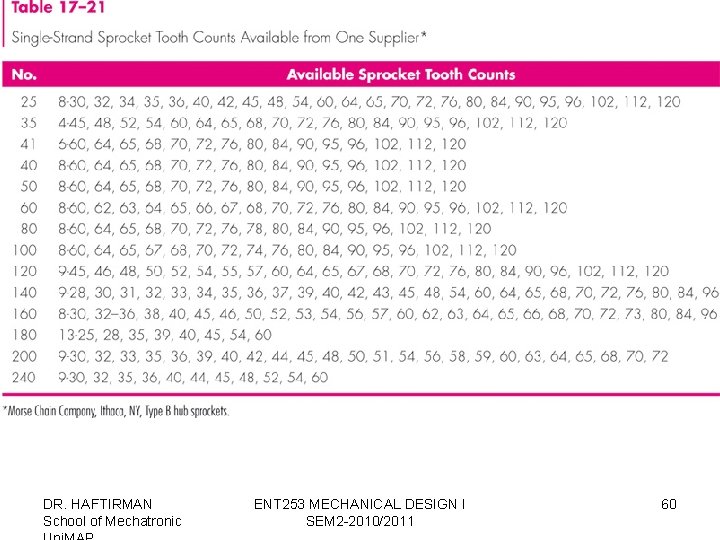
ROLLER CHAIN DR. HAFTIRMAN School of Mechatronic ENT 253 MECHANICAL DESIGN I SEM 2 -2010/2011 60
DR. HAFTIRMAN School of Mechatronic ENT 253 MECHANICAL DESIGN I SEM 2 -2010/2011 61
DR. HAFTIRMAN School of Mechatronic ENT 253 MECHANICAL DESIGN I SEM 2 -2010/2011 62
DR. HAFTIRMAN School of Mechatronic ENT 253 MECHANICAL DESIGN I SEM 2 -2010/2011 63
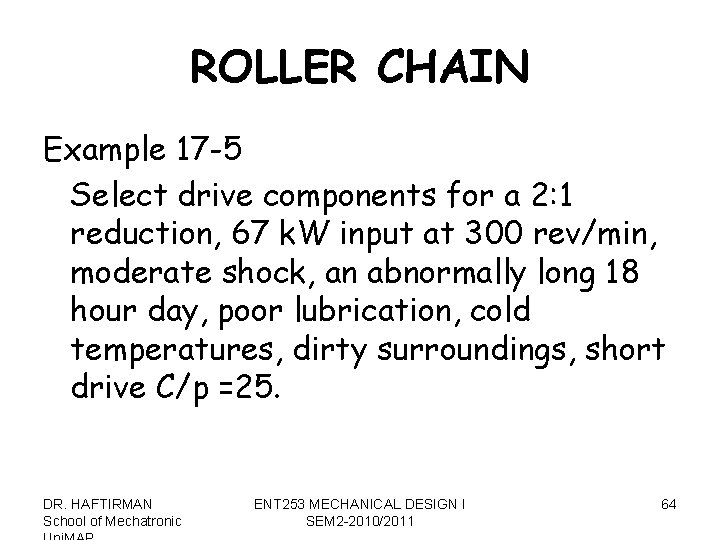
ROLLER CHAIN Example 17 -5 Select drive components for a 2: 1 reduction, 67 k. W input at 300 rev/min, moderate shock, an abnormally long 18 hour day, poor lubrication, cold temperatures, dirty surroundings, short drive C/p =25. DR. HAFTIRMAN School of Mechatronic ENT 253 MECHANICAL DESIGN I SEM 2 -2010/2011 64
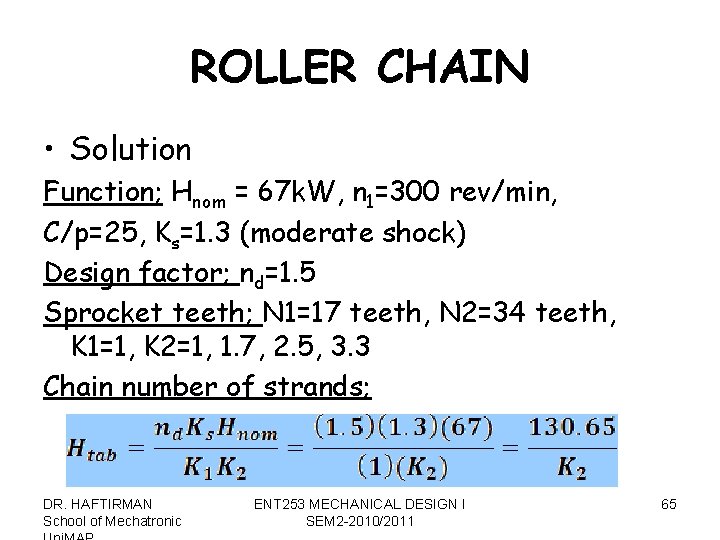
ROLLER CHAIN • Solution Function; Hnom = 67 k. W, n 1=300 rev/min, C/p=25, Ks=1. 3 (moderate shock) Design factor; nd=1. 5 Sprocket teeth; N 1=17 teeth, N 2=34 teeth, K 1=1, K 2=1, 1. 7, 2. 5, 3. 3 Chain number of strands; DR. HAFTIRMAN School of Mechatronic ENT 253 MECHANICAL DESIGN I SEM 2 -2010/2011 65
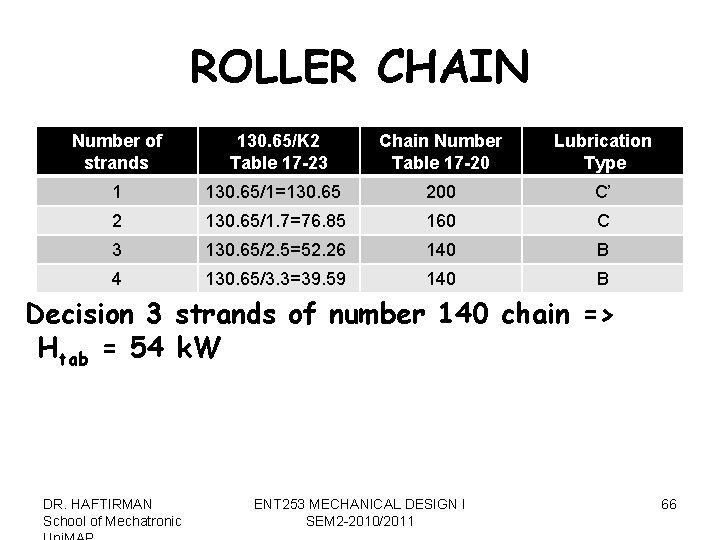
ROLLER CHAIN Number of strands 130. 65/K 2 Table 17 -23 Chain Number Table 17 -20 Lubrication Type 1 130. 65/1=130. 65 200 C’ 2 130. 65/1. 7=76. 85 160 C 3 130. 65/2. 5=52. 26 140 B 4 130. 65/3. 3=39. 59 140 B Decision 3 strands of number 140 chain => Htab = 54 k. W DR. HAFTIRMAN School of Mechatronic ENT 253 MECHANICAL DESIGN I SEM 2 -2010/2011 66
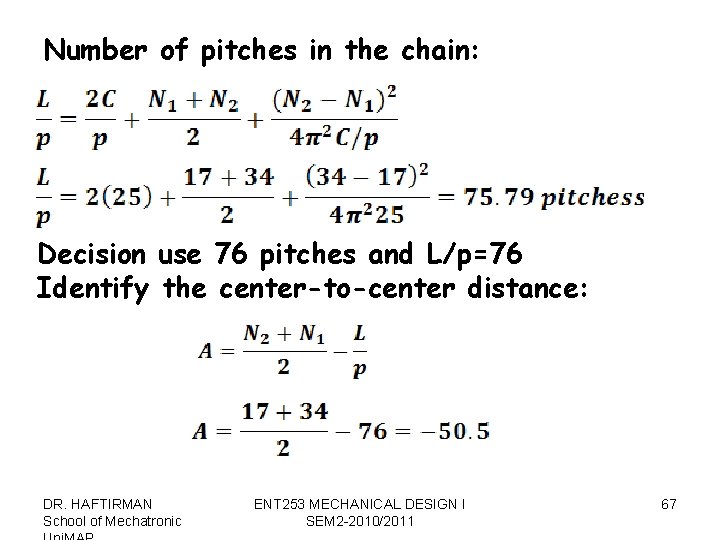
Number of pitches in the chain: Decision use 76 pitches and L/p=76 Identify the center-to-center distance: DR. HAFTIRMAN School of Mechatronic ENT 253 MECHANICAL DESIGN I SEM 2 -2010/2011 67
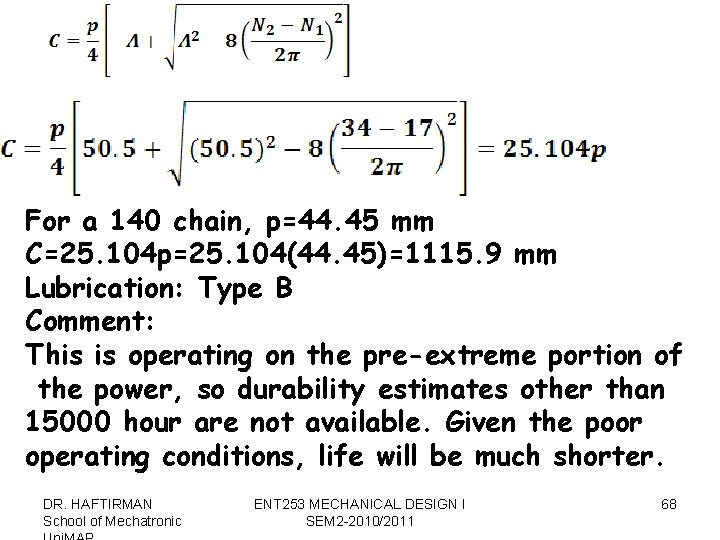
For a 140 chain, p=44. 45 mm C=25. 104 p=25. 104(44. 45)=1115. 9 mm Lubrication: Type B Comment: This is operating on the pre-extreme portion of the power, so durability estimates other than 15000 hour are not available. Given the poor operating conditions, life will be much shorter. DR. HAFTIRMAN School of Mechatronic ENT 253 MECHANICAL DESIGN I SEM 2 -2010/2011 68
Thank you DR. HAFTIRMAN School of Mechatronic ENT 253 MECHANICAL DESIGN I SEM 2 -2010/2011 69
QUIZ 2 A friction-drive Titanium metal belt runs over two 100 -mm metal pulleys (f = 0. 35). The belt thickness is to 0. 25 mm. For a life exceeding 5000000 belt passes with smooth torque (Ks = 1. 2), a) Select the belt if the torque is to be 5. 5 N. m b) Find the initial tension Fi. DR. HAFTIRMAN School of Mechatronic ENT 253 MECHANICAL DESIGN I SEM 2 -2010/2011 70
- Slides: 70