
Ensuring Success Through Breakfast After the Bell Models

Ensuring Success Through Breakfast After the Bell Models & CEP MAESP Leadership Conference March 2018
OVERVIEW & ELIGIBILITY COMMUNITY ELIGIBILITY PROVISION (CEP)
What is CEP? • • Allows high poverty LEAs & schools to serve free meals to all enrolled students for a period of 4 consecutive school years without using school meal applications. Can be Implemented: • • • Districtwide Individual Schools Group of Schools
What Are the Benefits? 2 STUDENTS • Free, healthy meals at school • No stigma attached PARENTS 3 SCHOOLS • No household application • Reduces paperwork • No worry about meal accounts • Streamlined service • Participation increase • Less time spent in cashier lines • Improved student learning
Who is Eligible for CEP? 5 Have an identified student percentage (ISP) of at least 40% as of April 1 st. Provide breakfast and lunch to all students at no charge by participating in the National School Lunch Program and School Breakfast Program. Will be reimbursed using a formula based on the ISP. Count total breakfasts and total lunches served to students daily. Agree that the school will not collect household applications from parents. Agree to cover any costs exceeding reimbursement through non-federal funds.

How is ISP Calculated? Identified Student % # of Identified Students X 100 Total # of Enrolled Students Remember to keep ALL documentation on file.
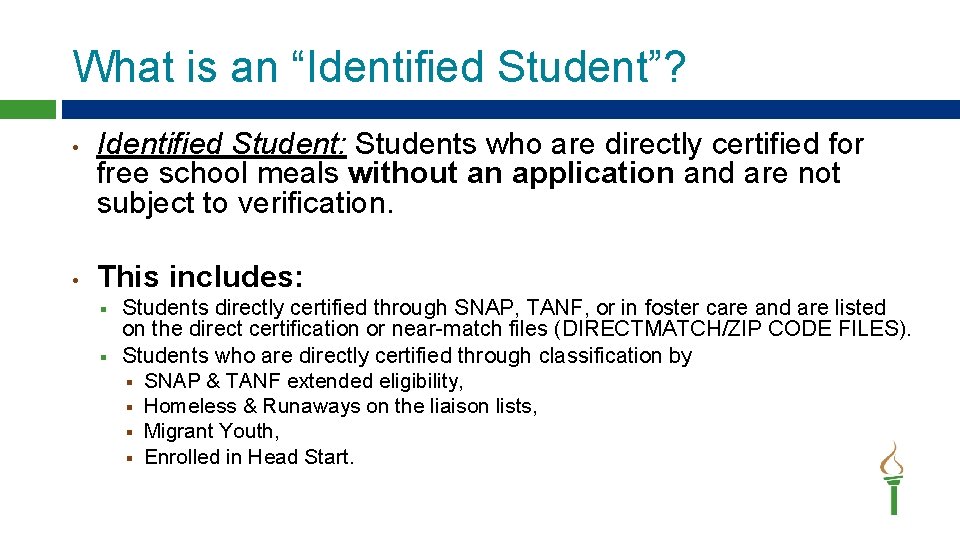
What is an “Identified Student”? • • Identified Student: Students who are directly certified for free school meals without an application and are not subject to verification. This includes: § § Students directly certified through SNAP, TANF, or in foster care and are listed on the direct certification or near-match files (DIRECTMATCH/ZIP CODE FILES). Students who are directly certified through classification by § SNAP & TANF extended eligibility, § Homeless & Runaways on the liaison lists, § Migrant Youth, § Enrolled in Head Start.
What is an “Enrolled Student”? • Enrolled Student: Students who are enrolled & attending schools, and who have access to at least one meal service daily.

How is ISP Calculated? Identified Student % # of Identified Students X 100 Total # of Enrolled Students Remember to keep ALL documentation on file.
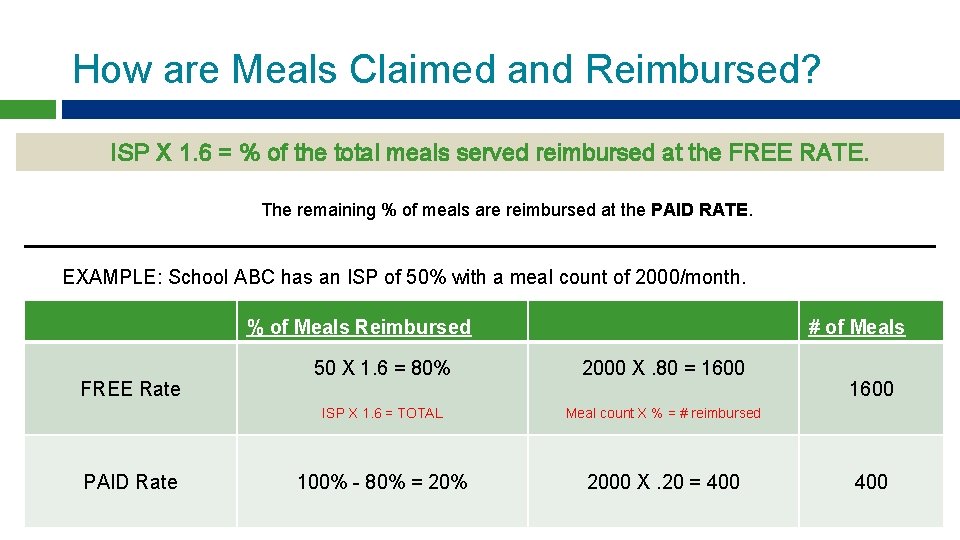
How are Meals Claimed and Reimbursed? ISP X 1. 6 = % of the total meals served reimbursed at the FREE RATE. The remaining % of meals are reimbursed at the PAID RATE. EXAMPLE: School ABC has an ISP of 50% with a meal count of 2000/month. % of Meals Reimbursed FREE Rate PAID Rate # of Meals 50 X 1. 6 = 80% 2000 X. 80 = 1600 ISP X 1. 6 = TOTAL Meal count X % = # reimbursed 100% - 80% = 20% 2000 X. 20 = 400 1600 400
Is My ISP High Enough for My Program to be Successful? • • CEP is designed to be financially viable for schools in high poverty communities. When considering CEP take in consideration: § ISP § Standard vs. CEP reimbursement § Impacts across entire LEA

CEP Comparison Calculator Tool https: //dese. mo. gov/financial-admin-services/food-nutrition-services/community-eligibility-provision-cep Click to enter Content
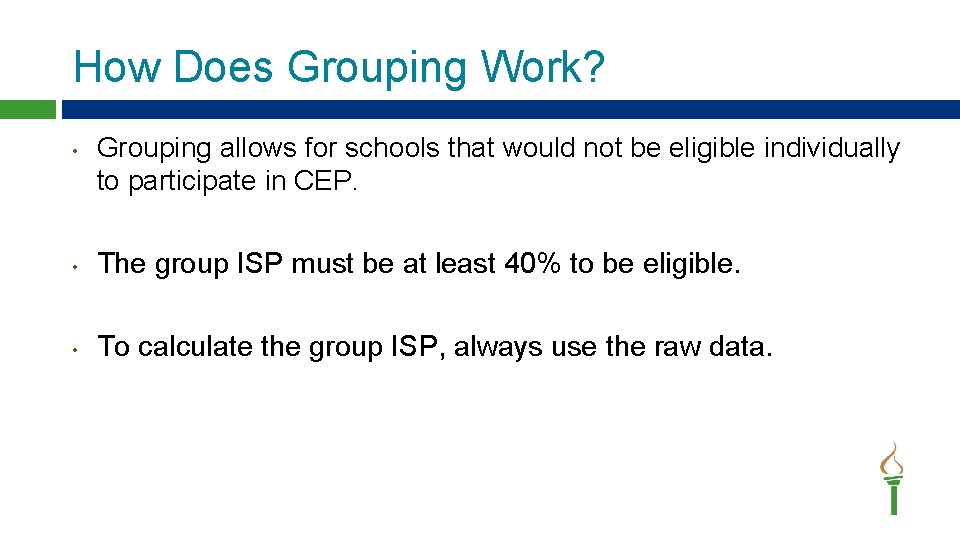
How Does Grouping Work? • Grouping allows for schools that would not be eligible individually to participate in CEP. • The group ISP must be at least 40% to be eligible. • To calculate the group ISP, always use the raw data.

How Does CEP Work with Other Education Funding and Child Nutrition Programs? 1. The Basic Funding Formula Calculation: • The Free Reduced Lunch (FRL) count is based on the numbers reported by the district in the year prior to participating in CEP. • This calculation is determined the year an LEA elects to become CEP in at least one building. For more information contact the School Finance Section at DESE.

HOW DOES CEP WORK WITH OTHER EDUCATION FUNDING AND CHILD NUTRITION PROGRAMS? 2. Title I: • LEAs operating under CEP are directed to use the prior year’s ISP and multiply by 1. 6 to determine the measure of poverty by building. For more information contact the Elementary and Secondary Education Act Finance Section (ESEA)

HOW DOES CEP WORK WITH OTHER EDUCATION FUNDING AND CHILD NUTRITION PROGRAMS? 3. E-Rate: • All LEAs operating under CEP will replace the free and reduced-eligible numbers with their ISP, by building. • The calculation used for E-rate will multiply the ISP by the USDA multiplier of 1. 6.
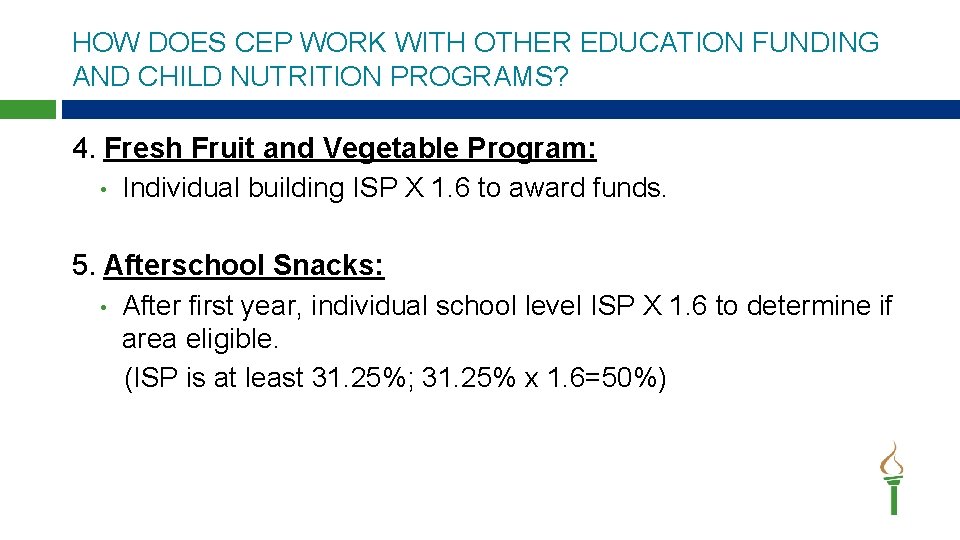
HOW DOES CEP WORK WITH OTHER EDUCATION FUNDING AND CHILD NUTRITION PROGRAMS? 4. Fresh Fruit and Vegetable Program: • Individual building ISP X 1. 6 to award funds. 5. Afterschool Snacks: • After first year, individual school level ISP X 1. 6 to determine if area eligible. (ISP is at least 31. 25%; 31. 25% x 1. 6=50%)
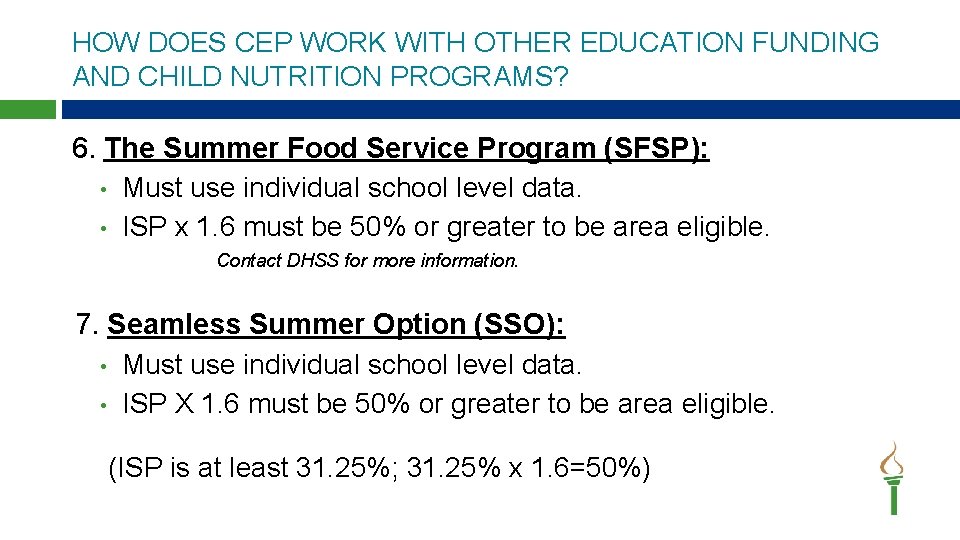
HOW DOES CEP WORK WITH OTHER EDUCATION FUNDING AND CHILD NUTRITION PROGRAMS? 6. The Summer Food Service Program (SFSP): • Must use individual school level data. • ISP x 1. 6 must be 50% or greater to be area eligible. Contact DHSS for more information. 7. Seamless Summer Option (SSO): • Must use individual school level data. • ISP X 1. 6 must be 50% or greater to be area eligible. (ISP is at least 31. 25%; 31. 25% x 1. 6=50%)
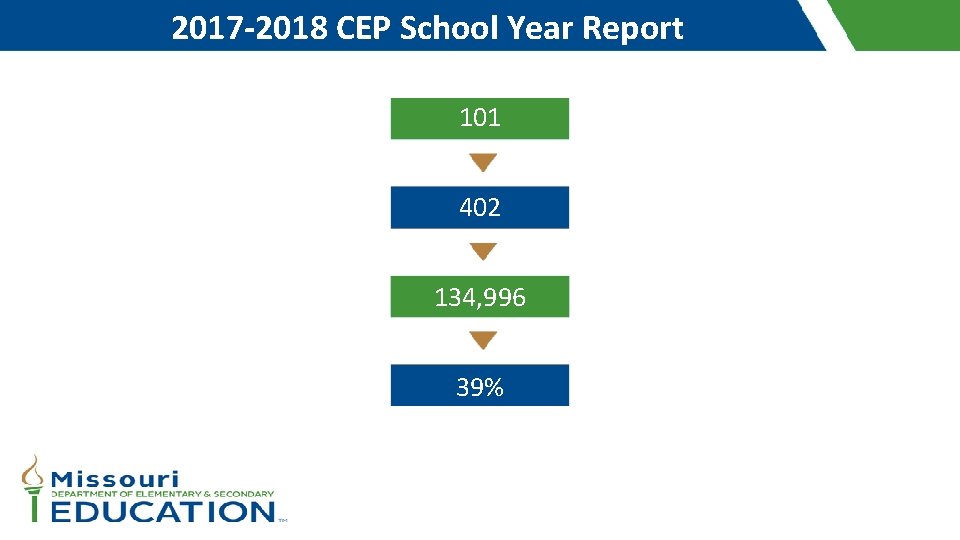
2017 -2018 CEP School Year Report 101 Click to enter Content 402 134, 996 39%
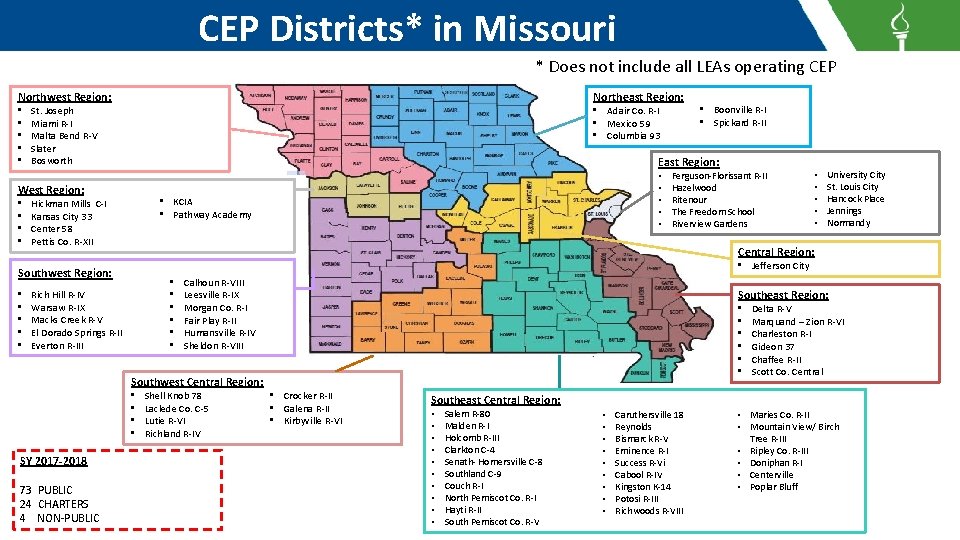
CEP Districts* in Missouri * Does not include all LEAs operating CEP Northwest Region: • • • Northeast Region: St. Joseph Miami R-I Malta Bend R-V Slater Bosworth • Adair Co. R-I • Mexico 59 • Columbia 93 East Region: West Region: • • • University City St. Louis City Hancock Place Jennings Normandy • Jefferson City • • • Calhoun R-VIII Leesville R-IX Morgan Co. R-I Fair Play R-II Humansville R-IV Sheldon R-VIII Southwest Central Region: • • 73 PUBLIC 24 CHARTERS 4 NON-PUBLIC Ferguson-Florissant R-II Hazelwood Ritenour The Freedom School Riverview Gardens Central Region: Rich Hill R-IV Warsaw R-IX Macks Creek R-V El Dorado Springs R-II Everton R-III SY 2017 -2018 • • • KCIA • Pathway Academy Hickman Mills C-I Kansas City 33 Center 58 Pettis Co. R-XII Southwest Region: • • • Boonville R-I • Spickard R-II Shell Knob 78 Laclede Co. C-5 Lutie R-VI Richland R-IV Southeast Region: • • Crocker R-II • Galena R-II • Kirbyville R-VI Delta R-V Marquand – Zion R-VI Charleston R-I Gideon 37 Chaffee R-II Scott Co. Central Southeast Central Region: • • • Salem R-80 Malden R-I Holcomb R-III Clarkton C-4 Senath- Hornersville C-8 Southland C-9 Couch R-I North Pemiscot Co. R-I Hayti R-II South Pemiscot Co. R-V • • • Caruthersville 18 Reynolds Bismarck R-V Eminence R-I Success R-Vi Cabool R-IV Kingston K-14 Potosi R-III Richwoods R-VIII • Maries Co. R-II • Mountain View/ Birch Tree R-III • Ripley Co. R-III • Doniphan R-I • Centerville • Poplar Bluff
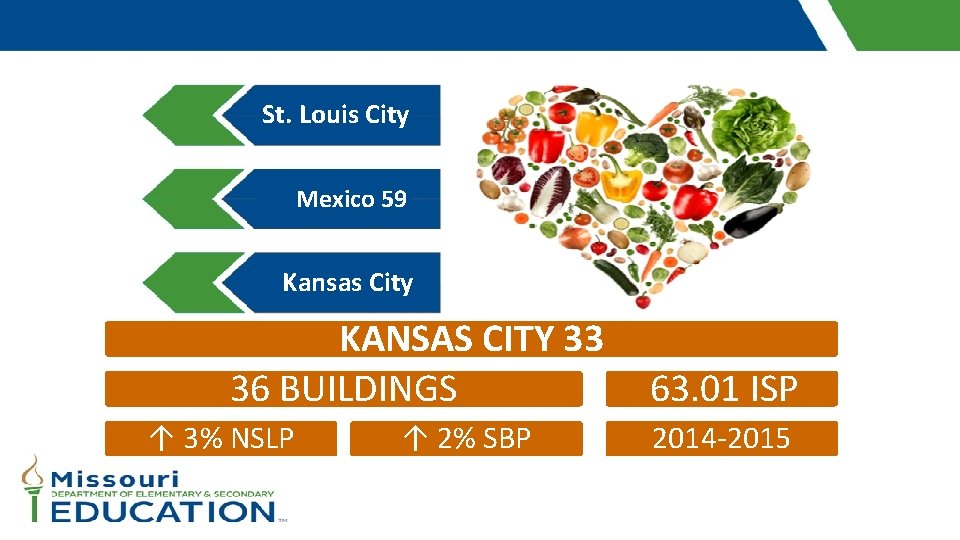
St. Louis City Click to enter Content Mexico 59 Kansas City KANSAS CITY St. Louis City MEXICO 5933 36 BUILDINGS 73 4 BUILDINGS ↑ 3% 8% 5% NSLP ↑ 2% 3% 6% SBP 63. 01 70. 12 42. 44 ISP 2014 -2015
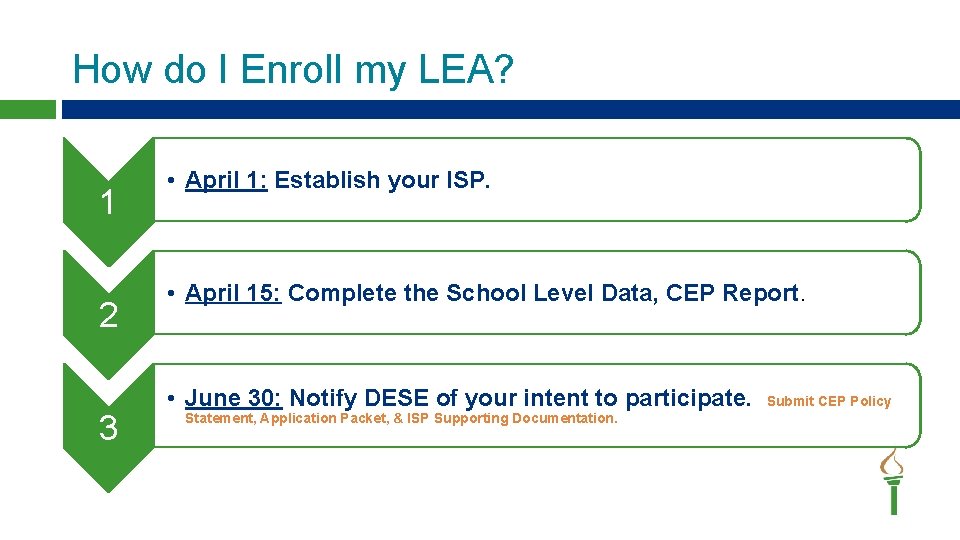
How do I Enroll my LEA? 1 2 3 • April 1: Establish your ISP. • April 15: Complete the School Level Data, CEP Report. • June 30: Notify DESE of your intent to participate. Statement, Application Packet, & ISP Supporting Documentation. Submit CEP Policy
WELCOME! • Who is Operation Food Search? • What is Breakfast After the Bell? • Why Implement Breakfast After the Bell? • What grants are available to support Breakfast After the Bell implementation?
OPERATION FOOD SEARCH The mission of Operation Food Search is to nourish and educate our neighbors in need to heal the hurt of hunger. • Emergency Food Distribution • Child Nutrition Programs • Nutrition Education • Community Engagement & Advocacy
BREAKFAST AFTER THE BELL Breakfast After the Bell takes the traditional approach to school breakfast and improves it by moving it from the cafeteria to the classroom. Breakfast is available to every child, no matter the family’s income level, making it possible for all children to participate.
IMPLEMENTATION OPTIONS Breakfast in the Classroom Students eat at their desks during the first 2025 minutes of the school day Grab ‘n Go Breakfast Students pick up bagged breakfast from kiosks and bring it to the classroom Second Chance Breakfast Students get breakfast from a designated location during an extended break after first period.

WHY OFFER BREAKFAST AFTER THE BELL? • 59% of parents admit that, in the last year, the food they bought didn’t last and they didn’t have money to buy more. • 75% of educators see students regularly come to school hungry because they aren’t getting enough to eat at home. • 77% of children say that school meals help them feel better, reducing headaches and upset stomachs. Data from No Kid Hungry, Hunger in Our Schools report:
WHY OFFER BREAKFAST AFTER THE BELL? Students who eat school breakfast: • Score higher in math and on standardized tests • Visit the school nurse less for hungerrelated illnesses • Demonstrate better school attendance and less tardiness • Exhibit improved concentration and memory • Display fewer behavioral issues in the
PARTNERS FOR BREAKFAST IN THE CLASSROOM GRANTS q ≥ 70% of students qualify for free or reduced-price lunch q Around 50% or fewer students are currently participating in school breakfast q Students must be allowed to eat breakfast in the classroom, after the bell q Breakfast must be served to all students at no charge q Strong stakeholder support and buy-in q Reasonable effort to maintain the program for at least 3 years
WHAT CAN BE PURCHASED? • Equipment & Supplies • Coolers & Hotboxes • Grab ‘n Go Kiosks • Portable Point-of-Sale Computer Equipment • Refrigeration/Freezers • Cleaning Supplies • Staff Support & Training • Marketing Materials
Lisa Percival Trina Ragain CEP Manager Food and Nutrition Services (o) 573 -751 -6341 Lisa. Percival@dese. mo. gov Director of Community Engagement Operation Food Search (o) 314 -325 -1290 Trina. Ragain@Operation. Food. Search. org The Department of Elementary and Secondary Education does not discriminate on the basis of race, color, religion, gender, national origin, age, or disability in its programs and activities. Inquiries related to Department programs and to the location of services, activities, and facilities that are accessible by persons with disabilities may be directed to the Jefferson State Office Building, Office of the General Counsel, Coordinator – Civil Rights Compliance (Title VI/Title IX/504/ADA/Age Act), 6 th Floor, 205 Jefferson Street, P. O. Box 480, Jefferson City, MO 65102 -0480; telephone number 573 -526 -4757 or TTY 800 -735 -2966; fax number 573 -522 -4883; email civilrights@dese. mo. gov.
- Slides: 32