
Ensuring an enabling environment for PPPs OECD experiences
Ensuring an enabling environment for PPPs: OECD experiences and the energy sector Kensuke TANAKA OECD Centre for Co-operation with Non-Members Japan-OECD-Vietnam Public-Private Partnership Forum 3 March 2008, Hanoi 1
Outline 1. OECD and PPPs 2. Why Governments promote PPPs? 3. How to make PPPs a success? - from OECD experience 4. PPPs in the energy sector 5. OECD and Southeast Asia 2
1. OECD and PPPs 3
Widespread use of PPPs among OECD Members n n Although some OECD Members have a long experience of PPPs, most Members started to use this scheme during the last two decades. Majority of the projects have been in transportation infrastructure. Public utility and services (water, education etc) are also seen. 4
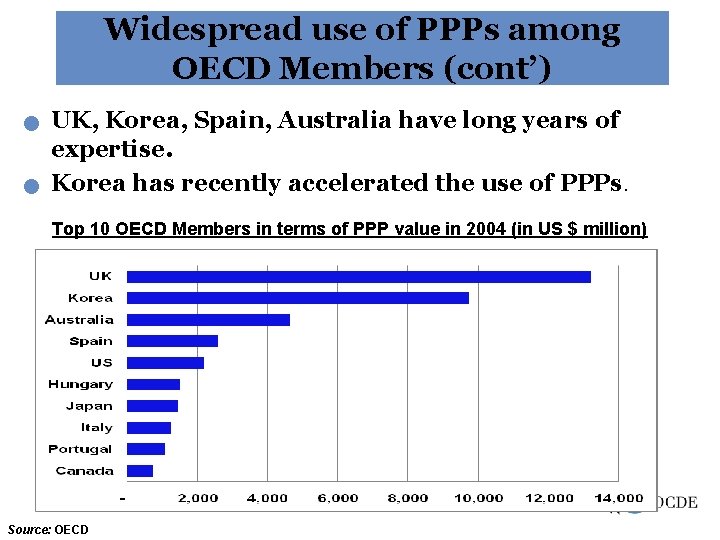
Widespread use of PPPs among OECD Members (cont’) n n UK, Korea, Spain, Australia have long years of expertise. Korea has recently accelerated the use of PPPs. Top 10 OECD Members in terms of PPP value in 2004 (in US $ million) 5 Source: OECD
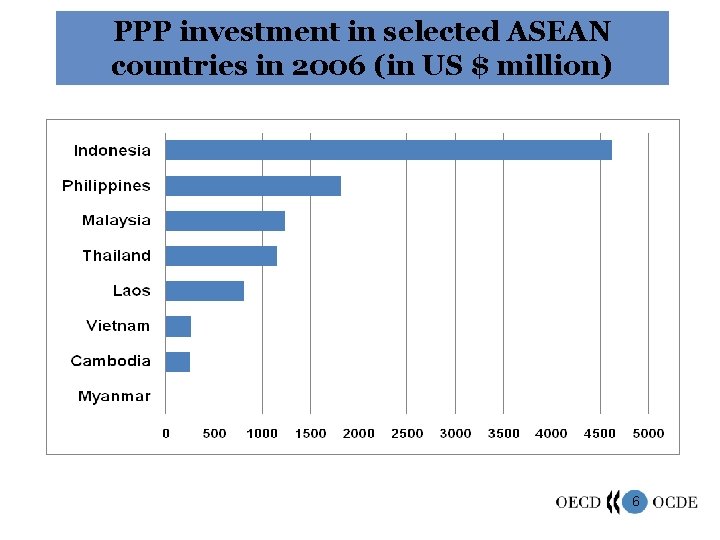
PPP investment in selected ASEAN countries in 2006 (in US $ million) 6
2. Why Governments promote PPPs? 7
Why Governments promote PPPs? Governments have many options for delivering infrastructure. Why do they promote PPPs? 1 ) Additional capital: high infrastructure demand while limitations in public resources to cover investments. Tight governmental budget and difficulty to increase tax. 2) Increase efficiency and improve service delivery. 3) Value-added to consumer and public, etc. 8
Increasing OECD work on PPPs Reflecting on the needs to analyse PPP schemes, OECD recently discussed PPPs at several directorates…. n n “Infrastructure to 2030” - OECD Futures Project (2006, 2007) “International Investor Participation in Infrastructure” (2006) , “OECD Principles for Private Sector Participation in Infrastructure” (2007) “Public-Private Partnerships: in Pursuit of Risk Sharing and Value for Money” (2008) “Transport Infrastructure Investment” (2008) 9
3. How to make PPPs a success? - from OECD experience 10
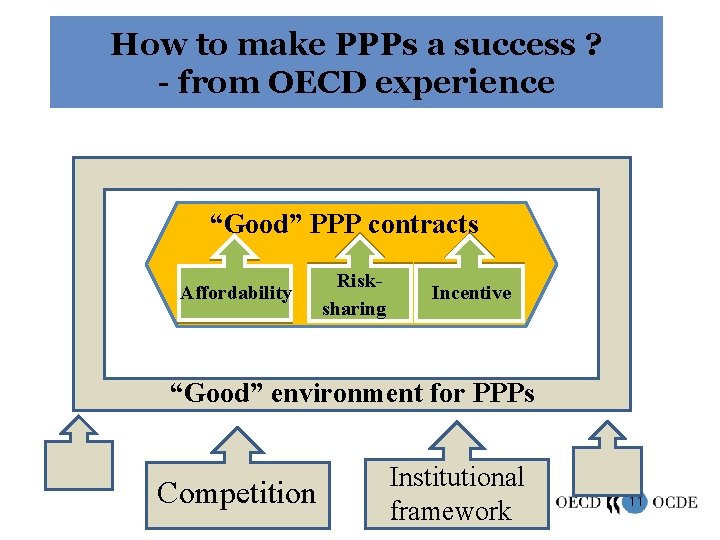
How to make PPPs a success ? - from OECD experience “Good” PPP contracts Affordability G Risksharing Incentive “Good” environment for PPPs Competition Institutional framework 11
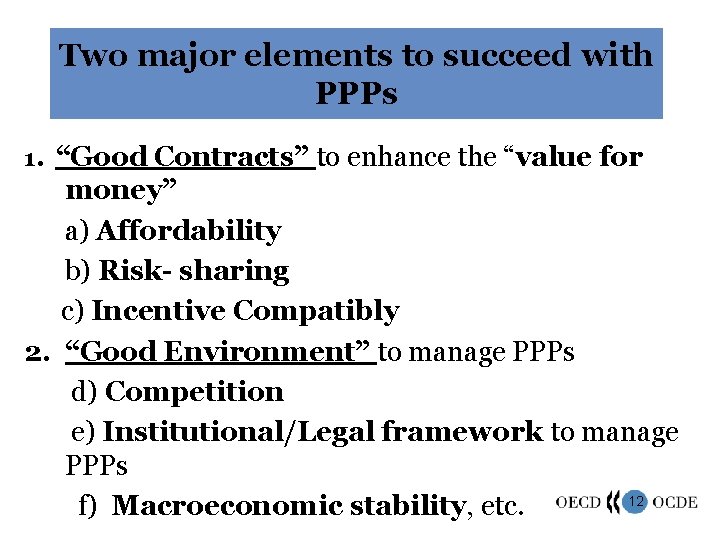
Two major elements to succeed with PPPs 1. “Good Contracts” to enhance the “value for money” a) Affordability b) Risk- sharing c) Incentive Compatibly 2. “Good Environment” to manage PPPs d) Competition e) Institutional/Legal framework to manage PPPs 12 f) Macroeconomic stability, etc.
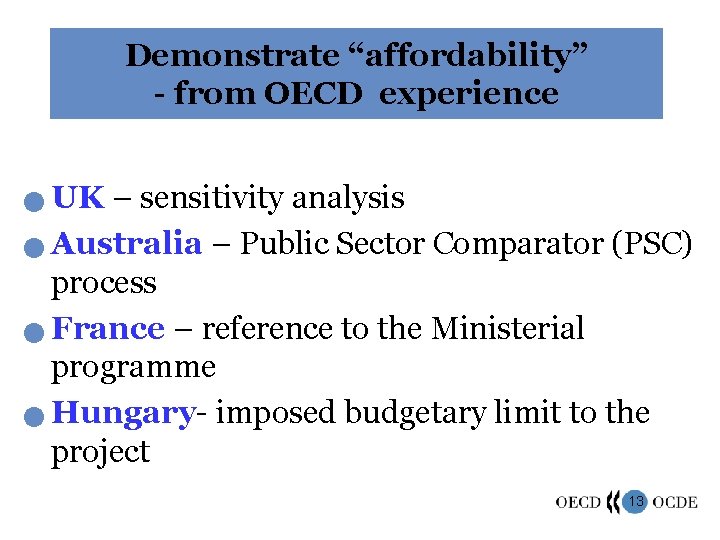
Demonstrate “affordability” - from OECD experience UK – sensitivity analysis n Australia – Public Sector Comparator (PSC) process n France – reference to the Ministerial programme n Hungary- imposed budgetary limit to the project n 13
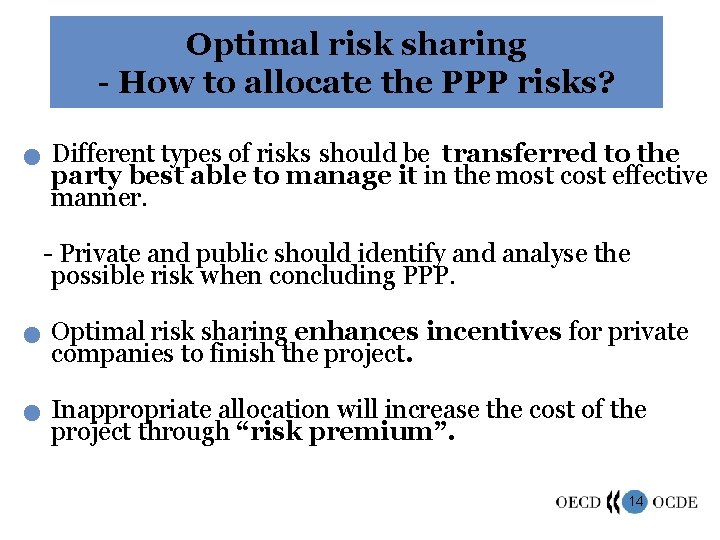
Optimal risk sharing - How to allocate the PPP risks? n Different types of risks should be transferred to the party best able to manage it in the most cost effective manner. - Private and public should identify and analyse the possible risk when concluding PPP. n Optimal risk sharing enhances incentives for private companies to finish the project. n Inappropriate allocation will increase the cost of the project through “risk premium”. 14
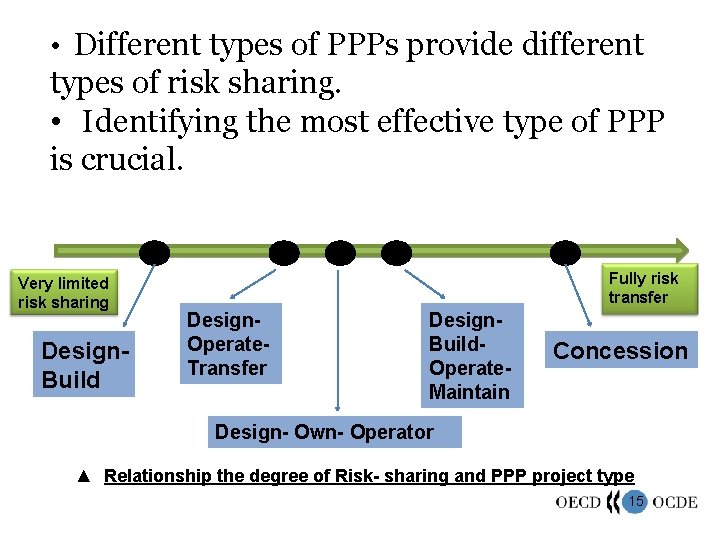
• Different types of PPPs provide different types of risk sharing. • Identifying the most effective type of PPP is crucial. Very limited risk sharing Design. Build Fully risk transfer Design. Operate. Transfer Design. Build. Operate. Maintain Concession Design- Own- Operator ▲ Relationship the degree of Risk- sharing and PPP project type 15
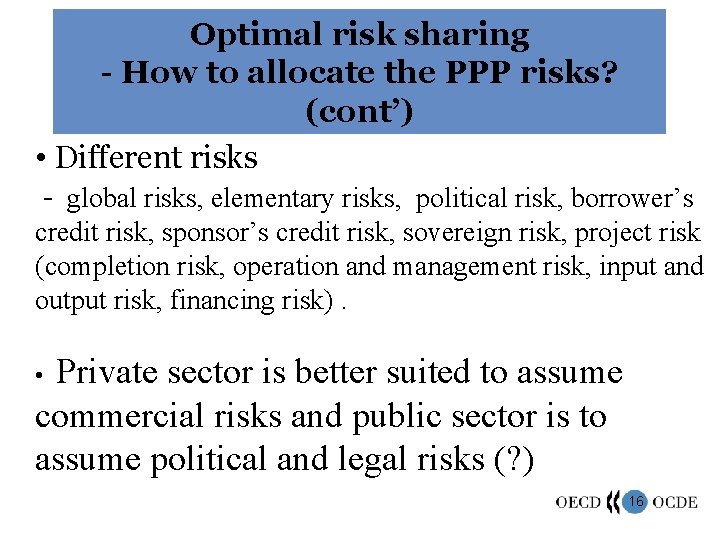
Optimal risk sharing - How to allocate the PPP risks? (cont’) • Different risks - global risks, elementary risks, political risk, borrower’s credit risk, sponsor’s credit risk, sovereign risk, project risk (completion risk, operation and management risk, input and output risk, financing risk). Private sector is better suited to assume commercial risks and public sector is to assume political and legal risks (? ) • 16
Optimal risk sharing - How to allocate the PPP risks? (cont’) Commercial risks – “supply” and “demand” risks. - Ability of the private sector to bear the risks. - Free-rider problem n Korea- Minimum Revenue Guarantee (MRG) scheme, various tax benefits, etc. n 17
Ensuring incentive compatibility n n Incentive compatible contracts will give the right incentive to both parties to implement the project. Flexibility and rigidity of the contract? - Theoretical argument- contract theory (Hart and Moore) - Experience of UK: providing flexibility in 18 the contract
PPP contract design should be a tailor made process considering several elements. 19
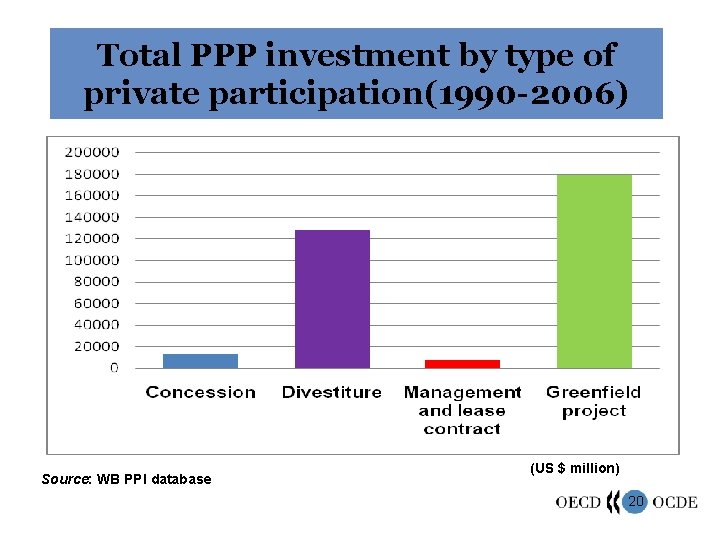
Total PPP investment by type of private participation(1990 -2006) Source: WB PPI database (US $ million) 20
Even if the contract itself is well designed, without a “good environment”, it’s difficult to achieve the objective. 21
Enhancing competition n The level of competition in both the preand post-contract stage is crucial. a) Pre-contract stage (Competition “for” the market ) - competitive bidding process – example of UK. b) Post-contract stage (Competition “in” the market) - “contestability” of the market - example of France. 22
Institutional framework to manage PPPs from OECD experience Performance of PPPs should be measured appropriately. – “Performance indicators” - UK, Australia, France, Hungary, etc. n Supporting PPP schemes: “PPP unit” - experience of Netherlands and Australia. n n Comprehensive legal framework - Turkey 23
“Good environment”- other points 1) - Efficiency gains and differences Different interest rates paid by government and private sector will effect the net benefit of the project to the government. 2) Should Infrastructure be paid for by taxes or charges? 24
4. PPPs in the energy sector 25
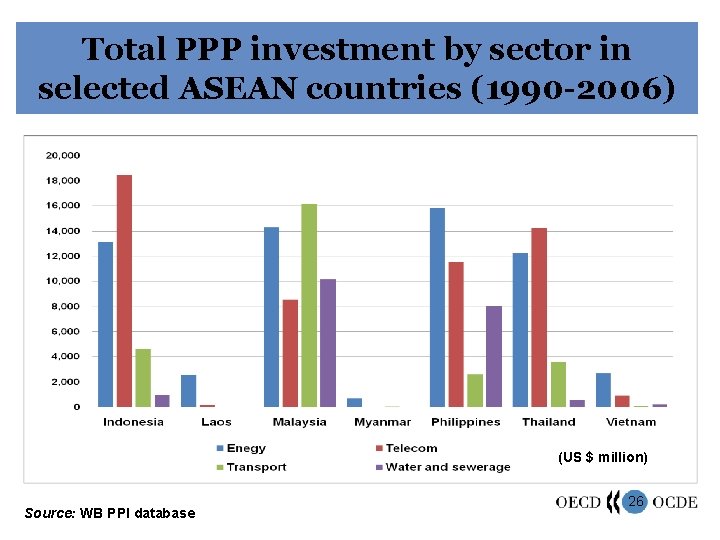
Total PPP investment by sector in selected ASEAN countries (1990 -2006) (US $ million) Source: WB PPI database 26
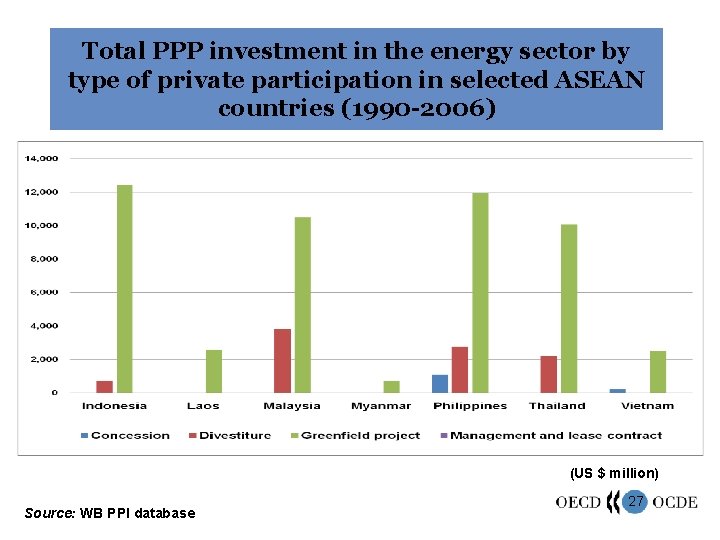
Total PPP investment in the energy sector by type of private participation in selected ASEAN countries (1990 -2006) (US $ million) Source: WB PPI database 27
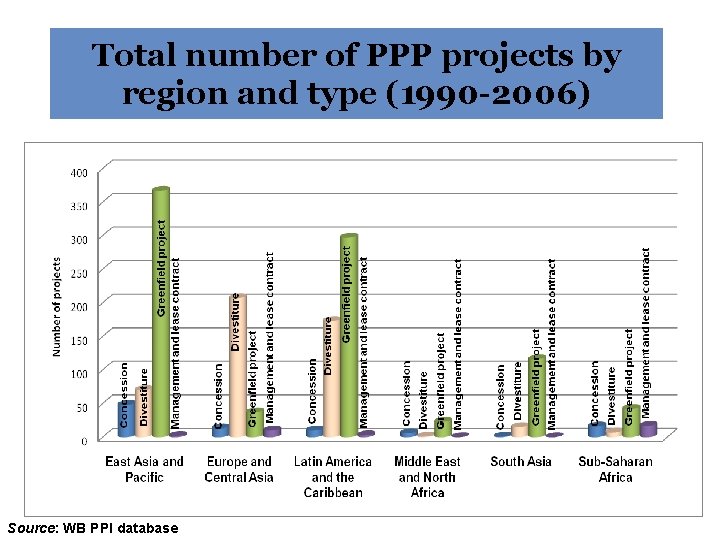
Total number of PPP projects by region and type (1990 -2006) 28 Source: WB PPI database
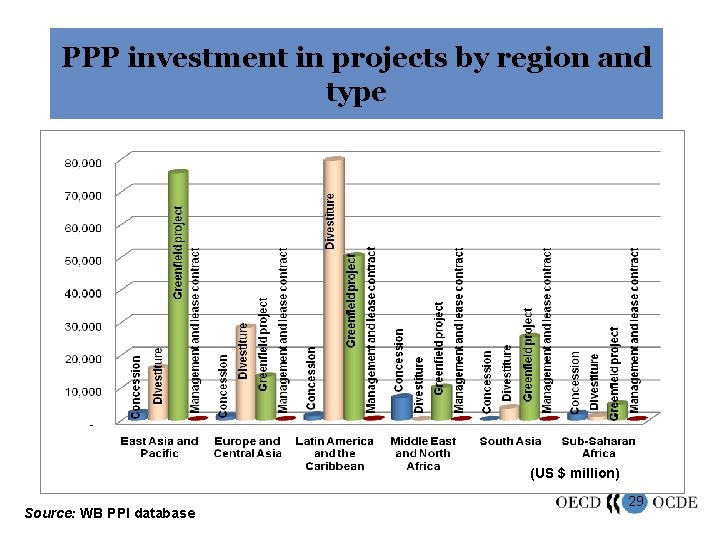
PPP investment in projects by region and type (US $ million) Source: WB PPI database 29
Some examples from OECD Members n - - - Turkey: New PPP legal framework Unify the PPP legislations (i. e. comprehensive legal framework) Provide legal basis for additional PPP models Establish a central PPP unit 30
Some examples from OECD Members n Ireland: The Alternative Energy Requirement (AER) programme - - Government support mechanism for renewable energy in the Irish market. It provides successful bidders with a 15 year power purchase agreement (PPA) , at guaranteed prices, which are index linked. 31
Some examples from OECD Members n - - USA: Advanced Turbine System (ATS) ATS is to improve fuel efficiency in power generation and reduce emissions of harmful pollutants. Governments can encourage more radical innovation in technological fields that are mature and may lack sufficient incentives to explore new technological approaches. 32
5. OECD and Southeast Asia 33
OECD and Southeast Asia n Ministerial Council Meeting 2007, May, I, (iv). Invites the Secretary-General to explore and develop recommendations to Council on how to expand the OECD’s relations, including through enhanced engagement, with selected countries and regions of strategic interest to the OECD, identified by Council. In light of its growing importance in the world economy, priority will be given to South East Asia with a view to identifying countries for possible membership. 34
OECD and Southeast Asia • Several ways of participation: Global Forum, Regional Forum, Observer, Ad-hoc Observer, etc. • “Regional integration” in Southeast Asia 35
Thank you. 36
- Slides: 36