
ENSO sensitivity to change in stratification in CMIP
![Solution of the mode [Xµ=X 0. ea. t. cos(β. t +φ)] as a function](https://slidetodoc.com/presentation_image/c421599c450d69cd4318739da8a62585/image-15.jpg "Solution of the mode [Xµ=X 0. ea. t. cos(β. t +φ)] as a function")
- Slides: 36
ENSO sensitivity to change in stratification in CMIP 3 Boris Dewitte Sulian Thual, Sang-Wook Yeh, Soon-Il An, Ali Belmadani CLIVAR Workshop, Paris, France, 17 -19 November 2010 New strategies for evaluating ENSO processes in climate models
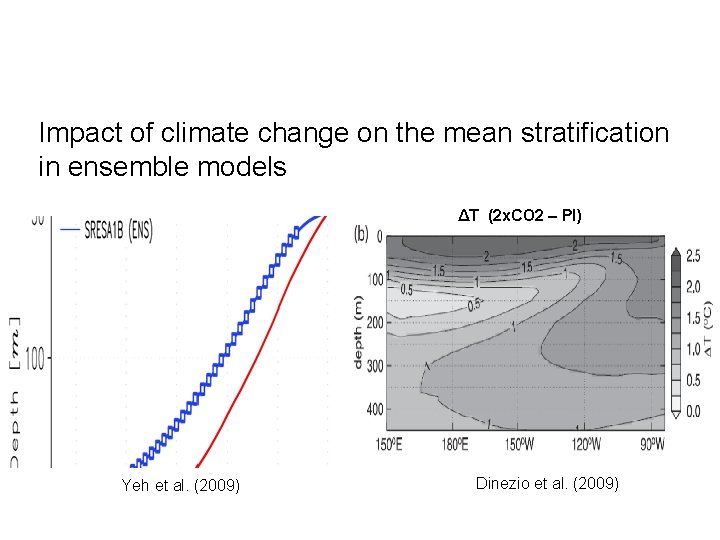
Impact of climate change on the mean stratification in ensemble models ΔT (2 x. CO 2 – PI) Yeh et al. (2009) Dinezio et al. (2009)
Conclusions/Perspectives • The characteristics of thermocline (depth, sharpness, intensity) needs to be taken into account for determining the stability of ENSO • SODA tells us that an increased stratification leads to more energetic and low-frequency ENSO (Climate change paradox. . ) • Need to understand the impact of stratification changes on ENSO non-linearities.
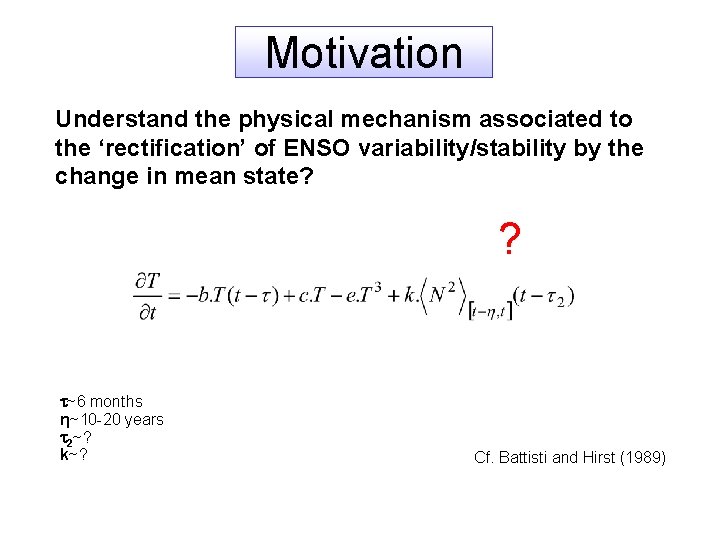
Motivation Understand the physical mechanism associated to the ‘rectification’ of ENSO variability/stability by the change in mean state? ? t~6 months η~10 -20 years t 2~? k~? Cf. Battisti and Hirst (1989)
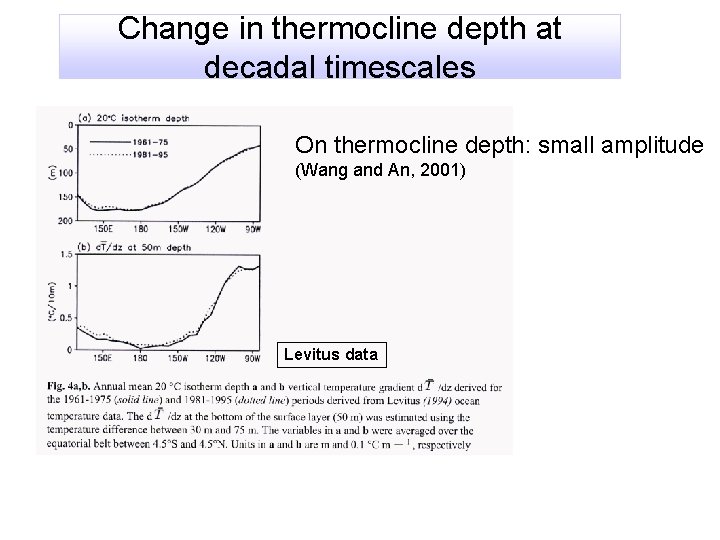
Change in thermocline depth at decadal timescales On thermocline depth: small amplitude (Wang and An, 2001) Levitus data
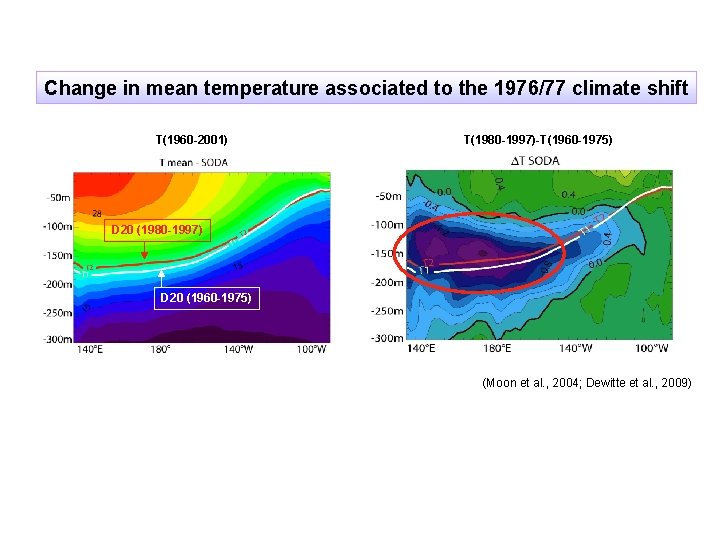
Change in mean temperature associated to the 1976/77 climate shift T(1960 -2001) T(1980 -1997)-T(1960 -1975) D 20 (1980 -1997) D 20 (1960 -1975) (Moon et al. , 2004; Dewitte et al. , 2009)
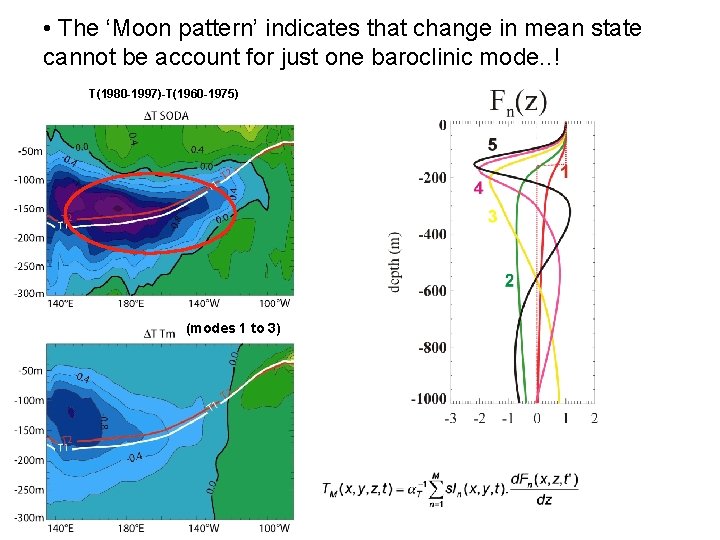
• The ‘Moon pattern’ indicates that change in mean state cannot be account for just one baroclinic mode. . ! T(1980 -1997)-T(1960 -1975) (modes 1 to 3)
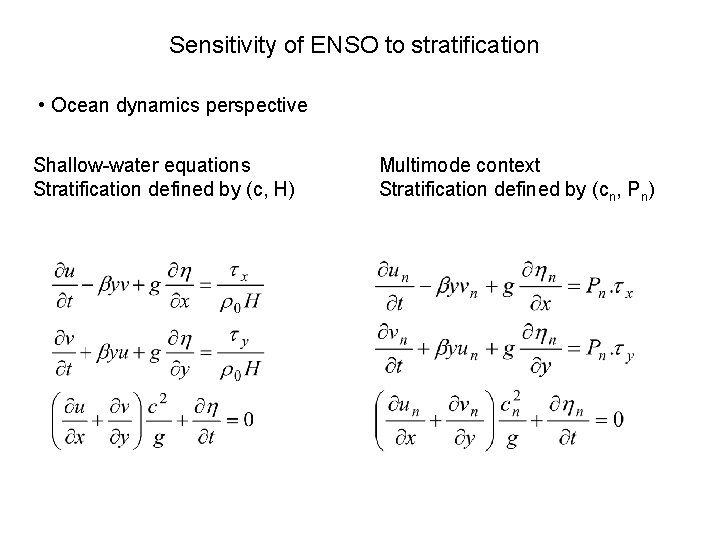
Sensitivity of ENSO to stratification • Ocean dynamics perspective Shallow-water equations Stratification defined by (c, H) Multimode context Stratification defined by (cn, Pn)
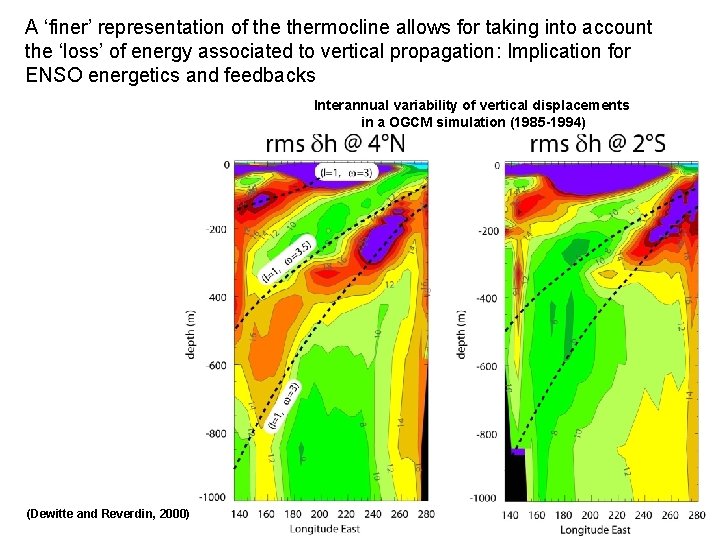
A ‘finer’ representation of thermocline allows for taking into account the ‘loss’ of energy associated to vertical propagation: Implication for ENSO energetics and feedbacks Interannual variability of vertical displacements in a OGCM simulation (1985 -1994) (Dewitte and Reverdin, 2000)
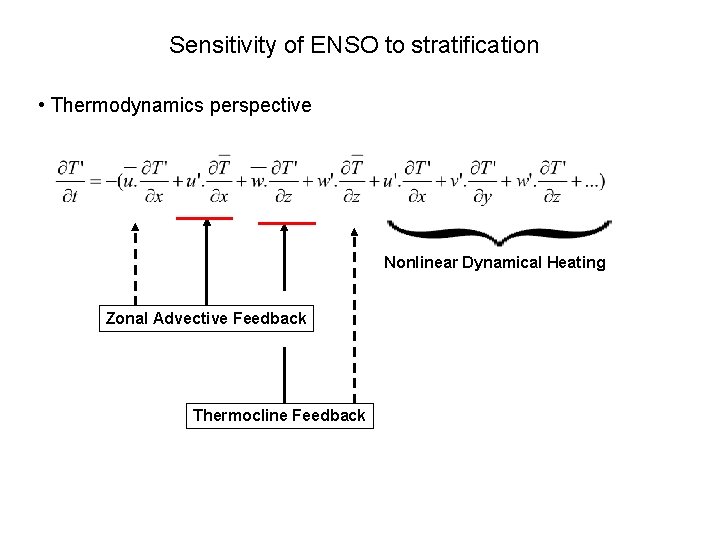
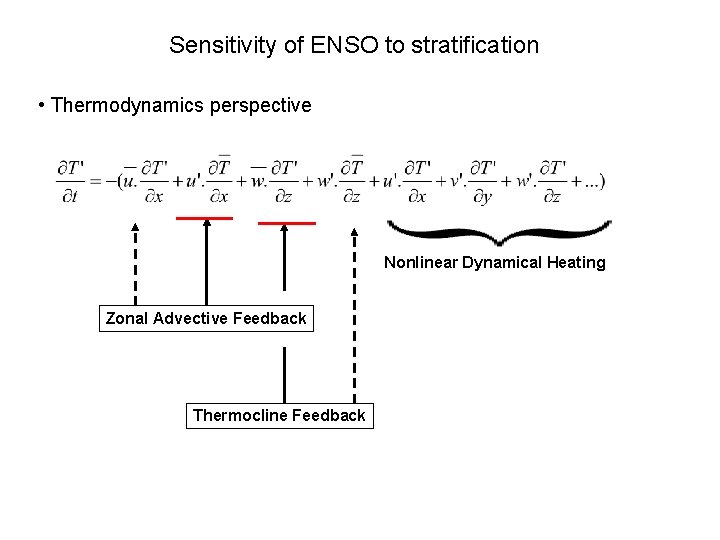
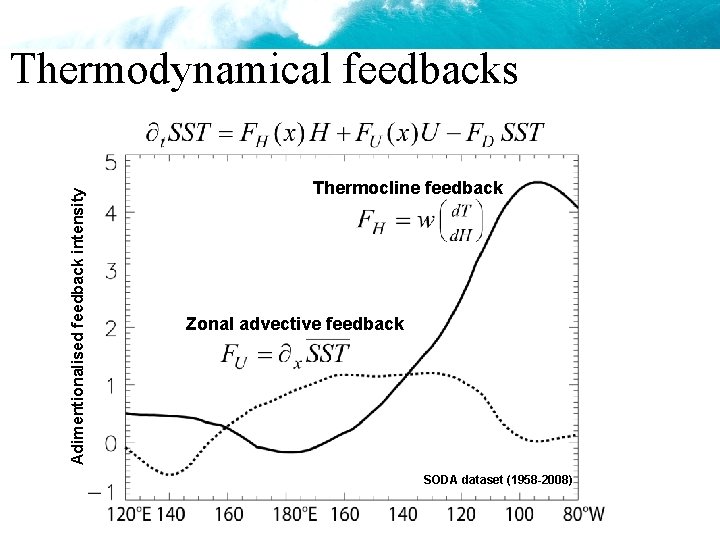
Sensitivity of ENSO to stratification • Thermodynamics perspective Nonlinear Dynamical Heating Zonal Advective Feedback Thermocline Feedback
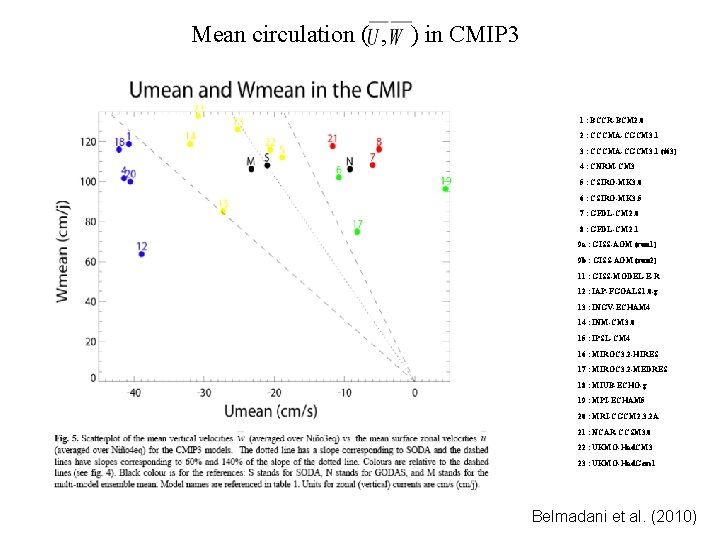
Mean circulation ( , ) in CMIP 3 1 : BCCR-BCM 2. 0 2 : CCCMA-CGCM 3. 1 3 : CCCMA-CGCM 3. 1 (t 63) 4 : CNRM-CM 3 5 : CSIRO-MK 3. 0 6 : CSIRO-MK 3. 5 7 : GFDL-CM 2. 0 8 : GFDL-CM 2. 1 9 a : GISS-AOM (run 1) 9 b : GISS-AOM (run 2) 11 : GISS-MODEL-E-R 12 : IAP-FGOALS 1. 0 -g 13 : INGV-ECHAM 4 14 : INM-CM 3. 0 15 : IPSL-CM 4 16 : MIROC 3. 2 -HIRES 17 : MIROC 3. 2 -MEDRES 18 : MIUB-ECHO-g 19 : MPI-ECHAM 5 20 : MRI-CGCM 2. 3. 2 A 21 : NCAR-CCSM 3. 0 22 : UKMO-Had. CM 3 23 : UKMO-Had. Gem 1 Belmadani et al. (2010)
Thermocline depth bias in CMIP 3 1 : BCCR-BCM 2. 0 2 : CCCMA-CGCM 3. 1 3 : CCCMA-CGCM 3. 1 (t 63) 4 : CNRM-CM 3 5 : CSIRO-MK 3. 0 6 : CSIRO-MK 3. 5 7 : GFDL-CM 2. 0 8 : GFDL-CM 2. 1 9 a : GISS-AOM (run 1) 9 b : GISS-AOM (run 2) 11 : GISS-MODEL-E-R 12 : IAP-FGOALS 1. 0 -g 13 : INGV-ECHAM 4 14 : INM-CM 3. 0 15 : IPSL-CM 4 16 : MIROC 3. 2 -HIRES 17 : MIROC 3. 2 -MEDRES 18 : MIUB-ECHO-g 19 : MPI-ECHAM 5 20 : MRI-CGCM 2. 3. 2 A 21 : NCAR-CCSM 3. 0 22 : UKMO-Had. CM 3 23 : UKMO-Had. Gem 1
Sensitivity of ENSO to stratification • Thermodynamics perspective Nonlinear Dynamical Heating Zonal Advective Feedback Thermocline Feedback
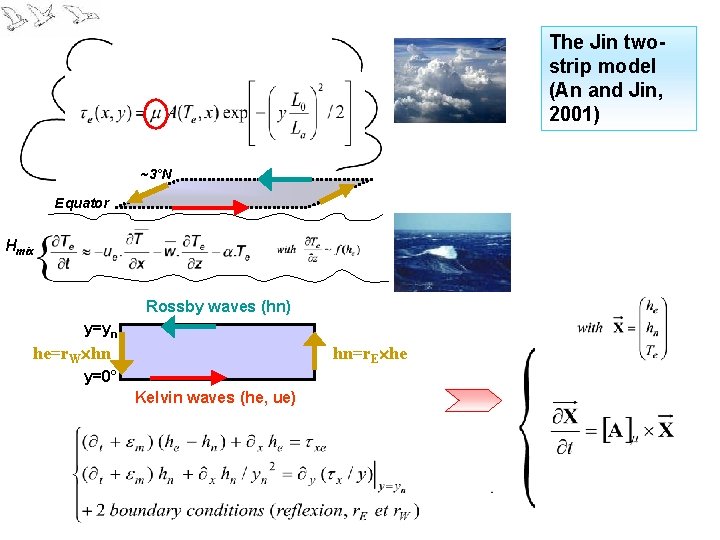
The Jin twostrip model (An and Jin, 2001) ~3°N Equator Hmix Rossby waves (hn) y=yn he=r. W hn hn=r. E he y=0° Kelvin waves (he, ue) y=0°-> y=yn->
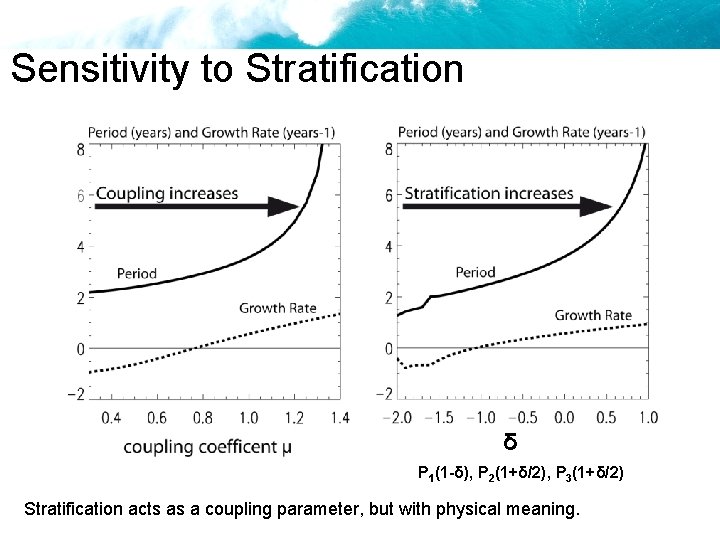
Solution of the mode [Xµ=X 0. ea. t. cos(β. t +φ)] as a function of coupling efficiency The Jin twostrip model (An and Jin, 2001) =1 α =0 (basin mode) β ~4 yrs ~ 9 months
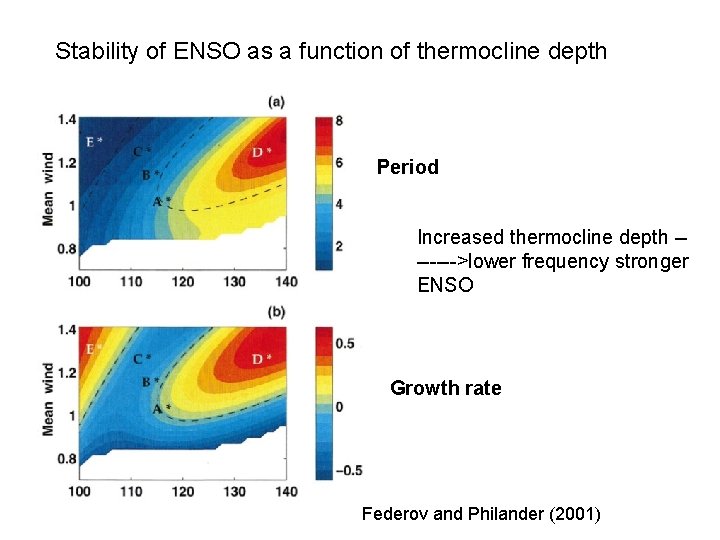
Stability of ENSO as a function of thermocline depth Period Increased thermocline depth ------->lower frequency stronger ENSO Growth rate Federov and Philander (2001)
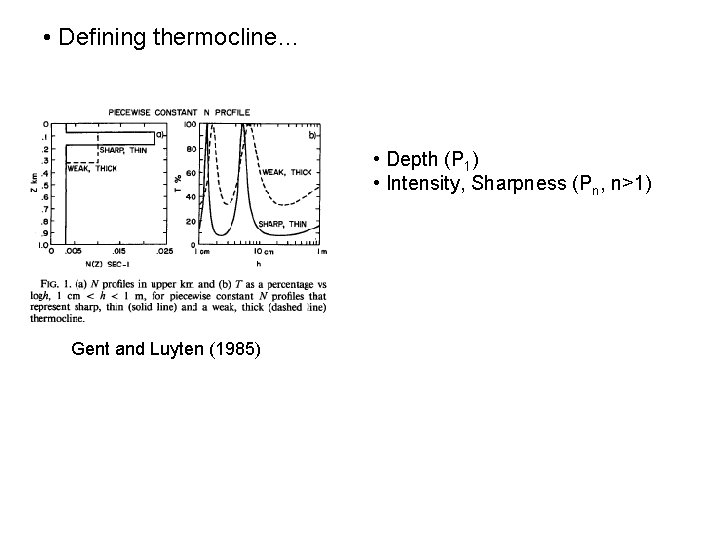
• Defining thermocline… • Depth (P 1) • Intensity, Sharpness (Pn, n>1) Gent and Luyten (1985)
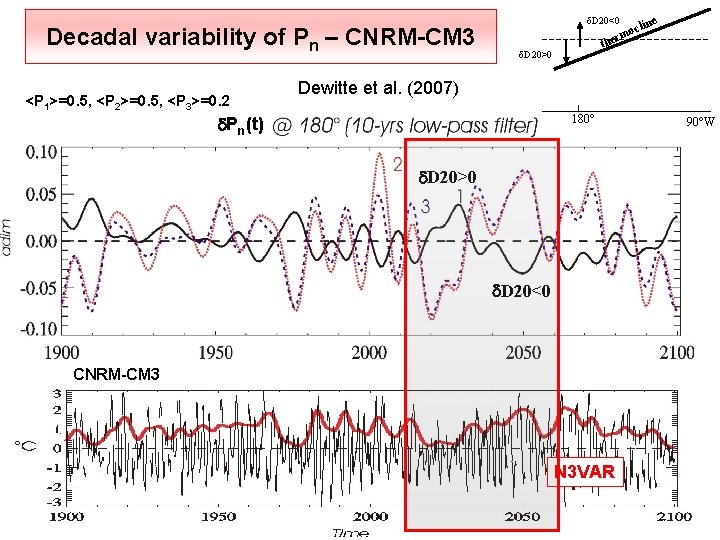
Decadal variability of Pn – CNRM-CM 3 <P 1>=0. 5, <P 2>=0. 5, <P 3>=0. 2 d. D 20<0 ine ocl erm th d. D 20>0 Dewitte et al. (2007) d. Pn(t) 180° d. D 20>0 d. D 20<0 CNRM-CM 3 N 3 VAR 90°W
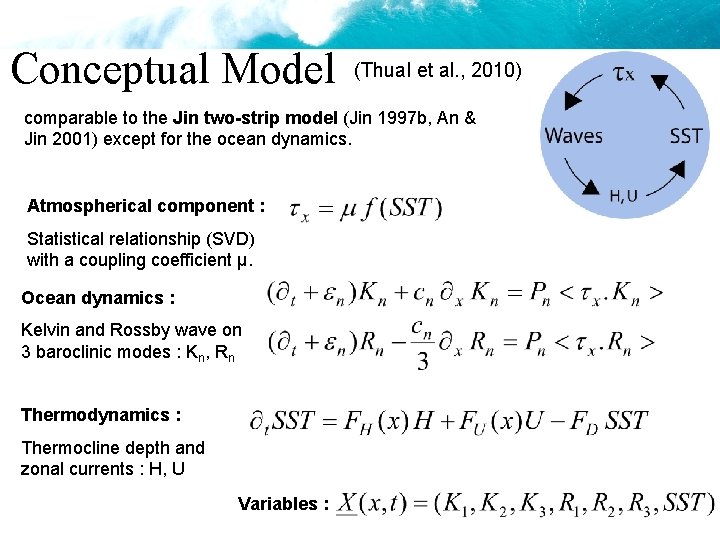
Conceptual Model (Thual et al. , 2010) comparable to the Jin two-strip model (Jin 1997 b, An & Jin 2001) except for the ocean dynamics. Atmospherical component : Statistical relationship (SVD) with a coupling coefficient µ. Ocean dynamics : Kelvin and Rossby wave on 3 baroclinic modes : Kn, Rn Thermodynamics : Thermocline depth and zonal currents : H, U Variables :
Adimentionalised feedback intensity Thermodynamical feedbacks Thermocline feedback Zonal advective feedback SODA dataset (1958 -2008)
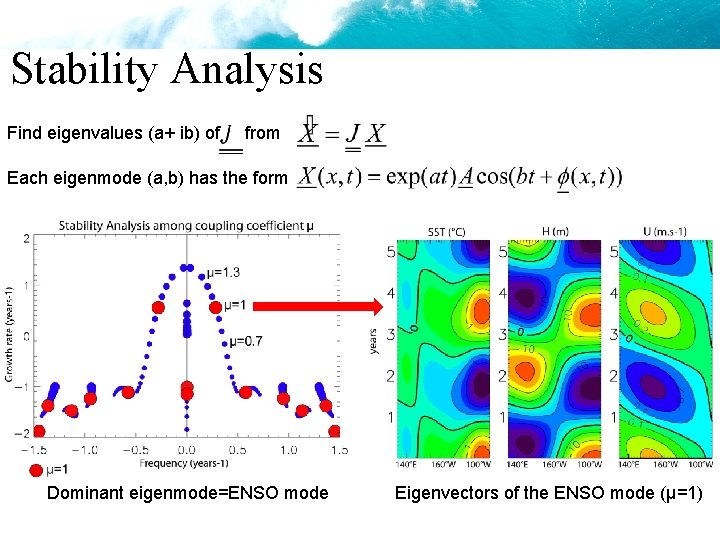
Stability Analysis Find eigenvalues (a+ ib) of from Each eigenmode (a, b) has the form Dominant eigenmode=ENSO mode Eigenvectors of the ENSO mode (µ=1)
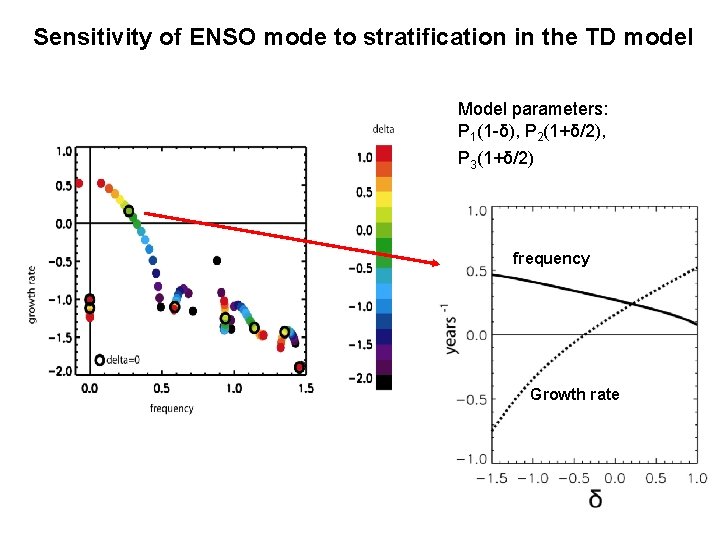
Sensitivity to Stratification δ P 1(1 -δ), P 2(1+δ/2), P 3(1+δ/2) Stratification acts as a coupling parameter, but with physical meaning.
Sensitivity of ENSO mode to stratification in the TD model Model parameters: P 1(1 -δ), P 2(1+δ/2), P 3(1+δ/2) frequency Growth rate
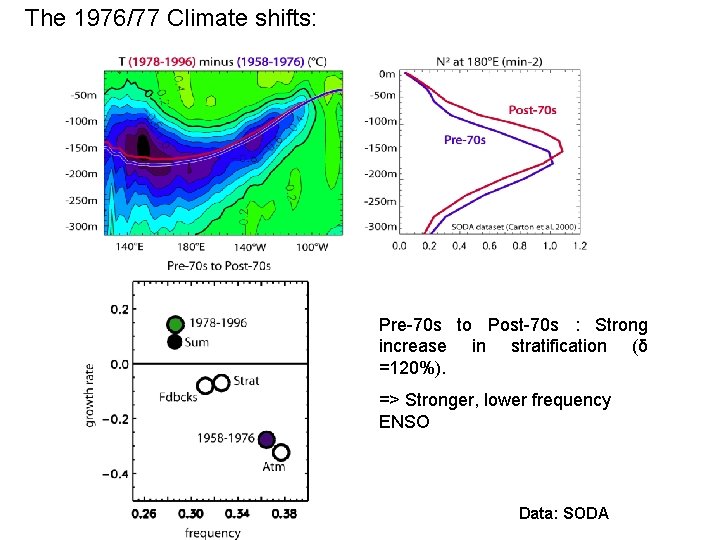
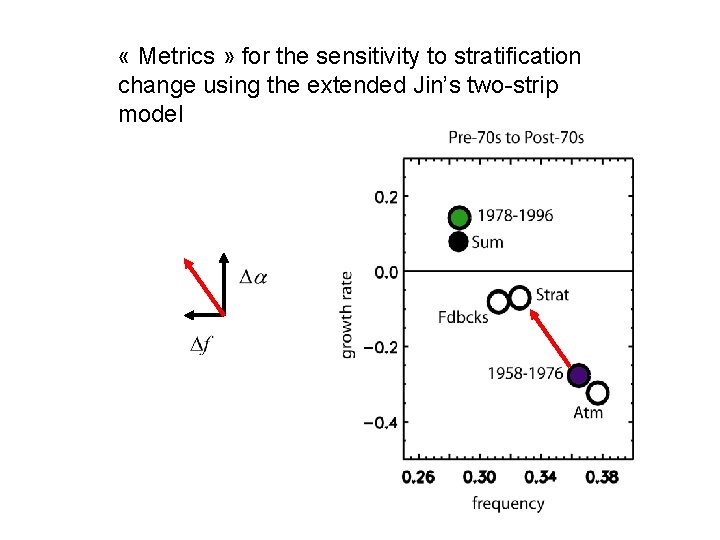
The 1976/77 Climate shifts: Pre-70 s to Post-70 s : Strong increase in stratification (δ =120%). => Stronger, lower frequency ENSO Data: SODA
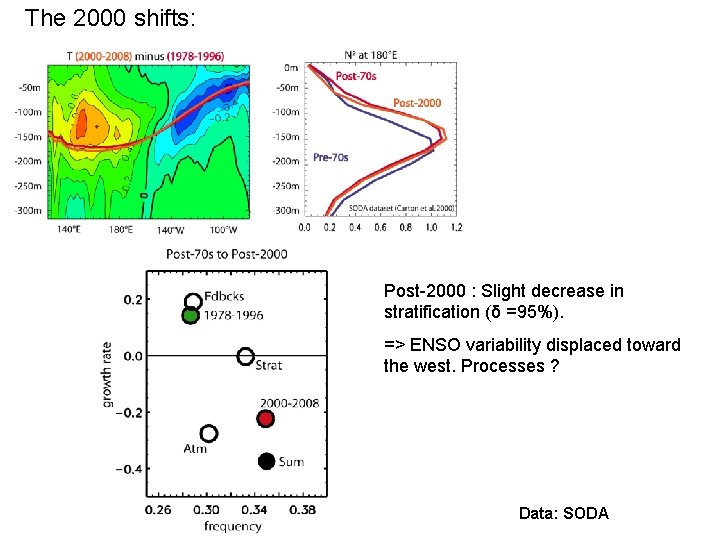
The 2000 shifts: Post-2000 : Slight decrease in stratification (δ =95%). => ENSO variability displaced toward the west. Processes ? Data: SODA
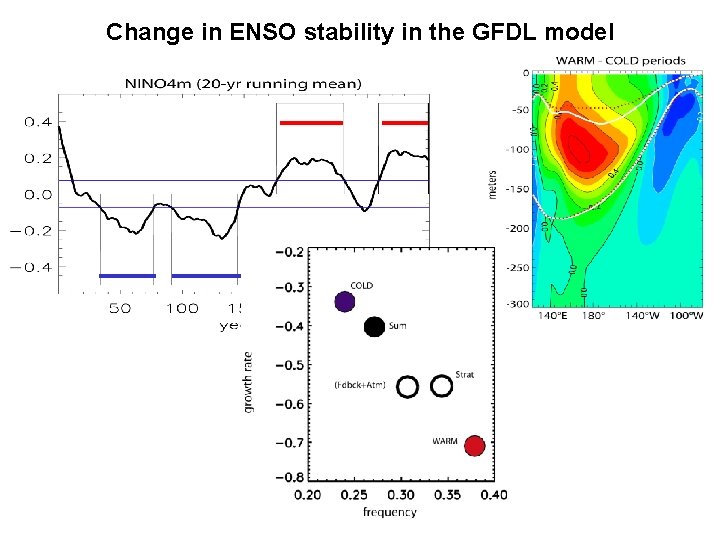
Change in ENSO stability in the GFDL model
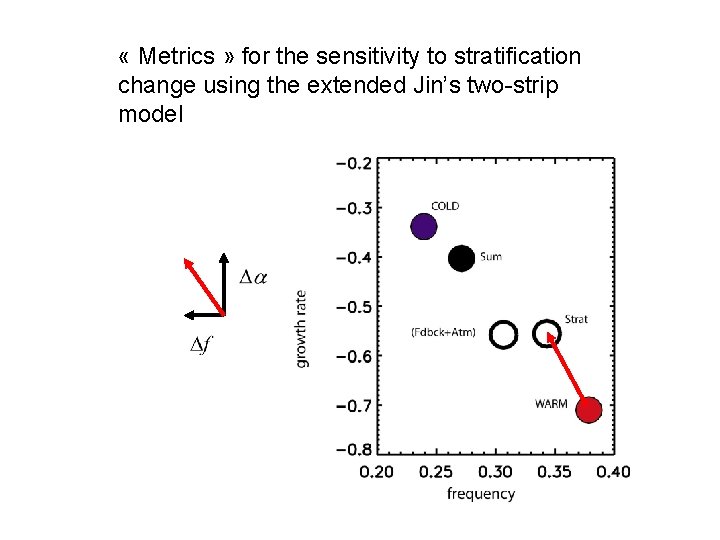
« Metrics » for the sensitivity to stratification change using the extended Jin’s two-strip model
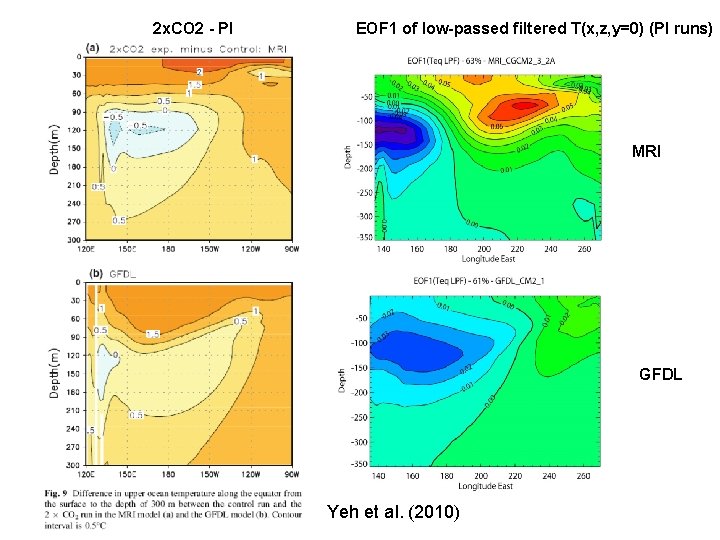
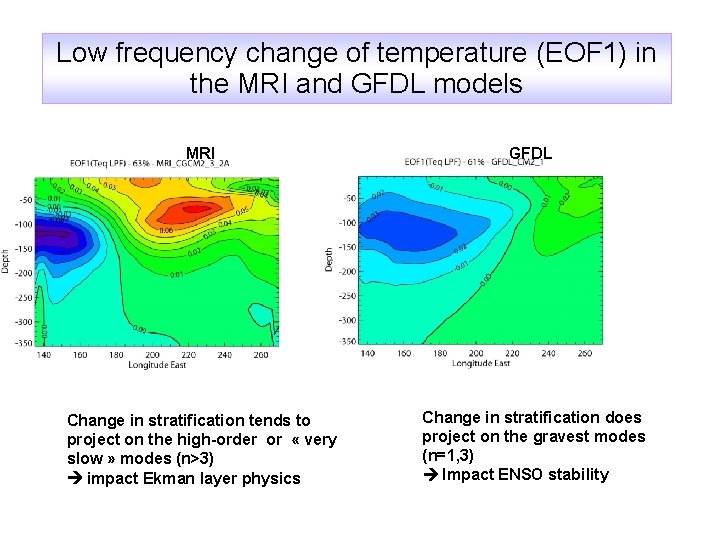
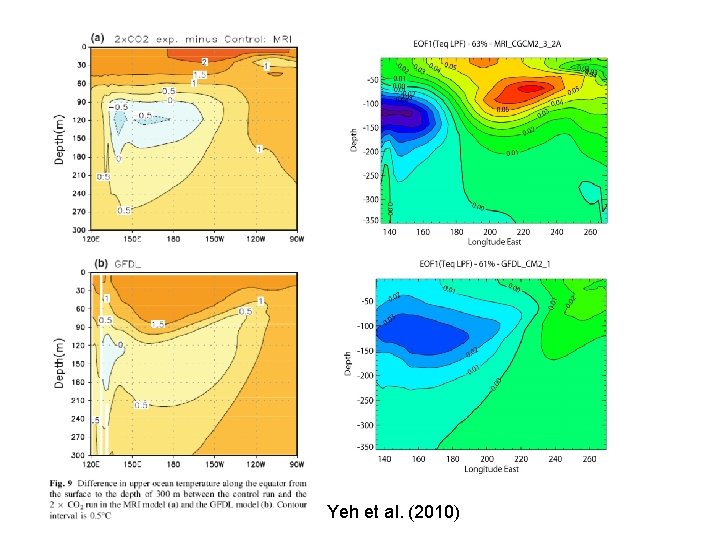
2 x. CO 2 - PI EOF 1 of low-passed filtered T(x, z, y=0) (PI runs) MRI GFDL Yeh et al. (2010)
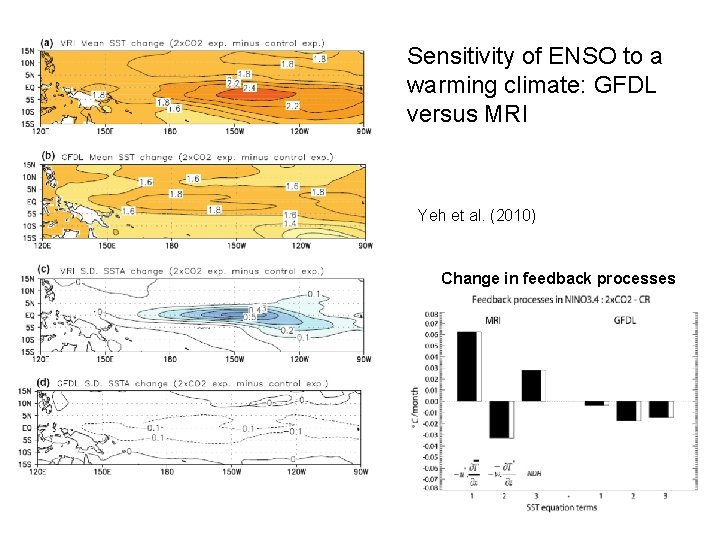
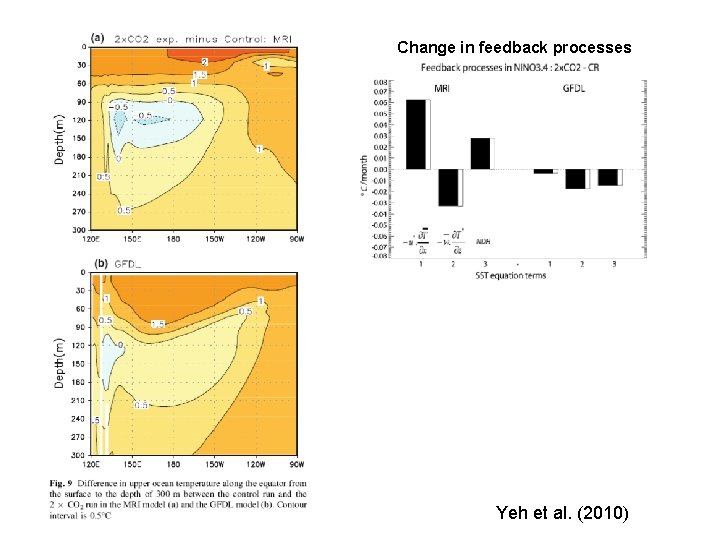
Sensitivity of ENSO to a warming climate: GFDL versus MRI Yeh et al. (2010) Change in feedback processes
Conclusions/Perspectives • The characteristics of thermocline (depth, sharpness, intensity) needs to be taken into account for determining the stability of ENSO • SODA tells us that an increased stratification leads to more energetic and lower-frequency ENSO (Climate change paradox. ? . ) • Need to understand the impact of stratification changes on ENSO non-linearities.
« Metrics » for the sensitivity to stratification change using the extended Jin’s two-strip model
Low frequency change of temperature (EOF 1) in the MRI and GFDL models MRI GFDL Change in stratification tends to project on the high-order or « very slow » modes (n>3) impact Ekman layer physics Change in stratification does project on the gravest modes (n=1, 3) Impact ENSO stability
Change in feedback processes Yeh et al. (2010)
Yeh et al. (2010)
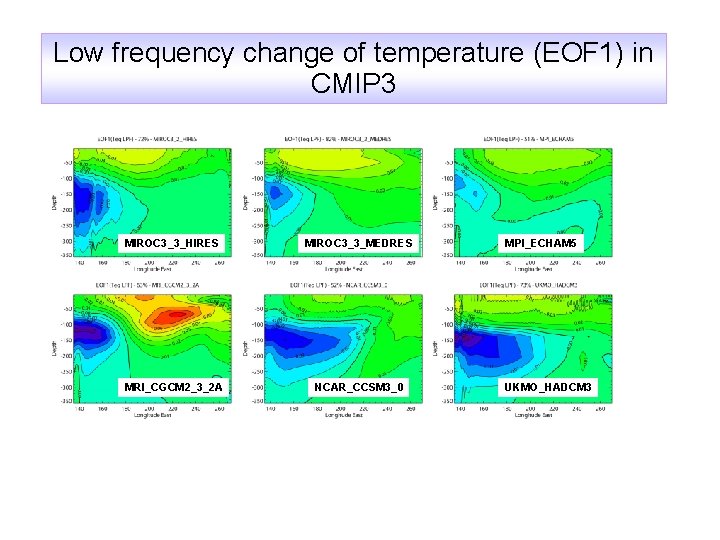
Low frequency change of temperature (EOF 1) in CMIP 3 MIROC 3_3_HIRES MIROC 3_3_MEDRES MRI_CGCM 2_3_2 A NCAR_CCSM 3_0 MPI_ECHAM 5 UKMO_HADCM 3
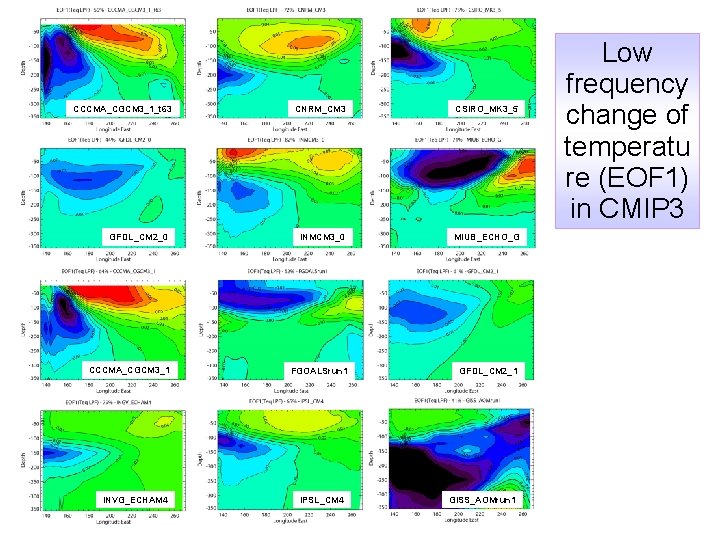
CCCMA_CGCM 3_1_t 63 CNRM_CM 3 CSIRO_MK 3_5 GFDL_CM 2_0 INMCM 3_0 MIUB_ECHO_G CCCMA_CGCM 3_1 FGOALSrun 1 GFDL_CM 2_1 INVG_ECHAM 4 IPSL_CM 4 GISS_AOMrun 1 Low frequency change of temperatu re (EOF 1) in CMIP 3