
ENSO Recent Evolution Current Status and Predictions Update
- Slides: 32
ENSO: Recent Evolution, Current Status and Predictions Update prepared by: Climate Prediction Center / NCEP 23 November 2020
Outline Summary Recent Evolution and Current Conditions Oceanic Niño Index (ONI) Pacific SST Outlook U. S. Seasonal Precipitation and Temperature Outlooks Summary
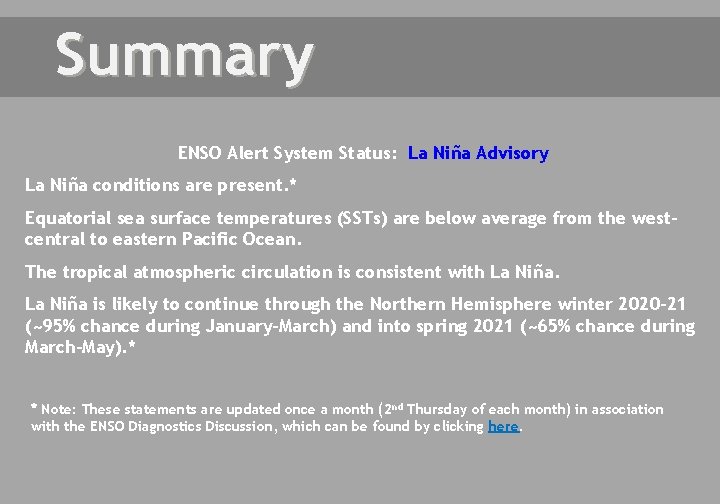
Summary ENSO Alert System Status: La Niña Advisory La Niña conditions are present. * Equatorial sea surface temperatures (SSTs) are below average from the westcentral to eastern Pacific Ocean. The tropical atmospheric circulation is consistent with La Niña is likely to continue through the Northern Hemisphere winter 2020 -21 (~95% chance during January-March) and into spring 2021 (~65% chance during March-May). * * Note: These statements are updated once a month (2 nd Thursday of each month) in association with the ENSO Diagnostics Discussion, which can be found by clicking here.
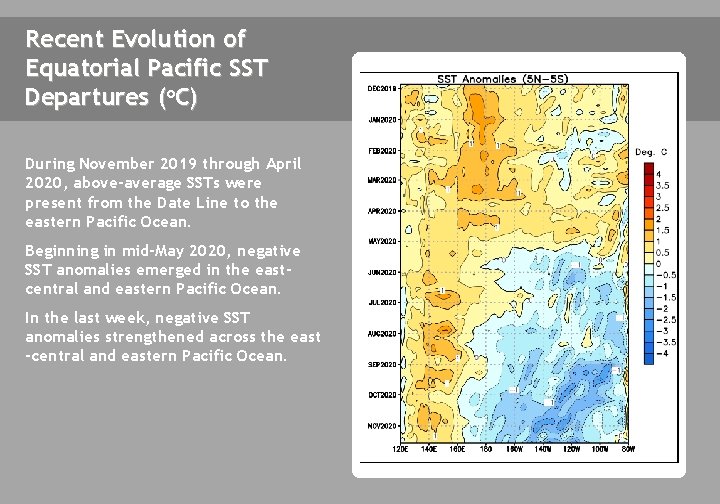
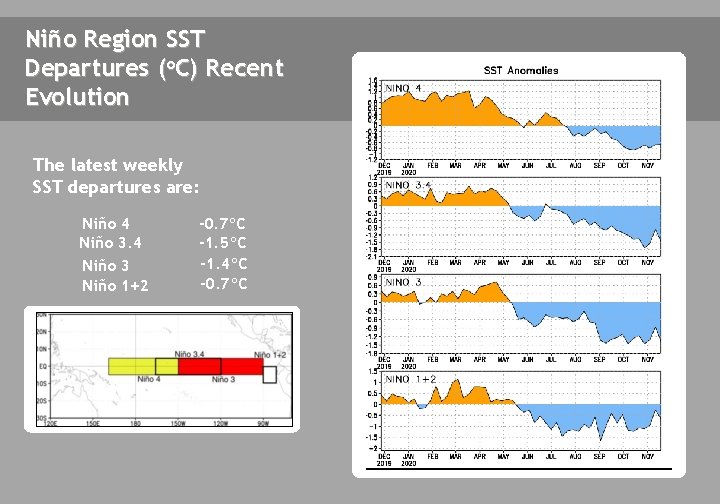
Recent Evolution of Equatorial Pacific SST Departures (o. C) During November 2019 through April 2020, above-average SSTs were present from the Date Line to the eastern Pacific Ocean. Beginning in mid-May 2020, negative SST anomalies emerged in the eastcentral and eastern Pacific Ocean. In the last week, negative SST anomalies strengthened across the east -central and eastern Pacific Ocean.
Niño Region SST Departures (o. C) Recent Evolution The latest weekly SST departures are: Niño 4 Niño 3 Niño 1+2 -0. 7ºC -1. 5ºC -1. 4ºC -0. 7ºC
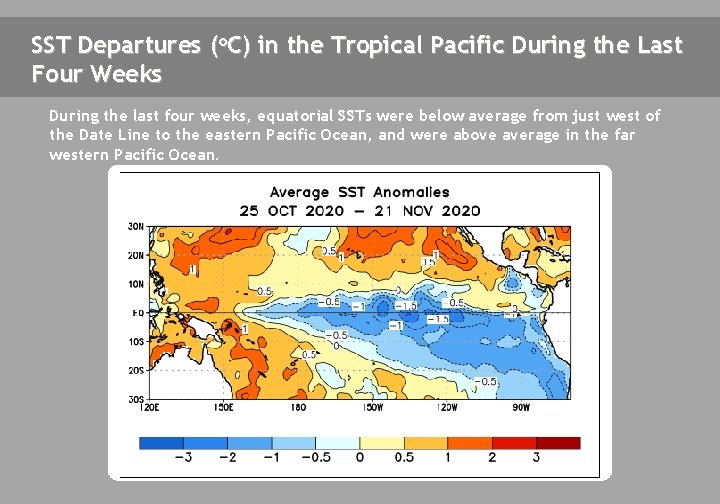
SST Departures (o. C) in the Tropical Pacific During the Last Four Weeks During the last four weeks, equatorial SSTs were below average from just west of the Date Line to the eastern Pacific Ocean, and were above average in the far western Pacific Ocean. 26 30
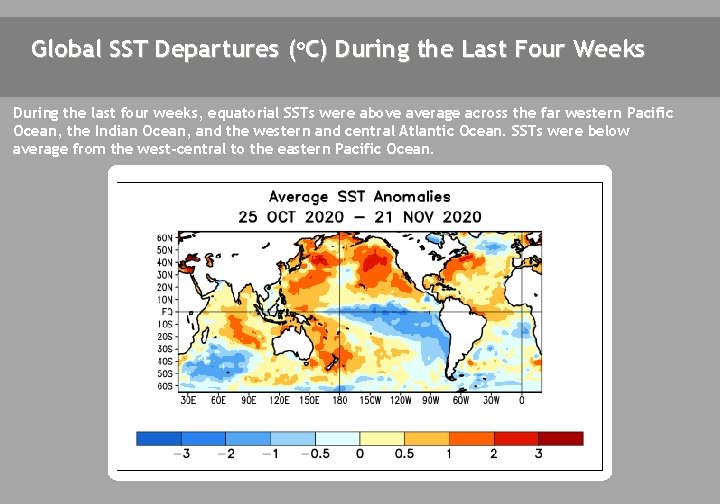
Global SST Departures (o. C) During the Last Four Weeks During the last four weeks, equatorial SSTs were above average across the far western Pacific Ocean, the Indian Ocean, and the western and central Atlantic Ocean. SSTs were below average from the west-central to the eastern Pacific Ocean. 30 26
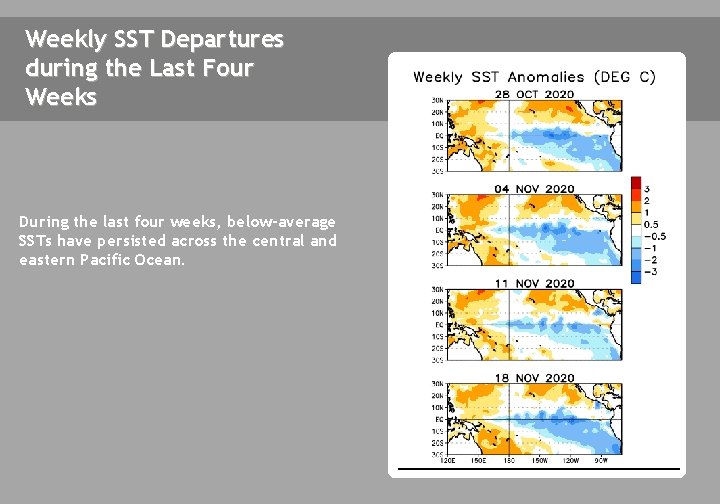
Weekly SST Departures during the Last Four Weeks During the last four weeks, below-average SSTs have persisted across the central and eastern Pacific Ocean.
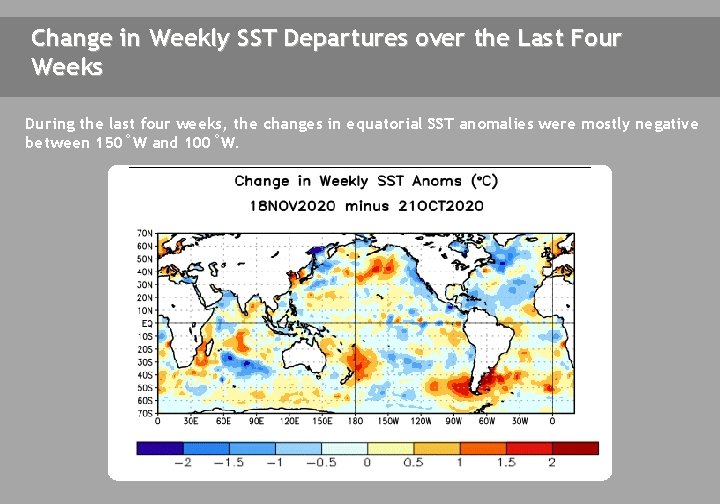
Change in Weekly SST Departures over the Last Four Weeks During the last four weeks, the changes in equatorial SST anomalies were mostly negative between 150˚W and 100˚W.
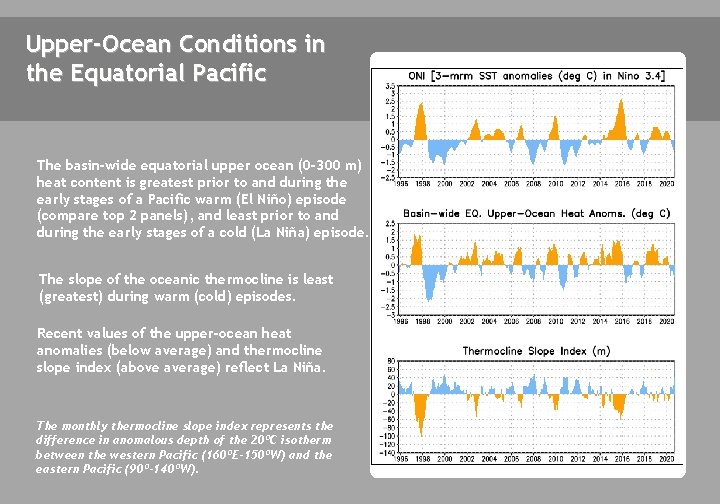
Upper-Ocean Conditions in the Equatorial Pacific The basin-wide equatorial upper ocean (0 -300 m) heat content is greatest prior to and during the early stages of a Pacific warm (El Niño) episode (compare top 2 panels), and least prior to and during the early stages of a cold (La Niña) episode. The slope of the oceanic thermocline is least (greatest) during warm (cold) episodes. Recent values of the upper-ocean heat anomalies (below average) and thermocline slope index (above average) reflect La Niña. The monthly thermocline slope index represents the difference in anomalous depth of the 20ºC isotherm between the western Pacific (160ºE-150ºW) and the eastern Pacific (90º-140ºW).
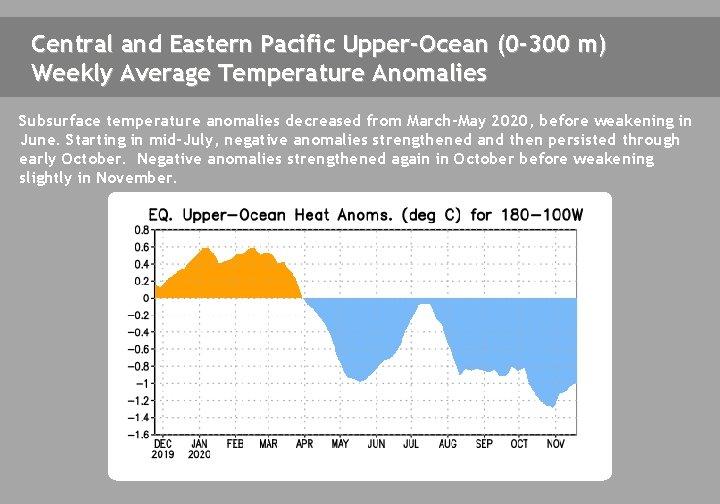
Central and Eastern Pacific Upper-Ocean (0 -300 m) Weekly Average Temperature Anomalies Subsurface temperature anomalies decreased from March-May 2020, before weakening in June. Starting in mid-July, negative anomalies strengthened and then persisted through early October. Negative anomalies strengthened again in October before weakening slightly in November.
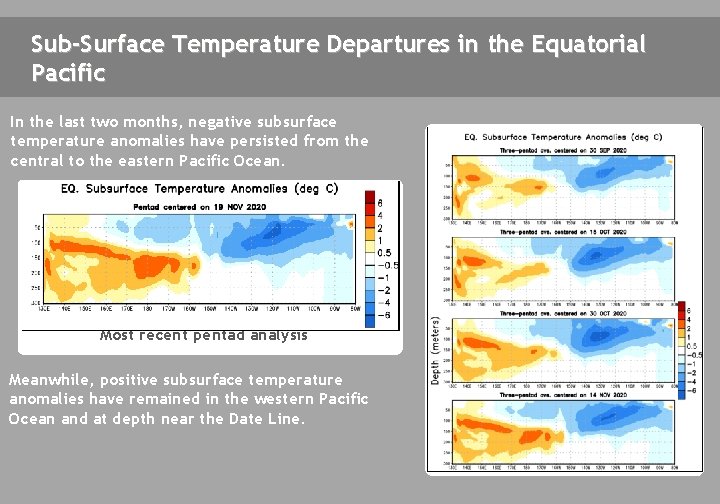
Sub-Surface Temperature Departures in the Equatorial Pacific In the last two months, negative subsurface temperature anomalies have persisted from the central to the eastern Pacific Ocean. Most recent pentad analysis Meanwhile, positive subsurface temperature anomalies have remained in the western Pacific Ocean and at depth near the Date Line.
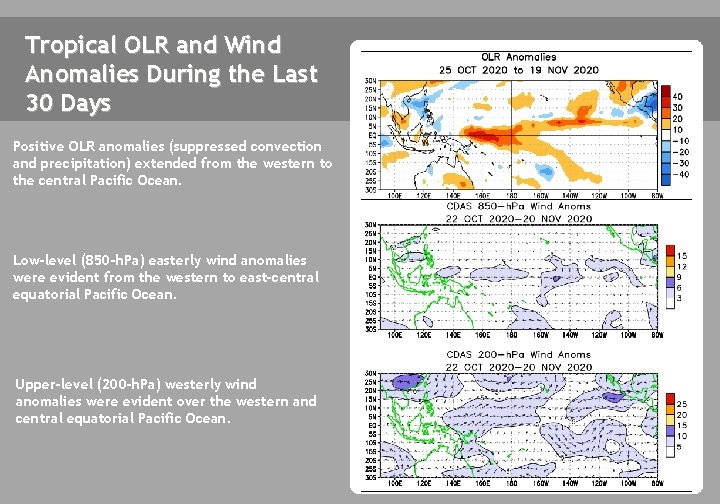
Tropical OLR and Wind Anomalies During the Last 30 Days Positive OLR anomalies (suppressed convection and precipitation) extended from the western to the central Pacific Ocean. Low-level (850 -h. Pa) easterly wind anomalies were evident from the western to east-central equatorial Pacific Ocean. Upper-level (200 -h. Pa) westerly wind anomalies were evident over the western and central equatorial Pacific Ocean.
Intraseasonal Variability Intraseasonal variability in the atmosphere (wind and pressure), which is often related to the Madden-Julian Oscillation (MJO), can significantly impact surface and subsurface conditions across the Pacific Ocean. Related to this activity: Significant weakening of the low-level easterly winds usually initiates an eastwardpropagating oceanic Kelvin wave.
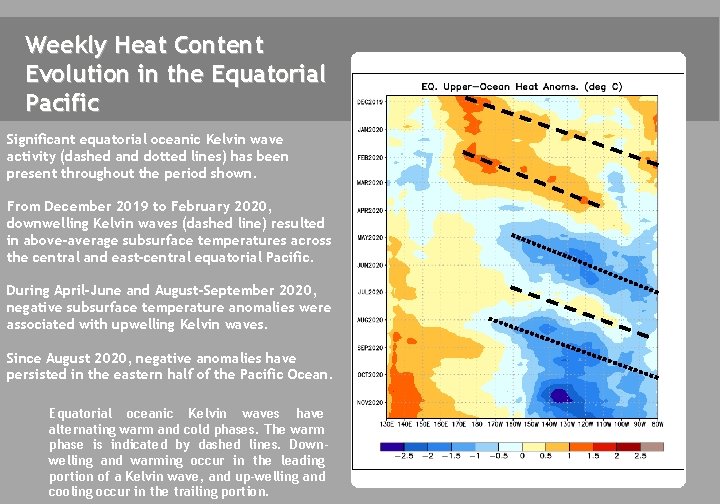
Weekly Heat Content Evolution in the Equatorial Pacific Significant equatorial oceanic Kelvin wave activity (dashed and dotted lines) has been present throughout the period shown. From December 2019 to February 2020, downwelling Kelvin waves (dashed line) resulted in above-average subsurface temperatures across the central and east-central equatorial Pacific. During April-June and August-September 2020, negative subsurface temperature anomalies were associated with upwelling Kelvin waves. Since August 2020, negative anomalies have persisted in the eastern half of the Pacific Ocean. Equatorial oceanic Kelvin waves have alternating warm and cold phases. The warm phase is indicated by dashed lines. Downwelling and warming occur in the leading portion of a Kelvin wave, and up-welling and cooling occur in the trailing portion.
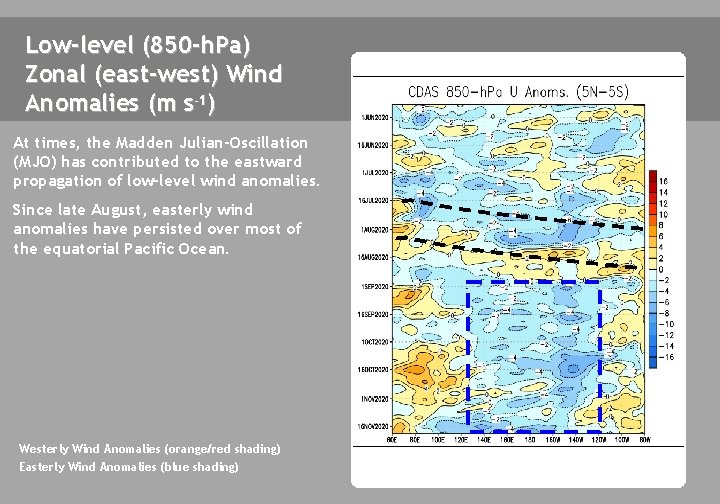
Low-level (850 -h. Pa) Zonal (east-west) Wind Anomalies (m s-1) At times, the Madden Julian-Oscillation (MJO) has contributed to the eastward propagation of low-level wind anomalies. Since late August, easterly wind anomalies have persisted over most of the equatorial Pacific Ocean. Westerly Wind Anomalies (orange/red shading) Easterly Wind Anomalies (blue shading)
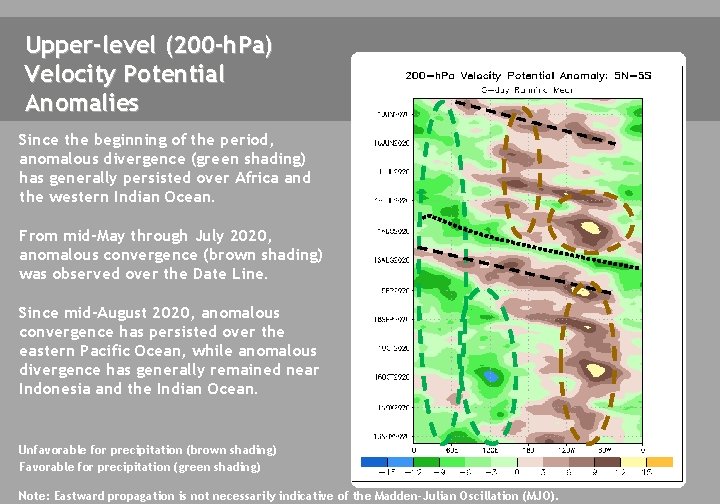
Upper-level (200 -h. Pa) Velocity Potential Anomalies Since the beginning of the period, anomalous divergence (green shading) has generally persisted over Africa and the western Indian Ocean. From mid-May through July 2020, anomalous convergence (brown shading) was observed over the Date Line. Since mid-August 2020, anomalous convergence has persisted over the eastern Pacific Ocean, while anomalous divergence has generally remained near Indonesia and the Indian Ocean. Unfavorable for precipitation (brown shading) Favorable for precipitation (green shading) Note: Eastward propagation is not necessarily indicative of the Madden-Julian Oscillation (MJO).
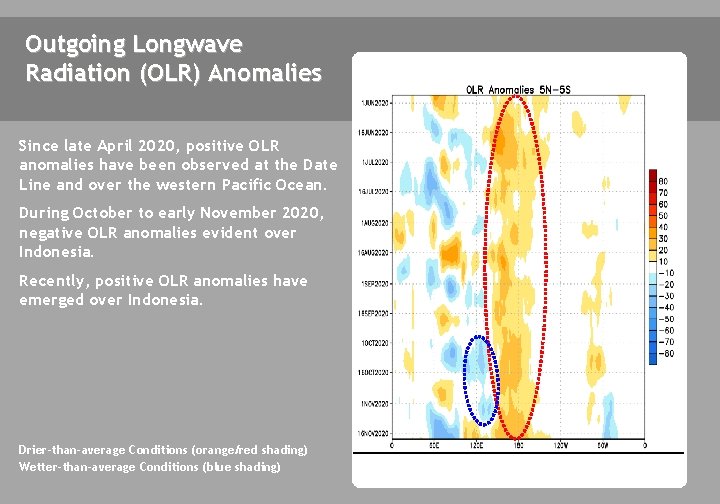
Outgoing Longwave Radiation (OLR) Anomalies Since late April 2020, positive OLR anomalies have been observed at the Date Line and over the western Pacific Ocean. During October to early November 2020, negative OLR anomalies evident over Indonesia. Recently, positive OLR anomalies have emerged over Indonesia. Drier-than-average Conditions (orange/red shading) Wetter-than-average Conditions (blue shading)
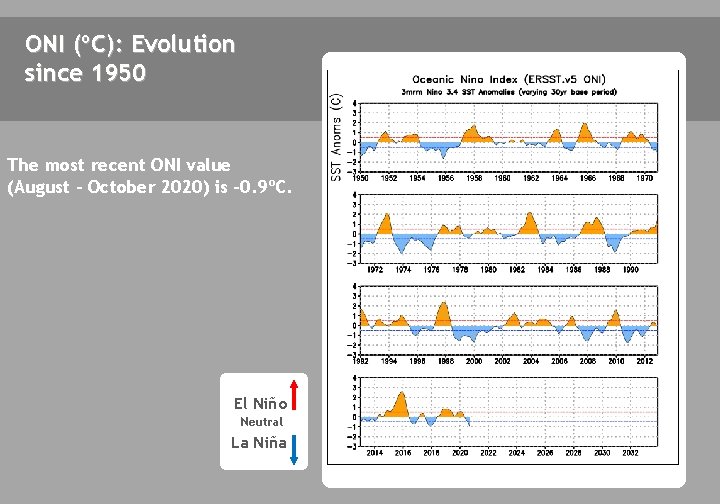
Oceanic Niño Index (ONI) The ONI is based on SST departures from average in the Niño 3. 4 region, and is a principal measure for monitoring, assessing, and predicting ENSO. Defined as the three-month running-mean SST departures in the Niño 3. 4 region. Departures are based on a set of improved homogeneous historical SST analyses (Extended Reconstructed SST – ERSST. v 5). The SST reconstruction methodology is described in Huang et al. , 2017, J. Climate, vol. 30, 8179 -8205. ) It is one index that helps to place current events into a historical perspective
NOAA Operational Definitions for El Niño and La Niña El Niño: characterized by a positive ONI greater than or equal to +0. 5ºC. La Niña: characterized by a negative ONI less than or equal to -0. 5ºC. By historical standards, to be classified as a full-fledged El Niño or La Niña episode, these thresholds must be exceeded for a period of at least 5 consecutive overlapping 3 -month seasons. CPC considers El Niño or La Niña conditions to occur when the monthly Niño 3. 4 OISST departures meet or exceed +/- 0. 5ºC along with consistent atmospheric features. These anomalies must also be forecasted to persist for 3 consecutive months.
ONI (ºC): Evolution since 1950 The most recent ONI value (August – October 2020) is -0. 9ºC. El Niño Neutral La Niña
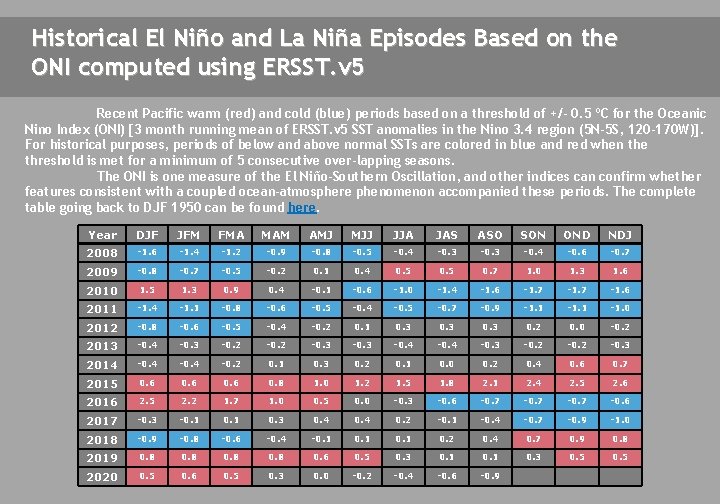
Historical El Niño and La Niña Episodes Based on the ONI computed using ERSST. v 5 Recent Pacific warm (red) and cold (blue) periods based on a threshold of +/- 0. 5 ºC for the Oceanic Nino Index (ONI) [3 month running mean of ERSST. v 5 SST anomalies in the Nino 3. 4 region (5 N-5 S, 120 -170 W)]. For historical purposes, periods of below and above normal SSTs are colored in blue and red when the threshold is met for a minimum of 5 consecutive over-lapping seasons. The ONI is one measure of the El Niño-Southern Oscillation, and other indices can confirm whether features consistent with a coupled ocean-atmosphere phenomenon accompanied these periods. The complete table going back to DJF 1950 can be found here. Year DJF JFM FMA MAM AMJ MJJ JJA JAS ASO SON OND NDJ 2008 -1. 6 -1. 4 -1. 2 -0. 9 -0. 8 -0. 5 -0. 4 -0. 3 -0. 4 -0. 6 -0. 7 2009 -0. 8 -0. 7 -0. 5 -0. 2 0. 1 0. 4 0. 5 0. 7 1. 0 1. 3 1. 6 2010 1. 5 1. 3 0. 9 0. 4 -0. 1 -0. 6 -1. 0 -1. 4 -1. 6 -1. 7 -1. 6 2011 -1. 4 -1. 1 -0. 8 -0. 6 -0. 5 -0. 4 -0. 5 -0. 7 -0. 9 -1. 1 -1. 0 2012 -0. 8 -0. 6 -0. 5 -0. 4 -0. 2 0. 1 0. 3 0. 2 0. 0 -0. 2 2013 -0. 4 -0. 3 -0. 2 -0. 3 2014 -0. 2 0. 1 0. 3 0. 2 0. 1 0. 0 0. 2 0. 4 0. 6 0. 7 2015 0. 6 0. 8 1. 0 1. 2 1. 5 1. 8 2. 1 2. 4 2. 5 2. 6 2016 2. 5 2. 2 1. 7 1. 0 0. 5 0. 0 -0. 3 -0. 6 -0. 7 -0. 6 2017 -0. 3 -0. 1 0. 3 0. 4 0. 2 -0. 1 -0. 4 -0. 7 -0. 9 -1. 0 2018 -0. 9 -0. 8 -0. 6 -0. 4 -0. 1 0. 2 0. 4 0. 7 0. 9 0. 8 2019 0. 8 0. 6 0. 5 0. 3 0. 1 0. 3 0. 5 2020 0. 5 0. 6 0. 5 0. 3 0. 0 -0. 2 -0. 4 -0. 6 -0. 9
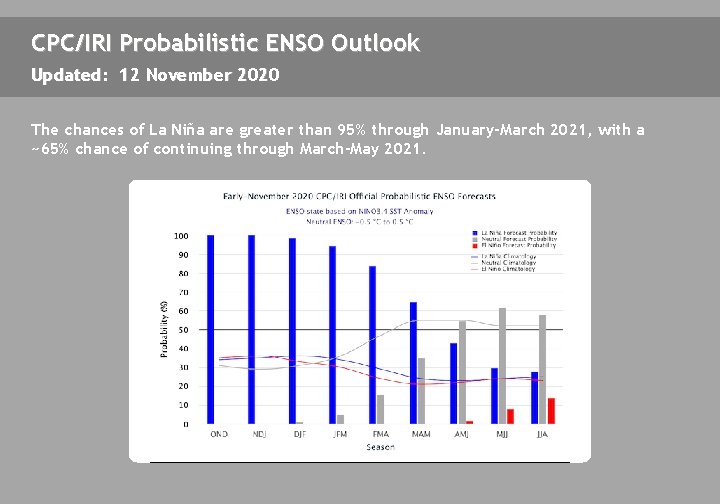
CPC/IRI Probabilistic ENSO Outlook Updated: 12 November 2020 The chances of La Niña are greater than 95% through January-March 2021, with a ~65% chance of continuing through March-May 2021.
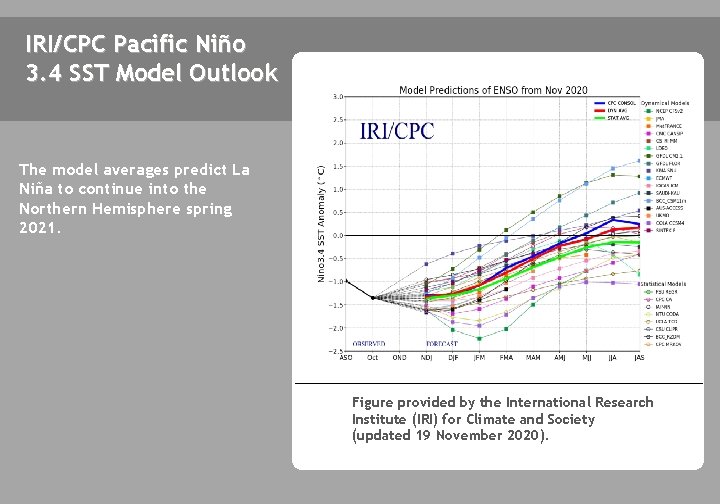
IRI/CPC Pacific Niño 3. 4 SST Model Outlook The model averages predict La Niña to continue into the Northern Hemisphere spring 2021. Figure provided by the International Research Institute (IRI) for Climate and Society (updated 19 November 2020).
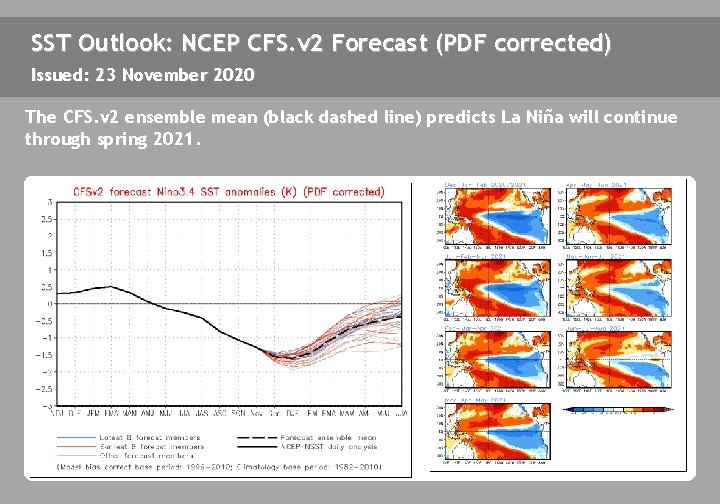
SST Outlook: NCEP CFS. v 2 Forecast (PDF corrected) Issued: 23 November 2020 The CFS. v 2 ensemble mean (black dashed line) predicts La Niña will continue through spring 2021.
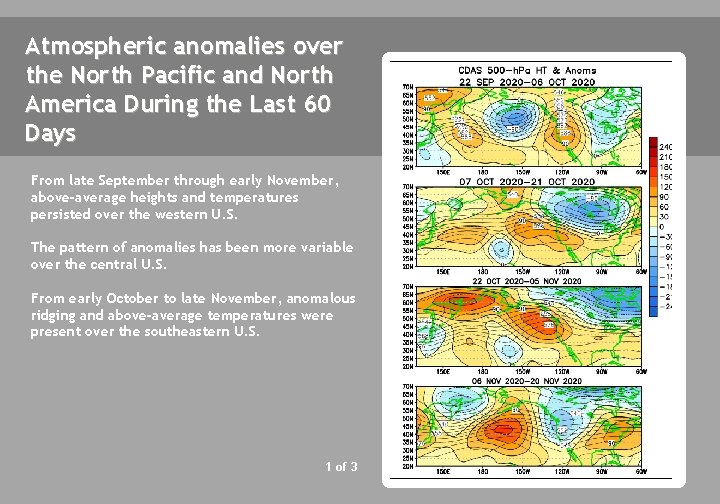
Atmospheric anomalies over the North Pacific and North America During the Last 60 Days From late September through early November, above-average heights and temperatures persisted over the western U. S. The pattern of anomalies has been more variable over the central U. S. From early October to late November, anomalous ridging and above-average temperatures were present over the southeastern U. S. 1 of 3
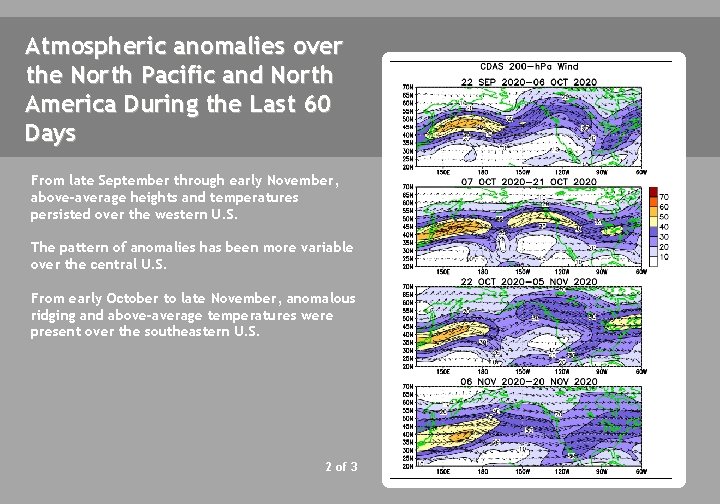
Atmospheric anomalies over the North Pacific and North America During the Last 60 Days From late September through early November, above-average heights and temperatures persisted over the western U. S. The pattern of anomalies has been more variable over the central U. S. From early October to late November, anomalous ridging and above-average temperatures were present over the southeastern U. S. 2 of 3
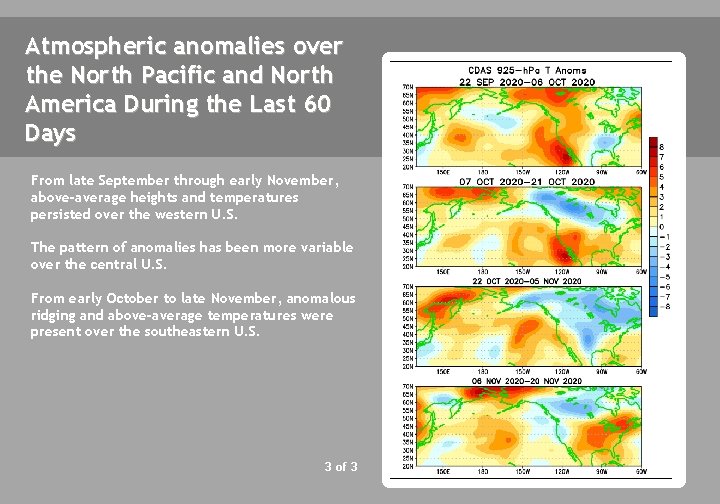
Atmospheric anomalies over the North Pacific and North America During the Last 60 Days From late September through early November, above-average heights and temperatures persisted over the western U. S. The pattern of anomalies has been more variable over the central U. S. From early October to late November, anomalous ridging and above-average temperatures were present over the southeastern U. S. 3 of 3
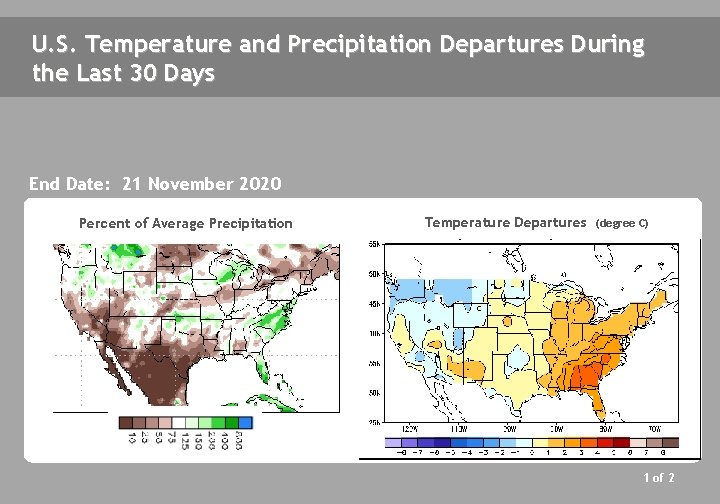
U. S. Temperature and Precipitation Departures During the Last 30 Days End Date: 21 November 2020 Percent of Average Precipitation Temperature Departures (degree C) 1 of 2
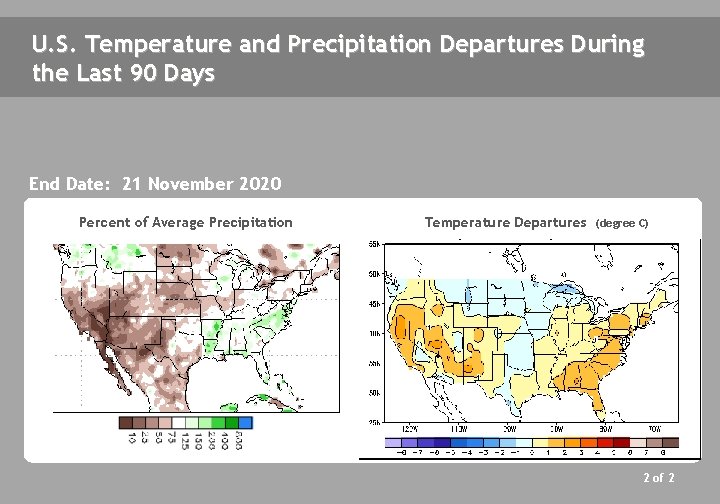
U. S. Temperature and Precipitation Departures During the Last 90 Days End Date: 21 November 2020 Percent of Average Precipitation Temperature Departures (degree C) 2 of 2
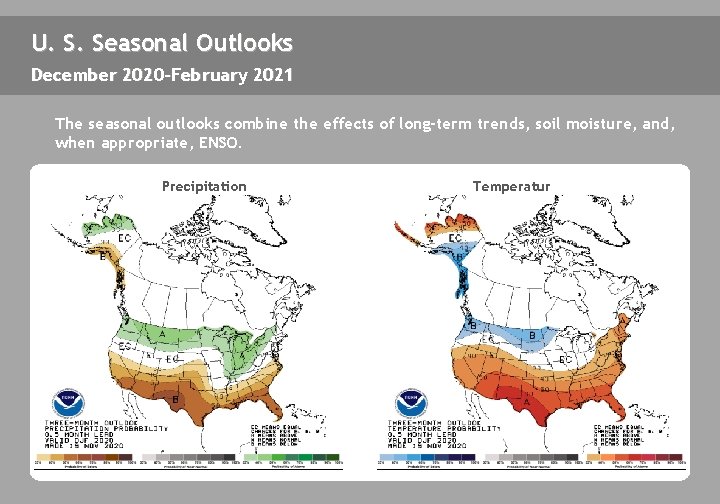
U. S. Seasonal Outlooks December 2020 -February 2021 The seasonal outlooks combine the effects of long-term trends, soil moisture, and, when appropriate, ENSO. Precipitation Temperatur e
Summary ENSO Alert System Status: La Niña Advisory La Niña conditions are present. * Equatorial sea surface temperatures (SSTs) are below average from the westcentral to eastern Pacific Ocean. The tropical atmospheric circulation is consistent with La Niña is likely to continue through the Northern Hemisphere winter 2020 -21 (~95% chance during January-March) and into spring 2021 (~65% chance during March-May). * * Note: These statements are updated once a month (2 nd Thursday of each month) in association with the ENSO Diagnostics Discussion, which can be found by clicking here.