
Ensembles Part 2 Boosting Geoff Hulten Ensemble Overview
Ensembles Part 2 – Boosting Geoff Hulten
Ensemble Overview • Bias / Variance challenges • Simple models can’t represent complex concepts (bias) • Complex models can overfit noise and small deltas in data (variance) • Instead of learning one model, learn several (many) and combine them • Easy (low risk) way to mitigate some bias / variance problems • Often results in better accuracy, sometimes significantly better
Approaches to Ensembles 1) Learn the concept many different ways and combine • Prefers higher variance, relatively low bias base models • Models are independent • Robust vs overfitting Techniques: Bagging, Random Forests, Stacking 2) Learn different parts of the concept with different models and combine • Can work with high bias base models (weak learners) and high variance • Each model depends on previous models • May overfit Techniques: Boosting, Gradient Boosting Machines (GBM)
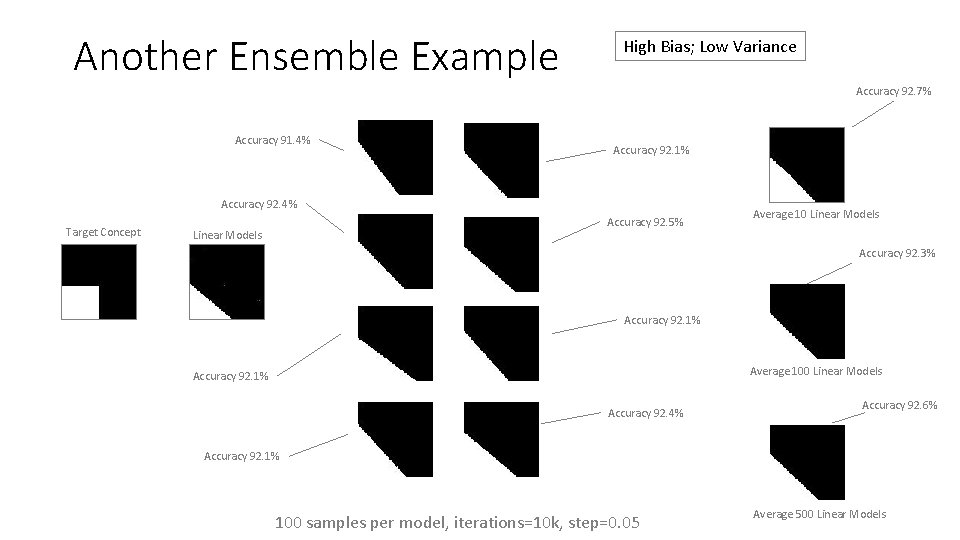
Another Ensemble Example High Bias; Low Variance Accuracy 92. 7% Accuracy 91. 4% Accuracy 92. 1% Accuracy 92. 4% Target Concept Accuracy 92. 5% Linear Models Average 10 Linear Models Accuracy 92. 3% Accuracy 92. 1% Average 100 Linear Models Accuracy 92. 1% Accuracy 92. 4% Accuracy 92. 6% Accuracy 92. 1% 100 samples per model, iterations=10 k, step=0. 05 Average 500 Linear Models
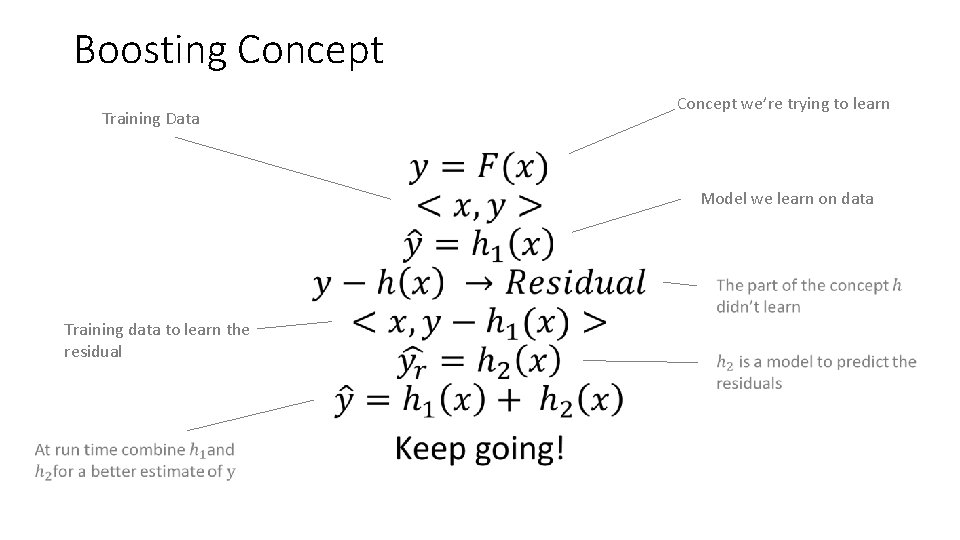
Boosting Concept Training Data Concept we’re trying to learn • Model we learn on data Training data to learn the residual
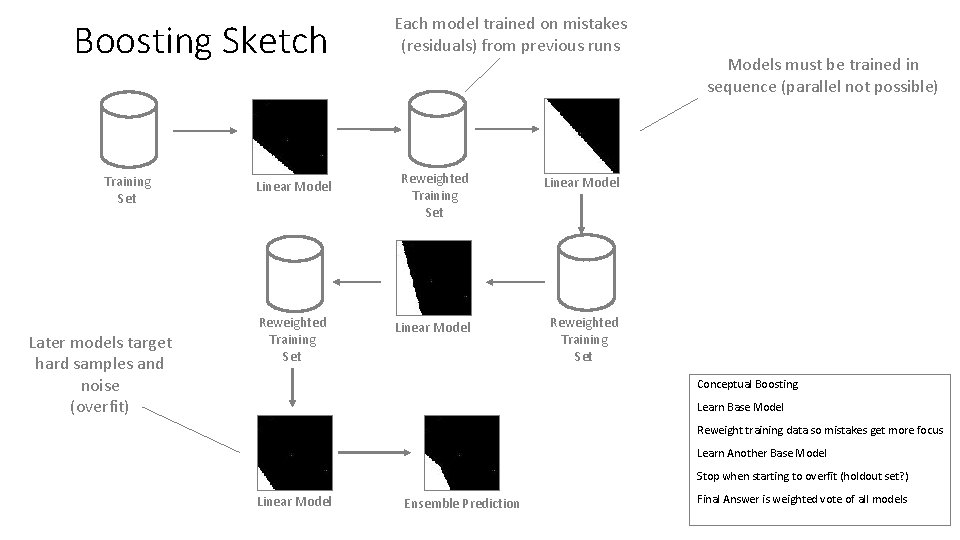
Boosting Sketch Training Set Later models target hard samples and noise (overfit) Linear Model Reweighted Training Set Each model trained on mistakes (residuals) from previous runs Reweighted Training Set Linear Model Reweighted Training Set Models must be trained in sequence (parallel not possible) Conceptual Boosting Learn Base Model Reweight training data so mistakes get more focus Learn Another Base Model Stop when starting to overfit (holdout set? ) Linear Model Ensemble Prediction Final Answer is weighted vote of all models
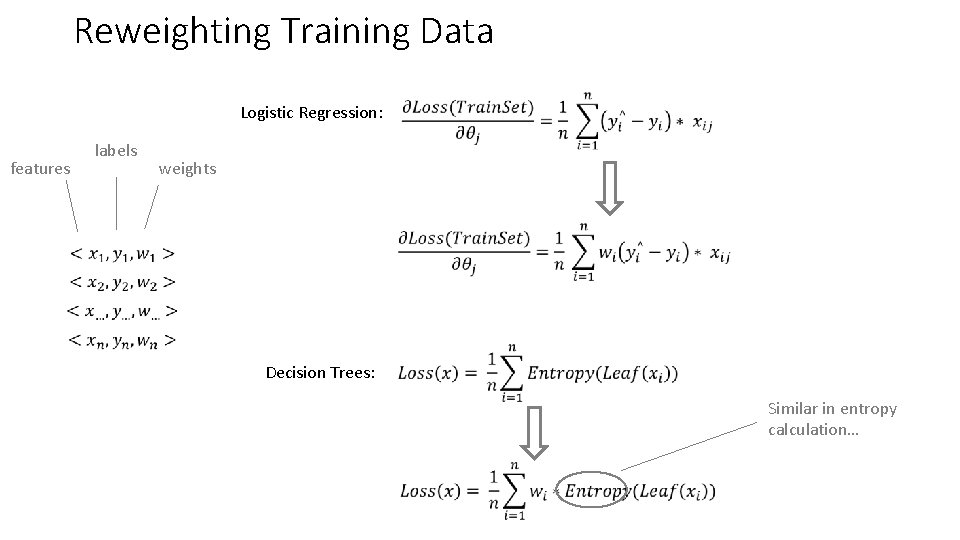
Reweighting Training Data Logistic Regression: features labels weights Decision Trees: Similar in entropy calculation…
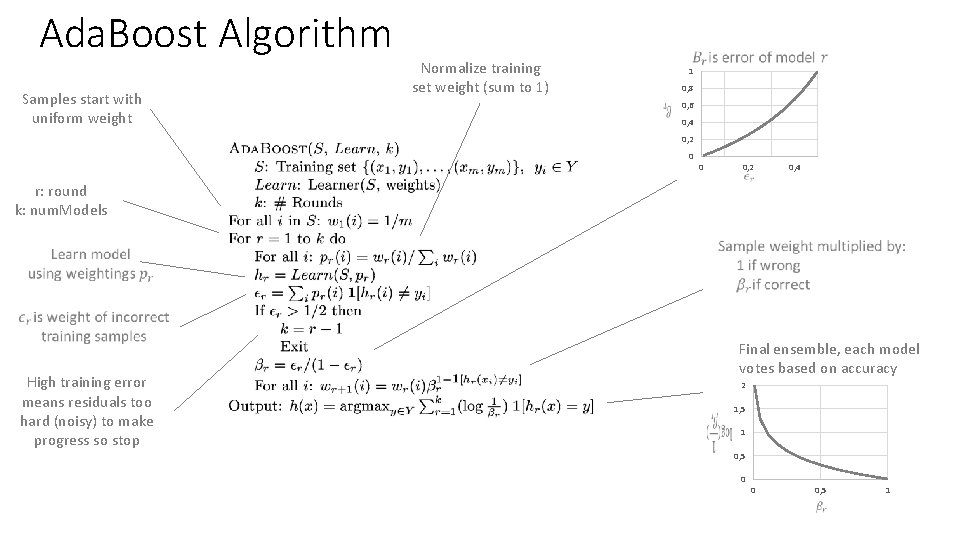
Ada. Boost Algorithm Samples start with uniform weight Normalize training set weight (sum to 1) 1 0, 8 0, 6 0, 4 0, 2 0 0 0, 2 0, 4 r: round k: num. Models High training error means residuals too hard (noisy) to make progress so stop Final ensemble, each model votes based on accuracy 2 1, 5 1 0, 5 0 0 0, 5 1
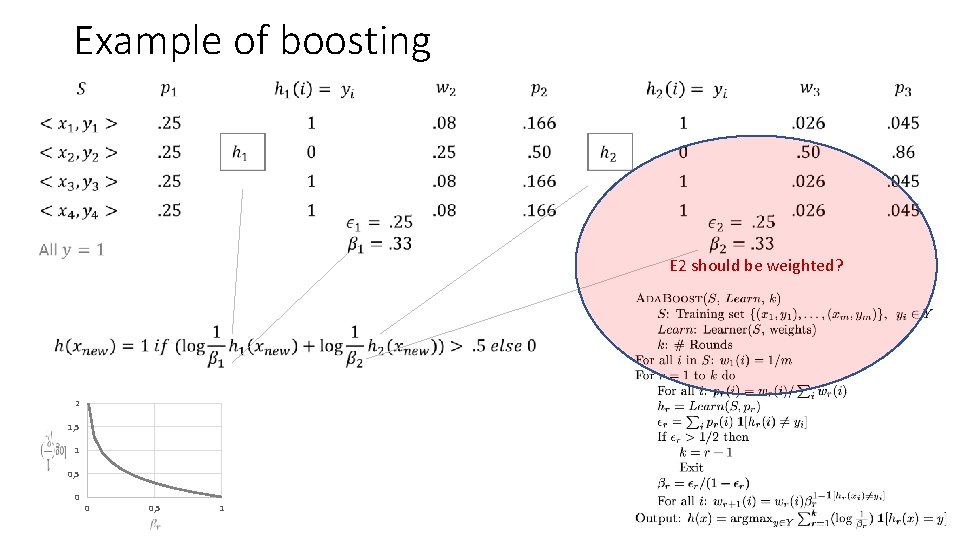
Example of boosting E 2 should be weighted? 2 1, 5 1 0, 5 0 0 0, 5 1

Summary • Boosting is an ensemble technique where each base model learns a part of the concept • Boosting can allow weak (high bias) learners to learn complicated concepts • Boosting can help with bias or variance issues, but can overfit – need to control the search • A form of boosting – Gradient Boosting Machines (GBM) – is currently used when chasing high accuracy in practice
- Slides: 10