
Ensemble River Routing Simulation Forced by GEFS Runoff
Ensemble River Routing Simulation Forced by GEFS Runoff Forecast: A Preliminary Experiment Dingchen Hou, Zoltan Toth, Kenneth Mitchell and Helin Wei EMC/NCEP/NOAA 5200 Auth Road Camp Springs, MD 20746
Motivation and Configuration of The Experiment Background: • Development in Land Surface component of NWP systems made it possible to include stream flow in NWP. • River routing experiment in data assimilation mode revealed potential benefit of river flow forecast in NWP. • Uncertainty in initial conditions, model structure and forcing should be considered. Purpose: • Demonstrate feasibility of river routing in operational GEFS. • Establish optimal configuration for river routing. • Develop suitable strategy to account for uncertainties. Design of Preliminary Experiment • River Routing Model: linear approach, distributed mode, same as used in NLDAS (Lohman et al. , 2004) • CONUS domain, 1/8 degree grid size. • Forcing: Runoff from GFS and GEFS forecasts. • Verification: using river routing products generated by the same model forced by NLDAS runoff, which is based on observed precipitation.
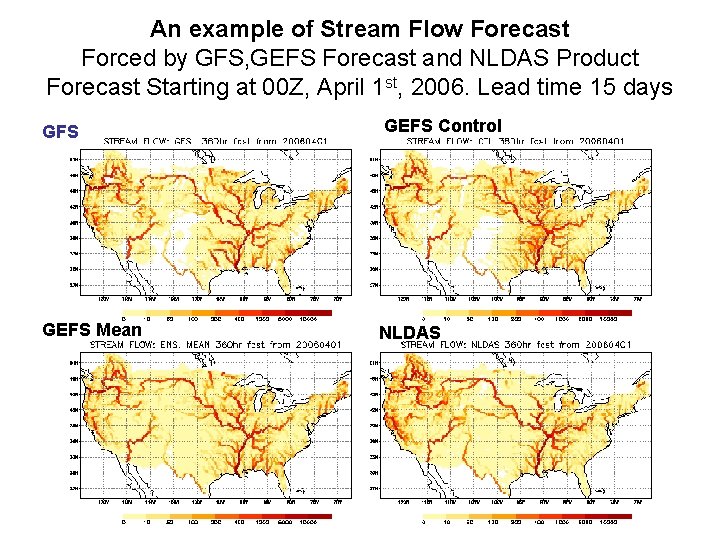
An example of Stream Flow Forecast Forced by GFS, GEFS Forecast and NLDAS Product Forecast Starting at 00 Z, April 1 st, 2006. Lead time 15 days GFS GEFS Control GEFS Mean NLDAS
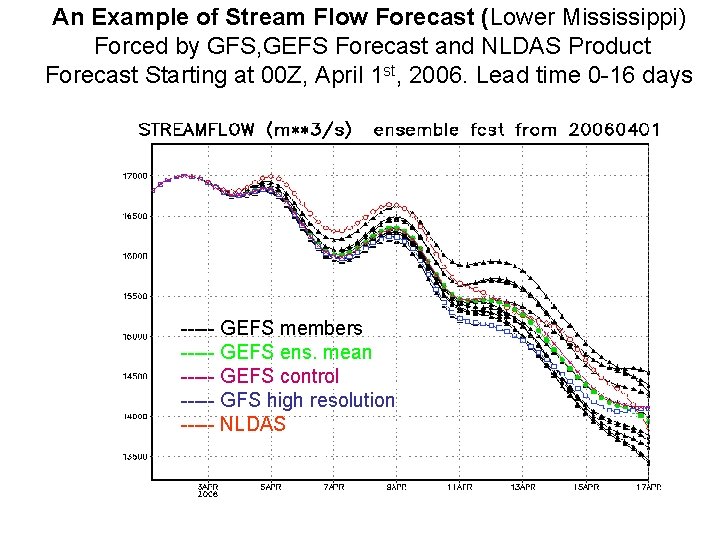
An Example of Stream Flow Forecast (Lower Mississippi) Forced by GFS, GEFS Forecast and NLDAS Product Forecast Starting at 00 Z, April 1 st, 2006. Lead time 0 -16 days ----- GEFS members ----- GEFS ens. mean ----- GEFS control ----- GFS high resolution ----- NLDAS
Preliminary Results Although rigorous verification and more extensive experiments are necessary for any concrete conclusion, the following preliminary results are encouraging: • The stream flow forecasts forced by GFS/GEFS runoff output are comparable to the verification (NLDAS). • Compared with single forecasts (higher or lower resolution), the ensemble mean provides more realistic (closer to NLDAS) geographic distribution of stream flow. • For the major rivers (where stream flow is large), the short range forecast of the single forecast are consistent to each other and to the verification. With longer lead time, although the ensemble spread increases significantly, the ensemble members may still fail to embrace the verification, suggesting that uncertainty in initial conditions and model structure need to be considered.
- Slides: 5