
Ensemble forecasting and the Global Flood Awareness System
Ensemble forecasting and the Global Flood Awareness System Peter Salamon, Joint Research Center, European Commission & many colleagues at the JRC and ECMWF 1
About myself… About myself: 2 • B. Sc. Geology & M. Sc. Applied Environmental Geosciences, University of Tuebingen (Germany) • Ph. D Environmental & Hydraulic Engineering, Polytechnical University of Valencia, Spain • Since 2006 at the Joint Research Center • Responsible for the European and Global Flood Awareness Systems
About the Joint Research Center of the European Commission: • In-house science service of the European Commission • Scientific & technical support to the EU policies 3
Outline • Why can’t we make perfect forecasts? • Ensemble Forecasting • How does the ensemble represent uncertainties? • Configuration of the ensemble • The Global Flood Awareness System (Glo. FAS) – an example of probabilistic flood forecasting • Why do we need a global flood forecasting system • Model set up & Basic concepts • New developments foreseen 4
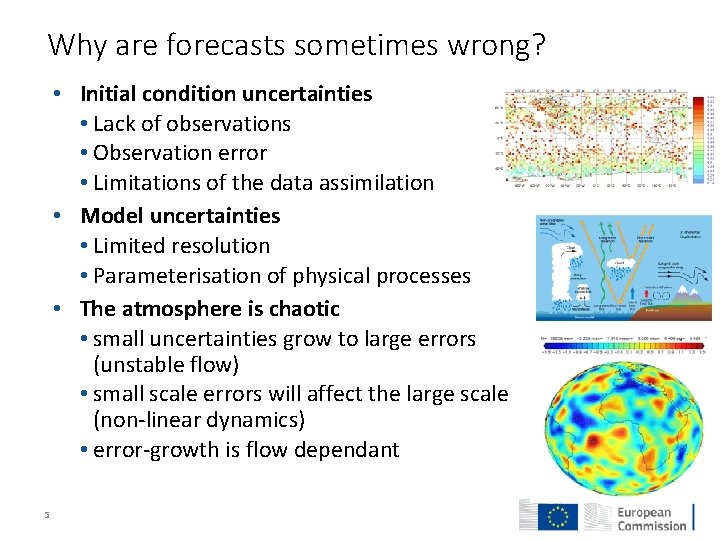
Why are forecasts sometimes wrong? • Initial condition uncertainties • Lack of observations • Observation error • Limitations of the data assimilation • Model uncertainties • Limited resolution • Parameterisation of physical processes • The atmosphere is chaotic • small uncertainties grow to large errors (unstable flow) • small scale errors will affect the large scale (non-linear dynamics) • error-growth is flow dependant 5
What is an ensemble? • A set of forecasts run from slightly different initial conditions to account for initial uncertainties • The forecast model also contains approximations that can affect the forecast evolution • The ensemble of forecasts provides a range of future scenarios consistent with our knowledge of the initial state and model capability 6
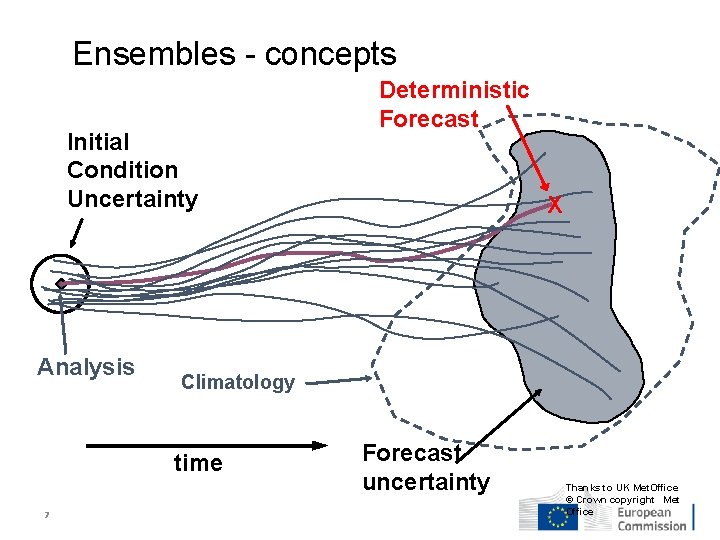
Ensembles - concepts Initial Condition Uncertainty Analysis X Climatology time 7 Deterministic Forecast uncertainty Thanks to UK Met. Office © Crown copyright Met Office
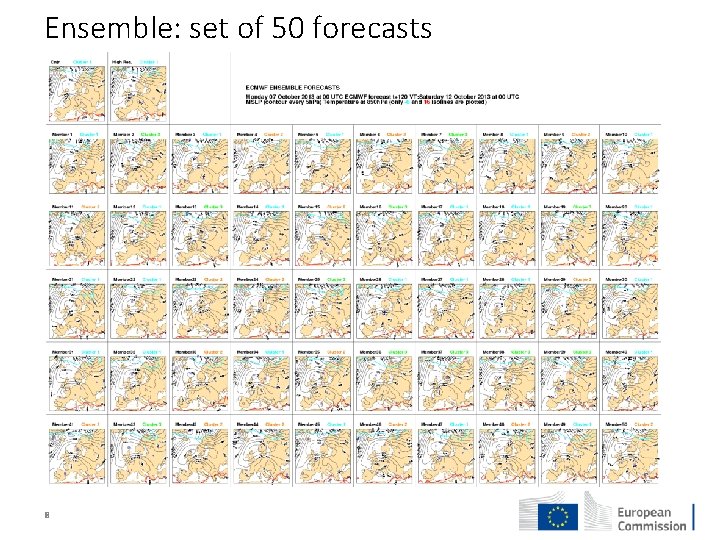
Ensemble: set of 50 forecasts 8
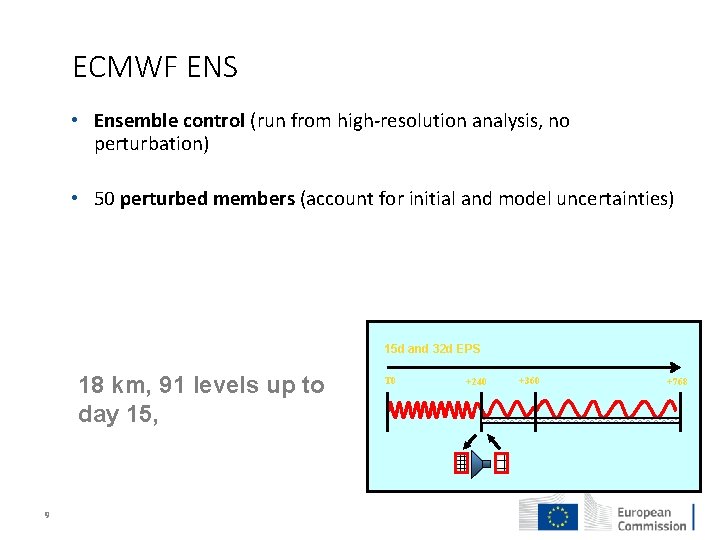
ECMWF ENS • Ensemble control (run from high-resolution analysis, no perturbation) • 50 perturbed members (account for initial and model uncertainties) 15 d and 32 d EPS 18 km, 91 levels up to day 15, 9 T 0 +240 +360 +768
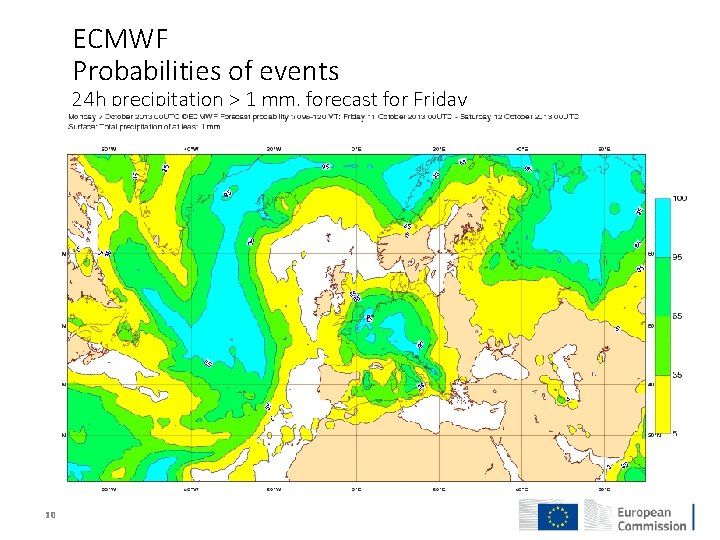
ECMWF Probabilities of events 24 h precipitation > 1 mm, forecast for Friday 10
Global/ large scale flood risk models can: Ø Fill the gap/ be complementary Ø Foster knowledge transfer & exchange Ø Improve data sharing 11 Image: UNEP-GRID
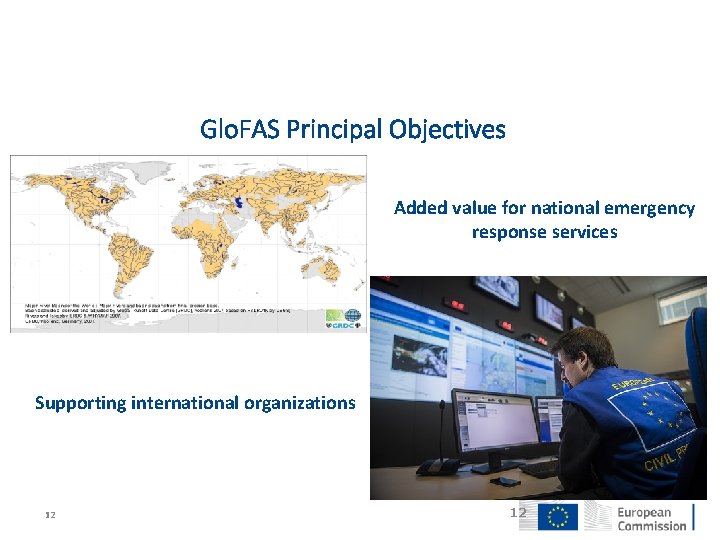
Glo. FAS Principal Objectives Added value for national emergency response services Supporting international organizations 12 12
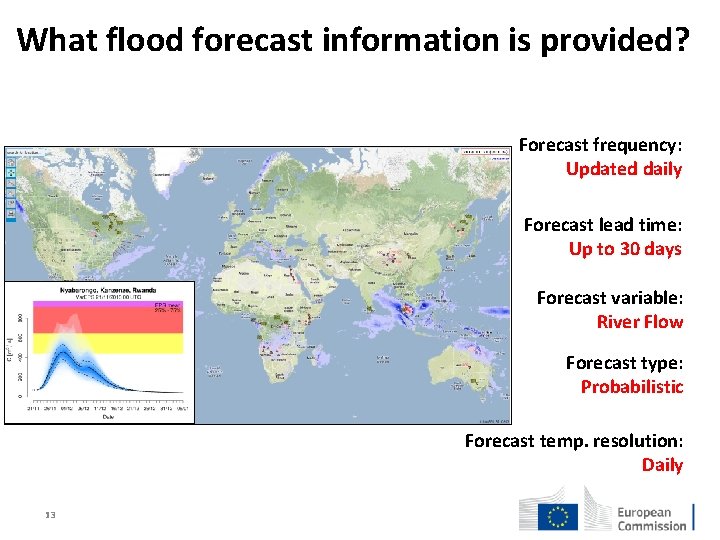
What flood forecast information is provided? Forecast frequency: Updated daily Forecast lead time: Up to 30 days Forecast variable: River Flow Forecast type: Probabilistic Forecast temp. resolution: Daily 13
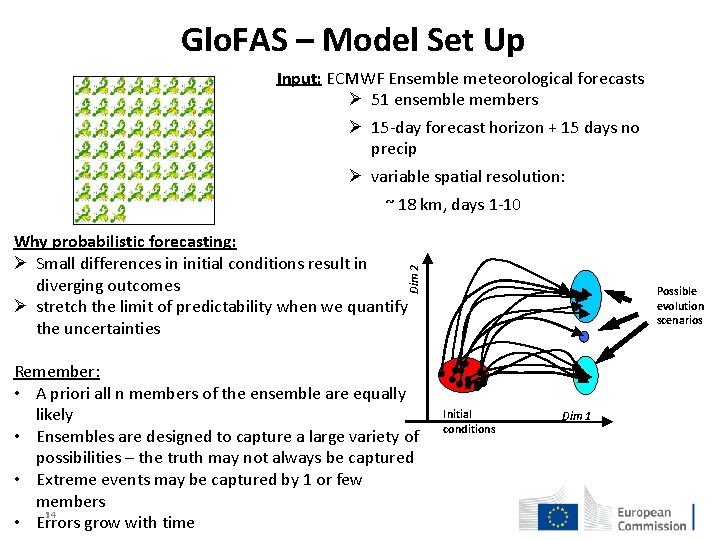
Glo. FAS – Model Set Up Input: ECMWF Ensemble meteorological forecasts Ø 51 ensemble members Ø 15 -day forecast horizon + 15 days no precip Ø variable spatial resolution: ~ 18 km, days 1 -10 Dim 2 Why probabilistic forecasting: Ø Small differences in initial conditions result in diverging outcomes Ø stretch the limit of predictability when we quantify the uncertainties Remember: • A priori all n members of the ensemble are equally likely • Ensembles are designed to capture a large variety of possibilities – the truth may not always be captured • Extreme events may be captured by 1 or few members 14 • Errors grow with time Possible evolution scenarios Initial conditions Dim 1
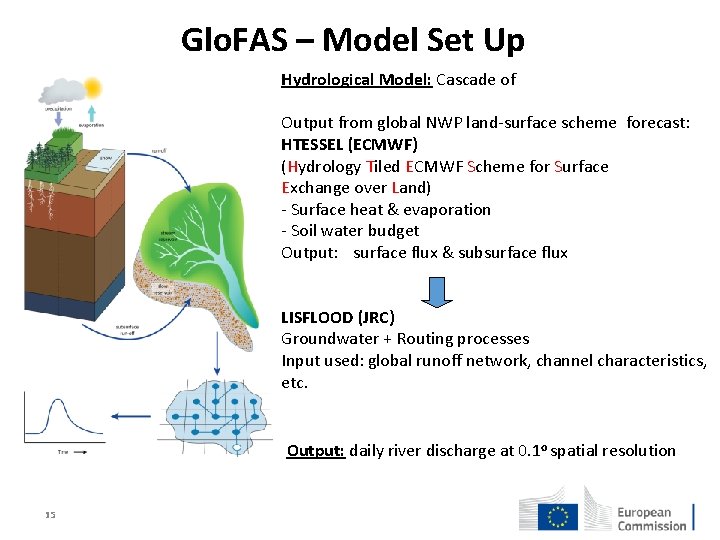
Glo. FAS – Model Set Up Hydrological Model: Cascade of Output from global NWP land-surface scheme forecast: HTESSEL (ECMWF) (Hydrology Tiled ECMWF Scheme for Surface Exchange over Land) - Surface heat & evaporation - Soil water budget Output: surface flux & subsurface flux LISFLOOD (JRC) Groundwater + Routing processes Input used: global runoff network, channel characteristics, etc. Output: daily river discharge at 0. 1 o spatial resolution 15
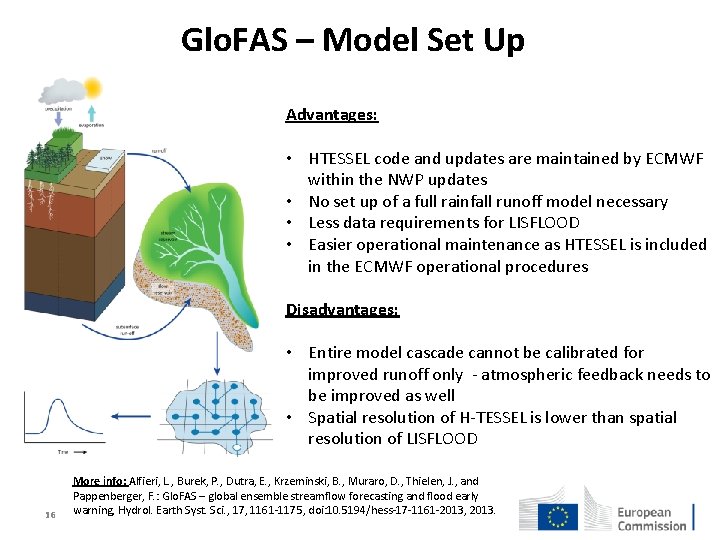
Glo. FAS – Model Set Up Advantages: • HTESSEL code and updates are maintained by ECMWF within the NWP updates • No set up of a full rainfall runoff model necessary • Less data requirements for LISFLOOD • Easier operational maintenance as HTESSEL is included in the ECMWF operational procedures Disadvantages: • Entire model cascade cannot be calibrated for improved runoff only - atmospheric feedback needs to be improved as well • Spatial resolution of H-TESSEL is lower than spatial resolution of LISFLOOD 16 More info: Alfieri, L. , Burek, P. , Dutra, E. , Krzeminski, B. , Muraro, D. , Thielen, J. , and Pappenberger, F. : Glo. FAS – global ensemble streamflow forecasting and flood early warning, Hydrol. Earth Syst. Sci. , 17, 1161 -1175, doi: 10. 5194/hess-17 -1161 -2013, 2013.
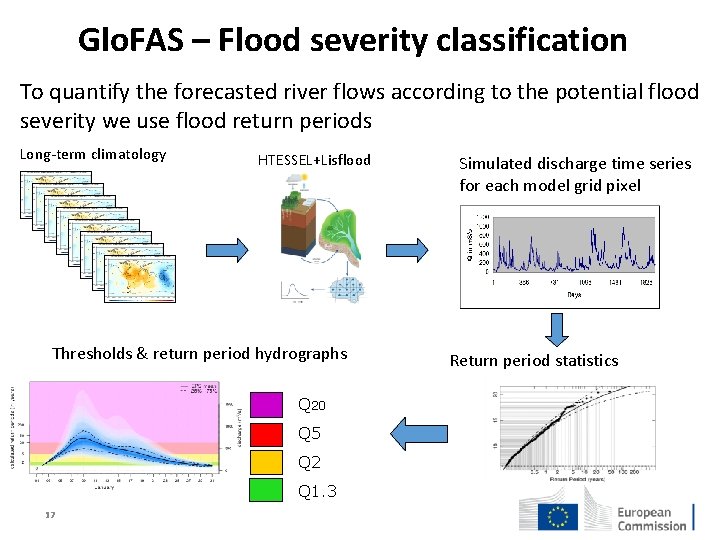
Glo. FAS – Flood severity classification To quantify the forecasted river flows according to the potential flood severity we use flood return periods Long-term climatology HTESSEL+Lisflood Thresholds & return period hydrographs Q 20 Q 5 Q 2 Q 1. 3 17 Simulated discharge time series for each model grid pixel Return period statistics
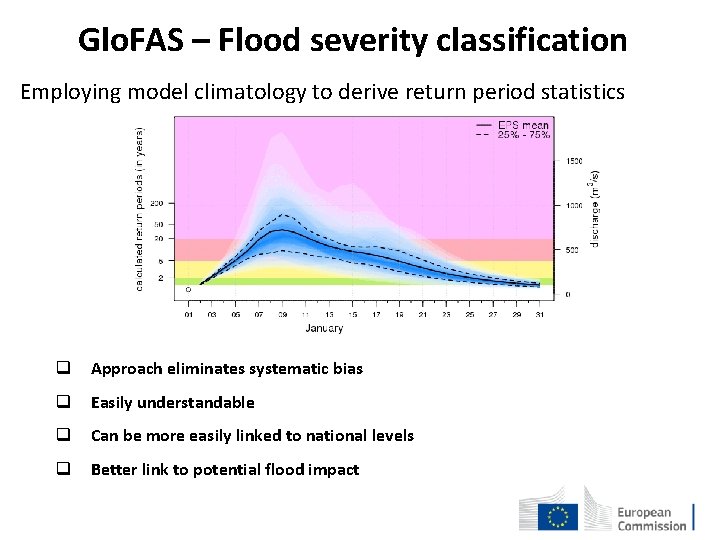
Glo. FAS – Flood severity classification Employing model climatology to derive return period statistics q Approach eliminates systematic bias q Easily understandable q Can be more easily linked to national levels q Better link to potential flood impact
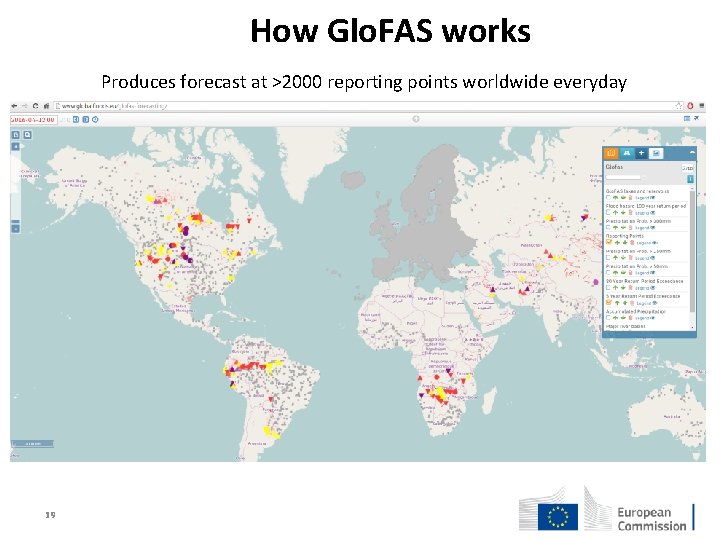
How Glo. FAS works Produces forecast at >2000 reporting points worldwide everyday 19
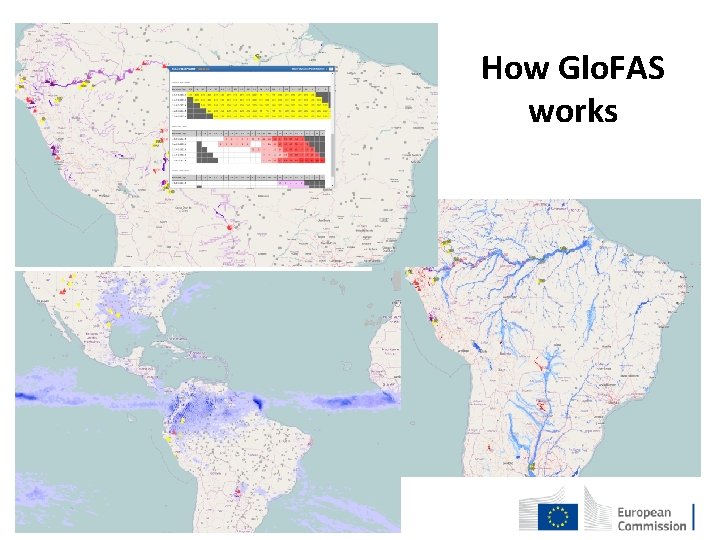
How Glo. FAS works 20
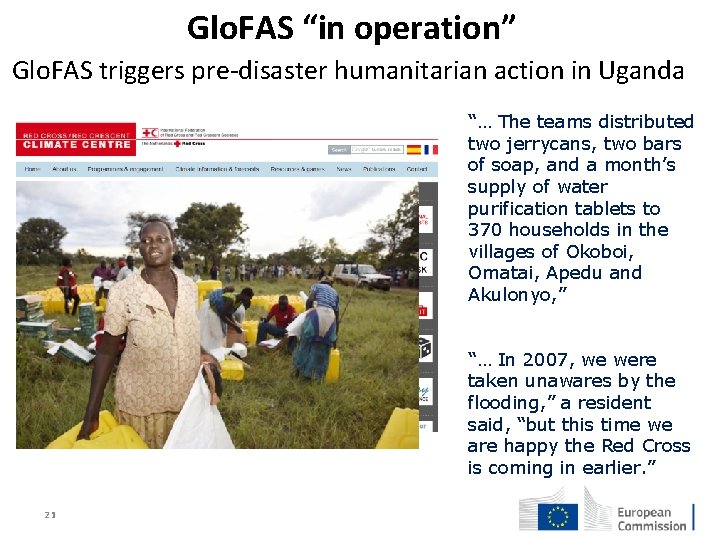
Glo. FAS “in operation” Glo. FAS triggers pre-disaster humanitarian action in Uganda “… The teams distributed two jerrycans, two bars of soap, and a month’s supply of water purification tablets to 370 households in the villages of Okoboi, Omatai, Apedu and Akulonyo, ” “… In 2007, we were taken unawares by the flooding, ” a resident said, “but this time we are happy the Red Cross is coming in earlier. ” 21
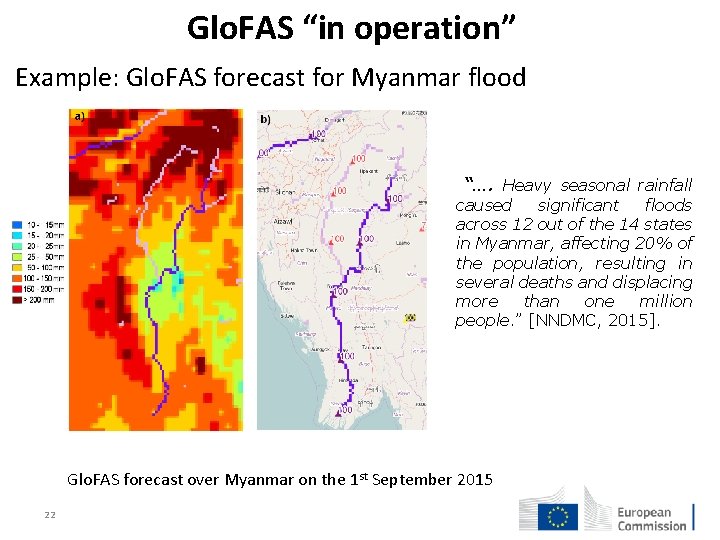
Glo. FAS “in operation” Example: Glo. FAS forecast for Myanmar flood “…. Heavy seasonal rainfall caused significant floods across 12 out of the 14 states in Myanmar, affecting 20% of the population, resulting in several deaths and displacing more than one million people. ” [NNDMC, 2015]. Glo. FAS forecast over Myanmar on the 1 st September 2015 22
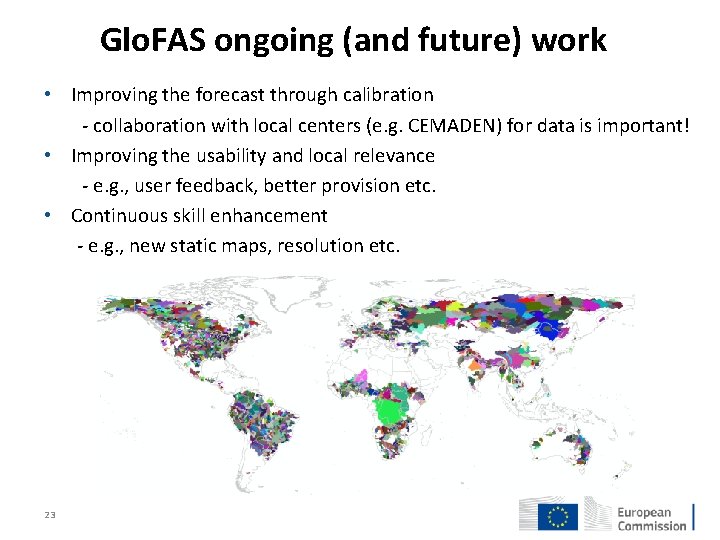
Glo. FAS ongoing (and future) work • Improving the forecast through calibration - collaboration with local centers (e. g. CEMADEN) for data is important! • Improving the usability and local relevance - e. g. , user feedback, better provision etc. • Continuous skill enhancement - e. g. , new static maps, resolution etc. 23
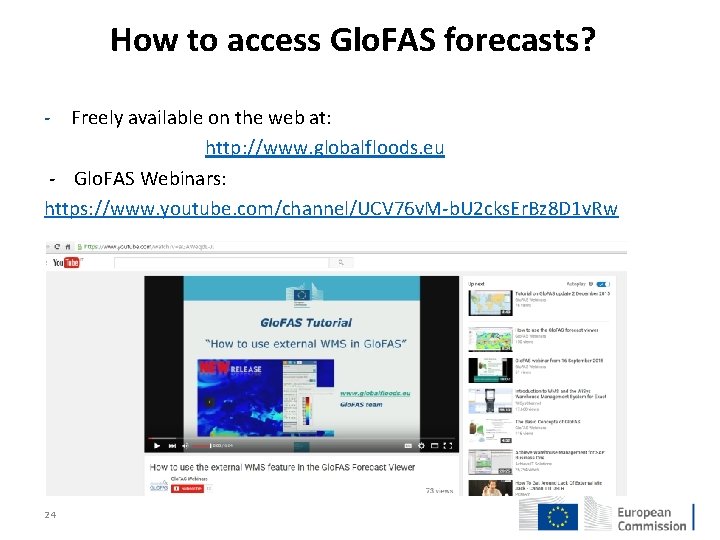
How to access Glo. FAS forecasts? - Freely available on the web at: http: //www. globalfloods. eu - Glo. FAS Webinars: https: //www. youtube. com/channel/UCV 76 v. M-b. U 2 cks. Er. Bz 8 D 1 v. Rw 24
Find out more: www. globalfloods. eu 25
- Slides: 25