
ENSC 351 Final Project Demo Group 20 Pair
- Slides: 13
ENSC 351 Final Project Demo Group 20 Pair #38 BAIMING QIAO (301243446) JIANGLIN FU (301256171) Pair #39 SHUO CHEN (301242896) YANGJIE LIU(301267615)
VGA
VGA Phase I l Implement test functions of drawing various shapes of image. l l Access specific pixel using x-y coordinates, width and height of images, and the initial offset from the buffer. Utilize alpha blending mechanism to generate transparent image. Perform mmap() function to allocate virtual memory address for pixel information. Run test functions to display opened images through screen buffer.
VGA Phase II l Implement VGA driver to establish the connection between user space and kernel space l l Perform dma_to_pfn function to map the memory between physical address and kernel space. Enable access to kernel frame number from user space via remap function. Implement functions of file operations to allow the kernel to match test functions from user space. Run test functions to display opened images through screen buffer.
VGA Phase III l Establish connection between keyboard and screen display via VGA transmission. l l Utilize draw_subimage to extract character from ASCII table image that matches the keyboard. Set up kermit connection and allocate memory location of it. Read the input character at runtime via serial port. Consider special cases when the new line is needed or the screen is filled up.
Application Functionality(Keyboard Part) l l Accomplish alphabetical interpretation on keyboard through VGA driver. Support several special functions such as changing new lines manually and automatically, delete characters using backspace. Simulate console working environment, add input prefix “>>” when the new lines appear, leave certain area space for timer display. Decrease processing delay by reducing the times of revisiting global buffer, transport intermediate data into local buffer instead of global buffer directly.
Extra Function Features l New Line Operation(/n) l l Backspace Operation l l Clear Screen(Automatically) l l Delay Reduction
TIMER
Timer Phase I Timer_probe: function to initialize all the variable that we need (will be called by zedboard when mknod) e. g. connect the peripheral device with corresponding driver and allocate timer resource address at kernel space implement device info like major, minor, (which will be used in insmod) timer-ioctl : allow device to issue a system call pass input data and able to read and write timer’s data (deal with timer’s read/write ops) request_irq : install interrupt driver, detect interrupts from peripheral device and tell OS to load the ISR (only initialized, didn’t use since we don’t use count up mode)
Timer Phase II Implement timer driver for recording timer_start: to reset timer and enable count up for write function: TIMER_WRITE_REG(ops -. h), IOCTL (func from driver) reset: LOAD_REG (register offset) count up: CONTROL_REG, LOAD 0, ENT 0 (register mask) timer_end: CONTROL_REG to stop _u 32 read_timer: TIMER_REG - cast to float while using (use above 3 functions as hardware timer)
Timer Phase III system time: include sysinfo library: uptime check sysinfo(&s) != 0, otherwise system time shows max value of the timer main: open driver/image/serial port and store into fd Read(serial_fd, &c, 1) to read char from serial_fd (part) change flag to avoid read func always waiting for input char flags = fcntl(serial_fd, F_GETFL, 0); fcntl(serial_fd, F_SETFL, flags | O_NONBLOCK); Write(serial_fd, &c, 1) to write char into serial_fd (part)
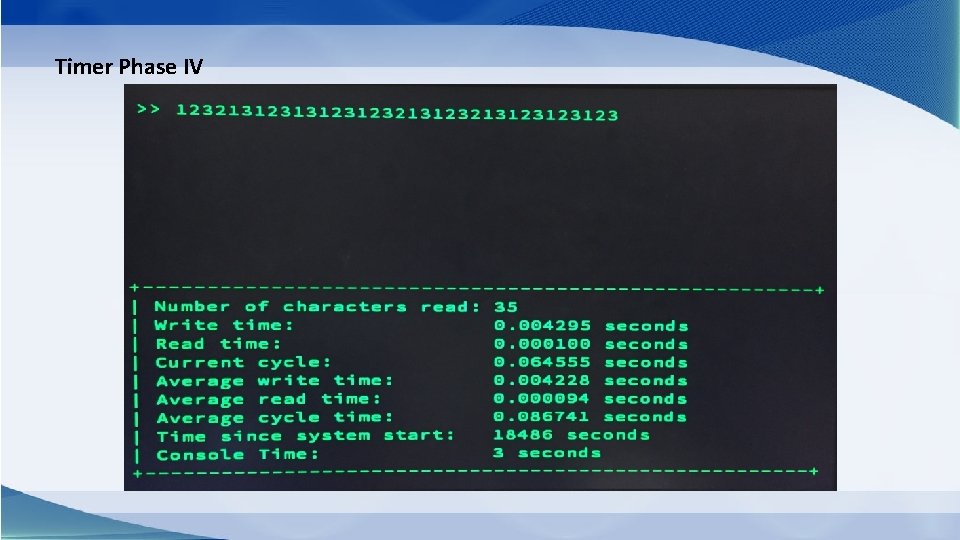
Timer Phase IV
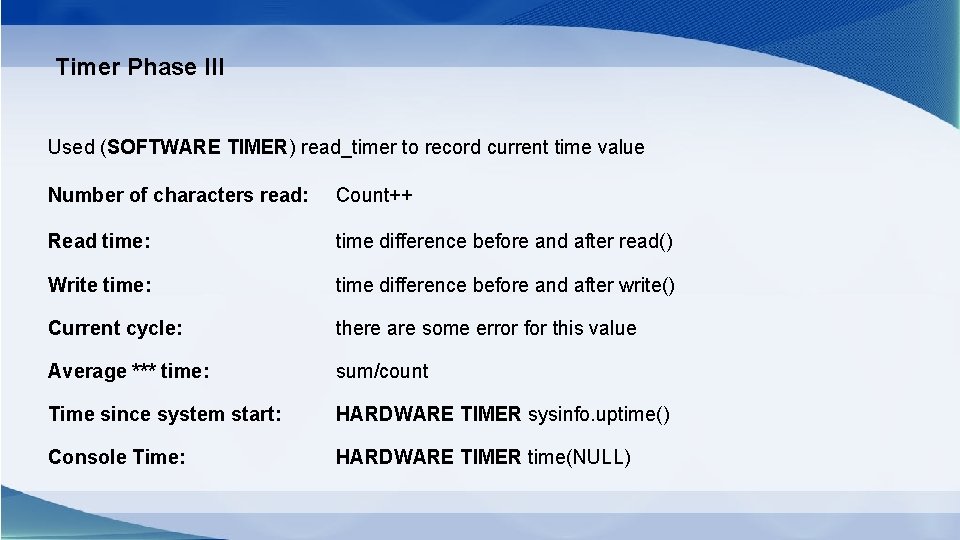
Timer Phase III Used (SOFTWARE TIMER) read_timer to record current time value Number of characters read: Count++ Read time: time difference before and after read() Write time: time difference before and after write() Current cycle: there are some error for this value Average *** time: sum/count Time since system start: HARDWARE TIMER sysinfo. uptime() Console Time: HARDWARE TIMER time(NULL)